Misbehaving Government

Misbehaving governmentChristians are to have an “alien” response to earthly governments. Simply stated: the Bible says we should not rail against governing authorities the way Earthlings do. Christians should respond with proper submission (check this out).

But what if those earthly governors are misbehaving? What then?

We can still be in God-honoring submission to them in the way we call out their misbehavior. 

Look at some examples—

  • Daniel asked permission to go against the king’s wishes (Daniel 1:8), proposed an alternative plan (v. 12), but ultimately agreed to submit to the authority’s decision (v. 13).
  • Shadrach, Meshach and Abednego didn’t argue with King Nebuchadnezzar (Daniel 3:16-18), but respectfully took their stance for God (notice the use of the phrase “O king” as a title of respect).
  • Peter and John simply stated, “We must obey God rather than human authority” (Acts 5:29).

This is exactly what Jesus told us to do when He said, “Give to Caesar what is Caesar’s, and to God what is God’s” (Luke 20:25). Jesus said something very similar to Pilate, when that governor said, “Don’t you realize I have the power to set You free?” Jesus said, “You would have no authority over Me if it were not given to you from above” (John 19:10-11).

So how do we respond to misbehaving governors?

[1] With respect to their office.

[2] With reverent fear of God (see 1 Peter 2:17). “Because we reverence God as the Lord of history, we see beyond the fear and intimidation of the moment.” —James W. Thompson

[3] Leaving the results to GodDaniel 3:26-29, 6:16-27; Acts 5:40-42.

[4] With lots of prayer1 Timothy 2:1-4.

Throughout history, Christians have always had the opportunity to confront ungodly governors. HOW they did it is what set them apart from the Earthling response, and what brought glory to God.

Here’s the video of my full message on this topic—

Next Sunday, November 8, is a day of prayer for those facing persecution for their Christian faith around the world. Join us in a time of prayer for them. If you’ve missed any messages in this series, you may find the complete list by clicking here.

In The Shadow Of The Cross

Listen to the podcast of this post by clicking on the player below, and you can also subscribe on AppleSpotify, or Audible.

Some people really know how to find the deals when they’re shopping. They know where to shop, when to shop, where to find the coupons, and how to find the rebates.

Rebates have always amazed me. I wondered how companies could give away money and still make a profit. Then I read that often up to 70 percent of rebates go unclaimed. Some people say it’s too much work to fill out all the correct forms, others say it takes too long to get their rebate, and still others think the amount they get back isn’t worth the effort.

I’m concerned about Christians who slip into a rebate mentality with God. It seems some Christians believe that they need to “fill out the right forms” in order to claim all that God has for them. They seem to think that salvation isn’t enough, and that they have to add church attendance, offerings, good works, Bible reading and other activities to make sure they don’t miss out.

Not that there’s anything wrong with those activities, but there is something wrong with thinking we have to do something to keep our salvation at its full effectiveness.

If we have placed our faith in Christ’s work on an old rugged Cross, then all of our sins have been forgiven (see Psalm 103:1-5, 10-12; Jeremiah 33:8). This is a gift that is available to everyone (Acts 10:43).

But here’s when I think satan steps in to deceive us: It’s when we feel convicted by the Holy Spirit. God’s Spirit is constantly refining us to make Christ’s image visible in us. But satan wants to twist and pervert this conviction into condemnation.

It’s only in the shadow of the old rugged Cross that I can see my sin correctly. Consider these four points:

(1) The Holy Spirit’s conviction of sin tells me that He desires for me to be more like Jesus―John 14:25-27.

(2) Sin isn’t my master any longer―Romans 6:1-2, 8-11.

(3) My sin never diminishes God’s love for me―1 John 1:8-2:2.

(4) Sin cannot condemn me―Romans 8:1-2.

As we remember and celebrate what Jesus did on Calvary for us, let’s also remember to stay in the shadow of the Cross. It’s only there we can see ourselves accurately from Heaven’s point of view.

If you are in the area and don’t have a church home, I would love for you to celebrate Resurrection Sunday with us! We’ll continue our look at what happened on the old rugged Cross.

►► Would you please prayerfully consider supporting this ministry? My Patreon supporters get behind-the-scenes access to exclusive materials. ◀︎◀︎

Links & Quotes

link quote

Open Door USA reports that Christian persecution around the world has never been worse than it is now. We must pray!!

Here is a cool story about how God used some praying Christians to save a young girl from sex trafficking.

J. Warner Wallace says, “When [Richard] Dawkins and [Sam] Harris say we, as Christians, believe in something for which there is no supporting evidence, they simply betray their ignorance about the nature of evidence and the way in which detectives and prosecutors build cases.” Check out his post on the evidence that supports the Christian worldview.

Frank Viola has an encouraging word. He says, “If God has called you to a specific work, there is a time in which that work will find its greatest fulfillment and its widest impact.” Please read Your Time Has Not Yet Come.

“Angels might have wept as they saw the folly of men who sought anything except the Lord, Who alone can make a house His temple; Who alone can make a ministry to be a ministration of mercy; without Whose presence the most solemn congregation is but as the herding of men in the market, and the most melodious songs but as the shoutings of those who make merry at a marriage. Without the Lord, our solemn days, our new moons, and our appointed feasts, are an abomination such as His soul hates.” —Charles Spurgeon

“Remember always that religious emotion is only a servant.” ―C.S. Lewis

I love this! Like an experience from the Book of Acts is Pastor Saeed Abedini in his Iranian prison.

Craig Gross writes this about Fifty Shades Of Grey, “This is not a love story. This is not even an erotic story. This is a story of broken people continuing a cycle of dysfunction in their lives rather than dealing with their issues.” Read the rest of his post.

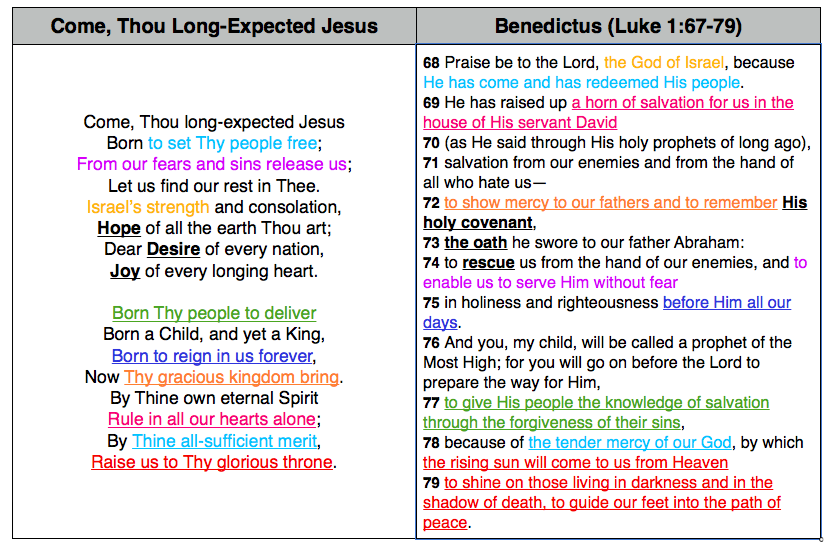
Come, Thou Long-Expected Jesus

AdventWe began our series on The Carols Of Christmas by looking at the poem written by Charles Wesley in 1744: Come, Thou Long-Expected Jesus. As far as I can find, Wesley never shared where he got his inspiration for this prose, but I have a hunch that it might be from a song in the Bible called The Benedictus.

Zechariah had been unable to speak for nearly a year because of his doubt over the message God sent him through the angel (see Luke 1:5-20). When his son was born and Zechariah named him John, his tongue was loosed and he “was filled with the Holy Spirit” and burst into song (Luke 1:67-79). The first word of his song in Latin is benedictus, from which the name is derived.

Here’s what I love about both Zechariah’s and Wesley’s songs—they both look forward to Christ’s First Advent and His Second Advent. Mary was still pregnant with Jesus when Zechariah sang his song, but his lyrics reflect the Redemption story that Jesus would fulfill as Emmanuel, God with us. Charles Wesley picks up this same theme, rejoicing over Christ’s birth and His imminent return.

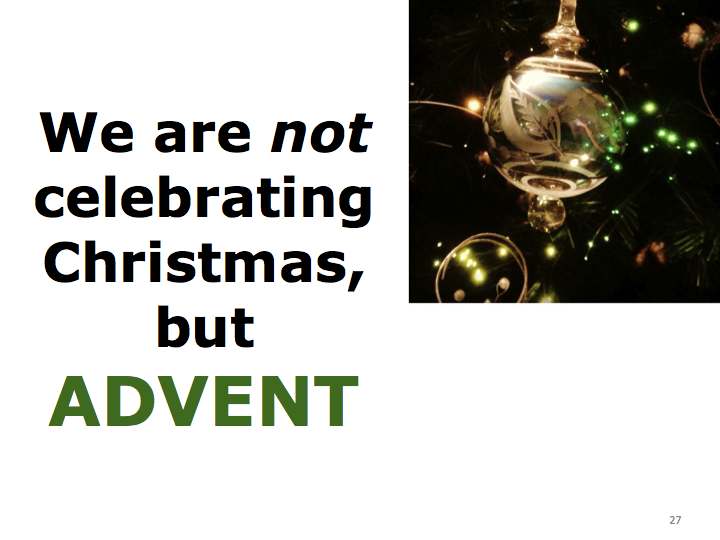
In fact, that’s exactly the point! We aren’t celebrating Christmas as much as we are celebrating Advent. Jesus was born “when the time had fully come” for His First Advent (Galatians 4:4-5), and “this same Jesus, Who has been taken from you into Heaven, will come back in the same way you have seen Him go into Heaven” (Acts 1:11). That’s the message that should encourage us (see 1 Thessalonians 4:13-18).

Check out the remarkable parallels between the Benedictus and Wesley’s hymn—

Come Thou Long-Expected Jesus & Benedictus

If you’d like to download a PDF of this side-by-side comparison, here it is → Come Thou Long-Expected Jesus & Benedictus ←

If you’ve missed any of the messages in this series, you may check them out by clicking here.

The Strength & The Story In Unity

© Lori Oxford Photography

© Lori Oxford Photography

Yesterday I had the honor of speaking at our annual United service in Cedar Springs. I shared something I noticed about the New Testament church: These Christians spent a lot of time together, and that togetherness became a source of strength and told a story to the those watching the Christians.

In passages like Acts 2:42-47 and Acts 4:32-35, we see Christians not only worshiping together, but actively involved in living out their faith. Luke, the writer of the Book of Acts, captures something that Eugene Peterson would summarize this way—

“Christians are a community of people who are visible together at worship but who remain in relationship through the week in witness and service.” 

This was not just Christians helping Christians, but Christians helping all the people in their communities. It was Christians who formed the first:

  • Blind asylums
  • Medical dispensaries
  • Hospitals
  • Orphanages
  • Elderly care home
  • Feeding programs for the poor

And this caught the notice of everyone. Aristides wrote to Emperor Hadrian about the Christians—

“They help those who offend them, making friends of them; do good to their enemies. They don’t adore idols; they are kind, good, modest, sincere, they love one another; don’t despise widows; protect the orphans; those who have much give without grumbling to those in need. When they meet strangers, they invite them to their homes with joy, for they recognize them as true brothers…. When a poor man dies, if they become aware, they contribute according to their means for his funeral; if they come to know that some people are persecuted or sent to prison or condemned for the sake of Christ’s name, they put their alms together and send them to those in need. If they can do it, they try to obtain their release. When a slave or a beggar is in need of help, they fast two or three days, and give him the food they had prepared for themselves, because they think that he too should be joyful….”

The Apostle Paul challenges followers of Jesus to constantly be growing in the outward demonstrations of our faith: to live our lives worthy of God’s calling, to get along with others, and to be making every effort to keep the bond on unity (see Ephesians 4:1-3).

With this in mind I have to ask myself: Am I doing this in my home town? Is there a strength and a story of Christ’s love that is told in my unity with other Christians? Am I helping to address the needs in Cedar Springs? What are people saying about Jesus because of my unity and service with other Christians?

Links & Quotes

link quote

Some good reading from today…

“Let there be a method in our giving, so that the poor may not go away empty nor the subsistence of the needy be done away and become the spoil of the dishonest.” —Ambrose

“Passion for the glory of the Lord is the key to making a difference all out of proportion to who we are. It is not the prerogative of old or young, intelligent or simple, men or women. This passion can flame up in the heart of any saint. Do we want it enough to seek it?” —John Piper

“Of one thing we are very sure. There will be a full restoration of the apostolic gifts and the full power of Pentecost before the coming of the Lord….” Read more of this quote from Dr. Charles S. Price from over 75 years ago.

[INFOGRAPHIC] A very cool timeline of the book of Acts.

Dr. Tim Elmore shares One Antidote To Male Disillusionment. Very helpful for anyone working with young men.

Be A Witness

Good newsJesus said we have some really, really, REALLY good news to share! It’s news about how much God loves us and wants us to know Him personally.

Jesus wanted us to spread the word far and wide about this really, really, REALLY good news, but He didn’t want us to try to do it in our own power. In fact, the last words He spoke to His disciples before ascending into Heaven were—

But you will receive power when the Holy Spirit comes on you; and you will be My witnesses in Jerusalem, and in all Judea and Samaria, and to the ends of the earth. (Acts 1:8)

Did you catch those words: power TO BE witnesses. The Holy Spirit provides us with the resident, miracle-working, moral, influential, and enabling power not to do witnessing, but to be witnesses.

“The Pentecostal believer is to be something, not just experience something. He or she must become a living witness of Christ on earth.” —Charles Crabtree

There are really two ways that we are witnesses for Him. Our witness is:

(1) Strategic

  • The New Testament believers strategically met house-to-house and in the Temple (Acts 2:46).
  • The church strategically picked leaders to help them be effective in their witness (Acts 6:2-3).
  • The Holy Spirit strategically picked missionaries to be witnesses in far-off lands (Acts 13:2-3).
  • Those missionaries were strategic in following up on their witnessing work (Acts 15:36).

(2) Spontaneous

  • The newly Spirit-baptized believers were able to spontaneously worship God (Acts 2:4) and testify of His power to others (Acts 2:14).
  • Peter could spontaneously respond to the crowd’s question after Peter had finished his sermon (Acts 2:37-39).
  • Peter and John had a spontaneous reply when the Sanhedrin called them in to testify (Acts 4:8).
  • This spontaneous witnessing power was available to them through the Holy Spirit just as Jesus had promised (Matthew 10:17-20).

If we try to just do witnessing, our strategy will be lacking and we’ll quite possibly be caught off-guard in a spontaneous setting. But when we allow the Holy Spirit’s power to transform us TO BE witnesses, our strategies are more effective and our spontaneous moments are too! The Holy Spirit helps us share the really, really, REALLY good news!

Money & Hammers

Money checklistHammers are very similar to money. Don’t believe me? Just take a look at some of the things they have in common. They both…

  1. …are tools.
  2. …can be used to build up or destroy.
  3. …are amoral.
  4. …don’t have any power until they’re in a person’s hand.

I realize in church circles it can make people uncomfortable to talk about money, but it shouldn’t be that way. The Bible is very clear in saying wealth comes from God, as well as how to use that wealth, so why should that be uncomfortable? Here are some of the things the Bible says about wealth:

  • If we honor God, He blesses our work (Proverbs 3:9-10).
  • If we take the glory for our success, God calls us “foolish” (Luke 12:16-21).
  • Money can be used to build God’s kingdom (Acts 4:34-37) or to build our own reputations (Acts 5:1-11).
  • Making the pursuit of money our priority becomes an idol (Luke 16:10-13).
  • The anxiety over money can choke our spiritual life (Matthew 13:22).
  • God gives us the ability to work, to make money, and to enjoy both the work and the rewards of work (Ecclesiastes 5:19).
  • God alone judges our attitude toward money (Luke 16:15).

It’s not money that is immoral, but our pursuit of Money (with a capital “M” or what the Bible calls Mammon) that is immoral.

It’s not money that will ruin us, but our trust in money that will ruin us.

It’s not money that gives us a secure future, but God Who richly provides us with everything for our enjoyment (1 Timothy 6:17).

Don’t envy people with more money than you. Don’t look down on people with less money than you. Don’t—as Jesus said to the Pharisees—justify your opinions and attitudes about money.

Only an honest listening to the Holy Spirit about your attitude and lifestyle concerning money is what can keep us from letting money rob us of God’s blessing.


What God Will You Choose?

What God:godMy friend Chuck and I have a sort of shorthand when we talk. We’ve been through so many experiences together, that now just a single word can bring to our minds the fullness of that time, with all of its tears and laughter. Someone listening to one of our conversations might not get the full impact, but we sure do!

It’s the same way when we read one of the Apostle Paul’s letters. He is writing to a church or an individual with whom he had a rich, personal experience. So when he alludes to something, those friends who went through that experience with him recall all of the fullness. When reading the letter to the church at Ephesus, you can experience some of that fullness by reading about Paul’s experience in that city in Acts 19.

In Acts 19 you will meet the followers of Jesus who were already there and see them get baptized in the Holy Spirit … watch Paul teach for three months in the synagogue before the Jewish troublemakers run him out … see Paul lecture for the next three years in the Hall of Tyrannus, so that everyone in that province heard the Word of God … see how God authenticated Paul’s ministry with miracles … experience those who tried to counterfeit what Paul was doing … see many in that city turn from their witchcraft and idol worship … and finally experience the tumult of a near-riot started by the merchants who were losing their income on sales of mythological trinkets because so many were turning to Christ.

With this backdrop, you can then understand why Paul uses such specific language in the opening greeting of his letter to Ephesus (see Ephesians 1:1-3). By doing so he is contrasting the followers of Jesus with the followers of Artemis—

  • Christians for whom God has a specific plan (“by the will of God” [1:1a]; see also 1:4 and 2:10) versus Artemis’ followers who felt like they had no choice (Acts 19:26).
  • Christians who are called saints (set apart for God’s special use) and faithful (trusting Jesus implicitly [1:1b]) versus those followers of Artemis who are self-serving (Acts 19:24, 25).
  • Christians who experience God’s grace and peace (1:2) versus those followers of Artemis who did not even know why they were there (Acts 19:32).

But the most specific language is in Ephesians 1:3—Praise be to THE God and Father of our Lord Jesus Christ (emphasis added)….

  • Not “a” god, but “THE” God.
  • Not a god that needs to be appeased, but THE loving Father.
  • Not a god that may or may not be able to respond, but OUR Lord Jesus Christ Who overcame death, hell and the grave so that our sins can be forgiven!

The question Paul invites the Ephesians to consider is the same question we must consider:

What God / god will you choose?

We will be continuing our study on the book of Ephesians next Sunday, and I would love to have you join us!

Links & Quotes

link quote

These are links to articles and quotes I found interesting today.

“The Hebrews have done more to civilize men than any other nation. … [God] ordered the Jews to preserve and propagate to all mankind the doctrine of a supreme, intelligent, wise, almighty sovereign of the universe… the great essential principle of morality, and consequently all civilization.” —John Adams, in a letter to Judge F. A. Van der Kemp, February 16, 1809

I will not execute the fierceness of mine anger, I will not return to destroy Ephraim: for I am God, and not man. (Hosea 11:9) 

The Lord thus makes known His sparing mercies. It may be that the reader is now under heavy displeasure, and everything threatens his speedy doom. Let the text hold him up from despair. The Lord now invites you to consider your ways and confess your sins. If He had been man, He would long ago have cut you off. If He were now to act after the manner of men, it would be a word and a blow and then there would be an end of you: but it is not so, for “as high as the heavens are above the earth, so high are His ways above your ways.” 

You rightly judge that He is angry, but He keepeth not His anger forever: if you turn from sin to Jesus, God will turn from wrath. Because God is God, and not man, there is still forgiveness for you, even though you may be steeped up to your throat in iniquity. You have a God to deal with and not a hard man, or even a merely just man. No human being could have patience with you. You would have wearied out an angel, as you have wearied your sorrowing Father; but God is longsuffering. Come and try Him at once. Confess, believe, and turn from your evil way, and you shall be saved. —Charles Spurgeon, Faith′s Checkbook (February 16) 

Stomach-churning: Former Planned Parenthood Nurse Speaks Out

“It was not an easy task which the Church faced when she came down from that upper room…. Left to herself the Church must have perished as a thousand abortive sects had done before her, and have left nothing for a future generation to remember. That the Church did not so perish was due entirely to the miraculous element within her. That element was supplied by the Holy Spirit who came at Pentecost to empower her for her task. For the Church was not an organization merely, not a movement, but a walking incarnation of spiritual energy. And she accomplished within a few brief years such prodigies of moral conquest as to leave us wholly without an explanation—apart from God.” —A.W. Tozer