How Do You Start A Conversation With God?

pray-through-the-bibleLast week I asked you to imagine how your relationship grew with your best friend. You probably found that this special friendship was formed during hours and hours of talking.

I’m going to guess that at first your conversation was a little on the superficial side. You talked about “tame” topics like sports teams, or your job, or the city you lived in. But at some point you took a huge riskyou became vulnerable by sharing something really personal. Perhaps you shared a time that you got hurt, or something that makes you anxious, or maybe a big dream you carry around in your heart. But if that friend is still your friend, that means they treated what you shared reverently. They didn’t laugh at you, belittle your hurts or dreams, nor did they share with others what you said.

The relationships became deeper and more special because you now knew each other on a more intimate level.

Prayer is a conversation with a Friend. Of course, that Friend is God, so some people wonder, “What do I talk to God about?” The simple answer is anything and everything!

Time and time again God calls us to come closer to Him (see Isaiah 55:1-3), to discuss with Him things we don’t understand (Jeremiah 33:3), or to be assured that He is intimately tuned in to what’s happening in our life (Psalm 139:17; 1 Peter 3:12).

How do we get there? A good place to start is with our Bible. Dwight Moody said:

“The two first and essential means of grace are the Word of God and Prayer. … If we read the Word and do not pray, we may become puffed up with knowledge, without the love that buildeth up. If we pray without reading the Word, we shall be ignorant of the mind and will of God, and become mystical and fanatical, and liable to be blown about by every wind of doctrine.”

Scripture was written to point us to Jesus. So we don’t read the Bible just to read it; we read it to get to know God.

We don’t want to know the Word of God; we want to know the God of the Word. 

A great place to start is in the book of the Psalms. Many of these were written as prayers, so it’s a good way to start our conversation with God. You can also search in the New Testament for all the places that biblical writers said, “I pray…” or “This is my prayer….”

I share a personal example of this in this video, especially if you want to fast forward to the 36:00 minute mark.

Don’t just read through the Bible this week—pray through the Bible. Use it as a means to have a conversation with the very Best Friend you could ever know!

I encourage you this week, as you think about this topic, to get together with an earthly friend and discuss these questions:

  1. How can I use my Bible as a “conversation starter” with God?
  2. How can I get into the regular practice of talking to God as a Friend?

Love Serves

love-serves-1I have blogged quite a bit about the tendency of our culture to be pragmatic. That is, people determine the rightness or wrongness of something based on how it feels to them. If it feels good,  or if they get something positive out of it, then it must be good; but if it feels bad, or if they don’t  get anything out of it, then it must be something they need to abandon.

True love is never pragmatic. Although culture tells us it is:

  • “You’ll know he’s the one by how he makes you feel.”
  • “We’ve fallen out of love.”
  • “There’s just no spark there any more.”
  • “He’s let me down one too many times.”
  • “You’ve lost that lovin’ feeling, oh that lovin’ feeling….”

“We dress ‘love’ in the fantasy of evening gowns and tuxedos, with silver and candelabras. But most of the time…love comes dressed in overalls—it is practical, down-to-earth, everyday hard work. It is really thinking of the other person and doing what the other person needs and being what the other person needs when he or she needs you to be there.” —Dr. Richard Dobbins

love-serves-2In writing to the church at Ephesus, Paul told them he became their servant—literally this means their waiter. But not so he could get something out of it. Instead it was a love completely focused on them…

  • the prisoner of Jesus Christ for the sake of you (Ephesians 3:1)
  • God’s grace was given to me for you (v. 2)
  • this grace was given to me to preach to [you] (v. 8)
  • my sufferings for you, which are your glory (v. 13)

Speaking to the Ephesian leaders as he was traveling to Jerusalem, he said…I served the Lord with great humility and with tears (Acts 20:19)

  • I never stopped warning each of you night and day with tears (v. 31)
  • I have not coveted anyone’s silver or gold or clothing (v. 33)
  • In everything I did, I showed you that by this kind of hard work we must help the weak (v. 35)

Dear Christian, is this the kind of love you demonstrate? Do you share God’s grace with the hurting? Do you walk alongside those who are limping or about to give up? Do you stand through the storms with those on the battlefield?

It’s not what I get out of it. 
Love focuses on the other person. 
Love is devoted by a solemn promise. 
Love doesn’t view “suffering” as something bad, but for the other person’s glory. 
Love doesn’t seek recognition or rewards. 
Love simply does what is important for the other person.

2 Life-Changing Words

whose-you-areThere’s an interesting story recorded in Acts. Seven sons of a priest named Sceva attempt to cast out a demon by saying, “In the name of Jesus whom Paul preaches, come out!” To which the demon replies, “Jesus I know and Paul I know, but who are you?”

Not only was the demon not exorcised, but the seven men came running out of the house bloodied and naked from the beating they received!

Think about it: If you spoke to the devil and said, “Get away from me!” would he be afraid of you? The simple answer is “No!” Why? Because you have no power in yourself.

It’s not about who you are, it’s about Whose you are.

john-14-20Jesus talked about our place in Him in John 14:20. Notice the word “in” in this verse:

  • Jesus is in the Father
  • The Christian is in Jesus
  • The Spirit of Christ is in the Christian

Here are the two life-changing words for any Christian to remember…

IN CHRIST

The devil wants to get you second-guessing your identity. He wants you to be uncertain if you are worthy of coming into God’s presence. He wants you doubting if you are truly forgiven and worthy of God’s attention. He wants you unsure if you can stand up against him in a spiritual fight.

This uncertainty and doubt is erased by faith in this: I am IN CHRIST!

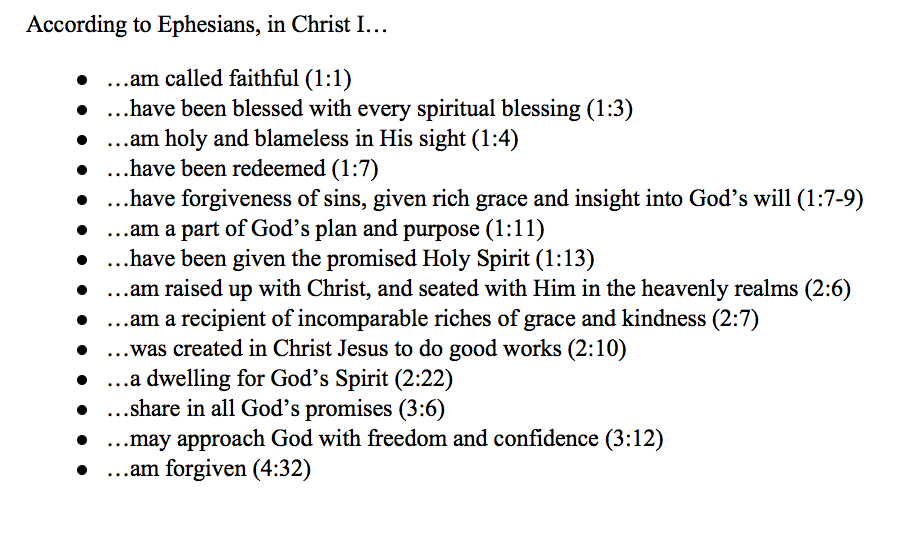
in-christ-i-amPlease print out this list from Ephesians of all the “in Christ” statements Paul shares with us. (You may download a PDF version by clicking here → in-christ-i-am)

Keep this list handy, and the next time satan whispers doubts in your ear like, “Jesus I know and Paul I know, but who are you?” say—

“It’s not who I am, but Whose I am! I am Christ’s. I am in Him and He is in me. I have been forgiven. I am a part of His family. I have a purpose. I am holy and blameless. I am the recipient of all God’s blessings. And you can never defeat me because I AM IN CHRIST!”

If you don’t have a home church, join us next week as we continue our series in the book of Ephesians called Sit Walk Stand.

3 Quotes For Uncommen Husbands

Uncommen HusbandsI recently finished a reading plan on YouVersion called Uncommen Husbands. Here are some quotes that I especially appreciated from Brian Goins’ insights.

“Paul indicates there a came a time in his life when he grew out of an immature, boyish love and embraced a more mature, and dare we say, manly love [1 Corinthians 13:11]. If we’re going to love our wives like Christ loved the church, we must let the boy die. And in marriage, that’s far easier said than done. Check out the comparisons below:

  • Boys retaliate quickly when hurt; manly love is patient and kind.
  • Boys require constant affirmation; manly love is not arrogant or rude.
  • Boys stew, stammer, and hold grudges when they don’t get their way; manly love does not insist on its own way; it is not irritable or resentful.
  • Boys try to win every argument; manly love does not rejoice at wrongdoing, but rejoices with the truth.
  • Boys have a short fuse; manly love bears all things.
  • Boys write people off when wronged; manly love believes God’s best for the relationship.
  • Boys lose hope after they’re hurt; manly love always hopes for reconciliation regardless of the pain.
  • Boys expect to be served; manly love endures all things.”

“Paul says, ‘cherish’ our bride like we cherish our own bodies. The word means, ‘bring warmth to,’ and from which we derive our words, thermal and thermostat. … When Paul tells us to love our wives as we love our own bodies, he’s encouraging us to cherish their emotional needs in the same way we cherish our own physical needs. If she’s chilly, it’s our job to warm her up. If she’s steaming, then we help lower the mercury. In other words, the call to cherish means we have to engage when we’d rather shrink back.”

“I’m not sure Paul was the most popular men’s retreat speaker. When he spoke, some fell asleep…and then fell out a window (Acts 20:9). He admitted to the church at Corinth his messages were a bit convoluted (1 Corinthians 2:3-5). Even his buddy Peter threw him under the bus for his ivory tower verbiage (2 Peter 3:15-16).

“Then there was his unfortunate use of the word nourish in Ephesians 5:28. I’m pretty sure every guy in the audience cringed a bit when Paul said to husbands, ‘nourish’ your wife. We may think of nutritious foods, but in Paul’s day, the word often referred to nursing moms. Try and get that picture out of your head.

“When my wife used her God-given equipment to nourish our children I don’t ever remember a time when I asked her, ‘Honey, when was the last time you fed the baby?’ and she responded, ‘Oh, I don’t know, it’s been a few days.’ Because instinctively a mom knows her baby’s nourishment has to be consistent, catered to their tastes, and is crucial for their survival. In the same way, Paul calls husbands to nourish their brides. Is your love consistent? I don’t know about you, but I rarely miss a meal. Unless I’m fasting (for a very short time!), about every 4-5 hours I feed the beast. It’s all too common for our wives to go months between meals: a date night, taking a walk, go on an adventure, a simple text saying, ‘are you tired? You should be because you’ve been running through my mind all day long,’ or a well thought out letter. Nourishment must be ongoing. Is your love catered to her tastes? You’re not going to catch me at the all-you-can-eat tofu bar. Unless I’m on the mission field, I generally nourish my body with stuff I like. It’s common to give love the way we want to receive love. But your love language probably doesn’t match hers. Want to know if you are catering to her ‘love’ taste buds, ask this UNCOMMEN question: ‘Honey, do you feel the depth of my love? Not do you know it, but do you feel it? If not, how can I nourish your soul?’ Do you realize your love is crucial to her survival?”

6 Quotes About Understanding Sexual Sin

Focus On The FamilyEarlier this week I shared some quotes from a Focus On The Family (FOTF) reading plan I completed on YouVersion regarding the problems with pornography. Here are some additional quotes from a related FOTF reading plan called Understanding Sexual Sin.

“Sexual sin distorts the image of the Trinity mirrored in our marital relationships.”

“If our sex lives are meant to function as reflections of the image of God, it stands to reason that they should be shaped by the qualities of the Trinity. Three primary principles apply here.

1) We may never use another person as an object, sexual or otherwise. The members of the Trinity never relate to each other as objects or things to be used. Instead, they relate to one another in love, each seeking to serve and enhance the goodness and glory of the others.

2) We must keep sexual relations within the bounds of a loving and committed marriage. … This sexual embrace within the bond of marriage mirrors the nature of the relationship between the members of the Trinity as nothing else in creation can. Ideally, the marital bond is designed to be loving, permanent, exclusive, and self-giving.

3) We must respect and honor the God-designed differences between male and female. Male and female are not simply cultural constructs. They are God-created characteristics of humanity. Together, they personify the Trinitarian nature of God in a fundamental way…. The differences between male and female provide the fullest picture of the image of God in creation.”

“Biblically speaking, sexual immorality (Greek porneia) is any sexual activity that takes place outside of marriage. This includes adultery, premarital sex, and extramarital sex. Scripture teaches that both are off-limits for Christians (see 1 Corinthians 6:9; Acts 15:29; Hebrews 13:4).”

“It’s a mistake to confuse normal sexual attraction with lust. Sexual attraction is natural. … True lust involves a choice and an act of the will. To a certain extent it’s a conscious decision to pursue the desirable object instead of simply allowing it to pass by. It’s a willingness to give in to the natural impulse.”

“Pornography represents a departure from God’s design for sex in that it depersonalizes real people, strips them of their dignity, and turns them into sexual objects.”

“It is never wise to give more weight to feelings than to rational conclusions and clear biblical teachings. Feelings don’t make you who you are. Beliefs, values, and conscious commitments do.”

The Key Decision For Influential Men

Influence like JesusNo matter how you look at it, being a Dad is hard work! Men have this constant balancing act between being tough and being tender. Guys have to have their game face on at work, and their family face on at home. They’ve got to work hard knocking down work competitors, and then work just as hard building up their family members.

But there is one key decision that will determine how successful a man will be at work, at home, in his social circles, and even in his relationship with God. 

In Acts 10 we meet a centurion named Cornelius. Centurions were professional military officers in charge of a centuria (usually 100 soldiers). Centurions were always “on the clock,” never letting down their guard nor their professionalism.

All of the centurions mentioned in the New Testament have noble characteristics associated with them. Whereas someone might be uncertain how a typical Roman soldier would behave, people felt more assured when the centurion was on the scene. Even Roman governors like Pilate, and Jewish kings like Herod, all seemed to fully trust the judgement, honesty, and resourcefulness of centurions.

Centurions worked hard to get where they were, and had some well-earned perks:

  • Good pay (one built a temple, Luke 7:1-5).
  • “Men of authority” with soldiers and servants reporting to them (Matthew 8:8-9).
  • Opportunity for advancement (Rome was the dominate world force).
  • A certain degree of autonomy (they had their own residences (Matthew 8; Acts 10).

In order to keep this position, they would have to buy into kurios Caesar (Caesar is lord). To do otherwise was to put their position and future advancement at risk.

Yet Cornelius was different. 

He was a trusted centurion, but something unusual stood out about his life. Luke the historian describes him as devout and God-fearing, mentioning his pious activities of prayer and giving to the poor. Cornelius’ own soldiers referred to him as righteous and respected by notable people in the community.

But probably most telling of all: God noticed how committed Cornelius was (see Acts 10:3-4)!

Cornelius had a lot to lose by rejecting kurios Caesar for, as the Christians said, kurios Iesous (Jesus is Lord). Yet after carefully weighing his options, he saw that trusting God was the best thing he could do for his family. His view of the eternal outweighed anything that he could gain in the temporal.

This one decision changed everything! 

Because Cornelius trusted God, look at the expansiveness of his influence, not only at home, but at work, and among his friends and extended family, and throughout his community:

  • His family—ALL his family were devout and God-fearing (v. 2)
  • His employees—a devout soldier (v. 7)
  • His community—respected by ALL the Jewish people (v. 22)
  • His relatives and friends—his relatives and close friends (v. 24)
  • In fact everyone around him—we are ALL here in the presence of God (v. 33)
  • And most importantly, with God—your prayers and gifts have come up as a memorial offering before God (v. 4)

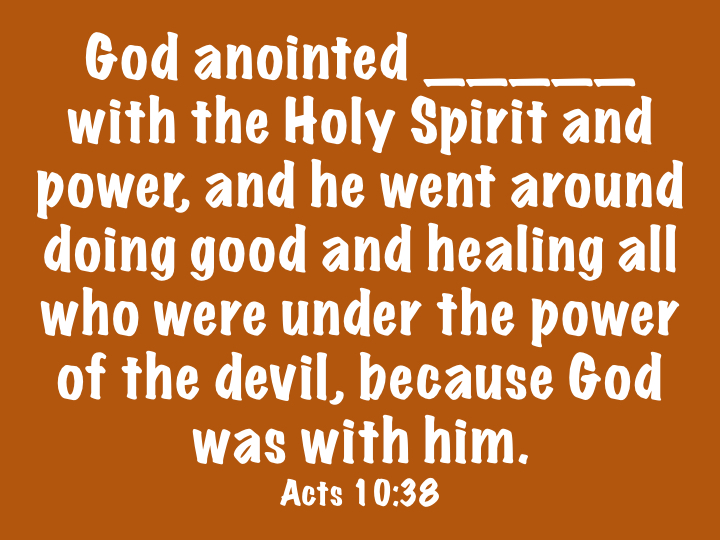
Fellas, you can have this same level of influence if you, too, will decide to live karios Iesous: Jesus is Lord. If you will do that, you can have said about your life what was said about Cornelius and Jesus: “God anointed ___________ with the Holy Spirit and power, and he went around doing good and healing all who were under the power of the devil, because God was with him!” (see Acts 10:38).

4 Ways To Share The Good News With Everyone

Everybody EveryoneJesus told His followers that their ministry assignment was to take His message of salvation throughout the entire world. One requirement to do this, is to be able to communicate with lots of people. Actually to be able to communicate with everyone.

Be careful to do what is right in the eyes of everybody. If it is possible, as far as it depends on you, live at peace with everyone. (Romans 12:17-18)

Really? Everybody and everyone?!

Yes!

Jesus said our Helper would be the Holy Spirit. He would come to empower us to be witnesses to everyone, everybody, everywhere (Acts 1:8).

We have been learning how to communicate with others better, but noticing their communication style “accent.” Check out this post to get some more insight into this. In a nutshell…

  • Doers are action-oriented
  • Planners like to work out all the details
  • People want to make sure everyone is connected
  • Visions are imagining a better future

So if you are a Doer, and you’re trying to share the Good News about Jesus with a Planner, you can probably see a potential problem. The Doer is speaking in bullet points, but the Planner is wanting a lot more facts and figures.

This is where the Holy Spirit can help us. He has the insight that we don’t, and He can direct our words, just as He directed Christ’s words (see John 12:49-50).

Here’s how to talk their talk when you’re sharing the Good News:

(1) Doer

  • Keep it brief
  • Share more facts than stories
  • Stress now/today
  • Rely on the Gospel of Mark (action oriented)

(2) Planner

  • Tell them the who, what, where, when, why, and how
  • Be ready for lots of questions
  • Give them time to process your information
  • Rely on the Gospel of Matthew (lots of background, lots of Old Testament references to answer the who, what, where, when, why and how)

(3) People

  • Develop a friendship first
  • Share more stories than facts
  • Don’t tell them, show them your personal life
  • Rely on the Gospel of Luke (lots of personal stories about changed lives)

(4) Vision

  • Share both the facts and the stories
  • Encourage them to “Imagine what would happen …”
  • Give them time to ask questions
  • Rely on the Gospel of John (very poetic and image-rich)

You can connect with everyone, everybody, everywhere and share the Gospel with them in an effective way. Allow the Holy Spirit to give you the insight you need.

Check out how I describe this in more detail here…

4 Ways To Evaluate Biblical Evidence

Reliability of the GospelsTo be honest, if someone hasn’t heard the biblical account of the life of Jesus Christ before, it can sound quite fantastic! Jesus was born of a virgin, lived a sinless life, performed miracles no one had seen before, died a horrific martyr’s death, was raised back to life three days later, and then ascended back into heaven until He returns to Earth again.

But as fantastic as this sounds, there is still enough evidence to reasonably believe it’s all true. An unreasonable faith believes in something in spite of the evidence; a blind faith believes in something without any evidence; and reasonable faith believes in something because of the evidence.

The Bible gives us eyewitness testimony about the life of Jesus which we can matter-of-factly evaluate. 

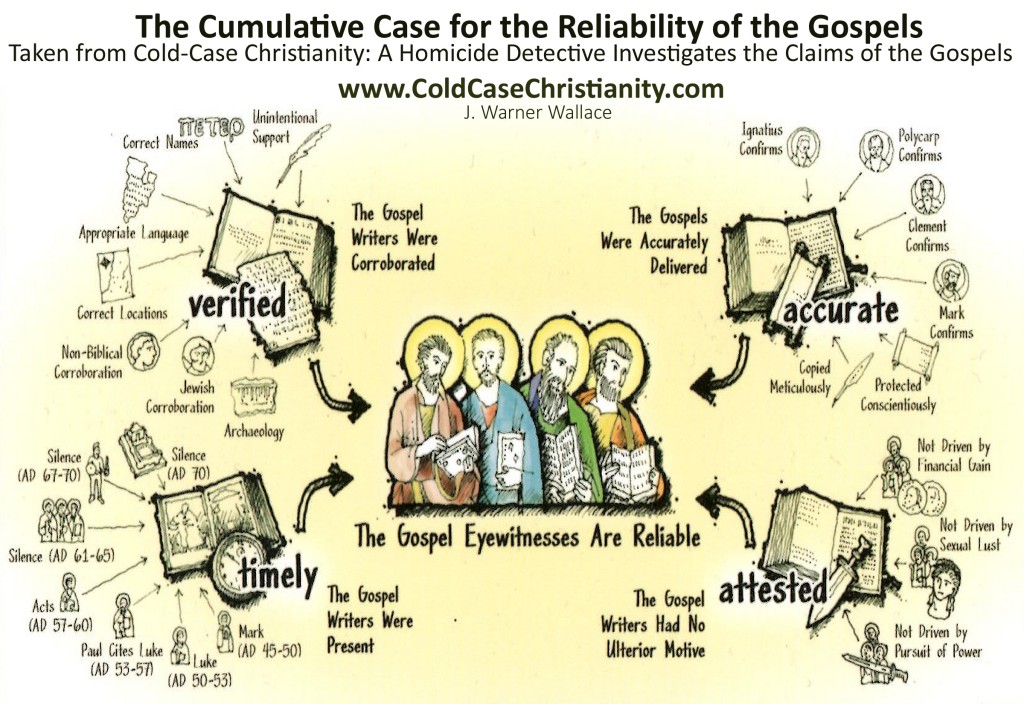
In a modern-day court of law, eyewitness testimony is evaluated on…

  • …the determination that the witnesses were actually present.
  • …the ability to corroborate their testimony.
  • …the consistency of their testimony over time.
  • …any biases they have that would cause them to exaggerate or misrepresent their testimony.

Let’s consider the testimony of the four Gospel writers: Matthew, Mark, Luke and John.

(1) Were The Eyewitnesses Present?

  • Luke is considered a credible historian, even by modern standards. He wrote the book of Acts following the ascension of Jesus into Heaven. Because he did not mention three major events in Jewish history (the Jewish uprising, the Roman siege of Jerusalem in response to that uprising, and the Roman destruction of the temple), we can determine that Acts was written before 61 AD.
  • Luke wrote the Gospel that bears his name before he wrote Acts. The Apostle Paul referenced portions of Luke’s Gospel in letters we can date by Paul’s Roman imprisonment, which means Luke was written prior to 53-57 AD.
  • Luke uses the Gospel of Mark as one of his references, which means Mark was probably written in 45-50 AD, just 10-15 years after the events of Christ’s life.
  • Mark was closely associated with the Apostle Peter, who was most assuredly Mark’s “source” in writing his Gospel, and Peter was one of the original twelve apostles called by Jesus.
  • Matthew and John were both apostles of Jesus, living and working closely with Jesus for over three years.

(2) Is Their Testimony Corroborated?

  • Archeological finds continually demonstrate the accuracy of the people, titles, places and details the Gospel writers mention.
  • Outside—or extra-biblical—sources like Josephus (a Jewish historian who wanted to preserve the purity of Judaism), Tacitus (a Roman historian), and Mara Bar-Serapion (a Syrian historian)—all who wrote between 40-70 AD—affirm things like where Jesus lived, the miracles He performed, the manner of His death, His resurrection, and the changed lives of people who believed in Jesus Christ.
  • In addition, Paul wrote of the “five hundred of the brothers” who were also eyewitnesses to the resurrected Christ (1 Corinthians 15:3-8).

(3) Has Their Testimony Remain Unchanged Over Time?

  • The history and accuracy of the scribes had already been demonstrated in the preservation and transmission of the Old Testament over a period of 1400 years.
  • These same scribal techniques were not only used in the transmission of the New Testament, but in subsequent years the Masoretic scribes became even more meticulous in the techniques they used.
  • The “chain of custody” of evidence can be absolutely traced from the Gospel authors, to their students, and to the writings of the Church Fathers.
  • In fact into the third-century AD, the writings of the Church Fathers contain so many direct quotations from the New Testament, that we can almost completely reconstruct the New Testament from their writings.

(4) Is Their Testimony Unbiased?

  • These eyewitnesses didn’t gain anything financially by their testimony. In fact, many of them lost or gave up all their possessions to tell others about Jesus.
  • They didn’t gain political power or influence that could save their own lives. All of the original apostles (except John) died a gruesome martyrs’ death.
  • In short, they had nothing to gain by making up and reporting a false story about Jesus.

All of these points make it reasonable to believe the evidence presented in the Bible about Jesus Christ is true. Check out this video where I elaborate a little more on each of these points—

If you live in the Cedar Springs area and don’t have a home church, I would love for you to visit with us Easter Sunday morning at 10:30am. We’ll be examining the evidence for Christ’s resurrection from the dead. Click here to get more details.

4 Terrible Ways & 4 Great Ways To Study Your Bible

Isaac Newton Bible study.001There are two Greek words in the New Testament that have to do with trying to figure things out. One of them leads to less knowledge, and one opens the way for greater learning. Not surprisingly, Jesus never used the first way, but He confronts people who try to.

The first Greek word is defined as learning through self-calculation. In other words, I try to get at the right answer by either teaching myself, or by talking with people who don’t know any more than I do. This way leaves me in the dark.

For example, notice the phrase “discussed among themselves” in Matthew 16:7 and Mark 11:31. These are people who wanted to try to get answers without going to someone who could teach them. So that leads to four terrible ways to study your Bible—

  1. Approach your Bible with a know-it-all attitude.
  2. Try to figure out what the Bible is saying all on your own.
  3. Try to be your own Bible teacher.
  4. Grade your own tests as to your answers being right or wrong.

These are not only terrible ways to learn, but they are the exact opposite of what God desires. God says things like, “Come, let us reason together” (Isaiah 1:18), and “Call to Me and I will tell you things you do not know” (Jeremiah 33:3).

There is another Greek word which means to learn by having a conversation with someone more knowledgable than myself. So that means four great ways to study your Bible are—

  1. Ask the Holy Spirit to illuminate Scripture to you (John 16:13).
  2. Study the Bible in a daily systematic way (Acts 19:9).
  3. Don’t take anyone else’s word for what the Word says (Acts 17:11).
  4. If you’re confused, ask God to make it clear to you (Jeremiah 33:3).

Luke records an important story for us that took place on the day Jesus was raised from the dead. Two men were walking along “discussing these things with each other,” but not consulting the Scriptures. The result: they were sad and confused. Jesus join them on their journey (although they didn’t recognize Him at first), and took them to the Scriptures that showed them the answers for which they were yearning. They even said, “When He talked to us from the Scriptures, that’s when our hearts burned within us!” (see Luke 24:13-32).

You can try to figure life out on your own, and you will probably end up stymied like the religious leaders in Mark 11, or downcast like the disciples in Luke 24. Or you can ask the Holy Spirit to show you truths from the Scriptures, and have your eyes opened, like the two disciples after Jesus met with them. I think the choice is obvious!

Join me next week as we continue our series How To Study Your Bible.

8 Quotes From “Light & Truth—Acts and the Larger Epistles”

Light & Truth [Acts]Horatius Bonar had great insight into the application of Scriptures. Check out my review of this commentary from Dr. Bonar by clicking here. Below are a few quotes that caught my attention. The reference in brackets after the quote is the biblical passage on which Bonar is commenting.

“Our Bible is of God; yet it is also of man. It is both divine and human. It comes to us from God’s Spirit; it comes also from man’s spirit. It is written in the language of the earth, yet its words are the words of him ‘Who speaketh it from heaven.’ Natural, yet supernatural; simple, yet profound; undogmatical, yet authoritative; very like a common book, yet very unlike also; dealing often with seeming incredibilities and contradictions, yet never assuming any need for apology, or explanation, or retraction; a book for humanity at large, yet minutely special in its fitnesses for every case of every soul; throughout its pages, from first to last, one unchanging estimate of sin as an infinite evil, get always bringing out God’s gracious mind toward the sinner, even in his condemnation of the guilt; such is the great Book with which man has to do, which man has to study, out of which man has to gather wisdom for eternity.” [Acts 1:1

“One of the great characteristics of the whole interval between Christ’s first and second coming is the world’s rage, secret and open, against the Father and the Son. … It is very useless anger. It accomplishes nothing. It is like an angry child striking a huge rock with its fist. It is the mere display of impotent hatred, or the temporary gratification of their dislike of God, and their rejection of His purpose regarding His Son. … It calls light darkness, and darkness light; good evil, and evil good; but the light and the darkness, the good and evil, still remain as they were. All the enlightenment of the age, all the appliances of modern progress, are impotent against God and His Christ, against His truth, and His church, and His Word.” [Acts 4:25]

“This is one of the many repetitions of the Pentecostal scene which occurred in early days. Most unscriptural is the statement of some that the giving of the Spirit at Pentecost was a thing done once for all, not to be repeated, and that we are not to pray for or expect such things again. The whole of the ‘Acts of the Apostles’ is a direct refutation of this piece of human fancy. Wherever the apostles went there was a repetition of Pentecost, whether at Jerusalem, or Samaria, or Antioch, or Corinth. Every conversion is the repetition of Pentecost; it is doing the same thing for an individual soul as was done for three thousand then, by a similar process, and by the same power—the power of the Holy Spirit. The Holy Ghost is the heritage of the church. The Old Testament saints possessed Him; and still more the New. This is our heritage, the heritage of every believing man.” [Acts 11:15

“Beware of seeking anything less than the baptism of the Holy Ghost. Our whole life is to be a reception of the Spirit. He is to be continually coming down on us, and filling us. Let us open our mouth wide that He may fill it. Let us beware of anything that would present itself as a substitute for the living Spirit. Many such things may we expect in these last days from satan as an angel of light.” [Acts 11:15]

“We are tempted in our day to be ashamed of the gospel. It is thought to be bare, unintellectual, almost childish by many. Hence, they would overlay it with argument and eloquence, to make it more respectable and more attractive. Every such attempt to add to it is being ashamed of it.” [Romans 1:16

“We must have a righteousness, else we cannot stand before God; we cannot have merely a religion.” [Romans 4:6-8]

“The prodigal did not work for the ‘best robe,’ but got it all ready-made from his father’s hands; Joseph did not work for his coat of many colors, but received it as the gift of his father’s love; Adam did not work for the skins with which the Lord God clothed him: so it is with the sinner in his approach to God, and in God’s approaches to him. ‘Righteousness without works’ is given him; nay, put upon him as a raiment, a divine raiment, to fit him for drawing near to God.” [Romans 4:6-8

“When the night is darkest, and the stars are hidden, and the clouds are black, then we think most of the clear fair day, and long for its dawn. When the storm is roughest, with the waves and wind roaring around the laboring vessel, then we are troubled, and look eagerly out for the glad and sunny calm. When winter binds the earth in its chain of frost, and wraps it in snow and ice, then we begin to ask for spring, with its flowers, and songs, and verdure. So with the saint, as represented by the apostle here. This is night, and storm, and winter to him; he is ever thinking of the day, and the calm, and the spring.” [Romans 8:19-23]

More quotes are here.