Listen to the audio-only version of this podcast by clicking on the player below, or scroll down to watch the video.
Accepting a new position is a very exciting experience! Whether it’s a promotion in your current organization or an opportunity elsewhere, it’s very tempting to want to immediately throw your full attention into the next project. In this episode, Greg and I discuss the necessity of maintaining a balance between that excitement and recognizing that the people on your team now still need your leadership. This might create more work for you in the short term, but the long-term benefits of transitioning well will be huge for you!
[0:33] Any fresh starts for leaders have to be handled thoughtfully.
[2:44] Leaders of integrity give their best effort all the way to the end.
[4:08] How can we maintain a humble attitude when we have been selected to be promoted to a new position?
[6:08] There are different things to keep in mind when moving to a new position in the same organization vs. moving to a new organization.
[8:02] Both of us share stories about friends who benefitted by leaving their old organizations well, and they identify what the true litmus test for leaving well is.
[10:14] Greg also has a negative example to share.
[11:03] How do senior leaders handle coworkers who leave poorly?
[13:06] How do we keep ourselves from being distracted by our new position while we attempt to finish well in our old position?
[16:15] How do we arrive well in our new position?
[18:35] We need to always keep in mind that we are leaving or joining a team of many—we aren’t a team of one.
[22:57] Finishing well is a compliment to the organization you are leaving, and beginning well is a compliment to the organization you are joining.
Check out this episode and subscribe on YouTube so you can watch all of the upcoming episodes. You can also listen to our podcast on Spotify and Apple.
In my book Shepherd Leadership, I talk about the simple three-word phrase that has helped me maintain this balance: God chose me. The fact that God did the choosing should give me the confidence to cast vision, but the humility that God chose me—out of all of the other people He could have chosen—should bring an appropriate humility that allows me to involve other leaders on my team.
If you would like to watch this full interview on the Leading From Alignment podcast, please go here. And if you would like to check out other clips I’ve already shared, please click here.
I’ll be sharing more clips from this interview soon, so please stay tuned. Shepherd Leadership: The Metrics That Really Matter is available in print or ebook, and in audiobook through either Audible or Apple.
If you were one of Christ’s disciples, wouldn’t you think it would be time for Jesus to take a victory lap? Maybe He could show up at the next meeting of the Sanhedrin, or in Pontius Pilate’s courtroom, or King Herod Antipas’ throne room. You can almost hear their longing for this when they asked Jesus, “Lord, are You at this time going to restore the kingdom to Israel?” (Acts 1:6).
Jesus answered that question by saying, “Your race is just now beginning!” You see, Christ’s resurrection wasn’t the end of the race, but an important—absolutely indispensable—part of our ongoing race. “I will be raised back to life again” was a bold claim, but it wasn’t the final bold claim. There is one more for us to consider.
The resurrection of Jesus is our assurance that what Jesus says He will do, He will do. One of the things He promised is, “I am going to prepare a place for you and I will come back to get you” (John 14:1-3). The place Jesus has prepared for us is the end of our race—the finish line for which every Christian should be longing.
The disciples asked Jesus how they could know when His return was getting closer. He gave them a lot of things to watch for, but He concluded by saying, “And this gospel of the kingdom will be preached in the whole world as a testimony to all nations, and THEN the end will come” (Matthew 24:14).
In order for us to go Home, the whole world—people in all nations—have to hear the Good News of the Kingdom of God.
In one of the boldest claims of all, Jesus says He has ultimate authority, and that He is commissioning us to use His authority for the express purpose of our missionary work to all nations. Notice the “therefore” which indicates what we are to do with His authority—
All authority in heaven and on earth has been given to Me. Therefore go andmake disciples of all nations, baptizing them in the name of the Father and of the Son and of the Holy Spirit, and teaching them to obey everything I have commanded you. And surely I am with you always, to the very end of the age. … But you will receive power when the Holy Spirit comes on you; and you will beMy witnesses in Jerusalem, and in all Judea and Samaria, and to the ends of the earth. (Matthew 28:18-20; Acts 1:8)
The apostle Paul appreciated this analogy of running a race. Just before it was time for Paul to go Home, he told his friend Timothy, “I have fought the good fight, I have finished the race, I have kept the faith” (2 Timothy 4:7).
Earlier in his life, Paul used a running example when he wrote to the Christians at Corinth—
Do you not know that in a race all the runners run, but only one gets the prize? Run in such a way as to get the prize. Everyone who competes in the games goes into strict training. They do it to get a crown that will not last, but we do it to get a crown that will last forever. Therefore I do not run like someone running aimlessly; I do not fight like a boxer beating the air. No, I strike a blow to my body and make it my slave so that after I have preached to others, I myself will not be disqualified for the prize. (1 Corinthians 9:24-27)
Paul gives us three don’ts and three dos in this passage:
Don’t fail to train, don’t run aimlessly, don’t get disqualified by focusing on the temporal
Do go into strict training, do stay focused on the eternal, do run for the prize of hearing Jesus say, “Well done!”
Do you want to go Home? Do you want Jesus to come again to take all of His children Home? Then finish the race of telling everyone in the whole world the Good News about Jesus.
The Holy Spirit can speak to us through other people. Be sure to check out all of my videos on my YouTube channel.
“A time will come when instead of shepherds feeding the sheep, the church will have clowns entertaining the goats.” —Charles Spurgeon
“It is possible to adopt an outward demeanor of great meekness, while inside our appetite for applause is insatiable. . . . Oh, what a constant companion, what a tyrannical commander, what a sly, subtle and insinuating enemy is this sin of pride!” —John Stott
“Every word from God comes with the power to make that word happen.” —Kevin Berry
“The question is not, ‘Should we pray for the lost people of our community?’ The question is, ‘Will we?’ Will we pray for our neighbors, our community, our nation, and our world? Will we seek the peace of the world and the wellbeing of all our fellow humans before the Lord in prayer? [Jeremiah 29:7]
“If we will not, then we must face up to the fact that we are disobeying a divine mandate, abandoning our neighbors to their folly, and stoking the fires of indifference—if not outright scorn—for the unbelieving world around. But if we will pray, who knows what God might be willing to do?
“Those prayers may be prayers of anguish and anger at times; but they must also be prayers for God to work in the hard hearts of our unsaved neighbors, just as He has worked in ours, to bring new life, forgiveness, and hope to those who now live apart from God in a world full of rebellion and sin.” —T.M. Moore
Axis is a great resource to help parents communicate effectively with their pre-teen and teenage children. In the wake of the school shooting in Nashville, Axis posted this: “We have created resources to help parents and caring adults have conversations about violence and school shootings. Consider our Conversation Kit on Violence, our Parent’s Guide to School Shootings, our Parent’s Guide to Talking About Violence, and our Parent’s Guide to Anxiety, for starters.”
“Failure is a part of success. There is no such thing as a bed of roses all your life. But failure will never stand in the way of success if you learn from it.” —Hank Aaron
Listen to the podcast of this post by clicking on the player below, and you can also subscribe on Apple, Spotify, or Audible.
On Resurrection Sunday, Christians celebrate an event that is the foundational truth for all of the Bible and for the Christian faith which springs from the Scriptures: The resurrection of Jesus.
If Jesus wasn’t resurrected, this is a terrible, cruel lie we are perpetuating. If Jesus was resurrected, we have been given the key to eternal life. No one has ever made the bold claims that Jesus made about His own death and resurrection and then backed them up!
On the Sunday morning after Jesus was crucified, some women arrived at His tomb to finish preparing His body for burial, but Luke records something fascinating: “They did not find the body of the Lord Jesus” (Luke 24:1-8).
Think about this in a modern-day setting. If you were at the bedside of your loved one when they took their last breath, if you heard the doctor pronounce them dead, if you were at the funeral and saw their body in a casket, and if you saw that casket closed, sealed, and lowered into the ground, you would have every reason to find a body if that casket were re-opened.
These women were on Golgotha when Jesus died, they saw the Roman soldiers verify His death, they witnessed Joseph and Nicodemus wrap His body in linen strips, and they saw His body placed in a sealed tomb.
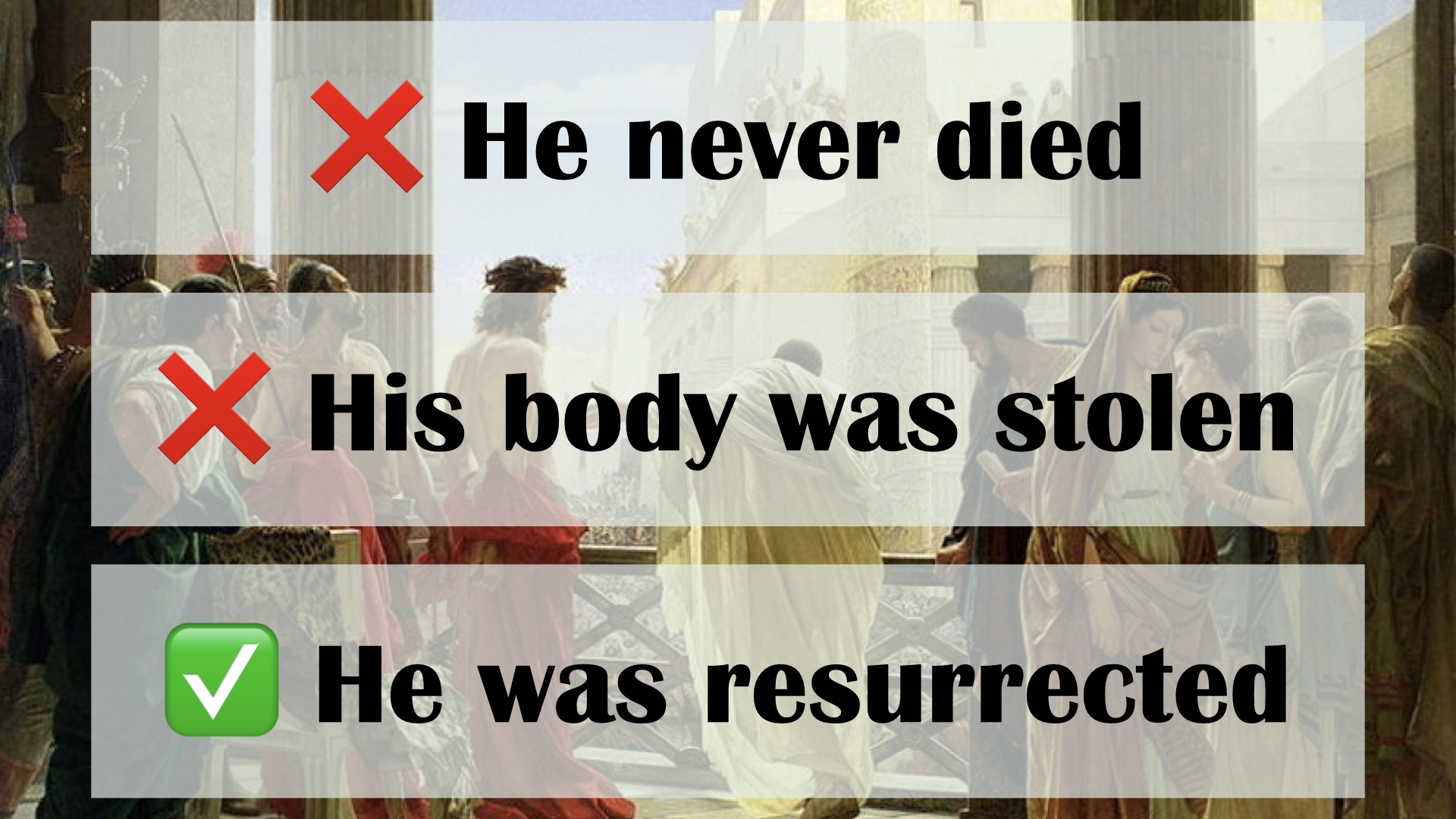
Then when there is no body where the dead body of Jesus is expected, there are only three possibilities:
(1) He never died
Medical experts have concluded that the horrific torture that Jesus endured prior to even being crucified resulted in significant blood loss, and would have put His body in shock. Then the strain on His weakened body during crucifixion would have resulted in His body experiencing either pleural effusion or cardiac effusion, which is attested to by the flow of “blood and water” from Jesus’ dead body when His side was pierced by a Roman spear (John 19:34).
The dead body of Jesus was thoroughly examined by both the Romans who conducted the crucifixion and His friends who prepared His body for burial (Mark 15:43-45; John 19:38-40). And two contemporary historians—Tacitus and Josephus—who were unfriendly to the cause of Christianity both attested to Christ’s death by crucifixion.
(2) His body was stolen
The Sanhedrin was so insistent on Jesus being crucified, they wouldn’t have left the “conspiracy” option open. So they convinced Governor Pontius Pilate to allow them to both seal the tomb and place a group of soldiers outside the tomb to guard it (Matthew 27:62-66). It is highly unlikely that the disciples who fled before the temple guard and who were now locked in a room because they were quaking with fear would somehow gain the courage to undertake a mission to steal Jesus’ body. Nor is it likely that they could have escaped the notice of the highly-trained Roman soldiers guarding the tomb.
(3) He was resurrected
The angels at the empty tomb reminded the women that Jesus had foretold both the manner of His death and the assurance of His resurrection. Jesus described His death in detail multiple times, including such key details as His death would be in Jerusalem, the religious leaders would pronounce a death sentence but the Romans would crucify Him, and that He would be resurrected three days later (Matthew 20:18-19; Luke 18:31-33). In addition, Paul tells us that there were hundreds of eyewitnesses to the resurrected Jesus (1 Corinthians 15:3-8).
Jesus said, “The reason my Father loves Me is that I lay down My life—only to take it up again. No one takes it from Me, but I lay it down of My own accord. I have authority to lay it down and authority to take it up again. This command I received from My Father” (John 10:17-18).
If Jesus foretold this and fulfilled this, we can also trust His other promises. Assurances such as:
He is preparing an eternal home for us and He will come back to take His followers there
That He alone holds the keys to Death and Hades
And that only those who have been cleansed from their sins will be able to enter Heaven
The bold claim that Jesus would be resurrected back to life is adequately backed up by the events on Resurrection Sunday! So now we can say that believing the bold claim of Christ’s resurrection gives us hope for the future and reason to tell others about Him!
There is a man that we meet in just a couple of verses of Scripture. We know that he is a Roman centurion. I gave him an appropriate Roman name of Vitellius. I created a fictional backstory for this centurion, but all of the events are well documented in both biblical history and contemporary history books of the time. I have listed below all of the scripture references that you may want to consult, along with some quotes from notable historians.
What isn’t fictional is the fact that the Cross didn’t happen to Jesus, but He came to make Calvary happen.
Jesus said this about His crucifixion, “And I, when I am lifted up from the earth, will draw all people to Myself” (John 12:32). That’s what happened to the thief, and to the centurion Vitellius, and to me, and to all who have acknowledged that Jesus is the Savior.
Vitellius’ bold claim on the day Jesus was crucified still rings true 2000 years later: “Certainly this was a righteous Man!”
Looking at Jesus who was lifted up on that Cross, we can appreciate the beauty of the 700-year-old prophecy about Him:
He had no beauty or majesty to attract us to Him, nothing in His appearance that we should desire Him. He was despised and rejected by mankind, a man of suffering, and familiar with pain. Like one from whom people hide their faces He was despised, and we held Him in low esteem. Surely He took up our pain and bore our suffering, yet we considered Him punished by God, stricken by Him, and afflicted. But He was pierced for our transgressions, He was crushed for our iniquities; the punishment that brought us peace was on Him, and by His wounds we are healed. (Isaiah 53:2-5)
Which is what we celebrate in Communion still to this day. “And [Jesus] took bread, gave thanks and broke it, and gave it to them, saying, ‘This is My body given for you; do this in remembrance of Me.’ In the same way, after the supper He took the cup, saying, ‘This cup is the new covenant in My blood, which is poured out for you’” (Luke 22:19-20).
The way Christians live today can still lift Jesus up for all to see. Jesus told His followers, “Whoever wants to be My disciple must deny themselves and take up their cross and follow Me. For whoever wants to save their life will lose it, but whoever loses their life for Me will find it” (Matthew 16:24-25).
When we live this way, our lives become the aroma of life to even sin-hardened thieves and war-hardened soldiers.
Check out this video of Vitellius’ personal experience—
Here are some further resources for you to check out:
Historian William Barclay wrote this about the centurions, “The centurions were the backbone of the Roman army. In a Roman legion there were 6,000 men; the legion was divided into sixty centuries, each containing 100 men, and in command of each century there was a centurion. These centurions were the long-service, regular soldiers of the Roman army. They were responsible for the discipline of the regiment, and they were the cement which held the army together. … A centurion was the equivalent of a regimental sergeant-major; and the centurions were the backbone of the Roman army.”
Listen to the podcast of this post by clicking on the player below, and you can also subscribe on Apple, Spotify, or Audible.
When Luke says first that “Jesus grew in wisdom” before he mentions any of the other ways Jesus grew, that is our indication that a healthy mind is at the foundation for every other aspect of health (Luke 2:52). If you’ve missed the mental health keys we’ve already learned, you can review them by clicking here.
It’s been said that lions are tamed with a chair. Specifically, with the legs of the chair. These powerful animals are trying to focus on too many points at one time which keeps them from initiating an attack. So they are not so much “tamed” as they are paralyzed and overwhelmed by trying to concentrate on too many things.
It’s the same with us: If we try to concentrate on every voice speaking to us, we’ll become overwhelmed and paralyzed. “The Bible says this … my Mom says that … my best friend told me to try … my agnostic coworker said I should….” It’s overwhelming and mentally draining! Just like our bodies can become exhausted, so can our minds. Exhausted bodies are susceptible to germs, and so are exhausted minds susceptible to unhealthy ideas.
Consider all of the voices Jesus had to deal with in His last days heading toward Calvary. From about 4 months out, things really began to intensify. He still had the voices of His critics constantly harping on Him, and I’m sure the devil was still looking for his “opportune time” (Luke 4:13), not to mention all of the other voices around Jesus. There are two important principles to keep in mind here:
God can speak truth to us through harsh, unfriendly voices
The devil can lie to us through kind, friendly voices
So we cannot automatically listen to or ignore messages because of who the messenger is.
The friendly voice of Peter told Jesus, “You are the Messiah!” To which Jesus replied, “The Holy Spirit revealed that to you. Now let me remind you that we are heading to Jerusalem where I am going to be crucified.”
The now not-so-friendly voice of Peter then rebuked Jesus, “Never, Lord! This shall never happen to You!” Jesus turned to Peter to say, “Get behind Me, satan! You are a stumbling block to Me; you do not have in mind the concerns of God, but merely human concerns.”
The Father gave Peter, James, and John a glimpse of the glory Jesus would have when He was resurrected from the dead when they saw Him transfigured. During this time Moses and Elijah affirmed that Jesus was headed to Jerusalem to fulfill all that was prophesied about Him. In the aftermath of His transfiguration, Jesus again repeated, “I am going to be crucified and resurrected.”
As Jesus entered Jerusalem on the day we now celebrate as Palm Sunday, people cheered and the religious leaders jeered. To both groups, Jesus once again affirmed His mission, “I am going to be crucified and resurrected.”
No matter what others said or did, Jesus never changed His tune. How did He keep clear about the mission He was on? He simply compared every voice with God’s voice. Jesus never changed His tune because He was in tune with the Father’s voice.
Years ago, I played the tympani in our church orchestra. I learned very quickly that the best way to tune these big kettle drums was to put my face close to the drumhead while I hummed the proper note. Then as I adjusted the tuning pedal, I knew I had the tympani tuned to the right note when what I was humming resonated back to me from the drumhead.
At the Transfiguration, the Father told the disciples to listen to the voice of Jesus. Jesus claimed that He only said and did what the voice of His Father resonated to Him. And Jesus told us that His sheep know and follow His voice in the same way (Luke 9:35; John 12:49-50; John 10:3-5).
The Book of Psalms opens with these words:
Blessed is the one who does not walk in step with the wicked or stand in the way that sinners take or sit in the company of mockers, but whose delight is in the law of the Lord, and who meditates on His law day and night. (Psalm 1:1-2)
The word meditate can be translated as “hum.” When we read and study God’s Word, the Holy Spirit will help us know which voices are in-tune with the Father’s heart and which ones are out-of-tune. You can check out a great example of this from the life of the apostle Paul in Acts 20:22-24; 21:10-15.
So our important mental health reminder is this: To make sure we are listening to the right voices, tune your ear to the voice of the Holy Spirit. Then receive any voice that resonates with that tune, and reject any voice that is out of key.
If you would like to download the graphic of this reminder for your phone, simply leave me a comment with the model of the phone, and I’ll get the right-sized graphic right out to you. If you’ve missed any of the messages in our mental health series, you can find all of them by clicking here.
I have a series of nearly 70 posts on the topic of godly leadership. Here is the latest installment about going all in. Be sure to check out all of my videos on my YouTube channel.
T.M. Moore writes persuasively to Christians to encourage them to build for the future. He wrote, “For most Christians today, the Kingdom which Daniel saw, Jesus proclaimed and brought near, and the Spirit inaugurated on that first Christian Pentecost—that Kingdom is little more than a theological idea, or a distant hope. It is not a daily reality to be sought, seized, shared, and strengthened in every nook and cranny of our Personal Mission Fields. Christians today are trapped in their past or mired in their present, and they have little or no sense of what it means to build for the future so that righteousness, peace, and joy in the Spirit increase wherever they live, move, and have their being.”
And another piece of research from both paleontologists and entomologists points to the Flood described in the Bible as historically viable. Researchers discovered fossilized giant ants in Canada where evolutionists claim they shouldn’t be. The Institute for Creation Research commented, “There is no need to postulate ants trekking across the Arctic to explain the distribution. Nor is there a need to inject short ‘hyperthermal’ episodes to allow passage from one continent to another. The global Flood explains what we observe the best. The warmer pre-Flood conditions and likely higher oxygen levels explain the large size of the ants. And their fossil distribution is best explained by their transport off the highest pre-Flood hills as the waters were receding.”
“If we were to look at Jesus’s death merely as a result of a betrayer’s deceit and the Sanhedrin’s envy and Pilate’s spinelessness and the soldiers’ nails and spear, it might seem very involuntary. And the benefit of salvation that comes to us who believe might be viewed as God’s way of making a virtue out of a necessity. But once you read Luke 9:51, all such thoughts vanish. Jesus was not accidentally entangled in a web of injustice. The saving benefits of His death for sinners were not an afterthought. God planned it all out of infinite love to sinners like us, and He appointed a time.” —John Piper, Love To The Uttermost reading plan on YouVersion
Listen to the audio-only version of this podcast by clicking on the player below, or scroll down to watch the video.
No need to call anyone out, but when I say “difficult peer” at least one person probably comes to mind right away, right? So what’s the solution: ignore them, scream, tear your hair out? Greg and I think there’s a better solution. In this episode, we walk through how we’ve dealt with difficult peers in the past and give actionable advice on how your leadership and coaching can help them improve.
[0:16] We are continuing our series about leading difficult people from wherever you are in your organization.
[1:24] Our goal as leaders should be to figure out why a particular peer is so difficult to work with.
[2:00] A warning about the least productive thing you can do when you are frustrated with a coworker.
[3:44] A great example from Jesus for those striving to be servant leaders.
[5:17] Some questions to ask ourselves to determine if our difficult teammates are coachable.
[7:31] We need to learn the best ways to communicate with our teammates.
[9:18] Where does mistrust play a role in these difficult situations?
[13:13] Leaders at every level need to learn the art of diplomacy.
[15:02] Where does defeatism come into play?
[17:03] A shepherd’s heart must be cultivated for us to lead well—especially leading difficult peers.
[18:45] “When you’re ready” is a great posture for a leader, but it must be lived out.
Check out this episode and subscribe on YouTube so you can watch all of the upcoming episodes. You can also listen to our podcast on Spotify and Apple.



 Accepting a new position is a very exciting experience! Whether it’s a promotion in your current organization or an opportunity elsewhere, it’s very tempting to want to immediately throw your full attention into the next project. In this episode, Greg and I discuss the necessity of maintaining a balance between that excitement and recognizing that the people on your team now still need your leadership. This might create more work for you in the short term, but the long-term benefits of transitioning well will be huge for you!









 Craig T. Owens