8 Quotes From “Jesus Always”

jesus-alwaysSarah Young does a masterful job in speaking the words of the Bible to us through the first-person voice of Jesus Christ in her book Jesus Always. Be sure to check out my review by clicking here. Below are a few quotes from this keepsake book.

“Train your mind to think great thoughts of Me! Many Christians are defeated by focusing mainly on less important things—the news, the weather, the economy, loved ones’ problems, their own problems, and so on. Granted, in this world you will have trouble, but don’t let troubles become your primary focus. Remind yourself that I am with you and I have overcome the world.”

“Be careful not to attach your sense of worth to your performance. When you’re dissatisfied with something you have done, talk with Me about it. … Your imperfect performance reminds you that you are human. It humbles you and helps you identify with flawed humanity. Since pride is such a deadly sin—the one that ultimately led to satan’s expulsion from heaven—being humbled is really a blessing. So thank Me for the circumstances that have diminished your pride, and draw near to Me.” 

“Praying not only blesses you but provides an avenue for serving Me. Rejoice that you can collaborate with Me through prayer as I establish My kingdom on earth.”

“When the task before you looks daunting, refuse to be intimidated. Discipline your thinking to view the challenge as a privilege rather than a burdensome duty. Make the effort to replace your ‘I have to’ mentality with an ‘I get to’ approach. … Remember that My Spirit who lives in you is the Helper; ask Him to help you when you’re perplexed.”

“Do not despise suffering. It reminds you that you are on a pilgrimage to a far better place. … While you continue your journey through this world, be thankful for the comforts and pleasures I bless you with. And reach out to others who are suffering. I comfort you in all your troubles so that you can comfort others. Offering help to hurting people gives meaning to your suffering—and Glory to Me!”

“Your natural tendency when you’re feeling anxious is to focus on yourself and your problems. The more you do this, the more you forget about Me and all the help I can supply. This worldly focus only increases your anxiety! Let the discomfort you feel at such times alert you to your neglect of Me. Whisper My Name, and invite Me into your difficulties.”

“Today is the time to delight in the blessings I have provided. Since you don’t know what tomorrow will bring, make the most of what you have today: family, friends, talents, possessions. And look for opportunities to be a blessing to others.”

“Thank Me frequently; be on the lookout for My blessings, searching for them as for hidden treasure. Praise Me not only in prayer and song but in your words to other people. Tell them about My marvelous deeds; declare how great I am!”

I will be sharing more quotes from Jesus Always in the near future. If you want to be notified as soon as these quotes are posted, please subscribe by entering your email address in the right column.

I’ve also been sharing quotes from this book (and lots of other high-quality authors) on both Twitter and Tumblr. If you’re not following me there, please do so.

Thursdays With Oswald—Making Saints

Oswald ChambersThis is a weekly series with things I’m reading and pondering from Oswald Chambers. You can read the original seed thought here, or type “Thursdays With Oswald” in the search box to read more entries.

Making Saints 

     It is not sufficient for a Christian to walk in the light of his conscience; he must walk in a sterner light, in the Light of the Lord. … 

     I am not judged by the light I have, but by the light I have refused to accept. … This is the condemnation, that the Light, Jesus Christ, has come into the world, and I preferred darkness, i.e., my own point of view. The characteristic of a man who begins to walk in the light is that he drags himself into the light all the time. He does not make excuses for things done in the dark, he brings everything to the light, and says, “This is to be condemned; this does not belong to Jesus Christ,” and so keeps in the light. … 

     The New Testament view of a saint is a more rugged type. You and I are a mixture of dust and Deity, and God takes that sordid human stuff and turns it into a saint by Regeneration. A saint does not mean a man who has not enough sin to be bad, but a man who has received from Jesus Christ a new heredity that turns him into another man. … 

     Conscience and character in the saint, then, means the disposition of Jesus Christ persistently manifested.

From The Shadow Of An Agony 

In order to become the saints God intends for us to be, Oswald Chambers says one big thing is required of Christians: Constantly bringing our thoughts and actions into the Light of Jesus.

I think this is what Paul means when he tells us to take captive every thought to make it obedient to Christ (2 Corinthians 10:5). And this is certainly what David invited when he prayed, Search me, O God, and know my heart; test me and know my anxious thoughts. See if there is any offensive way in me, and lead me in the way everlasting (Psalm 139:23-24).

I pray we will always be bringing our thoughts and actions into the Light, and never preferring the darkness of our own point of view!

T.M. Moore On Considering Jesus

T.M. Moore“We cannot follow what we do not know. And if we do not know Jesus, if our vision and understanding of Him are vague or merely general, following Him, in any sense, will be an act of self-deception. …

“The writer of Hebrews understood this. Twice in his epistle he instructs us to ‘consider Jesus.’ We must consider Jesus if we have any hope of persisting in the faith, no matter the struggle or threat that comes our way (Hebrews 3:1). And we must consider Jesus if we are to run our own particular race as fully and swiftly as possible (Hebrews 12:3). Following Jesus, it seems, means considering Him carefully. The writer uses two different words which we translate by the term consider.

“The first, in Hebrews 3:1, is the same word Jesus used to instruct us to consider the lilies of the field. It seems to have an aesthetic sense to it, implying wonder, admiration, mystery, and awe. To consider Jesus in this way is to wonder at His beauty, majesty, mystery, and power, and to delight in meditating on Him and lingering in His presence.

“The second use of consider, in Hebrews 12:3, encourages a more analytical, logical, and even theological consideration of Jesus Christ. We must study Jesus, think about all the implications of His life, death, and resurrection, and apply our minds to taking every thought captive for obedience to Him (2 Corinthians 10:3-5).” —T.M. Moore

Thursdays With Oswald—The Uncommon Attitude Of The Bible

Oswald ChambersThis is a weekly series with things I’m reading and pondering from Oswald Chambers. You can read the original seed thought here, or type “Thursdays With Oswald” in the search box to read more entries.

The Uncommon Attitude Of The Bible

     It is not necessary for a man to understand things before he can be a Christian. … Theology is the science of religion, an intellectual attempt to systematize the consciousness of God. Intellect systematizes things to a man’s mind, but we do not reach reality through intellect. Theology comes second, not first, and ought always to be open to dispute. … 

     The attitude of the Bible to the human race is not a common-sense one. The Christian aspect deals with the a specimen of a human race which is a magnificent ruin of what it was designed to be. Supposing the view of the Bible to be right, to whom it is it ‘up to’ to right the wrong? The Creator. Has He done it? He has, and He has done it absolutely single-handed. The tremendous revelation of Christianity is not the Fatherhood of God, but the Babyhood of God—God became the weakest thing in His own creation, and in flesh and blood He levered it back to where it was intended to be. No one helped Him; it was done absolutely by God manifest in human flesh. God has undertaken not only to repair the damage, but in Jesus Christ the human race is put in a better condition than when it was originally designed. … 

     The highest standard God has is Himself, and it is up to God to make a man as good as He is Himself; and it is up to me to let Him do it.

From The Shadow Of An Agony

It’s amazing how much we argue over theology! Especially because theology never saved a soul. Theology simply is a science that organizes our thoughts about God.

But God confounds those who merely want to analyze and systematize Him. I love Chambers’ thought: “The tremendous revelation of Christianity is not the Fatherhood of God, but the Babyhood of God.” Who would have ever conceived such a harebrained idea?!

Theology has value, but it comes second. First comes faith. Never let arguments over theology sway you from your childlike faith in a God Who loved you enough to single-handedly lift you back up to Him!

12 Quotes From “Think On These Things”

think-on-these-thingsJohn Maxwell’s books always inspire me to think differently. In Think On These Things—the first book Maxwell wrote—we get to see the seed thoughts that would appear in fuller form in his later books. Be sure to check out my review of Think On These Things by clicking here, and then enjoy a dozen John Maxwell quotes.

“Your life today is a result of your thinking yesterday. Your life tomorrow will be determined by what you think today.”

“The truth of a man is known not by how he acts when he is in control but how he reacts when things are beyond his control.”

“Your willingness to learn and adjust positively from mistakes and shortcomings will largely determine how far you will travel the road to success.”

“A thankful heart is one that has had time to count blessings.”

“Our spiritual, physical, and emotional condition will greatly determine how we react to situations. The better we feel, the more capable we will be to evaluate difficult situations and make important decisions.”

“If you haven’t made any mistakes lately, I question if you are trying hard enough. … When you make a mistake, you can resolve never to make another one. But that is impossible. You can decide that mistakes are too costly and become fearful of them, that that fear will keep you from fulfilling your potential. You can constantly think about your mistakes and live with regret, but that is self-torture. Finally, you can learn from your mistakes and become a better person, and that is progress.”

“Success is never instantaneous. It is never an accident. Success is continuous. It takes growth and development. It is achieving one thing and using that as a stepping-stone to rise higher up the mountain of accomplishment.”

“No problem will leave you the same person after it has gone. Problems are the great dividers between success and failure. How you handle them will determine on which side you will live.”

“An experience is not a failure if it prods us to keep on trying. An experience is not a failure if through it we discover how we failed and put that knowledge to good use. An experience is not a failure if through it we discover our own true selves. An experience is not a failure if through it we become better-disciplined individuals.”

“Problems are reminders. They remind us that we need God’s help to handle the upheavals of life.”

“Experience is a hard teacher. She gives the test first and the lesson afterward. Experience is yesterday’s answer to today’s problems.”

“It is vitally important to realize that either the situations around us control our lives or we control them.”

Think On These Things (book review)

think-on-these-thingsWhat we think about all day long determines not only the kind of day we are going to have, but the kind of life we are going to live, as well as the legacy that we will leave behind. It would make sense, then, to make sure to think the right thoughts. A great book to help you develop right thinking patterns is Think On These Things by John Maxwell.

I have read numerous John Maxwell books, but only recently have I read his very first book. Unlike many of his later books, Think On These Things doesn’t have as many quotes from other authors and notable characters of history. In this book we get John Maxwell’s original thoughts. And they’re very good!

The chapters are shorter and easy to digest, but they are packed with easy-to-apply principles to help you change your thought patterns. Having read Dr. Maxwell’s books which were published in subsequent years, it’s easy to see that he’s been practicing what he’s been preaching!

If you feel your personal growth has been in a rut, or if you’re ready to launch out into bigger things, the thought-seeds in this book may be just the thing the doctor ordered!

The Rewards For Getting Along With Difficult People

How To Get Along With OthersHere’s a shocking statement—Difficult people are difficult to get along with. I know, I probably just blew your mind with that one, but sometimes it’s important to state the obvious.

Christians should be the best at getting along with others. First of all, because they have the Holy Spirit to help them, and, second, because the world is watching to see if having a relationship with Jesus really does make a difference.

We’ve already learned that in order to change our behavior toward difficult people, we can’t change our behavior (check out my post on that topic here). Instead, we need to change our thoughts first. One thought to change is about ourselves, and another thought to change is the fact that Jesus promised rewards for those who loved difficult people—

If you love those who love you, what credit is that to you? Even sinners love those who love them. And if you do good to those who are good to you, what credit is that to you? Even sinners do that. And if you lend to those from whom you expect repayment, what credit is that to you? Even sinners lend to sinners, expecting to be repaid in full. But love your enemies, do good to them, and lend to them without expecting to get anything back. Then your reward will be great, and you will be children of the Most High, because he is kind to the ungrateful and wicked. (Luke 6:32-35)

One way to love others is by learning to “speak their language.” Most of us communicate with four different accents: Doer, People, Planner, Vision.

You can watch the video where I explain these styles in more detail, but you can learn their accent by listening for…

(1) How they handle stressful situations:

  • Doer—get hyper-focused
  • Planner—withdraw to plan
  • People—call a meeting
  • Vision—take time to daydream

(2) How they listen to others:

  • Doer—take short bullet points and then quick action
  • Planner—take detailed notes, and ask lots of detailed questions
  • People—make good eye contact, take very little notes, and then reiterate what was said
  • Vision—doodle, and express “ping pong ball” thoughts

(3) How they speak about folks with other “accents”:

  • Doer—this is taking too long; nothing ever gets done; they’re daydreamers
  • Planner—they jump the gun; they’re swayed by emotions; they’re unpredictable
  • People—why don’t they want to meet; they’re too aggressive; they’re too robotic
  • Vision—they don’t see the big picture; they’re too rigid; they’re too emotional

You CAN get along better with everyone. Romans 12:18 tells us that peaceful living with others depends on you and me. Let’s do this well so that Jesus is glorified!

Don’t Try To Change Your Bad Behavior

Thoughts to beahviorsAs I wrote previously, I believe Christians should be the best at getting along with others. First of all, Christians have been empowered by the Holy Spirit with the skills necessary to live at peace with everyone, IF we will only allow the Spirit to do the necessary work in us. And second, the way Christians treat others goes a long way toward either attracting or repelling others from a relationship with Jesus.

But here’s an important thing: If you don’t get along well with others now, don’t try to change your behavior!

Stephen Covey wrote, “To try to change outward behaviors does very little good in the long run if I fail to examine the basic paradigms from which those attitudes and behaviors flow.”

You see, behavior is the fruit. If we want to change the fruit, we need to back up a few steps.

The Apostle Paul used the life of Jesus as an example for Christians on how we can get along with others. But notice this: most of what Paul discusses is the “inside stuff.”

The progression goes like this (see Philippians 2:1-13)—

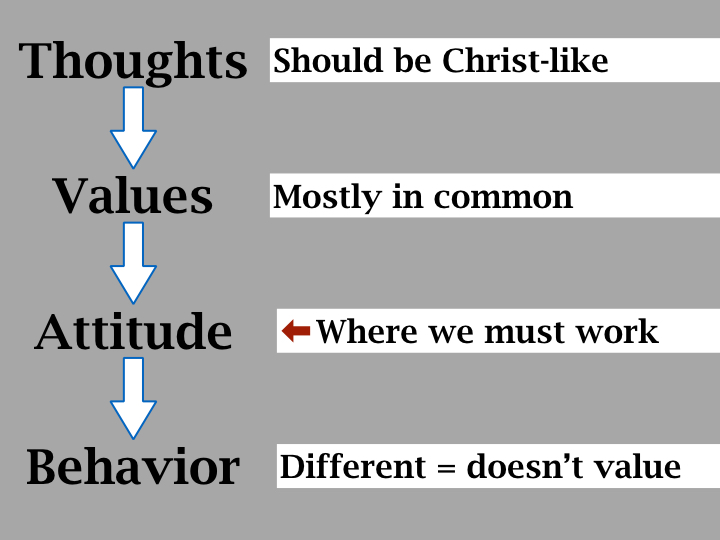
Thoughts → Values → Attitudes → Behaviors

(1) Thoughts—These need to be humble thoughts about God’s love toward us (v. 1).

(2) Values—Paul tells us to be “one in spirit and purpose” with others (v. 2). The definition of the Greek words here mean valuing the well-being of everyone. Paul then explains how our humility can lead to these win-win relationships (vv. 3, 4).

(3) Attitudes—“Your attitude should be the same as Christ Jesus” (v. 5). Jesus showed us what it was to have an attitude related toward obedience to God’s will.

(4) Behavior—If our thoughts, values and attitudes are rightly aligned to God, then our behavior will naturally be Christ-like as well. We see the example of Jesus in verses 6-8, and God’s reward for that behavior in verses 9-11. Then Paul calls on Christians to follow that pattern in our own lives (vv. 12, 13).

Most decent, reasonably-thinking human beings share the same values. Harry Truman said, “When we understand the other fellow’s viewpoint—understand what he is trying to do—nine times out of ten he is trying to do right.”

The problem is this: When the other person behaves differently from me, my natural tendency is to assume he doesn’t value what I value. In other words, I’m judging his value system on the way I normally behave.

The break-down is in my attitude. That’s the area I need to address. That’s the attribute of Jesus that Paul told us to copy.

So if I want to get along better with others, I shouldn’t try to change my behavior, but my attitude. My prayer should be: “I want this same attitude to be in me which was also in Christ Jesus. He served God and others, so I too want to follow His example of obedience, and I want to demonstrate my appreciation for all that Jesus has done for me by working hard to better get along with others. Help me change my attitude!”

Check out this video of the full message…

I hope you can join us next Sunday as we continue learning how to get along with others. Please join us in person or on Periscope.

Confession: I Struggle With Being An Atheist

ITLWYou see, I love my day to be highly organized. I like to get to all my meetings on time, and then have them run smoothly and efficiently. I like to setup my To Do list, and then methodically check off each item as I go through my day. I like to be in charge of my day.

I am an atheist.

I’m the one calling the shots. I set my agenda. I determine my day. I decide who to see and what project to accept.

There was a guy that Jesus talked about who did the exact same thing. This guy thought to himself and talked to himself all about his plans. Seriously, in just three verses he says me/I/my a dozen times (Luke 12:17-19)!

But God said, “You fool!” The word for fool means without mind. He didn’t mind his mind. He thought the thoughts he wanted to think, without ever consulting anyone else. Not even God.

Jesus made prayer a priority every day (Mark 1:35). What do you think He prayed? Do you think He said, “Here’s what I’m going to do today, and I want You to bless it, Father”? No way!

When Jesus taught us to pray He said, Your kingdom come, Your will be done” (Matthew 6:9-13). Not only did Jesus pray this way, He lived this way too. He didn’t do a single thing unless His Father directed Him to do it (John 6:38), and He didn’t say a single word unless His Father directed Him to say it (John 12:49).

The problem is not going into my prayer closet to meet with God in the morning, the problem is thinking I can leave God in the closet as I go about my day! That is atheism!

The Apostle James gave us this sound counsel: Instead of making my plans all on my own, I should say, “If the Lord wills, this is what I will do today” (James 4:13-17). And wise King Solomon said I shouldn’t lean on my own thoughts when planning my days, but lean onto God, and then watch to see how He will direct my life in the right way (Proverbs 3:5-6).

I’ve begun writing I.T.L.W. on the top of my daily calendar. It’s my reminder to say, “If The Lord Wills” this is what I will do today. And if something else comes up, I quickly acknowledge that God is directing my path where He needs me to go.

Your Kingdom come means my kingdom has to go. Your will be done means my agenda takes a distant second.

If you’re feeling stressed about your schedule, that should be your reminder to pray: “God, what do you want to have done here.” Silence the atheistic thoughts that sound like, “I have to get my list done.” Stop and pray right there on the spot.

Here’s the full video of my message on this topic—

We will be continuing our series called Practical Prayer this Sunday. If you don’t have a home church in Cedar Springs, please come be our guest. Or you can tune into our live broadcast via Periscope.

John Maxwell On Abundance

Intentional LivingJohn Maxwell’s most recent book Intentional Living is chockfull of thought-provoking, life-changing lessons. Here’s what he wrote about changing our outlook from scarcity to abundance.

“Scarcity thinking has nothing to give. It is preoccupied with receiving. Scarcity thinking is all about me. It says, ‘There’s not enough to go around. I had better get something for myself and hold onto it with all I have.’ … People who live in the world of abundance think differently. They know there’s always more. … Abundance thinking is the mindset of people of significance, and it has nothing to do with how much they have. … Anticipation is a key that unlocks the doors to abundance thinking. ‘Doors?’ you maybe asking. ‘Don’t you mean door?’ No. Expecting there to be only one door is scarcity thinking. … Finding and going through one door is an event. Going through many doors is a lifestyle. That requires an abundance mindset. … Sadly, too many people have a scarcity mindset and lack of positive anticipation. As a result, they never open the first door. Unopened doors reinforce scarcity thinking and scarcity living. … Keep searching for doors and opening them. And remember that with each open door, your anticipation will increase and so will abundance. … No one experiences abundance while anticipating scarcity. So why not try of abundance?”

I have posted other quotes from Dr. Maxwell in Intentional Living here and here.

John Maxwell also shares a lot of quotes from other wise people, and I posted a few of my favorite here.

You can also check out my review of Intentional Living by clicking here.