The Throne Of Shalom

Listen to the podcast of this post by clicking on the player below, and you can also subscribe on AppleSpotify, or Audible. 

The main point in Hebrew literature is usually found in the middle. In Psalm 122 that would be verse 5 where we see the keyword in this verse is thrones—“thrones for judgment” and “thrones of the house of David.” Before this, we have the call to go up to Jerusalem (the City of Peace) in the first four verses, and after this, we have overwhelming, saturating peace in the last four verses.

But I wonder: How do thrones—especially a throne of judgment—bring about peace? 

Remember that these are songs of ascent: we are called upward. I think “up” implicitly appears in verse 1—“I rejoiced with those who said to me, ‘Let us go UP to the house of the Lord,’—and “up” explicitly appears in verse 4—“That is where the tribes go UP, the tribes of the Lord, to praise the name of the Lord.” 

There is clearly a longing to go up to meet with God, but I also detect a note of uncertainty. Let me show you what I see. First of all, verse 3 in the New Living Translation says about Jerusalem that “its seamless walls cannot be breached.” And yet the walls were breached in 586 BC when Jerusalem fell to the Babylonians. So anyone singing this song of ascent after the time of exile would have known that the walls weren’t as secure as David hoped they would be. 

Second, verse 4 in the Contemporary English Version says that “every tribe of the Lord obeys Him.” And yet it was the disobedience of every tribe of the Lord that led to their defeat and then their 70-year exile. So, again, anyone singing this song of ascent after the time of exile would know about the punishment for disobedience. 

In an earlier Psalm, David asked God who could go up to the Holy City, and then he answered his own question like this—

The one whose walk is blameless, who does what is righteous, who speaks the truth from their heart; whose tongue utters no slander, who does no wrong to a neighbor, and casts no slur on others; who despises a vile person but honors those who fear the Lord; who keeps an oath even when it hurts, and does not change their mind; who lends money to the poor without interest; who does not accept a bribe against the innocent. (Psalm 15:1-5) 

That description also sounds a bit unachievable to me, because who has ever fulfilled all of the items on that list perfectly? 

So we get to verse 5 and read about the thrones. The word “throne” means the seat of honor, authority, and power. It represents the place where the final and unchallengeable word is spoken. There is a final day of judgment before God’s throne, which John records in Revelation 20:11-15. 

And yet, that day of judgment is not here yet. Jesus quoted the prophecy from Isaiah about Himself in His first sermon, but He purposely left off the last phrase about the day of judgment. He, instead, ended with the phrase where He had come to “proclaim the year of the Lord’s favor” (Isaiah 61:1-2; Luke 4:17-21). We see this thought again in John’s Gospel—

For God so loved the world that He gave His one and only Son, that whoever believes in Him shall not perish but have eternal life. For God did not send His Son into the world to condemn the world, but to save the world through Him. (John 3:16-17)

The reason why it’s so important that the “the throne of the house of David” is in the middle of Psalm 122 is because Jesus is the fulfillment of that—He is the final and eternal King to come from David’s line (see 2 Samuel 7:8-18; Matthew 1:1; Acts 2:25-36; Revelation 22:16)! 

If we try to earn our own way into the Eternal Jerusalem, we will find that the walls can be breached, our obedience is not consistent, and that we are unable to keep that full list in Psalm 15. As a result, we face a throne of judgment. 

But when we place our faith in what Jesus did for us on the Cross, where He paid the price for our sin, took away our unrighteousness, and gave us His righteousness in its place, then we will stand before the throne of shalom. 

In the second half of Psalm 122, the words we read are peace, secure, peace, security, brothers and friends, peace, prosperity. That word “peace” is the Hebrew word shalom, which means nothing lost, nothing missing. Jesus wants us to be in the Eternal Jerusalem with Him for ever and ever. 

Christ’s desire is that none should be separated from Him (see 2 Peter 3:9-14), so we could also say that shalom means no one lost, no one missing. We should want everyone—every tribe, nation, and people—to be with us in the Eternal Jerusalem forever!

I rejoiced with those who said to me, “Let us go UP to the house of Lord.” Let’s not go alone. Let’s bring as many people with us as we can to enjoy the eternal shalom of God’s Holy City! 

If you’ve missed any of the other messages in our look at the Psalms of Ascent, you can find them all here. 

►► Would you please prayerfully consider supporting this ministry? My Patreon supporters get behind-the-scenes access to exclusive materials. ◀︎◀︎

Jesus In The Seven Feasts

Listen to the podcast of this post by clicking on the player below, and you can also subscribe on AppleSpotify, or Audible. 

Douglas Carmel from Rock Of Israel ministries shared an amazing overview of the seven Jewish feasts that are listed in the Book of Leviticus, and how Jesus is the fulfillment of all of these feasts. Doug was born into a Jewish family and became a Christian in his late teens, so he has firsthand knowledge of both the traditional celebrations and the Christian understanding of these feasts. 

One of the things I appreciated was Doug’s explanation that the feasts were merely a shadow of the reality—Jesus is the Reality! 

Please check out the message he shared at Calvary Assembly of God. I encourage you to visit his website to get more information on all of the ministries Rock Of Israel. 

Passover—celebrated on the 14th day of the first month 

  • Leviticus 23:4-5
  • Matthew 26:17-29; Mark 14:12-26; Luke 22:7-20
  • Jesus was crucified on the same day that the Passover lamb was being sacrificed 

Unleavened Bread—celebrated on the 15th day of the first month

  • Leviticus 23:6
  • 1 Corinthians 5:6-9

Firstfruits—celebrated on the 16th day of the first month (or the day after the Sabbath) 

  • Leviticus 23:9-14 
  • 1 Corinthians 15:12-26 

Seven Weeks—celebrated 50 days after Firstfruits 

  • Leviticus 23:15-21 
  • Also known as Pentecost 
  • Acts 2:1-41

Doug called our attention to the calendar on which these feasts appeared. Passover, Unleavened Bread, Firstfruits, and Seven Weeks all happen in the spring. All four of these feasts have already been fulfilled in the life, death, and resurrection of Jesus. 

There are no feasts in the summer months, as these are the months of field work (Leviticus 23:22). This is where we are now, which is why Jesus told us, “Ask the Lord of the harvest, therefore, to send out workers into His harvest field” (Matthew 9:38). This is the time for us to tell others about Jesus the Messiah! 

The final three feasts appear in the autumn—Trumpets, Atonement, and Tabernacles. These are feasts that are still to be fulfilled at Christ’s Second Advent. 

Trumpets—celebrated on the 1st day of the seventh month

  • Leviticus 23:23-25 
  • This is also known as Rosh Hashanah when the shofar is blown 
  • 1 Corinthians 15:51-53; 1 Thessalonians 4:15-18

Atonement—celebrated on the 10th day of the seventh month

  • Leviticus 23:26-32 
  • This is also known as Yom Kippur—the one day of the year the high priest goes into the Holy of Holies 
  • Romans 11:25-32; Matthew 23:39 

Tabernacles—celebrated on the 15th through the 21st days of the seventh month

Jesus said of Himself, “I am the Alpha and the Omega, who is, and who was, and who is to come, the Almighty” (Revelation 1:8). Jesus is THE Reality and THE Fulfillment of all of these celebrations! 

(Check out all of the Scripture verses I listed above by clicking here.) 

►► Would you please prayerfully consider supporting this ministry? My Patreon supporters get behind-the-scenes access to exclusive materials. ◀︎◀︎

Talk Back To Your Thoughts

Listen to the podcast of this post by clicking on the player below, and you can also subscribe on AppleSpotify, or Audible. 

Do you talk to yourself? 

Of course you do. We all talk to ourselves: it’s called “thinking.” 

But do you talk out loud when you talk to yourself? 

An unhealthy habit for most of us is that our thoughts are only a one-way monologue. That is, we are listening to our thoughts but we are not talking back to them. As a result, everything negative we’ve heard from our enemies is bouncing around in our heads. The more we hear it, the more likely we are to believe it. 

In Psalm 42, we hear from a psalmist who is longing to experience God’s presence but at the same time there’s a nagging thought implanted by skeptics: “Where is your God?” The psalmist reminisces how it used to be, which means there is a nagging doubt in his mind that it may never be like that again. 

But finally, the psalmist does the mentally healthy thing: he talks back to his thoughts. He asks himself a question and then he gives a new response—a response that is hope-filled instead of doubt-plagued. 

Why are you downcast, O my soul? Why so disturbed within me? Put your hope in God, for I will yet praise Him, my Savior and my God. My soul is downcast within me; therefore I will remember You. (Psalm 42:5-6) 

When the nagging thought of “Where is your God?” comes up again just a couple of verses later, he doesn’t linger or brood over this doubt-inducing thought but immediately talks back to that negative voice with hope-filled words (vv. 10-11). 

The devil has a singular agenda: to separate you from God. He does this through lies and doubts. Jesus told us the devil’s native language is lies: “He was a murderer from the beginning, not holding to the truth, for there is no truth in him. When he lies, he speaks his native language, for he is a liar and the father of lies” (John 8:44). 

The Bible tells us that the devil can also put thoughts and desires in our hearts, but they are all lies (see John 13:2; Acts 5:3). 

We cannot let these lies go unchallenged, so here’s our battle strategy: 

For the weapons of our warfare are not physical weapons of flesh and blood, but they are mighty before God for the overthrow and destruction of strongholds, inasmuch as we refute arguments and theories and reasonings and every proud and lofty thing that sets itself up against the true knowledge of God; and we lead every thought and purpose away captive into the obedience of Christ—the Messiah, the Anointed One. (2 Corinthians 10:4-5 AMP) 

There are five questions we need to use to talk to ourselves about the thoughts we hear: 

  1. Is this thought unbiblical? (2 Timothy 3:16-17)
  2. Does this thought rob God of the glory due His name (Psalm 29:1-11)? 
  3. Does this thought stifle my love for God or others (Mark 12:28-31)? 
  4. If I linger on this thought, does it rob me of peace (Isaiah 26:3-4)? 
  5. Does this thought make me apathetic toward sin (Genesis 4:7)? 

(Check out all of the above verses by clicking here.)

If we answer “yes” to any of these questions, we must capture that thought and put it to death, which requires the sword of the Spirit, which is the Word of God (Ephesians 6:17). Because of what Jesus has done for us on the Cross, every promise in God’s Word is “yes and amen” in Jesus, and therefore is an invincible weapon against lying thoughts (2 Corinthians 1:20). 

Here’s how we use those promises: 

For the accuser of our brothers and sisters, who accuses them before our God day and night, has been hurled down. They triumphed over him by the blood of the Lamb AND by the word of their testimony. (Revelation 12:10-11)

Listen to your thoughts, but don’t listen too long before you start to challenge them with these five questions. Then demolish those lies—triumph over them by the blood of the Lamb and your spoken testimony. Speak the truth out loud for all to hear. 

This is part 4 in our series on a Christian’s mental health. If you’ve missed any of the other messages I’ve shared, you can find them all by clicking here. 

►► Would you please prayerfully consider supporting this ministry? My Patreon supporters get behind-the-scenes access to exclusive materials. ◀︎◀︎

Reason To Hope And To Proclaim

Listen to the podcast of this post by clicking on the player below, and you can also subscribe on AppleSpotify, or Audible. 

On Resurrection Sunday, Christians celebrate an event that is the foundational truth for all of the Bible and for the Christian faith which springs from the Scriptures: The resurrection of Jesus. 

If Jesus wasn’t resurrected, this is a terrible, cruel lie we are perpetuating. If Jesus was resurrected, we have been given the key to eternal life. No one has ever made the bold claims that Jesus made about His own death and resurrection and then backed them up! 

On the Sunday morning after Jesus was crucified, some women arrived at His tomb to finish preparing His body for burial, but Luke records something fascinating: “They did not find the body of the Lord Jesus” (Luke 24:1-8). 

Think about this in a modern-day setting. If you were at the bedside of your loved one when they took their last breath, if you heard the doctor pronounce them dead, if you were at the funeral and saw their body in a casket, and if you saw that casket closed, sealed, and lowered into the ground, you would have every reason to find a body if that casket were re-opened. 

These women were on Golgotha when Jesus died, they saw the Roman soldiers verify His death, they witnessed Joseph and Nicodemus wrap His body in linen strips, and they saw His body placed in a sealed tomb. 

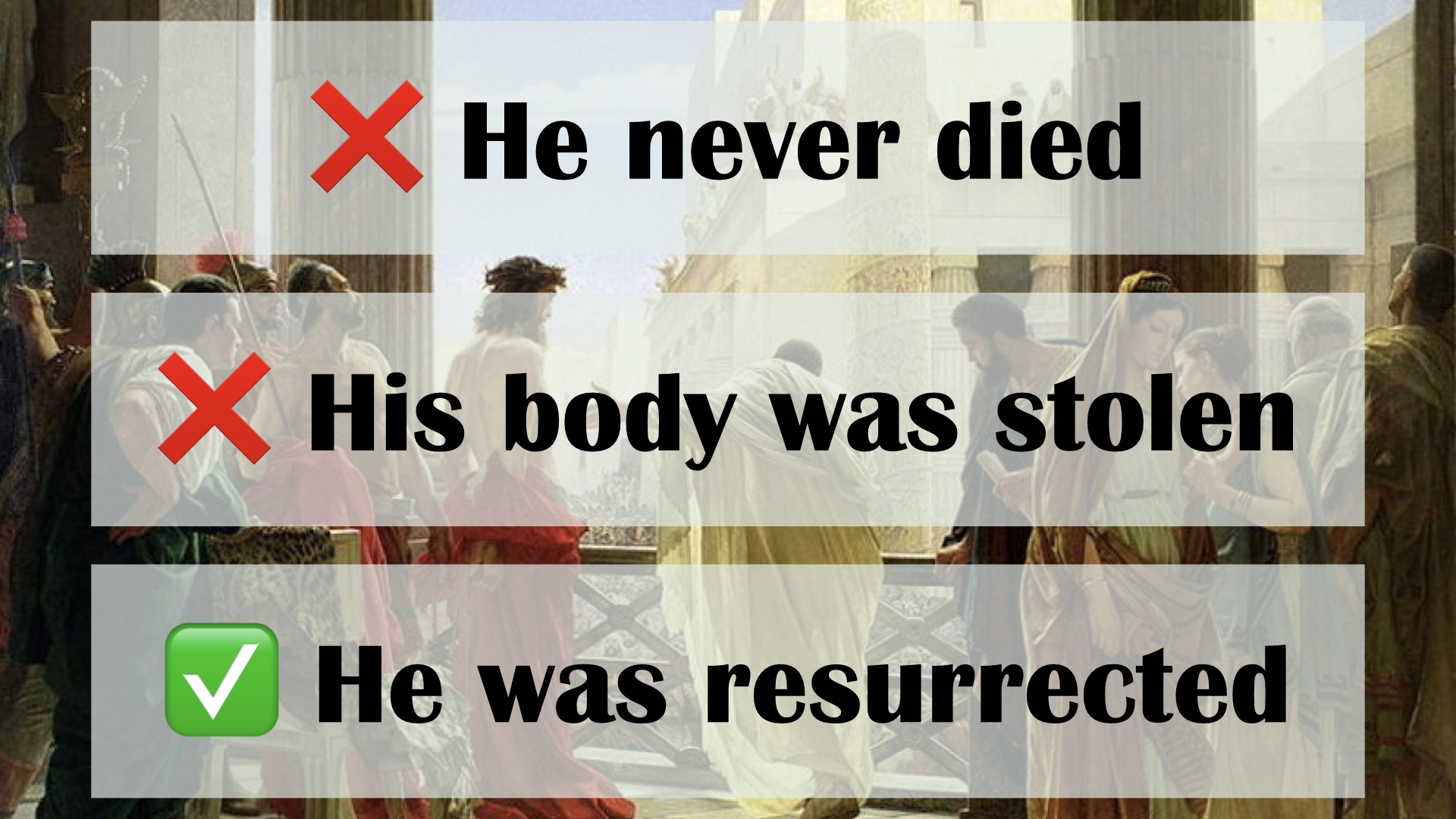
Then when there is no body where the dead body of Jesus is expected, there are only three possibilities: 

(1) He never died

Medical experts have concluded that the horrific torture that Jesus endured prior to even being crucified resulted in significant blood loss, and would have put His body in shock. Then the strain on His weakened body during crucifixion would have resulted in His body experiencing either pleural effusion or cardiac effusion, which is attested to by the flow of “blood and water” from Jesus’ dead body when His side was pierced by a Roman spear (John 19:34). 

The dead body of Jesus was thoroughly examined by both the Romans who conducted the crucifixion and His friends who prepared His body for burial (Mark 15:43-45; John 19:38-40). And two contemporary historians—Tacitus and Josephus—who were unfriendly to the cause of Christianity both attested to Christ’s death by crucifixion. 

(2) His body was stolen

The Sanhedrin was so insistent on Jesus being crucified, they wouldn’t have left the “conspiracy” option open. So they convinced Governor Pontius Pilate to allow them to both seal the tomb and place a group of soldiers outside the tomb to guard it (Matthew 27:62-66). It is highly unlikely that the disciples who fled before the temple guard and who were now locked in a room because they were quaking with fear would somehow gain the courage to undertake a mission to steal Jesus’ body. Nor is it likely that they could have escaped the notice of the highly-trained Roman soldiers guarding the tomb. 

(3) He was resurrected 

The angels at the empty tomb reminded the women that Jesus had foretold both the manner of His death and the assurance of His resurrection. Jesus described His death in detail multiple times, including such key details as His death would be in Jerusalem, the religious leaders would pronounce a death sentence but the Romans would crucify Him, and that He would be resurrected three days later (Matthew 20:18-19; Luke 18:31-33). In addition, Paul tells us that there were hundreds of eyewitnesses to the resurrected Jesus (1 Corinthians 15:3-8). 

Jesus said, “The reason my Father loves Me is that I lay down My life—only to take it up again. No one takes it from Me, but I lay it down of My own accord. I have authority to lay it down and authority to take it up again. This command I received from My Father” (John 10:17-18). 

If Jesus foretold this and fulfilled this, we can also trust His other promises. Assurances such as:

  • He is preparing an eternal home for us and He will come back to take His followers there 
  • That He alone holds the keys to Death and Hades
  • And that only those who have been cleansed from their sins will be able to enter Heaven

(see John 14:1-3; Revelation 1:18, 22:12-14)

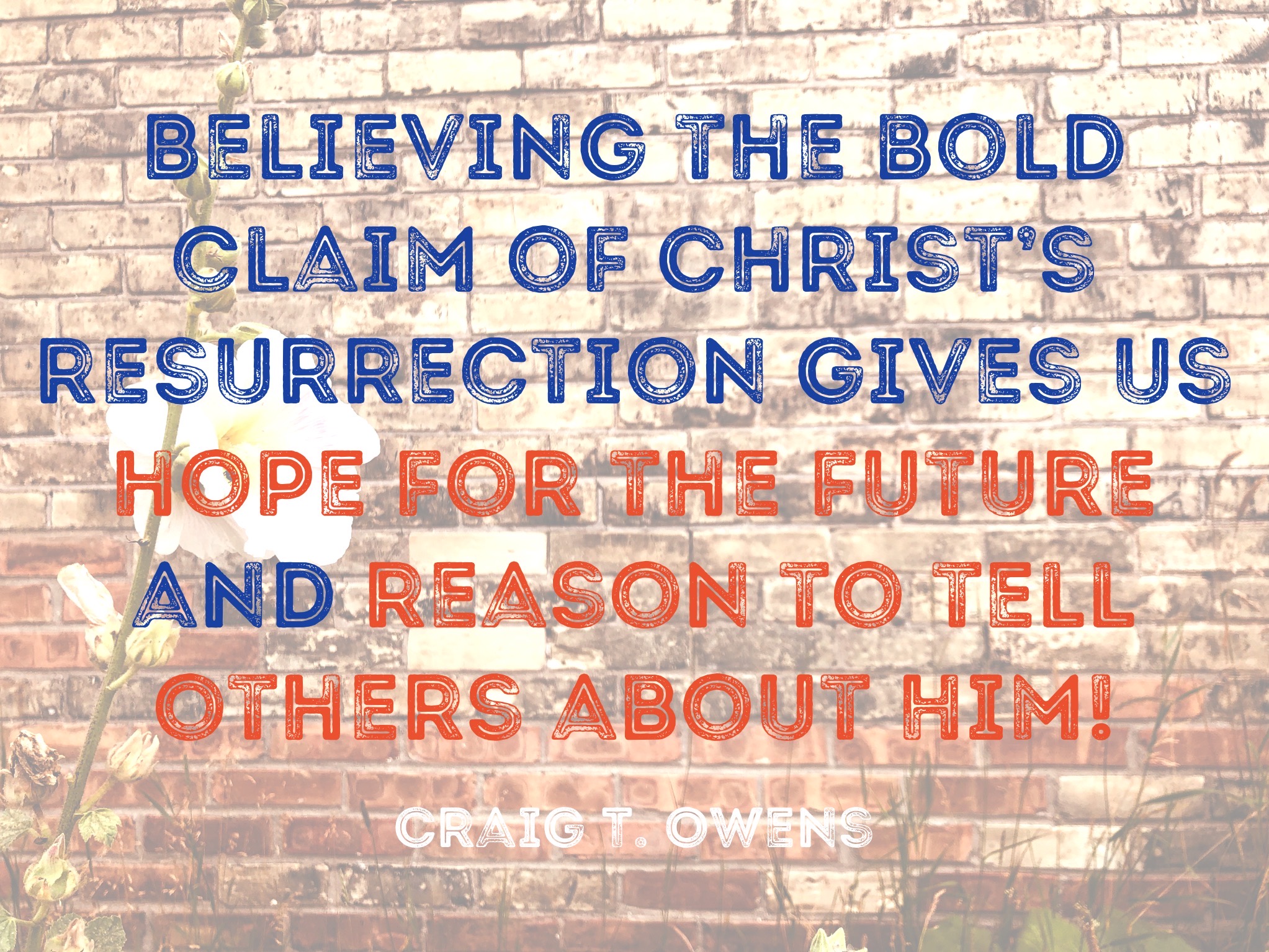
The bold claim that Jesus would be resurrected back to life is adequately backed up by the events on Resurrection Sunday! So now we can say that believing the bold claim of Christ’s resurrection gives us hope for the future and reason to tell others about Him! 

If you’ve missed any of the other bold claims that we have discussed, you can find them all by clicking here. 

►► Would you please prayerfully consider supporting this ministry? My Patreon supporters get behind-the-scenes access to exclusive materials. ◀︎◀︎

No Condemnation

Listen to the podcast of this post by clicking on the player below, and you can also subscribe on AppleSpotify, or Audible. 

Caiaphas’ bold claim couldn’t be backed up, but every bold claim Jesus made was backed up. In the process of looking at those claims, we’ve actually already read another bold claim—one that was repeated three times. It is a bold claim made by the Roman governor Pontius Pilate.

When Jesus was first brought to Pilate, he attempted to “pass the buck” by sending Jesus to King Herod Antipas. Since Herod sent Jesus right back to Pilate, the governor took that as support for his bold claim. Check out what Pilate said: 

  • I have found no basis for your charges against Jesus
  • neither has Herod
  • Jesus has done nothing to deserve death 
  • I have found in Him no grounds for the death penalty (Luke 23:13-22)

Even Pilate’s wife supported him by saying, “Don’t have anything to do with that innocent Man” (Matthew 27:19). 

Pilate’s role in this case was as a modern-day judge. A judge weighs the evidence from the prosecution, compares that with the laws on the books, weighs the evidence from the defendant, and then makes his ruling. Pilate rules multiple times: Not guilty. But the accusers keep coming back with their loud voices but no more evidence. Even though “[Pilate] knew it was out of self-interest that they had handed Jesus over to him” (Matthew 27:18), the shouts of the religious leaders finally prevailed (Luke 23:23-25). 

Why was Pilate’s claim of the innocence of Jesus so bold? Because the Bible tells us, “ALL have sinned and fall short of the glory of God” (Romans 3:23). 

These religious elites had been trying to find an accusation against Jesus almost since the beginning of His public ministry. Many of these same accusers were present on the day they hauled a woman caught in the act of adultery before Jesus (John 8:2-11). They claimed she deserved to be stoned to death, but Jesus simply said, “Let those without any sin throw the first stone at her.” Jesus once again allowed His eloquent silence to work on their hearts, as they knew that not one of them was without sin, so they all dropped their stones and left. 

Jesus freed this woman from her sin when He refused to condemn her. After all, He was the only sinless One who could have been justified in throwing the first stone, but He knew that “God did not send His Son into the world to condemn the world, but to save the world through Him” (John 3:17). 

Jesus doesn’t condemn us, but He doesn’t want us to stay in our sin either, which is why He then told this woman, “Go now and leave your life of sin.” 

Jesus called all of us to live a perfect life: “Be perfect, therefore, as your heavenly Father is perfect” (Matthew 5:48). Yet like those men in John 8, we all would have to drop our stones and leave. 

And satan loves to remind God’s saints of this. John shares with us that “the accuser of our brothers and sisters…accuses them before our God day and night” (Revelation 12:10). The accuser wants to keep us trapped in the guilt of our sin—wants to see us condemned to an eternity separated from God’s presence. 

But when someone has placed their faith in the sacrifice Jesus made for us with His death on the Cross, Jesus takes us into Himself and there is now no condemnation for those IN Jesus because there is nothing in Jesus to be condemned! Because of what Jesus did, it’s not us who is condemned, but sin is condemned! As a result, we no longer have to live according to the sinful nature and suffer the condemnation of sin, but instead when we are in Jesus, “the righteous requirements of the law” are fully met in us (see Romans 8:1-4). 

We cannot do this on our own, but only through the power of the blood of Jesus. Look at the rest of this passage from Revelation: “For the accuser of our brothers and sisters, who accuses them before our God day and night, has been hurled down. They triumphed over him by the blood of the Lamb” (Revelation 12:10-11). 

What amazing news! The writer of Hebrews gives us more details in this passage: 

For by one sacrifice [Jesus] has made perfect forever those who are being made holy. The Holy Spirit also testifies to us about this. First He says: “This is the covenant I will make with them after that time, says the Lord. I will put My laws in their hearts, and I will write them on their minds.” Then He adds: “Their sins and lawless acts I will remember no more.” (Hebrews 10:14-17)

When we are in Jesus—when we have accepted by faith His work on the Cross—God can make the same bold claim to the devil that Pilate made to the religious leaders: “I find no basis for a charge!” This is how we can then fulfill the righteous requirement Jesus gives us to “Be perfect, therefore, as your heavenly Father is perfect.” 

Only Jesus can do this for us! 

If you’ve missed any of the other messages in our series of Bold Claims, you can find them all here. 

►► Would you please prayerfully consider supporting this ministry? My Patreon supporters get behind-the-scenes access to exclusive materials. ◀︎◀︎

Our Perfect King

Listen to the podcast of this post by clicking on the player below, and you can also subscribe on AppleSpotify, or Audible. 

Our country has a policy of separation of church and state, and that appears to be a good thing. When the head of the government starts telling the church how to worship, or when the head of the church starts telling the government how to run its affairs, strife typically results. 

There have been some notable examples of wise kings who were God-fearing rulers, and some examples of religious leaders who had the wisdom to make just laws. But history has most often shown us that when a king imposes on the church a mode of worship or a pastor imposes on the king religious ways of governing, clashes result. Some of them have been bloody civil wars and some have spread into international conflicts. 

That being said, wouldn’t it be better for everyone if there was a way that one person could hold both of those offices simultaneously? If only there was some way to bring those different offices together. Very few people could ever accomplish this because it would require a perfect person with both absolute wisdom and complete God-honoring selflessness, someone so confident in both their wisdom and their relationship with God that they would never be swayed unfairly one way or the other. 

Last week we saw the first bold claim from Jesus: “I am the I AM.” With this title and authority, Jesus claimed to be the Head of the Church. This is a title Paul uses several times in his letter to the church at Ephesus (Ephesians 1:22, 5:23). Paul goes on to remind us that our aim as the Church body is to grow into maturity under the Headship of Jesus (Ephesians 4:15). 

Consider two other notable rulers during this same time period. As the high priest, Caiaphas would have laid claim to the title of “head of the church.” As the Roman governor, Pilate would have laid claim to the title of “head of the government in Judea.” Yet both of them clearly demonstrated that they had “become the symbol of those who make religious decisions based on political expediency rather than truth and justice,” as Dr. Donald Stamps noted. 

Paul goes father than calling Jesus simply the Head of the Church—

And He [Jesus] is the head of the body, the church; He is the beginning and the firstborn from among the dead, so that in everything He might have the supremacy. (Colossians 1:18) 

Not just Headship over the Church, but Headship over “everything.” 

After the bold claim of Jesus that He was the I AM, the Sanhedrin wanted to have Him put to death, so they took Jesus to Pontius Pilate (Luke 22:71—23:2; Matthew 27:1-2; John 18:28-37). 

Pilate “knew it was out of self-interest that they had handed Jesus over to him” (Matthew 27:18), but he still asked Jesus, “Are You the king of the Jews?” Just as Caiaphas was trying to save his position of power by keeping a delicate balance between the Jews and the Romans, Pilate was also trying to save his skin. Pilate was trying to appease both the Sanhedrin and Tiberius Caesar. 

Jesus answers Pilate’s question in a way Pilate never expected. Twice Jesus says “My kingdom,” noting that His kingdom is other-worldly. His kingdom comes from outside this world and therefore supersedes any government of this world. Pilate clearly has never heard anything like this, so after hearing this statement he announces, “You are a king, then!” 

Just as Jesus had answered the Sanhedrin with, “You are right in saying I am the Messiah,” now He answers Pilate, “You are right in saying I am a king.” 

Combining those two bold claims—“I am God” and “I am a King”—Jesus is the only One who can perfectly hold both offices without any conflict. This is what the prophecy in Isaiah 9:1-7 foretold, and this is the fulfillment that John shows us at the end of time (Revelation 17:14, 19:11-16). 

What does this mean for us? How are we now supposed to live knowing Jesus as our God and as our King? We should live confidently before our King and humbled before our God. We don’t fear earthly kings, but neither do we fight them. We don’t have to try to convince earthly kings to rule a certain way because they are God’s servants to accomplish God’s plan. We don’t have to get caught up in the politics of the day because this day will come to an end. 

We are subjects of a kingdom not of this world, so the kings of this world don’t get to decide our final destiny!

(If you would like to explore this topic further, check out my series of messages from 1 Peter called Aliens and Strangers.)

If you’ve missed any of the messages in our series called Bold Claims, you can find the full list of messages by clicking here. 

►► Would you please prayerfully consider supporting this ministry? My Patreon supporters get behind-the-scenes access to exclusive materials. ◀︎◀︎

Don’t Try To Get Even

Listen to the podcast of this post by clicking on the player below, and you can also subscribe on AppleSpotify, or Audible. 

When I work with students I frequently find that conflicts between them are really one-upmanship. Here’s what I mean: one student intentionally or unintentionally tweaks another student, that student then responds with a decidedly intentional verbal or physical shove, which is responded to by the initial student with a louder and more intentional reprisal. And on and on it escalates until someone steps in to stop it.

I often ask these students who are upset with each other, “What did you think was going to happen when you treated the other person that way?” The quick response is almost always, “I don’t know.” And I believe that because most of us don’t think through the counter-reaction to our reaction. 

So I will ask a follow-up question: “Did you think that by shoving him in response to his insult that he was going to say, ‘Oops, my bad. I’m sorry for that and I won’t do it again’?” 

Usually, the student answers quite honestly, “No, I didn’t think that would happen.” They were just so upset that they wanted to let the other person know that they had been hurt.

This idea of getting even is the longing of so many of the psalms: How long until we see victory? (see Psalms 6, 13, 35, and 94 as examples). It’s the cry of the martyrs before God’s throne: How long until we see justice? It’s the desire of every Christian wrongly accused and condemned: God, how long until Your truth prevails? 

Matthew quotes a passage from Isaiah 42:1-4 that is fulfilled in the ministry of Jesus. Part of that description says, “A bruised read He will not break, and a smoldering wick He will not snuff out, till He leads justice to victory. In His name the nations will put their hope” (Matthew 12:20-21). Notice this key word: till HE leads justice to victory

Jesus is Justice and Truth, and He does ultimately triumph. But notice how Jesus accomplishes this because it is to be our model too: 

  • No quarreling 
  • No shoving back on those who have hurt us
  • No attacking those who have attacked me

Victory comes only through Jesus. I have to relent trying to balance the scales of justice—this is never my place. If I try to make things right on my own, my so-called justice only sets off a one-upmanship shoving match that continues to escalate in very ungodly ways. 

Vengeance is God’s. Justice is God’s. My hope—my immovable hope—is only in what Jesus has accomplished. Remember what Matthew quoted: “In His name the nations” [and all those who have been persecuted, wronged, and martyrd] “will put their hope”! 

Let’s all ask the Holy Spirit to remind us of this the next time we want to shove back the person who just shoved us. 

►► Would you please prayerfully consider supporting this ministry? My Patreon supporters get behind-the-scenes access to exclusive materials. ◀︎◀︎

Triumphant King

Listen to the podcast of this post by clicking on the player below, and you can also subscribe on AppleSpotify, or Audible. 

Have you ever noticed how many of our Christmas carols celebrate the dark night giving way to the bright light? For instance, the hymn O Holy Night contains the line, “long lay the world in sin and error pining until He appeared.” 

English historian and theologian Thomas Fuller was the first to put into print what has now become a cliché that so many people use: “It is always darkest just before the Day dawneth.” Indeed, Micah paints a very dark scene just before the Messiah makes His First Advent (Micah 5:1). 

The Light of Jesus that burst onto planet Earth in a Bethlehem stable revealed Him as our Great Shepherd, our Prince of Peace, and our Mighty Deliverer. And there is also one more title that Micah foretells: our Triumphant King! 

What does our Triumphant King do? He confronts and defeats the darkest foes. Check out the words in Micah 5:9-15: destroy (5x), demolish (2x), tear down, uproot, take vengeance. 

Christ’s birth in Bethlehem is our proof that God’s plan prevails. God always gets the final word, the decisive word, and the best word! 

Most of the Old Testament prophets foresaw both the first and second advents of Jesus simultaneously. The mountains of prophecy look like they are on top of each other, so it’s very common for the prophets to see events of both advents happening simultaneously. So Micah sees both the coming of Jesus in Bethlehem and His coming at the end of time as King.

There is a spiritual battle that has been raging since before Time began (Ephesians 6:12). It started when Lucifer became satan by his rebellion against God, and then he began his agenda of the destruction of God’s people (Ezekiel 28:12-17; Revelation 12:7-9, 13, 17). 

Into this dark battle, Jesus enters the scene. The reason the Son of God was made manifest (visible) was to undo—destroy, loosen, and dissolve—the works the devil has done (1 John 3:8 AMP). 

I already talked about how the death of Jesus on the Cross meant the death of Death, and Jesus became our Mighty Deliverer! The resurrection of Jesus means satan’s time is nearing an end. It may be dark now, but the darkness has to give way to the Light of the King of kings (check out these verses in Revelation). 

“It is always darkest just before the Day dawneth” should assure us of the victory of the King of kings! Jesus assured us that darkness is only afforded an hour, and then the Light will completely overwhelm it. The Light dawned in Bethlehem and is returning soon to completely vanquish every last bit of darkness!

If you missed any of the messages in our Advent series, you can find a list of all of those messages by clicking here. 

►► Would you please prayerfully consider supporting this ministry? My Patreon supporters get behind-the-scenes access to exclusive materials. ◀︎◀︎

Verifiable Facts About The Birth Of Jesus

Listen to the podcast of this post by clicking on the player below, and you can also subscribe on AppleSpotify, or Audible. 

Check out the resources I mention in this video:

►► Would you please prayerfully consider supporting this ministry? My Patreon supporters get behind-the-scenes access to exclusive materials. ◀︎◀︎

Complacency Is Deadly

Listen to the podcast of this post by clicking on the player below, and you can also subscribe on AppleSpotify, or Audible. 

At that time I will search Jerusalem with lamps and punish those who are complacent… (Zephaniah 1:12). 

When I taught a series on the minor prophets, I noted that Zephaniah wanted to share some really, really good news, but first, he had to make his audience confront the really bad news. The really bad news is that we all have sinned and fall short of God’s righteous standard. The really, really good news is that God has provided forgiveness for our sins through Jesus. 

Sadly, one of the things that keeps us from addressing the sin in our heart is complacency. The King James Version of Zephaniah 1:12 says that the people were “settled in their complacency.” If you look up the definition of the Hebrew word here, it literally means settled on their lees. 

Look at the full verse in the NIV: “At that time I will search Jerusalem with lamps and punish those who are complacent, who are like wine left on its dregs, who think, ‘The Lord will do nothing, either good or bad.’” 

This phrase—“who are like wine left on its dregs”—puts the people at a tipping point. The lees or dregs of a barrel is where the wine is at its finest color and flavor. But wine that has “settled” is right at the point of curdling. 

God is addressing people who have become self-satisfied. They have reached the place that they have called their “good life.” They want nothing to disturb them; especially not any teaching or preaching that may bring the conviction of the Holy Spirit. 

So they have deluded themselves. They have said, “If everything seems to be going well for me, then I must be doing everything right. Don’t tell me anything that might make me uncomfortable.” Outward appearances and circumstances can be deceiving. We have to listen for the voice of the Holy Spirit. We must never become complacent in our relationship with Jesus. 

A very similar warning is sounded for the church in Laodicea. Jesus called them complacent when He said that they were neither hot nor cold, but lukewarm. They, too, had also stopped listening to the Holy Spirit because they had complacently said to themselves, “I am rich; I have acquired wealth and do not need a thing.” 

Laodicea was at the point where they should have been at their finest, but instead their complacency had brought them to a place of curdling—a place where Jesus threatened to spit them out of His mouth! 

Complacency is deadly! 

The solution: listen to the rebuke and discipline that the Holy Spirit brings, and repent of complacency. If we do, we will discover the inestimable, eternal riches that only a vibrant relationship with Jesus can give us (Revelation 3:14-22). 

Let us never become settled on our lees, but let us be ready to be poured out for our Master’s enjoyment and glory. May I suggest that we all regularly pray the prayer of David: “Search me, O God. Point out any sin that I have complacently allowed to remain in my heart” (Psalm 139:23-24). And when that sin is revealed, don’t wait to repent because your wine is just about to curdle! But the restoration that repentance will bring to your heart will allow the richness and vibrancy of your life to be pleasing to your Savior! 

►► Would you please prayerfully consider supporting this ministry? My Patreon supporters get behind-the-scenes access to exclusive materials. ◀︎◀︎