The Security In Our King

Listen to the podcast of this post by clicking on the player below, and you can also subscribe on AppleSpotify, or Audible. Check out the video content in this post by clicking here. 
There is a confidence and joy in knowing how things will turn out, in having “the inside scoop” that others don’t have. 

In my book Shepherd Leadership, I tell the story of the time when I was working as the executive director of a camp and conference center. I was breaking down boxes at the recycle dumpster when a guest approached me, not knowing I was the director. I was able to help her because I knew who to talk to, where the supplies were, and how things worked around the facilities. I knew what I knew, but our guest was a little surprised that I knew what I knew. 

We see this in the life of David as he became king of Israel and as his leadership expanded. 

David was first anointed king over merely the tribe of Judah, but his influence began to expand (2 Samuel 3:1). It wasn’t just fear of his military power, but people genuinely liked him and saw that he had the best in mind for them (3:36), until eventually all of the tribes of Israel saw David as their king (5:1-3). His reign as king saw him continuing to grow in his strength, wisdom, and influence (14:18-20). 

(Check out all of the Scriptures I mention in this post by clicking here.) 

David was unquestionably established as the king—the leader God had chosen. Seeing David reigning as king brings us to the next Royal Psalm (Psalm 97). 

The statement that “the LORD reigns” (v. 1) is widely accepted. For instance, the foundational document of the United States of America opens with the words, “The unanimous Declaration of the thirteen united States of America … We hold these truths to be self-evident, that all men are created equal, that they are endowed by their Creator with certain unalienable Rights.” 

The fact that we exist presupposes a starting point. It would appear that the starting point is something or someone with unimaginable power. Even atheists call the beginning of our universe “a singularity” with unimaginable power to bring all of this into being. The fact that our universe is so well ordered makes the case for an Intelligence behind the unimaginable power. This intelligent, awesome power is described in Psalm 97:2-6. 

Jesus is the One the biblical writers identify as this intelligent, awesome power (John 1:1-4; Colossians 1:15-17). Jesus even identifies Himself as being this One (Revelation 1:8, 18). Because Jesus holds the keys, He has the final word on our eternal existence. His desire is that all would come to know Him as their King and Savior (John 3:16-17). 

When our sins are forgiven, we have no fear of God’s punishment (Psalm 97:7-12). 

Those who oppose this worldview can be quite intimidating at times. Peter tells us, “Do not fear their threats; do not be frightened” (1 Peter 3:14). 

For now, in America, we don’t face bodily threats of violence (although that day may come). The threats Christians face today are being mocked for outdated or out-of-touch beliefs, being canceled because our stance is bigoted and hateful, or simply being pressured to compromise just a little bit on what we believe. 

To emphasize his point, Peter quotes words from King David in Psalm 34. David’s words in this psalm sound a lot like the tone of Psalm 97. Notice especially Psalm 34:1-2, 15-22 where David assures us that King Jesus gets the final word, the decisive word, and the best word! 

Someday every knee will bow to Him and every tongue will confess that He is God (Revelation 20:11-15). Knowing this should give Christians an incredible sense of security, especially in the presence of those who doubt, deny, or mock. 

So when atheists, agnostics, and skeptics want to attack your belief in an all-loving, all-powerful God Who says the only way to avoid His final judgment is to place our faith in the work Jesus did on the Cross, let’s be careful in our response. We don’t have to fight them—we should instead respond with love. Peter went on to say that our response to their attacks would be our testimony (1 Peter 3:14-17). 

Like David, let us extol the LORD at all times (even when under attack). Like the Royal Psalm, let us rejoice in the LORD and praise His holy name. Let us never forget Who gets the final word, the decisive word, and the best word! 

If you’ve missed any of the other messages about the Royal Psalms, check out our series All Hail King Jesus by clicking here. 

►► Would you please prayerfully consider supporting this ministry? My Patreon supporters get behind-the-scenes access to exclusive materials. ◀︎◀︎
Resting In Our King

Listen to the podcast of this post by clicking on the player below, and you can also subscribe on AppleSpotify, or Audible. Check out the video content in this post by clicking here. 

Throughout history, no one is ever seen approaching a king like it’s no big deal. Even those who are confident in themselves, still are seen reassuring themselves before they venture into the king’s throne room. 

Last week we talked about the King’s royal robes that allow us to enter into His presence. We see that in civic government too (Esther 4:1-2). Mordecai urges Queen Esther to approach King Xerxes to intercede for the Jewish people. She is clothed appropriately (2:12, 15-17) but even she knows that’s not enough (4:11). 

(Check out all of the Scriptures in this post by clicking here.) 

We who are clothed in the royal robes of Jesus can approach God’s throne confidently—Let us then approach God’s throne of grace with confidence, so that we may receive mercy and find grace to help us in our time of need (Hebrews 4:16). 

Our next Royal Psalm is Psalm 95. This psalm is both an invitation and a warning. 

Invitation: Come (3x)…

  • …with joyful shouts because He is “the Rock of our salvation” (v. 1; c.f. Hebrews 10:22). 
  • …with thanksgiving because of His greatness (vv. 2-5; c.f. Hebrews 12:28) 
  • …with worship because He is our God (vv. 6-7a; Matthew 2:2, 11) 

Remember this psalm is both an invitation and a warning. The warning is the danger of refusing to approach the King. We see a hint of this warning in Hebrews 12:28-29. 

Have you noticed that I have been referencing the Book of Hebrews quite frequently? That’s because the writer of Hebrews links back to this Royal Psalm in a way no other biblical author does. Check out how this psalm ends (Psalm 95:7-11).  

The writer of Hebrews quotes this royal psalm (Hebrews 3:7-11), and then shares a Spirit-inspired commentary or application in verses 12-19. 

Note the words unbelieving and unbelief (vv. 12, 19). These are the same Greek word which means faithlessness. This faithless attitude blocks miracles (Matthew 13:58), which can result in a hardening of our heart (Mark 16:14). Finally, this hardness of heart can keep us from resting in our King (vv. 12, 19); the word disobeyed in v. 18 means refusing to let yourself be persuaded. 

Now notice the Therefore…be careful in Hebrews 4:1-7.  The unbelief now moves to disobedience (vv. 6, 11), which is really better defined as obstinacy. In verses 8-11, the word Sabbath-rest is unique in all of Scripture. It’s the place of perfect contentment, undiluted and uninterrupted for all of eternity! But in order to enter this Sabbath-rest, we have to cease from our own way of doing things (see Matthew 11:28-30). 

Look at how Hebrews 4 concludes: Let us then approach the throne of grace with confidence, so that we may receive mercy and find grace to help us in our time of need (v. 16). 

Verses 1-8 quote the Scripture of God’s promised rest, culminating in the Sabbath-rest in v. 9. 

Verses 10-11 tell us to learn from the Scriptures the “example of disobedience” so that we don’t repeat it. Verse 12 tells us God’s Word exposes all our faithlessness, disobedience, and obstinacy that may even be hidden from our sight, but know that everything is uncovered and laid bear before our King of kings (v. 13). 

Notice the therefore (v. 14) and the then (v. 16). My flesh would have me run and hide when my sin is revealed, but here we see that the conviction of the Spirit through the exposing Word should prompt us to run to the throne of grace with confidence (vv. 14-16). 

Confident of what? Receiving mercy and finding grace. 

Where is the source of this confidence? Our great High Priest Jesus—our conquering King—has opened the way for us to come to a throne of grace instead of a throne of wrath! 

We come joyfully, thankfully, and worshipfully. We come not because of our deeds, but yoked to our King. 

In Esther 5:1-2 we see Esther adorned to enter the king’s presence, unsure if she would be accepted. But we don’t have to adorn ourselves. Instead, we are clothed in the righteous, royal robe of Jesus which makes God pleased so that He extends His scepter of Sabbath-rest (Hebrews 4:16)! 

May we all desire to enter into this place of Sabbath-rest! 

If you’ve missed any of the other royal psalms which we have already explored, you can find them all by clicking here. 

►► Would you please prayerfully consider supporting this ministry? My Patreon supporters get behind-the-scenes access to exclusive materials. ◀︎◀︎
That’s My King!

Listen to the podcast of this post by clicking on the player below, and you can also subscribe on AppleSpotify, or Audible. 

The apostle Paul writes one of the simplest but most profound statements about Jesus the Christ in his letter to the church at Colosse. He said, “The Son is the image of the invisible God, the firstborn overall creation” (Colossians 1:15).

Actually, Paul may be quoting something even closer to the time of Christ’s resurrection from the grave. Verses 15-20 are thought by many scholars to be a Christian hymn that Paul is quoting. And what a profound song it is!

Notice that the definitive article “the” is prominent in this hymn, highlighting the unique and exclusive Person of Jesus. He is called—

  • the Son
  • the image of God
  • the firstborn over all creation 
  • the head of the Body—the Church 
  • the Beginning of all things 
  • the Supreme One 

Not only is Christ’s position exclusive and unassailable, His power is unrivaled—

  • He is over all creation because He created all things 
  • He controls all things 
  • He is before all things 
  • He holds all things together 
  • He has supremacy over all things 
  • He possesses all the fullness of God
  • He alone can reconcile all things to Himself 

Our human language runs out of words and phrases to describe this majestic King of kings, but I love when people try their best to paint a picture of this King. S.M. Lockridge did just that in a sermon entitled “That’s my King!” Check out this portion of this message—

He’s the greatest phenomenon that ever crossed the horizon of this world.

He’s God’s Son…
He’s a sinner’s Savior…
He’s the centerpiece of civilization… He stands in the solitude of Himself… He’s august and…
He’s unique…
He’s unparalleled…

He’s unprecedented…
He’s the loftiest idea in literature…
He’s the highest personality in philosophy…
He’s the supreme problem in higher criticism…
He’s the fundamental doctrine of true theology…
He’s the cardinal necessity for spiritual religion…
He’s the miracle of the age…

He’s the superlative of everything good that you choose to call Him… He’s the only one qualified to be an all-sufficient Savior…

You can download the PDF of Rev. Lockridge’s sermon here → That’s My King – S.M. Lockridge ←

And you may also want to check out a series of messages I shared on the Royal Psalms called All hail, King Jesus! 

For in Christ lives all the fullness of God in a human body. So you also are complete through your union with Christ, who is the head over every ruler and authority. (Colossians 2:9-10 NLT) 

Don’t ever stop getting to know this King more and more intimately for yourself. He wants you to see Him in all of His glory so that your life is unalterably changed. 

►► Would you please prayerfully consider supporting this ministry? My Patreon supporters get behind-the-scenes access to exclusive materials. ◀︎◀︎
Jesus Is Our King

Listen to the podcast of this post by clicking on the player below, and you can also subscribe on AppleSpotify, or Audible. 

When we talk about the Baby in the manger, there is often an aspect that we overlook, although it’s included in many of our Christmas carols—

  • born is the King of Israel 
  • come and worship Christ, the newborn King 
  • hark the herald angels sing, glory to the newborn King 
  • joy to the world, the Lord is come, let earth receive her King 

I think many of us bristle a bit at the idea of any king—especially someone claiming absolute authority as King of kings—because of our unpleasant experiences, or perhaps the stories we have heard from history. Lord Acton was right when he said, “Power tends to corrupt and absolute power corrupts absolutely.” Every monarch throughout history has established their kingdom by the strength of their sword: “Do things my way, or else!” Lord Acton went on to correctly add, “Despotic power is always accompanied by corruption of morality.” 

The kings of Isaiah’s day in Israel were nothing but evil, and the kings of Judah were becoming more and more ungodly with each successive generation. What about during the time Jesus was to be born? Luke 2:1 tells of Caesar Augustus. Augustus was born Octavian and he came to power after Julius Caesar was assassinated and after fighting against Mark Anthony and Cleopatra. Augustus claimed to restore the republic, but he really kept all the power to himself.

Matthew tells us of King Herod the Great and his despicable family tree (Matthew 2:1-3, 16). 

This is why we tend to distrust those who claim authority over us and demand from us our allegiance to them. So when Isaiah begins to tell of the coming Messiah (Isaiah 9:2-5) it sounds like a warlord wielding His powerful sword. 

(Check out all of the Scriptures in this post by clicking here.) 

But recall that the first time time Isaiah uses the Hebrew word shalom (peace) is in the titles of this King. Isaiah calls Him a Child and then gives Him such unexpected titles (Isaiah 9:6)! 

Isaiah says “the government will be on His shoulders.” The word misra (government) is only used twice in the Old Testament, here in vv. 6-7. The root word sara is also only used twice, and both times are related to Jacob the trickster being transformed into Israel, the one in whom there is no deception. This tells us that the Messiah is going to take the burden on Himself—He flips the Kingdom upside! Instead of all of us serving Him, He comes to serve us! 

This is why it’s called His government and peace and establishing and upholding it with justice and righteousness! 

This King of absolute power—the One Who is also called Mighty God—could overwhelm us with His unquestioned, unrivaled, and unapproachable power, but He came to be our King who makes peace. 

Our King is the most awesome power in the universe, but He is approachable because He is humble (Philippians 2:6-8; Isaiah 53:1-5; Matthew 11:29; Matthew 21:5). 

This is exactly what the angel foretold to Mary (Luke 1:26-33), and this is what Mary grasped, as she relates it to us in her Magnificat. Listen as she expresses praise for both our King’s power and His gentleness (vv. 46-55). 

Our King came to draw His sword not against us but against the enemy that kept us enslaved and separated from God (Isaiah 9:2-5; Colossians 2:13-15; Revelation 1:18). 

In Isaiah 9:6 we read that the government will be on His shoulders. This is Jesus carrying the burden. This word for “shoulders” in the OT is almost always associated with the words “burden” or “yoke.” 

We were born with the yoke of sin burdening us (Hebrews 2:15). Jesus took that on His shoulders when He took an old rugged Cross on His shoulders. Now He invites us to give our burden and our yoke to Him (Matthew 11:28-30). 

Our King says, “Come to Me”—He is approachable because He was born as a Baby in Bethlehem. Our King says, “I will give you rest” because He is our conquering King who broke the yoke of sin for us. This is what Christmas should remind us! 

If you’ve missed any of the previous messages in our series looking at the titles and roles of the Messiah, you can check them all out here. 

►► Would you please prayerfully consider supporting this ministry? My Patreon supporters get behind-the-scenes access to exclusive materials. ◀︎◀︎

The Freedom In Fear

Listen to the podcast of this post by clicking on the player below, and you can also subscribe on AppleSpotify, or Audible. 

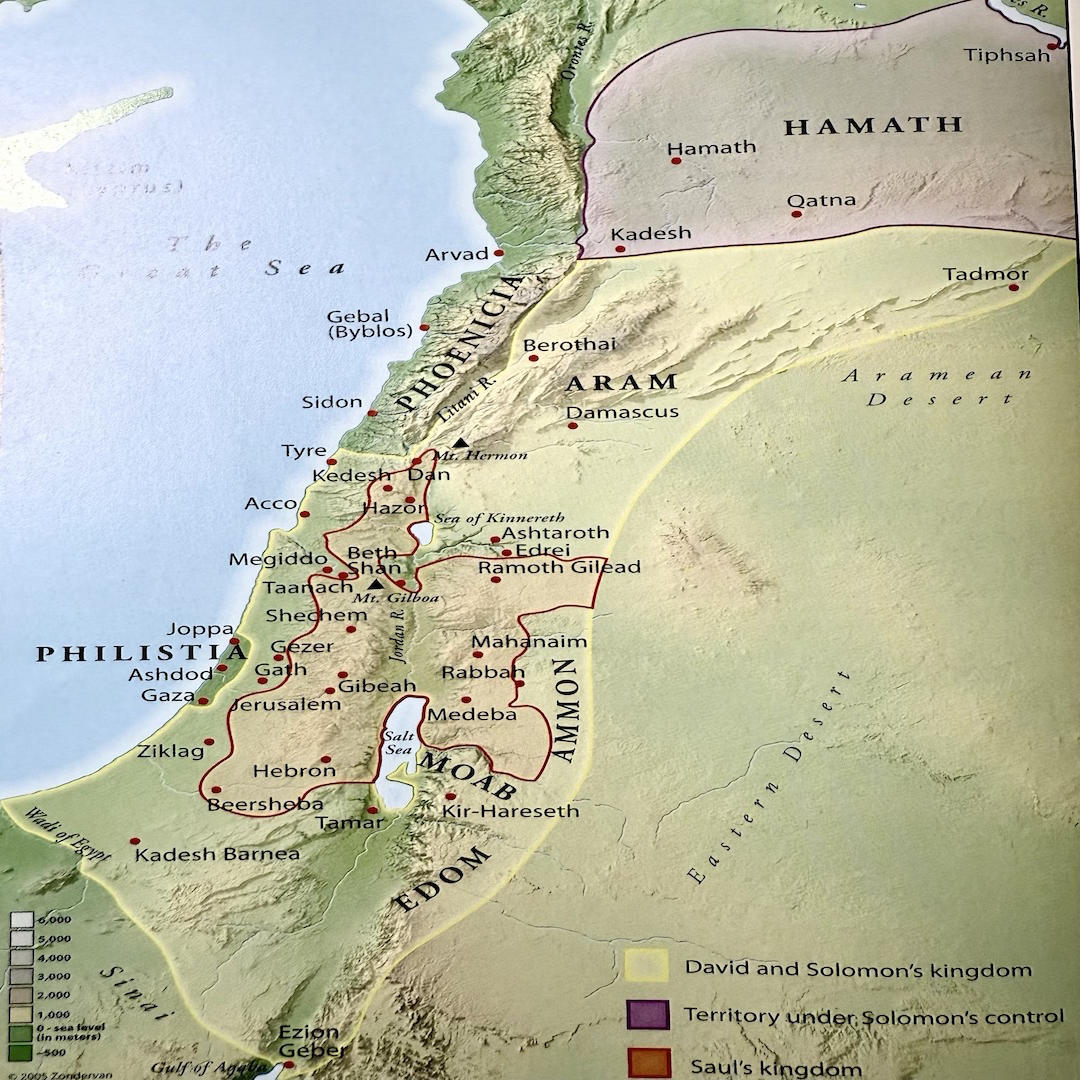
Our Royal Psalms take us from King David to King Jesus. David went from the anointed king on the run from King Saul, to being king over Judah (2 Samuel 2:4), to being king over “all the tribes” (2 Samuel 5:1-3; 8:15). 

(Check out all of the Scriptures in this post by clicking here.) 

David’s kingdom stretched far and wide (1 Chronicles 22:14-16; 29:10-13). This absolute control King David now wields over every nation surrounding Israel puts fear into the hearts of Israel’s enemies. Fear of David brings freedom for the people of his kingdom.

As the Sons of Korah think about this fear that brings them freedom, they look beyond their earthly king to the King of Heaven and compose this Royal Psalm recorded in Psalm 47. This psalm has majestic terminology for God in almost every verse; including, Lord Most High, great King over all the earth (vv. 2, 7, 9), God reigns over the nations; and God is seated on His holy throne. 

I’m especially intrigued by the word awesome in verse 2. The KJV says “the Lord Most High is terrible” because it does take two Hebrew words to give us the full definition of awesome. First, “Most High” is best thought of with the suffix -est: greatest, highest, noblest. In other words, there is nothing above Him. Then “terrible” is to be held in awe, to be honored, to be reverenced. 

Just as the Israelites had no fear of enemies because David was on the throne, God says the same thing to us: Because the Most High is on the throne, His people have no fear of their enemies. 

When we fear God we need not fear anything else. 

When we fear God: 

…we hate our own sin (Psalm 36:1-3) 

…we love His mercy that forgives our sin (Psalm 103:2-3, 10-12) 

…we hate sin in the world (2 Timothy 2:26) 

…we love sinners (2 Timothy 2:24-26; Acts 10:38; Jude 20-23) 

…we hate the darkness that traps people (2 Corinthians 4:4) 

…we love shining the light of King Jesus (Philippians 2:15-16) 

…we hate this life (John 12:25) 

…we love eternal life (Romans 3:23-24, 8:18)

When the people of Israel reverenced David as their king, they would be able to know his blessings. When we fear our awesome God, we will also receive His blessings. Take a look at the amazing blessings Jesus Himself—the King of kings—lists for those who reverence His awesome Kingship (Revelation 2:7, 11, 17, 26-28; 3:5, 11-12, 21)! 

God is awesome and asks us to reverence Him and then enjoy life in His freedom. 

If you have missed any of the other royal psalms we have covered, you can find the full list by clicking here. 

►► Would you please prayerfully consider supporting this ministry? My Patreon supporters get behind-the-scenes access to exclusive materials. ◀︎◀︎

Light In The Darkest Of Times

Listen to the podcast of this post by clicking on the player below, and you can also subscribe on AppleSpotify, or Audible. 

One of the reasons I appreciate the Bible—in fact, one of the main reasons that continually convinces me of the truthfulness of the Bible—is the way it portrays life as it really is. It doesn’t avoid the difficult subjects, nor does it sugarcoat the bitterness of life. The Bible tells it as it is. 

The songs that have us singing praises to God “when the sun’s shining down on me and the world’s all as it should be” are great, but when we can also find hope when we’re “found in the desert place” is the real test. 

Dark times come to all of us. 

David is anointed king of Israel and given a promise by God for a lasting legacy (2 Samuel 7:8-9, 16, 27-29; Psalm 110:1). And yet David cried out one of the most painful phrases ever uttered in Psalm 22:1-2, “My God, my God, why have You forsaken me?”  

(Check out all of the Scriptures in this post by clicking here.) 

Despite the promises that God gave David, when any of us are in a dark place, there is a natural human tendency to focus on the darkness around us and second-guess what is happening to us. You know the questions:

  • How did I get here? 
  • How will I get out of here? 
  • When will I get out of here? 
  • Have I offended God and perhaps missed out on His promise? 
  • Has He forgotten me? 

The Bible does tell us, “If You, Lord, kept a record of sins, Lord, who could stand?” and we also know it’s true that “all have sinned and fall short of the glory of God” (Psalm 130:3; Romans 3:23). 

That’s for us, not for Jesus. He is the sinless One. He obediently became human to rescue us, knowing full well that He was the fulfillment of the promise God made to David (Matthew 1:1; 22:41-44). Yet He ended up uttering the same painful words David did (Matthew 27:41-46). 

Remember I said that King David was a visible picture to help us see the coming King of kings. David was inspired by the Holy Spirit with this knowledge (Acts 2:29-30, 25-28). 

The old hymn says, “When darkness veils His lovely face, I rest on His unchanging grace” and “When all around my soul gives way, He then is all my hope and stay.” Look at David’s preaching to himself:

  • I am feeling forsaken (Psalm 22:1-2) … YET You are on Your throne (vv. 3-5) 
  • I am scorned by others (vv. 6-8) … YET You are closer than my scorners (vv. 9-11) 
  • I am completely cut off (vv. 12-18) … BUT You are my rescue (vv. 19-24) 

What did Jesus know:

  • He would sit on the throne of Heaven—Matthew 26:62-64 
  • His Father was completing everything—John 19:30; Psalm 22:25-31 
  • He would conquer every enemy—Revelation 1:8, 18 

Jeremiah cries out about his dark time, and then like David he says, “YET this I call to mind and have hope.” Jeremiah then talks about the never-ending love and mercy of God, and concludes by preaching to himself, “I say to myself, ‘The Lord is my portion; therefore I will wait for Him’” (Lamentations 3:19-24). 

The Lord is my portion” means the Lord is my King who declares promises and fulfills promises. 

The help in suffering is not found in focusing on the present darkness—and all the questions—but to focus on God’s promises. Like David’s “yet” and “but” we need to preach to ourselves about God’s past deliverance and then be assured of our future hope. 

Just assuredly as our King of kings said, “I will be resurrected from the dead to sit on the throne of Heaven,” He also said, “I will come to take you where I am”! 

Take your eyes off the present, temporary darkness and put them on the eternal King! 

If you have missed any of the messages in this series on the Royal Psalms, you can find them all here. 

►► Would you please prayerfully consider supporting this ministry? My Patreon supporters get behind-the-scenes access to exclusive materials. ◀︎◀︎
Refuge From The Shoving

Listen to the podcast of this post by clicking on the player below, and you can also subscribe on AppleSpotify, or Audible. 

I don’t know when the last was that you may have tried to get a dozen little kids lined up, but it’s quite an experience! Everyone is vying for their spot. Someone gets mad and yells out, “He cut!” And then the reply is yelled back, “No, I didn’t. She was saving my spot!” This usually results in lots of pushing and shoving as each person tries to reclaim their rightful place in line. 

This is the backdrop for Psalm 7. The introduction tells us that Cush is causing David grief. Maybe because Cush is from the tribe of Benjamin like King Saul, and he doesn’t want David cutting in line so he is shoving him back to his proper place. 

(Check out all of the Scriptures in this post by clicking here.)

There’s a musical term David uses, which isn’t used in any other psalm: shiggaion. This means a rhythm that isn’t normal—it’s a freewheeling, irregular, impassioned beat. This also helps set the atmosphere for what’s happening in David’s life. The root word for shiggaion implies a shakeup (or a shoving and pushing) that could lead to someone losing their way. 

David tries to do the right thing. He asks for God’s help (v. 1) so that he doesn’t get ripped to shreds (v. 2). He even takes time to ask himself if he has done anything that led to Cush’s shoving (vv. 3-5). But notice these are all David’s attempts to make things right. 

Remember that this is a Royal Psalm, but we haven’t heard anything about God as King yet. But now we come to the end of v. 5, which is also the end of David’s own striving. It’s marked by the word Selah. 

My little friends push and shove to try to get their place. But all of that stops when I say, “Johnny is my line leader, and this is the way the rest of you are going to line up behind him.” David’s Selah pause was a call to switch from doing things on his own to yielding to the King to sort things out. He was saying, “The King of kings is the Leader and He knows my place in line.” 

It’s only after the Selah that we see the royal terms for the Undisputed Leader:

  • He is the One who will decree justice (v. 6) 
  • He will rule…from on high (v. 7) 
  • He is the Supreme Judge (vv. 8, 11) so David yields his introspection to Him (vv. 3-4, 8-9) 
  • He is God Most High (vv. 10, 17) 

Our King has no rival. No one can shove Him. No one can contradict Him. No one can hide anything from Him (vv. 11-16). 

We must bow only to the King of kings (Philippians 2:10-11). 

We mistakenly bow our knee to man when…

  • …we aren’t willing to own our mistakes 
  • …we try to administer our own “shove” of justice 
  • …we make our own refuge 

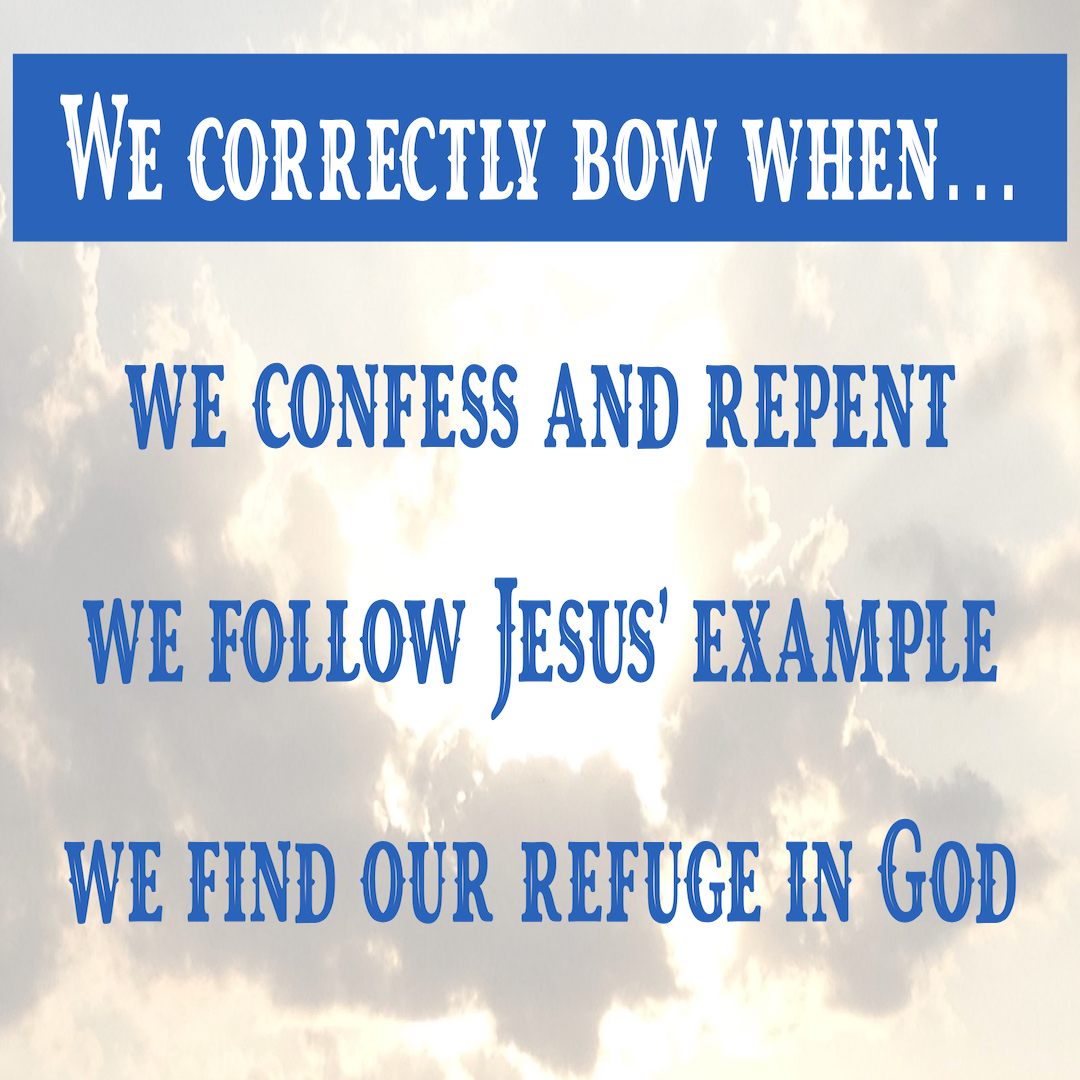
So we bow to the King when…

  • …we acknowledge, confess, and repent of our sins (vv. 3-5; Psalm 19:12, 69:5)
  • …we follow the example of Jesus when we’re shoved around (1 Peter 2:21-23)
  • …find our refuge solely in God (v. 1; c.f. 2:12; Ephesians 6:12; James 4:7)

Our best response in troublesome times—when you feel like you are being shoved around—is to fall to your knees in reverence to the King of kings (v. 17)! The beloved of the Lord shall dwell in safety by Him; He covers him all the day long, and makes His dwelling between his shoulders (Deuteronomy 33:12 AMPC). 

If you’ve missed any of the other messages in our series looking at the royal psalms, you can catch up by clicking here. 

►► Would you please prayerfully consider supporting this ministry? My Patreon supporters get behind-the-scenes access to exclusive materials. ◀︎◀︎
A Lost Culture Of Reverence

Listen to the podcast of this post by clicking on the player below, and you can also subscribe on AppleSpotify, or Audible. 

There are several psalms that are regal in their focus—talking about the King’s coronation, or the King ruling on His throne, or the ultimate victory of the King that is coming in the future. Although these royal psalms are extolling God as King, many of these psalms use King David as an object lesson. The idea is seeing how a man after God’s heart (1 Samuel 13:14) became the standard by which all other kings were measured: 

  • Asa did what was right in the eyes of the Lord, as his father David had done (1 Kings 15:11) 
  • Amaziah did what was right in the eyes of the Lord, but not as his father David had done (2 Kings 14:3) 
  • Unlike his father, Ahaz did not do what was right in the sight of the Lord, as his father David had done (2 Chronicles 28:1) 

(Check out all of the Scriptures in this post by clicking here.)

The people followed their king in both righteousness and evil. They were fiercely loyal to their monarch. We don’t really get that loyalty today. “We’re Americans,” we cry, “We live in the land of the free and don’t ever bow our knee to a king!” 

That’s an appropriate response for those living in a democratic republic, but we would do well to learn to bow our knee to a true King. 

After the United States Constitution was adopt adopted, Elizabeth Willing Powel asked Benjamin Franklin, “Well, Doctor, what have we got, a republic or a monarchy?“ Franklin replied, “A republic, if you can keep it.” Franklin went on to say, “In these sentiments, Sir, I agree to this Constitution, with all its faults, if they are such; because I think a General Government necessary for us, and there is no form of government, but what may be a blessing to the people if well administered; and believe further, that this is likely to be well administered for a course of years, and can only end in despotism, as other forms have done before it, when the people shall become so corrupted as to need despotic government.” 

Because of our defiance as free people in our government, we have become lacking in our loyalty, which shows itself in a lack of proper reverence or respect. Just listen to how people talk so disrespectfully or even hatefully about those in “the other political party.” Benjamin Franklin also said, “Only a virtuous people are capable of freedom. As nations become corrupt and vicious, they have more need of masters.” 

Where are the days of the armor bearer who said to Prince Jonathan, “Do all you have in mind. I’m with you heart and soul,” even though Jonathan was proposing an impossible task? Or the loyalty of the men around David who heard him sigh about the water in Bethlehem, and they put their lives at risk to bring him a drink? This was even before he was on a throne, and yet they showed their loyalty to him. I fear that our lost culture of reverence for earthly leaders has eroded our reverence for the King of kings, and vice versa. 

The first royal psalm (Psalm 2) practically open the Psalter. This psalm calls us to consider the differences between earthly kings and the King of kings.  

Notice that earthly kings “conspire”—they angrily boast and rage. They plot (v. 1b) and scheme (AMPC). They take their stand together (v. 2). 

Against Whom? Against the LORD (Jehovah) and against His Anointed One (the Messiah)! 

Much like the fiercely independent people I described us as earlier, these earthly rulers want to call their own shots—they don’t want to take directions from anyone else because they think they know best (v. 3). But notice in v. 1 that the peoples have followed their leaders in their plot. 

God doesn’t rage at them, but He laughs, He scoffs, He rebukes, and the people are terrified when they realize that they cannot overcome Him. In v. 1 we see their plots are “in vain.” 

There is nothing men can do—no matter how powerful they may seem or how many of them “take their stand…together”—to thwart or even delay the plans of Jehovah. 

All of History is His Story. Notice the phrase that God speaks, “I have … I will” (in vv. 6-7; c.f. Daniel 4:25). 

In vv. 7-9 God speaks to His Son—the Messiah, the Anointed One, the King of kings. We hear this repeated in Acts 13:32-33 and in God’s own voice in Matthew 3:17. Then we see the fulfillment of this in passages like Philippians 2:9-11 and Revelation 11:17-18. 

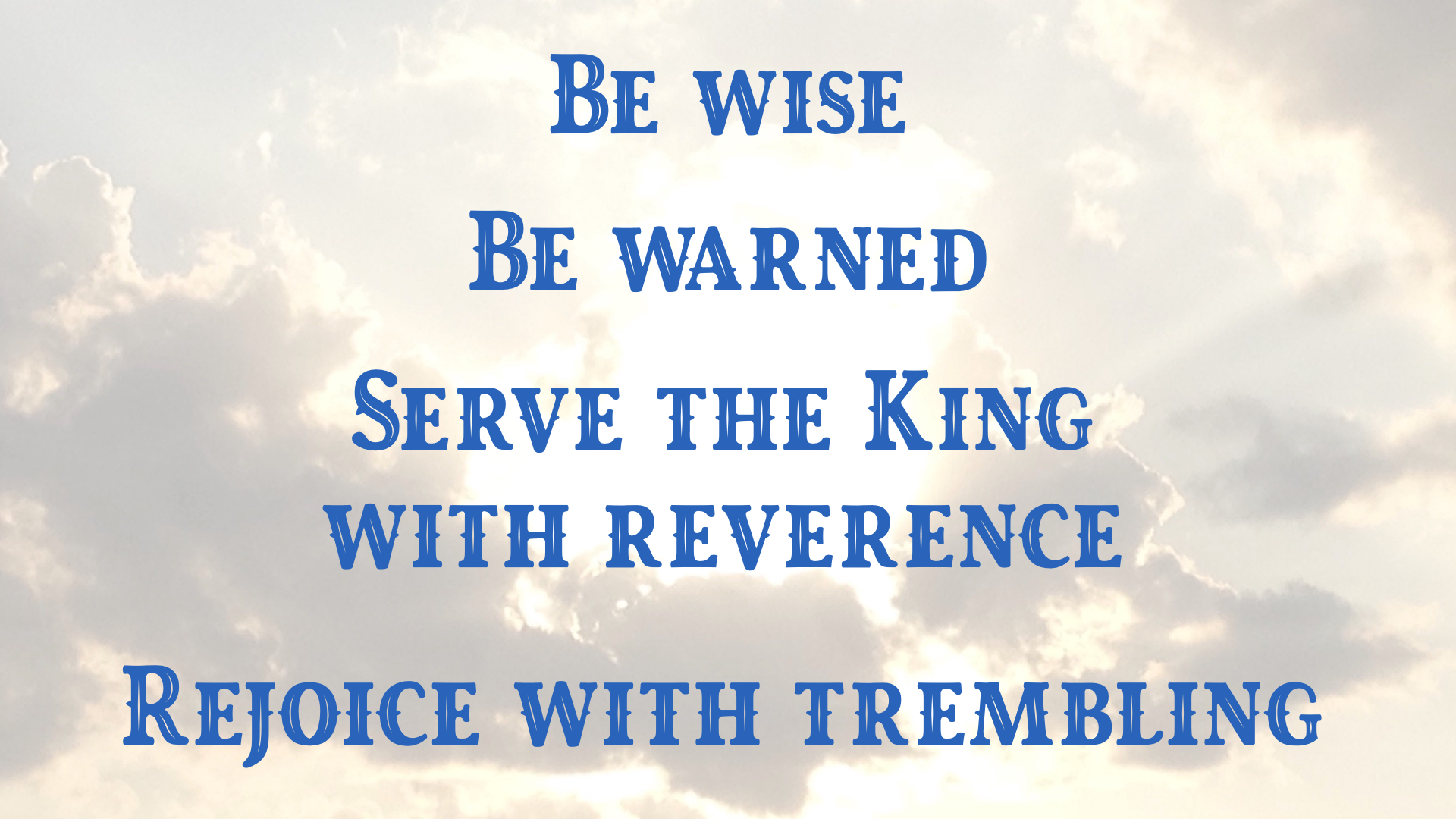
This royal psalm ends with an important conclusion: Therefore (vv. 10-12): 

  • Be wise 
  • Be warned 
  • Serve the King with reverential fear 
  • Rejoice with trembling  
  • Kiss the Son with absolute loyalty and joyful reverence 

Check out another “therefore” in Philippians 2:12-16. This is a call for righteous, reverent living for those who have acknowledged Jesus as their King. It’s only those who live this way who will know the blessed refuge in Him that is unshakable for ever and ever! 

Follow along with our look at all of the royal psalms by clicking here. 

►► Would you please prayerfully consider supporting this ministry? My Patreon supporters get behind-the-scenes access to exclusive materials. ◀︎◀︎
All Hail King Jesus

The Bible closes with a vivid picture of Jesus as the undisputed King of kings, and we look forward to that time when all creation bows before Him. Even more so, we cannot wait to be with our King for ever and ever! 

The psalmists of Israel also foresaw the coming of this King, especially in the example they had in their King David. Many of the poetic words they penned esteemed Jesus as the King for Whom they longed. David himself not only saw the future coming of the Eternal King, but he also looked back in time to see Jesus reigning as King before time began. 

It is these royal psalms that we will be studying as we celebrate the first arrival on Earth of our King and as we anticipate the second coming of our Royal Majesty. The more clear our vision is of this King, the more we will worship Him, follow Him, and invite others to know Him as their own Lord and Master. 

Please join us at Calvary Assembly of God as we explore the beautiful, reverent, and awe-inspiring description of our King of kings in the Book of Psalms. 

Long Live The King Of Kings

Listen to the podcast of this post by clicking on the player below, and you can also subscribe on AppleSpotify, or Audible.

Throughout human history, whenever a king died, the people would say something like, “The king is dead. Long live the king!” They would say this because the next king ascended to the throne immediately after his predecessor died. 

Except when a nation had been defeated, the cry, “The king is dead” was unanswered by, “Long live the king!” 

Israel must have felt like this. After being defeated by Nebuchadnezzar and spending 70 years in exile, it appeared to many that the line of kings was broken. Even after retuning to their homeland, Israel continued to live under the thumb of other powerful nations. 

And yet, some still clung to the glimmer of the promise God had made about an eternal King sitting on Jerusalem’s throne. 

The First Advent of Jesus revealed to us in the Gospels reassures us that the promise of an eternal King is true. Jesus came to earth to reveal His majesty to us. 

The First Advent is so important because it bolsters our faith for the imminent Second Advent when Jesus will return as the King of kings! Christmas is a great time to be reminded that even now we can confidently declare, “Long live the eternal King of kings!” 

I would like to invite you to join us for this encouraging series of messages of faith, hope, and eternal encouragement every Sunday during December. Check out any messages you may have missed: