Thursdays With Oswald—The Power Of Your “Say So”

Oswald ChambersThis is a weekly series with things I’m reading and pondering from Oswald Chambers. You can read the original seed thought here, or type “Thursdays With Oswald” in the search box to read more entries.

The Power Of Your “Say So” 

     Many of us are on the verge of a spiritual vision the realization of which never becomes ours because we will not open our mouths to “say so.” We have to “say so” before we “feel so.” … If I will not confess with my mouth what I believe in my heart, that particular phase of believing will never be mine actually. Assurance of faith is never gained by reserve but only by abandonment. 

     If you want to encourage your own life in spiritual things, talk about them. … If you have not received, ask; if you have not found, seek; if the door is shut, knock. When you are up against the barriers, the way out is to “say so,” then you will be emancipated, and your “say so” will not only be an emancipation for yourself, but someone else will enter into the light.

From The Place Of Help

Oswald Chambers is urging Christians to not just believe what they believe, but say what they believe. Say it out loud!

The tongue has the power of life (Proverbs 18:21).

For the accuser of our brothers and sisters, who accuses them before our God day and night, has been hurled down. They triumphed over him by the blood of the Lamb and by the word of their testimony (Revelation 12:10-11).

O give thanks to the Lord, for He is good; for His compassion and lovingkindness endure forever! Let the redeemed of the Lord say so (Psalm 107:1-2).

You need to hear your “say so” in your own ears to energize your faith. The enemy needs to hear your “say so” to defeat him. Others in need around you need to hear your “say so” to encourage them.

Don’t keep quiet! “Assurance of faith is never gained by reserve but only by abandonment.” Abandon your reserve and “say so” for all to hear!

Thursdays With Oswald—The Feast Is Just Beyond The Fight

Oswald ChambersThis is a weekly series with things I’m reading and pondering from Oswald Chambers. You can read the original seed thought here, or type “Thursdays With Oswald” in the search box to read more entries.

The Feast Is Just Beyond The Fight 

     The feast is just beyond the fight; when you have been through the fight, there is the wondrous joy and triumph of the feast. We learn to thank God for the trial of our faith because it works patience. The thing that is precious in the sight of God is faith that has been tried. Tried faith is spendable; it is so much wealth stored up in heaven, and the more we go through the trial of our faith, the wealthier we become in the heavenly regions. … 

     We are so impatient—“I thought God’s purpose was to make me full of happiness and joy.” It is, but it is happiness and joy from God’s standpoint, not from ours. God always ignores the present perfection for the ultimate perfection. … 

     God gives us a new revelation of His kindness in the valley of the shadow.

From The Place Of Help

The Apostle James said essentially the same thing when he wrote—

Consider it nothing but joy, my brothers and sisters, whenever you fall into various trials. Be assured that the testing of your faith through experience produces endurance leading to spiritual maturity, and inner peace. And let endurance have its perfect result and do a thorough work, so that you may be perfect and completely developed in your faith, lacking in nothing. (James 1:2-4)

If you’re in a fight, stay in the fight. God has a great reward for you!

The Non-Christmas Christmas Carol

No more tearsImagine that I invited you to my house for a Christmas party. When you arrived, I greeted you at the door with a cheerful hello and warmly welcomed you into my home. But as you hung out with the other guests, you might begin to wonder if we were truly celebrating Christmas. After all, when you looked around my house, you saw no Christmas tree, no ornaments, no wrapped gifts, no mistletoe, no Christmas stockings, no manger scene. You might be tempted to say that you were invited to a non-Christmas Christmas party! (By the way: my house IS fully decorated for the season!)

One of our 300-year-old Christmas carols sounds remarkably like my make-believe party. Joy To The World has no mention of angels, no wisemen, no manger, no nativity scene, no virgin birth, no star in the east. It seems like a non-Christmas Christmas carol! 

That’s because at this time of year, Christians aren’t celebrating Christmas, but we’re celebrating Advent. Actually we’re celebrating both Advents. 

Jesus was born in a Bethlehem manger (His First Advent), but He is also coming again to bring all of earth’s history to a close (His Second Advent). So we celebrate the First Advent, and then look with hopeful anticipation to the Second Advent. That’s exactly what Joy To The World does!

Each of the stanzas of this well-known hymn looks forward with joy to Christ’s ultimate fulfillment of all the prophesies of the Bible. The final joy comes when He reigns as King of Kings and Lord of Lords. But we can still live with joy right now!

The third stanza of this hymn says that Christ has come to make His blessings known far as the curse is found. The Apostle Paul says the same thing—sin used to reign, but the grace of God far exceeds the thorns of sin (see Romans 5:19-21; 6:8-12).

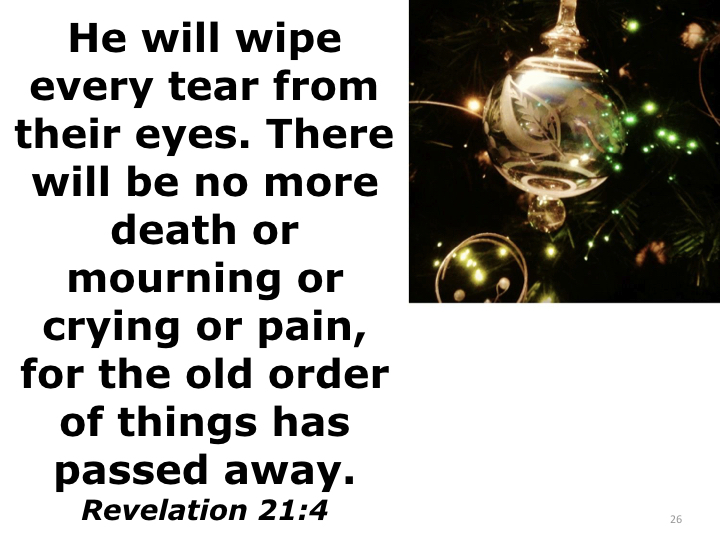
Our ultimate joy comes at the Second Advent of Christ when “He will wipe away every tear from their eyes. There will be no more death or mourning or crying or pain, for the old order of things has passed away” (Revelation 21:4).

So the next time you hear the non-Christmas Christmas carol Joy To The World, be reminded that it’s not Christmas we are celebrating, but Christ’s First Advent. And it’s not some shapeless, indefinable future that awaits us, but we can live in the joy of anticipating Christ’s Second Advent.

Check this out—

If you have missed any of the messages in our series The Carols Of Christmas, you can find the full list by clicking here.

6 Facts About Angels

Angels from the realms of gloryAngels play a fairly visible role in the First Advent story. As a result, we can begin to piece together some facts about angels from the biblical accounts. In my series on The Carols Of Christmas, I was looking at Angels From The Realms Of Glory, and there is information about the angels in this carol that is well-support from the Scripture.

  1.  Angels were created before the Earth was created, and they celebrated as God created our universe (Job 38:4-7). The Christmas carol says, “ye who sang Creation’s story now proclaim Messiah’s birth,” which we see in Luke 2:8-14.
  2. Angels are messengers sent from God, and they carry a message from God to turn people toward God (Daniel 10:12; Matthew 1:20-23; Luke 1:11-20, 26-38). In the Christmas carol they remind us to leave our contemplations and “seek the great Desire of nations.”
  3. Angels are not to be worshiped, because they are created beings. Lucifer’s desire to be worshipped is what led to his rebellion against God and expulsion from Heaven (Isaiah 14:13-14). And he still tries to appear today as an angel of light (2 Corinthians 11:14).
  4. Angels long to look into the Gospel that humans can know by personal experience (1 Peter 1:12).
  5. Angels know that Christ’s First Advent is a reminder of His Second Advent (Acts 1:10-11; see also 1 Thessalonians 4:13-18).
  6. We have been given an angelic responsibility to tell others about Christ’s First and Second Advents (notice that the messengers in the churches are called angels in Revelation 2:1, 8, 12, 18; 3:1, 7, 14; 22:16). The carol reminds us that it’s “all creation” (that includes us!) that joins the angels in praising God.

One of the biggest lessons we need to learn from this Christmas carol, and the corresponding verses about angels, is that we aren’t just celebrating the First Advent. We are anticipating and looking forward to the Second Advent as well! 

Next Sunday we will be continuing our look at the rich messages in the familiar Christmas carols. Please join me!

In the video below, we had some slight technical difficulties. But it clears up about the 5-minute mark, so hang in there!

If you have missed any of the messages in our series The Carols Of Christmas, you can find the full list by clicking here.

Holy Rescuers

QophThe Hebrew Aleph-Bet is nothing like the English alphabet. First of all, in English, letters are just letters; they don’t really mean anything. In Hebrew, every letter has its own definition and imagery. Second, in the English alphabet, the order of the letters doesn’t have any significance; but the order in Hebrew is of vital importance.

It is significant that qoph (vv. 145-152) comes after tsadhe (vv. 137-144) in Psalm 119. Tsadhe tells us about God’s righteousness, and how the Word gives us a reliable way to approach All-Righteous God as a humble, obedient servant. This must come before qoph, which encourages us to stay in the presence of Holy God for a specific reason.

Qoph is the second of two Hebrew letters that has two pen strokes that don’t touch. This is a reminder for us to stay close to God. But qoph is the only Hebrew letter that goes below the line. This is a reminder that God came down to rescue us!

Qoph is the first letter in the Hebrew word for holy. When Isaiah saw God, and heard the angels shouting, “Holy, Holy, Holy is the Lord God Almighty,” he saw himself unworthy to come into God’s presence, until his sin had been atoned for. After that, he was ready to be sent out as God’s messenger. (see Isaiah 6:1-8).

In the last book of the Bible, the picture in Heaven is similar, with angels still crying, “Holy!” (Revelation 4:8). As Christians, Jesus Christ has become our Atonement, so we can approach holy God’s throne with humble confidence.

Not only that, but Jesus sent us out as holy witnesses. He sent us “below the line.” Just like He came down to rescue us, He has commissioned us as holy rescuers (Proverbs 24:11-12; Jude 21-25).

As you stay close to God’s holiness, you become a more effective witness for Christ, a holy rescuer! What a privilege to be used by God in this way.

If you would like to watch the message I delivered yesterday on being holy rescuers, check this out—

If you have missed any of the messages in our P119 series, you can access them all by clicking here.

T.M. Moore On Prayer

T.M. MooreThen the angel took the censer, filled it with fire from the altar, and hurled it on the earth; and there came peals of thunder, rumblings, flashes of lightning and an earthquake. (Revelation 8:5)

Commenting on this verse, noted theologian T.M. Moore wrote—

“What the angel threw to the earth were the prayers of the saints, offered to God as a sweet offering of incense for His pleasure (cf. Psalm 141:1-2; Revelation 5:8). God intends the prayers of His people to fill the earth, to pervade it everywhere and at all times, to make the entire earth a sweet offering to Him, and to bring about the earth-shaking realization of His will (cf. Revelation 4:5), is this the way we pray? Are we as earnest, constant, and resolute about prayer as God intends we should be? Do we believe for our prayers what God holds out as expectations for them? We must allow Scripture to teach us how to pray, for then our prayers will be filled with holy fire, great expectations, and emboldening power to guide us in our daily lives. Lord, teach us to pray!” —T.M. Moore (emphasis added)

We have our monthly prayer time this Sunday at 5pm. If you are in the area, I’d love to have you join us. If you cannot be with us, please comment below if you have a prayer request and we will be sure to lift your need up to God in prayer.

An End To Tears

No more tearsI was asked the age-old question: Why is there suffering and pain? This is usually accompanied by the other often-pondered question: Why do bad things happen to good people?

I’m not sure that I can answer that one, because I’m not a “good” person. I’m a sinner. I’ve messed up more time than I can count, and it is only by God’s mercy that His righteous judgment hasn’t consumed me.

Here’s what I do know:

  • God loves me so much that He sent His Son to rescue me—John 3:16-17
  • I am of immeasurable value to my Heavenly Father—Luke 12:6-7
  • Suffering on earth is temporal; rewards in Heaven are eternal—Romans 8:18
  • God develops something in my through suffering that I could learn in no other way—Romans 5:3-4
  • God can be glorified through my suffering if I will let Him—John 9:1-3; 11:3-6

I also know that Jesus is Perfection. If anyone ever deserved to not have anything bad happen to them, it was Him. And yet He was rejected by His family (Mark 3:21), betrayed by one of His companions (John 13:21), abandoned by all His followers (Mark 14:50), and even felt the sting of God forsaking Him (Mark 15:34).

What makes this even more startling to me is that He knew all of this was coming (Isaiah 53:3; Luke 9:22; Matthew 26:54-56). But He went through all of that pain because His suffering meant He could become the prefect Intercessor and Mediator for our suffering (see Hebrews 5:7-9; 4:14-16).

Jesus us told us, “In this world you will have trouble. But take heart! I have overcome the world” (John 16:33).

And the last book in the Bible promises that eventually God’s children will have every tear wiped away! There will be no more death, no more mourning, no more crying, and no more pain! (Revelation 21:4)

In the midst of your pain, hold tightly to the One Who loves you so much and is interceding for you!

If you are near Cedar Springs this coming weekend, and you don’t have a home church, I would love for you to join us as we continue to learn about the greatest words ever spoken.

What God Is Building

Relativity by M.C. EscherI love the drawings of M.C. Escher. But some of his sketches are clearly optical illusions we all know couldn’t work in the real world. We don’t have to be architects or engineers or builders to know that for a building to be functional it has to have (1) a solid foundation, (2) it must be built with quality materials, and (3) it must be constructed by someone who knows what he/she is doing.

The Apostle Paul tells us that (1) Jesus Christ is the cornerstone of the sure foundation, (2) you and I—God’s saints—are the quality building materials that are being used, and (3) the Holy Spirit knows exactly what He is doing as He joins us together.

A cornerstone is the first stone set in the construction, the reference point for all other stone, which determines the position of the entire structure. Christ Jesus Himself is the cornerstone of His Church (Ephesians 2:20b). Orientated to that cornerstone we have the foundation of the apostles and prophets (2:20a).

This foundation is the Word of God (2 Peter 1:19-2:3 and 2 Timothy 3:14-4:5). We dare not try to replace, nullify, update, or change His Word. Not would this cause the foundation to crumble, but there are dire consequences for the one who tries to do so (Revelation 22:18-19).

Our foundationOn this foundation, God is constructing three things, each one growing in its level of intimacy with Him and with the surrounding saints:

  • God’s household (Ephesians 2:19)—this Greek word means a family home.
  • the whole building (Ephesians 2:21a)—this is a specific part of the family home used for prayer and fellowship.
  • a holy temple (Ephesians 2:21b)—this is the same word used for the Holy Place and Holy of Holies in the tabernacle.

God’s Presence dwells in us individually, but collectively we make a more powerful statement (1 Corinthians 3:16). There is a far greater testimony to the world when individuals willingly and actively allow themselves to be built together; when Christians give up their personal agendas to say, “I want to be a part of something bigger than me—I want to be a part of we.”

We must study God’s Word to make sure we are building on the same foundation. We must allow our lives to be quality building materials. We must allow the Holy Spirit to build us together through prayer and fellowship! This becomes the fulfillment of the prayer Jesus Himself prayed for us (John 17:20-23).

This was the last message (for this time) in our series on the Book of Ephesians. I hope to be able to continue this study next year.

7 Bible Study Ideas From D.L. Moody

Pleasure & ProfitAs I read D.L. Moody’s book Pleasure & Profit In Bible Study, I made note of several ideas that could stimulate a great Bible study. Check out my review of this book by clicking here, then check out these great study-starters:

“If you are impatient, sit down quietly and commune with Job. If you are strong-headed, read of Moses and Peter. If you are weak-kneed, look at Elijah. If there is no song in your heart, listen to David. If you are a politician, read Daniel. If you are getting sordid, read Isaiah. If you are chilly, read of the beloved disciple. If your faith is low, read Paul. If you are getting lazy, watch James. If you are losing sight of the future, read in Revelation of the promised land.” —Richard Baxter 

“Every chapter [of Mark] but the first, seventh, eighth and fourteenth begins with ‘And,’ as if there was no pause in Christ’s ministry.”

“Matthew begins with Abraham; Mark with Malachi; Luke with John the Baptist; but John with God Himself. Matthew sets forth Christ as the Jew’s Messiah. Mark as the active worker. Luke as a man. John as a personal Savior.”

“[In John’s Gospel] the word repent does not occur once, but the word believe occurs ninety-eight times.”

“Dr. A. T. Pierson says: Let the introduction cover five P’s; place where written; person by whom written; people to whom written; purpose for which written; period at which written.” 

“Some time ago a man wanted to take my Bible home to get a few things out of it, and when it came back I found this noted in it:

  • Justification, a change of state, a new standing before God.
  • Repentance, a change of mind, a new mind about God.
  • Regeneration, a change of nature, a new heart from God.
  • Conversion, a change of life, a new life for God.
  • Adoption, a change of family, new relationship towards God.
  • Sanctification, a change of service, separation unto God.
  • Glorification, a new state, a new condition with God.”

“I was wonderfully blessed by taking the seven ‘Blesseds’ of the Revelation. … Or you may take the eight ‘overcomes’ in Revelation…. I have been greatly blessed by going through the ‘believings’ of John. Every chapter but two speaks of believing. … Take the six ‘precious’ things in Peter’s Epistles. And the seven ‘walks’ of the Epistle to the Ephesians. And the five ‘much mores’ of Romans 5. Or the two ‘receiveds’ of John 1. Or the seven ‘hearts’ in Proverbs 13, and especially an eighth. Or ‘the fear of the Lord’ in Proverbs.” 

“No scripture is exhausted by a single explanation. The flowers of God’s garden bloom, not only double, but seven-fold: they are continually pouring forth fresh fragrance.” —Charles Spurgeon

11 Quotes From “Pleasure & Profit In Bible Study”

Pleasure & ProfitD.L. Moody’s book Pleasure & Profit In Bible Study is a Bible study rejuvenator for both the novice and experienced reader of the Bible. You can read my full book review by clicking here. Below are some of the quotes I especially appreciated in this book.

“The more you love the Scriptures, the firmer will be your faith. There is little backsliding when people love the Scriptures.” 

“I believe we should know better how to pray if we knew our Bibles better. … And if we feed on the Word, it will be so easy then to speak to others; and not only that, but we shall be growing in grace all the while, and others will take notice of our walk and conversation.”

“It is a very interesting fact that of the thirty-nine books of the Old Testament, it is recorded that our Lord made quotations from no less than twenty-two. … About 850 passages in the Old Testament are quoted or alluded to in the New…. In the Gospel by Matthew there are over a hundred quotations from twenty of the books in the Old Testament. In the Gospel of Mark there are fifteen quotations taken from thirteen of the books. In the Gospel of Luke there are thirty-four quotations from thirteen books. In the Gospel of John there are eleven quotations from six books. In the four Gospels alone there are more than 160 quotations from the Old Testament. … In Paul’s letter to the Corinthians there are fifty-three quotations from the Old Testament; sometimes he takes whole paragraphs from it. In Hebrews there are eighty-five quotations, in that one book of thirteen chapters. In Galatians, sixteen quotations. In the book of Revelation alone, there are 245 quotations and allusions.”

“It is very important that every Christian should not only know what the Old Testament teaches, but he should accept its truths, because it is upon this that truth is based. Peter said the Scriptures are not given for any private interpretation, and in speaking of the Scriptures, referred to the Old Testament and not to the New. … If the Old Testament Scriptures are not true, do you think Christ would have so often referred to them, and said the Scriptures must be fulfilled? When told by the tempter that He might call down the angels from heaven to interpose in His behalf, he said: ‘Thus it is written.’ Christ gave Himself up as a sacrifice that the Scriptures might be fulfilled. Was it not said that He was numbered with the transgressors? And when He talked with two of His disciples by the way journeying to Emmaus, after His resurrection, did He not say: ‘Ought not these things to be? am I not to suffer?’ And beginning at Moses He explained unto them in all the Scriptures concerning Himself, for the one theme of the Old Testament is the Messiah. … Christ referred to the Scriptures and their fulfillment in Him, not only after He arose from the dead, but in the book of Revelation He used them in Heaven. He spoke to John of them on the Isle of Patmos, and used the very things in them that men are trying to cast out. He never found fault with or rejected them.”

“Prophecy is history unfulfilled, and history is prophecy fulfilled. … Between 500 and 600 hundred Old Testament prophecies have been remarkably and literally fulfilled, and 200 in regard to Jesus Christ alone. Not a thing happened to Jesus Christ that was not prophesied from 1700 to 400 years before He was born.”

“Someone has said that there are four things necessary in studying the Bible: Admit, submit, commit and transmit. First, admit its truth; second, submit to its teachings; third, commit it to memory; and fourth, transmit it. If the Christian life is a good thing for you, pass it on to some one else.”

“Application to the Word will tend to its growth within and its multiplication without.”

“We learn that Christ prayed when he was baptized, and nearly every great event in His ministry was preceded by prayer. If you want to hear from Heaven you must seek it on your knees.”

“If you want to reach people that do not agree with you, do not take a club to knock them down and then try to pick them up. When Jesus Christ dealt with the erring and the sinners, He was as tender with them as a mother is with her sick child.” 

“Let us go to the Bible and see what that old Book teaches. Let us believe it, and go and act as if we believed it, too.”

“But we can not be ready if we do not study the Bible. So whenever you hear a good thing, just put it down, because if it is good for you it will be good for somebody else; and we should pass the coin of heaven around just as we do the coin of the realm.”