Listen to the podcast of this post by clicking on the player below, and you can also subscribe on Apple, Spotify, or Audible. Check out the video content in this post by clicking here.
It’s a good question: Why would I put all of this effort into writing yet another book? The simple answer: This book basically wrote itself!
In their book Spiritual Leadership, Henry and Richard Blackaby wrote, “Biblical praying can be the most challenging, exhausting, laborious, and yet rewarding thing leaders do. … More than any other single thing leaders do, their prayer life determines their effectiveness.”
This is exactly why I wrote Amen Indeed—I wanted to help shepherd leaders with this laborious yet rewarding discipline. You can pick up a copy by clicking here.
Listen to the podcast of this post by clicking on the player below, and you can also subscribe on Apple, Spotify, or Audible. Check out the video content in this post by clicking here.
Gentleness is both a safe word and an unsafe word, which makes gentleness such an indispensable trait for shepherd leaders. Check out this clip from my time on the Leading from Alignment podcast.
Here is an excerpt from the chapter that Jim Wiegand was referencing—
I mention this fruit of gentleness specifically because I think it is one of the least understood and one of the most powerful virtues in a shepherd’s life. If you go to a modern dictionary for a definition of gentleness, you might read words like kind, moderate, calm, and tame. If you dig a little deeper into the synonyms, you will discover words like meek and mild.
The Greek philosophers thought and taught extensively about the virtues. For them a virtue was a healthy tension or a balanced response between two opposite extremes. Many philosophers referred to a virtue as a “golden mean” between those extremes. For instance, the virtue of generosity might be described as the golden mean between thriftiness and lavishness; courage could be the golden mean between rashness and timidity; and purity the golden mean between prudishness and immorality.
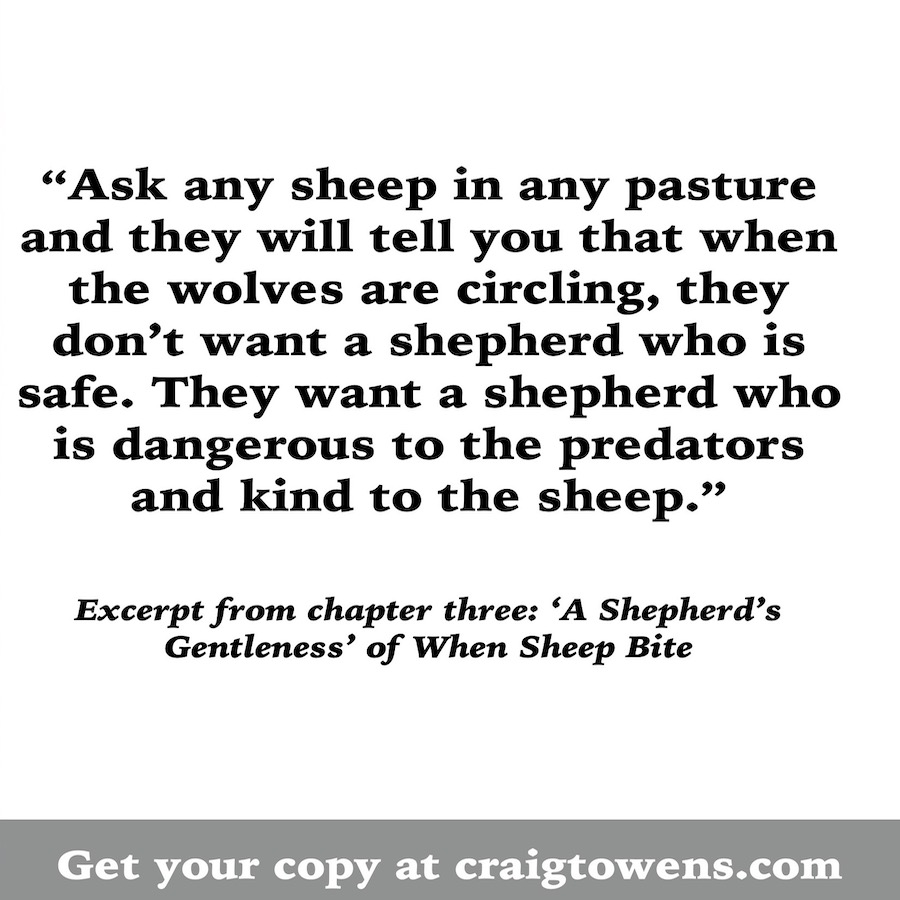
The gentleman or gentlewoman is not a pushover. They are strong. They know what they believe in and are passionate for the truth. They know when to fight and how to fight. So gentleness becomes the golden mean between a pacifist and a fighter. Gentleness is a lion with powerful muscles, razor-sharp claws, and a jaw strong enough to snap a bone who knows how to velvet its paws and use its nearly invincible strength as a means for good. —from Chapter 3: “A Shepherd’s Gentleness”
Listen to the podcast of this post by clicking on the player below, and you can also subscribe on Apple, Spotify, or Audible.
On the Leading From Alignment podcast, I was discussing my book When Sheep Bite which is about leadership pain. John Opalewski asked me to share some things leaders should consider when they get bit.
On a different podcast, I discussed in more detail the idea in Luke 2:52 about Jesus growing in favor with men. Check out The Pinnacle of a Leader’s Health.
You can get more information on When Sheep Bitehere. And also check out my book of prayer for pastors called Amen Indeed.
Listen to the podcast of this post by clicking on the player below, and you can also subscribe on Apple, Spotify, or Audible.
When people lash out at us—when they bite us—they could be giving us invaluable insight into what is truly in our heart. Before we respond too quickly, we need to take some time for introspection.
Check out this part of my conversation with John Opalewski and Jim Wiegand on the Leading From Alignment podcast.
Chapter 2 of When Sheep Bite is entitled ‘Is God Trying to Get My Attention?’ I tell a story about two similar bites I received from two totally different people who didn’t even know each other. I wrote—
As I drove back across the state, I kept the radio off and my ears open. I could feel the Holy Spirit asking me, “Why do you think two different people have called you the same nasty word?” The only honest answer I could give was, “Because it’s true.”
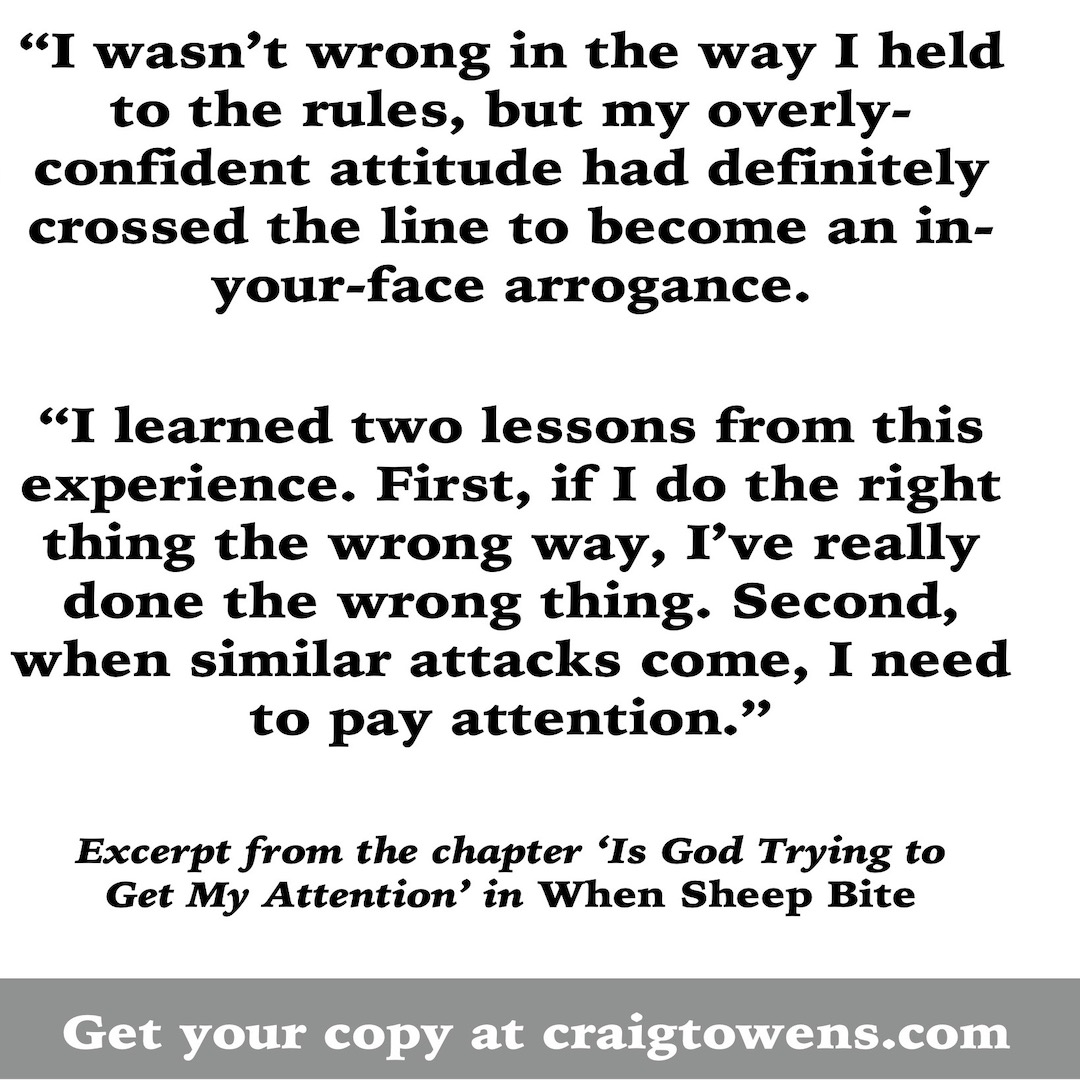
I wasn’t wrong in the way I held to the rules, but my overly-confident attitude had definitely crossed the line to become an in-your-face arrogance. I learned two lessons from this experience. First, if I do the right thing the wrong way, I’ve really done the wrong thing. Second, when similar attacks come, I need to pay attention.
Now, when a painful attack suddenly confronts me, I go to the mirror. Instead of asking, “What’s wrong with them that they would bite me like this?” I go to prayer to ask, “Did I do something that provoked this?” Sometimes I have literally gone into my bathroom, closed the door, and gotten nose-to-nose with myself to ask this question, and then listened for the Holy Spirit to speak to my heart.
My cousin Dick Brogden wrote, “Critics and skeptics are gifts to us, for in their aspersions they often bring to light a brokenness or a liability early on in its development in us. If we are secure enough to ferret out the truth through the condemnation of others, we remain healthy in the long term as our malady is exposed and dealt with before it becomes too serious.”
Remember that we are naturally self-protective, so this time of introspection will need to be supernaturally empowered by the Holy Spirit if we are going to see the true prompter of the attack.
Please check out my book When Sheep Bite to both heal from past bites and prepare yourself for the bites which are inevitably coming in the future.
The closing chapter of my book When Sheep Bite is entitled ‘Faithfulness > Fight or Flight.’ In that chapter I wrote—
Remember that we are all striving to not succumb to the natural fight-or-flight response, but to attain the supernatural response of faithfulness. In this, we have a perfect example in our Good Shepherd.
In the Book of Revelation, Jesus is called the One who is “Faithful” (Revelation 19:11), and Paul says that the Faithful One who has called us will empower us to remain steadfast: “He who calls you is faithful, who also will do it” (1 Thessalonians 5:24 NKJV).…
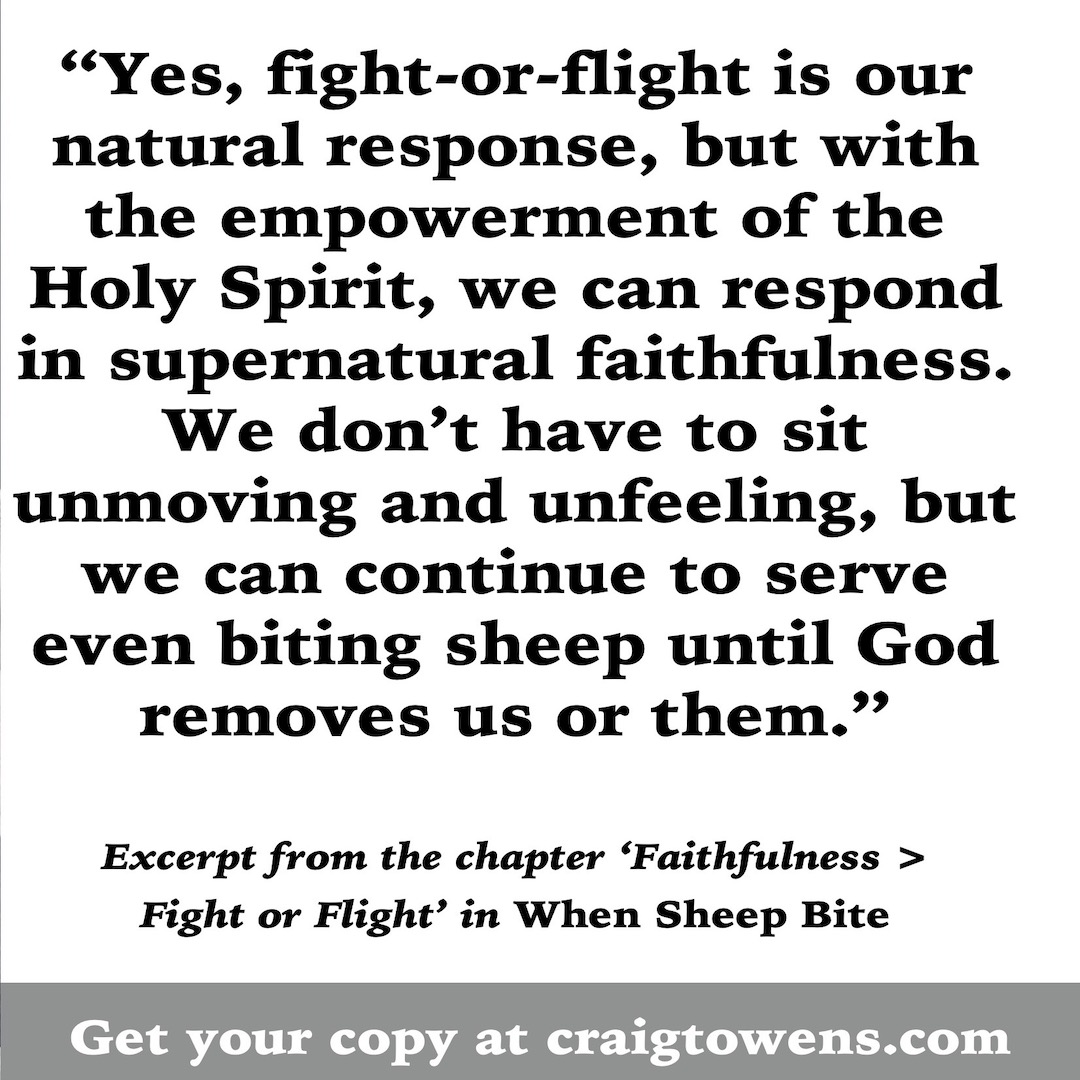
Yes, fight-or-flight is our natural response, but with the empowerment of the Holy Spirit, we can respond in supernatural faithfulness. We don’t have to sit unmoving and unfeeling, but we can continue to serve even biting sheep until God removes us or them.
We glorify God by faithfully serving the sheep He has placed under our care, giving our very best, even if our words and actions are unappreciated or ignored by those we are serving.
If you are in a difficult place in your leadership assignment, I encourage you to check out When Sheep Bite.
Listen to the podcast of this post by clicking on the player below, and you can also subscribe on Apple, Spotify, or Audible.
If leaders say or do the right thing in the wrong way, it really becomes the wrong thing. This is why leaders—especially those who have been sheep-bitten and want to bring corrections—need to take a pause.
In that short moment of reflection, the Holy Spirit can help pastoral leaders respond in a way that will bring restoration, not more pain and possibly division.
I talked about this idea from chapter 2 of my book When Sheep Bite on the Leading From Alignment podcast with John Opalewski and Jim Wiegand.
Listen to the podcast of this post by clicking on the player below, and you can also subscribe on Apple, Spotify, or Audible.
In someways, my new book When Sheep Bite came out of my first book Shepherd Leadership. And yet, in many ways I consider When Sheep Bite to be the prequel of Shepherd Leadership.
Check out this short clip from my interview on the Leading From Alignment podcast with John Opalewski and Jim Wiegand where I try to explain what I mean.
In whatever order you choose to read these books, I have been thrilled to hear back from pastors and other church leaders who have found encouragement from both of them.
You can watch the full Leading Form Alignment interview here.
Listen to the podcast of this post by clicking on the player below, and you can also subscribe on Apple, Spotify, or Audible.
In my book When Sheep Bite, I not only wrote about biting sheep, but I also wrote about wolves dressed in sheep’s clothing, and wolves who aren’t trying to hide themselves at all! How are shepherd leaders to deal with these folks?
That was one of the topics I addressed on the Leading From Alignment podcast with John Opalewski and Jim Wiegand.
In the chapter of my book called ‘Driving Away the Wolves,’ I wrote:
Loving shepherds are constantly among their sheep so that the sheep can know their voice and so the shepherd can know the voice of each individual sheep. This has the two-fold benefit of the sheep knowing which voice is trustworthy, and for you as the shepherd to spot the off-key voice of the “meaningless talk and deception” of those wolves who are hiding out among the sheep.
Listen to the podcast of this post by clicking on the player below, and you can also subscribe on Apple, Spotify, or Audible.
There are some know-it-alls who want to tell pastoral leaders how they should have done things differently. Much like the “armchair quarterbacks” that seem to know all the right calls a team should make, even though they have virtually no experience.
Pastor, pay very little attention to those armchair quarterbacks that would speak into your life!
To put the quote that Jim shared from When Sheep Bite into context, here is the full passage—
Jesus is our perfect example of a Shepherd Leader. His example was to lay it all on the line, regardless of how the sheep were behaving or misbehaving: “I am the Good Shepherd. The Good Shepherd lays down His life for the sheep” (John 10:11). By contrast, Jesus warns us that those who are not willing to put their lives on the line for the sheep are worse than armchair pastors—Jesus calls them mere hired hands: “The hired hand is not the shepherd and does not own the sheep. So when he sees the wolf coming, he abandons the sheep and runs away. Then the wolf attacks the flock and scatters it. The man runs away because he is a hired hand and cares nothing for the sheep” (John 10:12-13).
If I am called to be a shepherd leader, attacks will come from both sheep and wolves. It’s what I do in those hard times that shows whether I am truly called or merely acting as an armchair shepherd.