The Holy Spirit who inspired the words of the Bible is the same Holy Spirit in you. He can illuminate the biblical promises for your prayer time, and He can help you apply the biblical principles to your everyday circumstances. I have lots of new content every week, which you can check out on my YouTube channel.
“Carl M. ‘Daddy” Hanson (1865-1954), a spiritual father to many early Pentecostals on the northern Great Plains, earned his Pentecostal stripes on both sides of Azusa Street. He experienced the Pentecostal distinctive of speaking in tongues in the 19th century, and he became an early leader in the Assemblies of God in the first half of the 20th century.” Check out this mini-biography of this Pentecostal pioneer.
Absolutely astounding! The silk of spider webs has unique properties that medical science is beginning to use in humans. What an amazing Creator we serve!
In my sermon about parenting, I quoted from Proverbs 22:6. Commenting on this verse, Dick Brogden, in Proverbs: Amplified and Applied, wrote, “The principle regarding our children is that the things they are taught early on will give them every opportunity for stability later in life. This reality does not guarantee that they will make right choices (including whether or not to follow Jesus); it does guarantee that they have the resource of wisdom to draw on should they choose. … Whatever their choice, we can rest in the peace that we laid up for them every resource for good. Our peace (regarding our children) comes from what we have done with our heart and resources, not what they have done with theirs.”
Listen to the podcast of this post by clicking on the player below, and you can also subscribe on Apple, Spotify, or Audible.
The events in the Bible are rooted in history. These are actual events in which real people lived in a moment in recorded history. The songs of ascent were sung both pre-exile and post-exile. The post-exile pilgrims were returning to Jerusalem after the edict of King Cyrus (2 Chronicles 36:22-23).
The first pilgrims to go up to Jerusalem after the exile were the rebuilders of both Jerusalem and the temple, and they faced heavy opposition (Ezra 4:1-5; Nehemiah 4:1-3, 7-8). In light of these events, I think the song of ascent in Psalm 125 is especially pertinent to this situation.
The middle verse of Psalm 125 contains a warning to godly people. God’s followers may be tempted to grab earthly political power to try to make things right—to “fight fire with fire.” The phrase “the scepter of the wicked” symbolizes the royal authority of a foreign conqueror. In other words, we might justify using the scepter of the wicked because we think “the ends justify the means.” But notice the warning if we do: “the righteous might use their hands to do evil.”
You can see this in a couple of other biblical translations. The Amplified Bible says, “lest the righteous (God’s people) stretch forth their hands to iniquity and apostasy,” and the New Living Translation says, “the godly might be tempted to do wrong.”
Instead, we are called to look to God for our security. Psalm 125:1-2 sounds like an echo of Psalm 121, in which we are reminded that our God is unshakable, unrivaled, and eternal. Political parties come and go, even evil dictators and tyrannical regimes come and go, but the Sovereign God remains forever. All of History is His story!
Chuck Colson used to frequently remind his audiences, “Salvation does not arrive on Air Force One!”
The motto on our US currency is still accurate: In God we trust! Psalm 125:4 says the same thing: God does good to those who trust Him.
Earlier I mentioned the opposition that Ezra and Nehemiah recorded. Let me also share with you how these God-fearing men instructed the Jewish people to respond. Ezra says that the prophets called them to remember “the name of the God of Israel, who was over them,” and three times Nehemiah records that their response was prayer to God (Ezra 5:1; Nehemiah 4:4, 9; 6:9).
In God we trust, not in political power. On the flip side, Psalm 125:5 warns us that God treats as evildoers those who look to the worldly scepter to try to get ahead.
So when opposition and even persecution come, we should pray to God and ask for Him to remove the scepter of the wicked. Let’s pray for God to put His favor in the hearts of even ungodly leaders. Ezra recognized this when he said—
Praise be to the Lord, the God of our ancestors, who has put it into the king’s heart to bring honor to the house of the Lord in Jerusalem in this way and who has extended His good favor to me before the king and his advisers and all the king’s powerful officials. Because the hand of the Lord my God was on me, I took courage and gathered leaders from Israel to go up with me.(Ezra 7:27-28)
The New Testament calls on Christians to pray for those in governmental leadership over us (1 Timothy 2:1-2). But perhpas you ask, “What exactly are we to pray for these leaders?” Solomon wrote, “The king’s heart is like channels of water in the hand of the Lord; He turns it wherever He wishes” (Proverbs 21:1). So perhaps a God-honoring prayer is to ask for our leaders’ hearts to be moved as King Cyrus’ heart was.
“God is King of kings and ultimately always wins, always gets His way. Even when it seems that earthly authorities continually rebel against the Lord and His Anointed, the reality is that even their most heinous acts are turned against them. It must be very frustrating to be the devil and to constantly see how God turns situations to gospel good and God’s unique glory. God is so wise that He turns the hearts of authorities without them knowing it. Smug on their decaying thrones, the power brokers of this world revel in their supposed autonomy and imagined resistance, never realizing how foolish they look to the angel hosts who are privy to God’s unmatched strategic dominance.”
Let’s never try to fight fire with fire, but let’s turn repeatedly to God in prayer whenever opposition arises against God-fearing people anywhere.
God’s grace is so amazing. It keeps coming in like waves on a shore. God’s grace is unearned by our efforts, undeserved despite our sins, and unending for all of eternity! Check out this full message here. I have lots of new content every week, which you can check out on my YouTube channel.
“The humble servant of God is grateful for God’s past blessings, unashamed of his daily dependence on God, and confidant of God’s loving reply to every new request.” —Craig T. Owens
“There’s no shame in failing. The only shame is not giving things your best shot.” —Robin Williams
I’ve often said that praying, “God, here are my plans; please bless them” is an arrogant prayer. Instead, humility prays, “God, what would You have me do.” Proverbs 19:21 makes this point clearly. In his commentary on The Book of Proverbs, Dick Brogden noted on this verse, “God always gets His way over man’s ideas. In our hubris we think we know better than God, so we either make plans and then ask for His endorsement or we stand in judgment of what He is doing as if He should have asked us to endorse His plans. Folly judges only by results in Machiavellian crudity, but things going right doesn’t necessarily mean they were right, and things going wrong doesn’t necessarily mean we were wrong. Let us remember we are prophets, priests, and proclaimers, not pragmatists.”
“You don’t have to be a fantastic hero to do certain things—to compete. You can be just an ordinary chap, sufficiently motivated to reach challenging goals.” —Sir Edmund Hillary
Speaking of an exemplary work ethic, David Mathis writes, “However firsthand your experience as a soldier, athlete, or farmer, Scripture stands ready to fill in, supplement, recast, or override our personal experiences (or lack thereof) and teach us a Christian work ethic—for our own joy, the good of others, and the glory of Christ.” The biblical text Mathis uses to help us learn this Christian work ethic is 2 Timothy 2:1-7.
Marvin Olasky has a sobering and insightful post entitled “United States of Abortion.” He wrote, “For nearly four centuries, the frequency of abortion in America has depended on how citizens and residents answered five questions.” The five questions—and his five answers—are a mini history lesson on which all Christians should reflect.
“If you are ever inclined to pray for a missionary, do it at once, wherever you are. Perhaps he may be in great peril at that moment.” —Amy Carmichael
From the vastly large solar system to the microscopic level, the beauty and genius of our Creator is seen. A new report published in the journal Nature delves into the complexity of our tiny cilia. Only an all-wise Creator could fashion something so precise!
If you are looking for an easily accessible online library (especially for researching older books), check out the Internet Archive.
Though a professing atheist, Richard Feynman poetically mused that “you might say the ‘hand of God’ wrote that number, and ‘we don’t know how He pushed His pencil.’” What number is that? Physicists call it alpha (α): “That number is 0.00729735256—approximately 1/137. This is the fine-structure constant. It appears everywhere in the equations of quantum physics.” Another remarkable signpost to a magnificent Creator!
Listen to the podcast of this post by clicking on the player below, and you can also subscribe on Apple, Spotify, or Audible.
I read something which is really challenging my leadership paradigm. It’s a challenge to look at successful organizations through the lens of both a servant-hearted leader and a servant-hearted follower.
I shared several videos this week while I was on vacation. If you missed any, you can check them out on my YouTube channel.
A good definition of apologetics is found in Acts 17:2-3. We need to share (1) reasons from Scripture, (2) logical explanations, and (3) verifiable evidence. I have written quite a bit on my blog on the topic of apologetics, including several book reviews of apologetics books that you may want to check out.
“The life we speak over others they will pass on. While it is true that hurting people hurt others, it is just as true that healed people heal others, blessed people bless others, loved people love others, and ‘mercied’ people mercy others—if, that is, they have any sense of gratefulness.” —Dick Brogden, in Proverbs: Amplified and Applied
“The Kingdom of God will be present within us to the extent that we maintain a clean and good conscience. The conscience is the valuing center of the soul. It holds the priorities which serve to clarify and direct both the mind and the heart for Kingdom presence. As thoughts or affections stir in the soul, the conscience reads the Law of God, which is written on the heart and settled in the mind (Romans 2:14-15), and engages the will to act in line with the vision of Christ and the counsel of His Word.” —T.M. Moore
“Value those people who tell you the truth, not just those people who tell you what you want to hear.” —Pat Summitt
Some people claim those with a biblical worldview and lifestyle are “extremists.” I think this chart (I cannot find the author to give credit on this one) explains it well.
“Life without love isn’t worth anything. Justice without love makes you hard. Intelligence without love makes you cruel. Kindness without love makes you a hypocrite. And faith without love makes you a fanatic.” —Mother Teresa
T.M. Moore has a regular series of posts for pastors. This week he shared this, “In his training manual for pastors, Gregory the Great wrote, ‘There are some who investigate spiritual precepts with cunning care, but what they penetrate with their understanding they trample on in their lives: all at once they are teaching the things which not by practice but by study they have learnt; and what in words they preach by their manners they impugn. Whence it comes to pass that when the shepherd walks through steep places, the flock follows to the precipice’ (The Book of Pastoral Rule).” If you are a pastor, I encourage you to check out the Pastor To Pastor posts on The Fellowship Of Ailbe.
On May 22, A.D. 337, Emperor Constantine died. John Stonestreet wrote, “Many Christians think that Constantine was perhaps the worst thing to happen to the Church. They believe he made Christianity the imperial religion, thus leading the Church to compromise with pagan culture, marrying it to state power, and derailing the spread of the Gospel. The Church, they argue, was better off as a persecuted minority.” Please check out this post co-written by Dr. Glenn Sunshine that gives some better historical perspective than perhaps what you have heard previously.
One of the most powerful missions sermons I have heard was preached by Dick Brogden:
An important warning from Axis—What it is: The Surgeon General has issued a warning on the dangers of social media for teenagers. Why the alarm bell is reaching a fever pitch: People have been wary of social media’s impact on developing brains for two decades—so why are highly-visible tone setters, like the Surgeon General and the American Psychological Association, issuing big, sweeping statements now? Part of it could be because we are getting more quality data on how social media shapes a young person’s brain. One newer study that’s been getting some buzz suggests that individuals who received their first smartphone at a later age have better mental health as young adults. Several big bills that aim to protect minors online will be voted on this year as tech giants face increased scrutiny over their safeguards (or lack thereof), for younger users. Kids growing up even a decade from now may encounter a completely different digital landscape when it’s their turn to learn about online literacy.
Shalom—the peace that comes from God—could be defined simply as “nothing missing.” But couldn’t it also be defined as “no one missing”? It sure could! What peace there is when no one is missing from Heaven! Check out more of this message here. And be sure to check out all of my videos on my YouTube channel.
“Despite the moon’s apparently simple shape, uniformitarian scientists have long had great difficulty explaining how it could form by natural processes apart from a supernatural Creator. One Harvard astrophysicist once quipped that the best explanation for the moon’s existence was observational error—the moon doesn’t really exist!” This is a very interesting post from the Institute for Creation Research.
“Do we not miss very much of the sweetness and efficacy of prayer by a want of careful meditation before it, and hopeful expectation after it? … We too often rush into the presence of God without forethought or humility. We are like people who present themselves before a king without a petition, and what wonder is it that we often miss the end of prayer? We should be careful to keep the stream of meditation always running, for this is the water to drive the mill of prayer. … Prayer without fervency is like hunting with a dead dog, and prayer without preparation is hawking with a blind falcon. Prayer is the work of the Holy Spirit, but He works by means. God made man, but He used the dust of the earth as a material. The Holy Ghost is the Author of prayer, but He employs the thoughts of a fervent soul as the gold with which to fashion the vessel. Let our prayers and praises be not the flashes of a hot and hasty brain but the steady burning of a well-kindled fire.” —Charles Spurgeon, in Spurgeon and the Psalms
What a powerful word to pastors from T.M. Moore’s post First Things First. “Pastors sometimes complain that their people don’t seem very hungry or thirsty for the things of the Lord. Sated on the junk food of getting-and-spending, generously ladled over with pop culture, God’s people have little appetite for Christ or His Word. But what about us? Does our hunger and thirst for Christ make them long for the same? Do they see in us that earnest desire to be with the Lord that tells them they’re missing something of great importance? Loving Christ and delighting to be with Him is infectious. If the people we serve see it in us, they’ll want it for themselves, more than anything this world might offer.”
We don’t read about Jesus getting angry that often, but what usually got Him upset was when people in need were being kept from the God who could meet their needs. Sadly, it was usually man-made rules and practices that kept people away. I don’t want to make Jesus angry, so I need to evaluate anything in my life that may be standing in the way of connecting needy people with a need-satisfying God.
“So in our broader culture, people no longer sin; they make mistakes. What about our Christian environment? In our case, sin is not denied. Instead it is often redefined to refer to the more flagrant sins of society. We tend to ignore our own sins of pride, selfishness, gossip, and the like. So, effectively, no one sins anymore. The reason is that we have lost sight of the biblical meaning of sin. Typically, if we are not actually murderers, felons, or adulterers, we tend to think of our common sins as no more serious than a parking violation. We are so used to living with pride, selfishness, envy, gossip, and a whole host of other ‘respectable sins’ that we don’t even think of them as sin. But the fact is that, as serial sinners, we are all as guilty before God as that murderer. You and I sin every day in thought, word, deed, and motive. And whether those sins appear great or small in our own sight, in reality every sin we commit is an act of rebellion against God, a rejection and attempted negation of His sovereignty and rulership over us.” —Jerry Bridges
“Courage is the mastery of fear, not the absence of fear.” —Mark Twain
“A good man leaves an inheritance to his children’s children…” (Proverbs 13:22). In his excellent book Proverbs: Amplified and Applied, my cousin Dick Brogden uses our grandfather as an example of the principle in this verse: “Good has multi-generational implications. My grandfather was an incredibly generous man, and his children, grandchildren, and great-grandchildren have reaped the benefit. I am convinced that one of the reasons my family is so generously provided for is because our ancestor repeatedly gave significant financial gifts to his church, the Billy Graham Association, and missionaries around the world. Contrary to Shakespeare’s pessimism in the mouth of Mark Antony, the good that men do does indeed live after them, it is not interred with their bones.”
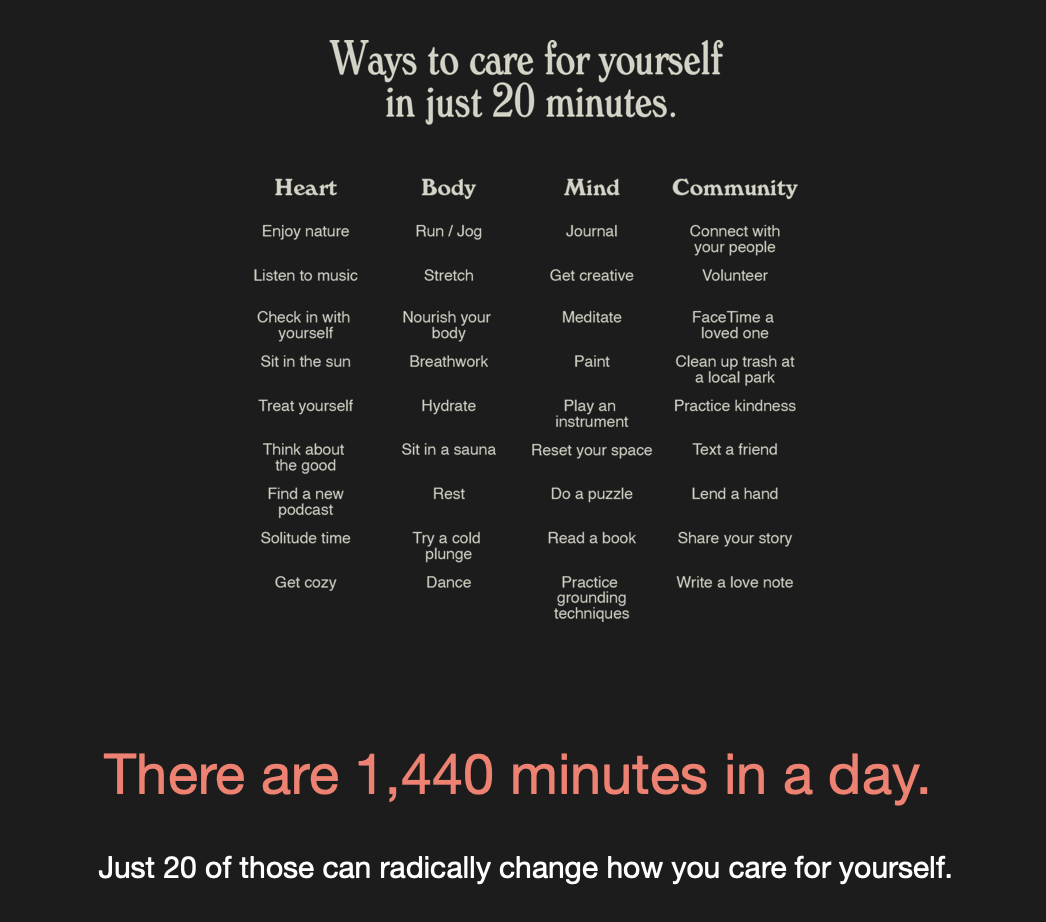
Self-care is vital. Without taking care of yourself first, how will you have any strength to take care of others? To Write Love On Her Arms has a helpful list of self-care items you can do in just 20 minutes per day.
“Knowledge follows understanding. We invert it and think that if we know facts, we are wise. In reality, it is only the wise who can rightly interpret the facts. … There is a posture of humility before God that opens the lowly to the understanding of God. This spirit of understanding becomes the filter with which we sift facts. Facts sifted by understanding lead us to accurate knowledge. Scoffers reject the reality that they need God’s help and God’s Spirit to understand facts. They foolishly think that true knowledge can be gained outside divinely enabled understanding. They have earned their PhD in ultimate idiocy.” —Dick Brogden, in ‘Proverbs: Amplified and Applied’ commenting on Proverbs 14:6
Listen to the podcast of this post by clicking on the player below, and you can also subscribe on Apple, Spotify, or Audible.
I don’t think there’s any arguing that Jesus must have been the healthiest Person to ever live. Dr. Luke records His growth in just one succinct verse: “And Jesus grew in wisdom and stature, and in favor with God and man” (Luke 2:52). Every word of Scripture is inspired, right down to the order the words are penned. So when Luke says first that “Jesus grew in wisdom,” that is our indication that a healthy mind is the foundation for every other aspect of health.
I recently received an email from a Christian brother asking for prayer and counseling in overcoming lust and pornography. I naturally agreed to pray with him, but I also said, “Before I offer you any strategies to try, let me ask you a quick question: What have you already tried to get victory over this?”
He replied, “I’ve tried praying, watching videos on it, and basically saying no to the devil. But the temptation comes when I am weak and I think, ‘I can just try again tomorrow!’ And then I fall into it. I am just tempted at times throughout the day, and sometimes I fight it with prayer, but other times I just fall right into it basically without even trying.”
What my friend is dealing with here is a natural, unconscious response. Our brains like well-worn paths because it’s very easy and comfortable for our minds to automatically respond as they have responded before. As in the case of my friend, it may be heading down a path of lust that leads to pornography. For others, it may be unhealthy choices made in response to certain triggers, or it may be the anger that flares up into biting words when a certain someone pushes your buttons.
We head down that well-worn path unconsciously and automatically. Our immediate response might bring some temporary relief, but usually, we’re not very happy with where we’ve ended up once again.
If we are going to make a new path—or a new, healthier response—we first need to become aware of the well-worn path we automatically go to. So my counsel to my friend who emailed me for help was to start keeping a journal. I wrote back:
Your willpower alone isn’t going to cut it (as you’ve probably realized). Here’s the first step I would suggest: keep a journal of every time you are tempted to lust or porn. Write down what you were feeling, was it day or evening, what was happening just before that, did you have time in prayer and Bible reading that day or not, how did you fight the temptation, were you successful or not? I think as you keep track of these things you will begin to see some triggers and some patterns. Maybe you were physically tired, or lonely, or hungry. Maybe it was a certain person you talked with or a show you watched. Maybe it was after checking your social medias or after a super-hard day at work. When you start to see patterns of what is causing you to go to porn for relief, you can recognize them earlier and head them off before they grip your mind so strongly.
Psychologists call it metacognition when we think about what we’re thinking about—when we think about why we are taking a certain well-worn path again.
We don’t think about our thinking very frequently. We keep thinking along those well-worn paths out of habit, not because we want to go down those paths. This is where the Holy Spirit is invaluable: He helps us see those well-worn paths, identify which paths are unhealthy or unproductive, and then help us begin to carve out a new path.
It’s not just thinking about right things, but thinking rightly about all things—even the painful things or the triggering things.
In Ephesians 4:22-25, Paul counsels us to take off the “old self” and “put on the new self, created to be like God in true righteousness and holiness. Therefore” (and this is an important conclusion) “each of you must put off falsehood and speak truthfully to his neighbor.”
Do you remember that Jesus taught us to love our neighbor as ourselves (Mark 12:28-31)? Paul says we are to speak truthfully to our neighbor, so doesn’t that mean that we have to first speak truthfully to ourselves? Yes, we do! If we are going to make new paths for our mind, we are going to have to talk to ourselves differently.
My cousin Dick Brogden wrote, “A primary theater of spiritual warfare is in our heads and thoughts. The primary weapon of the enemy is deceit. He starts with attractive little lies and half-truths, and works his way up to blatant, ridiculous, perverted nonsense. Winning the battle for truth in the mind is critical to winning the war. If we lose enough of the little skirmishes, we can believe and do any wicked thing. If we daily combat lies with light and truth, we will stand firm.”
The “little lies and half-truths” will keep us trapped on our old, well-worn paths. But identifying those lies, and speaking the truth to them, will help us travel down new paths that lead to health and freedom.
Let the Holy Spirit be your Counselor. Let the Holy Spirit help you think about what you’re thinking about when you’re triggered to unconsciously head down the unhealthy well-worn path. Let the Holy Spirit help you see a new path. And then let the Holy Spirit empower you to stick with it—to keep doing the hard work of blazing a new path.
I am going to build on this series of messages about a Christian’s mental health, but let’s start with this simple prayer:
Holy Spirit, help me make new paths.
As you pray this, listen to how the Holy Spirit will guide you away from the unhealthy, unconscious, well-worn paths, and will then lead you into the new, healthy path that brings you freedom.
Listen to the podcast of this post by clicking on the player below, and you can also subscribe on Apple, Spotify, or Audible.
Being the firstborn, I didn’t have a big brother, but I took being the big brother to my little sister very seriously! Like when young men would come to pick her up for a date, I would meet them on the front porch and say, “I hope you have a really nice evening. Just so you know, I will be home all evening waiting by the phone. You’d better pray that my little sister doesn’t have to call me!” Hopefully, that let my sister know I was ready to protect her whenever she may need it.
Whenever we go into any situation for the first time, there is always a natural fear of the unknown. What’s going to happen? How do I behave? What do I say? How will others treat me? How will I know who to trust? Or even, how will I know what to pray for?
Those unknowns cause fear, and fear prevents intimacy. The Bible says, “There is no fear in love” (1 John 4:18). Where there is love, fear has to leave. But when there is fear, love is pushed aside.
We learned that we can come to God in prayer as a Father—we can bring Him all our fears and concerns and problems—but did you know that we can also come to God in prayer as coming to a Brother?
Jesus loves the fact that we can come to our Abba Father just as He did, which is why He taught us to begin our prayers with, “Our Father in heaven.”
How wonderful it is to have a “big brother” to show us the ropes, to walk with us, to give us his counsel! One that says, “I’ve already been to that high school … I know that employer … I have experience with that kind of relationship … I’ve solved that problem … I’ve tasted that pain.…” That’s exactly what Jesus does for us. He is our perfect Big Brother!
Jesus knows everything we will experience in life. There might be unknown things that we walk into, but they are never unknown to Him. And more importantly, they are never unexperienced by Him. Check out these assuring words from the Book of Hebrews—
Both the One who makes people holy and those who are made holy are of the same family. So Jesus is not ashamed to call them brothers and sisters. … For this reason He had to be made like them,fully human in every way, in order that He might become a merciful and faithful high priest in service to God, and that He might make atonement for the sins of the people. Because He Himself suffered when He was tempted, He is able to help those who are being tempted. (2:11, 17-18)
For we do not have a high priest who is unable to empathize with our weaknesses, but we have one who has been tempted in every way, just as we are—yet He did not sin. Let us then approach God’s throne of grace with confidence, so that we may receive mercy and find grace to help us in our time of need. (4:15-16)
Jesus has been there, done that, and has the scars to prove that He is victorious!
We never have to be at a loss of what to say (John 12:49-50)
We never have to be at a loss of what path to take (John 14:6)
We never have to be at a loss of what prayer to pray (John 16:23)
Charles Spurgeon said, “The Lord Jesus Christ is always ready to take the most imperfect prayer and perfect it for us. If our prayers had to go up to heaven as they are, they would never succeed; but they find a Friend on the way, and therefore they prosper.”
Solomon wrote, “Trust in the Lord with all your heart; do not depend on your own understanding.Seek His will in all you do, and He will show you which path to take (Proverbs 3:5-6).
“We tend to crave God’s explicit direction for the momentous choices of life—marriage, study, career, transition, promotion, change—but sail through a thousand daily choices independent of consultation with Him. Functionally, we act as if we only need God’s help for big things because we can handle the small things without Him. The error in this dichotomy of dependence (thinking we only need God’s help for big decisions) is twofold. First, big decisions are not divorced from small decisions; they are simply the crowning act, the summary of a legion of choices. Second, big decisions are not more important than small decisions. It is the small, simple, silent, serial choices of daily living that make one wise. When we acknowledge the Lord in all the minutia, our course is chosen and our path is set, and we do not stand bewildered at the critical crossroads of life.”
Walking with Jesus as our Brother keeps us free from fear. His perfect love opens our hearts to have intimate conversation with our Heavenly Father. You can trust our Brother to help you with every single decision at every single moment. Let’s learn to lean on Him more!










 Craig T. Owens