The Courage Of A Spiritual Father

Listen to the podcast of this post by clicking on the player below, and you can also subscribe on AppleSpotify, or Audible. 

Father’s Day can bring up a lot of different emotions for folks. Growing up, you might not have had a very good experience with your father or perhaps you didn’t have a father involved with you at all. Maybe you look back on your own history as a Dad and have some regrets. Perhaps you’re an empty-nester now or maybe you’ve never had kids of your own. 

Regardless of your experience with your father or with your own circumstances, I think there are some things that we all naturally expect from our Dads. These are things that we should honor and things we as Dads should strive to demonstrate in our lives.  

Luke introduces us to a man in the Book of Acts named Joseph. We don’t know if he is a biological father or not, but he is presented to us as a spiritual father that we would do well to emulate. In fact, we only know his name is Joseph from our first introduction to him. This man was such an inspiration to so many people that he was given the nickname Barnabas—the name that is used everywhere else in the New Testament. 

When we think of our list of attributes of an ideal father, I think we all look to our fathers for these five things.

(1) Be there when we are getting started. Barnabas was there when Saul (later named Paul) first became a Christian and when the first Gentiles became Christians (Acts 9:26-28; 11:19-23). 

(2) Provide for us financially. Barnabas is the first person mentioned by name that gave a significant and much-needed financial donation to the Church (Acts 4:34-37).  

(3) Help us learn to leave our nest and fly on our own. Barnabas gave Paul his first leadership role in the Church (Acts 11:25-26). 

(4) Step back as we learn to soar on our own. Barnabas took the lead in the first commissioned missionary journey, but then we see him stepping aside for Paul to take the lead (Acts 13:1-2, 13). 

(5) Continue to “be there” for us even after we’ve left the nest. Barnabas also picked John Mark to accompany him and Paul on that first missionary endeavor, but when Barnabas stepped aside for Paul, Mark headed home instead of continuing on their trip. Later on, Barnabas wanted to give Mark another shot, but Paul was strongly against that. As a result, Paul and Barnabas parted company, with Barnabas taking Mark with him. From this point on, Luke doesn’t tell us anything else about Barnabas, but we know that Mark became the first one to write his Gospel account of the life of Jesus and that he became reconciled to both Paul and Peter, becoming an invaluable help to both of them. Although we don’t read what happened, I think it’s a good bet that all of this came about through the encouragement of Barnabas (Acts 13:13, 15:36-40; 2 Timothy 4:11; 1 Peter 5:13). 

(Check out all of the above Scriptures by clicking here.)

The name Joseph means “exalted.” Joseph was born into the tribe of Levi, placing him at the heart of the Jewish faith, yet he risked it all to not only acknowledge Jesus as the Messiah but to be so invested in the Christian Church that they called him Barnabas. Luke tells that his name means Son of Encouragement. 

The word “encourage” literally comes from in + courage—to put courage into someone, to inspire others with the courage or confidence they need to do something great. 

The word “encouragement” in Acts 4:26 in Greek is paraklesis: the same word used for the Holy Spirit. 

Fathers can only put in others what is already in themselves.

Acts 11:24 tells us that Barnabas was “a good man, full of the Holy Spirit and faith.” Because He was full of the Spirit of God, he could put that courage and security in others around him. 

Guys, it’s the same for us today. We have to be filled with the security, the joy, and the courage that springs eternally from the Holy Spirit. Only when we are filled with the Spirit can we put something truly impactful into the lives of our kids—both our biological and spiritual children. 

We don’t know how old Barnabas was. We don’t know if he had children of his own or not. All we know is that he was a good man that was full of the Holy Spirit, and that gave him the courage to put into others. 

What a great example for all of us to follow! 

If you’ve missed any of the other messages in our series We Are: Pentecostal, where we’ve been learning about the blessings that come to those who are baptized in the Holy Spirit, you can find all of those messages here. 

►► Would you please prayerfully consider supporting this ministry? My Patreon supporters get behind-the-scenes access to exclusive materials. ◀︎◀︎
Spirit-Filled Dads 

Listen to the podcast of this post by clicking on the player below, and you can also subscribe on AppleSpotify, or Audible. 

Last week I mentioned that there are numerous people who only appear in the Bible once. They come on the scene—many of them nameless to us—to play their part and then we never hear about them again. 

But we still hear from them because their lives are still teaching us. 

Remember that each of you is God’s gift to the world IF you are using God’s gift in you to glorify God in the world. We meet one of those gifts in the Book of Luke that can teach us Dads some valuable lessons. 

There are several “one-timers” listed by Luke in the Advent story. Luke was a first-rate historian, researching his subject and talking to eyewitnesses to the events. Some of these one-timers have a few details Luke shared with us: 

  • Zechariah and Elizabeth—we know their family lineage (priestly), Zechariah’s role in the temple, and the fact that Elizabeth was barren 
  • Shepherds—we know where they came from (the fields surrounding Bethlehem) and their occupation. 
  • Anna—we know her tribe (Asher), her father (Phanuel), and role (prophetess), and that she had been married and is now widowed. 

But all Luke can say of Simeon is, “There was a man called Simeon…” (Luke 2:25-35). 

Although, even that short introduction is packed with meaning. 

Simeon in Greek means harkening while Simeon in Hebrew means heard. So he was both one who heard God and one who was heard by God. This speaks to me of an intimacy of relationship. Simeon didn’t view his conversation with God as a monologue but as a dialogue. I think that far too often we view our Bible reading time as God simply speaking to us, and our prayer time as us speaking to God. But both of these activities should be a two-way dialogue.

A.W. Tozer has a great definition of a godly leader that I believe accurately portrays Simeon: “A true and safe leader is likely to be one who has no desire to lead but is forced into a position of leadership by the inward pressure of the Holy Spirit and the press of the external situation.” 

I think this means that a safe, godly leader is one who sees what is happening in a Christ-less culture, who then cries out in pain to God, and then who hears the Holy Spirit telling him how to live a holy life in that Christ-less culture.

We could call this external pressure grief over unrighteousness. Simeon so stood out in his culture that Luke calls him “righteous.” This is one whose way of thinking, feeling, and acting is wholly conformed to the will of God. 

He also calls Simeon “devout.” This is a compound Greek word that only Luke uses in the New Testament which means to catch good things and make them your own. Simeon took hold of the things of God, made them his own, and then observed them carefully.

Finally, Luke tells us that Simeon was “waiting for the consolation.” He was living expectantly to see God’s Word come to its fulfillment. He could do all of this because the Holy Spirit was upon him and the Holy Spirit had revealed truth to him. 

That phrase “revealed to him by the Holy Spirit” again speaks to the intimate relationship Simeon had with God. 

Simeon knew that what God promises, He fulfills. He knew the consolation God had promised through Isaiah (Isaiah 40:1-2), and then Simeon saw its fulfillment in Jesus the Christ—

“Sovereign Lord, as You have promised, You may now dismiss Your servant in peace. For my eyes have seen Your salvation, which You have prepared in the sight of all nations: a light for revelation to the Gentiles, and the glory of Your people Israel.” (Luke 2:29-32)

In today’s darkening, Christ-less culture, godly men like Simeon are needed again. 

Dads, do you feel the external pressure of today’s culture? If so, I pray that you will also feel the inward strengthening of the Holy Spirit drawing you into a more intimate relationship with Himself.

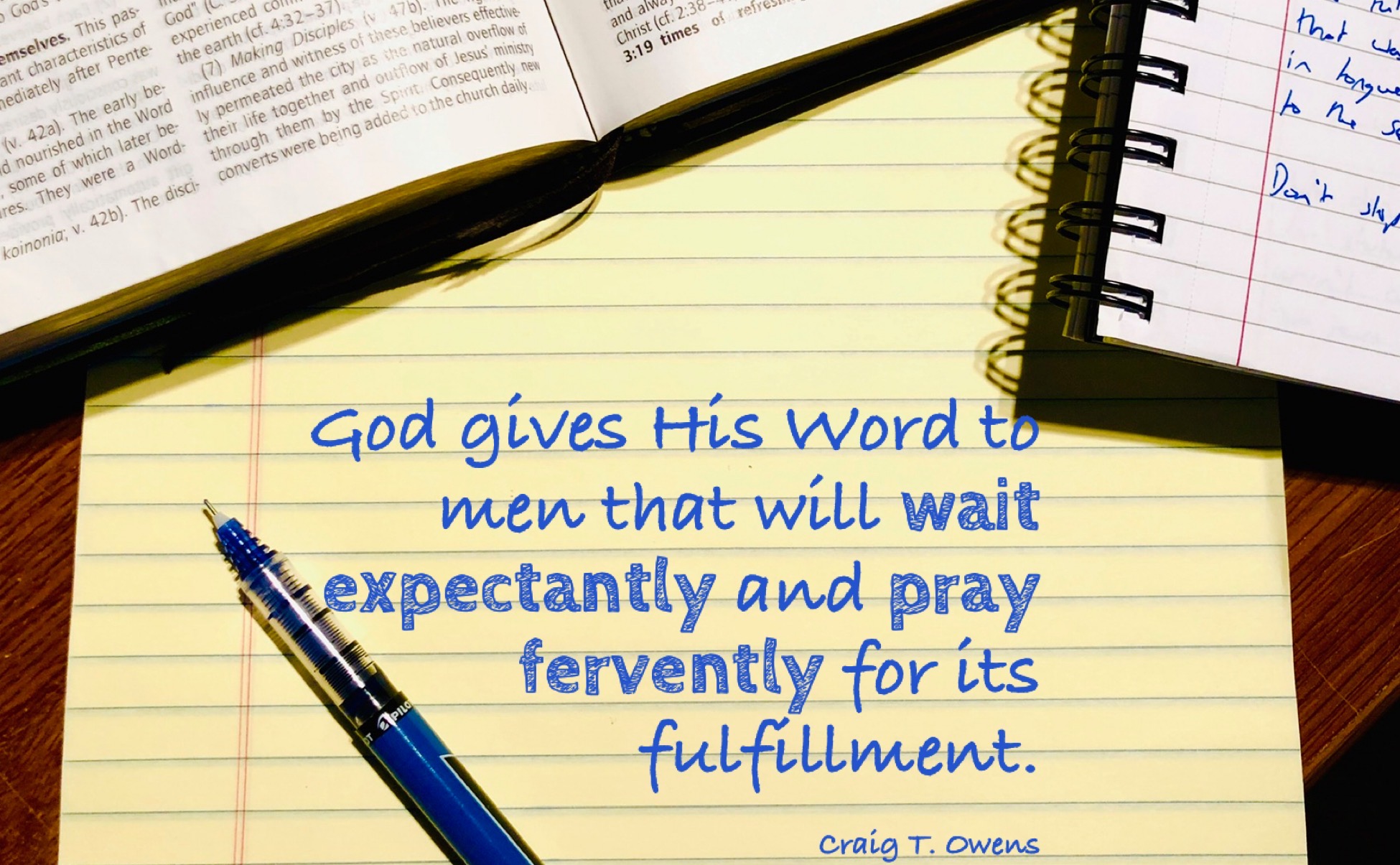
God gives His Word to men that will wait expectantly and pray fervently for its fulfillment. God is looking for men—for Dads—that will not cave in to cultural pressure. 

Guys, let the Holy Spirit’s inward pressure strengthen you to stand strong. As you see the external downward spiral away from God, don’t collapse, don’t complain, but hear God’s Word and remain a righteous and devout man for your family and your community. 

In our series We Are: Pentecostal, we talked much more in-depth about how the Holy Spirit wants to help us. You can check out all of those messages by clicking here.

►► Would you please prayerfully consider supporting this ministry? My Patreon supporters get behind-the-scenes access to exclusive materials. ◀︎◀︎

The Craig And Greg Show: Leaders Lead At Home First

Listen to the audio-only version of this podcast by clicking on the player below, or scroll down to watch the video.

On this episode of “The Craig And Greg Show” we talk about: 

  • [0:15] Leaders need to use their leadership skills at home 
  • [0:46] Home should be where leaders get replenished 
  • [2:12] Work comes and goes, but family can be our lasting legacy 
  • [2:30] How do effective leaders think about success at home? 
  • [4:09] A sad story of misplaced priorities 
  • [4:45] How I helped my church board learn how to make family a priority 
  • [6:31] Greg learned some parenting insights from one of his clients 
  • [8:20] God equips leaders to lead well with their spouse and kids 
  • [9:43] Greg shares a quote about sacrifice, investment, and ROI 
  • [10:16] We share habits and practices that have helped us lead at home 
  • [13:07] How do leaders create a legacy of success in our families? 
  • [15:14] Greg explores how leaders can even lead their parents 
  • [16:14] What do you want on your tombstone? 
  • [17:14] I share a poem from my son Brandon 
  • [18:30] Legacy is determined by what our family says about us 
  • [19:56] How leaders can set family leadership goals for the New Year

Check out this episode and subscribe on YouTube so you can watch all of the upcoming episodes. You can also listen to our podcast on Spotify and Apple.

Leaders Lead At Home

Listen to the podcast of this post by clicking on the player below, and you can also subscribe on AppleSpotify, or Audible. 

On a recent episode of The Craig And Greg Show, Greg and I discussed the vitally important role of leading in our families. 

Most parents know they should do this, but one of the things that gets in the way is trying to determine just how “success” should be defined in a family setting. 

Greg and I talk about the distractions to meaningful interactions with our spouse and kids, and I share a story about how I helped my church board understand this concept so that they could support me in this.

The bottom line: Someone else can do our jobs, but we are the only ones who can be the godly spouse for our husband or wife, and the godly parent for kids. Let’s make sure this is always our priority! 

If you would like to watch this full episode of The Craig And Greg Show, please click here. And if you would like to know more about my book which I mentioned in this podcast, please click here. 

►► Would you please prayerfully consider supporting this ministry? ◀︎◀︎

Poetry Saturday—He’s Here To Keep

Listen to the podcast of this post by clicking on the player below, and you can also subscribe on AppleSpotify, or Audible. 

BrandonMy Dad’s out of town
I feel alone
I’m feeling really down
He can’t reach the phone
All of a sudden the phone rings
My heart sings
I pick up the phone
He said only one more day
And in his voice was a great tone
He said what I wanted him to say
One more time of sleep
And then he’s here to keep —Brandon Owens (4th grade poetry assignment)


Poetry Saturday—The Children’s Hour

Between the dark and the daylight,
      When the night is beginning to lower,
Comes a pause in the day’s occupations,
      That is known as the Children’s Hour.

I hear in the chamber above me
      The patter of little feet,
The sound of a door that is opened,
      And voices soft and sweet.

From my study I see in the lamplight,
      Descending the broad hall stair,
Grave Alice, and laughing Allegra,
      And Edith with golden hair.

A whisper, and then a silence:
      Yet I know by their merry eyes
They are plotting and planning together
      To take me by surprise.

A sudden rush from the stairway,
      A sudden raid from the hall!
By three doors left unguarded
      They enter my castle wall!

They climb up into my turret
      O’er the arms and back of my chair;
If I try to escape, they surround me;
      They seem to be everywhere.

They almost devour me with kisses,
      Their arms about me entwine,
Till I think of the Bishop of Bingen
      In his Mouse-Tower on the Rhine!

Do you think, O blue-eyed banditti,
      Because you have scaled the wall,
Such an old mustache as I am
      Is not a match for you all!

I have you fast in my fortress,
      And will not let you depart,
But put you down into the dungeon
      In the round-tower of my heart.

And there will I keep you forever,
      Yes, forever and a day,
Till the walls shall crumble to ruin,
      And moulder in dust away! —Henry Wadsworth Longfellow

3 Lessons From A Devoted Dad

If you were to pick a man that would have been desperately devoted to Jesus as his Savior, Cornelius wouldn’t make anyone’s “top 10” list! 

Just take a look at all the strikes against this man. He was a… 

  • Gentile—to Jews, Gentiles were just the fuel to stoke the fires of hell. 
  • resident of the city of Caesarea—since this was the headquarters of the Roman government for Palestine, not many Jews would venture there. 
  • Roman—historians say only 10% of Romans in this era were monotheistic. 
  • centurion—not just any centurion, but an extremely powerful centurion from the Italian Regiment (not just a local mercenary who was in it for the money). And he took his name from Cornelius Sulla, a Roman general known both for his mercy and his ruthlessness.

All of this makes Cornelius a fully self-sufficient and a well-to-do man who was not likely to look for help from God. Nor was he the type of person that a Christian missionary might seek out. 

But clearly, something was missing in Cornelius’ life because he was completely countercultural in his pursuit after God. Not just his pursuit of God, but his quick understanding of exactly who Jesus was. 

Luke the historian describes Cornelius as:

  • devout and God-fearing. The Greek word for devout literally means “a right worshipper.” It’s a word Luke only uses three times in Acts, and two of those times are describing Cornelius. 
  • prayerful. The word Luke uses for him means someone who makes prayer personal and ongoing. 
  • generous. Cornelius took care of people who couldn’t take care of themselves. 

All of this got God’s attention (see Psalm 141:2; Revelation 5:8; Proverbs 19:17), and He sent an angel to direct Cornelius to Peter. 

When Peter came to Cornelius’ house, twice he said “as you know” (vv. 36, 37), showing us that Cornelius was aware that there was not only one true God, but that a relationship with Jesus was the only way to be in right relationship with God. As Peter spoke with Cornelius, his family, his relatives, his close friends, and even his fellow soldiers, the Holy Spirit baptized them just as He had done with the disciples of Jesus on the day of Pentecost. 

So here are 3 vital lessons for all men to learn from the life of Cornelius the centurion—

  1. Your devotion to God is influential. People around you do notice your devoted pursuit of God.
  2. Your openness to all that God has puts your family, friends, and coworkers in a place to receive God’s blessings too.
  3. God’s blessings flowing through you have lasting and far-reaching results. The outpouring of the Holy Spirit on Cornelius may have opened the door for Christian evangelism to Gentiles unlike anything that had happened before.

Dads, be devoted to God. Desire all He has for you, and all He has for those around you. Pursue Him no matter how many “strikes” there may be against you. 

If you missed any of the messages in this series, you can access the full list of messages by clicking here.

Book Reviews From 2017

I love reading, and I love sharing my love of good books with others! Here is a list of the books I read and reviewed in 2017. Click on a title to be taken to that review.

#Truth

10 Commitments For Dads

50 Core American Documents

A New Kind Of Apologist

Absolute Surrender

As Kingfishers Catch Fire

Born After Midnight

Brady vs. Manning

Cherish

Everything You Always Wanted To Know About God

Evidence That Demands A Verdict

How Great Is Our God

If

Interpretation Of The Scriptures

Islam Booklets

Joy To Your World

Know Who You Are

Leadership Promises For Every Day

Live Dead Journey

Live Dead Life

Longing For A Changed World

Man—The Dwelling Place Of God

Marching Off The Map

No Limits

On Calvary’s Hill

Ordering Your Private World

Paths To Power

Peace In The Face Of Cancer

Prevailing Prayer

Run Today’s Race

Seeing Jesus

Shade Of His Hand

Take Your Life Back

The Broken Way

The Christian Book Of Mystical Verse

The Christian In Complete Armour

The Christmas Candle

The Dawn Of Christianity

The Servant As His Lord

The World’s Last Night

Transforming Grace

When A Nation Forgets God

Your Next 24 Hours

Here are my book reviews for 2011.

Here are my book reviews for 2012.

Here are my book reviews for 2013.

Here are my book reviews for 2014.

Here are my book reviews for 2015.

Here are my book reviews for 2016.

How Guys Unintentionally Sabotage Their Relationships

There is a relationship killer that seems to be particularly hard for men. It’s hard because men’s brains are designed in a way that sometimes prohibits them from even seeing this issue.

Bill & Pam Farrel wrote a book called Men Are Like Waffles, Women Are Like Spaghetti. The Farrels identify how men tend to compartmentalize their lives. That is, guys can be so absorbed in one “box” in their life that they are completely oblivious to the other boxes. For instance, when a man is at work he seldom thinks about the other areas of his life (his wife, his kids, the bills that need to be paid, what he’s going to have for lunch).

In addition, men’s brains are also designed to stay in those boxes where things can be quickly fixed. A guy likes fixing things, so the boxes where he can do something and see an immediate result is a box he’s going to keep going back to again and again.

Here’s the trouble… Relationships don’t fit in nice, neat boxes. Neither are relationships something that can be “fixed.” And relationships are never, ever fixed or improved quickly.

So if a guy isn’t aware of these things, he can be unintentionally sabotaging the relationships around him.

King David illustrated this in his unintentional lack of involvement in three of his sons’ lives—

  • Amnon pursued an unhealthy relationship with his step-sister. David got mad but never did anything about it (2 Samuel 13:21).
  • Absalom got revenge for what Amnon did and then fled the country. When David finally allowed him to return to Israel, they never met to resolve what went wrong (2 Samuel 14:28).
  • Adonijah wanted to be king after David, but the Bible says, “His father had never interfered with him by asking, ‘Why do you behave as you do?’” (1 Kings 1:6).

Dave Wills wrote, “We all tend to craft a self-focused view of the world where we emerge as either a hero or a victim in every scene. We’re never the villains in the story. The truth is, though, that we’ve all been the bad guy more often than we’d like to admit. A life of love requires that we look in the mirror and give an honest and humble self-assessment.”

The way to defeat this relationship killer is to become aware of it through humble self-assessment. David learned this truth and shared his prayer with us: “Search me, O God. Show me any areas in my life where I am off-track” (Psalm 139:23-24).

In response to this prayer, the Holy Spirit must have showed David how he had unintentionally starved his relationships with Amnon, Absalom, and Adonijah, because he became highly involved in his son Solomon’s life.

So much so that as Solomon talked to his children about how they should live, he also told them where he had learned how to do this—his father taught him (Proverbs 4:1-4).

Guys, it doesn’t matter how long you’ve been unintentionally in another box. It doesn’t matter how strained the relationship may have become. If you will humbly ask God to search you, reveal to you where you’ve messed up, and ask Him to help you get better … your relationships WILL begin to improve!

Don’t wait another day to pray that “Search me” prayer!

Josh McDowell On Appreciating Our Kids

“Unconditionally accepting your kids tells them that being matters. Expressing your appreciation to them says that their doing matters too. …

“Unless your kids are absolutely convinced that you accept them for who they are, your praise and appreciation can become manipulative. Appreciation without acceptance may prompt your child to relate to you on a performance basis, thinking, ‘If I do a good job … if I get A’s … if I score a goal … then my dad will love me.’ Living on a performance basis will tend to produce feelings of false guilt in your kids. That’s why you need to be sure your kids first feel accepted then appreciated. …

“Appreciate your child’s efforts more than your child’s accomplishments, and appreciate your kid’s worth as God’s creation even more than your kid’s efforts.” —Josh McDowell, in 10 Commitments For Dads

If you are interested in more quotes from 10 Commitments For Dads, you can click here.