Then Darius the king wrote to all the peoples, nations, and populations of all languages who were living in all the land: “May your peace be great! I issue a decree that in all the realm of my kingdom people are to tremble and fear before the God of Daniel; for He is the living God and enduring forever, snd His kingdom is one which will not be destroyed, snd His dominion will be forever.He rescues, saves, and performs signs and miracles in heaven and on earth, He who has also rescued Daniel from the power of the lions.” (Daniel 6:25-27)
When you are facing adversity—even death threats—don’t ask, “God, why is this happening to me?” Instead you can declare, “God, You are going to be highly glorified among all the people! I will remain faithful and steadfast in my trust in You!”
The extent to which God will reveal His glory is not worthy to be compared to the single night we have to endure. “For I consider that the sufferings of this present time are not worthy to be compared with the glory that is to be revealed to us” (Romans 8:18).
Dr. Henry Halley points out another way the eternal trumps the temporal: “There is no authority apart from God. When human authority rejects God’s authority, it becomes twisted and loses its right to demand compliance (Acts 4:19-20, 5:29). God’s people are responsible to obey the government because it has been set in place by God [Romans 13:1-2; Daniel 4:17], but when government directs against God’s will, the Giver of all authority has the higher claim on our allegiance. We must resist any command that is against God’s will (Exodus 1; Daniel 3; Hebrews 11:23).”
Listen to the podcast of this post by clicking on the player below, and you can also subscribe on Apple, Spotify, or Audible.
The first Church in the Book of Acts could have easily become the first two churches right from the beginning. Why? Because of a deep disagreement that pitted two camps against each other.
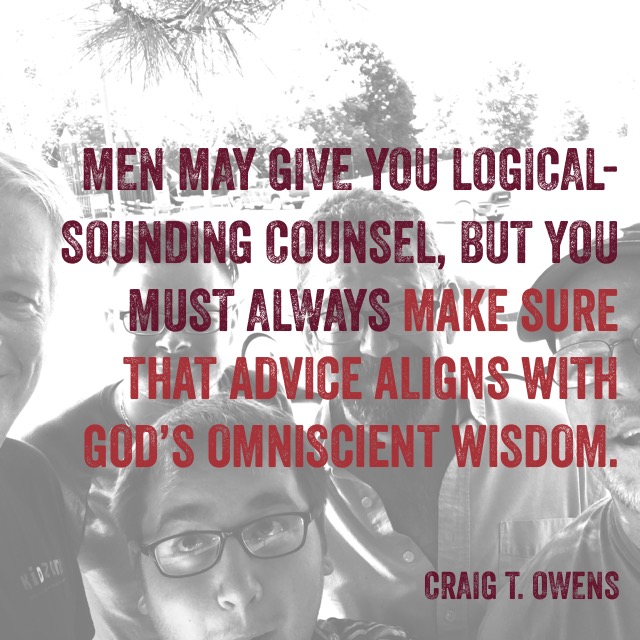
Unity was ultimately maintained because they all agreed to only listen to the counsel that agreed with Scripture.
Even if the world’s legal system seems unjust, Jesus says by continuing to press our case with the public servants He has put in place, we are really trusting God to bring us His perfect justice. Check out my full sermon on how the Bible from Moses to Jesus explains how to define the legal term, “An eye for an eye, a tooth for a tooth.”
I have lots of new content every week, which you can check out on my YouTube channel.
“A significant amount of research and scholarship (both scientific and theological) indicates that a young Earth is the most straightforward, conservative way to interpret God’s Word. … The most unambiguous way to interpret the Bible is according to its grammatical-historical sense, or the intended meaning of the authors. A literal interpretation accounts for all figures of speech in the text, providing the most straightforward method of exegeting Scripture. To this point, when Jesus quoted the Old Testament, it was always clear that He considered its passages as factual and true.” Check out the post Long Ages and the Bible—What’s the Problem?
“Your brain is made up of neurons that communicate with each other through synapses. Delta-FosB is one of the chemicals that creates neural circuits—i.e., ‘pathways’—to help those neurons communicate more quickly and efficiently. … Basically, what you experience as getting better and better at something is your brain ‘rewiring’ itself to become faster and more efficient at sending the same messages between the same neurons.” This works for both healthy and unhealthy activities. In this article from Fight The New Drug, research shows how regular consumption of pornography is hampering your brain’s ability to have normal, healthy relationships.
Dr. Henry Halley, in his Halley’s Study Bible, observed, “Note, too, the unceasing emphasis on the resurrection throughout this book. It was the pivotal point in Peter’s sermon on Pentecost (2:24, 31-32), in his second sermon (3:15), and in his defense before the Sanhedrin (4:2, 10), It was the burden of the apostles’ preaching (4:33). It was Peter’s defense in his second arraignment (5:30). A vision of the risen Christ converted Paul (9:3-6). Peter preached the resurrection to Cornelius (10:40). Paul preached it in Antioch (13:30-37), Thessalonica (17:3), Athens (17:18, 31), and Jerusalem (22:6-11), to Felix (24:15, 21), and to Festus and Agrippa (26:8, 23).” You can check out all of the Scriptures he mentions in this quote here.
Stephen Witmer asks an important question: “Which is closer to the center of your life as a Christian: what you’re doing for God, or what God has already done for you through Jesus Christ? Which one grounds your identity more deeply, affects your mood more frequently, rouses your passions more highly? Your answer to these questions will deeply shape the stability, tenacity, happiness, boldness, and humility of your Christian experience. Jesus wants to provide you grounds for unshakable joy.” Check out this example Witmer shares from an exchange between Jesus and His followers.
“Informing your opinion of the comparative merits of Christian men, never forget the old rule: ‘distinguish between times.’ Place yourself in each man’s position. Do not judge what was a right course of action in other times, by what seems a right course of action in your own.” —J.C. Ryle
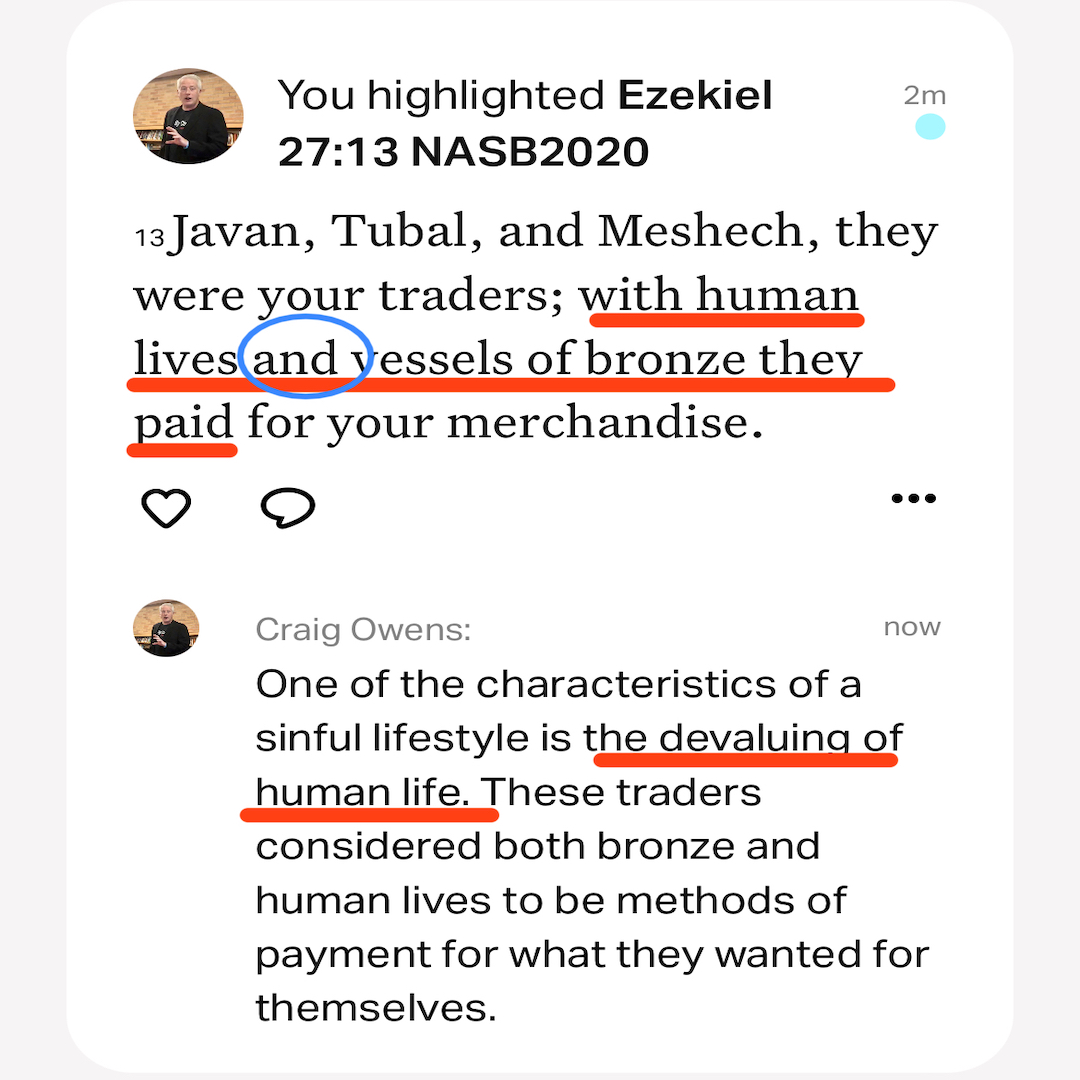
God holds human life as precious in His sight. Whenever anyone asks me why I support the sanctity of human life, my answer is simple, “Because God holds it sacred.” Consequently, God punishes those who devalue human life.
My friend, Pastor Tim Dilena, shares a thought about how God often uses people as the answer to our prayers.
A.W. Tozer said, “There’s an awesomeness about God which is missing in our day altogether; there’s little sense of admiring awe in the Church of Christ these days.” May we repent of little prayers and boldly pray to an awesome God who wants to do awesome things that will bring Him glory!
I have lots of new content every week, which you can check out on my YouTube channel.
This is a very informative Q&A session with cold case detective and Christian apologist J. Warner Wallace. But I especially like his answer to the first question: Do Christians have to investigate every other religion to be convinced that the Bible is true?
“Faith untried may be true faith, but it is sure to be little faith, and it is likely to remain dwarfish so long as it is without trials. Faith never prospers so well as when all things are against her: tempests are her trainers, and lightnings are her illuminators. … No flowers wear so lovely a blue as those which grow at the foot of the frozen glacier; no stars gleam so brightly as those which glisten in the polar sky; no water tastes so sweet as that which springs amid the desert sand; and no faith is so precious as that which lives and triumphs in adversity. … Faith increases in solidity, assurance, and intensity, the more it is exercised with tribulation. Faith is precious, and its trial is precious too.” —Charles Spurgeon
“Mature Christians can be recognized by a variety of indicators. They feast on the Word of God (Hebrews 5:14), persevere in love and good works (Hebrews 6:9-10), bear the fruit of the Spirit rather than the marks of the flesh (Galatians 6:16-23), use their gifts to help build the church (1 Corinthians 12:7-11; Ephesians 4:12-16), teach the things of Jesus to others (Hebrews 5:12: Acts 1:8), and more. This, the New Testament insists, is the condition toward which every Christian strives.” —T.M. Moore (check out all of the Scriptures T.M. references here)
“Now is the accepted time, not tomorrow, not some more convenient season. It is today that our best work can be done.” —W.E.B. Du Bois
Jesus shows us that only secure people can serve others. Insecure people won’t ever make themselves vulnerable, and so they miss out on God’s blessing. I address this in more depth in my book Shepherd Leadership.
Listen to the podcast of this post by clicking on the player below, and you can also subscribe on Apple, Spotify, or Audible.
The 12th Song of Ascent (Psalm 131) was written by David to remind us to rely on God’s help even more as we progress on the journey (or mature in our faith). In the 13th Song (Psalm 132), the psalmist says, “Remember David” and his passion for God’s people to experience God’s righteousness and joy. In order for us to know that, we have to remember Jesus.
Those who put this collection of Songs of Ascent together now include David’s fourth song (Psalm 133) in this collection which expresses his desire for unity among God’s people.
Can you imagine the pilgrims starting out from their individual villages? Maybe there’s not very many of them to begin with and traveling is pretty easy, but they do have to be vigilant against dangers on the road.
As they progress, they begin to join with pilgrims from other villages. Maybe these are from the same tribe, perhaps even distant relatives. The journey may go a bit slower now that there are more people to keep track of, and some complications of personality may start to arise. But the level of safety and assistance also increases.
Soon the group is getting larger as they now join with pilgrims from other tribes. These aren’t near relatives at this point, so there may be more complications, but there is even greater encouragement, safety, and potential.
Aha! Potential.
We’ve gone singing with a small ensemble to singing in a choir. And David is anticipating us singing in an even larger, majestic choir! There will undoubtedly be more problems, but there is also assuredly so much more potential, beauty, and strength in their combined worship.
My friend Dan Chastain has over 20 years of experience in the United States Army. He points out that the Army did the same things in his day as we read in the Old Testament.
The unity of a fighting force, Dan said, is a blessing. David was a professional soldier. Many people today join the military because of this professional, unity, and camaraderie. Maintaining this unity is the responsibility of everyone, because disunity leads to mistrust, chaos, and defeat.
David says this choir paints a picture—“it is like” (v. 2) and “it is as if” (v. 3). He is saying that God desires overflowing blessings on His people (v. 2), and that God desires saturating blessings on His people (v. 3). Why? Because God wants to give us more than enough for our needs so that there is plenty left for those who aren’t brothers and sisters yet. He longs for our choir to include people from every tribe, race, and nation.
Just as we said last week that a Christian’s joy is a testimony, a choir of Christians is an even more compelling testimony!
David calls this unity “good” which really means so much better than the alternative. And he calls this unity “pleasant.” The Hebrew word literally means singing a sweet sound!
The Hebrew word for “unity” here is also instructive. It means to be together in the same place—not just in spirit and desire—but in physical proximity. This is exactly the picture we see in the first Church (Acts 2:44, 46-47), as well as the picture of the choir from every nation, tribe, people, and language singing around God’s throne in Heaven (Revelation 7:9-10).
In order to navigate all of the differences of personality that could keep us from this unity, we have to work at. We need the attitude of Jesus (Philippians 2:1-5). This requires a daily transformation of our minds (Romans 12:1-3), and this transformed mind is what helps us move from a small ensemble to a majestic choir (Romans 12:4-5, 16-18).
Listen to the podcast of this post by clicking on the player below, and you can also subscribe on Apple, Spotify, or Audible.
A recent movie set box office records. Many Hollywood commentators are surmising that it is because the unlikely duo in the movie does something so noble at the end of the movie. Throughout the movie one of the main characters takes to calling himself “Jesus.” At the end of this movie, this character and his friend take the full brunt of the evil on them in the hopes of saving the universe.
Of course, this storyline isn’t new to Hollywood or even in ancient literature. This epic quest is longed for in the human heart, looking for a hero to selflessly sacrifice himself to save everyone else around them.
The only problem is that these heroes aren’t sure if their sacrifice is actually going to work.
This, of course, isn’t the case with Jesus. Angels announce before His incarnation that He will save His people. Jesus Himself says, “I will lay down My life for My friends and I will take it up again.” And in the very last book of the Bible we read that before Time even began, Jesus was already seen as the sacrificial Lamb slain for the deliverance of His people.
This story doesn’t start in Bethlehem, but when John 1:1 says, “In the beginning,” the language there is really saying, “From before there was a beginning, Jesus our Hero already knew the outcome of His selfless sacrifice.”
We see hints and foreshadowing of this Most Epic Story all throughout history and throughout Scripture. Like in Psalm 132—the longest of the Songs of Ascent (at 18 verses, the next longest song is only half its length).
The key verse (v. 10) is in the middle: it connects David and Jesus. The words “Anointed One” is one word in Hebrew: Masiah which is Messiah. In the New Testament,the word Christ also means Anointed One.
What do we learn in the first half of this song. It opens with the words, “O LORD, remember David…” (v. 1).
Because this psalmist mentions the same incident that we discussed in Psalm 131, this is another reason why I think David had the incident of moving the ark of the covenant to Jerusalem in mind when he wrote the previous song (see Psalm 132:2-5; 2 Samuel 6:17). The people continued to rejoices as David made arrangements and provided building materials for his son Solomon to build the temple (vv. 6-9).
Look at how verse 10 connects David to Jesus the Messiah. In verse 2, David swore an oath to the Lord, but he was physically unable to fulfill his promise. In verse 11 (also see 2 Samuel 7:11-16), “The Lord swore an oath to David.”
God was able to fulfill His promise, which we see in the life, death, resurrection, andascension of Jesus, and then in the promised outpouring of the Holy Spirit. On the Day of Pentecost, Peter declares this in his sermon—connecting the work of Jesus to the prophesy of King David (Acts 2:22-36).
We can sum up the first half of Psalm 132 with the words “Remember David.” And we can sum up the second half of this song of ascent with the words “Remember Jesus.”
Remember Jesus [the] Christ, raised from the dead, descended from David (2 Timothy 2:8).
I like this verse from the Amplified Bible: Constantly keep in mind Jesus Christ (the Messiah) as risen from the dead, as the prophesied King descended from David, according to the good news (the Gospel) that I preach.
David swears an oath (v. 2) but has no power to fulfill it. God swears an oath (v. 11-12) and fulfills it (Luke 1:33; Revelation 11:15).
David longs for blessings for the priests and saints (v. 10) but has no power to make it happen. God says, “I will” bless the priests and saints (vv. 13-18; 1 Peter 2:5-9; Revelation 1:6).
All of our longings for a Hero—for salvation, for purpose, for meaning—are fulfilled in Jesus. All of God’s promises for these things are fulfilled in Jesus. All of our life should be lived in this joyful assurance (Hebrews 10:35-39; Revelation 3:11)!
Not only should we not stumble in the homestretch, but we should live in such joyful assurance of God’s promises that we soar across the finish line!
If you cannot remember anything else, remember David and remember Jesus.
Listen to the podcast of this post by clicking on the player below, and you can also subscribe on Apple, Spotify, or Audible.
I’ve noticed how quick some people are to give up when things don’t get them the results they thought they should get, or the results don’t come as soon as they expected.
Anytime we try something new, there is always the potential for failure. Even later on, those who appear to be an expert at something rarely do it perfectly. But in either case, there are three things we need to do if we don’t get the results we expected: (1) reflect, (2) evaluate possible improvements, (3) re-engage.
Even before Jesus commissioned us to take His message of Good News to every street everywhere, He told us not to expect perfect results. In one of His best-known parables, Jesus talked about the farmer sowing seed (see Luke 8:5-8).
Jesus didn’t say, “All of your efforts at sharing the Gospel will be successful.” In fact, He said some efforts would totally fail (falling on the hard path), and some would have only temporary success (falling on the weedy and stony ground). But we keep on sowing the seed because some will fall on good soil and yield a harvest a hundred times more than was sown!
So, as John Wesley said, “Do all the good you can, by all the means you can, in all the ways you can, in all the places you can, at all the times you can, to all the people you can, as long as ever you can.”
The baptism of the Holy Spirit brings dynamic, life-changing power (Acts 1:8). The life that is changed first is our own. Everything about us begins to change.
When people heard Jesus speak, they said, “How did this Man get such learning without having been taught?” (John 7:15). The same Holy Spirit who empowered Jesus to speak is the same Holy Spirit who will empower our words.
When our words are Spirit-empowered words, people can feel it. When our words are matched by our lifestyle, people can’t ignore it (John 7:46; Acts 2:37, 4:13, 6:10)!
Just like salt that influences effortlessly, silently, and irreversibly, we never know what part the salt of our lives is playing in someone else’s life, even if it appears that nothing substantial is happening at all. But God said His word always accomplishes its purpose (Isaiah 55:10-11), which is why we keep on living and speaking as Spirit-empowered witnesses.
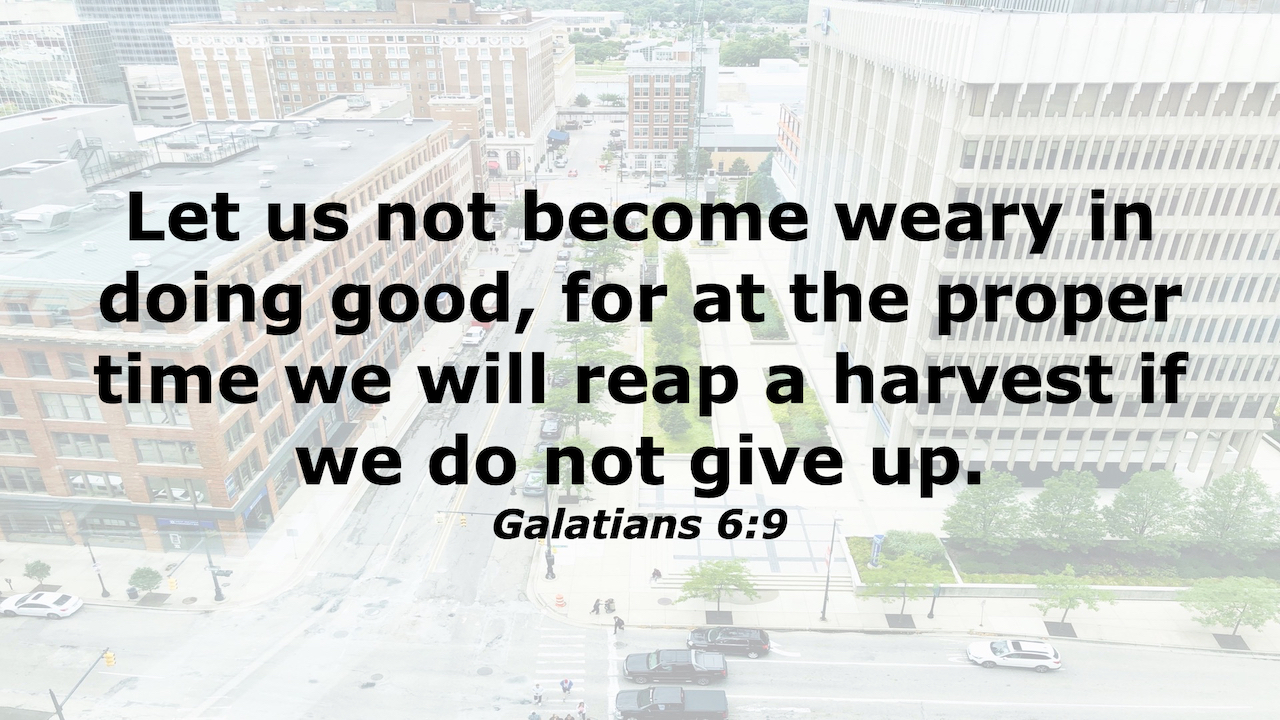
And we live expecting that something is happening—Let us not become weary in doing good, for at the proper time we will reap a harvest if we do not give up (Galatians 6:9).
How do we take this message of Jesus to every street?
Stay yielded to the influence of the Holy Spirit
Regularly and consistently read and apply God’s Word to your own life
Keep sowing in expectation
If your efforts appear to fail: reflect, evaluate, re-engage in expectation
We can be salt without being salty; we can be light without being annoying.
We have been empowered to take the Good News to every street, so let us not become weary in doing this.
Listen to the podcast of this post by clicking on the player below, and you can also subscribe on Apple, Spotify, or Audible.
Jesus sent us and the Holy Spirit empowers us to take the Good News to all nations—all the streets (Luke 24:47-49; Acts 1:8)—even the streets of Samaria where we will have more differences than similarities.
There is one street that has infiltrated and affected every other street more profoundly than any other: Hollywood Boulevard. The constant bombardment of messages through movies, television programs, music, literature, and the arts is almost immeasurable.
I think Christians rarely stop to ponder how much of the culture on Main Street is influenced by the content from Hollywood Boulevard. Probably because so few Christians are involved in the artistic or creative communities.
Here’s what we need to remember: All of this creativity is God-given. The opening words in the Bible say, “In the beginning God created…” (Genesis 1:1).
We specific examples of God-given creative skills in:
Bezalel—Exodus 31:1-5
Oholiab—Exodus 31:6, 35:34
craftsmen and craftswomen—Exodus 31:6; 35:10, 22, 25
In more modern times, we see notable creative people giving credit to God for their abilities.
William Shakespeare’s use of biblical themes—and even exact phrases—throughout his work is easy to spot. In the opening line of his last will and testament, he wrote, “I commend my soul into the hands of God my Creator, believing through the merits of Jesus Christ, my Savior, to be made a partaker of life everlasting.”
Johan Sebastian Bach, considered by many to be the greatest composer to ever live, placed “S.D.G.” on every one of his musical compositions, which stands for Sola Deo Gloria: only for the glory of God.
The apostle James tells us that every good and beautiful gift has come to us from God our Creator (James 1:17). And then this is my paraphrase of a similar thought the apostle Peter—
Each of you should use whatever gift you have received to serve others, as faithful stewards of God’s grace in its various forms. If anyone speaks [writes, paints, composes, sculpts], they should do so as one who speaks [writes, paints, composes, sculpts] the very words of God. (1 Peter 4:10-11)
So, here are four thoughts about how we can take the Good News of Jesus to Hollywood Boulevard.
Create a beautiful culture in your home, your Main Street, your workplace, your school. Ask the Holy Spirit to help you answer the question, “What can I do so that the love and beauty of Jesus will be felt here?”
Use your creative skills—write poems, compose music, paint a picture, sew clothing, bring innovation to your job.
Support beautiful authors, musicians, moviemakers, painters, etc. Hollywood produces what they think will make money, so if you are supporting creators of beautiful things, they will produce more of those things.
Leverage Hollywood’s culture to talk to others about heavenly culture. Point out biblical themes, challenge the rationale behind unbiblical lyrics, etc.
“Christians need to ask themselves a few key questions to help us respond to the society around us. First, what is good in our culture that we can promote, protect, and celebrate? Second, what’s missing in our culture that we can creatively contribute? Third, what’s evil in our culture that we can stop? And fourth, what’s broken in our culture that we can restore?” —John Stonestreet
Don’t complain—create something better.
Don’t compromise—promote what is beautiful and edifying.
The Holy Spirit can empower us to take the Good News of Jesus even to Hollywood Boulevard!
If you’ve missed any of the other messages in our series Takin’ Him to the Streets, you can find them all here.



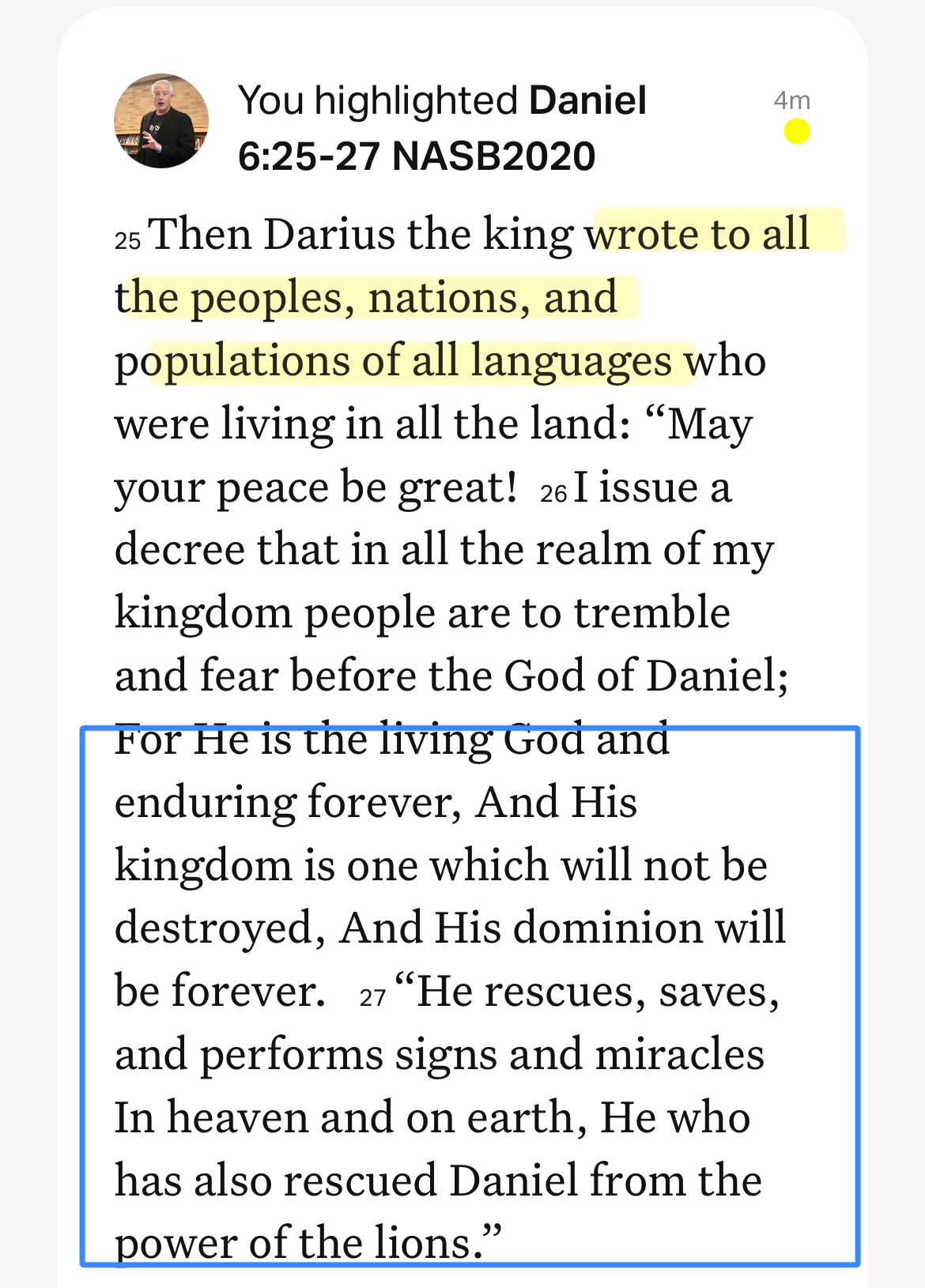 Then Darius the king wrote to all the peoples, nations, and populations of all languages who were living in all the land: “May your peace be great! I issue a decree that in all the realm of my kingdom people are to tremble and fear before the God of Daniel; for He is the living God and enduring forever, snd His kingdom is one which will not be destroyed, snd His dominion will be forever. He rescues, saves, and performs signs and miracles in heaven and on earth, He who has also rescued Daniel from the power of the lions.” (Daniel 6:25-27)
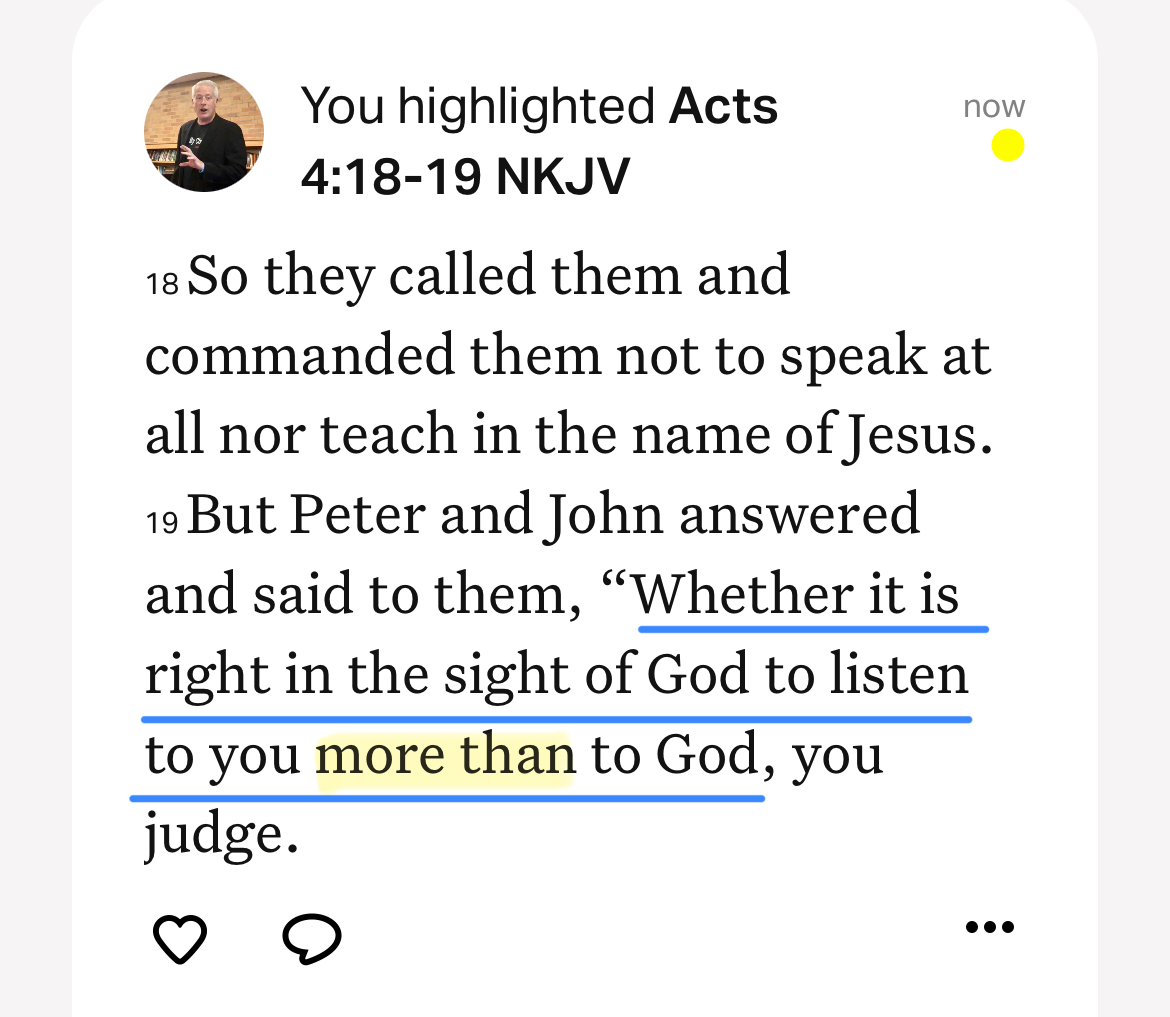 Dr. Henry Halley points out another way the eternal trumps the temporal: “There is no authority apart from God. When human authority rejects God’s authority, it becomes twisted and loses its right to demand compliance (Acts 4:19-20, 5:29). God’s people are responsible to obey the government because it has been set in place by God [Romans 13:1-2; Daniel 4:17], but when government directs against God’s will, the Giver of all authority has the higher claim on our allegiance. We must resist any command that is against God’s will (Exodus 1; Daniel 3; Hebrews 11:23).”