


 This short 3-minute video is well worth your time, as J. Warner Wallace helps us understand how a sound, theistic apologetic actually points to the Jesus in which Christians believe.
This short 3-minute video is well worth your time, as J. Warner Wallace helps us understand how a sound, theistic apologetic actually points to the Jesus in which Christians believe.
 Dan Delzell wrote a very thought-provoking book—The Mathematical Proof For Christianity—which gives skeptics a lot of evidence to contemplate. As I said in my review of this book (which you can read here), this is a good book for Christians to read with a skeptic as a great conversation-starter about the Christian faith.
Dan also presented this list…
“The true religion is a match to all 40 questions:
To read some of the other quotes I shared from this book, please click here.
Dan Delzell uses not only math, but many other sciences as well to give some great conversation-starters. Check out my full review of his book by clicking here.
“I live in Nebraska where I serve as a pastor. Imagine someone covering this entire state in silver dollars 6 feet deep. Then mark one coin and bury it anywhere across the state. Next, blindfold a man and have him choose one coin. The odds that he would choose the marked coin are the same odds as getting 8 prophecies all fulfilled in one man. God fulfilled about 300 prophecies in the Person of Jesus Christ. … There is no way one man could have fulfilled all 8 of these prophecies unless God was making it happen. Who else controls history? Who else could give us such irrefutable proof for Christianity? The odds are one in one hundred quadrillion. Here is what that number looks like: 1 in 100,000,000,000,000,000. (This mathematical proof was calculated by Professor Peter Stoner.)”
“What if jurors were presented with 300 pieces of evidence that all pointed to the same person, just like the 300 biblical prophecies all point to Christ. And so you see, you really can come face to face with reality, logic, reason, facts, evidence, and mathematical certainty before you decide whether to accept or reject the Bible.”
“The excessive skepticism shown toward the Bible by important historical schools of the eighteenth and nineteenth centuries, certain phases of which still appear periodically, has been progressively discredited. Discovery after discovery has established the accuracy of innumerable details, and has brought increased recognition to the value of the Bible as a source of history.” —William Albright, biblical and archeological scholar who mastered more than 26 ancient and modern languages
“The order is for Christianity is: (1) Evidence; (2) Faith; and then (3) Assurance. Christianity stands upon evidence. It is personally received through faith that Jesus died for your sins on the Cross. It brings comforting assurance to those who have stepped out in faith to trust Christ. You will never have the assurance of salvation until you take a step of faith based on the evidence.”
“Jesus didn’t come here to merely provide man with one more option.”
“It may be stated categorically that no archeological discovery has ever controverted a single biblical reference. Scores of archeological findings have been made which confirm in clear outline or in exact detail historical statements in the Bible.” —Nelson Glueck, Jewish archeologist
“Archeological work has unquestionably strengthened confidence in the reliability of the scriptural record.” —Millar Burrows, University of Yale archeologist
“In addressing the manuscript evidence for the New Testament, John Warwick Montgomery correctly states that ‘to be skeptical of the resultant text of the New Testament books is to allow all of classical antiquity to slip into obscurity, for no documents of the ancient period are as well attested bibliographically as the New Testament.’”
The Mathematical Proof For Christianity by Dan Delzell is really just one part of the big picture he presents. Dan uses mathematics, archeology, textual examination, logic, and sound semantics to present a compelling case for the authenticity of Scripture, and the Deity of Jesus Christ. But Dan is quick to add, “Mathematical proof for Christianity is powerful. But without faith in Christ, all the proof in the world won’t save your soul and bring you to heaven one day.”
If you are already a Christian, this book will do much to help you “be prepared to give an answer” (1 Peter 3:15) to seekers and skeptics. But I think the greatest value of this book would be as a conversation-starter with those who are seekers and skeptics. Giving them a copy of this book to read along with you will be a great way to have a meaningful conversation about your faith in Jesus. The subtitle of this book is “along with other reasons to believe,” and Dan does give many, many reasons.
No book written by a man will convince anyone to place their faith in Jesus (only the Bible can truly do that), but The Mathematical Proof is well-grounded in Scripture to help you use it as an effective tool in sharing your faith.

Join me tomorrow morning as we discuss the proofs concerning the resurrection from the dead of Jesus Christ. Get all of the details by clicking here. If you cannot join us in person, check out our live broadcast on Periscope.
 I love the detective-like approach that cold-case detective J. Warner Wallace brings to Christian apologetics! Wallace presents reasonable evidence to lead to a reasonable faith in the biblical claims about Jesus. A quick read to prepare you for Good Friday and Resurrection Sunday is Alive.
The material in this short 48-page booklet is taken from Wallace’s book Cold-Case Christianity, and is a just-the-facts look at the resurrection account of Jesus Christ. This booklet will prepare you to give a good answer to anyone who asks you about your faith.
These booklets are sold in a 10-pack, so buy a pack and pass them out to your friends who want to learn how to defend their Christian faith, or give one to a friend or coworker who is still skeptical about the accounts in the Bible surrounding Christ’s death and resurrection. All who read Alive will learn something they didn’t know before.
A great read!
 To be honest, if someone hasn’t heard the biblical account of the life of Jesus Christ before, it can sound quite fantastic! Jesus was born of a virgin, lived a sinless life, performed miracles no one had seen before, died a horrific martyr’s death, was raised back to life three days later, and then ascended back into heaven until He returns to Earth again.
But as fantastic as this sounds, there is still enough evidence to reasonably believe it’s all true. An unreasonable faith believes in something in spite of the evidence; a blind faith believes in something without any evidence; and reasonable faith believes in something because of the evidence.
The Bible gives us eyewitness testimony about the life of Jesus which we can matter-of-factly evaluate.
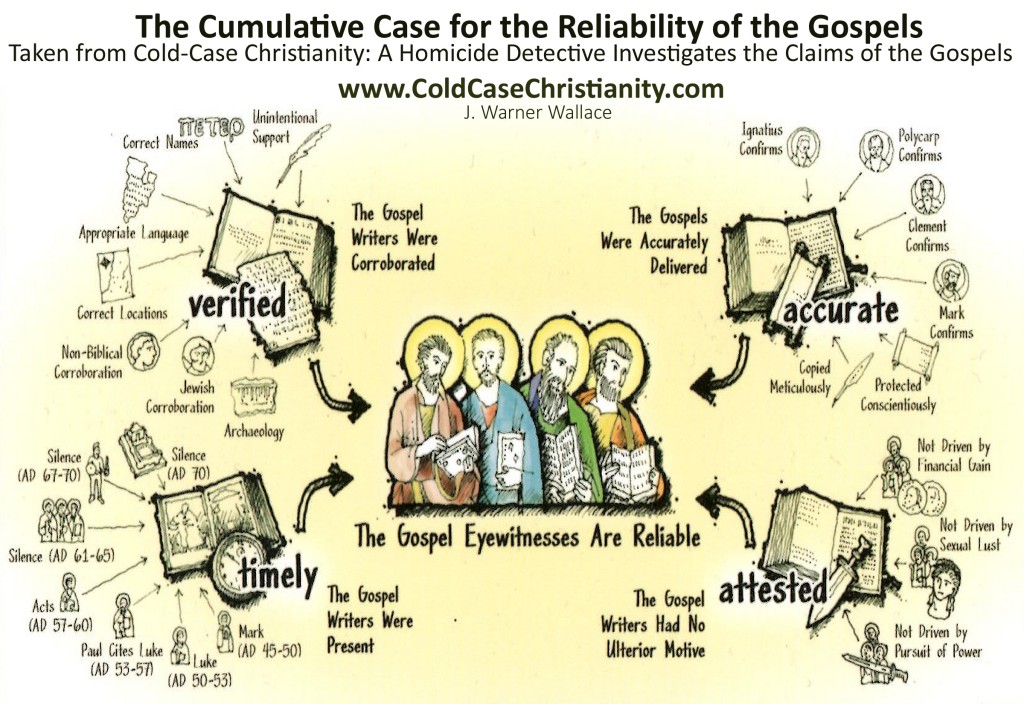
In a modern-day court of law, eyewitness testimony is evaluated on…
Let’s consider the testimony of the four Gospel writers: Matthew, Mark, Luke and John.
(1) Were The Eyewitnesses Present?
(2) Is Their Testimony Corroborated?
(3) Has Their Testimony Remain Unchanged Over Time?
(4) Is Their Testimony Unbiased?
All of these points make it reasonable to believe the evidence presented in the Bible about Jesus Christ is true. Check out this video where I elaborate a little more on each of these points—
If you live in the Cedar Springs area and don’t have a home church, I would love for you to visit with us Easter Sunday morning at 10:30am. We’ll be examining the evidence for Christ’s resurrection from the dead. Click here to get more details.
 Here are the books I read and reviewed in 2015. Click a title to read the review…
A Sketch of the Life of George Whitefield
The Surprising Imagination of C.S. Lewis
Here are my book reviews for 2011.
Here are my book reviews for 2012.
Here are my book reviews for 2013.
Here are my book reviews for 2014.

“Ah, what a thing is prayer! The simplest form of speech—such as even a child could utter—yet the highest and divinest of all utterances; such as the Holy Spirit alone can enable us to give fourth.” —Horatius Bonar
“When God feels distant, remember the Christmas story. When you feel alone, unloved, or unlovable, remember that God loves you. And He travelled a great distance to be close to you. Why? Because He loves to be with the ones He loves!” —Max Lucado
“Do you ever take a moment to pray but feel like you stumble out of the gate? Do you have trouble finding the words when it comes time to bow your head? Remember, the One who hears your prayers is your Daddy. You don’t need to wow him with eloquence. Jesus downplayed the importance of words in prayers. We tend to do the opposite. The more words the better. The better words the better. … Just as a happy child cannot mis-hug, the sincere heart cannot mis-pray.” —Max Lucado
J.Warner Wallace answers a good question: Why doesn’t the birth record of Jesus appear in every Gospel?
Dan Reiland has some good words for those in leadership positions in ministry.
Far too many school administrators and teachers think they are limited by the so-called “separation of church and state.” Here’s a post from Eric Buehrer you should share with any of your friends who work in the public school system.
John Stonestreet says, “Remember when people laughed about ‘death panels’?” Check out Who decides to end a life?
Frank Turek asks, “How do we fix a world filled with murder, rape, betrayal, adultery, fraud, theft, sexual exploitation, pornography, bullying, abortion, terrorism, cheating, lying, child abuse, racism, assault, drugs, robbery, and countless other evils?” He says we may not like the answer.
“To fulfill God’s destiny for your life, you likely don’t have to do more; you have to do less. … Enjoy the Christmas season. Wrap the presents. Prepare your home in a festive way. Make memories with your family. But don’t let this Christmas pass without spending some time at Jesus’ feet. Long after everything else fades from this Christmas, worshiping Jesus is all that will truly last.” —Rick Warren
“Holidays in America have come to be regarded as entitlements. They’re all about us, seasons of diversion, distraction, self-indulgence, and time off work. Even the great religious celebrations of the national calendar—Thanksgiving, Christmas, and Easter—are regarded by most Americans as opportunities to get some good bargains and enjoy a little time for relaxation, not for spiritual reflection and renewal, but just for doing whatever we want. Sort of like the way most Christians observe the Lord’s Day.” —T.M. Moore
As we are celebrating the First Advent, J. Warner Wallace asks a great question: Why didn’t the Apostle Paul mention the virgin conception?
“I am convinced many Christians today are troubled for the same reason Asa was [2 Chronicles 16:1-9]. They have war in their souls because they have traded faith for self-reliance. But the fact is, there is no way a follower of Jesus can have faith in any other source and not be troubled.” —David Wilkerson
“People who are exercised and preoccupied with such things as how the star worked and how the Red Sea split and how the manna fell and how Jonah survived the fish and how the moon turns to blood are generally people who have what I call a mentality for the marginal. You do not see in them a deep cherishing of the great central things of the gospel—the holiness of God, the ugliness of sin, the helplessness of man, the death of Christ, justification by faith alone, the sanctifying work of the Spirit, the glory of Christ’s return and the final judgment. They always seem to be taking you down a sidetrack with a new article or book. There is little centered rejoicing.” —John Piper
“Whether one makes the observation light-heartedly or in all seriousness, one must observe that, when the male body unites for procreation with the female, the pleasure that goes along with it is understood to be in accordance with nature, but that when male joins with male, or female with female, it is outside the bounds of nature. This outrage was first done by people whose desire for pleasure was without self-control.” —Plato. This agrees with what the Bible says in Romans 1:26-27.
Lenny Esposito has some good advice for students to defend their Christian faith in the classroom.
Seth Godin has some insight on whining—“Before starting, a question: Will it help? Like holding a grudge, or like panicking, whining rarely helps. If anything, any of the three make it far less likely that you’ll make progress solving the problem that has presented itself. And, like knuckle cracking, it’s best enjoyed alone.”
[VIDEO] Bobby Conway asks Lenny Esposito how to handle the claim “The Bible has contradictions in it”—


 Craig T. Owens