9 Quotes From “Your Joy Will Turn To Sorrow”

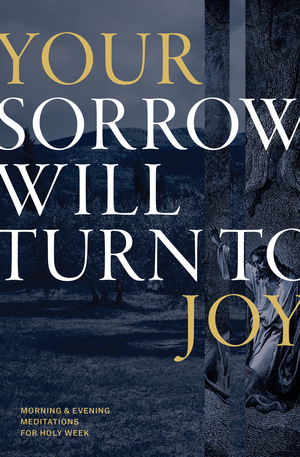
Your Sorrow Will Turn To JoyAlthough Your Joy Will Turn To Sorrow is intended to be read each morning and evening of Holy Week (check out my book review here), the content is so good that it will benefit you anytime you decide to read it! Here are some quotes that especially caught my attention.

“The only Savior who truly saves, only saves through suffering. The Cross was the only means of making us sinners right before a holy God. Our salvation was purchased with suffering, and it will be sealed and preserved with suffering (James 1:2-4), not comfort. We are promised comfort in the Christian life (2 Corinthians 1:4), but not the cheap, temporal imitation we’ve grown accustomed to in our modern world.” —Marshall Segal

“Jesus did not come to purchase the approval of others. No, He ‘was despised and rejected by men; a Man of sorrows, and acquainted with grief; and as One from whom men hide their faces He was despised’ (Isaiah 53:3). Why? Because it is God’s approval we desperately need. And God’s approval doesn’t come by popular opinion, but by divine intervention—the substitution of His own Son in our place.” —Marshall Segal

“The irony of Mark 14 is that Judas could see the value of the ointment rolling down Jesus’ head, but he couldn’t see the value of Jesus. He was a pawnbroker with cataracts. That’s why he took such offense at the woman. The woman, on the other hand, could see both the value of the ointment and the value of Jesus. That’s why she broke the flask.” —Jonathan Bowers

“No one understands better than God how difficult it can be for a human to embrace the will of God. And no human has suffered more in embracing the will of God the Father than God the Son. When Jesus calls us to follow Him, whatever the cost, He is not calling us to do something He is either unwilling to do or is never done Himself.” —Jon Bloom

“So, now, we say with an entirely different meaning, let His blood be on us, not defiantly as the crowds that crucified Him, but desperately—with gratitude and hope and adoration—as those who depend wholly on His sacrifice. Jesus, let Your blood be on us. Let it cover us. Let the blood that flows from Your head, Your hands, Your feet wash over us and cleanse us from all our iniquity. We proclaim Jesus’ death. We rejoice in his death, not because we believe He was a fraud or a lunatic, but because it is by His death, by His wounds, by His blood that we are healed.” —Marshall Segal

“Jesus spoke of this joy as He faced the torture of Good Friday. He faced denial, faced betrayal, faced beatings, faced splinters and nails and spears—He could not stop talking about joy! Only joy would keep Him going. Joy was on His mind, joy was on His tongue, and joy was drawing Him, not away from suffering, but into it (Hebrews 12:2). Jesus went to the Cross for joy: to buy joy, create joy, and offer joy. As the world celebrated the savage killing of God, out of this sea of foaming rebel hostility emerged a blood-bought, inextinguishable joy.

“If the killing of the Author of life could not extinguish this joy Jesus speaks about, nothing can—and nothing ever will. No opposition from the world, no opposition to the gospel, and no cultural despising of Christ will overcome the resurrection joy of Jesus.” —Tony Reinke

“If Christ is still dead, death reigns, and all our joys our vain. So hoard every plastic Easter egg you find, because whatever you find inside is all the joy you have to grab. Or, as Paul says, ‘If the dead are not raised, let us eat and drink, for tomorrow we die’ (1 Corinthians 15:32). But if death is dead, and if the dead are raised—if Christ is risen from the dead!—brothers and sisters, let us feast and celebrate, for the daunting light of our inextinguishable and inexhaustible eternal pleasures have broken into the darkness, offering us a life of joy in Christ that cannot fade or rust or be stolen away!” —Tony Reinke

“Easter has now become our annual dress rehearsal for that great coming Day. When our perishable bodies will put on the imperishable. When the mortal finally puts on immortality. When we join in the triumph song with the prophets and the apostles, ‘O death, where is your victory? O death, where is your sting?’ (Hosea 13:14; 1 Corinthians 15:55).” —David Mathis

“Indeed, even agony will turn to glory, but Easter doesn’t suppress our pain. It doesn’t minimize our loss. It bids our burdens stand as they are, in all their weight, with all their threats. And this risen Christ, with the brilliance of the indestructible life in His eyes, says, ‘These too I will claim in the victory. These too will serve your joy. These too, even these, I can make an occasion for rejoicing. I have overcome, and you will more than conquer.’ 

“Easter is not an occasion to repress whatever ails you and put on a happy face. Rather, the joy of Easter speaks tenderly to the pains that plague you. Whatever loss you lament, whatever burden weighs you down, Easter says, ‘It will not always be this way for you. The new age has begun. Jesus has risen, and the Kingdom of the Messiah is here. He has conquered death and sin and hell. He is alive and on His throne. And He is putting your enemies, all your enemies, under His feet.’” —David Mathis

Are You Expecting The Lord?

Horatius Bonar“Are you expecting the Lord? Are you living in this expectation? Is it a deep-seated, abiding, cherished hope? Is it a hope that tells upon your character, your life, your daily actings in public or private, your opinions, your whole man? Does it quicken you? Does it purify you? Does it keep you separate from the world? Does it keep you calm in the midst of earth’s most exciting events, or most untoward changes? Does it give you a new view of history as well as prophecy? …

“Let your expectation of the Lord’s coming be a calm and healthy one; not one that excites, but one that tranquilizes; not one that unfits for duty, but one that nerves you more firmly for it; not one that paralyzes exertion, but one that invigorates you for it; not one that makes you indifferent to present duty, but one that makes you doubly in earnest about everything that your hand findeth to do; not one that stops liberality, and prayer, and work, but one that increases all these a hundred fold; not one that dwells exclusively on the future’s dark side—the judgments that are at hand—but one that realizes the glory and the joy of Messiah’s approaching victory and triumphant reign.” —Horatius Bonar

4 Reasons To Study Your Bible

Commitment to readYou probably hear Christians say quite frequently, “You should read your Bible.” But one thing you may not hear as often is why you should read your Bible. There are probably many more reasons, but here are four reasons why I believe reading your Bible should be a daily part of your life.

(1) To help spot errors.

When the devil tempted Jesus, it is noteworthy that Jesus didn’t try to use logic, or persuasion, or even willpower. Every temptation was blocked by Jesus saying, “It is written” as He quoted Scripture.

In the second temptation, the devil tried the same tactic. He, too, quoted a couple of verses from the Psalms, but he took them out of their context. So notice Christ’s reply, “It is also written” (Matthew 4:7). The best way to spot error is to know the full counsel of God’s Word. This tactic the devil tried with Jesus wasn’t something new, but it was something he used on the very first humans: “Did God really say…” (Genesis 3:1), and he will try it again on you!

(2) To clarify your emotions.

Most of us allow our emotions to control our actions. Or sometimes we wrestle with, “My heart says one thing, but my head says something else!” In this tug-of-war, we allow our emotions to determine our beliefs, and then our beliefs determine our actions. This is not only dangerous, but it is contrary to what the Bible teaches.

The healthy way to respond is by fully knowing what we believe, and then acting according to our beliefs. Our proper emotional response will then follow those actions.

Look at the example of Jesus in John 2:13-16. He was ticked off at how people were misusing His Father’s house, and He did some serious house cleaning! Just reading those four verses, you may get the idea that Christ’s emotions carried Him away. But check out verse 17, in which we see He was acting in accordance to His beliefs, which were fully grounded in Scripture.

(3) To know prophesy.

All of the Scriptures point to Jesus, so all of the Scriptures are illuminated by Christ (Luke 24:27, 45). If you want to know what is happening in our world, turn to the pages of Scripture and see how Jesus is revealed. This will help you put even current events into perspective.

(4) To give sound answers.

When people need help, I want to be able to give them real answers. Not my opinion, but truth that they can apply. The Apostle Peter told us to always be prepared to give people an answer that is based on our knowledge of Jesus (1 Peter 3:15).

“Beware of saying, ‘I haven’t time to read the Bible, or to pray’; say rather, ‘I haven’t disciplined myself to do these things.’” —Oswald Chambers

Can I challenge you to do something I challenged my whole church to do … Make a commitment to read the Bible every day for the next seven days. See what happens as God meets with you, and reveals Himself and His wisdom to you, every day.

We’ll be learning some Bible study strategies next Sunday, and I invite you to join us.

Links & Quotes

link quote

“When something drops into your life that seems to threaten your future, remember this: The first shock waves of the bomb are not sin. The real danger is yielding to them. Giving in. Putting up no spiritual fight. And the root of that surrender is unbelief—a failure to fight for faith in future grace. A failure to cherish all that God promises to be for us in Jesus.” —John Piper

“The ultimate test of man’s conscience may be his willingness to sacrifice something today for future generations whose words of thanks will not be heard.” —Gaylord Nelson

My fellow pastors, may this be said of us: “Even now the Lord is raising up godly watchmen to speak for Him in these times. These shepherds are grieving, weeping and repenting as they seek God’s face. And I believe they’re hearing and understanding the Lord’s message behind the present events. Moreover, they’re not afraid to proclaim dire warnings, because they know they’ve heard from God. They’re compelled to speak of His purposes behind our calamities.” —David Wilkerson

“Who is doing exploits for God today? Where is the enemy being driven back? That is the great yearning of all spiritually-minded people. They are not enchanted with polished sermons and slick organizational technique. Where are the mighty men and women anointed by God to truly make a difference?” —Jim Cymbala

Good read for anyone in church leadership: 10 Fine Lines Of Church Leadership Tension.

Medical science validates what Scripture tells us: Unforgiveness can be lethal.

In the United States, roughly 10% of people struggle with dyslexia. Here are some helpful ways to make your materials more dyslexic-friendly for them.

J. Warner Wallace shares 6 pieces of evidence that point to our  universe having a beginning.

[VIDEO] Probably the best baby announcement I have seen yet—

8 Quotes From Horatius Bonar

Horatius BonarThere is a series of book by Horatius Bonar called Light And Truth. I am currently reading one of the books in the series as I read through the New Testament in my personal devotional time. Typically I post a book review after I’ve finished a book (which I will do with Light And Truth [update: the review is posted here]), and then I share some quotes from that book. In this case I’m mixing things up a bit: I’m sharing some quotes from the first half of this book today, and then I’ll post a review and more quotes after I finish the book. Enjoy!

(Note: Scripture references appearing in brackets following the quote reflects the passage or verse on which Bonar was commenting.)

“What is at the bottom of all the persecutions of various ages? It is Christ troubling the world. If He would let it alone, it would let Him alone. What means the outcry, and alarm, and misrepresentation, and anger, in days of revival? It is Christ troubling the world. What means the resistance to a fully preached gospel? It is Christ troubling the world. A fettered gospel, a circuitous gospel, a conditional gospel—a gospel that does not truly represent Christ—troubles no man; for in such cases it is another Christ that is announced, and not the Christ, the King of the Jews, that troubled Jerusalem. But a large, free, happy, unconditional gospel, that fully represents Jesus and His grace, Jesus and His completeness, does trouble men. It troubles all to whom it comes, in some measure. Some it troubles and then converts; some it only troubles. … The world’s only hope is to be ‘troubled’ by Christ. … Yet all this troubling is in love. He sounds His trumpet to awake the sleepers.” [Matthew 2:3]

“The Lord ends speaking and begins working; He comes down from the pulpit and enters the hospital. Such is His whole life: words and deeds intermingled; words of health and deeds of health. His lips breathe fragrance, and in His hand is the balm of Gilead. … [The leper] wants to be made clean, and he casts himself on Christ for this. He is the hyssop, the water, the blood, the ashes, the priest, the physician, all in one. Thus we still come, doubting neither the willingness nor the power, yet casting ourselves on the will of the Lord; not presuming to dictate, yet appealing to His sovereign Grace. As the needy, the sick, the unclean, we come; for the whole need not a physician, but they that are sick.” [Matthew 8:1-3]

“It is the voice of authority. It reminds us of Genesis 1:2-3. He speaks as one who knew that He could cure. Not hesitatingly. Nor are the words a prayer, but a command. He speaks, and it is done. … Thus love, authority, and power are all conjoined. It is the voice of Omnipotence. … He is the same Christ still; with the same love, and authority, and power. He is still a Healer, and the worst of diseases fly from His touch and voice. Let us go to Him with all that afflicts us. He calls and He will heal us of all. … Be persuaded to present thyself to Him, just as thou art give this divine Healer thy simple confidence. Take Him for what He is, and He will take thee for what thou art. Thus shalt thou meet in love; thou to be healed, and He to heal; thou to have the joy of being healed, and He to have the joy of healing thee, and to announce to heaven, in the presence of the angels of God, that another leper has been healed!” [Matthew 8:1-3]

“And is not this oftentimes the very point of the difficulty we experience in believing? We cling to the visible, the palpable prop—the human rope which we hold in our hand, unwilling to let go. We speak of our inability to believe; but what is this save our tenacity in holding on to the very things which God asks us to quit? We say that we ‘cannot lay hold’; should we not rather say that we ‘cannot let go’? We complain that we have no power to cling and grasp; whereas it should be that we have no will to let go.”

“As iniquity increases, faith decreases. … As iniquity increases, truth decreases. … As iniquity increases, righteousness and holiness decrease. … As iniquity increases, religion decreases. … As iniquity increases, delight in the things of God decreases. … But the special thing of which Our Lord predicts the decrease is love—love to God, love to himself, love to one another.” [Matthew 24:12]

“Our Lord will come! This is one of the great certainties of the unknown future. He may tarry, but He will come at last. Many obstacles made seem to rise up, but He will come. Men may not desire Him, but He will come. The Church may be cold, but He will come. Earth may think she has no need of Him, but He will come! The scoffer may say, where is the promise of His coming? but He will come. satan may do His utmost to oppose; but He will come. This is the great future certainty which Christ and His apostles have proclaimed to us. Our Lord will come! … The hour is, no doubt, fixed in God’s purpose, but the knowledge of that time is kept from us. They do wrong, then, who try to fix the hour, thus seeking to extract a secret from God. They do wrong who neglect the whole subject because this secret is connected with it. They do wrong who scoff at the whole subject because of the rash attempts or wretched failures of some pretended interpreters of prophecy. Thus, ‘we know,’ and ‘we know not’: we know that He will come, we do not when. … Beware of falling under any influences that would make you indifferent to the Lord’s appearing. Beware of worldly arguments; beware of pretended spiritual arguments; beware of confounding death and Christ’s coming; beware of the errors and seductions of the age.” [Matthew 22:42, 44]

“Ah, does not our faith often thus fail just at this point? We can go to Him for a little thing; we cannot go to Him for a great thing. We count it presumption to expect much. Instead of feeling that the worse the case, the greater the glory to His power and love, we stop short, and cease to expect anything from Him at all. I need not trouble the Master, we say, my case is so desperate; instead of saying, because my case is so desperate, I will trouble Him, I will give Him this opportunity of magnifying His skill and grace.” [Mark 5:36]

“Understand what is passing day by day; interpret events; connect them with the coming of the Son of Man. You see false Christs; you hear a Babel of opinions; you mark the new forms of immorality and infidelity; you are startled with the bold assaults made on Scripture, and on the Christ of God, on His blood, and Cross, and righteousness—connect all these with the coming of the Lord; interpret them as signs of the last days; do not treat them as common things; do not close your eyes upon them; do not be indifferent to them; do not admire them as tokens of intellectual development and human progress. Understand them all according to God’s purpose and mind. Examine them in the light of apostolic teachings and warnings. Be not deceived concerning them. Beware of the strong delusion. … Pray, then, for a needy church, that in all these respects God would visit her; raising her up; reviving her; rekindling her light; reinvigorating her strength; re-adorning her with all gifts and graces; reclothing her in apostolic raiment, and sending her forth to do His work with the old power and success of primitive days. Pray for a needy world. It is blind, and knows it not; poor, and thinks itself rich; foolish, and thinks itself wise. It is doubly needy. It is not aware of the extent of its ruin, and alienation, and depravity; not alive to its danger and hopeless prospects; not anticipating its doom. There is a hardening, and searing, and blinding process going on in connection with ‘modern progress.’” [Mark 13:33]

Read The Red Letters

Read the red lettersLet’s see if you can guess what famous person said the following (the answers are below … but no cheating!):

  1. “The phonograph is of no commercial value.”
  2. “I think there is a world market for about five computers.”
  3. “I tell you Wellington is a bad general, the English are bad soldiers; we will settle the matter by lunch time.”
  4. “There will never be a bigger plane built.”
  5. “The world potential market for copying machines is 5000 at most.”

People get it wrong lots of times. Even really smart, successful people. King Solomon, who was called the wisest of all, wrote a book called Ecclesiastes in which he shared some bad advice he tried to follow. In the closing verses he gave this warning, “My son, be warned. Of making many books there is no end so do not believe everything you read, and much study is the weariness of the flesh” (Ecclesiastes 12:12).

In the Hebrew world there were three departments of knowledge:

  • Law―words from God to man
  • Prophesy―judgment from God on how man is doing in observing God’s law
  • Wisdom―man’s attempt to live out God’s law based on observation, experience, and reflection (for a great example of all three departments at work, see Luke 10:25-37)

What we need is someone who (1) knows God’s way, (2) lives God’s way, and (3) can teach us how to live out God’s way for ourselves. Someone who is perfect, flawless in every phase. We need the One Who said, “Heaven and earth will pass away, but My words will never pass away” (Matthew 24:35). That One is Jesus.

Can I make a suggestion that will bring you amazing results? Spend some time reading the red letters. That is, go to the Gospels of Matthew, Mark, Luke and John and focus on the words of Jesus (which many Bible translations print in a red font). There I am certain you will discover the greatest words ever spoken!

If you can, please join me over the next few Sundays as we will be attempting to discover the greatest words ever spoken on a variety of subjects. Folks have turned in the questions that they would like answered, and we are going to look to the red letters to see what Jesus has to say.

Answers to the quiz:

  1. Thomas Edison, remarking on his own invention 
  2. Thomas Watson, Sr., chairman of IBM
  3. Napoleon Bonaparte, at a breakfast with his generals preceding the Battle of Waterloo
  4. A Boeing engineer, after the first flight of the 247, a twin engine plane that held ten people 
  5. IBM board of directors, to the eventual founders of Xerox

Links & Quotes

link quote

“How can I maximize my enjoyment of God for all eternity while I am an exile on this earth? And the answer is always the same: by doing the labors of love.” —John Piper

“For if we take the imagery of Scripture seriously, if we believe that God will one day give us the Morning Star and cause us to put on the splendor of the sun, then we may surmise that both the ancient myths and the modern poetry, so false as history, may be very near the truth as prophecy. At present we are on the outside of the world, the wrong side of the door. We discern the freshness and purity of morning, but they do not make us fresh and pure. We cannot mingle with the splendors we see. But all the leaves of the New Testament are rustling with the rumor that it will not always be so. Some day, God willing, we shall get in.” ―C.S. Lewis

No Plan B

The Old Rugged CrossIn my family, what starts off as Plan A at the beginning of the day is highly likely to end up as Plan K-13 by the end of the day! We just try to be flexible and roll with the changes.

But we must be careful about giving the characteristic of “flexibility” to God—He doesn’t need to be flexible and modify His plans. He has no Plan B; everything is His Plan A.

Jesus is described as being the sacrificial Lamb from before the dawn of Creation (1 Peter 1:18-20). And in Heaven Jesus is still known as the Lamb that was slain (Revelation 13:8 and 5:5-6). Jesus coming to earth to die on an old rugged Cross was always God’s Plan A. The whole time Jesus Christ was on earth, He knew what was happening.

Here are 5 things Jesus knew. He knew…

  1. …when His time had come, and that all things were about to be fulfilled through His crucifixion—John 13:1, 3
  2. …the exact sequence of events leading up to His death on Calvary—Matthew 20:17-19
  3. …the immutability of the Scriptures—Matthew 26:53-56
  4. …the infallibility of the Scriptures—Luke 24:25-27
  5. …that God would be glorified in fulfilling His Plan A—John 12:27-28

With this in mind, here are 5 things we should know. We should know…

  1. …that all my days were written down before the dawn of Creation—Psalm 139:16
  2. …God loves me more than I can fathom—Psalm 139:17
  3. …my life was always intended to be a part of God’s Plan A—Ephesians 2:10
  4. …no weapon formed against God’s Plan A for me will succeed—Isaiah 54:17
  5. …that God will be glorified in fulfilling His Plan A in my life—Romans 8:28

The old rugged Cross reminds us that God’s Plan A was always for Christ’s death to make it possible for our lives to make sense!

As Andrew Murray wrote: “God fully relied on His Son to see to it that His honor was respected. And in Jesus we too may bravely enter this covenant without fear that we will not be able to fulfill it. We can rely upon Jesus to see to it that He will bring everything to completion. Jesus has not only discharged our old debt but also undertaken the responsibility for whatever else may be required.”

I’ll be continuing our series on The Old Rugged Cross this Sunday, and I hope you can join me.

Both Testaments

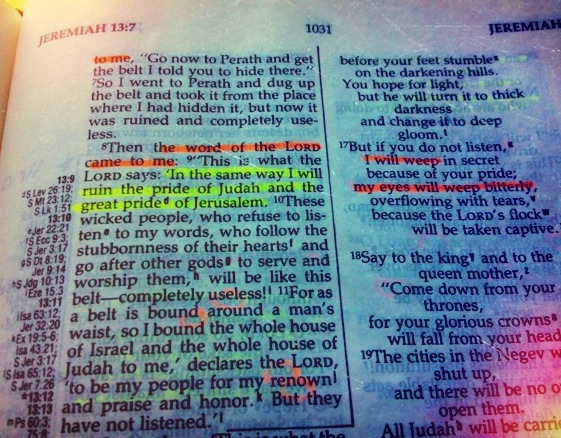
BibleThis past week I’ve had two conversations that seemed like contradicting thoughts about the Bible, but they’re really exactly the same.

Conversation #1—Since Jesus Christ set us free from the law, there is no longer any need for us to read or study the Old Testament.

Conversation #2—The New Testament is a perversion of the Old Testament, so we should ignore it and stick with the “original” Scripture.

One thing that has helped me see the Scripture in a more correct light is a thought I picked up from Leonard Sweet and Frank Viola in their book Jesus: A Theography. Instead of the titles we’ve given the two divisions of the Bible, it will be better to call them the First and Second Testaments. “Old” and “New” have a tendency to make us think out-dated and updated; First and Second remind us that they go together.

Hosea is one of the first prophets in the First Testament whose words were put into writing. It’s interesting to note how many of the themes from the Pentateuch, Joshua and Judges are linked to Israel’s condition in the last few years before the northern tribes went into exile.

“Hosea’s allusions to Genesis through Judges are highly significant. First, they help to establish the fact that these books had already been written by the time of Hosea, in the eighth century B.C. (Many scholars consider these books to be from the sixth century B.C. and even later.) Second, Hosea’s construal of these books helps us to understand early Biblical interpretation, which in turn gives us a better understanding of how the [Second] Testament interprets the [First].” —Archeological Study Bible

When we move into the Second Testament, we see over 850 First Testament passages are quoted, sometimes entire paragraphs. In every instance, the Second Testament authors see the fulfillment of the First Testament in the life of Jesus Christ.

In fact, Jesus Himself quoted from 22 books of the First Testament, even on the day of His resurrection He explained to them what was said in all the Scriptures concerning Himself (Luke 24:27), and He said He would open our minds so that we too could understand all the Scriptures (Luke 24:45-47).

Finally there is the issue of fulfilled prophesy. Not only were First Testament prophesies fulfilled during the First Testament time, but even more were fulfilled during the Second Testament. In Jesus Christ alone about 200 such prophesies were fulfilled.

Both Testaments are equally important, and equally valuable. In fact, either Testament without the other robs God of His glory and robs us of seeing His fullness.

7 Bible Study Ideas From D.L. Moody

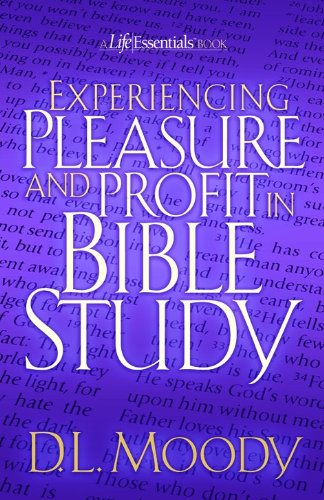
Pleasure & ProfitAs I read D.L. Moody’s book Pleasure & Profit In Bible Study, I made note of several ideas that could stimulate a great Bible study. Check out my review of this book by clicking here, then check out these great study-starters:

“If you are impatient, sit down quietly and commune with Job. If you are strong-headed, read of Moses and Peter. If you are weak-kneed, look at Elijah. If there is no song in your heart, listen to David. If you are a politician, read Daniel. If you are getting sordid, read Isaiah. If you are chilly, read of the beloved disciple. If your faith is low, read Paul. If you are getting lazy, watch James. If you are losing sight of the future, read in Revelation of the promised land.” —Richard Baxter 

“Every chapter [of Mark] but the first, seventh, eighth and fourteenth begins with ‘And,’ as if there was no pause in Christ’s ministry.”

“Matthew begins with Abraham; Mark with Malachi; Luke with John the Baptist; but John with God Himself. Matthew sets forth Christ as the Jew’s Messiah. Mark as the active worker. Luke as a man. John as a personal Savior.”

“[In John’s Gospel] the word repent does not occur once, but the word believe occurs ninety-eight times.”

“Dr. A. T. Pierson says: Let the introduction cover five P’s; place where written; person by whom written; people to whom written; purpose for which written; period at which written.” 

“Some time ago a man wanted to take my Bible home to get a few things out of it, and when it came back I found this noted in it:

  • Justification, a change of state, a new standing before God.
  • Repentance, a change of mind, a new mind about God.
  • Regeneration, a change of nature, a new heart from God.
  • Conversion, a change of life, a new life for God.
  • Adoption, a change of family, new relationship towards God.
  • Sanctification, a change of service, separation unto God.
  • Glorification, a new state, a new condition with God.”

“I was wonderfully blessed by taking the seven ‘Blesseds’ of the Revelation. … Or you may take the eight ‘overcomes’ in Revelation…. I have been greatly blessed by going through the ‘believings’ of John. Every chapter but two speaks of believing. … Take the six ‘precious’ things in Peter’s Epistles. And the seven ‘walks’ of the Epistle to the Ephesians. And the five ‘much mores’ of Romans 5. Or the two ‘receiveds’ of John 1. Or the seven ‘hearts’ in Proverbs 13, and especially an eighth. Or ‘the fear of the Lord’ in Proverbs.” 

“No scripture is exhausted by a single explanation. The flowers of God’s garden bloom, not only double, but seven-fold: they are continually pouring forth fresh fragrance.” —Charles Spurgeon