The Approachable Jesus

Listen to the podcast of this post by clicking on the player below, and you can also subscribe on AppleSpotify, or Audible. 

A friend of mine who was in a position of leadership in the Assemblies of God used to joke with people, “Since you’re bowing and walking backwards out of my office, would you like to kiss my ring too?” There are some people that we feel are in a special class so that we have to approach them differently. 

If we feel that way about certain people, what might we be thinking when we consider approaching the supreme, awesome, preeminent, incomparable Jesus?! It’s very likely that we could feel Him to be unapproachable, as though we aren’t worthy of His attention. 

But when Jesus Himself told us, “When [not ‘if’] you pray,” He is assuming that we will pray. And then He adds this amazing thought: “And I will do whatever you ask in My name, so that the Father may be glorified in the Son” (John 14:13)! 

Jesus loves to help us. He died a cruel death on the Cross so that He could help us! Jesus ties our trusting prayer with His willingness to serve us (Luke 12:22-37). Note this last line from our approachable Savior: 

It will be good for those servants whose Master finds them watching when He comes. Truly I tell you, He will dress Himself to serve, will have them recline at the table and will come and wait on them. (v. 37) 

Jesus serves us?! What an amazing thought! But does this make Jesus somehow less majestic? I like what John Piper has to say about this: “Does this belittle the risen Christ—to say that He was and is and will ever be the servant of His people? It would, if ‘servant’ meant ‘one who takes orders,’ or if we thought we were His masters. Yes, that would dishonor Him. But it does not dishonor Him to say that we are weak and need His help.” 

How do we not treat Jesus as an order-taking servant? First, we have to remember that approachable doesn’t mean something we do casually. I think this is discovered in our attitude—it’s the difference between being childlike and being childish. 

The childlike attitude is one of wonder and trust. One that calls God, “Daddy.” One that is lovingly dependent on Him. One that says, “I don’t understand what I’m going through right now, but I trust Your wisdom.” 

The childish attitude is one who treats majestic things flippantly. Perhaps the childish one talks about God as “the Big Guy upstairs.” Or one who remains selfishly independent, or who says, “Do it my way—now!”

The childlike attitude glorifies Jesus as our approachable Servant Savior. 

The childlike attitude also recognizes that there are more dimensions of the majesty of God to be discovered in an abiding relationship with Jesus. Our approachable Savior wants us to come to Him, to call to Him for help, and to know Him more intimately (Jeremiah 29:13-14; Matthew 11:28-30; Hebrews 4:16; 10:19, 22). 

Prayer not only unlocks deeper, proper intimacy with Jesus, but it conforms our heart more and more to His heart. As we are conformed to Him, we reflect His approachable glory to others (2 Corinthians 4:6, 3:18). 

We approach the awesome Jesus reverently in childlike faith. It’s in God’s presence that the Holy Spirit matures our faith so that we become glory-reflectors that point others to Jesus. 

If you’ve missed any of the eight messages in our series Awesome: Learning to pray in the awesome name of Jesus, you can find the list of all of the messages by clicking here. 

►► Would you please prayerfully consider supporting this ministry? My Patreon supporters get behind-the-scenes access to exclusive materials. ◀︎◀︎

Links & Quotes

In 1 Timothy 3:1, Paul writes, “This is a faithful saying: If a man desires the position of a bishop [overseer], he desires a good work.” T.M. Moore commented on this verse—

“The Greek word for ‘bishop’ translates literally to ‘overseer.’ Overseers—pastors, elders, anyone in a leadership role in the congregation—is charged with watching over the souls of God’s people for good (Hebrews 13:17; Acts 20:28; 1 Thessalonians 5:12-13). While the primary duty of watching over the Lord’s flock falls on pastors and elders, all who serve with them function in a role of overseeing, that all the members of the congregation might benefit from the continuous care and shepherding of those who lead them.”

I am so grateful for T.M.’s endorsement of my book Shepherd Leadership: The Metrics That Really Matter in which I expound more on this 1 Timothy verse, and talk about how shepherd leaders should be raising up more leaders around them.

Our church purchased a building to use as our new homebase for ministry in our city. I am super excited about the possibilities!

Tiny bacteria declare loudly the genius of the Creator. This new study on the ability of bacterium to protect its own DNA from mutations is fascinating!

Dan Reiland says, “Good character takes a lifetime to build and a moment to destroy.” Dan shares 5 practices that build leadership character to last for a lifetime.

Amenhotep I was the second pharaoh of the 18th dynasty, and ruled from ca 1525-1504 BC during the time the Israelites were slaves in Egypt. Using 3-D CT scans, Amenhotep has been unwrapped for the first time in over 3000 years!

How are you supposed to follow God when obedience feels impossible? John Piper explains in this post

Links & Quotes

John Piper wrote to pastors, “That is the main task of preaching, and the main purpose of small groups and all the ministries of the church: helping people see the greatness of what Christ has purchased for everyone who will value it above the world. Helping people see it and savor it, so that God’s superior worth shines in their satisfaction and in the sacrifices that come from such a heart.”

“The gospel of Christ, what is it? We look at the last two words, ‘of Christ.’ Indeed, if you understand Christ, you understand the gospel. Christ is the Author of it. He, in the council chamber of eternity, proposed to become the Surety for poor fallen man! He, in the fullness of time, worked out eternal redemption for as many as His Father had given Him. He is the Author of it as its Architect and Builder. We see in Christ Jesus the Alpha and the Omega of the gospel. He has provided in the treasury of grace all that is necessary to make the gospel the gospel of our salvation. And as He is the Author of it, so He is the matter of it. It is impossible to preach the gospel without preaching the Person, the work, the office, and the character of Christ. If Christ is preached, the gospel is promulgated, and if Christ is put in the background, then there is no gospel declared.” —Charles Spurgeon

Would you prayerfully consider supporting my Patreon page at only $5 per month?

Josh McDowell addresses the question, “Did Jesus say He is God?

Marshall Seagal wrote an insightful article about patience. He notes, “Patience exists only in a world of disruption, delays, and disappointment. It grows only on the battlefield. We cannot practice patience unless our circumstances call for it—and the circumstances that call for it are the kinds of circumstances we wouldn’t choose for ourselves.”

The Biblical Archeological Report has a history of Egyptian Pharaoh Hophra that is quite fascinating. It’s always so interesting to me to watch how these archeological finds square with the historical records contained in the Bible.

Links & Quotes

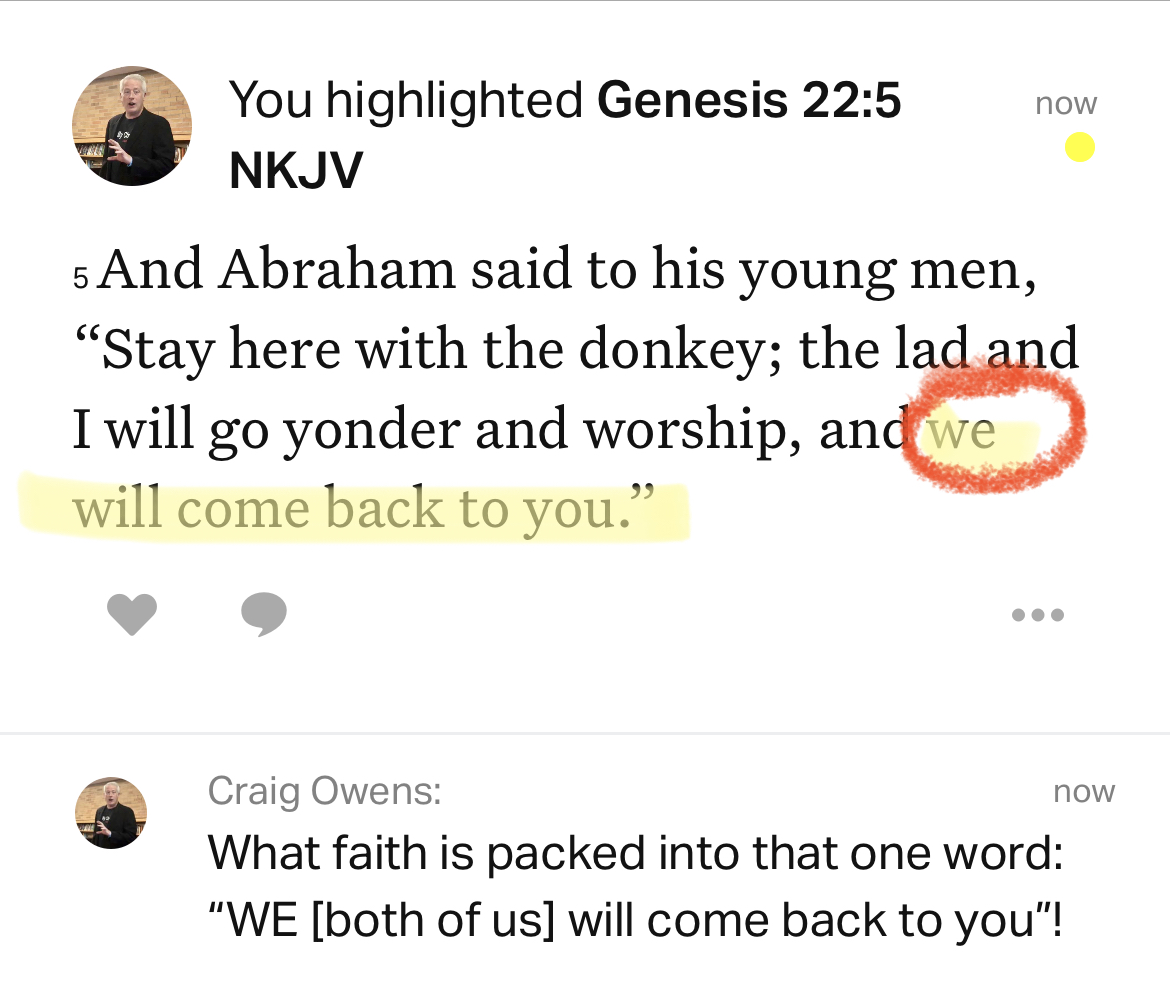
Abraham is commanded by God to sacrifice his son Isaac. Look at Abraham’s faith in just one word: “WE will come back to you.”

Follow me on YouVersion so we can share more thoughts on God’s Word with each other.

Wil Robinson shares a fable from Leo Tolstoy with the three most important questions everyone should ask themselves. The three questions are: How can I learn to do the right thing at the right time? Who are the people I most need, and to whom should I, therefore, pay more attention than to the rest? And, what affairs are the most important and need my first attention?

T.M. Moore reminds us how the promises of God can build courage in us. Check out all of the posts in his series called Brave Heart.

“Faithfulness is displayed in both word and deed—seen best by combining the Great Commission’s instruction to ‘make disciples’ with the second greatest commandment to ‘love thy neighbor.’ The beauty of the Gospel is found in both proclamation and demonstration. Neither comes first; neither comes second. Like the perfect marriage, it’s the duty of the Christians to take on each, giving 100 percent effort to both.” —Gabe Lyons, The Next Christians 

Fight The New Drug shared the results of a study of over 11,000 releationships, the five things the happiest couples have in common, and how pornography can undermine those relationships.

“Oh, that the eyes of sinners may be speedily opened—that they may see the difference of things, the beauty which is in holiness, and the astonishing madness that is in sin!” —Thomas Watson

Science is an important component in seeking truth. The Institute for Creation Research has an excellent perspective on the role of science for a Christian: “While the pursuit of science is certainly noble, it should be situated in its proper context and tackle matters within its empirically defined framework.”

John Piper observes, “The number-one reason why people in such seemingly hopeless situations purchase scratch-offs is because things already look so hopeless for improvement that the so-called ‘stupidity’ of wasting this dollar won’t really make anything worse.” This post elaborates on how the lottery preys on the poor.

The Legacy Of Sovereign Joy (book review)

Listen to the podcast of this post by clicking on the player below, and you can also subscribe on AppleSpotify, or Audible. 

God uses humans—flawed, imperfect humans—to accomplish His sovereign plan. As we yield to His sovereignty we can discover an unparalleled joy. In The Legacy Of Sovereign Joy, John Piper shows us this principle in the lives of three notable men of church history: Augustine of Hippo, Martin Luther, and John Calvin. 

Although separated by 1000 years, these men are inseparably linked to the beginning of the Reformation. Both Luther and Calvin relied heavily on the writings of Augustine as they called Christians away from the unbiblical teachings and traditions, and back to the pure, freeing truths of the Bible. 

These men are also linked in another way that should be quite encouraging to us. Augustine struggled with his sexual passions, Luther struggled to control his razor-sharp tongue, and Calvin used some rather worldly means to fight for biblical truths. All of them were flawed men, and yet God sovereignly used them. And through all of their struggles, the Holy Spirit brought all three of them into a place where they savored the sovereign joy that only God can give. This should give us great encouragement that God can use us too. 

By themselves, John Piper’s biographies of these men are worth your time to read, but the way Pastor John intertwines their stories to show us how sovereign joy can be our mainstay as well is absolutely brilliant. 

This was the first book Pastor John published in his series “The Swans Are Not Silent.” If you’re interested, I have previously shared reviews on The Hidden Smile Of God and Seeing Beauty And Saying Beautifully. 

Students of church history and those longing to know the joy of the Lord more deeply will enjoy reading The Legacy Of Sovereign Joy. 

►► Would you please prayerfully consider supporting this ministry? ◀︎◀︎

Links & Quotes

“If a claim to spiritual revelation leads us to depend less on the once-for-allness of the historical Word that comes to us by Jesus Christ through the apostles (Hebrews 2:3), then that claim is dubious.” —John Piper

“God, change me today because I have spent time being exposed to Your thoughts in Scripture. As risky as it is, I want Your Word to cut away everything in me that doesn’t look like Jesus.” —Kenneth Blanchard (see Hebrews 4:12) 

A scrip on my back, and a staff in my hand,
I march on in haste through an enemy’s land;
The road may be rough, but it cannot be long;
And I’ll smooth it with hope, and I’ll cheer it with song. —Henry Francis Lyte


Looking forward to beginning a new series at Calvary Assembly of God this Sunday…

Book Reviews From 2021

Listen to the podcast of this post by clicking on the player below, and you can also subscribe on AppleSpotify, or Audible.

I love reading, and I love sharing my love of good books with others! Here is a list of the books I read and reviewed in 2021. Click on a title to be taken to that review.

24

AC/DC

Churchill’s Ministry Of Ungentlemanly Warfare

Faithlife Illustrated Study Bible

George Whitefield

Hal Moore On Leadership

His Last Bow

Holy Sexuality And The Gospel

How Christianity Changed The World

How I Got This Way

How To Bring Men To Christ

Jesus On Trial

John Adams

Miracles Out Of Somewhere

My Lucky Life

Out Of The Silent Planet

Perelandra

Pilgrim’s Progress

Prayer

Prophet With A Pen

QB

Reading The Bible With The Founding Fathers

Secrets Of Dynamic Communication

Seeing Beauty And Saying Beautifully

Shepherd Leadership

Star Struck

Talking To GOATs

That Hideous Strength

The Art Of Writing And The Gift Of Writers

The Hidden Smile Of God

The Hiding Place

Thompson Chain-Reference Bible

To The Work!

Voice Of A Prophet

Washington’s Immortals

Word-For-Word Bible Comic: Jonah

Here are my book reviews for 2011.

Here are my book reviews for 2012.

Here are my book reviews for 2013.

Here are my book reviews for 2014.

Here are my book reviews for 2015.

Here are my book reviews for 2016.

Here are my book reviews for 2017.

Here are my book reviews for 2018.

       Here are my book reviews for 2019.

Here are my book reviews for 2020.

►► Would you please prayerfully consider supporting this ministry? ◀︎◀︎

The Hidden Smile Of God (book review)

Listen to the podcast of this post by clicking on the player below, and you can also subscribe on AppleSpotify, or Audible. 

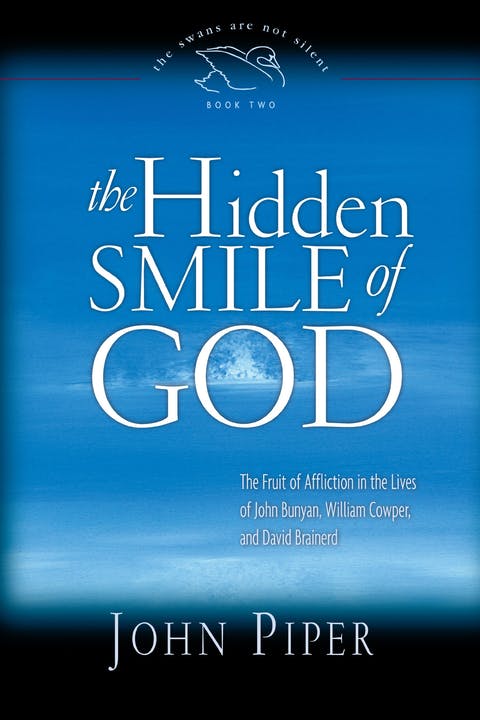
It’s one thing for someone to dispense sound advice, but it’s an entirely different thing for that advice to come from hard-won life experiences. The Hidden Smile Of God is the second book in John Piper’s excellent series of biographies called “The Swans are Not Silent.” 

Each book in this series features biographies and life lessons of three notable saints. Pastor John weaves these character studies together around a common theme. In this book, the lives of John Bunyan, William Cowper, and David Brainerd are examined to see the fruitful ministry that can emerge from a life plagued by affliction. 

John Bunyan, well-known author of The Pilgrim’s Progress, spent over a decade in prison, as well as the balance of his life under severely pressing circumstances. David Brainerd was a missionary to several American Indian tribes, while struggling with failing health and crushing loneliness. And William Cowper was suicidally depressed through nearly all of his life, and yet wrote some of the most intimate and moving poems. 

In fact, it is a line in one of Cowper’s poems from which the title of this John Piper book emerges—

Judge not the Lord by feeble sense, 
But trust Him for His grace; 
Behind a frowning providence 
He hides a smiling face.

Pastor John does more than merely share memorable biographies of these three men, but he extracts insights about suffering and affliction that will enable others to have a new biblical paradigm about their own suffering. Such amazing lessons for any of us struggling through dark times.

Even if you don’t personally struggle with affliction or anxiety or depression, chances are very good that someone around you does. Perhaps you could read this book and share some of these helpful insights with your friends or family members who are struggling. 

If you would like to check out my review of another book in this series—Seeing Beauty and Saying Beautifullyplease click here. 

►► Would you please prayerfully consider supporting this ministry? ◀︎◀︎

Our Blessed Hope

Listen to the podcast of this post by clicking on the player below, and you can also subscribe on AppleSpotify, or Audible. 

As we wrap up our series looking at our foundational belief statements, I want to combine the last four statements together, not only because they all cover the same theme of end-times events, but also because these statements should give every Christian hope! 

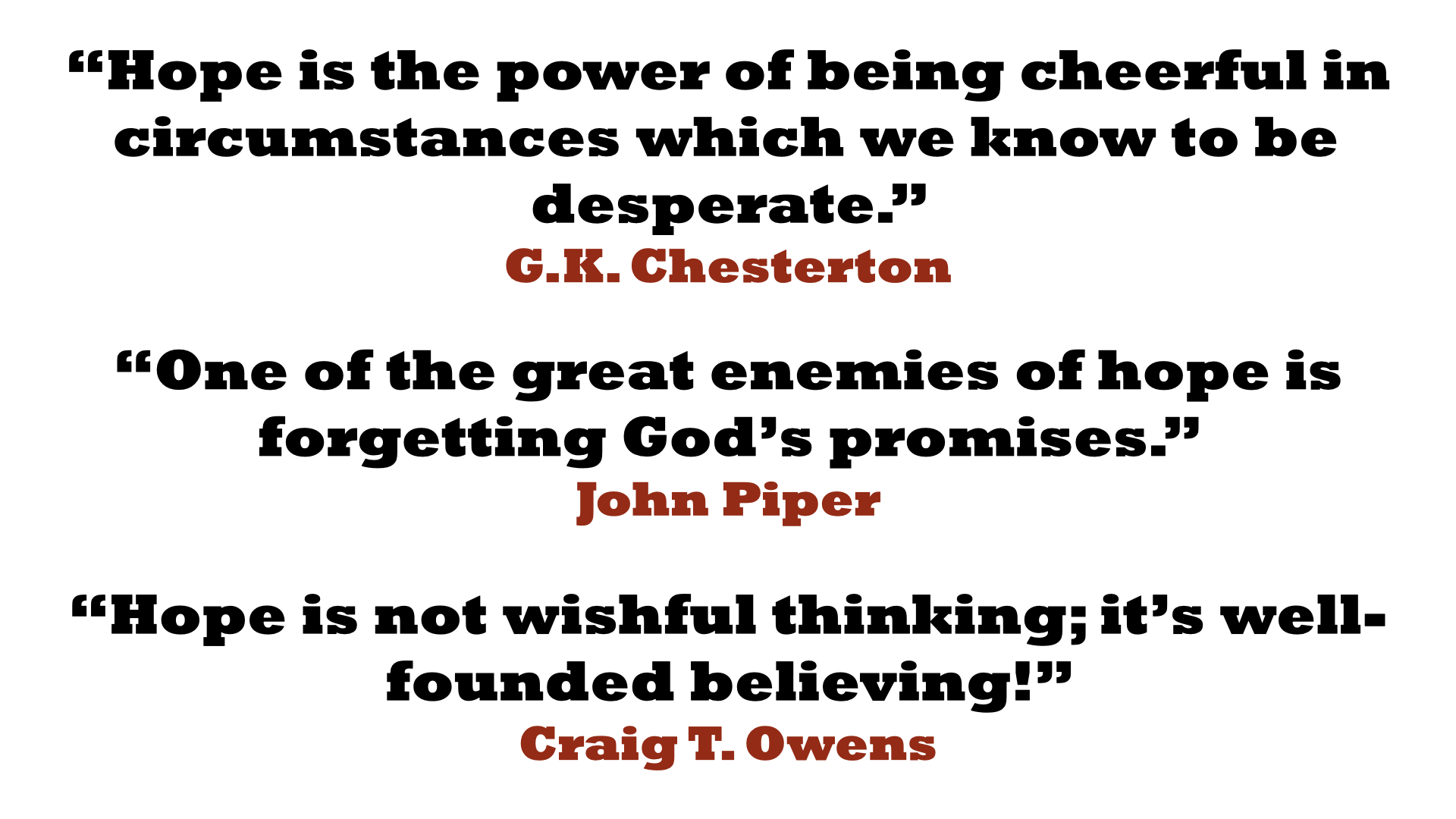
  • “Hope is the power of being cheerful in circumstances which we know to be desperate.” —G.K. Chesterton 
  • “One of the great enemies of hope is forgetting God’s promises.” —John Piper 
  • “Hope is not wishful thinking; it’s well-founded believing!” —Craig T. Owens 

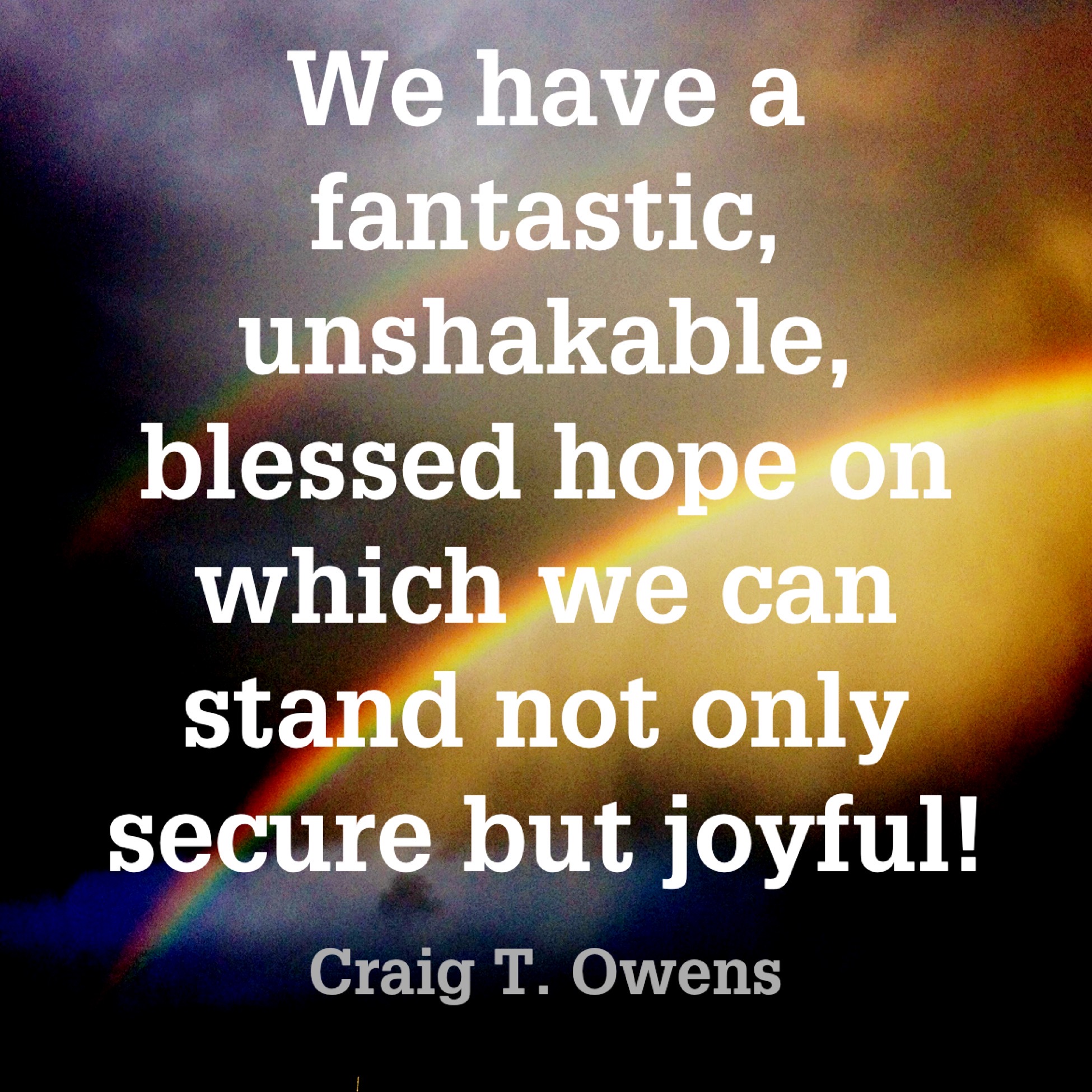
Christians have a fantastic, unshakable, blessed hope on which we can stand not only secure but joyful! 

Foundational truth #13: “The resurrection of those who have fallen asleep in Christ and their translation together with those who are alive and remain unto the coming of the Lord is the imminent and blessed hope of the church.” 

This blessed hope in the future helps us live with joy today! Knowing that death has been defeated and Jesus will come back to take us home with Him should fuel us to say “no” to the temporary pleasures of sin, and live such godly lives that it turns others’ eyes to Jesus (Titus 2:11-14; 1 Corinthians 15:51-52; 1 Thessalonians 4:16-17). 

Foundational truth #14: “The second coming of Christ includes the rapture of the saints, which is our blessed hope, followed by the visible return of Christ with His saints to reign on earth for one thousand years.” 

Sometimes you will hear Christians talk about the “rapture” of the Church. Although this word itself isn’t in the Bible, the Greek word harpazo in 1 Thessalonians 4:17 means “catching up.” It also means “to eagerly claim for one’s self,” which reminds me that Jesus is thrilled to bring His Bride home to be with Him forever! After the Church has been caught up to Heaven, a period of tribulation will plague the earth, followed by Christ’s Second Coming and His millennial reign (Zechariah 14:4-5; Revelation 19:11-15; 20:1-10). 

Foundational truth #15: “There will be a final judgment in which the wicked dead will be raised and judged according to their works. Whosoever is not found written in the Book of Life, together with the devil and his angels, the beast and the false prophet, will be consigned to the everlasting punishment in the lake which burns with fire and brimstone, which is the second death.” 

Christians have no fear of the second (or final) death because our names are written in the Book of Life (Luke 12:4-6; Revelation 20:11-15). Not only is there judgment for the wicked, but there will be rewards for the righteous. 

Foundational truth #16: “In keeping with His promise we are looking forward to a new heaven and a new earth, where righteousness dwells” (2 Peter 3:13). Revelation 21-22 give us a small glimpse of our eternal home. 

In light of these truths, how should Christians live while still on earth? I think there are three ways we should live: 

  1. Live circumspectly
  2. Live on-mission
  3. Live unafraid

(see Ephesians 5:15; Matthew 28:18-20; Proverbs 24:11-12; Jude 1:20-25) 

With this blessed hope of the Second Coming of Jesus and our security in knowing we will remain with Him forever, let’s tell everyone we can how they too can know what it is to live with this hope in their heart. 

If you’ve missed any of the messages in our series exploring our foundational beliefs, you can access the full list by clicking here. 

►► Would you please prayerfully consider supporting this ministry? ◀︎◀︎

Seeing Beauty And Saying Beautifully (book review)

Listen to the podcast of this post by clicking on the player below, and you can also subscribe on Apple or Spotify.

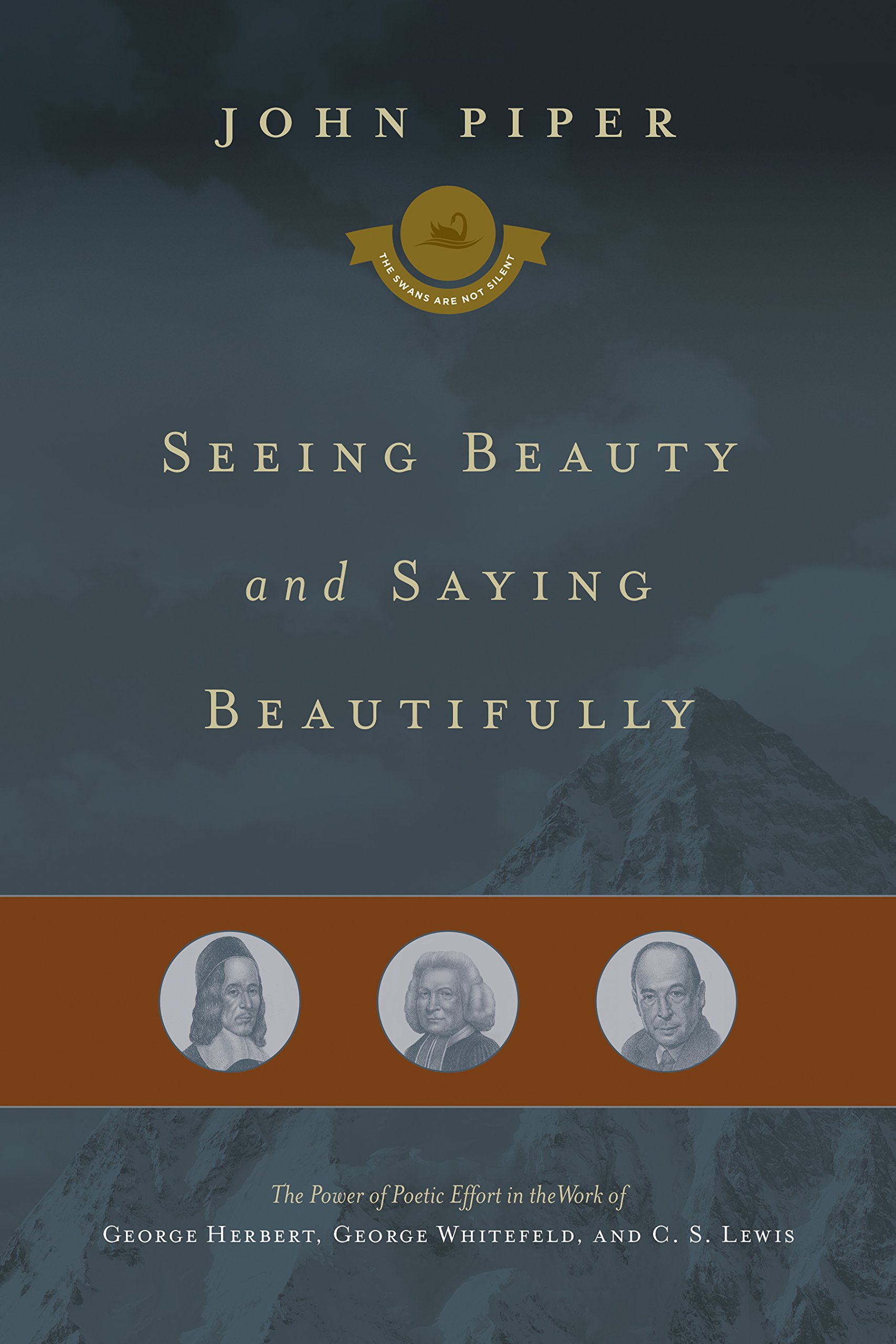
Seeing Beauty And Saying Beautifully is, in my mind, a grand slam! It features one of my favorite poets (George Herbert), possibly the most prolific evangelist of history (George Whitefield), my all-time favorite author (C.S. Lewis), all tied together by my go-to theologian (John Piper). Seeing Beauty And Saying Beautifully is part 6 in Piper’s series called “The Swans Are Not Silent.” 

George Herbert was a pastor of a small country church and a prolific poet who wrote almost all of his poems uniquely. “Of the 167 poems in The Temple, 116 are written with meters that are not repeated,” which even modern poets find astounding. George Whitefield spent more hours of his life preaching than he did sleeping, and he spoke with such a captivating style that he was quite possibly the first celebrity of the American colonies. C.S. Lewis wrote everything from history to fantasy, autobiography to poetry, theology to children’s novels. Peter Kreeft says of him, he “was not a man: he was a world.” 

John Piper finds in all three of these men a common thread: They all were able to not only see the beauty of God in everything, but they were able to express it in a beautiful way that drew in others to see the beauty of God for themselves. Pastor John calls this “poetic effort.” 

Pastor John also wrestles with how the profound creativity and eloquence of his three subjects meshes with the apostle Paul’s admonition that human eloquence could drain the Cross of Jesus of its power (see 1 Corinthians 1:17-2:5). He concludes that poetic effort for the sake of exalting the speaker or poet does turn people’s eyes to man and away from God. But that poet, evangelist, or author that uses the beauty in God’s creation to point people to the Creator is doing so in a way in which God is supremely exalted. This, Pastor John says, is exactly what Herbert, Whitefield, and Lewis have done, and done so well that their poetic efforts are still fruitful and God-glorifying long after their deaths. 

Seeing Beauty And Saying Beautifully is a wonderful book for those who enjoy biographies, theology, or the craft of skilled artisans. If you don’t know about the poems of George Herbert, the preaching of George Whitefield, or the vast library of literature of C.S. Lewis, let this book be your doorway to a rich new world of discovery, enjoyment, and God-glorification. 

►► Would you please prayerfully consider supporting this ministry? ◀︎◀︎