“Father, Forgive Them”

Listen to the podcast of this post by clicking on the player below, and you can also subscribe on Apple or Spotify.

In our system of law, special attention is given to someone’s dying declaration. If our legal system gives such weight to the last words of an imperfect man, it seems to me that we should take special note of the dying declarations of the only truly innocent Man who ever walked this earth: Jesus Christ. 

After being nailed to the Cross, the first dying declaration from Jesus was: Father, forgive them, for they do not know what they are doing (Luke 23:34). 

Let’s say that Billy is dying on a hospital bed after being fatally shot, and all he can muster the strength to do is point at Johnny and whisper, “He… shot… me….” We would know who the “he” was in that situation, but who exactly is the “them” in this declaration of Jesus? 

Who offended Jesus? Who mortally wounded Him? Who caused Him such anguish? Maybe it was…

  • His disciples who couldn’t stay awake to pray with Him 
  • Judas who betrayed Him with a kiss 
  • the nine disciples who ran away 
  • Peter who denied three times that he knew Jesus 
  • the false witnesses in Caiaphas’ house
  • the members of the Sanhedrin who hit Him and spit on Him 
  • the members of the Sanhedrin who were silent 
  • the temple guards who mocked Him 
  • those who spewed lies when Jesus stood before Pilate
  • those who lied about Jesus when He stood before Herod 
  • Herod and his soldiers who mocked Him 
  • the Roman soldiers who abused Him 
  • the Roman soldiers who stripped Him naked and crucified Him 

To all of the above, Jesus said, “Father, forgive them”!  

Listen to how Peter described the response of Jesus to all of this: When they hurled their insults at Him, He did not retaliate; when He suffered, He made no threats… (1 Peter 2:23). That word for insults means to heap abuse on Him or to pile on. This was a fulfillment of a 700-year-old prophecy: He was oppressed and afflicted… (Isaiah 53:7). Isaiah uses similar words, where oppressed means tyrannized, and afflicted means a humiliating, painful loss of dignity. 

Christ’s own disciples afflicted Him, and so did the temple guards, and Pilate, and King Herod, and the Roman soldiers… and you and me. All of this mistreatment and humiliation and tyrannizing was handed out by us too (see Isaiah 53:6; 1 Peter 2:24-25). That’s why His arms were spread so wide when He said, “Father, forgive them,” because there were so many that needed forgiveness! 

When Jesus said forgive, He was asking His Father to take away our guilt that kept us out of God’s presence. Think of a courtroom scene where God the Father is the Judge, satan is the prosecutor, Jesus is the victim, and I am the defendant. The evidence is overwhelming and incontrovertible, and I am pronounced guilty. My punishment is a death sentence. When Jesus says, “Father, forgive him,” He is taking the death penalty in my place! 

In another beautiful fulfillment of an Old Testament practice, Jesus became both our sin offering and our scapegoat, making atonement for us at the mercyseat in the Most Holy Place, and allowing us to be welcomed into God’s holy presence (Leviticus 16:15-16, 20-22; Hebrews 9:12-14). 

When Jesus said, “Father, forgive them,” He was saying, “Father, bring them into Your presence!” 

You and I need to accept by faith the atoning work done on the Cross, the forgiveness of sins that was purchased for us. Jesus didn’t come to condemn us, but to lovingly restore us, and for that we are eternally and humbly grateful. 

Please don’t miss out on any of these dying declarations from Jesus. You can find my thoughts on all of the confessions of this dying Man by clicking here.

►► Would you please prayerfully consider supporting this ministry? ◀︎◀︎
The Deity And Divinity Of Jesus

Listen to the podcast of this post by clicking on the player below, and you can also subscribe on Apple or Spotify.

Some really silly guys did a series of videos called “Neature Walk” because they wanted to share how neat is nature! In episode one Vic sees a tree that he really likes and says, “Score! This is an aspen tree. You can that it’s an aspen tree because of the way it is.” This is either circular reasoning or an obvious statement. “Just look at this thing. You can tell it’s this thing because it looks and acts like this thing.” 

I feel a lot like this when I look at the first part of our third foundational truth statement: “We believe in the Deity of the Lord Jesus Christ.” (As a side note, I covered the second part of this statement—“As God’s Son, Jesus was both human and divine”—in another post, which you may find here.) 

Check this out: the definition for Deity is the divine character of God, and the definition for divine means things relating to the Deity. In saying we believe Jesus is God we are really saying, “You can tell that Jesus is God because of the way He is.” 

In order to make this definition work, we need evidence for both the divinity and the deity of Jesus. That being said, let me remind you of J. Warner Wallace’s instruction on faith. There is:

  • Blind faith—believing in something without evidence 
  • Unreasonable faith—believing in something in spite of the evidence 
  • Reasonable faith—believing in something because of the evidence 

Here is some evidence that I think makes it reasonable to believe that Jesus is divine:

  1. Virgin birth—Isaiah 7:14; Luke 1:34-35; Matthew 1:22-23 
  2. Sinless life—Isaiah 53:4-6, 9; Hebrews 7:26-27; 1 Peter 2:22 
  3. Miracles—Acts 10:38; 2:22-24 
  4. Death, resurrection, exaltation—Isaiah 53:10-12; Philippians 2:6-8; Hebrews 1:3 

(Check out all the Scriptural references listed above by clicking here.) 

I think the best evidence for the Deity of Jesus is the connection He Himself made between the “Jehovah” titles of the First Testament and His “I AM” statements in the Second Testament:

  • Jehovah Jireh (I Am Your Provider) → I am the Bread of Life (John 6:35)
  • Jehovah Rapha (I Am Your Healing) → I am the Resurrection and the Life (John 11:25-26)
  • Jehovah Nissi (I Am Your Source) → I am the Vine (John 15:5)
  • Jehovah Shalom (I Am Your Peace) → I am the Light of the world (John 8:12)
  • Jehovah Raah (I Am Your Shepherd) → I am the Good Shepherd (John 10:11)
  • Jehovah Sabaoth (I Am Your Wall Of Protection) → I am the Gate (John 10:9)
  • Jehovah Tsid-kenu (I Am Your Righteousness) → I am the Way, Truth, and Life (John 14:6)
  • Jehovah Shammah (I Am Here) → I am the Alpha and Omega (Revelation 1:8; 22:13). 

(Check out all the Scriptural references listed above by clicking here.)

The Jewish leadership understood perfectly what Jesus was claiming! But the more pertinent question is this: Do we understand what we must do with this evidence? 

We cannot claim that Jesus was born of a virgin, or lived a sinless life, or did miracles, or died and rose again and then not believe He is God. We cannot pick and choose the parts of Jesus we want. 

The apostle Paul reminded us that someday “at the name of Jesus every knee should bow, in heaven and on earth and under the earth, and every tongue acknowledge that Jesus Christ is Lord, to the glory of God the Father” (Philippians 2:11-12). 

Every knee will bow to Him one day: Either in worship of Jesus their Savior, or in abject terror of Jesus their Judge. 

I pray that you believe in Jesus as your Lord and Savior today… don’t wait another moment! 

►► Would you please prayerfully consider supporting this ministry? ◀︎◀︎
If you’ve missed any of the other messages in our Foundational Stones series, which is exploring our foundational beliefs, you may access all of them by clicking here.

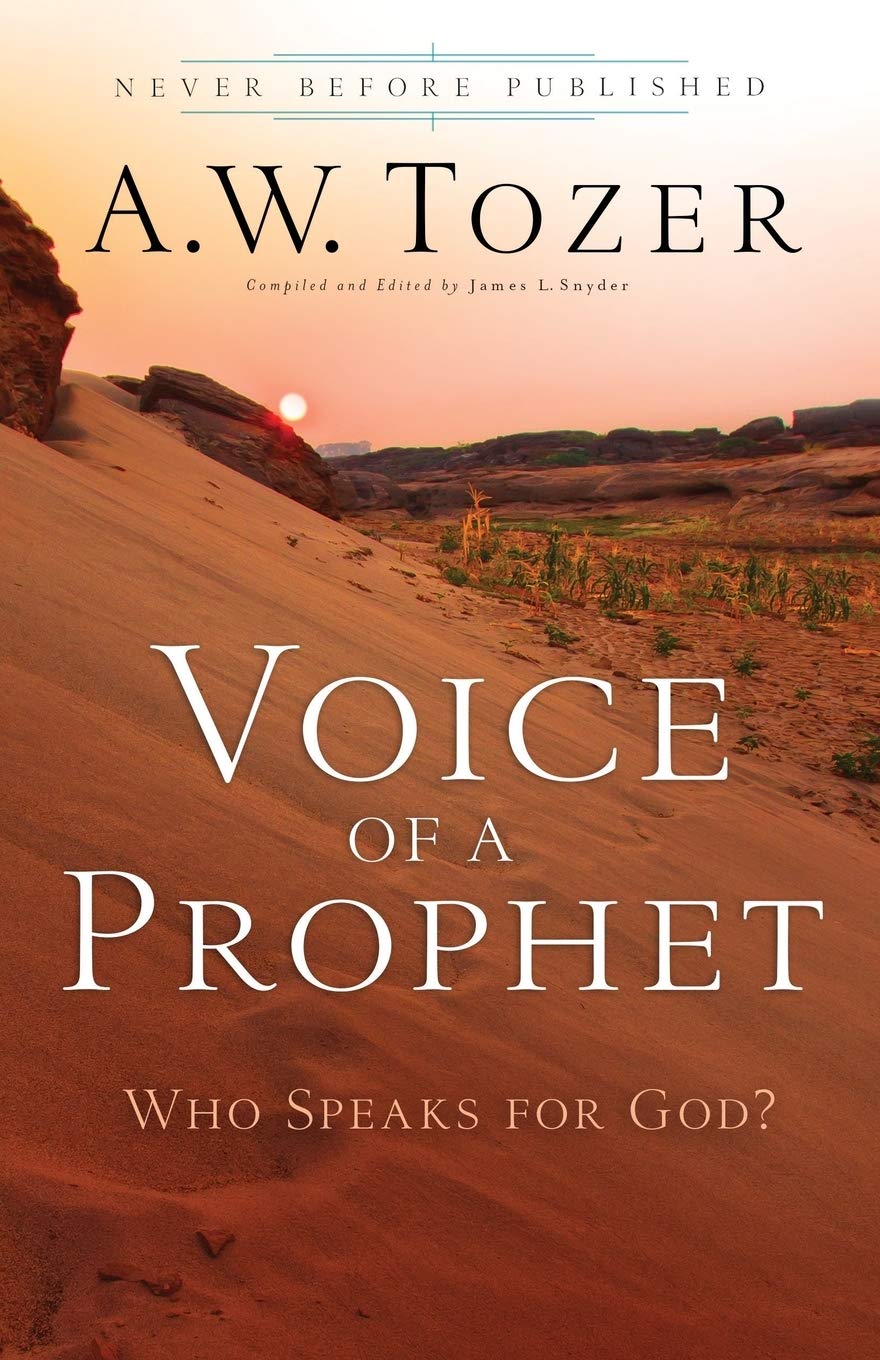
Voice Of A Prophet (book review)

Listen to the podcast of this post by clicking on the player below, and you can also subscribe on Apple or Spotify.

I’ve always appreciated A.W. Tozer’s prophetic voice. By that I mean, his unabashed call for Christians to live up to the Christlike standard given to us in the Scriptures. But in Voice Of A Prophet, Tozer hits a little closer to home for me (and for all of us who are in ministry positions) as he specifically calls on pastors to live up to the prophetic standard given to us in the Bible. 

Sometimes people misunderstand the title “prophet” to be one who foretells future events. At times, that is the function of a prophet, but primarily the prophet is more of a forthteller than a foreteller. The prophet is called upon to boldly proclaim God’s truth and tell forth where godly people are falling short. Prophets are God’s messengers to God’s people, usually sent to reawaken His people to truths that they have forgotten or strayed from. 

Tozer calls modern-day pastors and preachers—those he calls “the sons of the prophets”—to look to the prophetic fathers of the Scripture. He calls us to live up to the God-fearing standard of the prophets like Elijah, Isaiah, John the Baptist, and Jesus. He forthtells how too many have succumbed to the voice of culture instead of adhering to the voice of their Lord, and how they have traded “Thus saith the Lord” for “Thus saith me.” 

The opening chapter of Voice Of A Prophet reprints a prayer that Tozer wrote out when he was ordained in 1920. Part of that prayer for himself should remain a prayer for all who are called by God to be pastors today: “Let me stand before the great or minister to the poor and lowly; that choice is not mine, and I would not influence it if I could. I am Thy servant to do Thy will, and that will is sweeter to me than position or riches or fame and I choose it above all things on earth or in heaven.”

Voice Of A Prophet is an important read for those in pastoral ministry. FAIR WARNING: You will be challenged and convicted by Tozer’s timeless words! But if you will heed those words, God will be pleased to bless your efforts. I would also recommend this book to anyone who would like to know how they can better support and pray for their pastor, as I think they will find valuable insights in this book. 

Would you please prayerfully consider supporting this ministry?

God Is One, God Is Love

Listen to the podcast of this post by clicking on the player below, and you can also subscribe on Apple or Spotify.

There is a common characteristic among every human civilization: they all have had a pantheon of gods. It seems that no one god could capture all of the attributes each civilization thought were important, so they created multiple gods to help fill in the gaps. 

Onto the world scene comes the account recorded for us in the Bible of a God who creates the universe. The Hebrew word for this God is elohiym which means “a divine one.” This name is used throughout the Creation story in Genesis 1. 

Then in Genesis 2:4, a new name appears, one that is used over 6500 times in the Bible. It is the unpronounceable name YHWH: often pronounced Yahweh or substituted with the word Jehovah. In most Bible translations this name is designated by all capital letters: LORD. Yahweh or Jehovah means “the existing One.” 

The first part of our second foundational truth states, “The one true God has revealed Himself as the eternally self-existent ‘I AM,’ the Creator of heaven and earth and the Redeemer of mankind.” This Creator is uncreated: He sustains the universe without needing to be replenished Himself. He is utterly complete in Himself; hence, His name means I AM (see Exodus 3:13-15). 

The second part of this foundational truth statement says, “He has further revealed Himself as embodying the principles of relationship and association as Father, Son and Holy Spirit.” 

The I AM is One (see Deuteronomy 6:4), but He reveals Himself in three Persons—Father, Son, Spirit—that we call the Trinity (although this is not a word found in the Bible). 

Sometimes Christians have done a disservice to the I AM by making it appear He is divided. For instance, we might say, “The Father is the Creator, the Son is the Redeemer, and the Spirit is the Regenerator.” But remember that our One God is not a pantheon of gods; He is One. We see the fullness of the Trinity operating in every area. Here’s just a short sampling:  

  • The creation of the universe—Genesis 1:1; Colossians 1:15-16; Psalm 104:30 
  • The creation of man—Genesis 1:26-27 
  • A prophecy about Jesus’ advent—Isaiah 9:6 
  • The incarnation of Jesus—Luke 1:35 
  • The baptism of Jesus—Matthew 3:16-17
  • The resurrection of Jesus—Acts 2:32; John 10:18; Romans 1:4 
  • Our atonement—Hebrews 9:14 
  • A Christian’s baptism in the Holy Spirit—John 14:16 

(You can read all of these verses for yourself by clicking here.) 

A good question for us to ponder is: Why would this I AM God create humans? If He needs nothing to complete Himself or sustain Himself, why make us? 

The apostle John captures the essence of the Trinity in three words: God is love.

God created us out of an overflow of His love so that we too could enjoy the intimate, eternal pleasure of being at-onement with Him forever. God then wants our love to overflow to everyone around us, so that they will also be drawn into this at-oneness with the I AM. 

When Jesus was asked to state the greatest commandment, He first quoted from Deuteronomy 6: “Hear, O Israel: The LORD [Yahweh] our God, the LORD [Yahweh] is one.” Christ’s conclusion was for us to love this All-Loving God with all our heart, soul, mind, and strength. And then Jesus added an obvious overflow of that love: “And love your neighbor as yourself” (see Mark 12:29-31).

Love to God and from God should overflow from us to others to bring them into the One God who is love itself.  

The more we understand this love that the I AM has for us: (1) the better able we will be to love and worship Him, (2) the more we will love others out of this overflow of love, and (3) the more glory our awesome GOD will receive. Which is exactly what the apostle Paul prayed for us in Ephesians 3:14-19. 

This idea of an I AM God who reveals Himself as Father, Son, and Spirit has been described by the Latin phrase mysterium tremendum. It is indeed a mystery: not one that frightens and confuses, but one that energizes and enlivens. Pray Paul’s prayer for yourself, so that you can see more dimensions of this awesome love that God has for you! 

If you missed any parts of this series exploring our foundational belief statements, you can check out the full list by clicking here.

Learning Life’s Lessons

Listen to the podcast of this post by clicking on the player below, and you can also subscribe on iTunes or Spotify.

Have you heard the cliché, “Experience is the best teacher”? I don’t think that’s really true. I’ve known a lot of people who have had some huge experiences but haven’t learned a single lesson from them. Honestly this is the better statement: Evaluated and recalled experience is the best teacher. 

Many of my “life lessons” have cost me money. For instance, I was told numerous times by my parents, grandparents, and my driving instructor not to speed, but I didn’t learn that lesson the easy way. It cost me financially. I recovered from that, and I’ve only had one speeding ticket in the 40 years that followed! 

Most of us can recover from a financial loss. But other life lessons cost us more dearly: our broken physical health, lost intimacy in a relationship, a damaged reputation, or missed opportunities. Then we walk around with the weight of guilt, baggage, second-guessing, and regret. Jesus didn’t die on a Cross for us to live weighed down like this! 

God wants to help us! So why do we wait to call on Him until after we’ve tried to do it ourselves? Or until after we’re so deep in trouble or weighed down with baggage? Perhaps we think, “This is such a tiny thing. I can handle it myself.” 

  • Solomon said it was the tiny things that brought ruin 
  • God told Cain that it was the sin that was crouching at his door that wanted to take him down 
  • The devil prowls around and looks for the most opportune time to pounce on us 
  • Which is why Paul tells us to put on all of God’s armor and prayer all the time (see Song 2:15; Genesis 4:7; 1 Peter 5:8; Luke 4:13; Ephesians 6:10-11, 18) 

Portia Nelson summed it up well in her short story that I think all of us can relate to…

Chapter 1
I walk down the street.
   There is a deep hole in the sidewalk.
   I fall in.
   I am lost… I am helpless. It isn’t my fault.
It takes forever to find a way out.

Chapter 2
I walk down the same street.
   There is a deep hole in the sidewalk.
   I pretend I don’t see it.
   I fall in, again.
I can’t believe I am in the same place. But it isn’t my fault.

Chapter 3
I walk down the same street.
   There is a deep hole in the sidewalk.
   I see it is there.
   I still fall in… it’s a habit… but my eyes are open, I know where I am.
It’s my fault. I get out immediately.

Chapter 4
I walk down the same street.
   There is a deep hole in the sidewalk.
   I walk around it.

Chapter 5
I walk down another street.
    —Portia Nelson

Prayer helps us avoid the holes in our sidewalk, the crouching sin at our door, the prowling devil, and the lurking temptations. But more than that, prayer puts us on the right path to avoid all of these things in the first place (see Proverbs 3:5-6; Isaiah 30:21; 2 Samuel 22:34, 37)! 

God doesn’t have to get ready to help us; He’s already ready to help us. He’s just waiting for us to ask for His help. 

No matter how little or big the challenges, with God I can overcome! 

No matter how obvious or hidden the hole is, with God I can go down the right street! 

No matter how many times I fall in the hole, God can get me out! 

No matter how much the devil wants to bring me down, with God I can live righteously! 

No matter how many times sin pounces on me and I give in to it, God can forgive me! 

Don’t wait a moment longer to call on your heavenly Father in prayer. Let Him hear your voice early and often—He loves to hear from you and respond to you! 

If you’ve missed any of the other posts in this series on prayed called Be A First Responder, you can find the full list by clicking here.

Thursdays With Spurgeon—The Greatest Gift

This is a weekly series with things I’m reading and pondering from Charles Spurgeon. You can read the original seed thought here, or type “Thursdays With Spurgeon” in the search box to read more entries.

Listen to this post as a podcast by clicking here:

The Greatest Gift

Come…buy wine and milk without money and without price. … The gift of God is eternal life in Christ Jesus our Lord…. (Isaiah 55:1; Romans 6:23) 

     The free grace of God would be insulted by being put up for auction or set forth for sale. … It is a gift and not a prize. There are heavenly prizes to be run for, to be fought for, and to be obtained by divine help. There is a recompense of reward to which we are to look and a crown for which we are to strive, but the divine grace that forgives sin and works faith is no prize for exertion but rather a gift for those without strength. ‘It is not of him who wills, nor of him who runs, but of God who shows mercy’ (Romans 9:16). … 

     The blessings of salvation are freely given us of God; therefore they are not a loan, handed to us for a time and to be one day recalled. Our heavenly heritage is not held on lease, upon terms of annual payment. It is an unencumbered freehold to every man who has by faith put his foot upon it. … When He has given it, the deed is done outright and can never be reversed. O believer, if your sin is blotted out, it can never be written in again! God has declared that He has forgiven our transgressions. And then He adds, ‘Their sins and iniquities will I remember no more’ (Hebrews 10:17). … 

     God is unchangeable, and therefore what He has given He will give again. ‘Still there’s more to follow’ is a popular way of putting a great truth. The stream that has begun to flow will never cease flowing. The more the Lord gives, the more we may expect. Every blessing is not only in itself a mercy, but it is a note for more mercies.

From Grace For Grace

I shared a series of messages on God’s favor—His free gift that we call grace—that was one of the most downloaded and watched of any series I have presented. It almost seems inconceivable to people that God would give so freely and lavishly without expecting some sort of payment in return. 

Why would God “not spare even His own Son but [give] Him up for us all” (Romans 8:32)? Because if you feel distant from Him, how can you glorify Him? If you feel disconnected from His love, how will you draw others to Him? If you feel like your relationship with Him is hanging by a thread, how can you happily abide in His presence? 

Knowing God’s favor—His free gift—is the key to living the abundant life Jesus purchased for you on the Cross!

Thursdays With Spurgeon—The Plan Of The Cross

This is a weekly series with things I’m reading and pondering from Charles Spurgeon. You can read the original seed thought here, or type “Thursdays With Spurgeon” in the search box to read more entries.

The Plan Of The Cross

What we have received is not the spirit of the world, but the Spirit who is from God, so that we may understand what God has freely given us. (1 Corinthians 2:12) 

     The course of our fallen race has been a succession of failures. Whenever there has been an apparent rise, it has been followed by a real fall. Into ever-increasing darkness the human mind seems resolved to plunge itself in its struggles after a false light. When men have been fools, they have danced in a delirium of sin. When they have been sober, they have given themselves up to a phantom wisdom of their own that has revealed their folly more than ever. It is a sad story, the story of mankind! Read it in the light of God’s Word and it will bring tears from your very heart.

     The only hope for man was that God should interpose. And He has interposed, as though He began a new creation or worked a resurrection out of the kingdom of death. God has come into human history and here the bright lights begin. … See yonder avalanche rushing down the steep mountainside? Such is humanity left to itself. Lo, God in Christ Jesus throws Himself in the way. He so interposes as to be crushed beneath the descending rocks. But beloved, He rises from the dreadful burial. He stops the avalanche in its terrible path. He hurls back the tremendous mass and changes the whole aspect of history. … 

     The plan of the Cross is to conquer death by death, to remove sin by the endurance of the penalty, to work mightily by suffering terribly, and to glorify Christ by shame.

From Grace For Grace

This sermon reminds me of the poignant words from Isaac Watts—

When I survey the wondrous Cross 
On which the Prince of Glory died, 
My richest gain I count but loss, 
And pour contempt on all my pride. 
Forbid it, Lord, that I should boast, 
Save in the death of Christ my God! 
All the vain things that charm me most, 
I sacrifice them to His blood.
 

All of man’s attempts to control his universe, or determine his fate, or even make himself acceptable to God have been an abysmal failure. So God Himself stepped in, but He came in a way that no one could have imagined and no one could claim as their idea. The prophet Isaiah said it this way, “The Lord looked and was displeased that there was no justice. He saw that there was no one, He was appalled that there was no one to intervene; so His own arm achieved salvation for Him, and His own righteousness sustained Him” (Isaiah 59:15-16). 

It is by grace alone, through faith alone, in Christ alone that we have hope of our salvation. And for that we give all glory to God alone. Sola Deo gloria!


Fear’s Invitation

Have you ever had a really good scare? Maybe in the dark or when you were young? Then in the light or as you got older you thought, “Why was I afraid of that?” Our relief came from the fact that we think we know more. But here’s the problem: there is a difference between a healthy fear and an unhealthy fear, so not every fear is something we should try to alleviate.

Sometimes we treat too lightly the things that are really quite powerful. Consider the arrival of Jesus in Bethlehem. There are more angels sent by God surrounding this one event than anywhere else in all the Bible. Yet all four angelic appearances have the same message: “Do not be afraid.” 

Why would people fear what we now celebrate as such a joyous event? I think it’s because God Himself—the All-Holy Creator of the Universe—is coming near to sinful man (see John 1:9; 1 Timothy 6:15-16). 

God is holy, and His holiness is unapproachable by sin. At the exact same moment, God is love, and His love desires for us to approach Him. We cannot make this happen on our own, which leads to more fear. 

Thankfully for us, God Himself has provided the way for sinful man to approach His awesome, unapproachable holiness!  

In the Greek language of the New Testament phobeō is the main word for “fear.” This word can be defined as either fleeing from a terrible thing or clinging in obedience to an awesomely reverent thing. Jesus said the same things when He told us, “I tell you, my friends, do not be afraid of those who kill the body and after that can do no more. But I will show you whom you should fear: Fear Him who, after your body has been killed, has authority to throw you into hell. Yes, I tell you, fear Him” (Luke 12:4-5). 

In the Advent story, the first appearance of “Do not be afraid” is when an angel appears to Zechariah. Why would Zechariah be so afraid at the approach of God? I think there may have been three reasons: 

  • Herod was king—making the society Zechariah lived in politicized and irreligious 
  • Zechariah was without a priestly heir to carry on his family name 
  • his wife Elizabeth may have sinned—at least that’s what people would have whispered about her barrenness 

All of this added up to Zechariah feeling like God was displeased with them and that He was only coming close to bring fiery judgment. 

The angel told Zechariah not to fear because “your prayer has been heard.” In other words, “I am inviting you to trust in what God HAS already done versus trusting in what you might or might not be able to do on your own.” Phobeō was an invitation to choose reverential obedience (holy fear) of the eternal over the terror of the temporal. 

Sadly, Zechariah initially clung to the negative phobeō. Yet after Elizabeth did conceive and John was born, this was transformed into holy, reverential fear, as heard in the Spirit-inspired song he sang. Notice in Luke 1:67-75 Zechariah’s emphasis on all that God has done: He has come, He has redeemed, He has raised, He said, He has kept His covenant, He has rescued, He has enabled.  

Have you put yourself in the category of “unworthy of God’s favor”? Has fear crippled you—like it had done with Zechariah—from continuing to pray, believe, and try? 

Fear is an invitation to evaluate in who or in what I have placed my trust.

I invite you to accept the invitation to take your eyes off the temporary and put them on the Eternal One. “…The time is coming quickly, and what I show you will come true. It may seem slow in coming, but wait for it; it will certainly take place, and it will not be delayed. (Habakkuk 2:3 GNT) 

Check out the other messages in this Do Not Be Afraid series by clicking here. 

Thursdays With Spurgeon—Honey In My Mouth

This is a weekly series with things I’m reading and pondering from Charles Spurgeon. You can read the original seed thought here, or type “Thursdays With Spurgeon” in the search box to read more entries.

Honey In My Mouth

He will glorify Me, for He will take of what is Mine and declare it to you. All things that the Father has are Mine. Therefore I said that He will take of Mine and declare it to you. (John 16:14-15) 

     So we actually receive, through Jesus Christ, by the Spirit, what is in the Father!  

     Ralph Erskine, in the preface to a sermon upon the fifteenth verse, has a notable piece. He speaks of grace as honey for the cheering of the saints, for the sweetening of their mouths and hearts. But he says that in the Father, ‘The honey is in the flower….’ In the Son, ‘the honey is in the comb…. But then we have honey in the mouth. That is the Spirit taking all things and making application of them, by showing them to us and making us to eat and drink with Christ and share of these things….

From Honey In My Mouth

My grandfather had honeybees on his farm and I was fascinated by them. So much so that in my ecology class in college, I wrote my final research paper on the fascinating inner workings of the honeybee hive. My grandfather would often plant various crops so that the nectar from those flowers would give a distinct flavor to the honey. 

The nectar of a flower has everything in it to make honey except for one thing: a honeybee’s care. The nectar has to be transported back to the hive where it then undergoes the process of being transformed into honey—precise temperatures, storage, and evaporation processes are perfectly overseen by the bees until edible honey emerges. 

Ralph Erskine’s analogy of this nectar-to-honey process is very apropos to the things of God. Our Heavenly Father said that His thoughts are higher than our thoughts: they are inaccessible by our finite human minds (Isaiah 55:8-9). Jesus came as the revelation of all of the things of the Father, declaring to us all that God has for us. Jesus added, “I still have many things to say to you, but you cannot bear them now” (John 16:12), which is why the Holy Spirit illuminates the inspired Word of God.

Do you see the whole Trinity active in this process? The Father creates, the Son reveals, and the Spirit makes accessible (or, if you will, the Spirit makes edible). 

The Holy Spirit not only makes the things of God edible to us, but He gives us new tastebuds. No longer will the things of the world satisfy our tastes, no longer will we find any satisfaction in them, no longer will those earthly things nourish us. What the Father has created, and the Son has revealed, the Spirit will make real—and delicious!—to us.


Thursdays With Spurgeon—Poetic Groans

This is a weekly series with things I’m reading and pondering from Charles Spurgeon. You can read the original seed thought here, or type “Thursdays With Spurgeon” in the search box to read more entries.

Our Prayer Helper 

Likewise the Spirit also helps in our weaknesses. For we do not know what we should pray for as we ought, but the Spirit Himself makes intercession for us with groanings which cannot be uttered. (Romans 8:26) 

     A man’s heart is moved when he groans. A groan is a matter about which there is no hypocrisy. A groan comes not from the lips, but from the heart. A groan, then, is a part of prayer that we owe to the Holy Spirit, and the same is true of all the prayer that wells up from the deep fountains of our inner life. [see also Jeremiah 4:19; Isaiah 38:14; Psalm 77:4, 38:8-9] … 

     That which is thrown up from the depths of the soul, when it is stirred with a terrible tempest, is more precious than pearl or coral, for it is the intercession of the Holy Spirit! … 

     Beloved, what a different view of prayer God has from that which men think to be the correct one! You may have seen very beautiful prayers in print and you may have heard very charming compositions from the pulpit, but I trust you have not fallen in love with them. Judge these things rightly. I pray you never think well of fine prayers, for before the thrice-holy God it ill becomes a sinful supplicant to play the orator! … The tail feathers of pride should be pulled out of our prayers, for they need only the wing feathers of faith. The peacock feathers of poetical expression are out of place before the throne of God. … God looks at the heart. To Him fine language is as sounding brass or a tinkling cymbal, while a groan has music in it! 

From The Holy Spirit’s Intercession

God is not looking for well-polished prayers; He’s looking for real prayers. Let’s be honest: Not even the most educated person in the world has a vocabulary sufficient enough to accurately communicate with The Almighty God! 

Our Heavenly Father wants us to come to Him in simple, childlike anticipation. Notice I didn’t say childish anticipation—there is a huge difference. What Paul is telling us in Romans 8 is that the Holy Spirit can make the most eloquent, childlike, sincere prayer out of our deepest longings in our hearts. 

Jesus reminded us, “Your Father knows the things you have need of before you ask Him” (Matthew 6:8). Our Father wants to answer our prayers, and He has given us His Holy Spirit to help us pray in a way that He can answer. 

Don’t try to spruce up your vocabulary before you come to God in prayer. Just come to God in prayer, trusting that the Holy Spirit will make a beautiful prayer even out of your childlike groanings! The Holy Spirit turns our groans into prayerful poetry in our Heavenly Father’s ears!