


 Last week I shared how in a span of a month and a half Peter went from a man who crumbled before a little servant girl, to one who boldly stood up for Jesus before a huge crowd. Don’t you think that some of the other disciples that had spent the previous 3-plus years with Peter were thinking, “Who is this guy?! He’s preaching this amazing sermon that he didn’t even prepare for ahead of time!”
That’s what the Holy Spirit does for us: He opens up God’s Word like we’ve never seen it before! It wasn’t just for Peter, or the original 12 disciples, or the first-century Church. This is still available to you and me today!
Please note that it’s not just a relationship with Jesus that opens up the Scriptures to us. No one spent more time in the presence of Jesus than His disciples. And yet even after Jesus explicitly shared truth with them, we read, “His disciples didn’t understand at the time that this was a fulfillment of prophecy. But after Jesus entered into His glory, they remembered what had happened and realized that these things had been written about Him” (John 12:16).
Notice those words “after…they remembered…and realized.”
After what? After they were baptized in the Holy Spirit on Pentecost (see Acts 2:1-16). In every setting after that we see their new understanding and correct application of the Scriptures (check out Acts 2:16, 25, 34; 2:42; 4:25-26; 8:35; 2 Timothy 3:16-17; Hebrews 4:12; 2 Peter 1:21).
This is still available to you and me today! Jesus told us that He had more to say to us, and that’s why the Holy Spirit would come. The same Holy Spirit that inspired the Word of God is available today to illuminate it to us!
R.T. Kendall made this observation about the teachings of Jesus, “[His teachings] cannot be truly understood until you see that it is our Lord’s doctrine of the Holy Spirit. It means we must embrace His interpretation of the Law and how it is fulfilled in us.”
This is what God foretold through Ezekiel—I will give them an undivided heart and put a new spirit in them; I will remove from them their heart of stone and give them a heart of flesh. Then they will follow My decrees and be careful to keep My laws… (Ezekiel 11:19-20). In other words, God is saying, “When the Holy Spirit is in you, you will know how to apply My laws to your every-day life. You will become skilled in the correct and timely biblical application.”
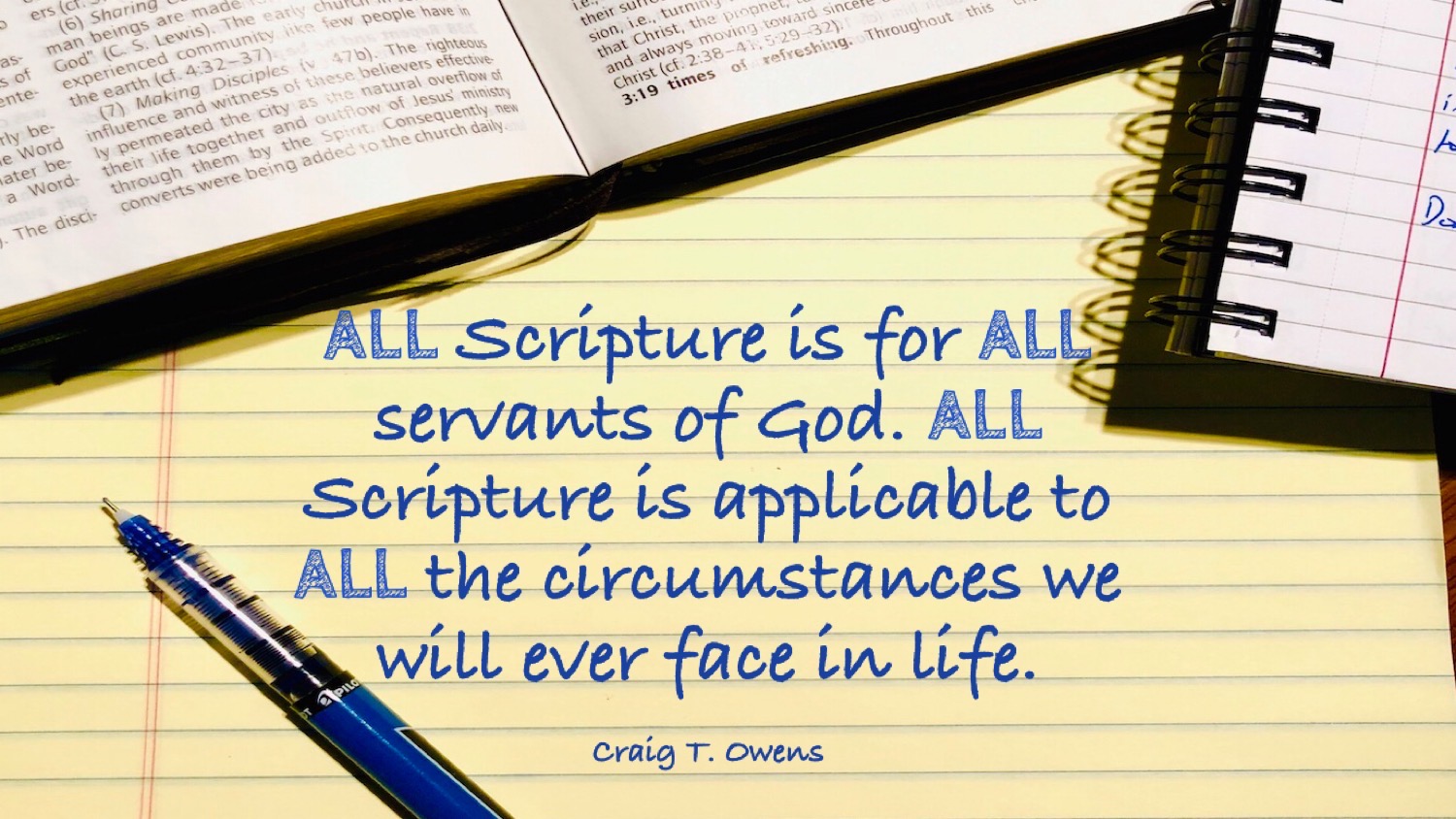
ALL Scripture is for ALL servants of God. ALL Scripture is applicable to ALL the circumstances we will ever face in life. But we need the illumination of the Holy Spirit in order to make the connection from the written Word to the real-life application.
So don’t stop at salvation—press on to be baptized in the Holy Spirit.
If you have missed any of the other lessons in this series, you may access them by clicking here.






 Craig T. Owens
Thursdays With Spurgeon—Comments On Commentaries
March 5, 2020 — Craig T. OwensComments On Commentaries
It has been said that the passage I have taken for my text [Isaiah 7:1-17] is one of the most difficult in all the Word of God. It may be so. I certainly did not think it was until I saw what the commentators had to say about it, and I rose up from reading them perfectly confused! One said one thing, and another denied what the other had said. And if there was anything that I liked, it was self-evident that it had been copied from one to the other and handed through the whole of them!
One set of commentators tells us that this passage refers entirely to some person who was to be born within a few months after this prophecy….
Well, that seems a strange frittering away of a wonderful passage, full of meaning, and I cannot see how they can substantiate their view when we find the evangelist Matthew quoting this very passage in reference to the birth of Christ [Matthew 1:22-23]….
I find, moreover, that many of the commentators divide the sixteenth verse from the fourteenth and fifteenth verses, and they read the fourteenth and fifteenth verses exclusively of Christ, and the sixteenth verse of Shear-Jashub….
Then another view, which is the most popular of all, is to refer the passage, first of all, to some child who was then to be born, and afterward, in the highest sense, to our blessed Lord Jesus Christ. …
But I think that if I had never read those books at all, but had simply come to the Bible without knowing what any man had written upon it, I would have said, ‘There is Christ here as plainly as possible! Never could His name had been written more legibly than I see it here.’
From The Birth Of Christ
Spurgeon was not advocating that we never consult commentaries because elsewhere he said about the use of commentaries: “I find it odd that he who thinks so highly of what the Holy Spirit teaches him speaks so little of what the Holy Spirit teaches others also.”
But what I believe Spurgeon is advocating here is this important principle—The best commentary on a passage of Scripture is another passage of Scripture. Which is why he used the passage in Matthew to help him understand the passage in Isaiah.
God makes Himself clear in His Word. The same Holy Spirit that inspired the pen of those who wrote the words in the Bible is the same Holy Spirit in you that can illuminate those words to your heart and mind.
Commentators have their place. I believe that place is after you have prayed through and wrestled with a passage of Scripture for yourself. Think of commentators as the answers in the back of your math book. After you have worked through the equations for yourself, go to the answer key to verify your answers. If you simply look up the answer before you wrestle with the problem, how have you benefitted yourself?
And always remember that God’s Word is infallible, but men are fallible. Commentators may provide an insight that helps you see something more clearly, but they are never a substitute for God’s very own word on a matter.
Should you use commentaries? Sure! Find a good one, but consult it only after you have asked the Holy Spirit to help illuminate the passage, and after you have allowed the commentary of Scripture itself to shine its light on the difficult verse or passage.
Share this: