Thursdays With Spurgeon—Love So Amazing

This is a weekly series with things I’m reading and pondering from Charles Spurgeon. You can read the original seed thought here, or type “Thursdays With Spurgeon” in the search box to read more entries.

Listen to the podcast of this post by clicking on the player below, and you can also subscribe on iTunes or Spotify.

Love So Amazing  

Forgiving one another, even as God for Christ’s sake has forgiven you. (Ephesians 4:32) 

     The first phrase to think about is ‘for Christ’s sake.’ We use these words very often, but probably we have never thought of their force. … All the good things that God has bestowed upon us have come to us ‘for Christ’s sake.’ But especially the forgiveness of our sins has come ‘for Christ sake.’ …  

     It is His very love as well as His holiness and His justice that, if I may use such a term, compels Him to severity of judgment so that sin cannot and must not be blotted out till atonement has been presented. There must, first of all, be a sacrifice for sin, that, mark you, the great Father, to show His love, supplies, for it is His own Son who is given to die! And so the Father Himself supplies the ransom through His Son, that Son is one with Himself by bonds of eternal unity, mysterious but most intense. If God demands the penalty in justice, He Himself supplies it in love. … 

     I want you to consider, for a moment, how readily God may now blot out sin since Christ has died. … God, for Christ’s sake, has accepted us in Him, has forgiven us in Him, and looks upon us with infinite love, changeless in Him. This is how all our blessings come to us, in and through Christ Jesus. And if we are indeed in Him, the Lord does not only forgive us our sins, but He bestows upon us the boundless riches of His grace in Him. In fact, He treats us as He would treat His Son. He deals with us as He would deal with Jesus! … 

     And you, big evil sinner, if you will go to God at this moment and say, ‘Lord, I cannot ask You to forgive me for my own sake, but do it out of love for Your dear Son,’ He will do it…. Christ took the shame that He might magnify His Father, and now His Father delights to magnify Him by blotting out the sin.

From Forgiveness Made Easy 

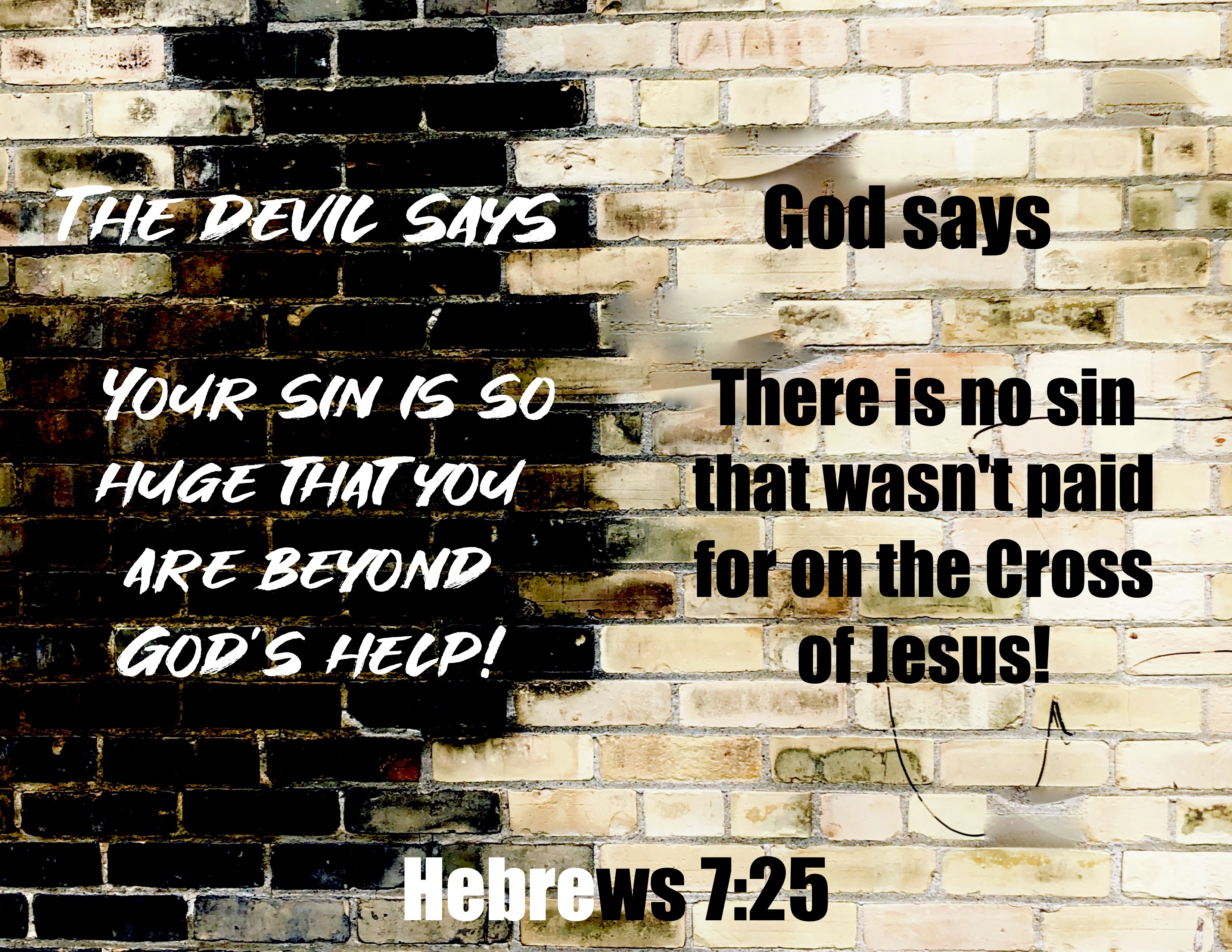
I’ve lost track of the number of times someone has told me, “I’ve messed up for so long—I’ve done such atrocious things—there is no way God could forgive me.” This is one of satan’s lies that keeps people from accepting God’s forgiveness. 

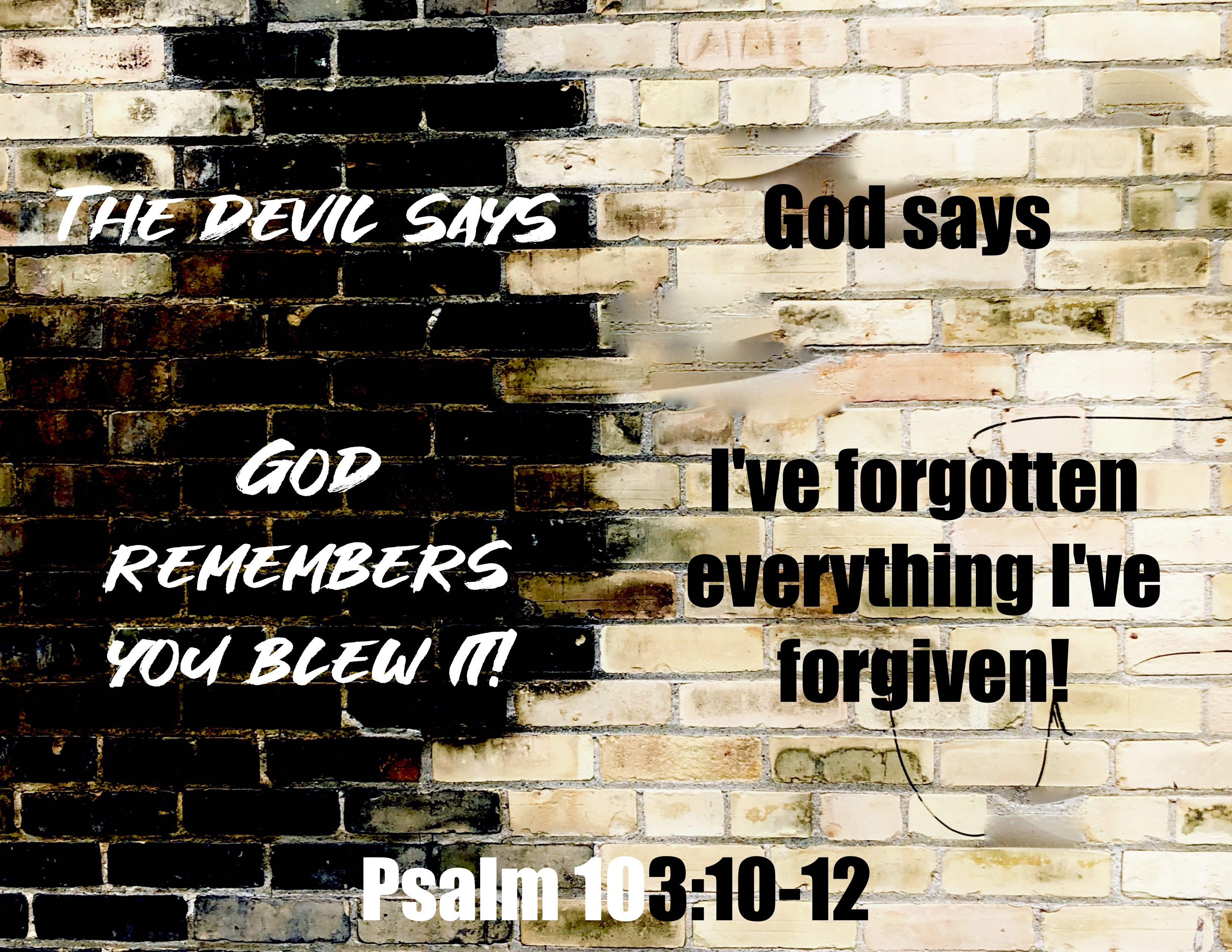
Jesus took your penalty, He paid the price for your sin! The moment you believe that, you are clothed in Christ’s righteousness. So now when the Holy God looks at you, He says, “You look like My Son. I love to bless My Son. I love to do what He asks of Me. For His sake, I have forgiven you. Not only forgiven, but I’ve forgotten everything I’ve forgiven!” 

Don’t wait another moment: If you haven’t asked God to forgive you “for Christ’s sake,” do it right this very minute! I’d love to chat with you about this, so reach out to me and let’s talk more about this amazing new relationship you now have with Almighty God because you are forgiven for Christ’s sake. 

This reminds me of a song by Chris Tomlin—

He became sin Who knew no sin
That we might become His righteousness
He humbled Himself and carried a Cross
Love so amazing!

►► Would you please prayerfully consider supporting this ministry? ◀︎◀︎
 

It’s A Big Deal

Listen to the podcast of this post by clicking on the player below, and you can also subscribe on AppleSpotify, or Audible. 

I get a little leery when people are advocating for a government that is friendly to Christianity. In biblical history and world history, Christians tend to backslide when things are going smoothly for them. 

Difficulties and even persecution cause us to evaluate if what we’re standing on is really a sure foundation (2 Corinthians 1:9; Philippians 4:10-13). 

As the Jews returned from their exile in Babylon, things were going fairly easily for them. And as they had done so many times before, they began to backslide. The Archeological Study Bible noted, “This generation was not guilty of the gross idolatry of its forefathers. Rather, these Israelites embraced a kind of dead orthodoxy, in which they tried to get by with the minimum that their faith required.”  

Onto this scene comes a prophet named Malachi. Malachi means “My messenger,” and we don’t know if this was actually the prophet’s name or not, but he took it on as his nature, delivering the heavy words of God. In fact, he held the words of God with such respect that when he says this is “an oracle,” he literally is saying, “This is a heavy burden to bear!” 

Malachi uses the phrase “LORD Almighty” (or LORD of Hosts in the KJV, and Lord of Heaven’s Armies in the NLT) twenty-four times. By contrast with the other minor prophets…

  • Hosea, Joel, Amos, Obadiah, and Jonah use this phrase zero times 
  • Micah and Habakkuk each use it once
  • Nahum and Zephaniah each use it twice
  • Haggai uses it 12 times (or 32 percent of the total verses in his book) 
  • Zechariah uses the phrase 46 times (which 22 percent of his total verses) 

But Malachi’s 24 times is 44 percent of his total verses! In other words, he wanted his audience to be crystal clear that it wasn’t him who was speaking, but the King of kings was speaking to us through Malachi! 

God is still speaking through Malachi to us today! Just like Israel in Malachi’s day, I think Christians today run the very real risk of backsliding. Just like Israel, when we forget the weightiness of the glory of the LORD ALMIGHTY we can begin to slip into an it’s-no-big-deal attitude. 

By contrast, when we’re honoring the LORD of Hosts, and reverencing Him, and desirous of His glory being seen, it’s a very big deal that we listen to His voice and closely follow His commands.  

So Malachi’s six warnings to the Israelites of his day should still be heeded by Christians today. We should examine ourselves very closely to see if we have the same it’s-no-big-deal attitude. We should ask ourselves, “Are we…

(1) …offering less-than-our-best sacrifices? Are we just giving God the leftovers?”  

(2) …listening to church leaders that don’t reverence God’s name?” 

(3) …honoring the sanctity of marriage?” 

(4) …self-seeking instead of neighbor-loving?” 

(5) …withholding the full tithe from our local church?” 

(6) …following God only for personal gain?” 

(Check out all of the verses for these questions by clicking here.) 

If this study of the minor prophets—especially these last three—has told us anything, it’s that God keeps His word. When He says He is coming back as the righteous Judge, that will happen. In fact, it could happen at any moment! 

We must be ready! We must guard our hearts against the it’s-no-big-deal attitude. We must reverence our awesome God. The things of God are a very big deal indeed (see Hebrews 10:37-39; Revelation 22:12-16). 

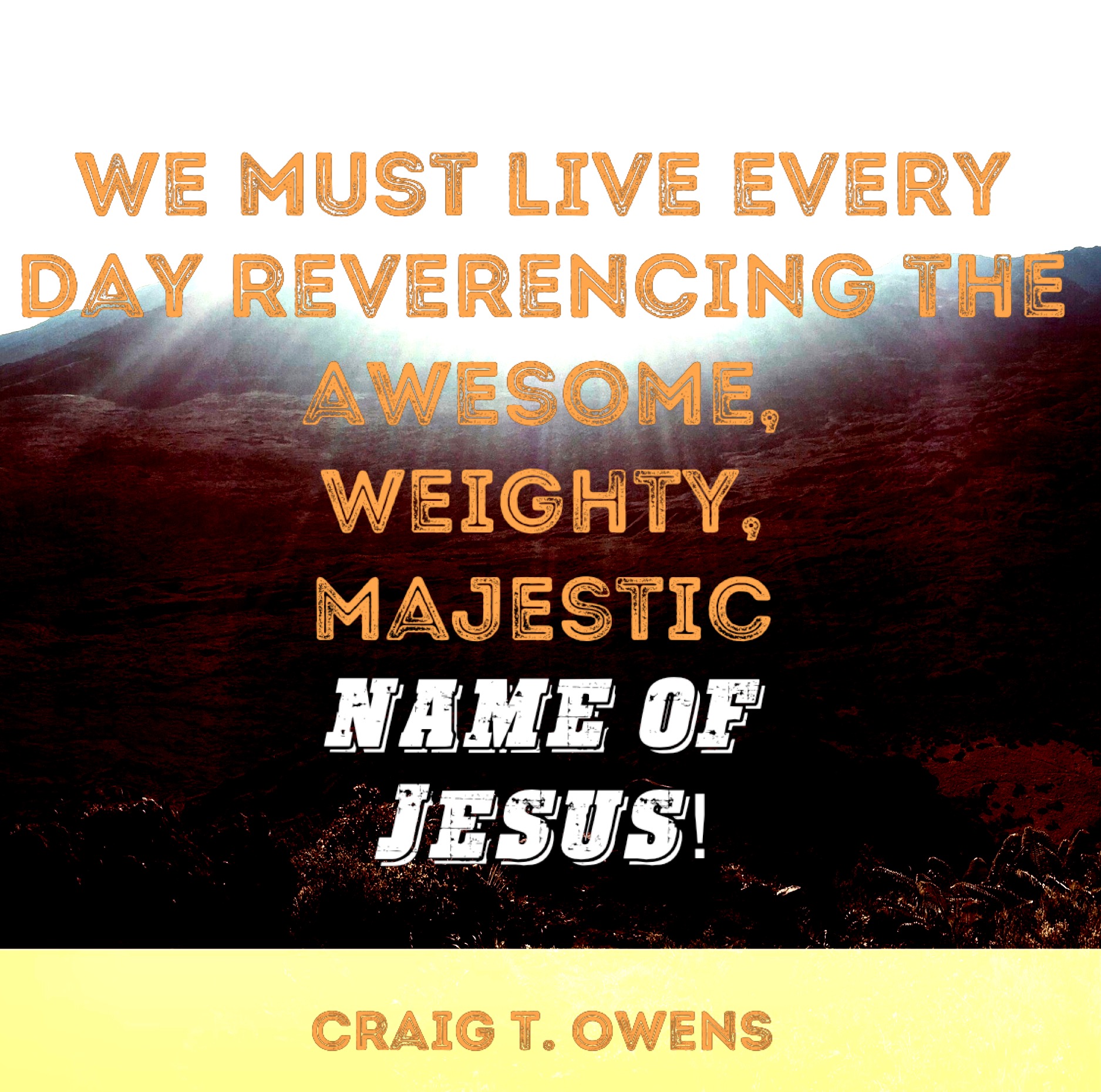
To guard ourselves against this backsliding attitude, we must live every day reverencing the awesome, weighty, majestic name of Jesus! 

If you’ve missed any of the messages in our series exploring the powerful lessons in the the twelve minor prophets, please click here to get the list of all of those messages. 

►► Would you please prayerfully consider supporting this ministry? ◀︎◀︎
Thursdays With Spurgeon—Faith Sees Better Than Sight Does

This is a weekly series with things I’m reading and pondering from Charles Spurgeon. You can read the original seed thought here, or type “Thursdays With Spurgeon” in the search box to read more entries.

Listen to the podcast of this post by clicking on the player below, and you can also subscribe on iTunes or Spotify.

Faith Sees Better Than Sight Does  

For we walk by faith, not by sight. (2 Corinthians 5:7) 

     There is walking by faith, and there is walking by sight. The most of men, all men indeed, naturally walk by sight. They have a proverb that says, ‘Seeing is believing,’ and they are wise men, for they trust people as far as they can see them, and no further. … Self-reliance is the name of the principle, and according to the world, the best and grandest thing that a man can do is have faith in himself. … 

     I think the world must be pretty well ashamed of itself if it still considers this poor earth to be all that a soul has to live for. I feel as if I could not talk upon the matter. Solomon tried everything there was in this world—riches, power, pleasure—every sort of delicacy and delight he had, beyond the point of satisfaction. And what was his verdict upon at all? ‘Vanity of vanities, all is vanity’ (Ecclesiastes 1:2). … 

     If there is not another world to live for, I must say that this life is a most unutterably empty kind of thing! It is not worthy of a man! But oh, to believe what God tells me: that there is a God; that God became flesh to bear me up to Himself! To believe that I am God’s son, that I have an immortality within myself that will outlast the stars, that I will one day see His face and sing His praise forever with cherubim and seraphim! Why, there is something here! …

     If you walk only by sight and believe only what you see, what do you believe? You believe that while you are living here, it is a good thing to make the best you can of it. And then you will die and be buried, and that will be the end of you! What a poor, miserable, ignorant belief this is! … But when you believe in what God reveals and come to walk by faith, how your information expands! Now riddles are all solved, and the inexplicable is understood! … 

     The principle of faith does best in the dark. He who walks by faith can walk in the sunlight as well as you can, for he walks with God. He has enlightened eyes, but he can walk in the dark as you cannot, for his light is still shining upon him. He trusts in the unseen and in the invisible, and his soul rejoices when present things are passing away.

From Faith Versus Sight

One of the temptations of the devil has been to try to get us focused on the seen—the temporal. He did this successfully with Adam and Eve in the Garden of Eden. He tried to get Jesus to focus on the temporal in his wilderness temptations, but Jesus steadfastly kept His eyes on the unseen. 

The devil’s strategy hasn’t changed. He will try to get you to say, “Woe is me! Look at all of the bad things happening around me!” 

But we walk by faith, not by sight. “Faith is the assurance—the confirmation, the title deed—of the things we hope for, being the proof of things we do not see and the conviction of their reality—faith perceiving as real fact what is not revealed to the senses” (Hebrews 11:1 AMP).   

Don’t give in to the temptation to believe only what you see. There is so much more waiting for you. It’s all yours by faith in Jesus Christ!

►► Would you please prayerfully consider supporting this ministry? ◀︎◀︎
Soul Watchers

I share T.M. Moore’s heartbeat for the role of shepherd leaders in the Church today. I highly recommend that every pastor subscribe to the newsletters that are available through the Fellowship of Ailbe. 

A recent article called “Soul Watchers” really caught my attention. Here are a few excerpts to whet your appetite… 

Elders are called “overseers” and “shepherds” in their relationship to the congregations of the Lord (1 Peter 5:1-3). … Elders were charged with the responsibility of watching over the flocks of the Lord (Acts 20:28), preserving sound doctrine and right practice in the churches (Acts 15:1-6; Titus 1), and, in particular, keeping watch over the souls of God’s people (2 Corinthians 12:15; Hebrews 13:17). … 

The elders appointed to serve the churches of the New Testament were called to be shepherds, leading the Lord’s flocks into fuller realization of His Kingdom and promises. In fact, so vital were elders to the churches of the New Testament that Paul insisted that any church that didn’t have elders was to that extent not “in order” (Titus 1:3).

(Check out the bible verses T.M. references in this piece by clicking here.)

T.M. Moore wrote one of the endorsements for my book Shepherd Leadership: The Metrics That Really Matter, and I recently appeared as a guest on his Ailbe Podcast.

Thursdays With Spurgeon—Holy Familiarity

This is a weekly series with things I’m reading and pondering from Charles Spurgeon. You can read the original seed thought here, or type “Thursdays With Spurgeon” in the search box to read more entries.

Listen to the podcast of this post by clicking on the player below, and you can also subscribe on iTunes or Spotify.

Holy Familiarity  

     All these thirteen years, so far as Scripture informs us, Abram had not a single visit from his God. We do not find any record of his either doing anything memorable or having so much as a single audience with the Most High. Learn from this that if we once forsake the track of simple faith, once cease to walk according to the purity that faith approves, we strew our path with thorns, cause God to withhold the light of His countenance from us, and pierce ourselves through with many sorrows. 

     But mark, beloved, the exceeding grace of God: The way to recover Abram from his backsliding was that the Lord should appear to him…. This brings to my remembrance the words in the book of Revelation concerning the church in Laodicea: ‘You are neither cold nor hot. I could wish you were cold or hot. So then, because you are lukewarm, and neither cold nor hot, I will vomit you out of My mouth’ (Revelation 3:15-16)—a very solemn declaration. But what follows? ‘Behold, I stand at the door and knock. If anyone hears My voice and opens the door, I will come in to him and dine with him, and he with Me’ (Revelation 3:20). That means just this: For recovery out of a horrible state of languishing and lukewarmness there is no remedy but the coming of Jesus Christ to the soul in near and dear communion! …

     Distance from God’s presence always means sin. Holy familiarity with God engenders holiness. The more you think of God, the more you meditate on His works, the more you praise Him, the more you pray to Him, the more constantly you talk with Him and He with you by the Holy Spirit, the more surely are you on the road to thorough consecration to His cause!

From Consecration To God

I’ve often said that one of the most powerful prayers we can pray is simply, “God, help!” In those two words we acknowledge our helplessness and His omnipotence, our sin and His forgiveness, our shortcomings and His desire to restore us. 

The devil lies! He loves to whisper the condemning words of, “You’ve messed up one too many times. You’re too far away for God to rescue you now. This time you exhausted God’s mercy.” 

Once again, by simply crying out, “God, help!” you are calling out satan’s lies. Jesus paid too high of a price for Him to ever let you go. Near the end of this sermon, Charles Spurgeon spoke a powerful reminder: “The blessings of grace are not given today to be taken back tomorrow, but are eternal blessings [Genesis 17:7, 13, 19].” Amen! 

My friend, cry out to God today—He loves you and He’s longing to restore you!

►► Would you please prayerfully consider supporting this ministry? ◀︎◀︎


Complaining To God

Listen to the podcast of this post by clicking on the player below, and you can also subscribe on AppleSpotify, or Audible.

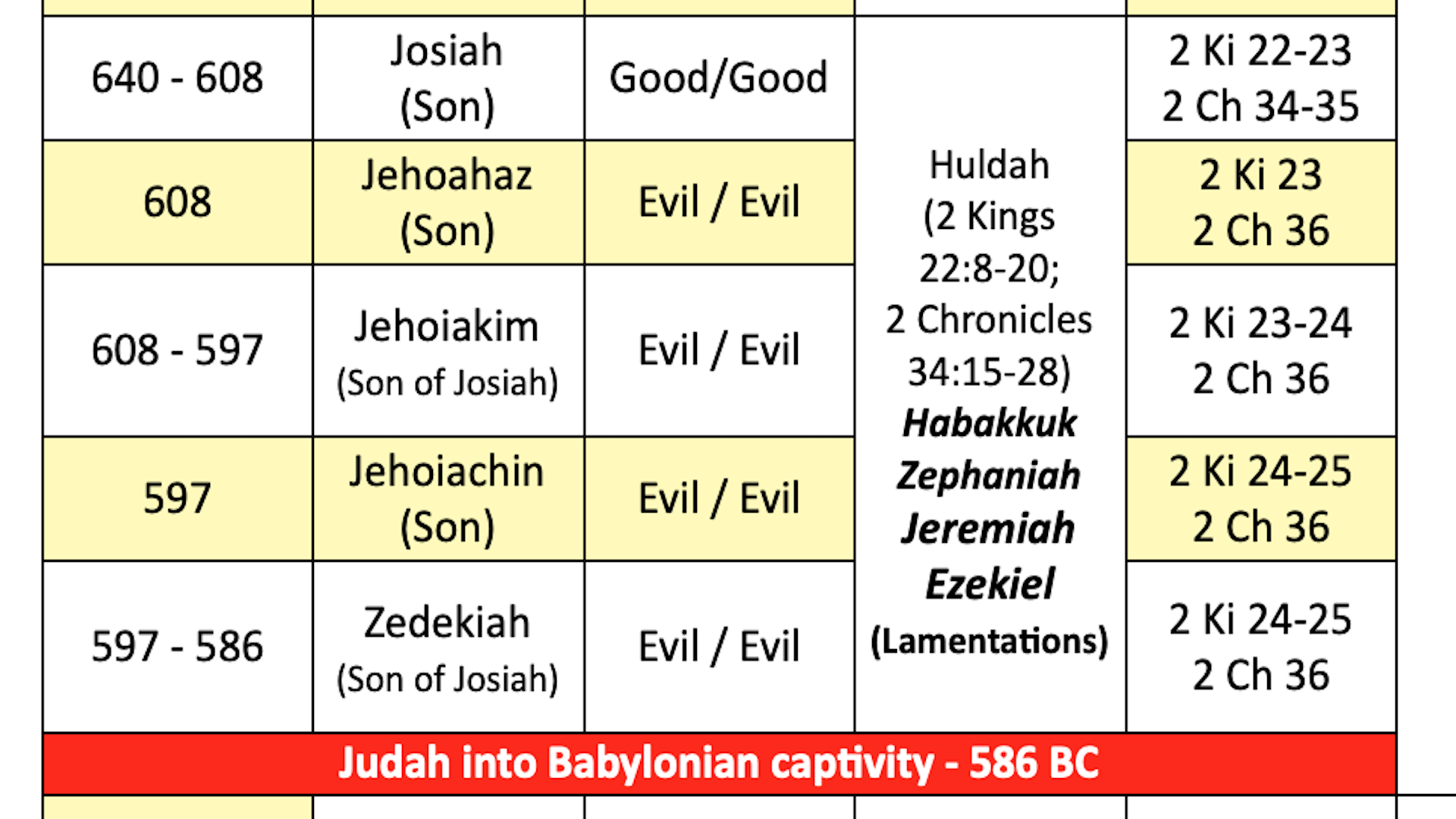
One of the things I love about the minor prophets is the reminder of the historicity of the Bible. Habakkuk, and the other prophets, lived in an actual moment of history. Check out some of the key dates during the ministry of Habakkuk: 

  • 605 BC—Nebuchadnezzar invades Judah and carries off Daniel and his friends 
  • 597 BC—the Babylonians attack Judah again and take 10,000 exiles back to Babylon, including the prophet Ezekiel 
  • 586 BC—Judah is besieged and defeated, and all remaining residents are exiled to Babylon 

Jeremiah, a contemporary of Habakkuk, preached to faithless Israelites, imploring them to return to God, while Habakkuk attempted to encourage faithful Israelites to continue to trust Jehovah. 

Habakkuk recognized that he was delivering a heavy word. When he opens this book by saying this is “the oracle” that he received from God, that word is better translated “burden.” Part of this burden may have been due to the fact that Habakkuk had something on his heart that we often have: a complaint. 

Can we complain to God? 

Habakkuk complained to God—twice!—and God doesn’t reprimand him, so there must be a right way to vent about our frustrations and confusions. Here’s what we can learn from Habakkuk’s two complaints: 

  1. Instead of making accusations, ask questions. Habakkuk asks God eight questions in his two complaints. I think this is an attitude issue. Complaints are saying, “God I disagree with what You’re doing,” while questions seem to be more like, “God, I don’t understand what You’re doing.” 
  2. Desire God’s glory to be seen. At the conclusion of both of Habakkuk’s complaints he uses the word “therefore” (1:4, 16). His conclusion is something along the lines of, “God, if You let this continue, it appears that Your glory is being obscured by the activities of wicked people.” 
  3. After your complaint, close your mouth and open your eyes and ears. After Habakkuk’s first complaint, God tells him to “look” at all He is going to do. And after the second complaint, God tells him to “write down the revelation” God gives him and then “wait for it” to be fulfilled” (2:2, 3). 

Then Habakkuk does something that isn’t seen anywhere else in the Bible outside of the book of Psalms: he calls for us to Selah pause three times! 

Habakkuk shows us that our best response to what God reveals to us should be worship: 

  • Selah (3:3)—pause to consider what God has done 
  • Selah (3:9)—pause to stand in awe of His very present glory 
  • Selah (3:13)—pause in anticipation of His righteous justice and awesome glory that will be revealed 

Key phrases from Habakkuk are quoted in the New Testament, and at least three of them are directly tied to these Selah pauses:

  • The earth WILL be filled with the knowledge of the glory of the Lord” (2:14), is echoed in the way all of humanity will see the glory of the risen Jesus.  
  • The righteous WILL live by his faith” (2:4), is quoted as a Christian’s ongoing interaction with the indwelling Holy Spirit. 
  • I WILL rejoice in the Lord my God … I WILL be joyful in God my Savior” (3:17-18) figures prominently in Mary’s song after she realizes that she is pregnant with the soon-to-be-born Savior. 

(Check out all of the above biblical references: Habakkuk 2:14, 2:4, 3:17-18; Revelation 1:5-8; Romans 1:17; Galatians 3:11; Hebrews 10:37-39; Luke 1:46-47, 54-55) 

Can you air your complaints to God? Yes, but do it the right way. Then silently listen, patiently wait, and then eagerly tell others about the coming judgment that they can avoid by having their sins forgiven through faith in Jesus our Savior. Only then can we also echo the “I will” statements of Habakkuk that are echoed in the New Testament—I will live by faith, I will look forward to the glory of God being fully revealed, I will continue to rejoice in God my Savior every day, and I will tell others how they, too, can live this way themselves! 

If you’ve missed any of the messages in our series looking at the major lessons we find in the minor prophets, you can find the complete list by clicking here. 

►► Would you please prayerfully consider supporting this ministry? ◀︎◀︎

Three Pictures Of The Church

Listen to the podcast of this post by clicking on the player below, and you can also subscribe on AppleSpotify, or Audible. 

When you’ve been at a church service have you ever asked yourself, “What are we doing here? What exactly is ‘church’? What are we supposed to be doing?”  

 Some people think church is saints going out to tell people about Jesus, and some people think church is saints coming together to hear about Jesus (see Matthew 28:19-20; 1 Corinthians 11:18). I think this is an either-or trap. 

I think a better way of looking at this is “both-and” and “so that”: BOTH coming to a gathering of believers so that we can be equipped to go out AND going out to tell people about Jesus so that we can bring new disciples into the church. 

Our foundational truth statement says: The Church is the Body of Christ, the habitation of God through the Spirit, with divine appointments for the fulfillment of her great commission. Each believer, born of the Spirit, is an integral part of the General Assembly and Church of the Firstborn, which are written in heaven. 

To help us see where we play a vital role in all of this, the Bible gives us three pictures of the church:

  1. A Body
  2. A Building
  3. A Bride

(see Ephesians 1:22-23; 1 Corinthians 12:12-26; Ephesians 2:19-22; John 3:29; 2 Corinthians 11:2; Ephesians 5:21-33)

All of these pictures speak of multiple parts making up one unified, healthy whole. Remove any part or any function, and the whole thing is diminished. All of these pictures also speak of intentionality. No one becomes healthy by accident, or builds a sound structure by accident, or enjoys a fulfilling marriage by accident. Health, soundness, and fulfillment all result from being intentional about our choices and interactions. 

I believe these three pictures also help us see what the church isn’t and is. 

  • A healthy church isn’t about numbers  
  • A healthy church isn’t about the day of the week that we meet
  • A healthy church isn’t about an “order of service” (there is no such thing listed in the New Testament!)
  • A healthy church is about Jesus being the focal point. As Jesus said, “I will build My Church.”   
  • A healthy church is about being intentional in everything we do 
  • A healthy church is about doing everything we can to glorify Jesus, both when we come together and when we go out into the world

(see Matthew 18:20; Romans 14:5; Matthew 16:18; Acts 10:38; 1 Corinthians 10:31; Hebrews 10:23-25) 

The first Church in the New Testament showed us how they followed the example of Jesus. Before trying to fulfill the Great Commission of going into all the world, they first obeyed the directive from Jesus to stay in Jerusalem until they were empowered by the Holy Spirit. Then we see an intentionality, and an empowerment, and a complete reliance on the Holy Spirit in everything they undertook from that point on. 

(see Acts 1:8; 2:42-47; 4:29-35; 6:1-7; 8:4, 26; 10:19-20; 13:1-3; 15:1-29)  

It’s not about going to “my church” or going to “your church.” It’s about being the Church (with a capital “C”)—the Body of of Christ, the Building of Christ, the Bride of Christ. 

Bottom line:

Christians are being the Church when they are intentionally living in a way that makes Jesus known. 

This is a part of our ongoing series looking at our foundational truths. If you’ve missed any of the messages in this series, you can find the full list by clicking here.

►► Would you please prayerfully consider supporting this ministry? ◀︎◀︎

The Story Isn’t Over Yet

Listen to the podcast of this post by clicking on the player below, and you can also subscribe on AppleSpotify, or Audible. 

One of the things I enjoy about my Apple Watch is the connection I have with others who also use an Apple Watch. For instance, I get notified when my wife has finished a workout, and one of the pre-set replies I could choose is, “I’ve got questions!” That’s a funny way of me saying, “How did you complete that workout?!” 

In Psalm 75 and Psalm 76, Asaph tells us how God will deal with the wicked. But then Psalm 77 begins with Asaph using words like, “My soul refused to be comforted, my spirit is overwhelmed,” and then he launches into the tough questions like: “How long is this going to last? Has God forgotten me? Have I fallen out of favor with God? Has His mercy dried up? Can God keep what He has promised? Is God angry with me?” When I read all this, I feel like saying, “Asaph, I’ve got questions!” 

Yet, these complaints of Asaph ring true to real life. Like when a friend called me last week and started our conversation by asking, “Why can’t things just go easy for me?”

Here’s the simple answer: The Story isn’t over yet. We are in a battle, and the enemy of our soul is still trying to take us out, or at least shut us up. 

In Psalm 77, Asaph tells his story to Jeduthun (a Levite worship leader whose name means praising) in four chapters, with a Selah for each of the breaks between the chapters. 

Chapter 1—Distress (vv. 1-3)

The word distress means confronted by an adversary. Ever been there? Every follower of God has been, so Asaph invites us to Selah: pause to contemplate things like (a) Is this distress causing me to reevaluate the foundation on which I stand? (b) What is it God is shaking in my life? When God shakes things up, it is to cause us to remember and muse about the ONLY sure foundation that can withstand any storm (see Matthew 7:24-27). 

Chapter 2—Questioning (vv. 4-9) 

Notice the words Asaph uses: thought, remembered, mused, inquired. He is asking those tough questions, but he is asking them in a way that he can carefully consider the answers. That means he is really taking a Selah pause with each question. I think he has come to this conclusion: “Aren’t all these really just rhetorical questions? And isn’t the answer to all of them a resounding ‘NO!’?” If you aren’t sure the answer to all of these questions is no, please read Romans 8:31-39.

Chapter 3—Recalling (vv. 10-15) 

Notice the continuation of the words: thought, remember, meditate, consider. He also asks another question in v. 13 which he then answers in the next two verses. His call to Selah here is another pause to reflect: “Has God lost His power? Has He changed His mind?” And once again the answer is a loud and clear, “NO!” (see Isaiah 59:1; Hebrews 13:8) 

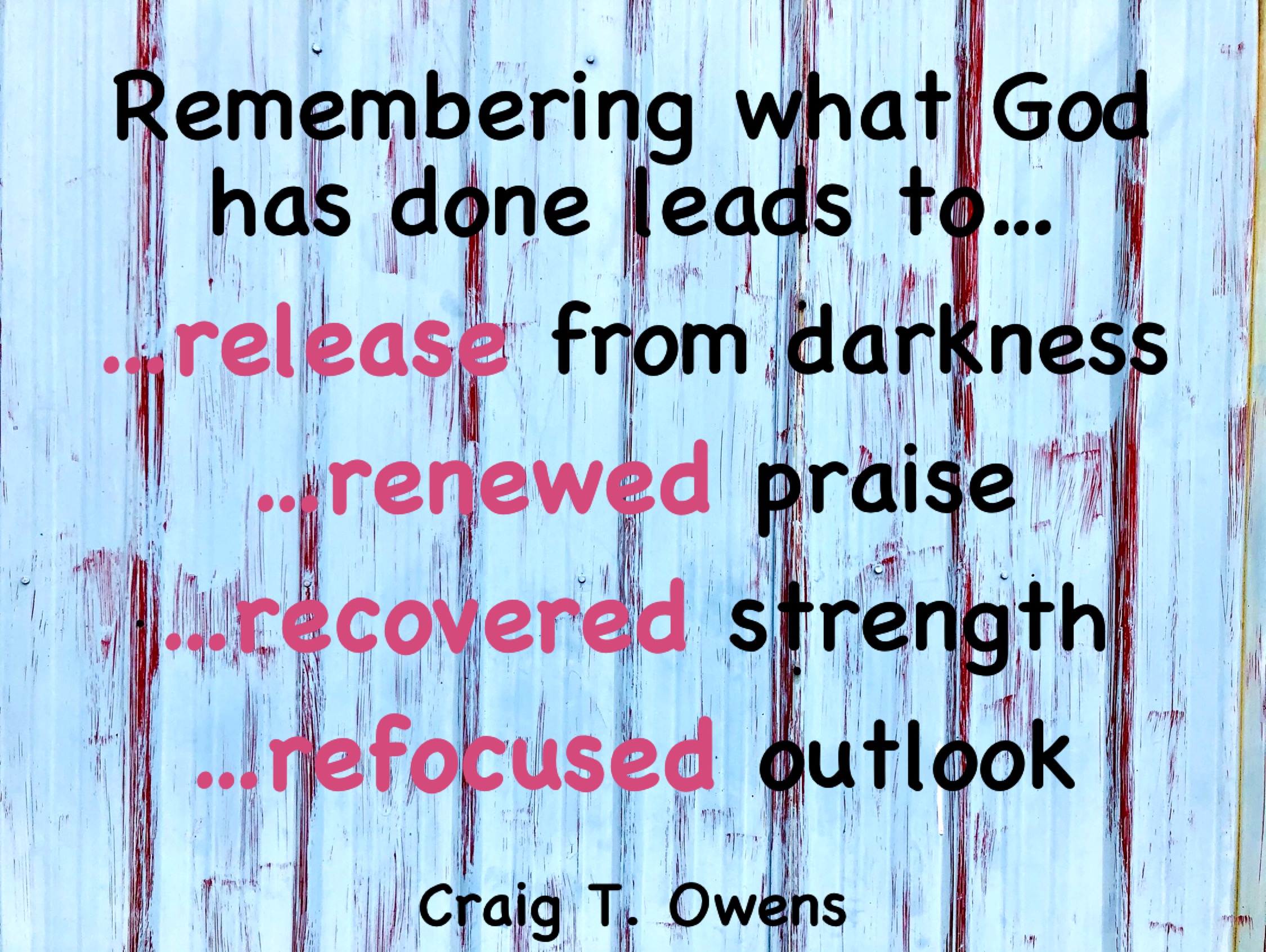
One of the important takeaways from this stanza of Psalm 77 is this: Looking back in gratitude at what God has done allows me to look forward in hope to what He is still going to do. My remembering what God has done in the past leads to: 

  1. Release from the darkness 
  2. Renewed praise 
  3. Recovered strength 
  4. Refocused outlook 

Chapter 4—Hope (vv. 16-20) 

Asaph says, “Look what God did! And since He is the same today as He was yesterday, guess what He’s still able to do!” We know this because the Bible says, “For no matter how many promises God has made, they are ‘Yes’ in Christ. And so through Him the ‘Amen’ is spoken by us to the glory of God” (2 Corinthians 1:20). 

Remember I said earlier that God isn’t done telling His story yet? God isn’t done yet, He knows His Story, and His Story is still being told. But He’s also already told us how His story will end (see Revelation 21:4-6). And the end of His story is really just the beginning of the Real Story! 

C.S. Lewis said it this way in the closing words of The Last Battle:

“And for us this is the end of all the stories, and we can most truly say that they all lived happily ever after. But for them it was only the beginning of the real story. All their life in this world and all their adventures in Narnia had only been the cover and the title page; now at last they were beginning Chapter 1 of the Great Story, which no one on earth has read; which goes on forever; in which every chapter is better than the one before.” 

When you find yourself saying, “I’ve got questions: How long is this going to last,” Selah to remember that the Story isn’t over yet. The Storyteller knows how it ends, and He promises us: But what of that? For I consider that the sufferings of this present time—this present life—are not worth being compared with the glory that is about to be revealed to us and in us and for us and conferred on us! (Romans 8:18 AMP)

If you have missed any of the messages in our Selah series, you can find the complete list by clicking here.

►► Would you please prayerfully consider supporting this ministry? ◀︎◀︎
Ruth + Boaz—The Father’s Day Version

Listen to the podcast of this post by clicking on the player below, and you can also subscribe on Apple or Spotify.

On Mother’s Day that we saw how Ruth’s obedience allowed her to realize God’s favor, part of that favor is being included in the genealogy of Jesus Christ. Of course, Ruth can’t give birth to her son Obed without there being a father, which makes Boaz’s part in this story just as important. 

[This whole story of Ruth + Boaz is just four short chapters, so I’d encourage you to take a couple of minutes to read it.] 

When we first meet Boaz, he is described as “a man of standing.” Some Bible translations say “a man of wealth,” which is an acceptable definition. In fact, the word can mean strength, wealth, valor, or prominence, but the root word means something brought forth out of travail and pain. That tells us that Boaz wasn’t born a man of standing, he became a man of standing by going through difficult times, not giving in to the downward slide of culture, and remaining true to God. 

Boaz had a steel-forged integrity! 

Believe me, it would have been easy for Boaz to compromise! This was a dark time of selfishness in Israel’s history. A time where just doing the bare minimum was acceptable because most of the Israelites were selfishly doing whatever would benefit them (Judges 21:25). 

The other description we read about Boaz is that he is a “kinsman-redeemer.” This same word is used in this verse: “Plead my cause and redeem me; revive me and give me life according to Your word” (Psalm 119:154). A redeemer is one who is close by to help, has the strength or resources to help, and is willing to help. Of course, the perfect example of a Kinsman-Redeemer is Jesus, who became our human kinsman so that He could rescue us (see Hebrews 2:14; Philippians 2:7-8). 

Boaz was given the opportunity to do this for Naomi and Ruth, and he seized the opportunity with gusto. Far from being a “bare minimum” man, Boaz always went the second mile to bless Ruth and Naomi:

  • he practiced the “hospitality clause” plus he protected Ruth and gave her more than was required 
  • he provided food for his workers plus he provided food for Ruth and Naomi 
  • he blessed his workers plus he blessed Ruth in the name of the Lord 

Ultimately, Boaz did indeed become the kinsman-redeemer for Naomi (by paying off all the debts of her deceased husband) and for Ruth (by marrying this non-Israelite woman and bringing her into the family line of Jesus). 

Boaz was King Solomon’s great-great-grandfather. When Solomon was completing the temple in Jerusalem, he erected two pillars at the entrance: one was named Boaz, and the other was Jakim (with means “God will establish”). Taken together these pillars proclaim the message: By His integrity and faithfulness, God establishes and makes firm. 

Boaz exhibited integrity at every opportunity, which is what forged his character and made him “a man of standing.” Boaz demonstrated that integrity is really faith in God plus faith-filled, second-mile, others-focused actions.

“Faith without works is just wishful dreaming.
Works without faith is just religious posturing.
Works with faith is God-glorifying!” —Craig T. Owens

Men of God, please remember this: 

  • Every Word of God that you read or hear is a test—will you obey Him or will you compromise? 
  • Every setback you go through is a test—will you learn and grow or will you sulk and shrink back? 
  • Every success you experience is a test—will you bless others or will you hoard your blessings? 
  • Every decision you make in a dark culture is a test—will you just have faith, just have bare-minimum works, or will you exhibit the steel-forged integrity that comes from putting your faith to work? 

God’s blessing on your life of integrity will show others a picture of Jesus. God’s blessing on your life of going the second mile will show others that it is God who establishes and makes firm. 

Don’t rob your family, don’t rob us, don’t rob future generations of the outpouring of God’s blessing because you are selfish or compromising. Stand strong, trust God, go the second mile, be the kinsman-redeemer for those in need, and then watch for God’s blessings! 

If you missed Ruth’s vital part in this story, please check that out by clicking here.

►► Would you please prayerfully consider supporting this ministry? ◀︎◀︎
“Father, Into Your Hands I Commit My Spirit”

Listen to the podcast of this post by clicking on the player below, and you can also subscribe on Apple or Spotify.

I have some sobering news for you: You are going to die. 

Death is the great equalizer. It comes for the rich and poor, the scholar and the illiterate, all races, all ages, the healthy as well as the sick. Unless you’re still alive when Jesus comes back again, your odds of dying are 1-in-1. 

What happens “on the other side”? What happens after this life is over? Since it seems dark and mysterious to most people, they tend to ignore it until it’s thrust upon them. That’s why I find the dying words of people interesting. Like P.T. Barnum asking, “How were the receipts today at Madison Square Garden?” or W.C. Fields reading a Bible on his deathbed and telling a friend, “I’m looking for a loophole.” 

Or the very last words of Jesus: “Father, into Your hands I commit My spirit.” 

Jesus is steeped in Scripture, so nearly everything He says in His final four declarations come directly from the Psalms, including His final phrase which comes from Psalm 31:5. 

When Jesus broke a three-hour silence with His cry, “My God, My God, why have You forsaken Me,” both Matthew and Mark use the Greek words megas phoné to describe how loudly Jesus spoke. And now with His final words, Luke uses the same megas phoné description. 

Notice in the first megaphone cry Jesus calls on God the All-Powerful Creator. And with His last megaphone declaration, He calls on His Father who is All-Loving. How comforting it is to know that God is both All-Powerful and All-Loving! Not only can He answer our cries, but He delights to answer them! 

The word Jesus uses for “commit” is in the future tense and it means “to entrust as a deposit.” Jesus believed that God was going to do more than just give Him life again, but that He would give life to all who would believe in Him. 

Unlike atheist Bertrand Russell who said, “I would never die for my beliefs because I might be wrong,” Jesus DID die for His beliefs, and by rising from the dead proved He was right in trusting God. 

Job saw an inescapable death for all mankind, but he also foresaw the forgiveness of God (Job 14:5, 16-17). Jesus died once for all mankind and was then resurrected, bringing about the death of death by making forgiveness accessible to anyone (Hebrews 9:27-28; 1 Corinthians 15:19-22). 

We can now have the peace that comes from trusting the only One to Whom we can safely entrust our souls. Because Jesus brought death to death, we can have the same peace when we die that Jesus had when He died. 

With faith in Jesus, you can…

…live today knowing you’re invincible until God calls you home 

…live today full of joy because your home in heaven is secure

…live your very last day in peace because you know to Whom your soul is entrusted 

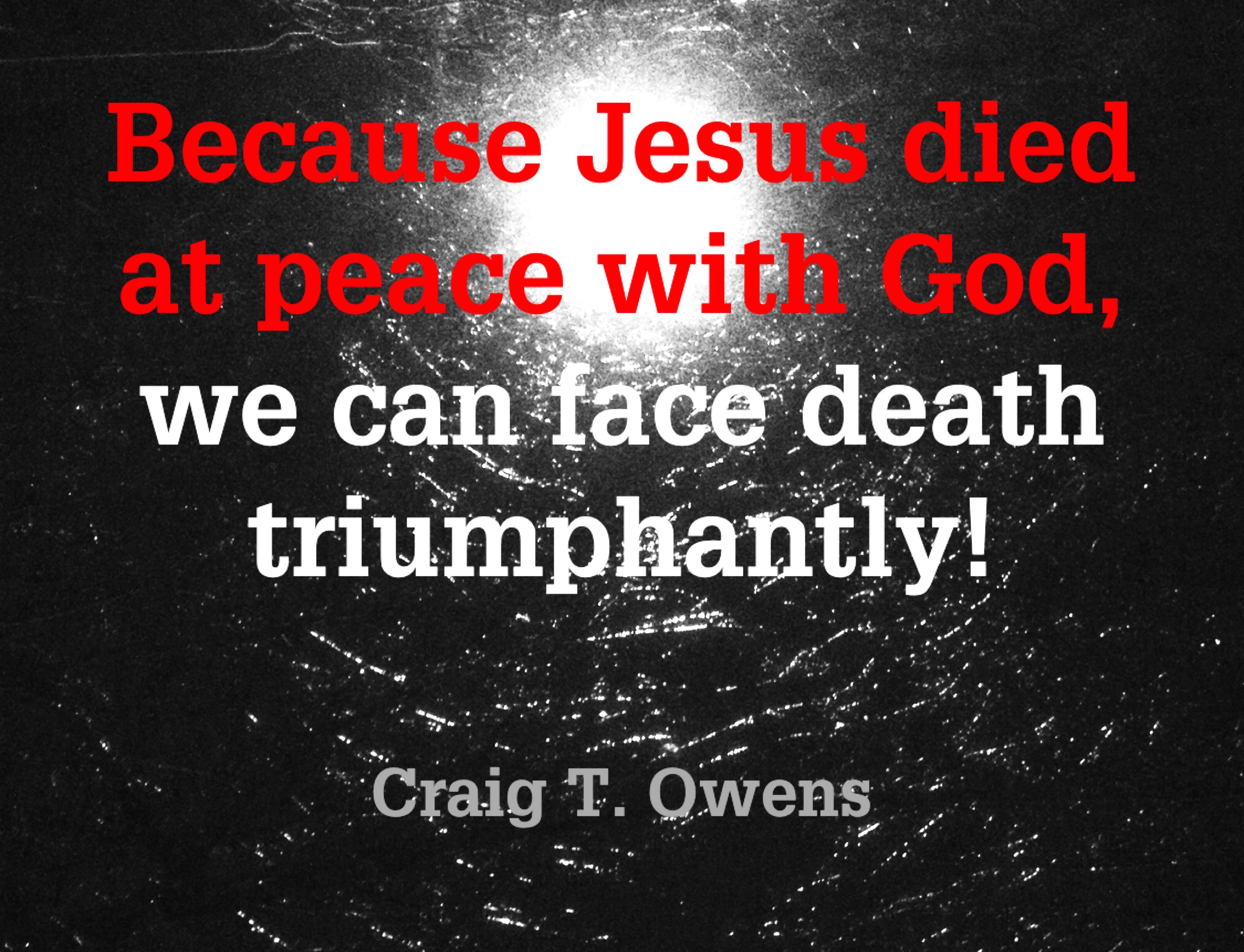
Because Jesus died at peace with God, we can face death triumphantly! 

If you’ve missed any of the messages in our series on the dying declarations of Jesus, you can access the full list by clicking here.

►► Would you please prayerfully consider supporting this ministry? ◀︎◀︎