Who Can Claim God’s Promises?

Listen to the podcast of this post by clicking on the player below, and you can also subscribe on Apple, Spotify, or Audible. 
It’s a bit scary to me to realize how many people have a scarcity mindset. As a result, far too many people are trying to figure out how to get their piece of the pie, but they don’t really want others to have their piece too. This should never be the mindset of a Christian! Our God has an unlimited supply, so we should be the most generous and abundance-minded people. 

Sadly, sometimes I still encounter Christians who think that only some people can claim some of God’s promises. 

This is part 5 in our series “Is that in the Bible?” 

Statement #5—Old Testament promises are for the Jews, New Testament promises are for the Christians. Is that in the Bible? No! 

First of all, this assumes a dichotomy between the Old Testament and the New Testament. Second, it reveals a lack of understanding of what Jesus has done for everyone who places their faith in Him. 

Jesus Himself said, “Do not think that I have come to do away with or undo the Law or the Prophets; I have come not to do away with or undo but to complete and fulfill them” (Matthew 5:17 AMP). 

Plato told a story about people chained in a cave in such a way that they could only see the shadows on the wall. He said that if the chains were unlocked, some would turn toward the opening of the cave, see the solid figures that had been creating the shadows, and move out of the cave. Plato also said that some would see the reality and choose to stay trapped in the cave—they would prefer shadows over reality. 

Both John and the writer of Hebrews describe how Jesus came as the incarnate Reality of God. Jesus reveals that He is the Substance behind all of the shadows of worship in the First Testament (Hebrews 1:1-2; John 1:1-14). 

Look at the worship practices of the tabernacle, specifically the practices on the Day of Atonement. Two goats or lambs were brought into the outer court on that day—one had all of the sins of the people transferred to it and was sent into the wilderness as the scapegoat, and the other was sacrificed so its blood could make atonement for the sins of the people. The high priest would take this blood past the curtain separating the Holy Place from the Holy of Holies, and would sprinkle it on the atonement cover (also called the mercyseat) of the ark of the covenant of the Lord. 

John said that Jesus came to make His dwelling among humans. The word John uses for “dwelling” is the same word for “tabernacle.” Jesus Himself became not only our High Priest, but every single item the earthly high priest used on the Day of Atonement. Jesus is the…

  • scapegoat—Leviticus 16:20-22; John 1:29 
  • sacrificial lamb—Leviticus 16:15; 1 Peter 1:18-19
  • curtain in front of the Holy of Holies—Hebrews 10:22 
  • mercyseat—Exodus 24:8; Leviticus 4:6, 5:9; Hebrews 4:16

(Check out all of the above references by clicking here.)

By His life, death, and resurrection the shadows became Substance through Jesus. Hebrews 10:1-14 describes this, but especially note verse 12: “But when this High Priest [Jesus] offered for all time one sacrifice for sins, He sat down at the right hand of God.” 

Look again at the picture of the tabernacle and note that there are no chairs. That was because the earthly priest’s work was never done. But our fully human, fully divine High Priest completed everything that needed to be done, so He could sit down. 
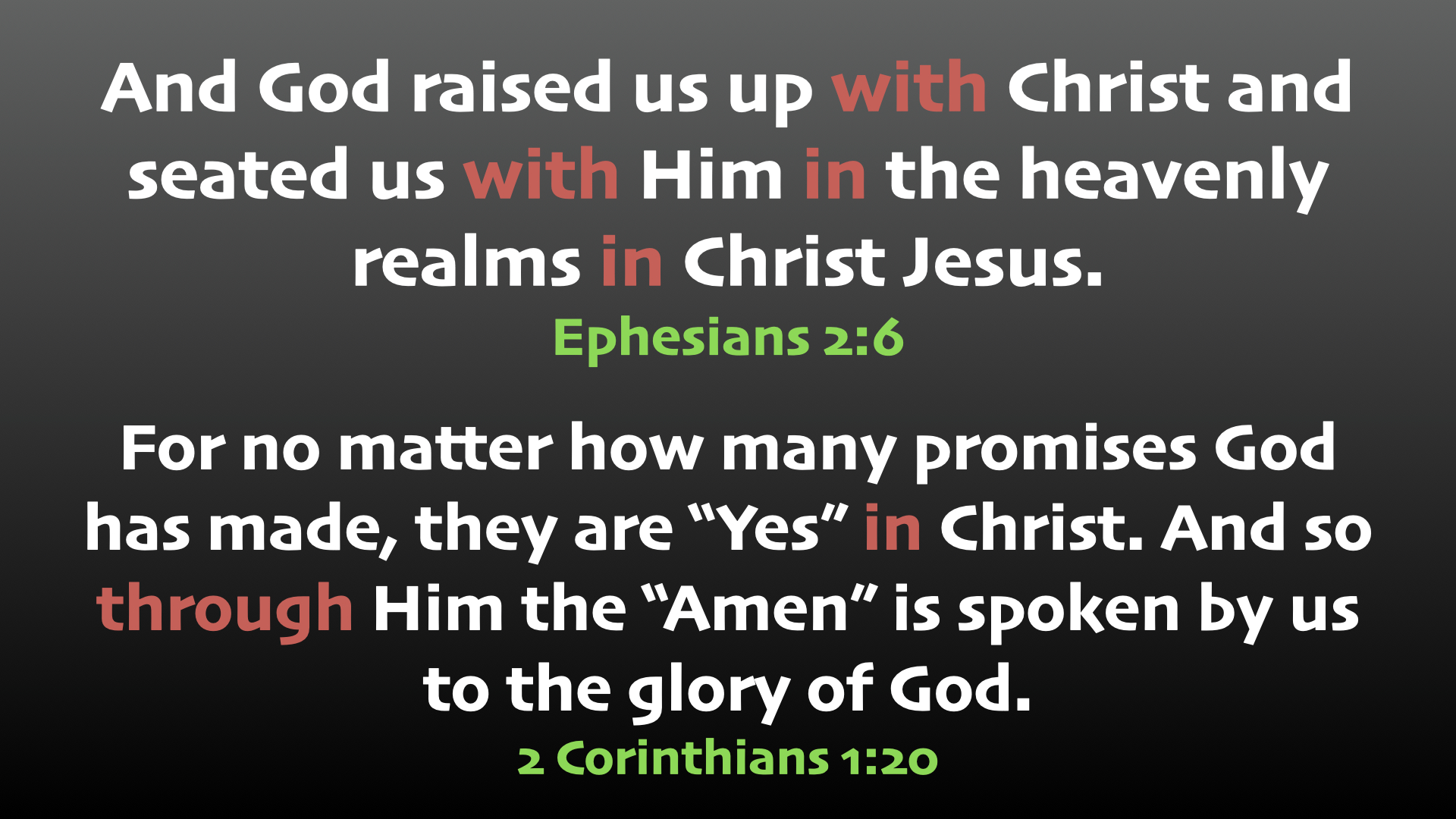
This High Priest not only sits down in God’s presence, but He takes us with Him into the Holy of Holies: “God raised us up with Christ and seated us with Him in the heavenly realms in Christ Jesus” (Ephesians 2:6)! 

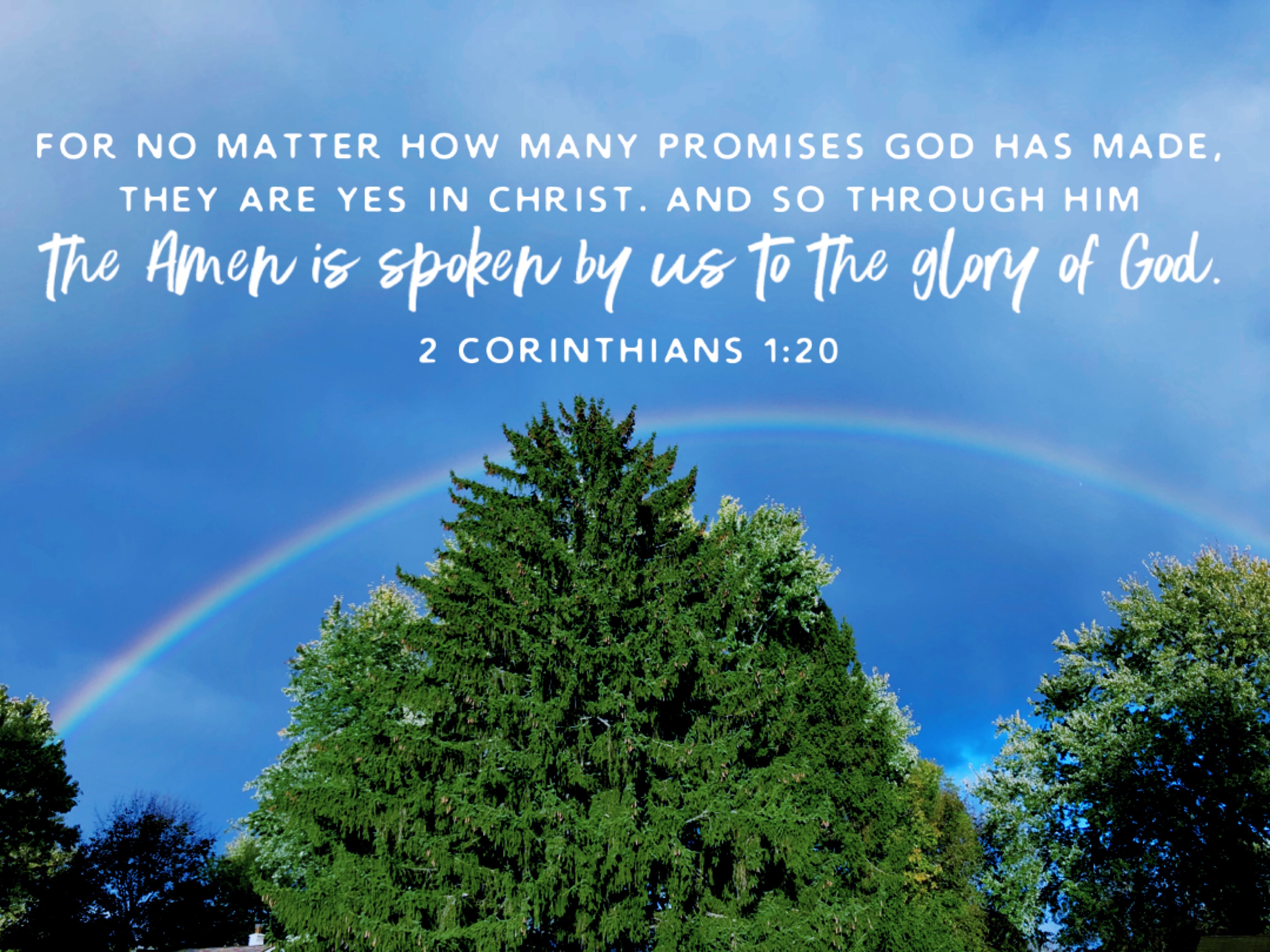
So now ALL God’s promises are for ALL who are in Jesus! “For no matter how many promises God has made, they are ‘Yes’ in Christ. And so through Him the ‘Amen’ is spoken by us to the glory of God” (2 Corinthians 1:20). 

I like how the Personalize Promise Bible turns that verse into this prayer: “My heavenly Father is faithful to His every Word. No matter how many promises He has made, in Jesus, He makes good on every one. I have God’s Word; therefore, I have God’s will. Every time that I pray in line with His Word, the answer is guaranteed.” 

My friend, if you have placed your faith in the completed work of Jesus, then EVERY promise in the Bible is a promise you can claim for your life. Hallelujah! What an amazing thing God has done for us through His Son Jesus Christ! 

If you’ve missed any of the topics we have covered in this series, you can find the full list by clicking here. 

►► Would you please prayerfully consider supporting this ministry? My Patreon supporters get behind-the-scenes access to exclusive materials. ◀︎◀︎

The Approachable Jesus

Listen to the podcast of this post by clicking on the player below, and you can also subscribe on Apple, Spotify, or Audible. 

A friend of mine who was in a position of leadership in the Assemblies of God used to joke with people, “Since you’re bowing and walking backwards out of my office, would you like to kiss my ring too?” There are some people that we feel are in a special class so that we have to approach them differently. 

If we feel that way about certain people, what might we be thinking when we consider approaching the supreme, awesome, preeminent, incomparable Jesus?! It’s very likely that we could feel Him to be unapproachable, as though we aren’t worthy of His attention. 

But when Jesus Himself told us, “When [not ‘if’] you pray,” He is assuming that we will pray. And then He adds this amazing thought: “And I will do whatever you ask in My name, so that the Father may be glorified in the Son” (John 14:13)! 

Jesus loves to help us. He died a cruel death on the Cross so that He could help us! Jesus ties our trusting prayer with His willingness to serve us (Luke 12:22-37). Note this last line from our approachable Savior: 

It will be good for those servants whose Master finds them watching when He comes. Truly I tell you, He will dress Himself to serve, will have them recline at the table and will come and wait on them. (v. 37) 

Jesus serves us?! What an amazing thought! But does this make Jesus somehow less majestic? I like what John Piper has to say about this: “Does this belittle the risen Christ—to say that He was and is and will ever be the servant of His people? It would, if ‘servant’ meant ‘one who takes orders,’ or if we thought we were His masters. Yes, that would dishonor Him. But it does not dishonor Him to say that we are weak and need His help.” 

How do we not treat Jesus as an order-taking servant? First, we have to remember that approachable doesn’t mean something we do casually. I think this is discovered in our attitude—it’s the difference between being childlike and being childish. 

The childlike attitude is one of wonder and trust. One that calls God, “Daddy.” One that is lovingly dependent on Him. One that says, “I don’t understand what I’m going through right now, but I trust Your wisdom.” 

The childish attitude is one who treats majestic things flippantly. Perhaps the childish one talks about God as “the Big Guy upstairs.” Or one who remains selfishly independent, or who says, “Do it my way—now!”

The childlike attitude glorifies Jesus as our approachable Servant Savior. 

The childlike attitude also recognizes that there are more dimensions of the majesty of God to be discovered in an abiding relationship with Jesus. Our approachable Savior wants us to come to Him, to call to Him for help, and to know Him more intimately (Jeremiah 29:13-14; Matthew 11:28-30; Hebrews 4:16; 10:19, 22). 

Prayer not only unlocks deeper, proper intimacy with Jesus, but it conforms our heart more and more to His heart. As we are conformed to Him, we reflect His approachable glory to others (2 Corinthians 4:6, 3:18). 

We approach the awesome Jesus reverently in childlike faith. It’s in God’s presence that the Holy Spirit matures our faith so that we become glory-reflectors that point others to Jesus. 

If you’ve missed any of the eight messages in our series Awesome: Learning to pray in the awesome name of Jesus, you can find the list of all of the messages by clicking here. 

►► Would you please prayerfully consider supporting this ministry? My Patreon supporters get behind-the-scenes access to exclusive materials. ◀︎◀︎

Links & Quotes

In 1 Timothy 3:1, Paul writes, “This is a faithful saying: If a man desires the position of a bishop [overseer], he desires a good work.” T.M. Moore commented on this verse—

“The Greek word for ‘bishop’ translates literally to ‘overseer.’ Overseers—pastors, elders, anyone in a leadership role in the congregation—is charged with watching over the souls of God’s people for good (Hebrews 13:17; Acts 20:28; 1 Thessalonians 5:12-13). While the primary duty of watching over the Lord’s flock falls on pastors and elders, all who serve with them function in a role of overseeing, that all the members of the congregation might benefit from the continuous care and shepherding of those who lead them.”

I am so grateful for T.M.’s endorsement of my book Shepherd Leadership: The Metrics That Really Matter in which I expound more on this 1 Timothy verse, and talk about how shepherd leaders should be raising up more leaders around them.

Our church purchased a building to use as our new homebase for ministry in our city. I am super excited about the possibilities!

Tiny bacteria declare loudly the genius of the Creator. This new study on the ability of bacterium to protect its own DNA from mutations is fascinating!

Dan Reiland says, “Good character takes a lifetime to build and a moment to destroy.” Dan shares 5 practices that build leadership character to last for a lifetime.

Amenhotep I was the second pharaoh of the 18th dynasty, and ruled from ca 1525-1504 BC during the time the Israelites were slaves in Egypt. Using 3-D CT scans, Amenhotep has been unwrapped for the first time in over 3000 years!

How are you supposed to follow God when obedience feels impossible? John Piper explains in this post. 

The Preeminent Jesus

Listen to the podcast of this post by clicking on the player below, and you can also subscribe on Apple, Spotify, or Audible. 

There is only one Jesus, but He is presented to us in the Bible with many facets, and we get to pray in all of those facets of His name! 

One of the facets of Jesus is His preeminence. The dictionary defines preeminent as “above and before others; superior; surpassing.” 

The Bible uses the word preeminence to mean “holding the first place.” The apostle Paul uses this idea of Christ’s supremacy when He describes Him this way—

The Son is the image of the invisible God, the FIRSTBORN over all creation. For in Him ALL things were created: things in heaven and on earth, visible and invisible, whether thrones or powers or rulers or authorities; ALL things have been created through Him and for Him. He is BEFORE ALL things, and in Him ALL things hold together. And He is the HEAD of the body, the church; He is the BEGINNING and the FIRSTBORN from among the dead, so that in EVERYTHING He might have the SUPREMACY. For God was pleased to have ALL His fullness dwell in Him. (Colossians 1:15-19, emphasis mine) 

Therefore God exalted Him to THE HIGHEST PLACE and gave Him the name that is above EVERY name, that at the name of Jesus EVERY knee should bow, in heaven and on earth and under the earth, and EVERY tongue acknowledge that Jesus Christ is Lord, to the glory of God the Father. (Philippians 2:9-11, emphasis mine) 

Praying in Christ’s preeminence means that we never have to settle for less than God’s best! 

When we began this series, I mentioned that there were some people who misuse the words of Jesus. Specifically the phrase where Jesus says, “I will do whatever you ask in My name” (John 14:13, 15:16, 16:23). They have taken this as license to ask for things for their own comfort, or claiming that praying “in the name of Jesus” means that we never have to experience pain, poverty, or any setbacks. 

But preeminence ≠ prosperity! 

Prosperity wrongly says Christians will never have trouble, never experience poverty or lack, and can claim and obtain lavish things just by invoking “in the name of Jesus.” 

Preeminence correctly says that Christians may have trouble, or poverty, or even martyrdom, but that Christ’s preeminence gets the final word, the decisive word, and the best word! 

Jesus didn’t pray to be removed from trials. The godly apostle Paul experienced ample trouble, and so did the heroes of faith (John 12:27-28; 2 Corinthians 11:23-27; Hebrews 11:35-38). Yet even in all of these troubles and pain and hardship, Christ’s preeminence prevails! 

As Paul said in Colossians 1, Jesus was the “firstborn from among the dead,” meaning that He is now preeminent even over death! Jesus said that His followers will—not “may”—experience persecution here, just as those heroes of the faith listed in Hebrews 11 did, but that the rewards in eternity are beyond compare (see 1 Corinthians 15:55, 57-58; Matthew 5:11-12; Hebrews 11:39-40). 

Horatio Spafford wrote the hymn It Is Well With My Soul. One of the stanzas reminds us:

Though satan should buffet though trials should come
Let this blest assurance control
That Christ has regarded my helpless estate
And has shed His own blood for my soul

Praying in the name of the preeminent Jesus does at least four things for us: 

  1. Gives us a surpassing victory—Romans 8:31-32, 37 
  2. Keeps us humble and God glorified—2 Corinthians 4:7
  3. Detaches us from earthly things that would take our eyes off of Jesus—Philippians 3:8
  4. Keeps us focused on Heaven—2 Corinthians 4:17

(check out all of the verses listed above by clicking here)

Let me say it again: Praying in Christ’s preeminence means that we never have to settle for less than God’s best! 

God’s best is not awaiting us here on earth, but it is our promised eternal reward for persevering to the end. It may seem tough at times, but our preeminent Savior walks with us every step of the way! 

If you’ve missed any of the other messages in this series on prayer, you can find links to all of those messages by clicking here. 

►► Would you please prayerfully consider supporting this ministry? My Patreon supporters get behind-the-scenes access to exclusive materials. ◀︎◀︎

The Divine Jesus

Listen to the podcast of this post by clicking on the player below, and you can also subscribe on Apple, Spotify, or Audible. 

I was teaching a class for my team members, and at one of the breaks a new employee came up to me to say how much he was enjoying the day, and to tell me that he would like to do what I was doing. I asked him, “But do you want to do what I did in order to do what I’m doing?” When I explained that I read about 10-12 books for this training time, and that it took me about 40 hours to prepare for our 4-hour class, he didn’t seem as interested. 

Most people don’t want to put in the work, but they just want the results. As Christians we need to remember these words from William Penn: “No pain, no palm; no thorns, no throne; no gall, no glory; no cross, no crown.” 

The human Jesus understands and empathizes with our painful struggles, and the divine Jesus helps us endure through these painful struggles to get the rewards on the other side. 

What do we mean by divine? The dictionary simply defines it as things relating to God or gods, so we need to use some context to help us understand who this divine Jesus is. After all, the New Testament refers to both Jesus and Artemis as divine (Romans 1:20; Hebrews 1:1-3; Acts 19:27). 

One way we can distinguish is by doing what the writer of Hebrews advised: “Remember your leaders, who spoke the word of God to you. Consider the outcome of their way of life and imitate their faith” (Hebrews 13:7). We see that the so-called worshippers of Artemis were more interested in their own financial gain than they were her divinity (Acts 19:23-27). In contrast, the apostle Paul demonstrated a totally Jesus-focused lifestyle: “However, I consider my life worth nothing to me; my only aim is to finish the race and complete the task the Lord Jesus has given me—the task of testifying to the good news of God’s grace” (Acts 20:24). 

Paul was following Jesus, and called all Christians to do the same. He noted that Jesus gave up all of His divine privileges to become our human Jesus, but because of this obedience, God made the divinity of Jesus shine more gloriously than anything else in creation! Then Paul transitioned to a word specifically for Christians: 

Therefore, my dear friends, as you have always obeyed—not only in my presence, but now much more in my absence—continue to work out your salvation with fear and trembling, for it is God who works in you to will and to act in order to fulfill His good purpose. (Philippians 2:12-13) 

In essence this is like Jesus saying, “I want you to have what I have, but you will have to do what I did to get it: That is, go through the painful struggles of life. But I will be right here with you every single step of the way!” 

The writer of Hebrews echoes this idea by reminding us that Jesus was made perfect through suffering, and so are we. So he calls us to “not throw away your confidence; it will be richly rewarded.” He also reminds us that although the times of suffering are not pleasant, there is an unimaginable reward on the other side (Hebrews 2:9-11; 10:35-39; 12:1-11).

I especially like this conclusion: “No discipline seems pleasant at the time, but painful. Later on, however, it produces a harvest of righteousness and peace for those who have been trained by it” (Hebrews 12:11).

The divine Jesus has made it possible for us to be rewarded as He was rewarded! His divine power leads to our divine nature. And His divine power helps us defeat the world’s weapons (2 Peter 1:3-4; 2 Corinthians 10:4) 

Jesus asks, “Do you want to do what I did in order to do what I’m doing?” The power of the divine Jesus can help us be perfected, but we only get to this perfected place by suffering as He suffered. That’s why we need to know our human Jesus understands, empathizes, and helps. 

Most people don’t want to put in the work, but they just want the rewards. Our divine Savior helps us work out what God has worked in us. He helps us get the rewards! 

If you’ve missed any of the messages in our series on prayer called Awesome: Learning to pray in the awesome name of Jesus, you can find all of the messages by clicking here. 

►► Would you please prayerfully consider supporting this ministry? My Patreon supporters get behind-the-scenes access to exclusive materials. ◀︎◀︎

The Human Jesus

Listen to the podcast of this post by clicking on the player below, and you can also subscribe on Apple, Spotify, or Audible. 

We saw that our beautiful Jesus became grotesque—taking our ugly sin on Himself so that He could clothe us with His perfectly righteous robe. In so doing, He became even more resplendent. His friend John saw Him in such radiant beauty that he crumbled to his knees at the sight of His majesty (Revelation 1:12-16)! 

Just like John and others in the Bible, when we see ourselves in contrast to His awesome beauty, we often feel shabby and unworthy to be in His presence. Job expressed his desire to somehow get away from this Perfection (Job 7:11-21). Ultimately, in his desperation, Job utters something prophetic—

God is not a mere mortal like me that I might answer Him, that we might confront each other in court. If only there were someone to mediate between us, someone to bring us together, someone to remove God’s rod from me, so that His terror would frighten me no more. Then I would speak up without fear of Him, but as it now stands with me, I cannot. (Job 9:32-35) 

When we are confronted with the perfection of God, we all want “someone to arbitrate”—someone who will fairly represent both sides. We need someone both God and man. Since man cannot become God, only God can become man. Isaiah prophesied it this way, “God saw that there was no one, He was appalled that there was no one to intervene; so His own arm achieved salvation for Him” (Isaiah 59:16). 

This Arbitrator or Mediator is Jesus the Christ! 

Jesus means “help from Jehovah.” This is His human name given to Him at His birth (Luke 1:31; Matthew 1:21, 25; Luke 2:21). 

Christ or Messiah means “anointed by God” and is His divine title. Often His title is used with the definite article “the” to signify that Jesus is the One and Only Messiah (Luke 2:26-27; John 1:41; Matthew 16:16; Acts 10:38). 

William Barclay commented on this: “Peter states [that Jesus was a human descendent of David] in the first recorded sermon of the Christian Church (Acts 2:29-36). Paul speaks of Jesus Christ descended from David according to the flesh (Romans 1:3). The writer of the Pastoral Epistles urges men to remember that Jesus Christ, descended from David, was raised from the dead (2 Timothy 2:8). The writer of the Revelation hears the Risen Christ say: ‘I am the root and the offspring of David’ (Revelation 22:16).” 

Many times this human name and divine title are linked together. In Hebrews, the name Jesus is used more times than any other title (19x), and Christ is the second-most used title (15x).

(For my Patreon supporters, I’ve shared a list of all of the titles for Jesus used in the book of Hebrews.)

Hebrews makes it perfectly clear how important it is that Jesus was made fully human just like us. We read phrases like…

  • “made a little lower than the angels,” which was David’s way of talking about humans (see Psalm 8:4-6) 
  • “made perfect through suffering”—only humans can suffer 
  • “flesh and blood” 
  • “made like His brothers in every way” 
  • “His life on earth”

Remember that I said the most-used titles in Hebrews were Jesus and Christ. The third-most used title in Hebrews is high priest (14x). Only the Human Jesus and the Divine Jesus could be the perfect High Priest and Mediator that Job longed for, and that you and I have to have!

This post is a part of a bigger series on prayer with the subtitle: “Learning to pray in the awesome name of Jesus.” So what does it mean that we can pray in the human name of Jesus? 

It means we don’t have to pray majestic prayers in order for God to take notice. We can pray very human prayers, we can groan with real human pain, we can growl with real human anger. Our totally human Jesus understands us, and the totally divine Christ runs to help us! 

Don’t try to sanitize your prayers to make them sound acceptable. Jesus didn’t! How awesome it is to have a High Priest who is both fully human and fully divine! 

If you’ve missed any of the other messages in this series on prayer, you can find a link to all of them by clicking here. 

►► Would you please prayerfully consider supporting this ministry? My Patreon supporters get behind-the-scenes access to exclusive materials. ◀︎◀︎

The Awesome Jesus

Listen to the podcast of this post by clicking on the player below, and you can also subscribe on Apple, Spotify, or Audible.

Comedian Brian Regan tells a story about people trying to one-up others with their stories. He explains that he has a “social fantasy” that he wishes he was one of the 12 people who have walked on the moon. How nice it must be, he says, that they can top any story!  

It’s one thing to read things, hear things, and even believe things, but it’s something completely different when you experience those things for yourself. 

The one with an experience…

  1. …is never at the mercy of the one with an argument 
  2. …gains the ear of others 
  3. …inspires others to desire a similar experience for themselves 

In the case of prayer, I feel bad for those who have heard that God no longer answers prayer, or no longer does the miraculous for His children. I have personally experienced God’s healing power as a direct result of someone praying for me. In fact, I’m alive today because of the prayers of my two grandmothers! 

When God answers prayer, it is awesome! 

The dictionary defines awesome with three main words: reverence, admiration, and fear. I think we can be a bit more specific with these definitions—

  • for saints: reverence 
  • for seekers: admiration 
  • for sinners: fear 

It is so important for Christians to personally experience the awesome deeds our God has done because we have prayed in the awesome name of Jesus! 

A.W. Tozer wrote, “There’s an awesomeness about God which is missing in our day altogether; there’s little sense of admiring awe in the Church of Christ these days.” 

I think this is because our prayers are too tame. 

The writer of Hebrews tells us about the powerful personal relationship we can have to Almighty God through Jesus Christ. His conclusion is, “Therefore, since we are receiving a kingdom that cannot be shaken, let us be thankful, and so worship God acceptably with reverence and awe, for our ‘God is a consuming fire’” (Hebrews 12:28-29). 

When Christians pray in the awesome name of Jesus, and God does awesome things in response, the saints stand in reverent worship of Him. God told Moses, “The people you live among will see how awesome is the work that I, the Lord, will do for you,” and David exclaimed, “You answer us with awesome and righteous deeds” (Exodus 34:10; Psalm 65:5). 

These awesome answers that we personally experience gain the attention and admiration of seekers. Again, David said, “Come and see what God has done, His awesome deeds for mankind!” (Psalm 66:5). 

But God showing up in His awesome strength will also create fear in sinners. The prophet Joel said, “The day of the Lord is an awesome, terrible thing” (Joel 2:11). The righteous judgment of God is awesome, but so is the love of God: “Lord, the God of heaven, the great and awesome God, who keeps His covenant of love with those who love Him and keep His commandments” (Nehemiah 1:5). We need to use the awesomeness of God as a means to tell both sinners and seekers how they can know the awesome love of God.  

Remember that Tozer said “there’s little sense of admiring awe in the Church of Christ these days.” So I think we need to pray this, “God, forgive us for expectations of You that are too low.” 

I challenge you: 

  • Let’s pray bolder prayers this year to our awesome God. 
  • Let’s worship in reverence of His awesome deeds. 
  • Let’s create a sense of admiration in seekers which will lead them to reverence as saints. 
  • Let’s address the fear of sinners, and lead them to admiration as seekers, and to reverence as saints. 

If you’ve missed any of the messages in our series on prayer called Awesome, you can find all of the messages by clicking here. 

►► Would you please prayerfully consider supporting this ministry? ◀︎◀︎

Links & Quotes

“If a claim to spiritual revelation leads us to depend less on the once-for-allness of the historical Word that comes to us by Jesus Christ through the apostles (Hebrews 2:3), then that claim is dubious.” —John Piper

“God, change me today because I have spent time being exposed to Your thoughts in Scripture. As risky as it is, I want Your Word to cut away everything in me that doesn’t look like Jesus.” —Kenneth Blanchard (see Hebrews 4:12) 

A scrip on my back, and a staff in my hand,
I march on in haste through an enemy’s land;
The road may be rough, but it cannot be long;
And I’ll smooth it with hope, and I’ll cheer it with song. —Henry Francis Lyte


Looking forward to beginning a new series at Calvary Assembly of God this Sunday…

Awesome

Jesus told us that we could pray in His name and expect amazing things (see John 14:13-14, 15:16, 16:23-24). This does not mean that simply adding the phrase “in Jesus’ name, Amen” to the end of a prayer unlocks a secret code. Rather, it means that the more we understand just how awesome our Savior is, and that He is the Key to God’s storeroom, the more we will being to align our prayers with the will of God. 

Jesus desires for His Father’s glory to be seen on earth through the answers to our prayers. The writer of Hebrews opens his letter by reminding us that Jesus is “the radiance of God’s glory and the exact representation of His being, sustaining all things by His powerful word” (Hebrews 1:3). 

We will be working our way through the Book of Hebrews to learn just how awesome the name of Jesus truly is. As we do so, my prayer is that your prayer life will flourish into something far greater than it has ever been before! 

Join us beginning this Sunday for our series on prayer called Awesome: Learning to pray in the awesome name of Jesus.

If you have missed any of the messages in this series, check them out here:

All Talk But No Action

Listen to the podcast of this post by clicking on the player below, and you can also subscribe on Apple, Spotify, or Audible. 

What people were saying about Jesus from His birth—before He preached a sermon, performed a miracle, or stepped on the toes of religious or political leaders—was revealing the truth. I’ve already discussed the words of the Magi and King Herod the Great, but all of these men also interact with another group (Matthew 2:1-6). Matthew calls them “all the people’s chief priests and teachers of the law.” 

This group was commonly called the Sanhedrin. It was an influential body of 70 + 1 leaders (Numbers 11:16), whose influence was felt in the temple in Jerusalem, in the synagogues in small villages, in King Herod’s throne room, and in the palace of the Roman governors. 

Notice that Matthew says “chief priests” in the plural. At the time of the birth of Jesus, Caiaphas was high priest and Annas his father-in-law was the former high priest. In the time of the early church, Annas is again called the high priest (Luke 3:2; John 18:13; Acts 4:6) 

Even under the Roman government the Sanhedrin held tremendous power…

  • they were experts in the Mosaic law and its application (Matthew 22:35) 
  • Jesus said, “the teachers of religious law and the Pharisees are the official interpreters of the law of Moses” (Matthew 23:2 NLT) 
  • Jesus also said they had storehouses of helpful knowledge (Matthew 13:52) 
  • they decided who would get to use their authority (Mark 11:27-28; 1:22) 
  • they were keepers of the traditions and became “indignant” when those traditions weren’t followed (Mark 7:5; Matthew 21:15) 
  • they were exorcists (Mark 9:14-17; Acts 19:13-14) 
  • Jesus said these leaders would be instrumental in His death (Matthew 16:21) 
  • they had their own armed guards and prisons (Mark 14:43; Acts 4:1; 5:18) 
  • yet they were afraid of the opinions of the people (Luke 22:1-2; Mark 11:31-32) 

(check out all of the above Scriptures by clicking here)

Jesus said they were “the official interpreters of the law,” yet they oftentimes interpreted the law to benefit themselves. 

When Herod asks them where the Messiah is to be born, they quote Micah 5:2 as saying, “a Ruler who will be the Shepherd of My people Israel.” But the word they use for “Ruler” means a leader with authority, or a governor (the same word is used for Joseph in Acts 7:10). Remember Herod’s violent temper and his insane suspicion? The word these religious leaders used gave them an “out.” They were almost saying to Herod, “When the Messiah does come, He will be a governor, which means there’s a good chance that He would report to you.” This “tame” interpretation was an attempt to keep them in the good graces of King Herod the Great 

But Micah himself uses the word for “Ruler” that means one with absolute dominion. Jesus will be THE Sovereign King. 

After hearing that this long awaited Messiah had finally been born in fulfillment of the prophecies, take a look at their response—

  • they said   . 
  • they did   . (even though Bethlehem was only 6 miles away!) 

How sad! 

But I think this is because they believed themselves to be “in” with Jehovah because they so carefully kept the rules. They didn’t need a Messiah to save them because—in their minds—they believed they were already saved from God’s punishment. 

Keeping religious rules doesn’t save anyone. 

Honoring age-old traditions doesn’t save anyone. 

Only coming to Jesus saves anyone! 

A key prophecy about Jesus in Isaiah 9:2 says that the Messiah will save us from darkness and shadows. What exactly are these? 

The writer of Hebrews tells us that the law and rules are merely shadows of the True Substance. God said through Isaiah that relying on the rules keeps us trapped in meaningless religious traditions. But Jesus came as the Light and as the Substance that set us free. His death and resurrection made it possible for our sins to be forgiven (see Hebrews 10:1-7; Isaiah 1:11-14, 18).

Rules don’t take us into God’s presence, but Jesus does. Not just talking about Jesus, but coming to Jesus as our Savior and Lord. 

People will talk about Jesus—even you may talk about Him. That doesn’t do anything. But when we do more than talk—when we come to Him to follow Him as our Ruler and Shepherd—then we find forgiveness and freedom. 

Let’s not just talk about Jesus, but let’s be actively obedient! 

If you’ve missed any of the messages in our Advent series People Will Talk, you can find those messages by clicking here. 

►► Would you please prayerfully consider supporting this ministry? ◀︎◀︎