7 Quotes From “The Philosophy Of Sin”

The Complete Works Of Oswald ChambersOswald Chambers always makes me think deeply, but The Philosophy Of Sin was a graduate-level, deep-thinking book on theology and philosophy for me! Check out my review of this book by clicking here. Below are some quotes I especially enjoyed.

“To people who are satisfied on too shallow a level the Bible is a book of impertinences, but whenever human nature is driven to the end of things, the Bible becomes the only Book and God the only Being in the world.”

“The life of nature is neither moral nor immoral; our bodies are neither moral nor immoral, we make them moral or immoral. Our Lord had a body, and we read that He hungered; it was not a sin for Him to be hungry, but it would have been a sin for Him to have eaten during the forty days in the wilderness, because His Father’s word at that time was that He should not eat. It is not a sin to have a body, to have natural appetites, it is a sin to refuse to sacrifice them at the word of God.”

“Lust simply means, ‘I must have this at once’; it may be a bodily appetite or a spiritual possession. The principal lust works on is, ‘I must have it at once, I cannot wait for God’s time, God is too indifferent,’ that is the way lust works.”

“If all Jesus Christ can do is to run a parallel counteraction with what satan can do, His right name is ‘Culture,’ not ‘Savior’; but His revealed nature was stated by the angel to Mary, and repeated over and over again, ‘Thou shalt call His name Jesus; for He shall save His people from their sins.’ The slight views of salvation, the sympathetic drifty views that all Jesus Christ can do is to put in us a principle that counteracts another principle, will cause anyone who is got to the last limit to blaspheme God for a thing like that. It all comes from a flimsy, wrong view of sin. If that is all He can do, what is the good of calling Him Savior? … It is sin that He came to cope with; He did not come to cope with the poor little mistakes of men, they cope with their own mistakes; He came to give them a totally new stock of heredity, that is, He came to implant into them His own nature, so that satan’s power in the soul is absolutely destroyed, not counteracted.”

“This aspect of the death of Jesus takes us into a spiritual domain beyond the threshold of the thinking of the majority of us. The cry of the Cross, ‘My God, My God, why hast Thou forsaken Me?’ is unfathomable to us. The only ones—and I want to say this very deliberately—the only ones who come near the threshold of understanding the cry of Jesus are not the martyrs, they knew that God had not forsaken them, His presence was so wonderful; not the lonely missionaries who are killed or forsaken, they experience exultant joy, for God is with them when men forsake them: the only ones who come near the threshold of understanding the experience of God-forsakenness are men like Cain—‘My punishment is greater than I can bear’; men like Esau, ‘…an exceedingly bitter cry’; men like Judas. Jesus Christ knew and tasted to a fuller depth than any man could ever taste what it is to be separated from God by sin.”

“How Jesus Christ does cleanse our conscience! It is freedom not only from sin and the damage sin has done, but emancipation from the impairing left by sin, from all the distortions left in mind and imagination.”

“The conscience formed in us by the Holy Spirit makes us amazingly sensitive to the things that tell against the honor of God.”

I’ll be sharing other quotes from this book in the near future, and I also share an extensive passage from the current Chambers’ book I am reading every Thursday. If you want to be notified when those quotes are posted, please enter your email address in the box to the right and click “Sign me up!”

I share quotes from Oswald Chambers and other inspirational authors daily on both Tumblr and Twitter.

11 More Quotes From “Culture”

cultureA.W. Tozer wrote almost 50 years ago, but his words to the church still ring true today. Check out my review of Culture, and then enjoy some additional quotes from this book.

“To preserve life the physician and the druggist use words of fixed meaning common to both. How much more should the pulpit and the pew have a clear understanding about the words of eternal life. The modern effort to popularize the Christian faith has been extremely damaging to that faith. The purpose has been to simplify truth for the masses by using the language of the masses instead of the language of the church. It has not succeeded, but has added to rather than diminished religious confusion.”

“The hope of the church yet lies in the purity of her theology, that is, her beliefs about God and man and the relation to each other. These beliefs have been revealed to her by the inspiration of the Holy Spirit in the sacred Scriptures. Everything there is clear-cut and accurate. We dare not be less than accurate in our treatment of anything so precious.”

“I think we make two mistakes in our attitude toward our Christian leaders, one is not being sufficiently grateful to them and the other in following them too slavishly.”

“Today we evangelicals are showing signs that we are becoming too rich and too prominent for our own good. With a curious disregard for the lessons of history we are busy fighting for recognition by the world and acceptance by society.”

“That terrible zone of confusion so evident in the whole life of the Christian community could be cleared up in one day if the followers of Christ would begin to follow Christ instead of each other.”

“The difficulty we modern Christians face is not misunderstanding the Bible, but persuading our untamed hearts to accept its plain instructions.”

“Our churches these days are filled (or one-quarter filled) with a soft breed of Christian that must be fed on a diet of harmless fun to keep them interested. About theology they know little. Scarcely any of them have read even one of the great Christian classics, but most of them are familiar with religious fiction and spine-tingling films. No wonder their moral and spiritual constitution is so frail.”

“To accept the call of Christ changes the returning sinner indeed, but it does not change the world. The wind still blows toward hell, and the man who is walking in the opposite direction will have the wind in his face. And we had better take this into account when we ponder on spiritual things.”

“Christianity’s scramble for popularity today is an unconscious acknowledgment of spiritual decline.”

“The desire to stand well with our fellow man is a natural one, and quite harmless up to a point, but when that desire becomes so all-consuming that we cannot be happy apart from the praises of man, it is no longer harmless, it is sinful in itself and injurious in its effects.”

“A Christian’s standing before God does not depend upon his standing before men. A high reputation does not make a man dearer to God, nor does the tongue of the slanderer influence God’s attitude toward His people in anyway.”

To read some additional quotes I shared from Culture, click here. You may also follow me on Twitter and Tumblr to read quotes which I share daily from Tozer and other notable thinkers.

7 Quotes From “Hope … The Best Of All Things”

HopeJoni Eareckson Tada knows what it is to battle darkness and depression. And she also know the power of hope in those dark places. Hope … The Best Of All Things is an encouraging book for anyone going through a difficult place (please check out my book review here).

Here are some of the quotes from Hope which especially stood out to me.

“People are angry; cynicism and despair are on the rise, and the nightly news reminds us we are only one terrorist plot away from another national nightmare. Oh, how we need to grasp the soul-settling hope found in the pages of God’s Word—not only grasp it, but allow the hope of God to fill and overflow our hearts, transforming us into people who are confident and at peace with themselves, their God, and their circumstances.”

“For me, suffering is still that jackhammer breaking apart my rocks of resistance every day. It’s still the chisel that God is using to chip away at my self-sufficiency and my self-motivation and my self-consumption. Suffering is still that sheepdog snapping and barking at my heels, driving me down the road to Calvary where otherwise I do not want to go. My human nature, my flesh, does not want to endure hardship like a good soldier (2 Timothy 2:3) or follow Christ’s example (1 Peter 2:21) or welcome a trial as friend. No, my flesh does not want to rejoice in suffering (Romans 5:3) or be holy as He is holy (1 Peter 1:15). But it is at Calvary, at the Cross, where I meet suffering on God’s terms.”

“Do you know who the truly handicapped people are? They are the ones—and many of them are Christians—who hear the alarm clock go off at seven-thirty in the morning, throw back the covers, jump out of bed, take a quick shower, choke down breakfast, and zoom out the front door. They do all this on automatic pilot without stopping once to acknowledge their Creator, their great God Who gives them life and strength each day. Christian, if you live that way, do you know that James 4:6 says God opposes you? ‘God opposes the proud, but gives grace to the humble.’”

“Take up your cross daily and follow the Lord Jesus (Luke 9:23). I must qualify that statement. Please know that when I take up my cross every day I am not talking about my wheelchair. My wheelchair is not my cross to bear. Neither is your cane or walker your cross. Neither is your dead-end job or your irksome in-laws. Your cross to bear is not your migraine headaches, not your sinus infection, not your stiff joints. That is not your cross to bear. My cross is not my wheelchair; it is my attitude. Your cross is your attitude about your dead-end job and your in-laws. It is your attitude about your aches and pains. Any complaints, any grumblings, any disputings or murmurings, any anxieties, any worries, any resentments or anything that hints of a raging torrent of bitterness—these are the things God calls me to die to daily.”

“You see, we are to God the fragrance of Christ. The world can’t see Jesus endure suffering with grace because He’s not here on earth, but you and I are. And we can fill up in our flesh what is lacking in His afflictions (Colossians 1:24), and in so doing become that sweet fragrance, that perfume, that aroma of Christ to God.”

“God mandates that we go out into the streets and the alleys and the highways and the byways. He mandates that we find the poor, the blind, the disabled, and the lame, and help them get busy living, because misery might love company, but joy craves a crowd. And the Father and the Son and the Holy Spirit crave a crowd of joy, joy spilling over and splashing and filling the hearts of thirsty people in this world who are absolutely dehydrated from a lack of hope.”

“The hope we wait for is our only hope, the blessed hope, the glorious appearing of our great God and Savior, Jesus Christ (Titus 2:13). It is Jesus for Whom we have prevailed through all of this suffering, and, oh, for the sweetness of melding one heart into His in that intimacy that is so precious. … Our hope is for the Desire of the nations. Our hope is the Healer of broken hearts, the Friend of sinners, the God of all encouragement, the Father of all comfort, the Lord of all hope. And it is my prayer that the eyes of your heart might be enlightened so that you might know this hope to which He has called you.”

Life Or Death?

Life or deathSince Jesus predicted His death on a Cross, and His resurrection from the dead three days later, and since that really happened(!), I think that it would be wise to consider the other words Jesus said!

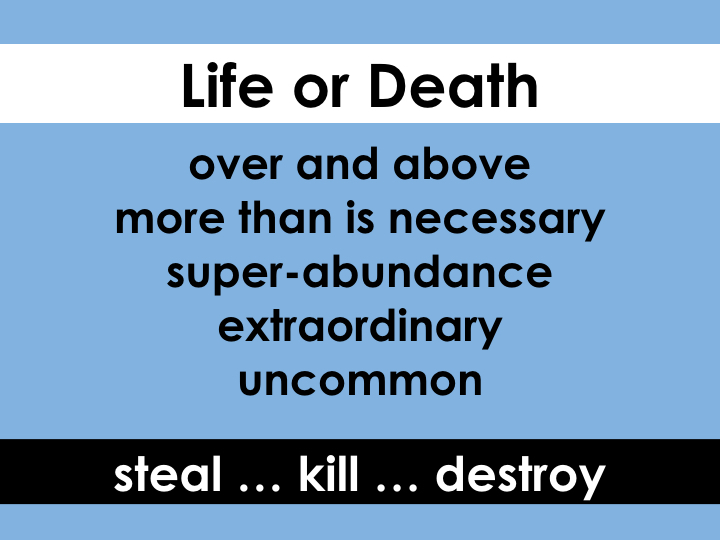
Here’s an important one—The thief cometh not, but for to steal, and to kill, and to destroy: I am come that they might have life, and that they might have it more abundantly (John 10:10).

It’s a pretty clear distinction: One way brings death and the other way brings life. But not just any kind of life.

The Greeks had three words for “life”—

  1. Bios from which we get our word biology. We can see when something is alive because of its biological growth.
  2. Psuche from which we get our word psychology. Plants might be biologically alive, but they don’t have the psychological life of a human.
  3. Zoe. This is the word Jesus used in John 10:10. It’s the word that means “life force” or better stated it’s God’s life.

God is a Triune God: Father, Son, and Spirit. When God created humans, we were created in His “trinity” image—Let Us make man in Our image (Genesis 1:26). Adam was created with bios, psuche, and zoe life. God told Adam and Eve that if they sinned, they would die (Genesis 2:17). When they did eat that forbidden fruit, they remained biologically and psychologically alive, but the zoe life force was cut off.

Jesus came to restore that! He came to bring us back to the state God originally intended for us, which meant He had to go to the Cross to become our sin, so that we could be forgiven and brought back to life.

Placing your faith in Jesus Christ’s work on the Cross means a complete about-face. The devil wants to steal from you, kill you, and destroy your soul for eternity. But Jesus came that you could have zoe in a way that was above-and-beyond, super-abundant, extraordinary and uncommon!

To get this life, Jesus asks us to do something that He did—If anyone would come after Me, he must deny himself and take up his cross and follow Me (Matthew 16:24).

Jesus isn’t calling for our hands and feet to be nailed to a wooden Cross. But He is calling for our selfish thoughts to be crucified (Matthew 16:23), and for us to give no more attention to our old sinful life.

I think this passage in Romans captures that thought so well—

Could it be any clearer? Our old way of life was nailed to the Cross with Christ, a decisive end to that sin-miserable life—no longer at sin’s every beck and call! What we believe is this: If we get included in Christ’s sin-conquering death, we also get included in His life-saving resurrection. We know that when Jesus was raised from the dead it was a signal of the end of death-as-the-end. Never again will death have the last word. When Jesus died, He took sin down with Him, but alive He brings God down to us. From now on, think of it this way: Sin speaks a dead language that means nothing to you; God speaks your mother tongue, and you hang on every word. You are dead to sin and alive to God. That’s what Jesus did. That means you must not give sin a vote in the way you conduct your lives. Don’t give it the time of day. Don’t even run little errands that are connected with that old way of life. Throw yourselves wholeheartedly and full-time—remember, you’ve been raised from the dead!—into God’s way of doing things. Sin can’t tell you how to live. After all, you’re not living under that old tyranny any longer. You’re living in the freedom of God. (Romans 6:6-14)

The choice is yours: the rip-off, destruction, and death the devil offers OR the abundant, overflowing, extraordinary, more-than-is-needed, zoe life that Jesus offers.

Life or death. Your choice.

9 Quotes From “Your Joy Will Turn To Sorrow”

Your Sorrow Will Turn To JoyAlthough Your Joy Will Turn To Sorrow is intended to be read each morning and evening of Holy Week (check out my book review here), the content is so good that it will benefit you anytime you decide to read it! Here are some quotes that especially caught my attention.

“The only Savior who truly saves, only saves through suffering. The Cross was the only means of making us sinners right before a holy God. Our salvation was purchased with suffering, and it will be sealed and preserved with suffering (James 1:2-4), not comfort. We are promised comfort in the Christian life (2 Corinthians 1:4), but not the cheap, temporal imitation we’ve grown accustomed to in our modern world.” —Marshall Segal

“Jesus did not come to purchase the approval of others. No, He ‘was despised and rejected by men; a Man of sorrows, and acquainted with grief; and as One from whom men hide their faces He was despised’ (Isaiah 53:3). Why? Because it is God’s approval we desperately need. And God’s approval doesn’t come by popular opinion, but by divine intervention—the substitution of His own Son in our place.” —Marshall Segal

“The irony of Mark 14 is that Judas could see the value of the ointment rolling down Jesus’ head, but he couldn’t see the value of Jesus. He was a pawnbroker with cataracts. That’s why he took such offense at the woman. The woman, on the other hand, could see both the value of the ointment and the value of Jesus. That’s why she broke the flask.” —Jonathan Bowers

“No one understands better than God how difficult it can be for a human to embrace the will of God. And no human has suffered more in embracing the will of God the Father than God the Son. When Jesus calls us to follow Him, whatever the cost, He is not calling us to do something He is either unwilling to do or is never done Himself.” —Jon Bloom

“So, now, we say with an entirely different meaning, let His blood be on us, not defiantly as the crowds that crucified Him, but desperately—with gratitude and hope and adoration—as those who depend wholly on His sacrifice. Jesus, let Your blood be on us. Let it cover us. Let the blood that flows from Your head, Your hands, Your feet wash over us and cleanse us from all our iniquity. We proclaim Jesus’ death. We rejoice in his death, not because we believe He was a fraud or a lunatic, but because it is by His death, by His wounds, by His blood that we are healed.” —Marshall Segal

“Jesus spoke of this joy as He faced the torture of Good Friday. He faced denial, faced betrayal, faced beatings, faced splinters and nails and spears—He could not stop talking about joy! Only joy would keep Him going. Joy was on His mind, joy was on His tongue, and joy was drawing Him, not away from suffering, but into it (Hebrews 12:2). Jesus went to the Cross for joy: to buy joy, create joy, and offer joy. As the world celebrated the savage killing of God, out of this sea of foaming rebel hostility emerged a blood-bought, inextinguishable joy.

“If the killing of the Author of life could not extinguish this joy Jesus speaks about, nothing can—and nothing ever will. No opposition from the world, no opposition to the gospel, and no cultural despising of Christ will overcome the resurrection joy of Jesus.” —Tony Reinke

“If Christ is still dead, death reigns, and all our joys our vain. So hoard every plastic Easter egg you find, because whatever you find inside is all the joy you have to grab. Or, as Paul says, ‘If the dead are not raised, let us eat and drink, for tomorrow we die’ (1 Corinthians 15:32). But if death is dead, and if the dead are raised—if Christ is risen from the dead!—brothers and sisters, let us feast and celebrate, for the daunting light of our inextinguishable and inexhaustible eternal pleasures have broken into the darkness, offering us a life of joy in Christ that cannot fade or rust or be stolen away!” —Tony Reinke

“Easter has now become our annual dress rehearsal for that great coming Day. When our perishable bodies will put on the imperishable. When the mortal finally puts on immortality. When we join in the triumph song with the prophets and the apostles, ‘O death, where is your victory? O death, where is your sting?’ (Hosea 13:14; 1 Corinthians 15:55).” —David Mathis

“Indeed, even agony will turn to glory, but Easter doesn’t suppress our pain. It doesn’t minimize our loss. It bids our burdens stand as they are, in all their weight, with all their threats. And this risen Christ, with the brilliance of the indestructible life in His eyes, says, ‘These too I will claim in the victory. These too will serve your joy. These too, even these, I can make an occasion for rejoicing. I have overcome, and you will more than conquer.’ 

“Easter is not an occasion to repress whatever ails you and put on a happy face. Rather, the joy of Easter speaks tenderly to the pains that plague you. Whatever loss you lament, whatever burden weighs you down, Easter says, ‘It will not always be this way for you. The new age has begun. Jesus has risen, and the Kingdom of the Messiah is here. He has conquered death and sin and hell. He is alive and on His throne. And He is putting your enemies, all your enemies, under His feet.’” —David Mathis

Poetry Saturday—The Rock

T.S. EliotThe endless cycle of idea and action,
Endless invention, endless experiment,
Brings knowledge of motion, but not of stillness;
Knowledge of speech, but not of silence;
Knowledge of words, and ignorance of the Word.
All our knowledge brings us nearer to our ignorance,
All our ignorance brings us nearer to death,
But nearness to death no nearer to God.
Where is the Life we have lost in living?
Where is the wisdom we have lost in knowledge?
Where is the knowledge we have lost in information?
The cycles of Heaven in twenty centuries
Bring us farther from God and nearer to the Dust. —T.S. Eliot

Links & Quotes

link quote

No matter how loving Christians are, and no matter how carefully we present our beliefs, people will still be offended. Check out this short video from Alan Shlemon at Stand To Reason.

“I am considering not how, but why, [God] makes each soul unique. If He had no use for all these differences, I do not see why He should have created more souls than one. Be sure that the ins and outs of your individuality are no mystery to Him; and one day they will no longer be a mystery to you. The mould in which a key is made would be a strange thing, if you had never seen a key: and the key itself a strange thing if you had never seen a lock. Your soul has a curious shape because it is a hollow made to fit a particular swelling in the infinite contours of the Divine substance, or a key to unlock one of the doors in the house with many mansions. For it is not humanity in the abstract that is to be saved, but you—you, the individual reader, John Stubbs or Janet Smith. Blessed and fortunate creature, your eyes shall behold Him and not another’s. All that you are, sins apart, is destined, if you will let God have His good way, to utter satisfaction.” —C.S. Lewis in The Problem Of Pain

“One doesn’t realize in early life that the price of freedom is loneliness. To be happy one must be tied.” —C.S. Lewis

Eric Metaxas asks, “What’s the difference between evolutionary theory and an octopus?” You will love his answer!

“We make a mistake as Christians if we hold the view that all non-Christian culture is worthless and should be avoided. This is simply not the case. God has given gifts for making culture to every human being, and very often those who do not know Him are capable of making artifacts, establishing institutions, or promoting conventions that actually are very useful for human flourishing. This is a measure of God’s common grace to all people. Believers must not despise such gifts, and we must not ignore or avoid them. … We do not repudiate those unbelieving aspects of culture which are good and useful. Rather, we appropriate all such forms, learning as much as we can about them and considering ways they might be put to use for the glory of God.” —T.M. Moore

Margaret Sanger, the founder of Planned Parenthood wanted to rid society of “human weeds,” and in 1925 she wrote, “We must clear the way for a better world; we must cultivate our garden.” Read more here.

“There is no rule binding with iron force upon you, for we are not under law in Christ’s church, but under grace, and grace will prompt you to do more than law might suggest….” —Charles Spurgeon

“We wouldn’t dare rob somebody of his gold watch or bank account. Yet God states clearly that slandering someone’s name is robbery of the worst kind. And we can do it in the subtlest of ways: by pointing an accusing finger, questioning one’s character, passing on tidbits of gossip. Indeed, three of the most damning words we can speak are, ‘Have you heard?’ The mere suggestion of the question robs a person of something valuable. And it defiles our own mouth.” —David Wilkerson

Frank Turek has an interesting look at the Kim Davis situation in Kentucky.

Links & Quotes

link quote

“Remember it is God, and not man, that must have the glory. It is not much speaking, but much faith, that is needed.” —Robert Murray McCheyne

“That very church which the world likes best is sure to be that which God abhors.” —Charles Spurgeon

Mark Atteberry asks a good question: “Aren’t we out-of-touch, narrow-minded, sexually-repressed Christians supposed to be the only ones who are bothered by rampant sexuality? Why, then, are these such big stories Jared Fogle, Ashley Madison, Larry Flynt], worthy of reporting on national newscasts?” Check out his post A Big Day For Sexual Sin.

Reminder: There is no such thing as free pornography. “The simple truth is that porn always costs us dearly, and it is never a victimless crime. Peer-reviewed research suggests that porn is highly addictive, negatively affects our behavior, and functionally operates as a destructive drug.”

Eric Metaxas shares some cool archeological findings about Jesus Christ’s hometown of Nazareth.

“Believing in your heart that God raised Jesus from the dead is much more than accepting a fact. It means being confident that God is for you, that He has closed ranks with you, that He is transforming your life, and that He will save you for eternal joy.” —John Piper

C.S. Lewis On The Scarcity Mindset

C.S. Lewis at his deskWhen C.S. Lewis wrote The Screwtape Letters, he wrote as an experienced demon giving advice to his young, protege demon. In this writing, when he refers to the “the Enemy” he’s talking about God, and “our Father” is the devil.

“The Enemy’s demand on humans takes the form of a dilemma; either complete abstinence or unmitigated monogamy. Ever since our Father’s first great victory, we have rendered the former very difficult to them. The latter, for the last few centuries, we have been closing up as a way of escape. We have done this through the poets and novelists by persuading the humans that a curious, and usually shortlived, experience which they call ‘being in love’ is the only respectable ground for marriage; that marriage can, and ought to, render this excitement permanent; and that a marriage which does not do so is no longer binding. This idea is our parody of an idea that came from the Enemy. The whole philosophy of Hell rests on recognition of the axiom that one thing is not another thing, and, specially, that one self is not another self. My good is my good and your good is yours. What one gains another loses. Even an inanimate object is what it is by excluding all other objects from the space it occupies; if it expands, it does so by thrusting other objects aside or by absorbing them. A self does the same. With beasts the absorption takes the form of eating; for us, it means the sucking of will and freedom out of a weaker self into a stronger. ‘To be’ means ‘to be in competition.’” —C.S. Lewis, The Screwtape Letters

Jesus came that we might have life in abundance; the devil wants to leave you competing for scarcity after he steals, kills and destroys. Choose God’s way. Choose abundance! Choose life!

Links & Quotes

link quote

“Faith does not shirk the fight; she longs for it, because she foresees the victory.” —Charles Spurgeon

“Faith honors Him whom it trusts with the most reverent and highest regard, since it considers Him truthful and trustworthy.” ―Martin Luther

“A rejection, or in Scripture’s strong language, a crucifixion of the natural self is the passport to everlasting life. Nothing that has not died will be resurrected.” ―C.S. Lewis

“You didn’t sign up for this crash course in single parenting or caring for a disabled spouse, did you? No, God enrolled you. Why? So you can teach others what He has taught you. Rather than say, ‘God, why?’ ask, ‘God, what?’ What can I learn from this experience? Your mess can become His message!” —Max Lucado

I have often said that low expectations can sink someone’s future. Seth Godin agrees. Check out his post The Tragedy Of Small Expectations.

[VIDEO] Pentatonix is a very talented a cappella group! Check out this mash-up of Michael Jackson hits—