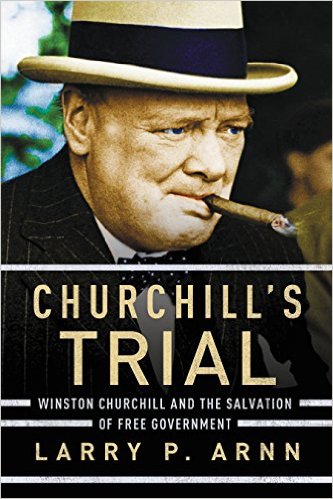
12 Quotes From “Churchill’s Trial”

Churchill's TrialIn Churchill’s Trial, Larry Arnn has given us a fascinating look at Winston Churchill’s battle to keep freedom alive, both in the moment of crisis and after the crisis has passed. You can read my full book review by clicking here. Below are a few of the quotes I highlighted as I read.

“Mankind has never been in this position before. Without having improved appreciably in virtue or enjoying wiser guidance, it has got into its hands for the first time the tools by which it can unfailingly accomplish its own extermination. That is the point in human destinies to which all the glories and toils of men have at last lead them. They would do well to pause and ponder upon their new responsibilities. Death stands at attention, obedient, expectant, ready to serve, ready to shear away the peoples en masse; ready, if called upon, to pulverize, without hope of repair, what is left of civilization. He awaits only the word of command. He awaits it from a frail, bewildered being, long his victim, now—for one occasion only—his master.” —Winston Churchill 

“Science is necessary, and also science is a master. As the human ability to make grows, the human ability to control the engines by which we make diminishes. The logical problem is relentless: we may stay as we are and lead shorter lives of pain and trouble, or we may use our capacity to make our lives easier and safer. If we do that we will gain power, and we can use that power against ourselves.” —Larry Arnn

“No material progress, even though it takes shapes we cannot now conceive, or however it may expand the faculties of man, can bring comfort to his soul.” —Winston Churchill 

“We must never cease to proclaim in fearless tones the great principles of freedom and the rights of man which are the joint inheritance of the English-speaking world and which through Magna Carta, the Bill of Rights, the Habeas Corpus, trial by jury, and the English common law find their most famous expression in the American Declaration of Independence. …

“All this means that the people of any country have the right, and should have the power by constitutional action, by free unfettered elections, with secret ballot, to choose or change the character or form of government under which they dwell; that freedom of speech and thought should reign; that courts of justice, independent of the executive, unbiased by any party, should administer laws which have received the broad ascent of large majorities or are consecrated by time and custom. Here are the title deeds of freedom what should lie in every cottage home. Here is the message of the British and American peoples to mankind. Let us preach what we practice—let us practice what we preach.” —Winston Churchill

“There is enough for all. The earth is a generous mother; she will provide in plentiful abundance food for all her children if they will but cultivate her soil in justice and in peace.” —Bourke Cockran

“Human relations are not a contest in which the advantage of some requires the disadvantage of others. That means in turn that government need not have the authority to allocate resources, at least not comprehensively. A government with such power would be in one sense at war with any citizens who have more than others, effectively with all citizens but the few poorest.” —Larry Arnn

“In republics, the greater danger is that the majority may not sufficiently respect the rights of the minority.” —James Madison

“He who molds public sentiment goes deeper than he who enacts statutes or pronounces decisions.” —Abraham Lincoln

“Democracy properly understood means the association of all through the leadership of the best.” —Winston Churchill

“Our hearts will ache…if we have not a vision above material things.” —Winston Churchill

“If men were angels, no government would be necessary. If angels were to govern men, neither external nor internal controls on government would be necessary.” —James Madison

“We now watch the workings of a written Constitution enforced by a Supreme Court according to the letter of the law, under which anyone may bring a test case challenging not merely the interpretation of the law, but the law itself, and if the Court decides for the appellant, be he only an owner of a few chickens, the whole action of the Legislature and the Executive becomes to that extent null and void.” —Winston Churchill 

More quotes coming soon…

Churchill’s Trial (book review)

Churchill's TrialI have read so much written by and about Winston Churchill, that it’s hard to imagine learning something new about this remarkable man. And yet, I was amazed at how much more I learned in reading Churchill’s Trial by Larry Arnn.

It’s easy to take for granted the freedoms people have in countries like England and the United States because of the foresight of the framers of our Constitutions. But there are trials which put these freedoms in a precarious place, and if it were not for strong and insightful men—like Winston Churchill—those freedoms could have disappeared.

Churchill played key roles in his country, and in world politics, through two world wars, a global depression, the coming of age of new military super-powers, the dawn of the era of atomic warfare, and the rise of Communism. In all of these intense events, the temptation was there to make radical changes to meet the challenge of the moment. Churchill had the wisdom and foresight to leverage the strength of his country’s Constitution, without undermining it nor setting a precedent which would erode future freedoms.

In what Churchill did for England, he also helped strength the resolve of key leaders in the United States, who faced similar challenges in a shifting geopolitical climate. Churchill not only saved the world from the spread of fascism and communism, but he did so in a way that would guarantee freedom for millions of people in generations to follow. The question before us now is: Will we learn from Churchill’s example, or will we fail the trial we now face?

For history buffs, political junkies, and fans of Winston Churchill, Churchill’s Trial is an excellent read.

I am a Thomas Nelson book reviewer.

Book Reviews From 2015

Links & Quotes

link quote

“What a great responsibility God has laid upon us preachers of His gospel and teachers of His Word. In that future day when God’s wrath is poured out, how are we going to answer? How am I going to answer? I fear there is much we are doing in the name of the Christian church that is wood, hay and stubble destined to be burned up in God’s refining fire. A day is coming when I and my fellow ministers must give account of our stewardship: What kind of a gospel did we preach? Did we make it plain that men and women who are apart from Christ Jesus are lost? Did we counsel them to repent and believe?” —A.W. Tozer

“Prayer pursues God’s glory by treating Him as the inexhaustible reservoir of hope and help. In prayer, we admit our poverty and God’s prosperity, our bankruptcy and His bounty, our misery and His mercy.” —John Piper

“We love beauty with simplicity, and we love the pursuit of knowledge without effeminacy. We employee wealth properly, for use rather than for noisy display, and we do not consider poverty to be a disgrace but do regard it as shameful for someone not to seek to escape poverty through labor. We citizens of Athens care for both our own domestic concerns and for the affairs of state; those of us engaged in business are not lacking in understanding of public matters. For we alone consider those who avoid engagement in public affairs not as ‘uninvolved’ but as useless. And we, as we judge and reflect carefully on matters, do not consider words to be a hindrance to actions. Rather, the real hindrance to action is to enter into whatever must be done without taking forewarning through discussion.” —Pericles, speaking about Athenian culture, quoted in the Archaeological Study Bible

The serious mental health costs of watching pornography. Don’t be fooled: porn is dangerous!

Tim Dilena talks about the difference between truth and “viral fame” in this video.

Truth! Why marriage shouldn’t end your dating life.

I like Seth Godin’s thoughts on our vocabulary. “It’s not about knowing needlessly fancy words (but it’s often hard to know if the fancy word is needless until after you learn it). Your vocabulary reflects the way you think (and vice versa). It’s tempting to read and write at the eighth-grade level, but there’s a lot more leverage when you are able to use the right word in the right moment.” Read more in Does Vocabulary Matter?

Links & Quotes

link quote

“The question, then, isn’t, ‘when am I going to get promoted?’ No, I think the question is, ‘will I grab these openings to become someone who’s already doing work at a higher level?’” Read more from Seth Godin’s post.

“Faith is not a distant view but a warm embrace of Christ.” —John Calvin

“The honest truth is that I have seen God do more in people’s lives during ten minutes of real prayer than in ten of my sermons.” Read more of Jim Cymbala’s post The Day Jesus Got Mad.

“Success is a tale of obstacles overcome, and for every obstacle overcome, an excuse not used.” —Robert Brault

“Knowing is not enough; we must apply. Wishing is not enough; we must do.” —Goethe

“The good news of the Bible is that God is not at all disinclined to satisfy the hearts of those who hope in Him. Just the opposite: The very thing that can make us happiest is what God delights in with all His heart and with all His soul. With all His heart and with all His soul, God joins us in the pursuit of our everlasting joy because the consummation of that joy in Him redounds to the glory of His own infinite worth.” —John Piper

You may need to bookmark this: 15 Scriptures on starting over.

60+ eminent legal scholars call on elected officials to not recognize the Supreme Court’s Obergefell decision on homosexual “marriage.”

Another place to reject culture’s language is on the issue of abortion.

Jeff Jacoby has an important look at Christopher Columbus.


Links & Quotes (video edition)

link quote

A short biography on the richest American who ever lived—

Brett Kunkle and Bobby Conway talk about exposing our children to atheistic ideas—

John Maxwell looks at Christopher Columbus through the lens of leadership development—

Murray Vassar rips apart Joel Osteen’s attempt to re-write and/or twist Scripture to fit his “prosperity gospel”—

WOOD TV8 has a feature on the ArtPrize exhibit out together by Adam Bird and Heart of West Michigan United Way, highlighting some of the Champions of Change in West Michigan.

[Tear-jerker warning!!] A mother has a special note for her adopted daughter on her wedding day—

Links & Quotes

link quote

“From the beginning of the Bible to the end, God warns that any nation which departs from Him is going to suffer judgment. America has been given more spiritual and moral light than any nation in the history of the world, and yet this great nation has departed from Him and stands in peril of His judgment.” —Billy Graham

“Belief is not faith without evidence but commitment without reservation.” —Leighton Ford

Documented proof of Planned Parenthood breaking the law. They even allowed a high school coach, who impregnated a 14-year-old girl, to sign-off on her abortion without informing the parents nor reporting this as statutory rape!!

Eric Metaxas debunks some of Planned Parenthood’s old lies.

Scientific studies show that forgiving people helps you physically and psychologically.

Tim Elmore always has great insights into the youth culture. Here are his 6 defining characteristics of Generation Z.

[VIDEO] John Maxwell talks about the right attitude to handle rejection, and what it can do to move us forward—

Links & Quotes

link quote

“Is it not said in Scripture, ‘If any man sin, we have an Advocate’? Why is Christ an advocate today? Only because we want an advocate every day. Does He not constantly intercede yonder before the eternal throne? Why does He do that? Because we want daily intercession. And it is because we are constantly sinning that He is constantly an advocate, constantly an intercessor.” —Charles Spurgeon

“The only right a Christian has is the right to give up his rights.” —Oswald Chambers

“Unbelief hinders Christ from working those works which show the glory. It seems a strange saying, and one which we could not have ventured to utter had it not been written down for us by inspired men. That a child’s hand held up against the sun should hinder it from shining; that a weathered leaf thrown into a stream should stay its flowing or dry up its source; that the breath of man, breathed up against the sky, should quench the light of its myriad stars—these things would not really be so marvelous as that man’s unbelief should prevent God’s power from being sent forth, and the Son of God from doing those things which would reveal the glory of the Father. Yet we find the strange truth thus recorded. The evangelist Matthew thus writes, ‘He did not many mighty works there, because of their unbelief’ (13:58); and Mark uses still stronger language, ‘He could there do no mighty work, saving that He laid His hands upon a few sick folk and heal them; and He marveled because of their unbelief ‘(6:5, 6).” —Horatius Bonar

A really nice story about our church’s move.

Despite what some people want to teach, here are 24 reasons to believe Hell is a reality.

George Muller was a faith giant. But check out what John Piper writes about him: Muller did not have the gift of faith.

Jon Bloom writes, “If we want to really know what’s going on in the world, we cannot depend on CNN or FoxNews. We will keep our eyes on the global church. She is at the center of history,” in his post entitled America’s one enduring legacy in history.

[VIDEO] Does free speech offend you?

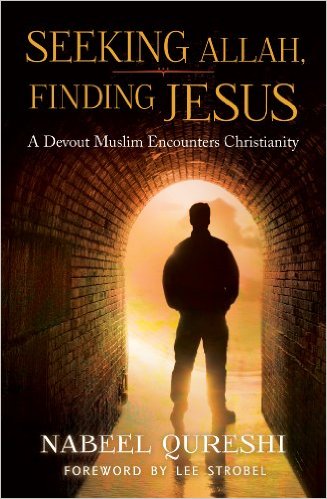
13 Quotes From “Seeking Allah, Finding Jesus”

Seeking Allah Finding JesusIf you want to know about Islam from an insider’s perspective, Seeking Allah, Finding Jesus by Nabeel Qureshi is simply a phenomenal book! Check out my book review by clicking here. Below are just a few of the quotes I found quite educational.

“There is much division in Islam. The best determination of whether a man is Muslim is if he exclusively declares that Allah is God and Mohammad is Allah’s messenger. Beyond this point, there is great diversity in Islam.”

“There is no book of sharia. We must derive the law from a hierarchy of sources using a process of jurisprudence called fiqh. The first and greatest source is the Quran. Nothing can supersede the Quran because it is the word of Allah. But the Koran is not comprehensive. As Muslims, there is much we must do and believe that is not found in the Quran. For this, we go to the second source, hadith. The hadith elaborate and clarify what is found in the Quran, but they never contradict. There is no contradiction in Islam. If a hadith is found in any way to contradict the Quran, then it is inauthentic and must be disregarded. If no hadith can be found to clarify an issue, then we must turn to the third source of sharia: the ulema, Muslim scholars who are wise and experienced in Islam.”

“Muftis from different schools of thought have different precedents and therefore provide different fatwas. Each denomination differs on what hadith they consider accurate. Since the hadith are the second rung of sharia, these differences of opinion have real consequences. Many of the differences between the ways Sunnis and Shias practice Islam are over this very matter. Their books of hadith are disparate. This difference, combined with the Shia position regarding the authority of imams, results in a significantly different view of sharia. … Most Muslims do not know these things. They know Islam to the extent that they practice it, and these are matters for the learned.”

“Christians believe Jesus is God incarnate, and this is a necessary belief for orthodox Christianity. Muslims believe that Jesus is no more than a prophet, and to consider Him God incarnate would be blasphemy and would cause one to be condemned to hell eternally, according to the Quran.”

“Regarding Jesus, there are two issues on which Muslims particularly disagree with Christians: that Jesus died on the Cross and that Jesus claimed to be God. The Quran specifically denies both of these beliefs.” 

“Sahih Bukhari…is the most trustworthy book of hadith, compiled by Imam Bukhari. The hadith were not collected into the books until a long time after Mohammad’s death. Many false hadith had been fabricated, and it was difficult to determine which ones were accurate. Imam Bukhari sifted through five hundred thousand hadith and pick out the five thousand most accurate.”

“The earliest historical records show that Mohammad launched offensive military campaigns and used violence at times to accomplish his purposes. He used the term jihad in both spiritual and physical contexts, but the physical jihad is the one Mohammad strongly emphasizes. The peaceful practice of Islam hinges on later, often Western, interpretations of Mohammad’s teachings, whereas the more violent variations of Islam are deeply rooted in orthodoxy and history.”

“The Bible and the Quran were nothing alike. Not in the slightest. … Mohammad dictated the contents of the Quran to his scribes over a period of twenty-three years. Only after his death was the Quran collected into a book. Verses that had been dictated years or decades apart are frequently found side-by-side in the Quran, often with no obvious connection. The result is that Muslims placed relatively little weight on surrounding passages when trying to interpret sections of the Quran.”

“Almost everything Muslims know about Mohammad comes to them orally, rarely from primary sources. Unlike Christians learning about Jesus from the Bible, the Quran has very little to say about Mohammad.”

“Mohammad’s first biography, Sirat Rasul Allah by Ibn Ishaq, comes down to our date only through the transmission of a later biographer, Ibn Hisham. In his introduction, Ibn Hisham explains that he altered the story of Mohammad’s life. ‘Things which it is disgraceful to discuss, matters which would distressed certain people, and such reports as [my teacher] (sic) told me he could not accept as trustworthy—all these things I have omitted.’”

“According to the hadith, Mohammad named four men as the best teachers of the Quran. The first one was Abdullah ibn Mas’ud, whome Mohammad distinguished as the foremost expert of the Quran. The last one was Ubay ibn Ka’b, whom Sahih Bukhari identifies as the best reciter of the Quran. These were the men that Mohammad hand selected as the best teachers of the Quran, but as I studied the early sources, I found that they did not agree with the final Quran, which has been passed down as today’s version. They did not even agree with each other. … Ubay is known to have had 116 chapters in his Quran, two more than Zaid’s edition. Ibn Mas’ud had only 111 chapters in his Quran, insisting that the additional chapters in Zaid’s Quran and Ubay’s Quran were just prayers, not Quranic recitation.”

“In Islam, there is only one unforgivable sin, shirk, the belief that someone other than Allah is God. Shirk is specifically discussed in the context of Jesus in 5:72. He who believes Jesus is God, ‘Allah has forbidden Heaven for him, and his abode will be the Hellfire.’”

“All suffering is worth it to follow Jesus. He is amazing.”

The Printer And The Preacher (book review)

The Printer And The PreacherRandy Peterson has written an amazing story of the unlikely friendship between two men who loom large in history: Benjamin Franklin and George Whitefield. The book is called The Printer And The Preacher: The Surprising Friendship That Invented America.

These men were arguably the first celebrities in the American colonies. They each achieved their level of fame in totally different professions, and yet their paths continue to cross time and time again, until a 30-year-long friendship ensued. Each of them was instrumental in sharpening the other in their craft, promoting their pursuits, and defending each other’s reputations. And perhaps most notably, together they became pivotal in the build-up to America’s independence both politically and religiously.

In concluding this very enjoyable book, Peterson writes—

“Like George [Whitefield], we are, as a nation, very religious. Like Ben [Franklin], we like to make up our own beliefs. About half of Americans call themselves evangelical, children of the Great Awakening. Many even use George’s favorite term: born again. But others do not share this faith. Many, like Ben, are scientific in their outlook. They take an ‘enlightened’ approach to life, focusing on the natural world, not the supernatural.

“We are George and Ben.

“Thanks to Ben and others, we have religious liberty carved into our Constitution. We have freedom to be religious or not to be. We can be Methodists, Calvinist, Catholic, deist, Pietist, or all of the above. No authority can coerce us to believe anything or force us to say we do. Spiritual life is a personal matter, a transaction between us and God. George and Ben both taught us this.

“We are still figuring out how religious freedom works. As a nation, we seem to vacillate between Ben and George, skeptic and zealot, the right to doubt and the right to believe. The question in our deeply divided country is how to preserve the freedom to live without a vibrant Christian faith as well as the freedom to choose something else. The relationship between these two forefathers points to an answer.”

This book will appeal to so many people: history buffs, pastors, scientists, leaders, politicos, and biography readers. I highly recommend it!

I am a Thomas Nelson reviewer.