Listen to the podcast of this post by clicking on the player below, and you can also subscribe on Apple, Spotify, or Audible.
Gratitude is a great separator for leaders—it gives them a better vantage point from which to lead people and increases their effectiveness as a catalyst for organizational change.
In short, a grateful leader is a great leader.
Check out the full conversation Greg and I had on The Craig and Greg podcast episode We are Grateful.
And you may be interested in a whole series of posts and video where I talked about the psychological, physiological, emotional, and relational benefits of making gratitude our focus. The series was called Be Thankful.
Listen to the podcast of this post by clicking on the player below, and you can also subscribe on Apple, Spotify, or Audible.
The word Advent means the appearing—something that bursts onto the scene. At this time of year we are actually thinking about TWO Advents. We look backward in gratitude to celebrate the first Advent of Jesus when He was born in a manger in Bethlehem. And then we look forward in joyful expectation to the second Advent of Jesus when He will return to earth again as King of kings. As we will in this time between the Advents, there are four qualities that we should exemplify—the first is hope.
When the candle is lit, darkness disappears.
Darkness is not the opposite of light, it is the absence of light. In the same way, despair or hopelessness is the absence of hope.
Adam and Eve lived in perfection, but when they tried to do things their way—instead of obeying God’s way—their sin caused them despair. They tried to cover their nakedness, but with a hopeless covering of dying leaves. God came with a promise of full restoration, and illustrated it by covering them with the skin of a sacrificial animal (Genesis 3:7, 15, 21).
Job knew the hopelessness of self-covering and finality of earthly life, and even David—the man after God’s own heart knew this too (Job 6:11-13, 17:13-16; 1 Chronicles 29:15).
But Job and David both knew the hope they could have in their Redeemer (Job 19:25; Psalm 16).
Hope in both the Old and the New Testaments means a patient waiting, anticipating with pleasure, having a confident expectation. It’s a light shining in the darkness that cannot be extinguished—it’s hope that despair cannot darken (Isaiah 9:1-2, 6-7).
At His first Advent, Jesus appeared in our “clothing” so that He could become our sin and then clothe us in His righteousness (Hebrews 2:17; John 1:14; Romans 4:6-8; Hebrews 6:16-20). For this we look back in gratitude.
But we don’t live today merely in gratitude for Christ’s first Advent, but we also live in confident hope of Christ’s second Advent (Acts 1:11; John 14:1-3; 2 Corinthians 5:1-8; Revelation 22:7, 12, 20).
He came into this world of sin,
Made flesh and blood His dearest kin;
He died, that He might take us in,
And keep us till He comes again. —Scott Hubbard
How do we live out this confident hope—
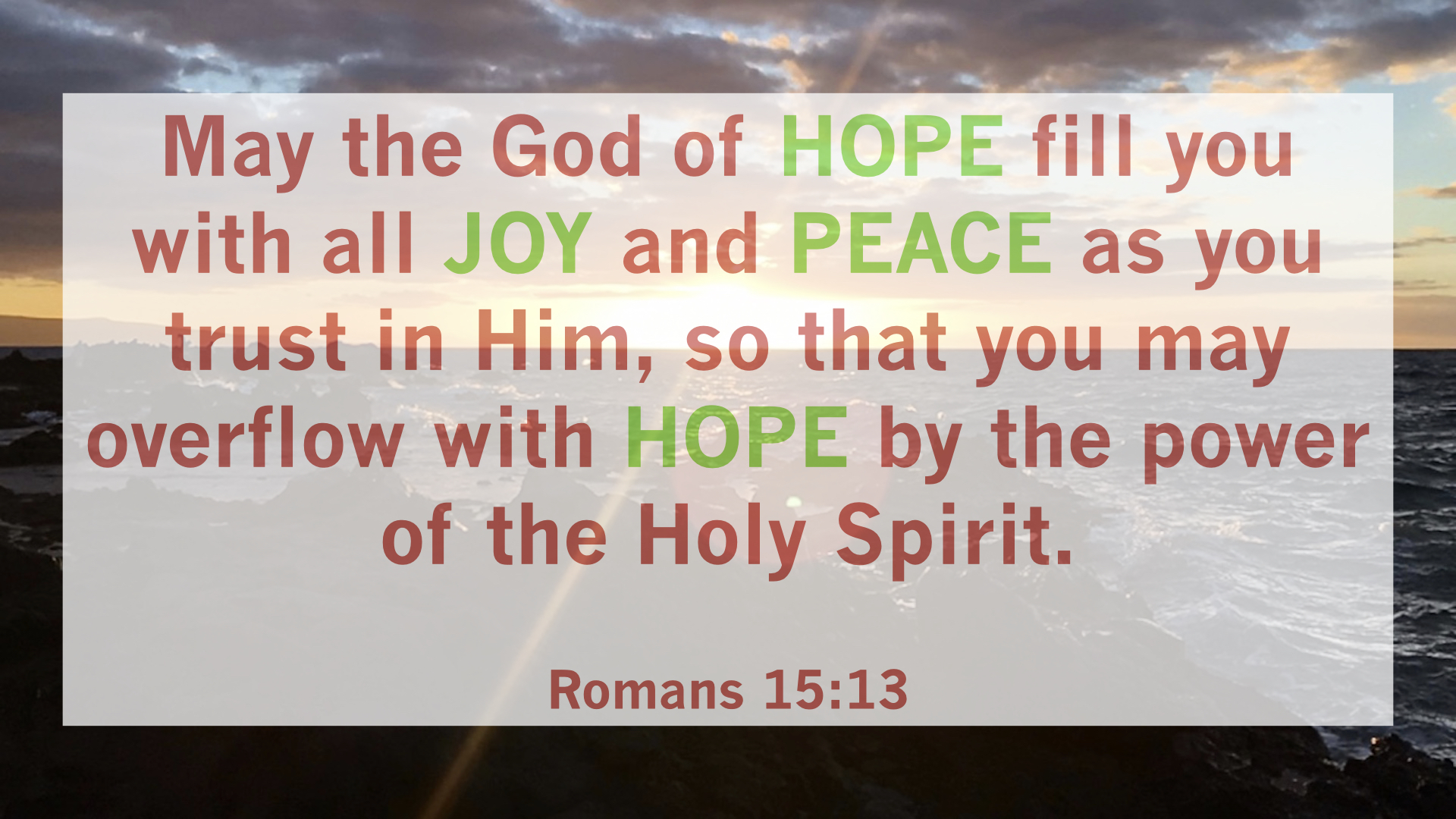
May the God of HOPE fill you with all JOY and PEACE as you trust in Him, so that you may overflow with HOPE by the power of the Holy Spirit. (Romans 15:13)
Follow along with all four of the Advent attributes by clicking here.
Shepherd leaders cannot allow past hurts to negatively impact their current situations. Don’t give in to the natural fight-or-flight response, but ask God to help you response with supernatural faithfulness. I unpack this idea in greater depth in my book When Sheep Bite.
I have lots of new content every week, which you can check out on my YouTube channel.
In responding to an evolutionary biologist’s claims that the material world is all that matters, John Stonestreet invokes the timely wisdom of G.K. Chesterton and C.S. Lewis. One of my favorite quotes from Lewis appears in this post: “A theory which explained everything else in the whole universe but which made it impossible to believe that our thinking was valid, would be utterly out of court… It would be an argument which proved that no argument was sound—a proof that there are no such things as proofs—which is nonsense.”
“Good leaders love leading the people they lead more than they love leading people.” —John Maxwell
Gerrit Scott Dawson writes about how the Bible helps us see ourselves more clearly. “The truth-telling mirror of Scripture exposes and composes us. Imagine a mirror that would make you as appealing as you could hope to be. Imagine a well of clear water that not only reflected but washed you clean of dirt and blemishes. When we read Scripture with open hearts and in reliance on the Spirit, that’s what happens.”
“Twice in the book of Hebrews we are urged to ‘consider Jesus.’ In Hebrews 3:1, the writer exhorts us to consider Jesus (κατανοήσατε) so that we will continue believing in and confessing Him throughout our lives. This word means to pay attention to something through direct observation, with the implication of also thinking about it, meditating on it, and returning to it often, just as one might carefully observe an object in creation or a work of art. … In Hebrews 12:3, the writer calls us again to consider Jesus, but this time as a work of rational analysis (ἀναλογίσασθε), a theological analysis, as opposed to an aesthetical contemplation. This suggests the need to study, read, think deeply, meditate, talk with others, and know Jesus in terms appropriate to His uniqueness and mission.” —T.M. Moore
“Be silent, if you choose; but when it is necessary, speak—and speak in such a way that people will remember it.” —Wolfgang Amadeus Mozart
Listen to the podcast of this post by clicking on the player below, and you can also subscribe on Apple, Spotify, or Audible.
Jesus not only gave us an example of well-rounded, healthy growth, but He also gave us a barometer of measuring just how healthy we truly are.
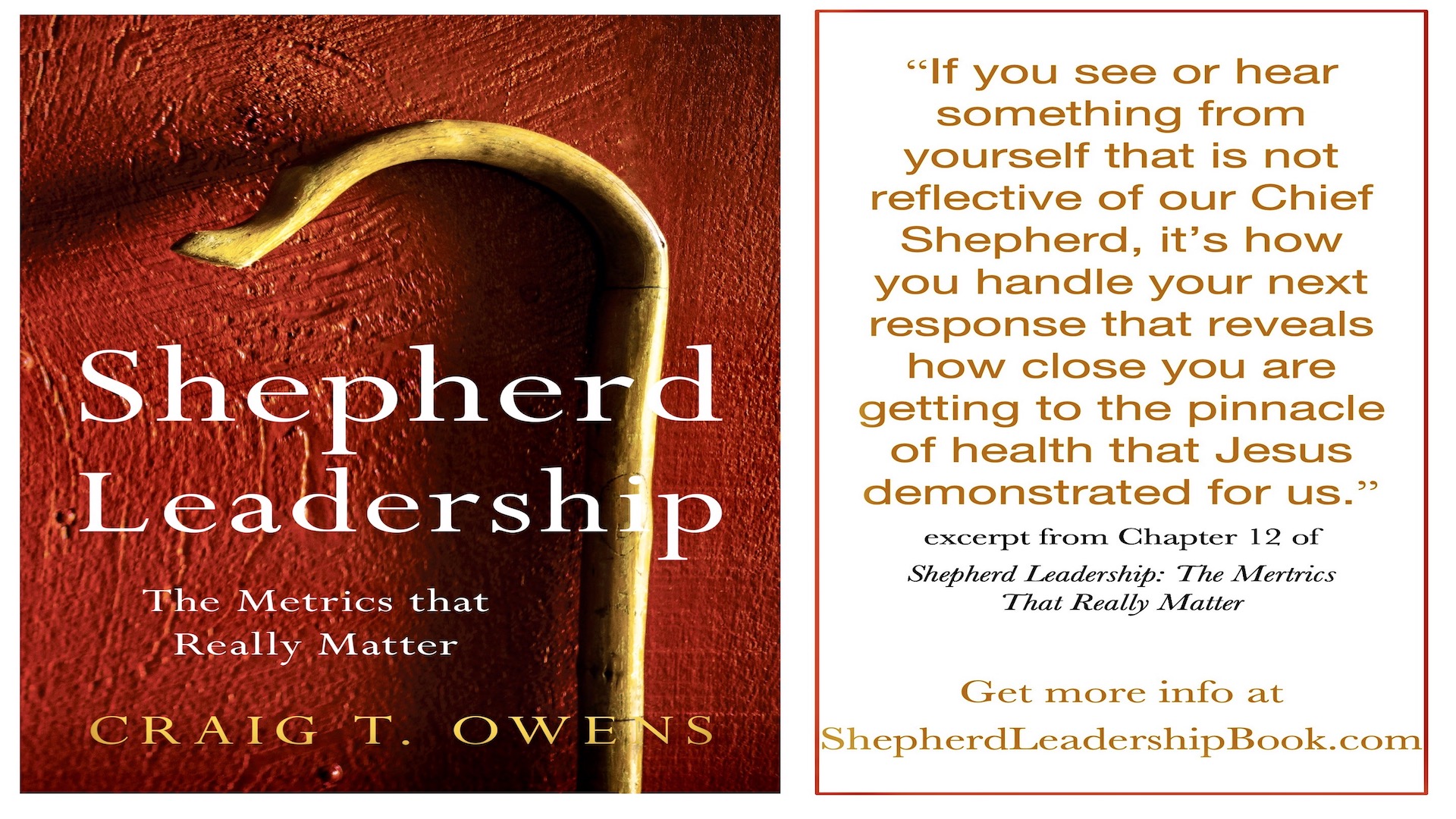
I talk about this pyramid of healthiness in Chapter 8 of Shepherd Leadership, but the example we really see of Jesus at the pinnacle of spiritual health is in Chapter 12. Here’s an excerpt—
Friends, the mark of a maturing shepherd is not one who never misspeaks or never makes a mistake. No, the mark of a maturing shepherd is the one who is closing the gap between his mess up and his confession, and one who is experiencing fewer mess ups over time because the Holy Spirit is helping him get healthier and more mature.
The pinnacle of a shepherd leader’s health is not how wise you are, nor how physically healthy, nor even how much spiritual insight you have gained, but it is how appropriately God-honoring your actions and reactions are among the sheep you pasture.
If you see or hear something from yourself that is not reflective of your Chief Shepherd, it’s how you handle your next response that reveals how close you are getting to the pinnacle of health that Jesus demonstrated for you.
I’ve got a great Christmas gift idea for you to give to your favorite pastor: a copy of my book When Sheep Bite. I promise you that your pastor has been bitten and that there will be more bites in the future. This book will bring about the healing and restoration that your pastor needs.
I have lots of new content every week, which you can check out on my YouTube channel.
“Good advice is always certain to be ignored, but that’s no reason not to give it.” —Agatha Christie
“Let us remember, dear friends, that as we meet at our tables today with our sisters and brothers from distant parts, we are also invited by our elder Brother, our divine Friend, to join with Him in a higher feast, the way there sprinkled with His own blood. Let us not forget, as we are blessed with the providential bounties for the nourishment of these frail bodies that Christ the Lord summons us to a spiritual feast.” —Rev. James Cruickshanks, November 21, 1861
“The apostle Paul explained that the power of God at work within us, the power of His indwelling Holy Spirit, is exceedingly abundantly greater than all we could ever ask or think (Ephesians 3:20). Greater for what? For a clearer vision of Christ and more intimate communion with Him (Colossians 3:1-3; 2 Corinthians 3:12-18). More continuous and abundant yields of spiritual fruit (Galatians 5.22-23). Greater consistency and effectiveness in the exercise of spiritual gifts for ministry (1 Corinthians 12:7-11). More power to bear witness for Christ, to love God and our neighbors, and to advance His rule of righteousness, peace, and joy on earth as it is in heaven (Acts 1:8; Matthew 22:34-40; Romans 14:17-18).” —T.M. Moore [check out all of the Scripture here]
Listen to the audio-only version of this podcast by clicking on the player below, or scroll down to watch the video.
We are grateful for you! Greg and I love talking about leadership, and it’s a great joy that you tune in to listen. In this episode we discuss why an attitude of gratefulness is so important for leaders year-round, not just around the holidays.
[0:17] We are so grateful for you!
[1:25] What is it about gratitude that make someone a great leader?
[4:28] Grateful leaders have greater influence with people around them.
[8:14] It’s easier to build consensus on our teams when we have a thankful paradigm.
[10:52] Thankful correlates with graceful. This is such an attractive quality for leaders.
[14:10] Greg asks me elaborate on how gratitude ties into my book Shepherd Leadership.
[16:09] How does a grateful mindset help us get through the tough times?
[18:56] Happiness is not the same as joy. Joy is much deeper and serves us as leaders much better because happiness can be gone really quickly.
[23:16] We give you some “homework” that will help you grow your gratitude.
Check out this episode and subscribe on YouTube so you can watch all of the upcoming episodes. You can also listen to our podcast on Spotify and Apple.
Listen to the podcast of this post by clicking on the player below, and you can also subscribe on Apple, Spotify, or Audible.
Let me remind you of something I covered last week:
If we start out thankful but then forget about our blessings, we become fearful and selfish, which makes us susceptible to the sin of grumbling against God.
But if we start our thankful and then continually remember all that God has done for us, we remain joyful and secure, which fortifies us against giving in to the sin of grumbling against God.
As I have shared with you during this series, medical science has discovered so many connections between gratitude and wellbeing—mentally, physically, emotionally, and relationally. Here’s another important finding from medical science: Chronic stress impairs memory formation.
Remember this insight from George Santayana: “Those who do not learn from history are doomed to repeat it”?
But what if we cannot learn the lessons from history because we cannot remember and recall those lessons? That’s one of the ways chronic stress ravages our ability to be grateful. Stress literally clogs up the amygdala in our brain so that these lessons cannot be filed away for future use.
Where does this chronic stress come from? Stress can be a good thing—think of the stress we put on our lungs, heart, and muscles when we exercise. That good stress (eustress) prepares us to respond well in difficult situations.
But chronic stress is unhealthy. It begins to make us withdraw into ourselves. We become self-protective. We start to see potential problems even behind blessings.
Self-protective becomes self-focused, which is the exact opposite of the God-focus we looked at last week in Psalm 103:2. This also makes us want to isolate from people (see Psalm 42:1-4, especially the “used to” in v. 4).
Consider the example of David’s life. David is in a stressful state where I am sure it is becoming increasingly difficult for him to find praiseworthy things. He is becoming more and more self-protective and therefore self-focused.
Saul tries to kill him—1 Samuel 20:28-33
The Philistines have him trapped—21:10-13; Psalm 56
The people of Keilah reward David’s help with betrayal—23:10-12
David is in a desert place (literally!) and sold-out by the Ziphites—23:14, 19-20
Psalm 54 is written when David learns about the Ziphites’ plan. He begins to pour out his complaint to God in vv. 1-3, but then there is a totally different tone in vv. 4-7. What comes between is the word Selah—a pause to consider.
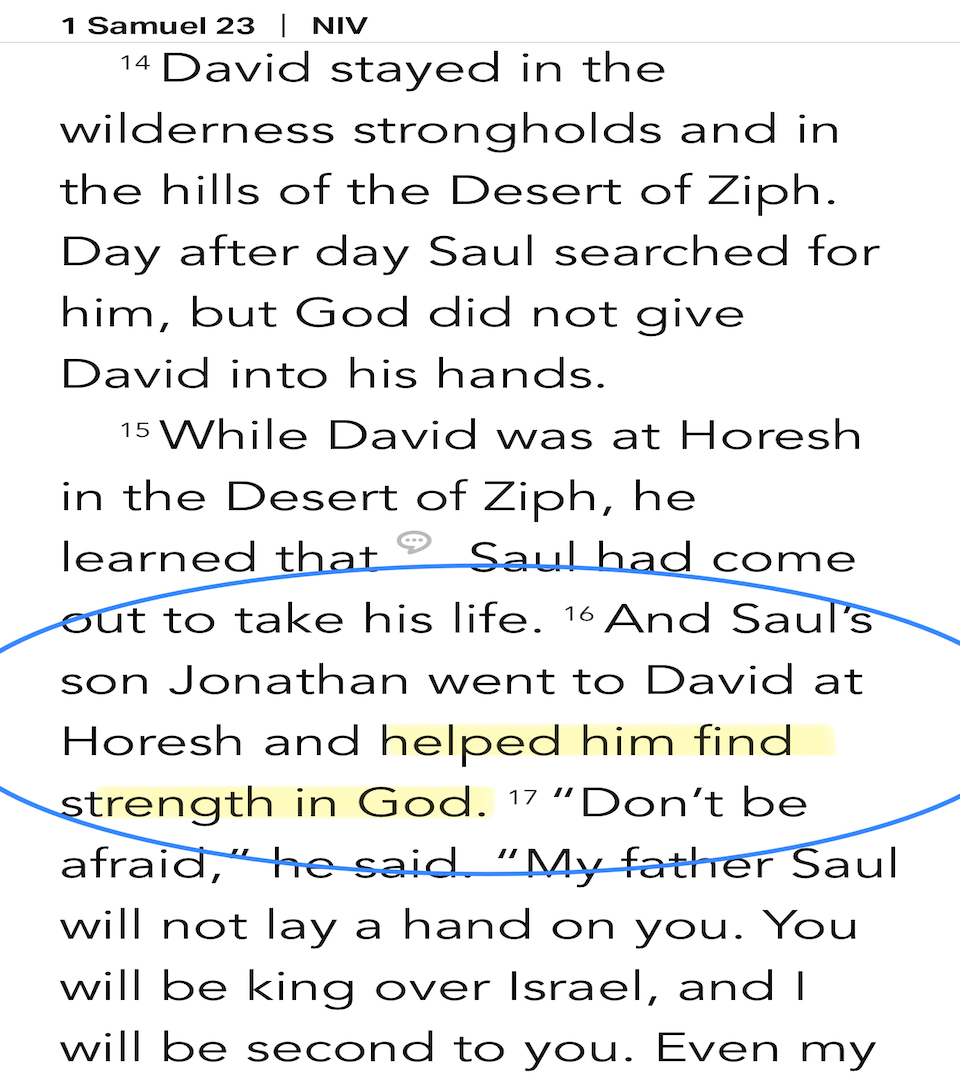
I believe at this time is when Jonathan shows up to encourages David—And Saul’s son Jonathan went to David at Horesh and helped him find strength in God (1 Samuel 23:16).
David learned this lesson well because when he’s in another tight spot, we read that David found strength in the Lord his God, which allowed him to encourage his distraught men to seek God’s help. It was with God’s help that they recovered everything single thing that had been taken from them (1 Samuel 30:1-18)!
Your gratitude fortifies you and helps you encourage other saints. As you encourage other saints, they will then be fortified to help other saints—maybe even you!
I like how Eugene Peterson paraphrases 1 Thessalonians 5:11 in The Message: “So speak encouraging words to one another. Build up hope so you’ll all be together in this, no one left out, no one left behind. I know you’re already doing this; just keep on doing it.”
Your gratitude could make all the difference in someone else’s life, so “just keep on doing it”!
“The world cares very little what you or I know, but it does care a great deal about what you or I do.” —Booker T. Washington
T.M. Moore is in the midst of sharing an eye-opening series of posts on what eternal life truly is. Here is a short snippet: “In Ephesians 1:15-23 Paul provides insight to how we may engage heavenly realities throughout our earthly and temporal sojourn. As he prayed for the Ephesians, so, we can believe, he would have prayed for us as well. But what did he pray? First, that God would give us His Spirit for ‘wisdom and revelation in the knowledge of Him’ (v. 17). The Spirit, we know, works with the revelation of God in Scripture to make us more like our Lord Jesus Christ (2 Corinthians 3:12-18). He uses the entire Bible to help us increase in our experience of eternal life. This is true for knowing more of our great salvation as well as for glimpsing more of our eternal life.”
“Comparison sabotages two relationships at the same time: your relationship with God, and your relationship with other people. You can’t fully love others when you’re jealous of them or trying to outperform them. And you can’t love God when you think maybe God has given you a bad deal.” —Practicing Gratitude reading plan on YouVersion
Recent studies have shown a connection between rising boredom rates and increasing digital media usage. The Axis Culture Translator reported, “Most of us (including our teens) reach for a digital device when we feel boredom creeping in. We might logically assume that the near-constant stimulation we receive from our devices would reduce our experience of boredom—but the truth might be the opposite. Analysis and discussion based on ten years’ worth of data suggests that while boredom might drive us towards digital media, it isn’t actually satisfied by it. Many users find themselves in a loop where the perceived solution to restlessness and boredom actually amplifies those uncomfortable feelings. In other words, the ‘thirst’ of boredom leads us to the ‘water’ of digital media, but the water is salty.”
Listen to the podcast of this post by clicking on the player below, and you can also subscribe on Apple, Spotify, or Audible.
The Israelites had just been released from the slavery in Egypt when they faced one of the most difficult places they would know. God taught them how to thinking differently in this hard place.








 Craig T. Owens