Takin’ Him To Easy Street And Skid Row

Listen to the podcast of this post by clicking on the player below, and you can also subscribe on AppleSpotify, or Audible. 

Jesus sent us and the Holy Spirit empowers us to take the Good News to all nations—all the streets (Luke 24:47-49; Acts 1:8). As we move away from Jerusalem and into Judea, we should expect to see more differences with our audience. And then as we move into Samaria, there will probably be more differences than similarities. Regardless of how little we may have in common with those on other streets, the Holy Spirit still empowers us to witness there. 

(You can find all of the Scriptures I reference in this post by clicking here.) 

When we don’t live on someone else’s street, we tend to make some pretty big assumptions about them. For example, until I married a school teacher, I thought, “How nice it must be to be done with work by 3:00 every afternoon and have three months off in the summer!” 

Mistakenly, we think we can so easily fix the problems people on other streets have—we think we can show them how simple it is to correct anything out of balance on their street. These are natural thought patterns when so little of our circles overlap.

If you live on Main Street, two streets which are quite different from you are Easy Street and Skid Row. When it comes to finances, there tends to be extremes in our thoughts about the Samaritans that live on those streets—

  • Those on Easy Street only cares about themselves
  • Those on Skid Row should work harder 
  • Those on Easy Street have too much—it’s not fair! 
  • Those on Skip Row don’t have enough—it’s not fair! 

But here’s the thing: It’s really not about the money but it’s about our attitude about the money. 

In Luke 21:1-6, Jesus saw both rich people from Easy Street placing their tithe in the temple treasury, and a poor widow from Skid Row doing the same. Jesus said this widow put in more than anyone else. He was talking in terms of quality, not quantity. 

While they were still in the temple, the disciples pointed out how beautifully embellished the temple was. These decorations came from the money those on Easy Street had contributed. Jesus told them not to focus on the temporal temple but on the eternal Kingdom of God.  

As I said, Jesus doesn’t have a problem with money, but He does warn us about our ungodly attitude toward money (Luke 8:1-3; Matthew 27:57; Acts 4:32-5:4; Exodus 20:17; Luke 12:13-22).  

Even though Easy Street and Skid Row seem to be at opposite ends of the spectrum, I think we are effective witnesses for Jesus on these streets in exactly the same way. 

(1) Guard your attitude about money. Remember that Gad often provides for us by giving us a skill, and then making a job available that can use our skill. So let’s be thankful for our God-given jobs. Then we guard our attitude about money by tithing regularly, and making sure that when we bless others financially, we do it without expecting any fanfare (Colossians 3:23; Malachi 3:10; Matthew 6:2-3). 

(2) Let God be unique as unique with these folks on Easy Street and Skid Row as He is with you on Main Street. Don’t try to be someone else, and don’t expect others to be you—simply obey what God has spoken to your heart, just as you allow others to obey what God has spoken to their hearts. 

(3) Don’t tell, but show how you use the resources God has given to you. It’s not our place to “preach” to others about how they should or shouldn’t be handling their finances, but simply live out the biblical principles outlined above, and let your life show your godly attitude. 

(4) Always turn the focus to the eternal. Just as Jesus did with His disciples in the temple, He always reminded people that this world with its perks or tragedies is only temporary. What ultimately matters is where we will spend eternity (Luke 13:1-5). 

Money is always a touchy subject with people, so let’s make sure we have our own attitude aligned with Scripture before we try to bring the subject up with others. 

If you’ve missed any of the other messages in our Takin’ Him To The Street series, you can find them all here. 

►► Would you please prayerfully consider supporting this ministry? My Patreon supporters get behind-the-scenes access to exclusive materials. ◀︎◀︎

The Promise Of The King

Listen to the podcast of this post by clicking on the player below, and you can also subscribe on AppleSpotify, or Audible.

My podcast partner Greg and I just recorded an episode of our leadership podcast about Christmas traditions. I think there more traditions associated with this time of year than with any other event on our calendars. Traditions keep us connected to our roots, but they also help us feel like we can be in control of things. 

There has been a tradition in countries with monarchies that whenever a king died, the people would say something like, “The king is dead. Long live the king!” They would say this because the next king ascended to the throne immediately after his predecessor died. Except when a nation had been defeated, the traditional cry of, “The king is dead” was unanswered by, “Long live the king!” 

It appears at this moment that a new tradition has to be started—one where we take leadership over our own fates. 

The apostle Peter noted that people awaiting the Second Coming of Jesus would question if that event was ever going to happen. And the prophet Malachi closed the Old Testament with people saying much the same thing: “There doesn’t seem to be any advantage to following God’s laws, so maybe we should just do things our own way” (2 Peter 3:3-4; Malachi 3:13-15).

But then we turn the page to the dawn of the New Testament, and Matthew writes his Gospel about the First Advent of Jesus. He wants to show us that although the line of earthly kings in Israel may have been broken, the promised King of kings had now come to earth. 

I’m intrigued by the exceptions Matthew lists in his opening genealogy to illustrate this truth. First, as you might expect, the phrase “the father of” appears 39 times. This tells us a biological fact of life. These men didn’t know if they had fathered a son or a daughter, what their child’s contribution to the world might be, or even if their child would live faithfully to God. 

Matthew opens his genealogy by saying “the son of” twice. First, Matthew lists Jesus as the son of David—the king to whom God gave a very special promise of an eternal King coming from David’s family line. Then Matthew traces the genealogy back further to say “the son of Abraham”—the one through whom God said He would bless all nations (2 Samuel 7:11-16; Genesis 12:1-3). 

And what about the exceptional women Matthew records in this male-dominated genealogy? We have Tamar, Judah’s daughter-in-law, who tricked him into fathering a child by her; Rahab, a Canaanite prostitute who put her faith in God; Ruth, a Moabitess who left her homeland because she trusted God; Bathsheba, an adulteress who became David’s wife; and then Mary, the mother of Jesus, who was called “highly favored” of God (Luke 1:28). 

The phrase “son of” appears one more time when the angel calls Joseph by this title (Matthew 1:20). Jospeh is also called “the husband of Mary” (Matthew 1:16). 

Whereas Abraham and David were rewarded for their faithfulness to God and were told of future blessings, Joseph’s act was different. Joseph had a choice. He was told that the Child in Mary’s womb would be the Messiah. Now Jospeh had to decide: Would he choose to believe this? Would he choose to bear the shame and reproach to accept his role as father? 

We have the a similar choice today: Will we choose to believe that God has announced His plan and that He is fulfilling His plan? 

Here’s the simple truth. It appears as two statements, but it is really the same thought—

The Advent of Jesus has come. The Advent of Jesus will come. 

The First Advent of Jesus should build our anticipation for the Second Advent. His First Advent should be proof that God keeps His promise. 

Jesus told us that believing God’s promise would bring us into God’s family. Jesus said, “For My Father’s will is that everyone who looks to the Son and believes in Him shall have eternal life, and I will raise them up at the last day” (John 6:40). 

The apostle Paul also assures us, “So in Christ Jesus you are all children of God through faith” (Galatians 3:26). 

Let’s not blindly follow the traditions of previous generations, but let us chose for ourselves to believe in God’s promised Messiah, to trust that He alone can give us eternal life, and then let us live in both celebration of His First Advent and expectation of His Second Advent. 

If you’ve missed any of the messages in our Christmas series called Long Live The King Of Kings, you can find them all by clicking here. 

►► Would you please prayerfully consider supporting this ministry? My Patreon supporters get behind-the-scenes access to exclusive materials. ◀︎◀︎
The Comfort And The Terror Of God’s Love

Listen to the podcast of this post by clicking on the player below, and you can also subscribe on AppleSpotify, or Audible. 

The Book of Hosea is a love story. It’s a real story telling a much grander story. 

The real story is between a man named Hosea and his wife Gomer. Sometime after their marriage, Gomer became unfaithful to Hosea and became entrapped to someone like a pimp, because it required a rather large payment from Hosea to redeem her. Gomer was restored to Hosea and they lived together faithfully from that point on. 

The grander story is the relationship between God and His people. God’s faithful love redeemed us, but our sin is like that of a cheating wife who has abandoned her husband for another lover. 

God’s love sounds like this:

  • “Let My tender words woo you back to Me” (2:14) 
  • “I will betroth you to Me forever” (2:19) 
  • “My compassion is aroused toward you” (11:8) 
  • “I will not carry out my fierce anger against your sin” (11:9) 
  • “I will care for you in the wilderness” (13:5) 
  • “I will feed you until you are satisfied” (13:6)

But God’s love also sounds like:

  • “I will block your path with thornbushes” (2:5) 
  • “I will ignore you” (4:6) 
  • “I will hide Myself from you” (5:6) 
  • “My sword will flash in your cities” (11:6) 
  • “I will terrify you like a roaring lion” (11:10) 
  • “I will attack you like a mother bear robbed of her cubs” (13:8)

(Check out all of the above references by clicking here.) 

We love the first list—and, indeed, that’s where God would desire us to stay—but the second list is just as loving. 

The opposite of love is not hate, but the opposite of love is apathy. 

God loves us too much—His Son paid too high of a price for us—for Him to let us head down a path that leads to eternal destruction. Listen to how the prophet Isaiah says this:

In all their distress He too was distressed, and the angel of His presence saved them. In His love and mercy He redeemed them; He lifted them up and carried them all the days of old. Yet they rebelled and grieved His Holy Spirit. So He turned and became their enemy and He Himself fought against them. (Isaiah 63:9-10) 

We need both the comfort and the terror of God’s love. 

We need Him to roar His lion’s roar and flash His terrible sword when we are on the path of destruction so that we can return to the path of life and experience His tender voice and bountiful provision. 

When we pray for our wayward loved ones, pray for both God’s sword and His loving words. He knows best which to use. And for ourselves, when we are stricken with fear, use that as an opportunity to ask why we have heard God’s roar or seen His sword flash. Then, if needed, repent and return to His tender embrace. 

God’s love speaks tenderly and roars ferociously because He loves you so very much! 

►► Would you please prayerfully consider supporting this ministry? My Patreon supporters get behind-the-scenes access to exclusive materials. ◀︎◀︎

It’s A Big Deal

Listen to the podcast of this post by clicking on the player below, and you can also subscribe on AppleSpotify, or Audible. 

I get a little leery when people are advocating for a government that is friendly to Christianity. In biblical history and world history, Christians tend to backslide when things are going smoothly for them. 

Difficulties and even persecution cause us to evaluate if what we’re standing on is really a sure foundation (2 Corinthians 1:9; Philippians 4:10-13). 

As the Jews returned from their exile in Babylon, things were going fairly easily for them. And as they had done so many times before, they began to backslide. The Archeological Study Bible noted, “This generation was not guilty of the gross idolatry of its forefathers. Rather, these Israelites embraced a kind of dead orthodoxy, in which they tried to get by with the minimum that their faith required.”  

Onto this scene comes a prophet named Malachi. Malachi means “My messenger,” and we don’t know if this was actually the prophet’s name or not, but he took it on as his nature, delivering the heavy words of God. In fact, he held the words of God with such respect that when he says this is “an oracle,” he literally is saying, “This is a heavy burden to bear!” 

Malachi uses the phrase “LORD Almighty” (or LORD of Hosts in the KJV, and Lord of Heaven’s Armies in the NLT) twenty-four times. By contrast with the other minor prophets…

  • Hosea, Joel, Amos, Obadiah, and Jonah use this phrase zero times 
  • Micah and Habakkuk each use it once
  • Nahum and Zephaniah each use it twice
  • Haggai uses it 12 times (or 32 percent of the total verses in his book) 
  • Zechariah uses the phrase 46 times (which 22 percent of his total verses) 

But Malachi’s 24 times is 44 percent of his total verses! In other words, he wanted his audience to be crystal clear that it wasn’t him who was speaking, but the King of kings was speaking to us through Malachi! 

God is still speaking through Malachi to us today! Just like Israel in Malachi’s day, I think Christians today run the very real risk of backsliding. Just like Israel, when we forget the weightiness of the glory of the LORD ALMIGHTY we can begin to slip into an it’s-no-big-deal attitude. 

By contrast, when we’re honoring the LORD of Hosts, and reverencing Him, and desirous of His glory being seen, it’s a very big deal that we listen to His voice and closely follow His commands.  

So Malachi’s six warnings to the Israelites of his day should still be heeded by Christians today. We should examine ourselves very closely to see if we have the same it’s-no-big-deal attitude. We should ask ourselves, “Are we…

(1) …offering less-than-our-best sacrifices? Are we just giving God the leftovers?”  

(2) …listening to church leaders that don’t reverence God’s name?” 

(3) …honoring the sanctity of marriage?” 

(4) …self-seeking instead of neighbor-loving?” 

(5) …withholding the full tithe from our local church?” 

(6) …following God only for personal gain?” 

(Check out all of the verses for these questions by clicking here.) 

If this study of the minor prophets—especially these last three—has told us anything, it’s that God keeps His word. When He says He is coming back as the righteous Judge, that will happen. In fact, it could happen at any moment! 

We must be ready! We must guard our hearts against the it’s-no-big-deal attitude. We must reverence our awesome God. The things of God are a very big deal indeed (see Hebrews 10:37-39; Revelation 22:12-16). 

To guard ourselves against this backsliding attitude, we must live every day reverencing the awesome, weighty, majestic name of Jesus! 

If you’ve missed any of the messages in our series exploring the powerful lessons in the the twelve minor prophets, please click here to get the list of all of those messages. 

►► Would you please prayerfully consider supporting this ministry? ◀︎◀︎

Solving The Unsolvable Dilemma

When Gabriel told Mary that she would be the mother of Jesus, he said that “the Lord God will give Him the throne of His father David.” Just before the angel showed up Luke noted that Mary was “pledged to be married to a man named Joseph, a descendant of David (Luke 1:27, 32).

At this time in history marriages were often arranged to preserve and strengthen family lines. Both Joseph and Mary could trace their family lineage through the royal line of Israel’s King David. 

Mary is betrothed to Joseph. Betrothal was considered as strong as a marriage with the only exception being that the couple didn’t yet live together nor sleep together. Betrothal usually lasted a year and would require a divorce to cancel it. 

Mary tells Joseph what Gabriel said to her and then she leaves to visit Elizabeth for the next three months! Joseph is left alone to consider his options. 

The word Luke uses for “consider” is not even close to what’s happening in Joseph’s mind. The word means to revolve around and around in your mind, like trying to solve a Rubik’s Cube. 

Consider Joseph’s options. If he divorces Mary—which was apparently his first reaction—Mary would be publicly embarrassed. Not to mention that Joseph knew that God hated divorce. 

If Joseph decided to proceed with the marriage, he would either have to confess he was the father of her child—which could result in both of them being stoned—or admit that she was pregnant by another man—which would be a permanent disgrace for Mary’s family. 

In either case, both families would be shamed! 

While Joseph was still considering all these unsavory options an angel says to him, “Joseph, son of David, do not be afraid.” By calling him by that title he is really saying, “I know how important your family heritage is to you. I know how important Mary’s family heritage is to her. But do not be afraid to take Mary home as your wife because this all fits into God’s plan. 

Would it have been easier on Joseph and Mary and their families if God could have waited until after they were married? Of course! But then it wouldn’t fit into God’s miraculous plan, because 700 years earlier God promised that Jesus would be born of an unmarried virgin. 

Fearing what’s coming in the future means we have forgotten Who already knows the future. 

God knows YOUR future too! It’s a future He already saw as good and fruitful, if you will put your trust in Him (Psalm 139:16; Jeremiah 29:11; John 15:16).

If you seem paralyzed by a no-win dilemma like Joseph was, first DON’T do what Joseph did: pray! Then DO what Joseph did after hearing the angel: obey. 

Remember Who knows you and Who knows your future, and then take each step on your journey as God directs you. 

If you’ve missed any of the other messages in our series called Do Not Be Afraid, you can access the full list by clicking here. 

A Minor Introduction

The minor prophets in the Bible are pretty cool! But we have to be careful with man-made titles. For example, the “old” in Old Testament doesn’t mean outdated; nor does the “new” in New Testament mean something updated to modern times. 

In the same way, the minor prophets are only called “minor” because of the volume of their writing, not the quality of their message. In fact, their messages are actually quite major! 

The minor prophets cover a span of about 300 years, from 760 BC (Amos) to 450 BC (Malachi). You can check out this side-by-side chart to see where these prophets fit in the history of Judah and Israel. 

Here are some interesting tidbits about the minor prophets:

  • In the Hebrew Bible, these books are referred to simply as “The Twelve.” 
  • All of these prophets identify themselves in the first verse of their writing except Jonah, but he is identified in 2 Kings 14:23-25. 
  • The only others of the Twelve that are mentioned elsewhere in the Old Testament are Micah, Zephaniah, Haggai, and Zechariah (see Jeremiah 26:16-19; 2 Kings 25:18-21; Ezra 5:1). 
  • The prophets consistently give us some historical context in their writings to help us place when, where, and to whom their ministry took place. 

The Twelve also show up quite liberally in the New Testament. Every one of them has either direct quotations or has their writings implicitly referred to throughout the New Testament. Here’s just a small sampling… 

  • Micah 5:2 tells us where Jesus would be born (Matthew 2:6)
  • Hosea 11:1 says Jesus would spend time in Egypt (Matthew 2:15)
  • Malachi 4:5 says an “Elijah” would precede Jesus (Matthew 17:10-11)
  • Zechariah 9:9 foretells Christ’s triumphal entry into Jerusalem (Mark 11:1-10)
  • Jonah 1:17 was used by Jesus to predict His own resurrection (Matthew 12:39-42)
  • Joel 2:28-32 was quoted by Peter on the Day of Pentecost (Acts 2:16-21)
  • Amos 9:11-12 foretold all peoples coming to Jesus (Acts 15:16-17)
  • Hosea 13:14 was quoted by Paul to show how death was defeated (1 Corinthians 15:53-57)
  • Habakkuk 2:4 was also quoted by Paul to tell how righteous people live (Galatians 3:11)
  • Haggai 2:6 foretells the end times (Hebrews 12:26-29)

I look forward to diving deep into the major lessons in the minor prophets over the next several weeks, but in preparation for that let me give you 3 overarching lessons for all Bible studies:

  1. Christianity is rooted in history. The Bible is a historical record of real people, saying and doing real things in real places in the world. It’s not a collection of fables, myths, or legends. 
  2. We need to study the whole counsel of God’s Word. All of Scripture is interdependent on all the other parts of Scripture, and every part reinforces and amplifies every other part. Don’t limit your Bible reading to just one or two parts.
  3. Looking back in wonder and gratitude builds faith for today and hope for tomorrow. When we see what God has done in the past, and we realize that He is still the same God today, it builds our faith for today. And when our faith today is strengthened, it gives us a bright hope for tomorrow. 

I look forward to having you join me on this journey of discovery through the minor prophets! 

9 More Quotes From “Brothers, We Are Not Professionals”

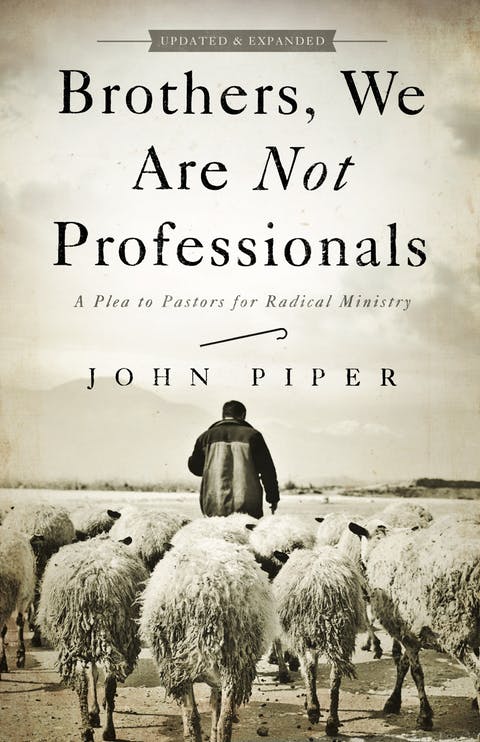
Those in pastoral ministry are ministers; they are not professional, career-minded, corporate ladder-climbers. John Piper has written a book that I believe every pastor should read: Brothers, We Are Not Professionals. Here are a few more quotes from this excellent book. 

“Is not our most painful failure in the pastorate the inability to weep over the unbelievers in our neighborhoods and the carnal members of our churches? …  

“I must feel the truth of hell—that it exists and is terrible and horrible beyond imaginings forever and ever. ‘These will go away into eternal punishment’ (Matthew 25:46). Even if I try to make the ‘lake of fire’ (Revelation 20:15) or the ‘fiery furnace’ (Matthew 13:42) a symbol, I am confronted with the terrifying thought that symbols are not overstatements but understatements of reality. …

“I say to you, on the authority of Scripture, remember, remember, remember the horrid condition of being separated from Christ, without hope and without God, on the brink of hell. ‘Remember that you were at that time separated from Christ, alienated from the commonwealth of Israel and strangers to the covenants of promise, having no hope and without God in the world’ (Ephesians 2:12). … 

“When the heart no longer feels the truth of hell, the gospel passes from good news to simply news.” 

“Warning has value in stirring us up to take the glories of holiness and heaven seriously so that we come to see them for what they are and delight in them. But it is the delight in them that causes the true grief when we fall short.” 

“Pastors, you will know your people’s souls best by knowing your own. So try to be ruthlessly honest with yourself.” 

“If the heart is without passion, it will produce lifeless, jargon-laden spontaneity. And if the heart is aflame, no form will quench it.” 

“We ought to experience the deepest emotions about the deepest things. And we ought to speak often, and publicly, about what means most to us, in a way that shows its value.” 

“Eating, exercising, and sleeping are more spiritually relevant in the ministry than we may think. … The point is that we be intentional about how our eating affects the ability of our body to be a helpful partner in seeing the glory of God.” 

“When we say that what we do on Sunday morning is to ‘go hard after God,’ what we mean is that we are going hard after satisfaction in God, and going hard after God as our prize, and going hard after God as our treasure, our soul-food, our heart-delight, our spirit’s pleasure. Or to put Christ in His rightful place—it means that we are going hard after all that God is for us in Jesus Christ, crucified and risen.” 

“It will transform your pastoral leadership in worship if you teach your people that the basic attitude of worship on Sunday morning is not to come with your hands full to give to God but with your hands empty to receive from God.” 

“Brothers, we are leaders, and the burden of change lies most heavily on us.” 

You can read my full book review of Brothers, We Are Not Professionals by clicking here, and you can check out some other quotes from this book here. 

Test God In This

Lettie CowmanTest me in this…and see if I will not throw open the floodgates of heaven and pour out so much blessing that you will not have room enough for it (Malachi 3:10). Here is what God is saying in this verse: ‘My dear child, I still have floodgates in heaven, and they are still in service. The locks open as easily as before, and the hinges have not grown rusty. In fact, I would rather throw them open to pour out blessings than hold them back. … On My side of the floodgates, Heaven is still the same rich storehouse as always. The fountains and streams still overflow, and the treasure-rooms are still bursting with gifts. The need is not on My side but on yours. I am waiting for you to test Me in this. But you must first meet the condition I have set to bring the whole tithe into the storehouse, and thereby give Me the opportunity to act.’” —L.B. Cowman

Harsh Words

Keep it closedThis is an interesting exchange between God and His people―

God says, “You have said harsh things[*] against Me.” 

“What have we said against You,” the people asked. 

“You have said, ‘It is futile to serve God…’” (Malachi 3:13-14).

We think we know better than God.

We tell God how we think it should be.

We complain that God is letting some people get away with bad stuff, and He’s not rewarding quickly enough those who are doing good stuff.

We think God doesn’t care if we do things our own way.

We think we can better manage our lives than He can.

We act like we’re in charge.

This is speaking harsh, arrogant, rude, terrible words against God. It’s really saying, “I know better, so I should be God.” This not only removes God’s blessing, but invites His punishment.

Ouch! It’s good to examine our thoughts and words to make sure we aren’t thinking or speaking harsh things against God.

[*] Some other translations say things like “You have spoken arrogantly against Me” and “You have said terrible things about Me” and “You have spoken rude words to Me.”

Links & Quotes

link quote

“That is the religion of ninety-nine English people out of every hundred who know nothing of divine grace—we are to be as good as we can; we are to go to church or to chapel, and do all that we can, and then Jesus Christ died for us, and we shall be saved. Whereas the gospel is, that He did not do anything at all for people who think they can rely on themselves, but gave Himself for lost and ruined ones. He did not come into the world to save self-righteous people; on their own showing, they do not want to be saved.” —Charles Spurgeon

Twitter stands up to ISIS. About time!

bu-030415-1Interesting research results from The Barna Group in What Millennials Want When They Visit Church.

“The engagement of God’s power never takes the place of the engagement of our will! The power of God in sanctification never makes us passive! The power of God engages itself beneath or behind and within our will, not in place of our will. … God will never appear with power in your will in any other form than a good resolve that you make and keep.” —John Piper

“Jesus is Amen as to His righteousness. That sacred robe shall remain most fair and glorious when nature shall decay. He is Amen in every single title which He bears; your Husband, never seeking a divorce; your Head, the neck never being dislocated; your Friend, sticking closer than a brother; your Shepherd, with you in death’s dark vale; your Help and your Deliverer; your Castle and your High Tower; the Horn of your Strength, your confidence, your joy, your all in all, and Amen in all.” —Charles Spurgeon

Read this in my Archeological Study Bible and thought this rang true for our generation still today: “This generation was not guilty of the gross idolatry of its forefathers. Rather, these Israelites had embraced a kind of dead orthodoxy, in which they tried to get by with the minimum that their faith required.”