Listen to the podcast of this post by clicking on the player below, and you can also subscribe on Apple, Spotify, or Audible.
Now faith is confidence in what we hope for and assurance about what we do not see. (Hebrews 11:1)
All of the examples of faith-filled living in this 11th chapter of Hebrews are people who believed what God told them about their unseen future. And yet, they lived as though they could see it and hear it!
Abel offered “a better sacrifice” because he knew a greater reward was in his future.
Enoch walked with God like a friend.
Noah prepared for rain and for a flood.
Abraham saw his descendants living in their own land.
Sarah prepared to have a baby when she “was past childbearing age” and her husband was “as good as dead.”
Isaac blessed Jacob and Esau, and Jacob blessed Manasseh and Ephraim’s future descendants, as they saw them perpetuating Abraham’s family line.
Joseph planned for the exodus.
Moses’ parents saw him as a national leader.
Moses saw a kingdom greater than Egypt.
The Israelites saw dry ground where there was a vast ocean and a rushing river, and collapsed walls where there was there was an impassable city.
Rahab believed in the true God.
“There were others who were tortured”; “the world was not worthy of them”—“they were too good for this world” (v. 38 in the NLT).
But they were more “commended for their faith” than anyone who may have received accolades while on this earth.
Their commendation was, “Well done, good and faithful servant! Enter into your Master’s happiness forever!” (see Matthew 25:21, 23, 34).
“Some faced jeers” but then heard the cheers of the “great cloud of witnesses” (12:1) and the applause from nail-scarred Hands!
Reading these faith-filled biographies prompts me to search my motivations—
What do I see? Am I too focused on the here and now?
What do I hear? Am I motivated by earthly cheers and discouraged by earthly jeers?
May my eyes see and my ears hear what God has promised. May my faith be confident in hope of what God has promised and assured about what I do not see or hear with my natural eyes and ears. Instead, may I see promises fulfilled and hear the joyful shout of, “Well done!”
Listen to the podcast of this post by clicking on the player below, and you can also subscribe on Apple, Spotify, or Audible.
My podcast partner Greg and I just recorded an episode of our leadership podcast about Christmas traditions. I think there more traditions associated with this time of year than with any other event on our calendars. Traditions keep us connected to our roots, but they also help us feel like we can be in control of things.
There has been a tradition in countries with monarchies that whenever a king died, the people would say something like, “The king is dead. Long live the king!” They would say this because the next king ascended to the throne immediately after his predecessor died. Except when a nation had been defeated, the traditional cry of, “The king is dead” was unanswered by, “Long live the king!”
It appears at this moment that a new tradition has to be started—one where we take leadership over our own fates.
The apostle Peter noted that people awaiting the Second Coming of Jesus would question if that event was ever going to happen. And the prophet Malachi closed the Old Testament with people saying much the same thing: “There doesn’t seem to be any advantage to following God’s laws, so maybe we should just do things our own way” (2 Peter 3:3-4; Malachi 3:13-15).
But then we turn the page to the dawn of the New Testament, and Matthew writes his Gospel about the First Advent of Jesus. He wants to show us that although the line of earthly kings in Israel may have been broken, the promised King of kings had now come to earth.
I’m intrigued by the exceptions Matthew lists in his opening genealogy to illustrate this truth. First, as you might expect, the phrase “thefather of” appears 39 times. This tells us a biological fact of life. These men didn’t know if they had fathered a son or a daughter, what their child’s contribution to the world might be, or even if their child would live faithfully to God.
Matthew opens his genealogy by saying “the son of” twice. First, Matthew lists Jesus as the son of David—the king to whom God gave a very special promise of an eternal King coming from David’s family line. Then Matthew traces the genealogy back further to say “the son of Abraham”—the one through whom God said He would bless all nations (2 Samuel 7:11-16; Genesis 12:1-3).
And what about the exceptional women Matthew records in this male-dominated genealogy? We have Tamar, Judah’s daughter-in-law, who tricked him into fathering a child by her; Rahab, a Canaanite prostitute who put her faith in God; Ruth, a Moabitess who left her homeland because she trusted God; Bathsheba, an adulteress who became David’s wife; and then Mary, the mother of Jesus, who was called “highly favored” of God (Luke 1:28).
The phrase “son of” appears one more time when the angel calls Joseph by this title (Matthew 1:20). Jospeh is also called “thehusband of Mary” (Matthew 1:16).
Whereas Abraham and David were rewarded for their faithfulness to God and were told of future blessings, Joseph’s act was different. Joseph had a choice. He was told that the Child in Mary’s womb would be the Messiah. Now Jospeh had to decide: Would he choose to believe this? Would he choose to bear the shame and reproach to accept his role as father?
We have the a similar choice today: Will we choose to believe that God has announced His plan and that He is fulfilling His plan?
Here’s the simple truth. It appears as two statements, but it is really the same thought—
The Advent of Jesus has come. The Advent of Jesus will come.
The First Advent of Jesus should build our anticipation for the Second Advent. His First Advent should be proof that God keeps His promise.
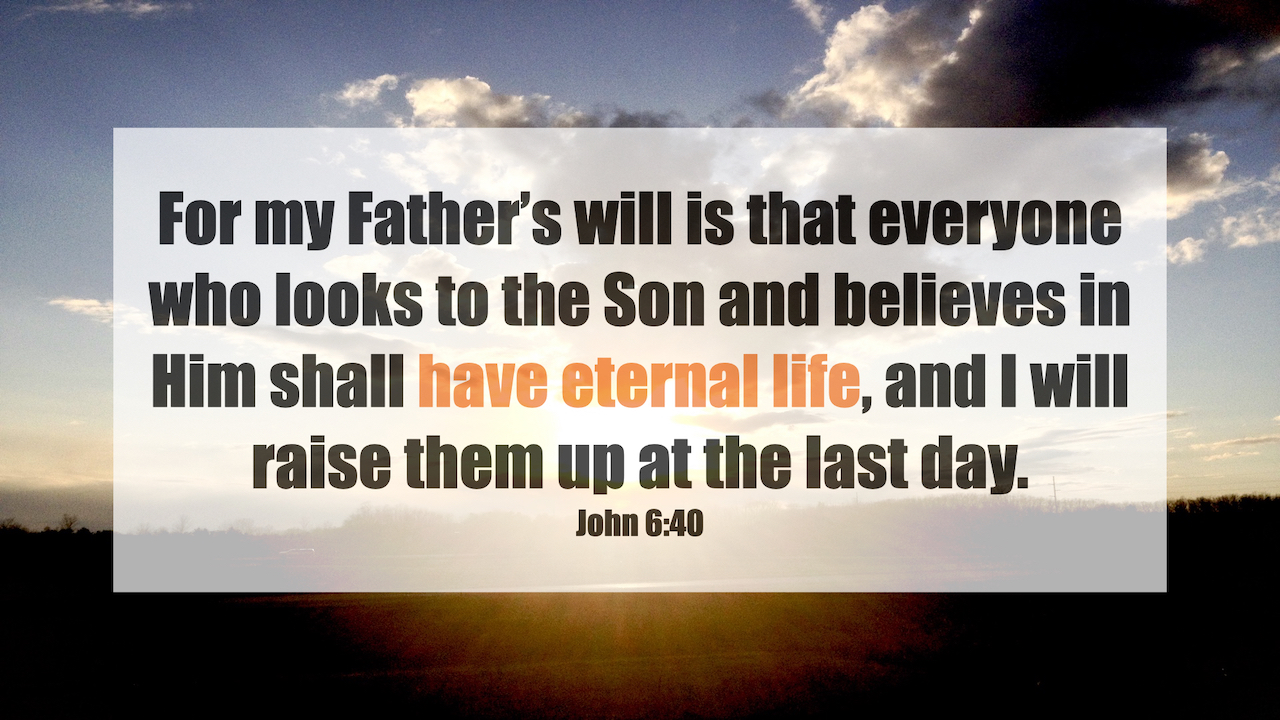
Jesus told us that believing God’s promise would bring us into God’s family. Jesus said, “For My Father’s will is that everyone who looks to the Son and believes in Him shall have eternal life, and I will raise them up at the last day” (John 6:40).
The apostle Paul also assures us, “So in Christ Jesus you are all children of God through faith” (Galatians 3:26).
Let’s not blindly follow the traditions of previous generations, but let us chose for ourselves to believe in God’s promised Messiah, to trust that He alone can give us eternal life, and then let us live in both celebration of His First Advent and expectation of His Second Advent.
For some of you, it’s hard to put the word “happy” in front of Mother’s Day.
One definition of happy is “favored by fortune; lucky.” In other words, we’re happy IF things happen to be going our way. But we don’t know how things are going to turn out?
In the last Super Bowl, the New England Patriots were down by 25 points early in the 3rd quarter. It didn’t appear that things were going the Patriots’ way … except they won!
So don’t judge “happy” or “not happy” by how things are going in the middle of the story!
To God, all of History is His Story. He knows every move, every hurt, every fumble, every betrayal, every noble deed, every evil deed … nothing escapes His notice. And it all fits into His Story—We are assured and know that God being a partner in their labor ALL THINGS work together and are fitting into a plan for good… (Romans 8:28).
Check out the stories of these five women—
Tamar had to pretend to be a prostitute in order to get her father-in-law to followthrough on his commitment. As a result, she became pregnant by him and was almost burned at the stake.
Rahab didn’t pretend to be a prostitute; she was a prostitute. She lived in an important city that was about to be defeated by the Israelites. Instead of trying to make things easier on herself, she trusted God and put herself in a very dangerous position.
Ruth was a non-Israelite married to an Israelite man. But when her husband, her brother-in-law, and her father-in-law all died, she took a huge risk in staying with her mother-in-law. She could have moved in with her family in a country she knew, but she went where she was an alien, a widow, and dirt poor.
Bathsheba was married to Uriah, who was a member of the king’s inner circle. But the king took advantage of her when Uriah was away at war, impregnated her, killed her husband, and then married her. Their son from that union died shortly after being born, but Bathsheba trusted God to make something good of her tragedy.
Mary was engaged to be married when she was found to be pregnant. Society could have shunned her, her fiancé could have had her killed for her unfaithfulness, but she trusted God to keep His word.
These five mothers are the ONLY women mentioned in the genealogy of Jesus (Matthew 1:1-6, 16)
God used all of these women. Despite the way they were treated or mistreated; despite their own mistakes; despite the injustices committed against them. God used all of them as irreplaceable parts of His Story.
To God, all of History is His Story! He’s doing things through your life that you can’t possibly imagine. Trust Him—if you do, your name will also be recorded in the best “His Story” ever recorded!
Whenever you don’t know what’s going on, lean into Him, cry out to Him. But then say with Mary, “I am the Lord’s servant. May it be to me as you have said.” And what does God say? “I am working ALL THINGS together to tell My Story through your life!”
One of my favorite old-time television shows is Perry Mason, the famous attorney who always wins for his clients. In the courtroom, sometimes Perry appears to be daydreaming or disinterested, but he is always tuned-in to the proceedings.
Sometimes he will speak up, “I object, your honor, on the grounds that this is not best evidence.” Or perhaps he will say, “Objection! Hearsay, your honor.” In other words Perry is pointing out that the witness doesn’t have personal, first-hand knowledge but is merely telling the court what they heard someone else say.
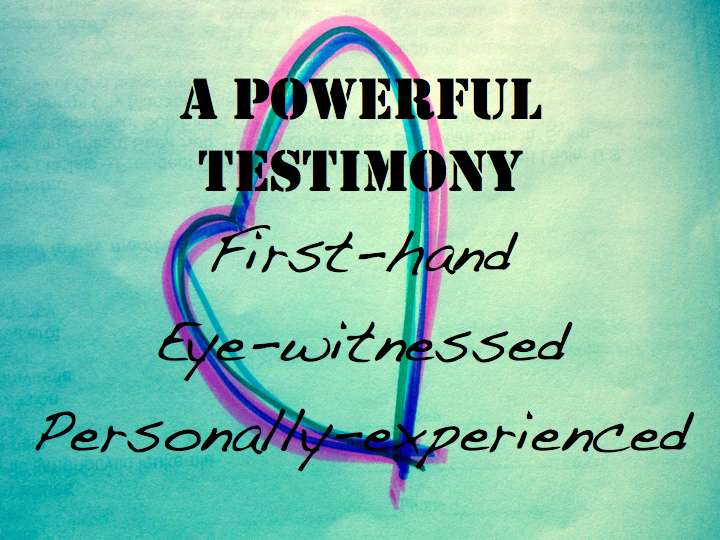
A powerful testimony is one that is a first-hand, eye-witnessed, and personally-experienced.
As the Israelites are preparing to attack the city of Jericho, two young men are having a conversation with a citizen of Jericho named Rahab. She has grown up with stories of her gods El, Baal, and Ashera, but she is listening to these Israelite men tell of their first-hand experiences with Jehovah God. They have personally walked through the parted Red Sea; they have tasted manna and have drank water that God brought out of a rock in the middle of the dessert; they have seen God defeat their enemies.
As Rahab hears this new testimony, she realizes that what she has believed about her gods has all been hearsay testimony. She has no first-hand experience, but is only living on stories others have told her. She cries out, “Objection! Hearsay!” And then reaches this startling verdict: “The Lord your God IS GOD” (Joshua 2:11)!
This is why it is so important for those of us who have personally known and experienced God’s blessings togive first-hand testimony. Those around us think they have heard convincing evidence, but when they hear testimony from you that is first-hand, eye-witnessed, and personally-experienced, it annihilates that old hearsay testimony.
Everyone who calls on the name of the Lord will be saved. But how can they call on Him to save them unless they believe in Him? And how can they believe in Him if they have never heard about Him? And how can they hear about Him unless someone tells them? (Romans 10:13-14, NLT)
Don’t keep quiet about God’s blessings. Don’t let others live with their paltry hearsay testimony. Be a vocal and convincing witness thatthe Lord your God IS GOD!
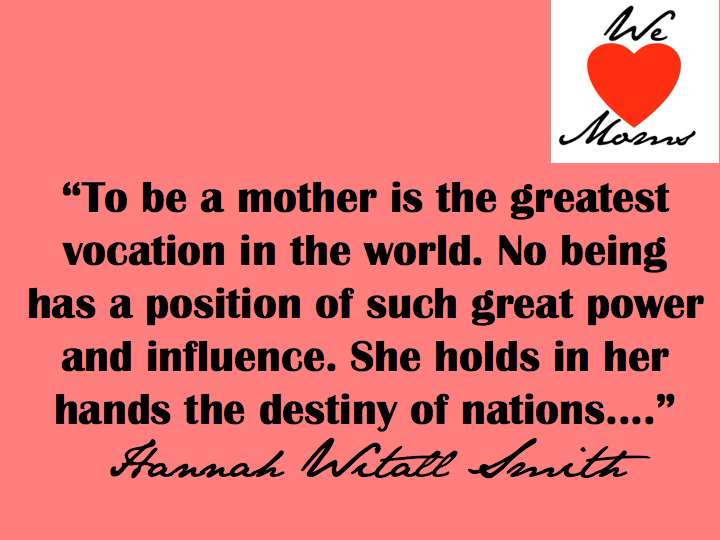
“To be a mother is the greatest vocation in the world. No being has a position of such great power and influence. She holds in her hands the destiny of nations….” —Hannah Whitall Smith
A great example of this is a woman by the name of Rahab who lived in ancient Jericho. She was doing her best to provide for her family in a very unsavory way: she was a prostitute. Yet this is a woman who is commended for her faith in God (Hebrews 11:31) and her righteous actions (James 2:25).
I know many moms who work hard to provide for their families, sometimes taking jobs that are very difficult and pay a low wage. They still find the time to buy the groceries, fix the meals, do the laundry, help with homework, attend after-school functions, and a million other things. Even after all this they feel inadequate, like they are not quite measuring up to the “best mom” standard.
To those moms, I say this: Look at Rahab, and learn what she learned. Rahab tried to provide for her family too, but when she got to the point where she was completely desperate she turned her family over to God. By helping the young Jewish spies, she turned her back on her countrymen and lost any other options for help. She said, “I believe in God, and I’m willing to trust Him with my family completely” (see Joshua 2:1-13).
As a result, God’s faithfulness to her is something we still are blessed by today. In giving us the genealogy of Jesus Christ, Matthew says this: Salmon the father of Boaz, whose mother was Rahab, Boaz the father of Obed, whose mother was Ruth, Obed the father of Jesse, and Jesse the father of King David (Matthew 1:5-6). Rahab went all-in with God, and is now an indispensable part of the lineage of Jesus Christ!
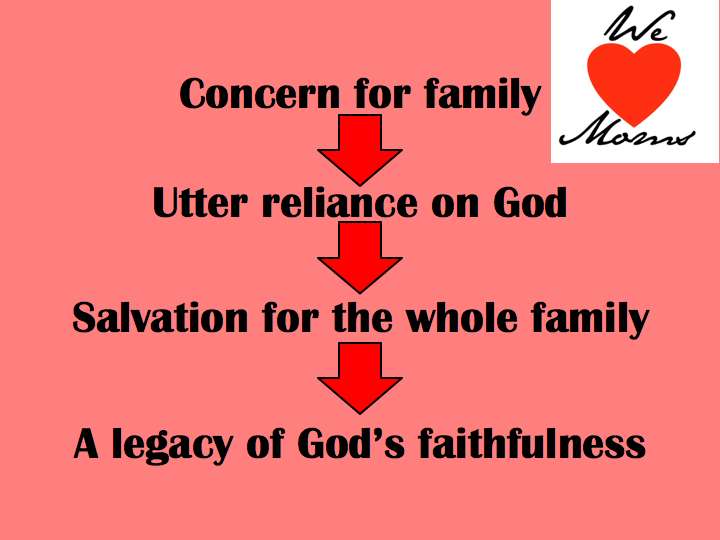
Here’s the pattern for all moms to follow:
Concern for your family → Your utter reliance on God → The salvation of all in your family who will listen → A legacy of God’s provision and faithfulness
Moms, you have great power and you hold in your hands the destiny of nations, if you will just turn your concerns for your family over to God, and leave them in His loving hands.



 Now faith is confidence in what we hope for and assurance about what we do not see. (Hebrews 11:1)