This is a weekly series with things I’m reading and pondering from Charles Spurgeon. You can read the original seed thought here, or type “Thursdays With Spurgeon” in the search box to read more entries.
Listen to the podcast of this post by clicking on the player below, and you can also subscribe on iTunes or Spotify.
We Are All Laborers
I planted, Apollos watered, but God gave the increase. So then neither he who plants is anything, nor he who waters, but God who gives the increase. Now he who plants and he who waters are one, and each one will receive his own reward according to his own labor. For we are God’s fellow workers; you are God’s field, you are God’s building. (1 Corinthians 3:6-9)
Remember that the ablest ministers, the most powerful evangelists, the most profound teachers are, after all, nothing but laborers together with God. Let your mind be set upon the Master and not upon the servants! Do not say, ‘We are for this man because he plants,’ or ‘We are for the other because he waters,’ or ‘We are a third party for nobody at all.’ But let us join in ascribing all honor and praise to God, Who works all our works in us, since every good gift and every perfect gift is from above and comes down from the Father of lights, to Whom be glory world without end! …
The church is God’s farm.… In the margin of the Revised Version, we read, ‘You are God’s tilled ground….’
We begin by considering that the church is God’s farm. The Lord has made the church of His sovereign choice to be His own by purchase, having paid an immense price for it. ‘For the Lord’s portion is His people; Jacob is the lot of His inheritance’ (Deuteronomy 32:9). Because the Lord’s portion was under mortgage, therefore the only begotten Son laid down His life as the purchase price and redeemed His people to be the Lord’s portion forever and ever. Henceforth it is said to all believers, ‘You are not your own. For you were bought at a price’ (1 Corinthians 6:19-20). Every acre of God’s farm cost the Savior bloody sweat, yes, the blood of His heart! He loved us and gave Himself for us; that is the price He paid! …
The Master’s commission is not ‘sit still and see the Spirit of God convert the nations,’ but ‘Go into all the world and preach the gospel to every creature’ (Mark 16:15).
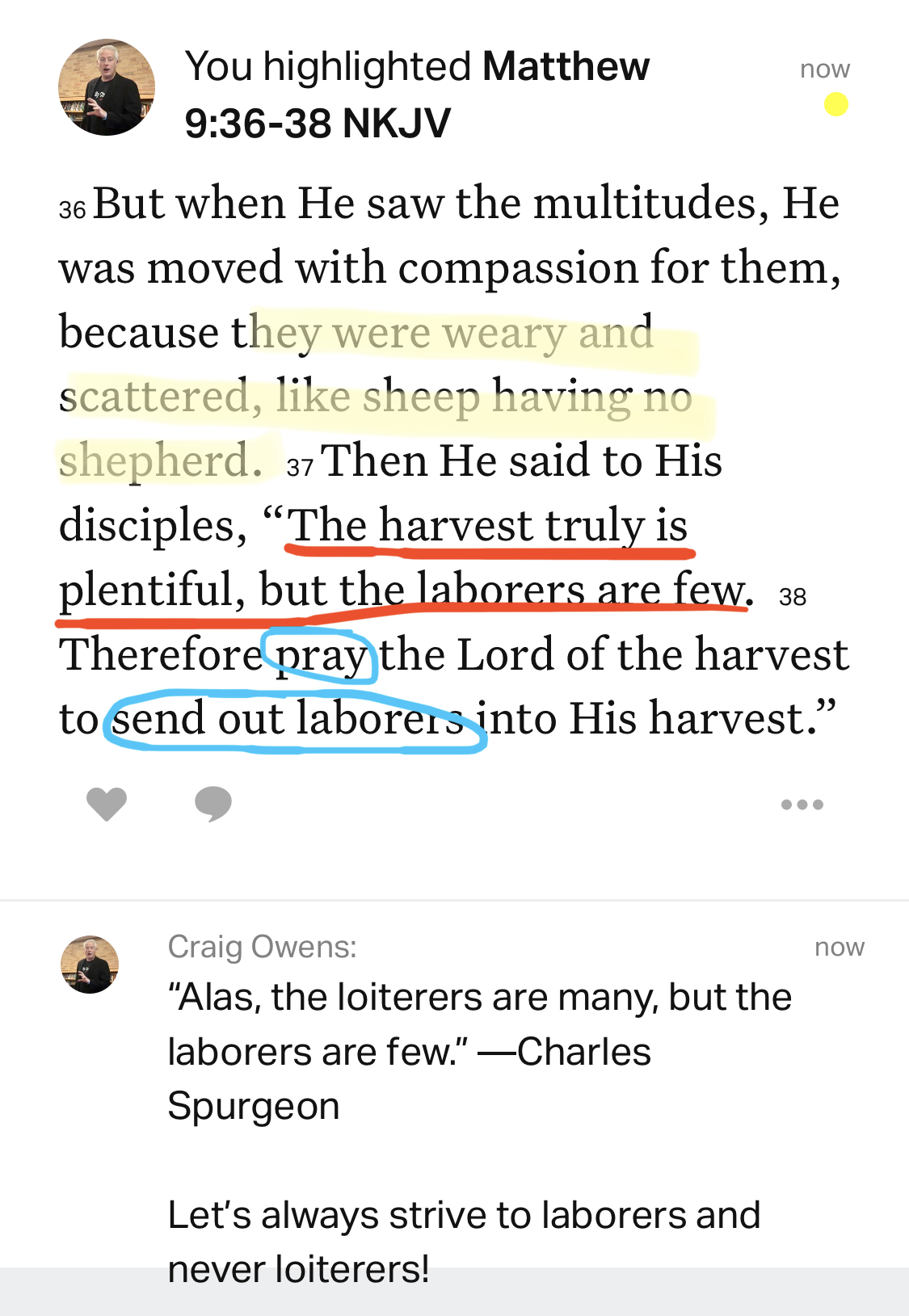
Alas, the loiterers are many, but the laborers are few.
From Farm Laborers
It’s sad how much time Christians spend on non-essential things. We church shop to find the pastor or the music that suits our tastes; we claim ownership over ministries and only allow others to work under us, but never alongside us; or we attend church and give our tithes and offerings and expect the pastor to do all of the ministry.
All of this is not only unbiblical but none of this is focused on eternity. And as C.S. Lewis said, “All that is not eternal is eternally useless.”
Jesus paid too high a price for us to keep the good news to ourselves, or claim that our ministry is superior to someone else’s, or to simply loiter and watch others do the work. All Christians are laborers in God’s field. God made an invaluable investment in the work Jesus did on the Cross, so He wants to see a return on His investment that will last for all eternity.
It’s time for us to stop squabbling, stop protecting our turf, and stop loitering. We must get to the work because the time is short and the Master is looking for eternal results.
Listen to the podcast of this post by clicking on the player below, and you can also subscribe on Apple, Spotify, or Audible.
I had just finished playing three games of full-court basketball and it was time to leave for work. A young kid challenged me to stay for another game by making some comment about my old(er) age, which give me a fresh motivation to play another game. I told him I would play one more game on one condition: he had to guard me. I scored all 15 of our team’s points. One of my teammates said to that kid after the game, “You shouldn’t have made Craig angry.”
I know the Israelites had strayed from God, but the Assyrians made no pretense whatsoever to honor Yahweh, so why was God allowing them to get away with this? Doesn’t it seem sometimes like God is waiting too long to deal with these wicked insulters?
Many scholars feel that Psalm 76 was written after Sennacherib’s defeat. And make no mistake about this: it was a decisive defeat—God struck down 185,000 Assyrian soldiers while they slept! Asaph’s song of victory contains two Selah pauses, both of them intended for us to consider the greatness of Yahweh:
one Selah is after verse 3—pause and remember that God is Sovereign and Resplendent in glorious victory
the second Selah is after verse 9—pause and reflect that God’s wrath defeats His enemies and brings forth praise from His people
Jesus said, “No one can serve two masters. Either you will hate the one and love the other, or you will be devoted to the one and despise the other. You cannot serve both God and money.” The Pharisees, who loved money, heard all this and were sneering at Jesus. (Luke 16:13-14)
Jesus said, “Father, forgive them, for they do not know what they are doing.” And they divided up His clothes by casting lots. The people stood watching, and the rulers even sneered at Him. They said, “He saved others; let Him save Himself if He is God’s Messiah, the Chosen One.” (Luke 23:34-35)
These are the only two times in the New Testament that this Greek word for “sneer” is used. It means to deride, scoff, or mock. But in the Septuagint (the Greek translation of the Old Testament) the same word that Luke used for sneer is used when God Himself says to Sennacherib, “The Virgin Daughter Zion despises you and mocks you” (see 2 Kings 19:20-28).
Sennacherib thought he was insulting God’s people, but God said, “You are really insulting Me!” Yikes—you shouldn’t make God angry!
Psalm 76 gives us the same reminder that we read in Revelation 12:10-11—“Now have come the salvation and the power and the kingdom of our God, and the authority of His Messiah. For the accuser of our brothers and sisters, who accuses them before our God day and night, has been hurled down. They triumphed over him by the blood of the Lamb and by the word of their testimony; they did not love their lives so much as to shrink from death.”
We defeat the enemy of our soul not by facing him but by facing our King!
When we are confronted by the ungodly insults from snarling, scoffing, wicked people, we must Selah to remind ourselves that Yahweh is—
Alpha
Known and Renown
Invincible
Majestic
Awesome
Holy
The Final Judge
Irrefutable
Glorious
Omniscient
Omnipotent
Unrivaled
Undefeated
King of kings
Lord of lords
Sovereign Ruler
Omega
THE Decisive Word
Let me say it again: We defeat the enemy of our soul not by facing him but by facing THIS King of kings!
Listen to the podcast of this post by clicking on the player below, and you can also subscribe on Apple, Spotify, or Audible.
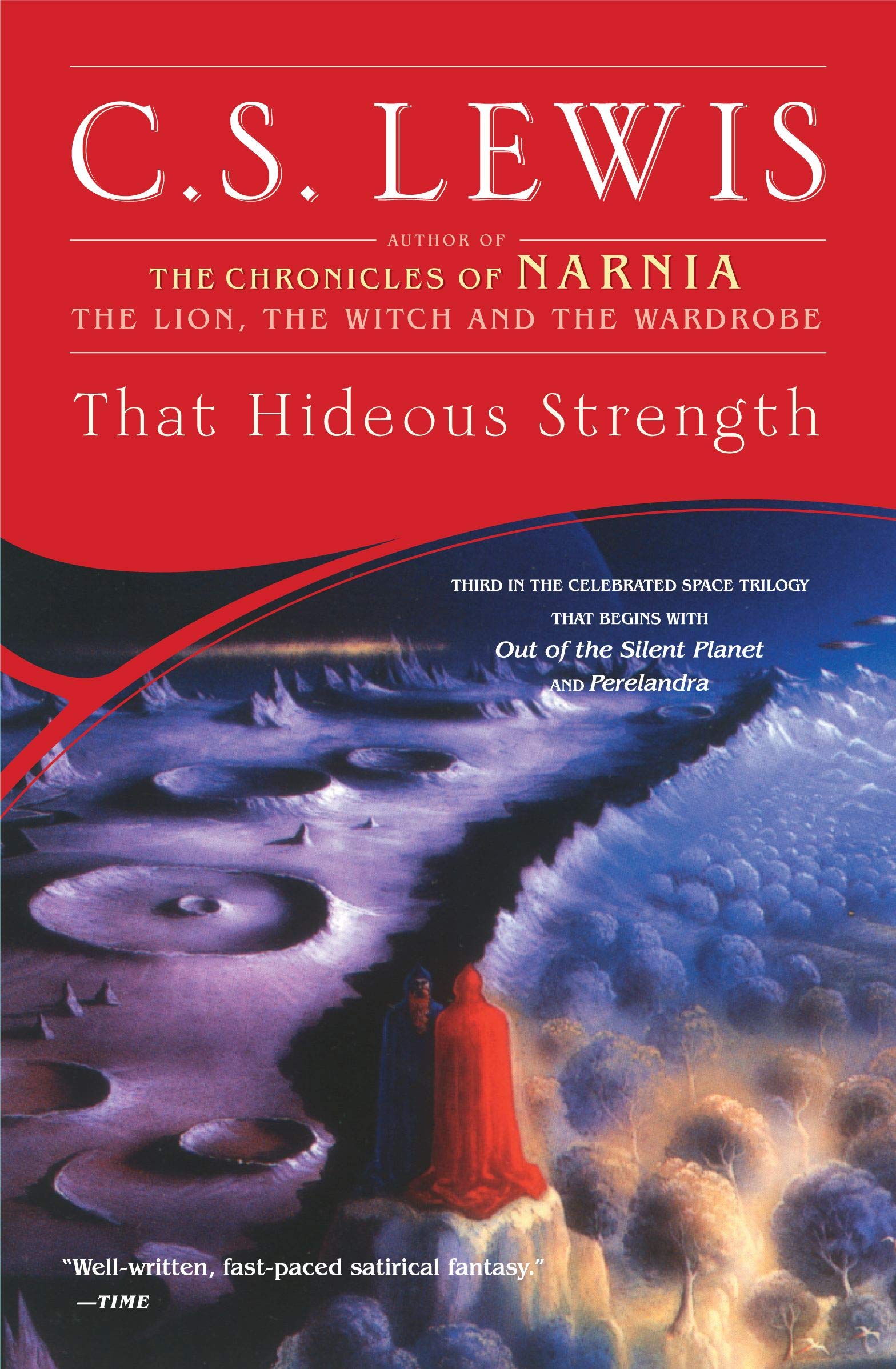
That Hideous Strength is the conclusion of C.S. Lewis’ space trilogy. Although this was written almost 70 years ago, it sounds ominously like our culture today.
I mentioned in a previous book review that the first two books of this trilogy—Out Of The Silent Planet and Perelandra—should be read together. Those who have read these first two books will definitely have a greater appreciation of the themes which come to their conclusion in this capstone book. But That Hideous Strength is such a well-told story and culture commentary that it may be read by itself and still be highly enjoyable.
It’s amazing to me how much foresight Lewis had into the hideous ways the spirit of the antichrist can insinuate itself into our day-to-day culture and ultimately into our politics. This book is really a behind-the-scenes look at both how evil people propagate their evil plans, and how godly people stand in God’s strength to combat those plans. Spoiler alert for those who haven’t read the last chapters of the Bible yet: Evil always loses because Jesus Christ is the undefeated Champion even over the darkest of evil forces.
As I’ve mentioned in a previous C.S. Lewis book review, this space trilogy is probably not the best place for first-time Lewis readers to jump in. This trilogy is more of a graduate-level course in seeing biblical themes portrayed in ways only a mastermind like Lewis could imagine. But for those who are already well steeped in Lewis’ writings, all three books of this trilogy are must-reads!
Listen to the podcast of this post by clicking on the player below, and you can also subscribe on Apple, Spotify, or Audible.
During my freshman year of college, I was once the butt of a good-natured joke. I didn’t mind it so much except for the fact that there were several people in the room that didn’t know me, so they would have walked away thinking I was a jerk. As I vented to my roommate about this, his counsel was simply, “Just forgive ‘em, man!”
Yeah, right … easier said than done! I didn’t want forgiveness—I wanted payback! Ever been there?
The Hebrew word Selah is a call for us to pause and calmly think about what’s going on in our heart and mind. For instance, in those moments where we may want someone to get justice for the way they hurt us.
In Psalm 75, God is literally the One who speaks the Selah. In fact, God speaks twice in this short psalm: once in verses 2-5 and again in verse 10 to close this psalm. Putting together His two speeches, God says, “I choose the right time, I judge perfectly, I hold everything firm. Selah. I will cut off the horns of all the wicked, but the horns of the righteous will be lifted up.”
What is meant by “the horn of the wicked” or “the horn of the righteous”? Literally, it means a show of strength, but it can be used in both a negative or a positive sense.
In the negative sense it means:
boasting of your own power
standing in defiant opposition to all other powers
proudly trumpeting your own strength
the English words “arrogant” and “boast” in verse 5 are both the same word Hebrew word halal. This means to shine a light on yourself, literally to say “Hallelujah!” to or about yourself!
This pride is so dangerous! As C.S. Lewis said, “Pride is ruthless, sleepless, unsmiling concentration on the self.”
In the positive sense, a horn means the righteous person who shines a light on God, who concentrates on Him, who knows that anything good they have comes from Him.
The wicked lift up their own horn (literally lift up themselves), while the righteous bow their horn (literally lift up God). What does God do? God opposes the proud but shows favor to the humble (1 Peter 5:5).
This psalm essentially has God giving two warnings:
To the wicked He says, “Do not lift up your horn against Me.”
To the righteous He says, “Submit to Me and do not try to rush My timing.”
Notice that Asaph says “a cup of foaming wine” is coming to the wicked (v. 8). This symbolizes God’s judgment (Revelation 19:11-16). This was to be our just punishment too, but Jesus took the cup of God’s wrath Himself, and in its place gave us the cup of God’s blessing (Isaiah 51:22; Matthew 26:39-42; 1 Corinthians 10:16). This switching of the cups is what we celebrate every time we drink the cup of Communion.
God was patient with us and He is still being patient with the boastful wicked, which is why He warns them—and us—to Selah. We were rescued from judgment and now God calls upon us to tell others about Him, so that they may also be reconciled to Him through Jesus Christ (Proverbs 24:11-12; 2 Peter 3:9).
Here’s the call to Christians: Watch your horn! Don’t shine a light on yourself, but shine a light on Jesus Christ and remain on-mission to rescue those who persist in blowing their own horn.
This is a weekly series with things I’m reading and pondering from Charles Spurgeon. You can read the original seed thought here, or type “Thursdays With Spurgeon” in the search box to read more entries.
Listen to the podcast of this post by clicking on the player below, and you can also subscribe on iTunes or Spotify.
Unity Not Uniformity
And the glory that You gave Me I have given them, that they may be one just as We are One: I in them, and You in Me; that they may be made perfect in one, and that the world may know that You have sent Me, and have loved them as You have loved Me. (Jesus, in John 17:22-23)
Beloved, those in whom Christ lives are not uniform, but one. …
As I have remarked, it is not uniformity. Of this our Lord says nothing. Though we are one body in Him, yet all the members have not the same office. The eye is very different from the ear, and the foot has not the same form as the hand. Neither does He speak of any formal organization by which unity is to be secured. How many have tried to create a mechanical union and have made confusion worse confusion! Their eagerness for unity has threatened to dash everything to shivers! The very first step toward a visible unity of the church is, with most men, that they will fix a standard of what the church ought to be and cut off everybody who will not conform to their idea! …
Christ lives in His people, and we are to act so, in the power of the Holy Spirit, that onlookers will say, ‘Surely Christ lives again in that man, for he acts out the precepts of Jesus. Did you notice how he bore the insult? Did you notice how he laid himself out to oblige and to serve? Did you observe how, without introducing religious talk, he gradually steered the conversation toward that which is to edification?’ …
Brothers and sisters, if you and I are living for the same design that our Lord lived for, and if the very life that quickens us is the life of Jesus, then, since Jesus lives always for the same thing that God proposes and works out, surely there is a grand unity, the likes of which are not found in the universe! …
‘That the world may know that You have sent Me.’ How will they know it? Why, when they see such characters as I have so feebly tried to paint! When they see men who are no longer selfish, hard, and ungenerous—when they see men no longer governed by their passions, no longer earthbound—when they see loving men, men who desire that which is holy, just, and good! When they see men living for God, the world will say, ‘Their Master must have been sent of God.’
From The Glory, Unity, And Triumph Of The Church
Several years ago I was meeting with a group of pastors from various denominations. Although the meeting was friendly, I still sensed some “walls” between us. At one point I asked, “By a quick show of a raised hand, how many of us believe that salvation from the penalty of our sin comes only through the work that Jesus did for us on the Cross?” Every pastor in the room raised a hand. “Great,” I said, “let’s just focus on that!”
Some Christians are Calvinist, and some are Arminian; some take Communion one way, and some another way; some are charismatic, and some more liturgical; some baptize one way, and some baptize differently. Jesus wasn’t looking for uniformity, but He did pray for unity.
We can all be unified around the love of Christ, and the unity of the family of Christ.
Charles Spurgeon concluded the sermon I just quoted from with a prayer, to which I sincerely hope all of us Christians can add our own Amen: “Oh, for grace so to live to God in Christ Jesus that the world will never be able to answer the argument of our lives! Help us, O Spirit of the Lord! Amen.”
Listen to the podcast of this post by clicking on the player below, and you can also subscribe on Apple, Spotify, or Audible.
How many are Your works, O Lord! In wisdom You made them all; the earth is full of Your creatures. There is the sea, vast and spacious, teeming with creatures beyond number—living things both large and small. (Psalm 104:24-25)
This psalm makes me want to go on a nature walk!
The psalmist is in awe of the Creator’s handiwork—from the majestic sun and moon, to the smallest of creatures, God created them and sustains them all.
God set the earth on its foundations; it can never be moved.… He makes springs pour water into the ravines; it flows between the mountains. They give water to all the beasts of the field; the wild donkeys quench their thirst. The birds of the air nest by the waters; they sing among the branches. He waters the mountains from His upper chambers; the earth is satisfied by the fruit of His work. He makes grass grow for the cattle, and plants for man to cultivate—bringing forth food from the earth. … The moon marks off the seasons, and the sun knows when to go down. … The lions roar for their prey and seek their food from God. … These all look to You to give them their food at the proper time. When You give it to them, they gather it up; when You open Your hand, they are satisfied with good things.
Take a walk. See God’s beauty.
Listen to the wind, the birds, the lions.
Taste the food from the soil and the trees.
Feel the coolness of the water, the warmth of the sun, the invigoration of the breeze.
Smell the flowers, the soil, the sea air.
And then as you take all of these in, remind yourself: “If God cares for the fields, if He sees the smallest sparrow, how much more does He care for me!”
Jesus told us much the same thing—
Look at the birds of the air; they do not sow or reap or store away in barns, and yet your Heavenly Father feeds them. Are you not much more valuable than they? … See how the lilies of the field grow. They do not labor or spin. Yet I tell you that not even Solomon in all his splendor was dressed like one of these. If that is how God clothes the grass of the field, which is here today and tomorrow is thrown into the fire, will He not much more clothe you? … Are not two sparrows sold for a penny? Yet not one of them will fall to the ground apart from the will of your Father. And even the very hairs of your head are all numbered. So don’t be afraid; you are worth more than many sparrows. … Your Father knows what you need before you ask Him. (Matthew 6:8, 26, 28-30; 10:29-31)
My friend, the next time you need reassurance of God’s love for you, I invite you to take a nature walk and let the beauty of the Creator fill you with confidence of His love for you and His power to care for your every need!
This is a weekly series with things I’m reading and pondering from Charles Spurgeon. You can read the original seed thought here, or type “Thursdays With Spurgeon” in the search box to read more entries.
Listen to the podcast of this post by clicking on the player below, and you can also subscribe on iTunes or Spotify.
Sent To Show Jesus To The World
And the glory that You gave Me I have given them, that they may be one just as We are One: I in them, and You in Me; that they may be made perfect in one, and that the world may know that You have sent Me, and have loved them as You have loved Me. (Jesus, in John 17:22-23)
The essence and cause of the glory that the Father gave the Son was, first of all, that He endowed Him with the Holy Spirit. ‘God does not give the Spirit by measure. The Father loves the Son, and has given all things into His hand’ (John 3:34-35). The Holy Spirit descended upon our Lord in His baptism and abode upon Him so that in the power of the indwelling Spirit He lived, spoke, acted, and in all that He did, the Spirit of God was manifest. …
Now this glory, our Lord has given to all His disciples. Upon each true disciple, the Spirit of God rests according to his measure. If we have not the anointing to the fullest, it is either from lack of capacity or by reason of our own sin, for the Spirit of God is given to the saints—He dwells with us and will be in us always. My brothers and sisters, I would to God we realized this, that the glory of the Holy Spirit that was given to Christ is also given to us, so that it is ours to think, to feel, to speak, to act under His guiding influence and supernatural power! What are we apart from the Holy Spirit? How can we hope to convince even one man, much less the world, that God has sent His Son unless the Holy Spirit is with us? …
If men would see God, let them look at Jesus, for there is He to be seen! And with bated breath we add—let them look at Christ’s people, for there also is God revealed! It is the glory of the saints that they are the mirror of the divine character! …
Christ Jesus was sent to reveal the Father, sent to reclaim the wandering souls of men, sent to seek and to save the lost. And this is exactly what every true Christian is sent into the world to do. He is commissioned to reveal God in his every act and word. He is commissioned to win back rebellious hearts. He is commissioned to save the sons of men and bring them up out of the horrible pit into which their sins have cast them. …
Jesus was the Son of God, and He overcame the world in the power of His Sonship. Now, this glory that the Father gave Him, He has given us, that we, too, may be accepted; that we, too, may have access; that we, too, may have prevalence in prayer; that we, too, may have the Spirit of Adoption; and that we, too, may trample upon sin and overcome the hosts of darkness. This is the glory that rests upon all the faithful!
When we first meet Boaz, he is described as “a man of standing.” Some Bible translations say “a man of wealth,” which is an acceptable definition. In fact, the word can mean strength, wealth, valor, or prominence, but the root word means something brought forth out of travail and pain. That tells us that Boaz wasn’t born a man of standing, he became a man of standing by going through difficult times, not giving in to the downward slide of culture, and remaining true to God.
Boaz had a steel-forged integrity!
Believe me, it would have been easy for Boaz to compromise! This was a dark time of selfishness in Israel’s history. A time where just doing the bare minimum was acceptable because most of the Israelites were selfishly doing whatever would benefit them (Judges 21:25).
The other description we read about Boaz is that he is a “kinsman-redeemer.” This same word is used in this verse: “Plead my cause and redeem me; revive me and give me life according to Your word” (Psalm 119:154). A redeemer is one who is close by to help, has the strength or resources to help, and is willing to help. Of course, the perfect example of a Kinsman-Redeemer is Jesus, who became our human kinsman so that He could rescue us (see Hebrews 2:14; Philippians 2:7-8).
Boaz was given the opportunity to do this for Naomi and Ruth, and he seized the opportunity with gusto. Far from being a “bare minimum” man, Boaz always went the second mile to bless Ruth and Naomi:
he practiced the “hospitality clause” plus he protected Ruth and gave her more than was required
he provided food for his workers plus he provided food for Ruth and Naomi
he blessed his workers plus he blessed Ruth in the name of the Lord
Ultimately, Boaz did indeed become the kinsman-redeemer for Naomi (by paying off all the debts of her deceased husband) and for Ruth (by marrying this non-Israelite woman and bringing her into the family line of Jesus).
Boaz was King Solomon’s great-great-grandfather. When Solomon was completing the temple in Jerusalem, he erected two pillars at the entrance: one was named Boaz, and the other was Jakim (with means “God will establish”). Taken together these pillars proclaim the message: By His integrity and faithfulness, God establishes and makes firm.
Boaz exhibited integrity at every opportunity, which is what forged his character and made him “a man of standing.” Boaz demonstrated that integrity is really faith in God plus faith-filled, second-mile, others-focused actions.
“Faith without works is just wishful dreaming.
Works without faith is just religious posturing.
Works with faith is God-glorifying!” —Craig T. Owens
Men of God, please remember this:
Every Word of God that you read or hear is a test—will you obey Him or will you compromise?
Every setback you go through is a test—will you learn and grow or will you sulk and shrink back?
Every success you experience is a test—will you bless others or will you hoard your blessings?
Every decision you make in a dark culture is a test—will you just have faith, just have bare-minimum works, or will you exhibit the steel-forged integrity that comes from putting your faith to work?
God’s blessing on your life of integrity will show others a picture of Jesus. God’s blessing on your life of going the second mile will show others that it is God who establishes and makes firm.
Don’t rob your family, don’t rob us, don’t rob future generations of the outpouring of God’s blessing because you are selfish or compromising. Stand strong, trust God, go the second mile, be the kinsman-redeemer for those in need, and then watch for God’s blessings!
This is a weekly series with things I’m reading and pondering from Charles Spurgeon. You can read the original seed thought here, or type “Thursdays With Spurgeon” in the search box to read more entries.
Listen to the podcast of this post by clicking on the player below, and you can also subscribe on iTunes or Spotify.
Context Is King
And the glory that You gave Me I have given them, that they may be one just as We are One: I in them, and You in Me; that they may be made perfect in one, and that the world may know that You have sent Me, and have loved them as You have loved Me. (Jesus in John 17:22-23)
Some words serve many uses and have many meanings. We are very apt to make mistakes if we give the same sense in all places to the same word. The word world throughout Scripture is used with a very remarkable variety of meaning, and one had need to have his wits about him and to read carefully in order to know what is the precise source of the term in each place where it occurs. …
I say again, the word world, therefore, has many shades of meaning ranging from that jet black meaning in which the world lies in the wicked one—‘Love not the world, neither the things that are in the world’ (1 John 2:15)—upward to the milder sense in John 1:10, ‘He was in the world, and the world was made through Him, and the world did not know Him.’ And yet higher to the bright meaning, ‘The kingdoms of this world have become the kingdoms of our Lord and of His Christ’ (Revelation 11:15). It is not in the worst sense that our text speaks of the world, but in the same manner as we find it used in such passages as these: ‘The Lamb of God who takes away the sin of the world!’ (John 1:29). ‘God was in Christ reconciling the world to Himself, not imputing their trespasses to them’ (2 Corinthians 5:19). And again in 1 John 2:2, ‘And He Himself is the propitiation for our sins, and not for ours only but also for the whole world.’
It is certain that ‘God so loved the world that He gave His only begotten Son, that whoever believes in Him should not perish but have everlasting life’ (John 3:16), and we cannot suppose that the great Redeemer would refuse to pray for those whom He was given. I understand in this particular place by the word world the whole mass of mankind upon the face of the earth who are not as yet converted. …
For the sake of the world, He would have the church in a high state of holy beauty and strength. May His gracious prayer be answered in all of us by the working of the Holy Spirit! … Our wish is to bring multitudes to the Savior and to conquer province after province of this revolted world for King Jesus. ‘Let the whole earth be filled with His glory’ (Psalm 72:19) is a prayer that we cannot, we dare not, we would not fail to pray!
From The Glory, Unity, And Triumph Of The Church
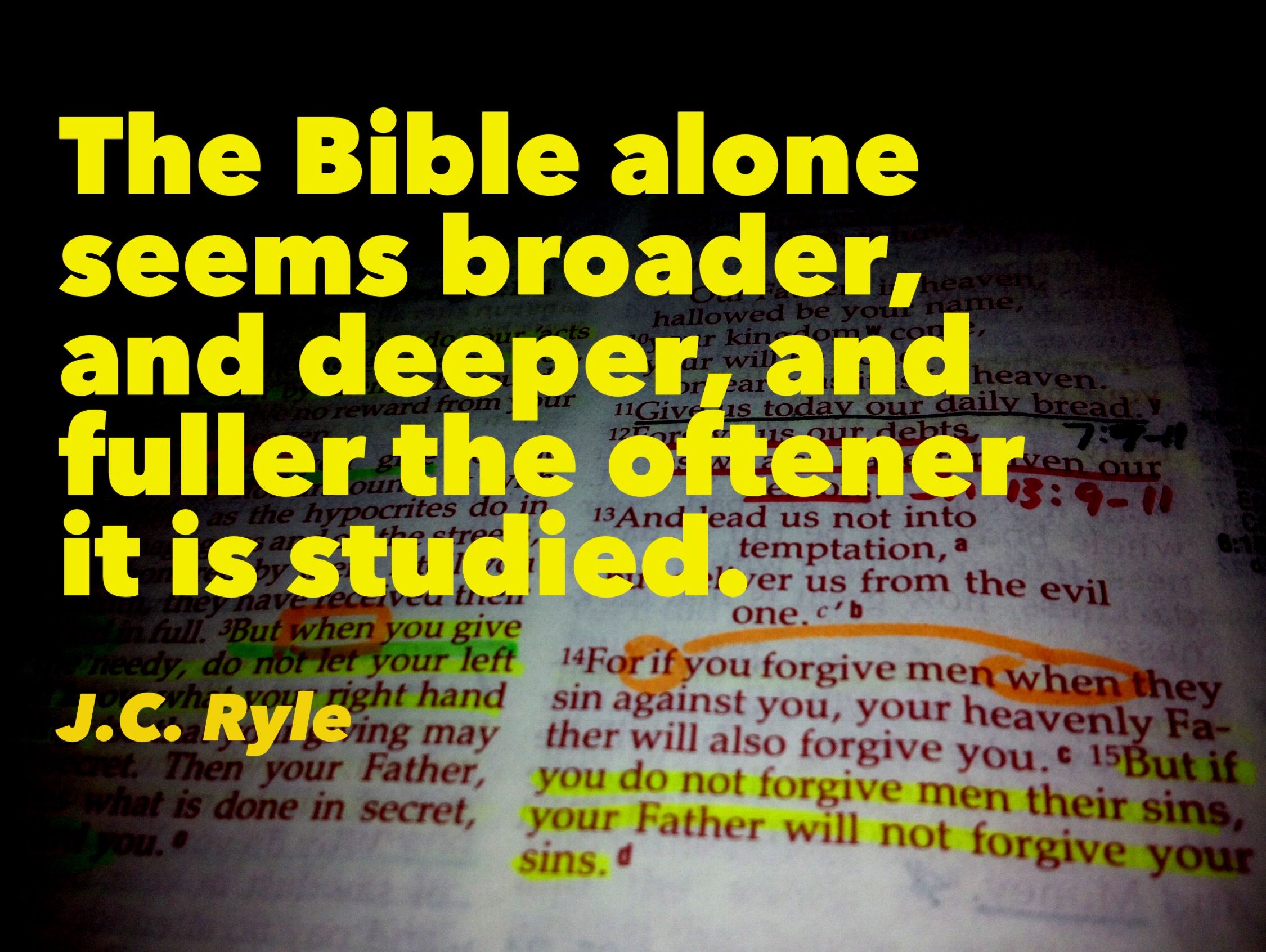
When we are studying our Bibles, we must remember that context is so vital. We have to read each inspired word in its proper context so that we know how to believe, think, live, and pray. I urge you to slow down in your Bible reading—aim for better and richer comprehension than to just try to read a lot in one sitting. Sometimes in my own personal Bible study time, I may spend several minutes just thinking about one phrase, and that may be the only part that I read on that particular morning.
However you read your Bible, make sure you are reading each part in its proper context. Pray before you begin reading and ask the Holy Spirit—Who inspired the Scriptures—to illuminate them to your heart and mind. These thoughtful Bible studies will do more to grow your spiritual maturity than simply rushing through your reading time.



 Christ hath a garden walled around,










 Craig T. Owens