Leaders may have to talk about people on their team, but how do we do this without crossing the line into gossip? Greg and I discussed this on a recent episode of our leadership podcast.
I have lots of new content every week, which you can check out on my YouTube channel.
“The Christian ideal has not been tried and found wanting. It has been found difficult; and left untried.” —G.K. Chesterton
“Christianity does not consist in telling the truth, or walking in a conscientious way, or adhering to principles; Christianity is something other than all that, it is adhering in absolute surrender to a Person, the Lord Jesus Christ.” —Oswald Chambers, in Baffled To Fight Better
“Critics may nitpick the Scriptures upon which we base our beliefs, but each year, the Lord will increasingly demonstrate that His Word contains no errors, exaggerations, or omissions. … We won’t feel ashamed of our hope. It will unfold just as the Lord has promised. We will be nourished, guided, blessed, and comforted. Our Lord will return, and then our days of sorrow will be over. How we will exult in the Lord, who first gave us a vibrant hope and then fulfilled that which we hoped for!” —Charles Spurgeon
Listen to the podcast of this post by clicking on the player below, and you can also subscribe on Apple, Spotify, or Audible.
Last week I challenged you to free up some time in your schedule so that you could begin to apply these six spiritual disciplines we are going to discuss.
Let’s keep in mind why we are learning and working on these disciplines. The key phrase is “so that”: I’m going to get stronger so that I have something to give to others, so that they will have something to give to others (and to me), and on and on it goes. Each of us needs all of us, and all of us need each of us!
I love to read. In fact, I’m usually reading several books at the same time. Without a close second, my favorite book is my Bible. I say “my Bible” because I’ve made it mine—it’s underlined, circled, notated, and marked. It’s the Book I’m in every day, and it’s the Book that helps me glean the best knowledge from all the other books I read.
G.K. Chesterton, the famous British writer, was once invited to a meeting of the leading intellectuals in England. They were discussing what one book they would want to have with them if they were shipwrecked on an island. Everybody expected Chesterton to say, “My Bible.” But when it came to his turn to speak, Chesterton said, “If I were shipwrecked on a desert island, I’d like to have Thomas’s Guide to Practical Shipbuilding.”
Chesterton wasn’t saying the Bible wouldn’t have been of benefit to him on that island, but he was saying that those who study the Bible have the most practical insights! The Bible doesn’t just have lofty ideas, but it gives us heavenly wisdom that is highly practical to our everyday lives.
The first spiritual discipline we are considering in our series Saints Together is: Studying our Bible. Notice I didn’t say just to read the Bible, but to really study the Book of books.
The apostle Paul wrote, “So then faith comes by hearing, and hearing by the Word of God” (Romans 10:17). How do we know our faith is growing? It must be tested. Look at what James had to say about growing our faith—“the testing of your faith produces perseverance” (James 1:3).
Testing really comes down to this: Does what I believe work in my everyday life? Can I truly put what the Bible teaches me into action? James went a little deeper with this in James 2:17-19.
Allow me to share four indispensable components of our Bible study time. You will notice that for all of these components, I am giving you verses from the 119th chapter of the Psalms. This single chapter mentions God’s Word in every single one of its 176 verses. As an added bonus, this chapter is divided into twenty-two 8-verse sections. Scientists tell us that if you do anything for twenty-one days in a row, you will have gone a long way toward making it a permanent habit. So reading one section of Psalm 119 every day is a great place to start on this spiritual discipline of studying your Bible.
Here are the four components:
(1) Read the Word. You cannot study something you haven’t read. I would suggest you pray before reading (Psalm 119:18, 33). I’d also suggest you leverage the power of your brain using a well-worn path by setting aside the same time, same place, and same method of study every day.
(4) Live out the Word. Apply it by allowing it to make a change in your life. Notice the action words in Psalm 119:1-4: walk … keep … walk … fully obey…. Or as God said to Joshua—
“Keep this Book of the Law always on your lips; meditate on it day and night, so that you may be careful to do everything written in it. Then you will be prosperous and successful.” (Joshua 1:8)
This is how Jesus lived His life and it’s also how He said the Holy Spirit would help us live our lives in a God-glorifying way (John 12:49-50, 14:26).
Every day we should be living out the living Word of God!
Listen to the podcast of this post by clicking on the player below, and you can also subscribe on Apple, Spotify, or Audible.
The London Times asked, “What’s wrong with the world today?”
In his characteristic wit and candor, G.K. Chesterton responded with a letter:
“Dear Sir,
I am.
Yours, G.K. Chesterton”
I hear the same humble honesty in Ezra’s prayer:
O my God, I am ashamed and embarrassed to lift up my face to You, my God, for our iniquities have risen above our heads and our guilt has grown even to the heavens. … Now, our God, what shall we say after this? For we have forsaken Your commandments (Ezra 9:6, 10).
This isn’t a word for “back then” or exclusively for Israelites—this is still a word for all of us today.
Several years ago I was asked to sign a joint letter from local pastors condemning a couple of headline-making heinous activities. In part of my response to these pastors, I wrote,
“I’m not sure if a letter to the editor is an appropriate response or not. But if this is the correct response for us, I am very hesitant to sign my name to a letter that calls out merely one of many sins. The problem we face is a singular one: sin.
“The solution is also a singular one: Jesus.
“A response that merely denounces evil acts is not, in my mind, effective. Such a letter is only highlighting sins, but not the solution.”
This, also, is what I see Ezra doing. It may have been one particular sin that got his attention (in this case, intermarriage with non-believers) but he then confesses their universal condition: the sin of departing from God’s commandments.
It’s so easy to spot sins in society, shake our heads in disgust, and say, “They should know better! What’s wrong with the world today? Someone should do something about that!”
Instead, any and every sinful expression we observe should send us to our knees saying, “But for the grace of God, I would be guilty of the same thing. God, be merciful to me, a sinner. I confess my sin and plead for Your mercy and forgiveness.”
Revival will never be a widespread response until it is first an individual response.
When we began as individuals to confess “my sin,” others will soon join with us in confessing “our sin” (see Ezra 9:4). That attitude is the seed of revival.
If you are a pastor and would like to join other pastors in a weekly prayer time for revival, please email T.M. Moore to get plugged into this strategic online gathering.
Listen to the podcast of this post by clicking on the player below, and you can also subscribe on Apple, Spotify, or Audible.
Last week I mentioned over-dramatic kids complaining, “I’m starving!” Or people with expensive phones complaining about a slow internet connection. We’re really good at expressing what we want, aren’t we? In fact, we’re really good at loudly letting everyone around us know that we want something.
But here’s a good question: Are we just as quick to loudly express our gratitude?
It’s innate human nature to behave this way. No one has to teach a child to express their desires—loudly! But we do have to teach our children to say, “Thank you.” And sometimes it takes even more prompting to get them to say it loud enough for others to hear, and sincere enough for others to believe that they are truly grateful.
So why would we expect it to be any different just because we happen to be older? That’s why we’ve noted that the attitude of gratitude is a great attitude, and it’s also an attitude that makes the grateful person stand out from the crowd.
G.K. Chesterton noted, “In life you can take things one of two ways: you can take them for granted or you can take them with gratitude.” Sadly, it seems that “for granted” is what is typically exhibited. In fact, I think the granted-to-grateful ratio is 10-to-1.
Luke alone tells a story in his Gospel about ten men with leprosy (Luke 17:11-19). All ten lepers had no problem calling out their need for healing “in a loud voice.” And they called out to the right Person, as they called Jesus “Master.” This word shows that they believed He could do something no one else could do. Indeed, Jesus shows His authority over leprosy with just the word, “Go” and “as they went, they were cleansed.”
All ten were quick to loudly express their desire for healing and to call on the authority of Jesus, but only “one of them…came back, praising God in a loud voice.” Both Luke and Jesus affirm that all ten men were cleansed on the outside—their skin no longer showed the ravages of leprosy, but only to the one grateful man did Jesus say, “Your faith has healed and saved you” (v. 19 MSG).
The Greek word here is sōzō. This is the same word used for the eternal salvation that Jesus alone can bring. Check out John 3:17, John 10:9, Acts 2:21, and Romans 10:9. This is better than just physical cleansing, it’s wholeness that lasts for eternity!
E.M. Bounds wrote, “Gratitude and murmuring never abide in the same heart at the same time.” Sadly, the ratio of grumblers-to-praisers is only going grow as we move closer and closer to the end of the age, culminating in people who have the outward appearance of godliness (like the nine cleansed lepers) but ignore the true power of God for salvation (see 2 Timothy 3:1-5).
In this take-everything-for-granted, focus-on-the-outward culture, those 1-in-10 stand out. Those who have gone beyond skin-deep cleaning to soul-deep salvation, and who loudly express their gratitude, are the ones the apostle Paul declares shine brightly and influence those around them (Philippians 2:14-16).
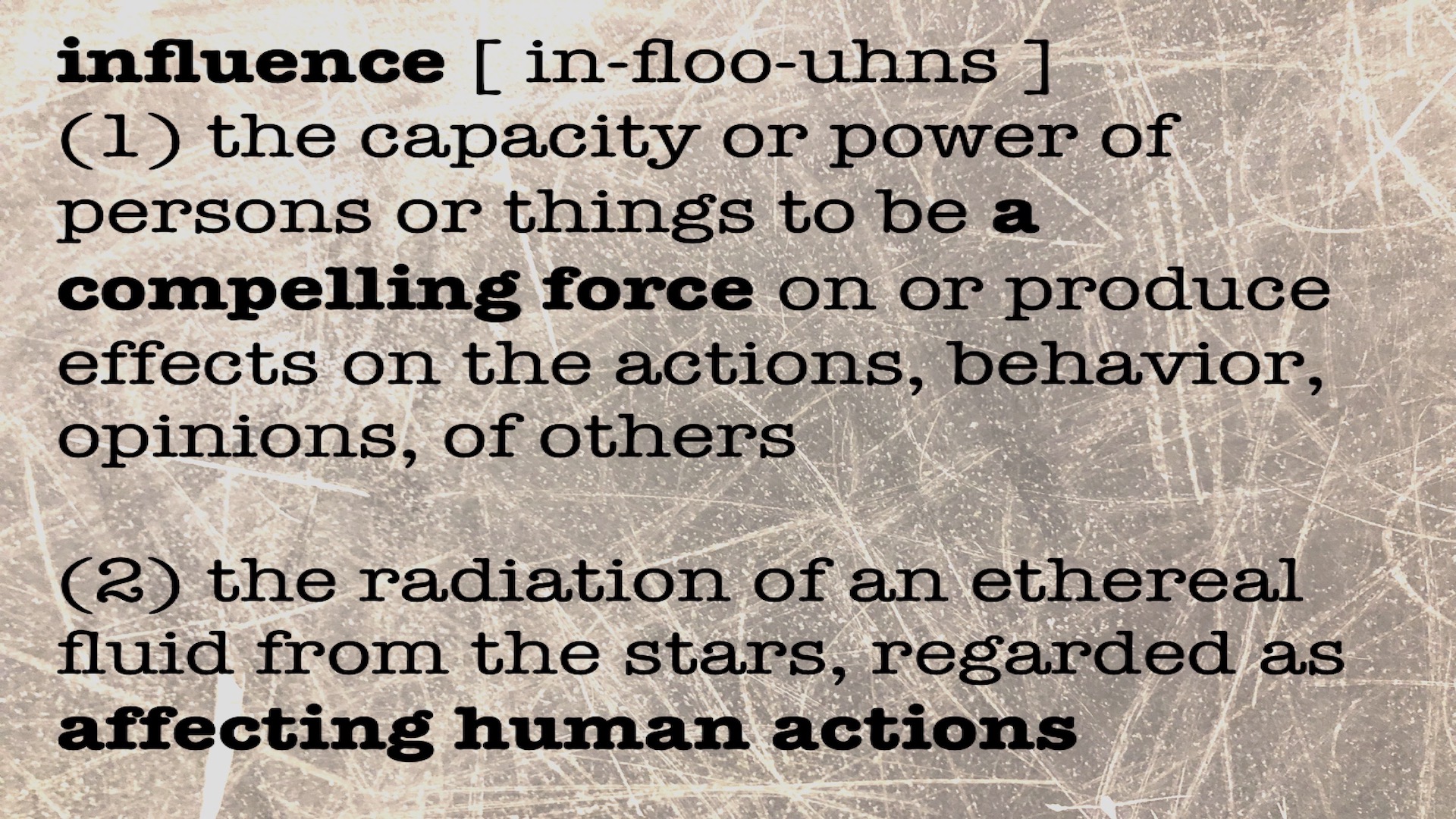
The origin of the word influence comes from a power people thought those bright stars had to affect the lives of humans. So your consistent gratitude is influencing those around you, and giving them a star to chart their course, more consistently than almost anything else you can do.
So shine on! Praise God loudly, quickly, and sincerely for what He has done for you! Be the 1-in-10! And then watch your influence impact everyone who encounters you.
Don’t wait until you feel like doing the next good thing, just do the next good thing and the good feelings will follow. Not only that, but you will motivate others too!
“Excellence is to do a common thing in an uncommon way.” —Booker T. Washington
“Forgiveness does not excuse the offending behavior. Forgiveness excuses the offender. The fact that God forgives us of sin, does not make sinning okay. The fact that we forgive someone of their sin towards us, does not make the sin okay.” —Kanayo Situ
“The happiness of a man in this life does not consist in the absence but in the mastery of his passions.” —Alfred Lord Tennyson
“In life you can take things one of two ways: you can take them for granted or you can take them with gratitude.” —G.K. Chesterton
T.M. Moore has an excellent post on how we can prepare for temptation before it even comes. Please check out this whole post which concludes with this thought, “Make up your mind, each day, that you’re going to resist temptation with prayer, preparation, and resting in the Word of God. Let the Spirit Who brings conviction and repentance be at work within you before you come upon the nets and snares of temptation, and you’ll be in a much better position to overcome the evil that threatens to engulf you, with the good choices and conduct that please the Lord and honor Him.”
Listen to the podcast of this post by clicking on the player below, and you can also subscribe on Apple, Spotify, or Audible.
As we wrap up our series looking at our foundational belief statements, I want to combine the last four statements together, not only because they all cover the same theme of end-times events, but also because these statements should give every Christian hope!
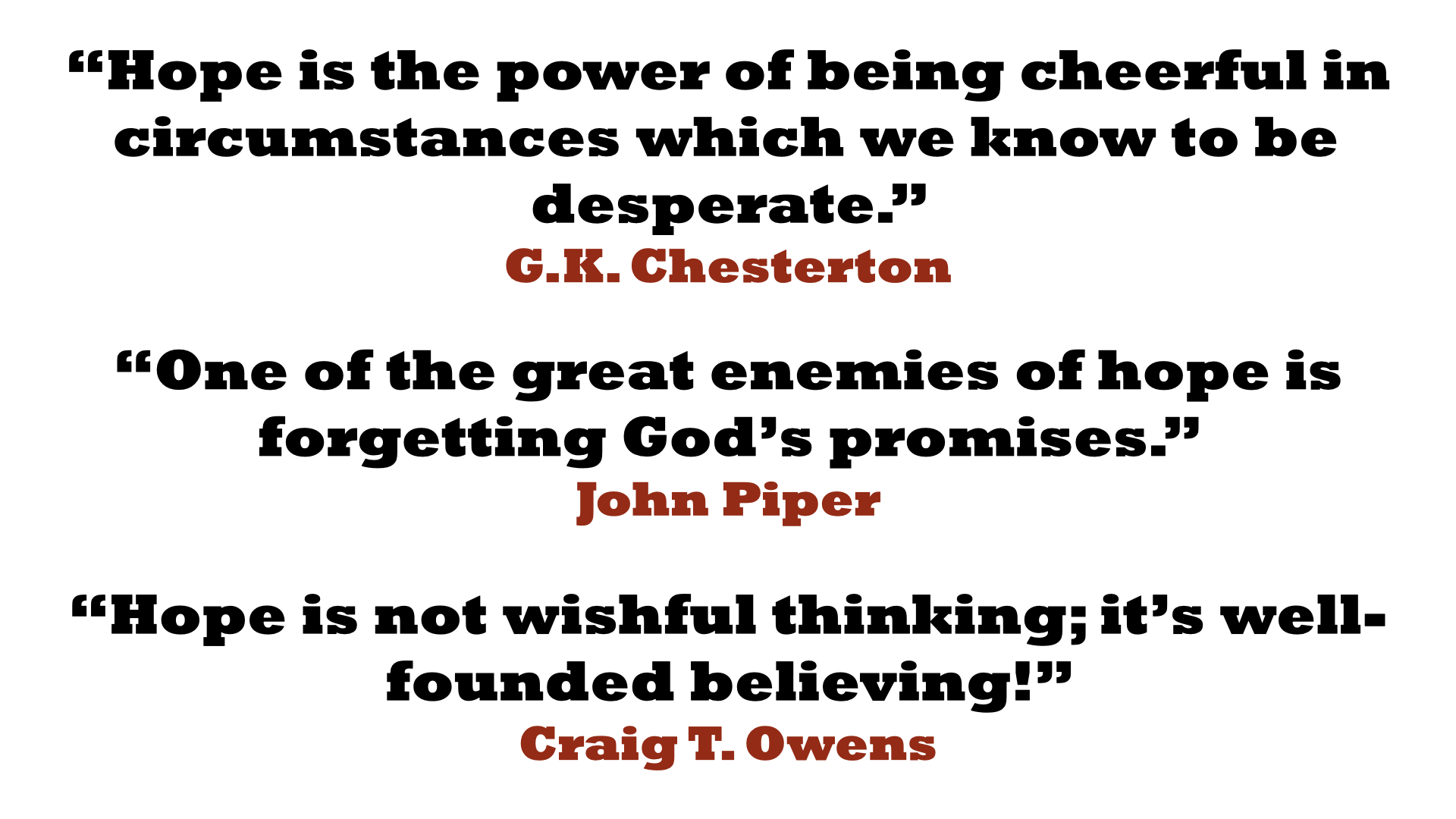
“Hope is the power of being cheerful in circumstances which we know to be desperate.” —G.K. Chesterton
“One of the great enemies of hope is forgetting God’s promises.” —John Piper
“Hope is not wishful thinking; it’s well-founded believing!” —Craig T. Owens
Christians have a fantastic, unshakable, blessed hope on which we can stand not only secure but joyful!
Foundational truth #13: “The resurrection of those who have fallen asleep in Christ and their translation together with those who are alive and remain unto the coming of the Lord is the imminent and blessed hope of the church.”
This blessed hope in the future helps us live with joy today! Knowing that death has been defeated and Jesus will come back to take us home with Him should fuel us to say “no” to the temporary pleasures of sin, and live such godly lives that it turns others’ eyes to Jesus (Titus 2:11-14; 1 Corinthians 15:51-52; 1 Thessalonians 4:16-17).
Foundational truth #14: “The second coming of Christ includes the rapture of the saints, which is our blessed hope, followed by the visible return of Christ with His saints to reign on earth for one thousand years.”
Sometimes you will hear Christians talk about the “rapture” of the Church. Although this word itself isn’t in the Bible, the Greek word harpazo in 1 Thessalonians 4:17 means “catching up.” It also means “to eagerly claim for one’s self,” which reminds me that Jesus is thrilled to bring His Bride home to be with Him forever! After the Church has been caught up to Heaven, a period of tribulation will plague the earth, followed by Christ’s Second Coming and His millennial reign (Zechariah 14:4-5; Revelation 19:11-15; 20:1-10).
Foundational truth #15: “There will be a final judgment in which the wicked dead will be raised and judged according to their works. Whosoever is not found written in the Book of Life, together with the devil and his angels, the beast and the false prophet, will be consigned to the everlasting punishment in the lake which burns with fire and brimstone, which is the second death.”
Christians have no fear of the second (or final) death because our names are written in the Book of Life (Luke 12:4-6; Revelation 20:11-15). Not only is there judgment for the wicked, but there will be rewards for the righteous.
Foundational truth #16: “In keeping with His promise we are looking forward to a new heaven and a new earth, where righteousness dwells” (2 Peter 3:13). Revelation 21-22 give us a small glimpse of our eternal home.
In light of these truths, how should Christians live while still on earth? I think there are three ways we should live:
With this blessed hope of the Second Coming of Jesus and our security in knowing we will remain with Him forever, let’s tell everyone we can how they too can know what it is to live with this hope in their heart.
In Whisper, Mark Batterson gives us seven love languages which God uses to speak to us (check out my review of Whisper here). Mark always does a masterful job of weaving together Scripture, quotes from other authors, historical and his own personal accounts. Here are some of the quotes he shared from others.
“The voice of the Spirit is as gentle as a zephyr. So gentle that unless you are living in a perfect communion with God, you never hear it.” —Oswald Chambers
“The sole cause of man’s unhappiness is that he does not know how to stay quietly in his room.” —Blaise Pascal
“The best translation of the Hebrew in Genesis 1 was not ‘and God said’ but ‘and God sang.’” —Leonard Bernstein
“How much happier you would be, how much more of you there would be, if the hammer of a higher God could smash your small cosmos!” —G.K. Chesterton
“Vocatus atque non vacates, Deus aderit. Bidden or not bidden, God is here.” —Desiderius Erasmus
“A Bible that’s falling apart usually belongs to someone who isn’t.” —Charles Spurgeon
“The Christian shoemaker does his duty not by putting little crosses on the shoes, but by making good shoes, because God is interested in good craftsmanship.” —Martin Luther
“No crooked table legs or ill-fitting drawers ever, I dare swear, came out of the Carpenter’s shop at Nazareth.” —Dorothy Sayers
“Parents! I do hope you are all endeavoring to bring your children to Christ by teaching them the things of God. Let them not be strangers to the plan of salvation. Never let it be said that a child of yours reached years in which his conscience could act, and he could judge between good and evil, without knowing the doctrine of the atonement, without understanding the great substitutionary work of Christ. Set before your child life and death, hell and heaven, judgment and mercy, his own sin, and Christ’s most precious blood; and as you set these before him, labor with him, persuade him, as the apostle did his congregation, with tears and weeping, to turn unto the Lord.” —Charles Spurgeon
“The role of God’s Word is to feed faith’s appetite for God. And, in doing this, it weans my heart away from the deceptive taste of lust. … As I pray for my faith to be satisfied with God’s life and peace, the sword of the Spirit carves the sugar coating off the poison of lust. I see it for what it is. And by the grace of God, its alluring power is broken.” —John Piper
“This triangle of truisms, of father, mother and child, cannot be destroyed; it can only destroy those civilizations which disregard it.” —G.K. Chesterton
“Have you realized that most of your unhappiness in life is due to the fact that you are listening to yourself instead of talking to yourself? Take those thoughts that come to you the moment you wake up in the morning. You have not originated them, but they start talking to you, they bring back the problems of yesterday, etc. Somebody is talking … yourself is talking to you!” —Martyn Lloyd-Jones
Planned Parenthood updates:
Ultrasounds = good for saving babies, bad for Planned Parenthood’s business.
“In the matter of reforming things, as distinct from deforming them, there is one plain and simple principle; a principle which will probably be called a paradox. There exists in such a case a certain institution or law; let us say, for the sake of simplicity, a fence or gate erected across a road. The more modern type of reformer goes gaily up to it and says, ‘I don’t see the use of this; let us clear it away.’ To which the more intelligent type of reformer will do well to answer: ‘If you don’t see the use of it, I certainly won’t let you clear it away. Go away and think. Then, when you can come back and tell me that you do see the use of it, I may allow you to destroy it.’
“This paradox rests on the most elementary common sense. The gate or fence did not grow there. It was not set up by somnambulists who built it in their sleep. It is highly improbable that it was put there by escaped lunatics who were for some reason loose in the street. Some person had some reason for thinking it would be a good thing for somebody. And until we know what the reason was, we really cannot judge whether the reason was reasonable. It is extremely probable that we have overlooked some whole aspect of the question, if something set up by human beings like ourselves seems to be entirely meaningless and mysterious. There are reformers who get over this difficulty by assuming that all their fathers were fools; but if that be so, we can only say that folly appears to be a hereditary disease. But the truth is that nobody has any business to destroy a social institution until he has really seen it as an historical institution. If he knows how it arose, and what purposes it was supposed to serve, he may really be able to say that they were bad purposes, or that they have since become bad purposes, or that they are purposes which are no longer served. But if he simply stares at the thing as a senseless monstrosity that has somehow sprung up in his path, it is he and not the traditionalist who is suffering from an illusion.” —G.K. Chesterton
“The most common remedy for most behavioral and mental disorders today is some form of self-worth enhancement. It pervades our educational institutions, the psychotherapeutic and counseling system, the personnel and motivational industry, advertising, and even the church. I think the remedy is flawed. … What is the root of mental health? My answer is, God. Or seeing God as God and enjoying Him as God, which involves being forgiven by God and welcomed with utterly free grace. I personally believe that these truths are hijacked when they are used to make self-esteem the root of mental health.” —John Piper











 Craig T. Owens