This is a weekly series with things I’m reading and pondering from Charles Spurgeon. You can read the original seed thought here, or type “Thursdays With Spurgeon” in the search box to read more entries.
Listen to the podcast of this post by clicking on the player below, and you can also subscribe on iTunes or Spotify.
Love So Amazing
Forgiving one another, even as God for Christ’s sake has forgiven you. (Ephesians 4:32)
The first phrase to think about is ‘for Christ’s sake.’ We use these words very often, but probably we have never thought of their force. … All the good things that God has bestowed upon us have come to us ‘for Christ’s sake.’ But especially the forgiveness of our sins has come ‘for Christ sake.’ …
It is His very love as well as His holiness and His justice that, if I may use such a term, compels Him to severity of judgment so that sin cannot and must not be blotted out till atonement has been presented. There must, first of all, be a sacrifice for sin, that, mark you, the great Father, to show His love, supplies, for it is His own Son who is given to die! And so the Father Himself supplies the ransom through His Son, that Son is one with Himself by bonds of eternal unity, mysterious but most intense. If God demands the penalty in justice, He Himself supplies it in love. …
I want you to consider, for a moment, how readily God may now blot out sin since Christ has died. … God, for Christ’s sake, has accepted us in Him, has forgiven us in Him, and looks upon us with infinite love, changeless in Him. This is how all our blessings come to us, in and through Christ Jesus. And if we are indeed in Him, the Lord does not only forgive us our sins, but He bestows upon us the boundless riches of His grace in Him. In fact, He treats us as He would treat His Son. He deals with us as He would deal with Jesus! …
And you, big evil sinner, if you will go to God at this moment and say, ‘Lord, I cannot ask You to forgive me for my own sake, but do it out of love for Your dear Son,’ He will do it…. Christ took the shame that He might magnify His Father, and now His Father delights to magnify Him by blotting out the sin.
From Forgiveness Made Easy
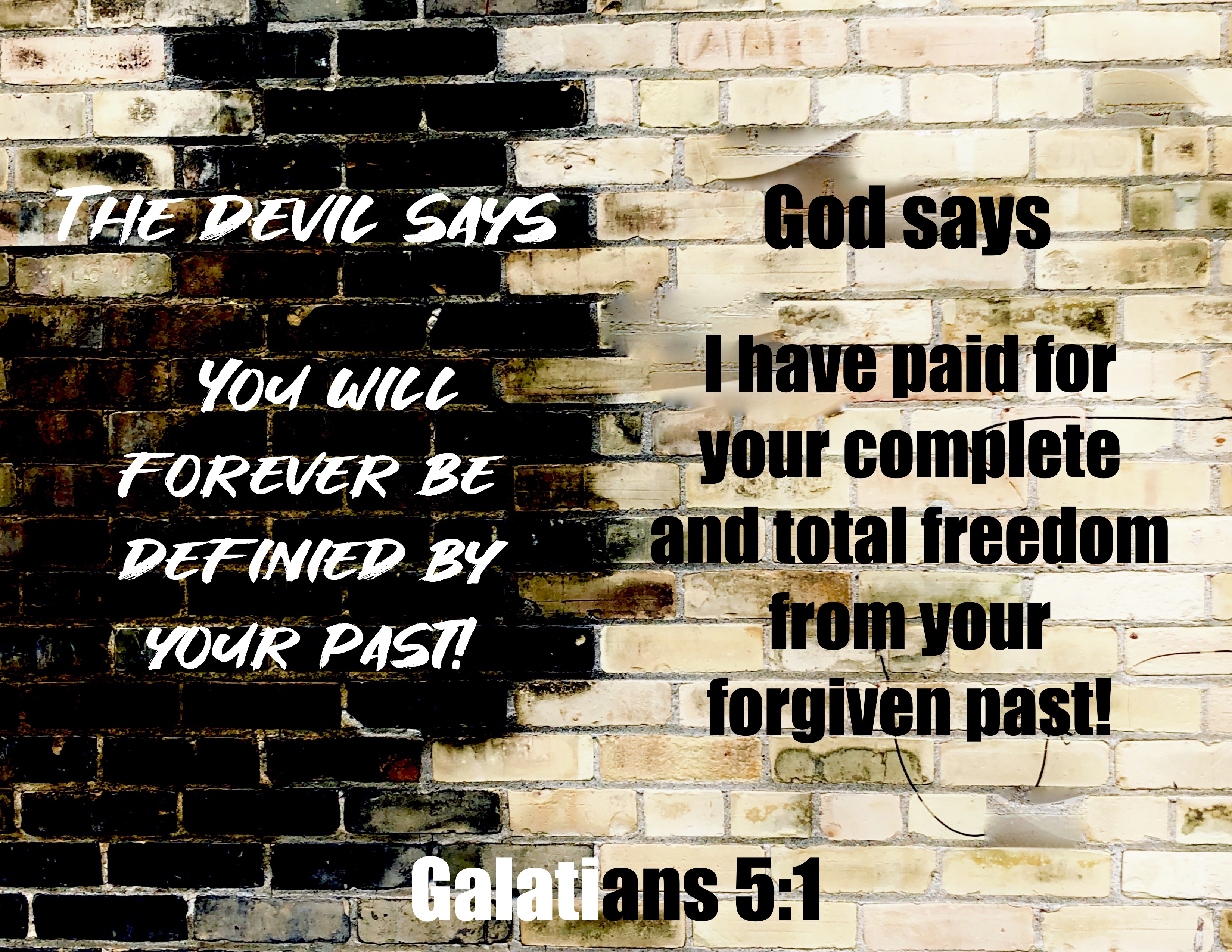
I’ve lost track of the number of times someone has told me, “I’ve messed up for so long—I’ve done such atrocious things—there is no way God could forgive me.” This is one of satan’s lies that keeps people from accepting God’s forgiveness.
Don’t wait another moment: If you haven’t asked God to forgive you “for Christ’s sake,” do it right this very minute! I’d love to chat with you about this, so reach out to me and let’s talk more about this amazing new relationship you now have with Almighty God because you are forgiven for Christ’s sake.
Listen to the podcast of this post by clicking on the player below, and you can also subscribe on Apple, Spotify, or Audible.
As we wrap up our series looking at our foundational belief statements, I want to combine the last four statements together, not only because they all cover the same theme of end-times events, but also because these statements should give every Christian hope!
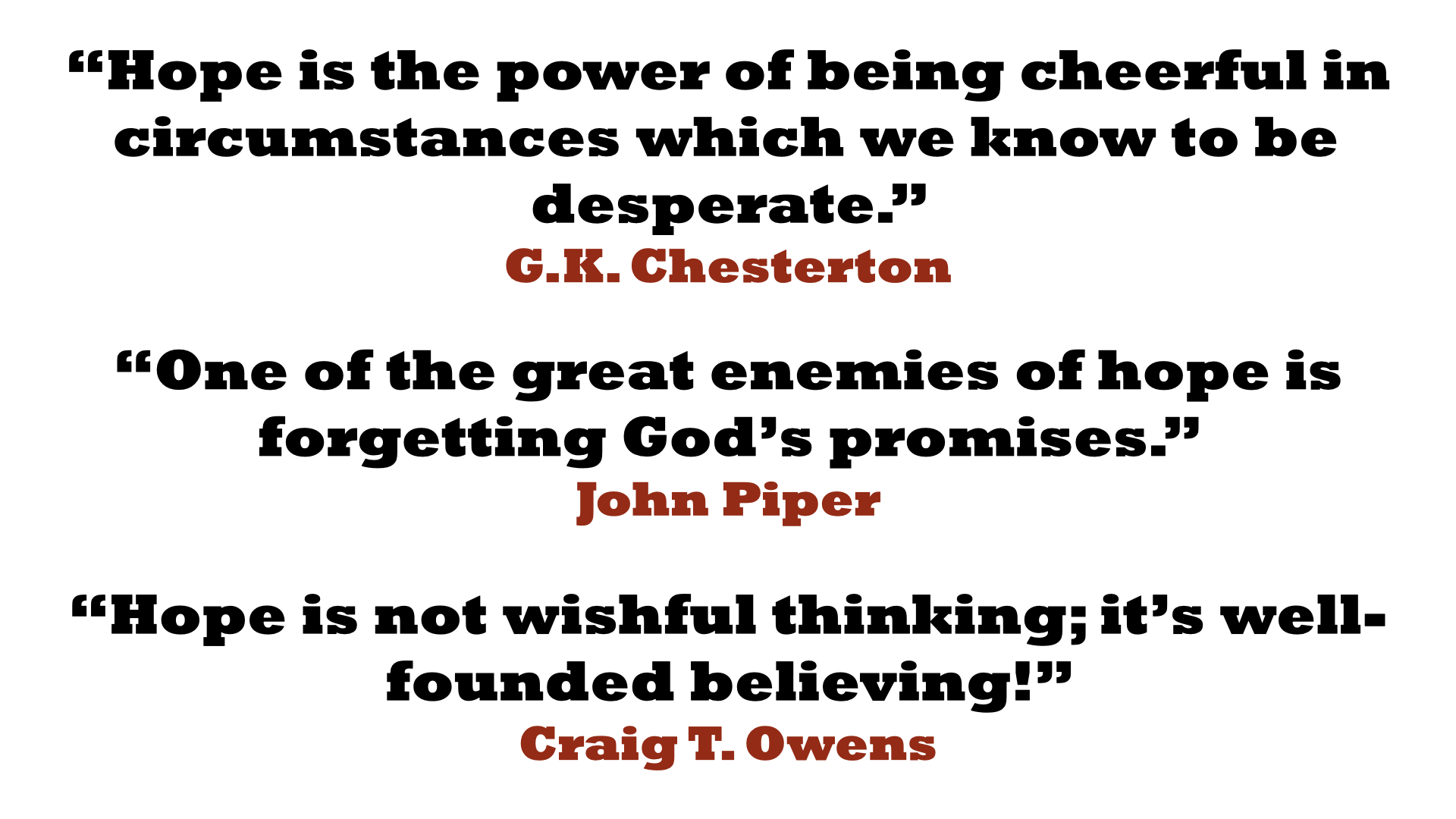
“Hope is the power of being cheerful in circumstances which we know to be desperate.” —G.K. Chesterton
“One of the great enemies of hope is forgetting God’s promises.” —John Piper
“Hope is not wishful thinking; it’s well-founded believing!” —Craig T. Owens
Christians have a fantastic, unshakable, blessed hope on which we can stand not only secure but joyful!
Foundational truth #13: “The resurrection of those who have fallen asleep in Christ and their translation together with those who are alive and remain unto the coming of the Lord is the imminent and blessed hope of the church.”
This blessed hope in the future helps us live with joy today! Knowing that death has been defeated and Jesus will come back to take us home with Him should fuel us to say “no” to the temporary pleasures of sin, and live such godly lives that it turns others’ eyes to Jesus (Titus 2:11-14; 1 Corinthians 15:51-52; 1 Thessalonians 4:16-17).
Foundational truth #14: “The second coming of Christ includes the rapture of the saints, which is our blessed hope, followed by the visible return of Christ with His saints to reign on earth for one thousand years.”
Sometimes you will hear Christians talk about the “rapture” of the Church. Although this word itself isn’t in the Bible, the Greek word harpazo in 1 Thessalonians 4:17 means “catching up.” It also means “to eagerly claim for one’s self,” which reminds me that Jesus is thrilled to bring His Bride home to be with Him forever! After the Church has been caught up to Heaven, a period of tribulation will plague the earth, followed by Christ’s Second Coming and His millennial reign (Zechariah 14:4-5; Revelation 19:11-15; 20:1-10).
Foundational truth #15: “There will be a final judgment in which the wicked dead will be raised and judged according to their works. Whosoever is not found written in the Book of Life, together with the devil and his angels, the beast and the false prophet, will be consigned to the everlasting punishment in the lake which burns with fire and brimstone, which is the second death.”
Christians have no fear of the second (or final) death because our names are written in the Book of Life (Luke 12:4-6; Revelation 20:11-15). Not only is there judgment for the wicked, but there will be rewards for the righteous.
Foundational truth #16: “In keeping with His promise we are looking forward to a new heaven and a new earth, where righteousness dwells” (2 Peter 3:13). Revelation 21-22 give us a small glimpse of our eternal home.
In light of these truths, how should Christians live while still on earth? I think there are three ways we should live:
With this blessed hope of the Second Coming of Jesus and our security in knowing we will remain with Him forever, let’s tell everyone we can how they too can know what it is to live with this hope in their heart.
Listen to the podcast of this post by clicking on the player below, and you can also subscribe on Apple, Spotify, or Audible.
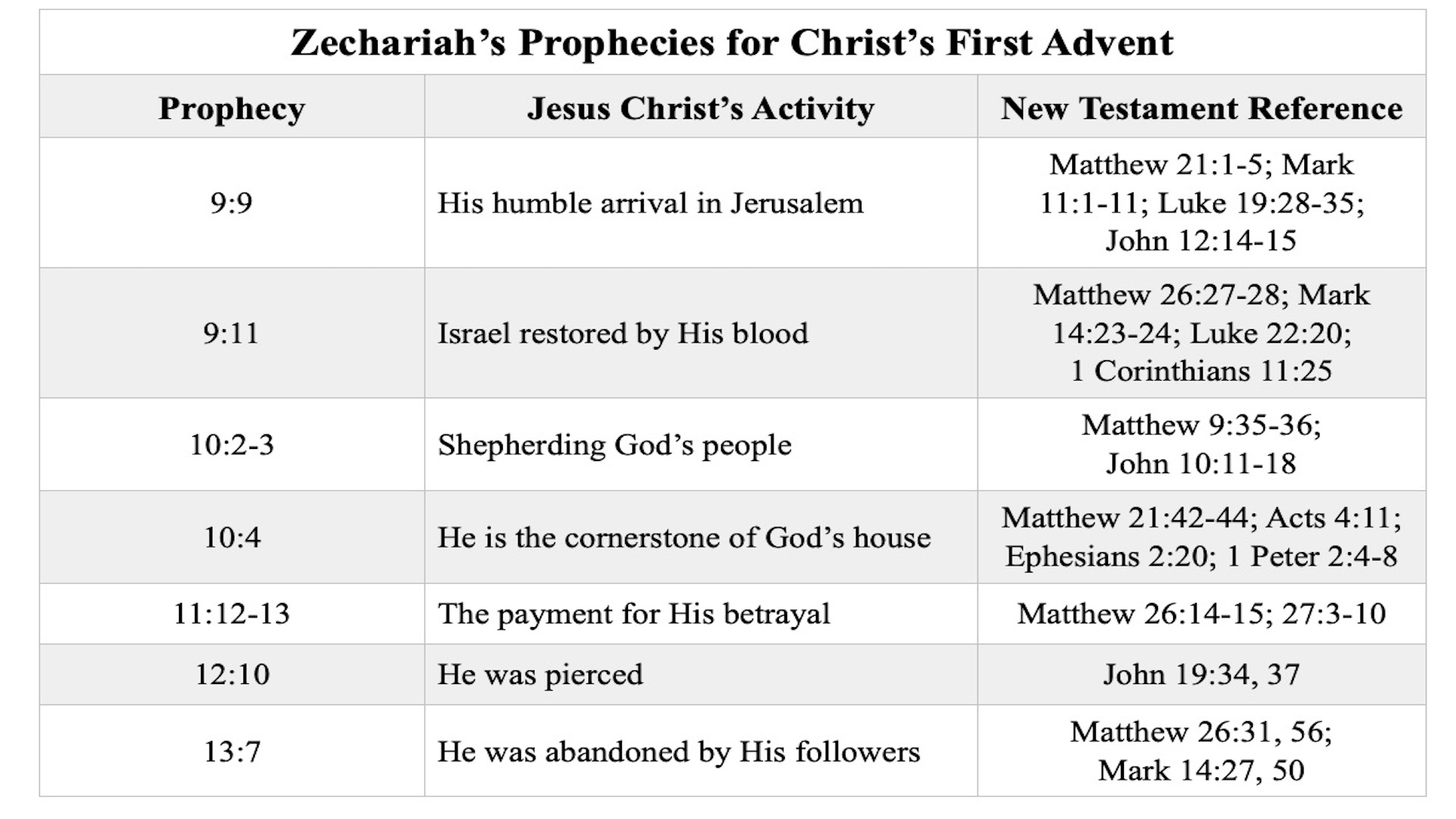
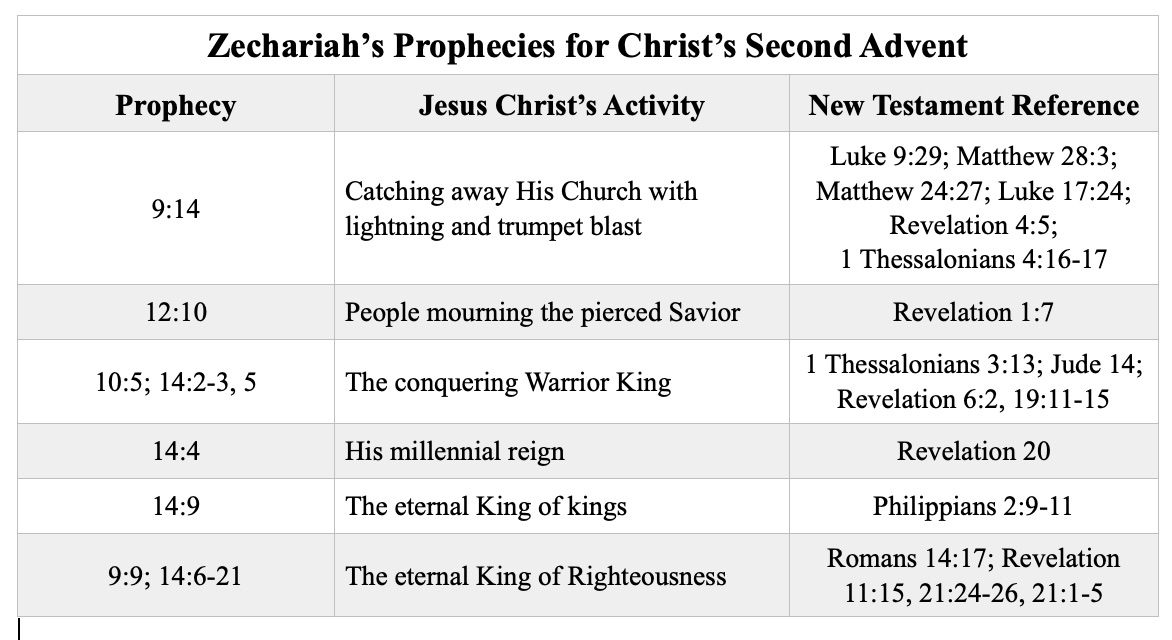
Zechariah pronounces more messianic prophecies than any other biblical writer, with the exception of Isaiah (and he wrote 66 chapters!). These prophecies are fulfilled in Christ’s First Advent, and promised for His Second Advent. Check these out for yourself…
(All of the biblical references for the above chart can be viewed by clicking here.)
Why is it so vital that Jesus fulfilled these prophecies?
(1) The historicity of these fulfilled prophecies gives us a confidence for the future.
These fulfilled prophecies assure us that God is sovereign over all history. There are no accidents, and God needs no help from anyone else in fulfilling what He has promised. As a result, no world event—no matter how big it may seem—should be able to rattle us!
(2) The authenticity of what God has done gives us boldness for today.
When God does the miraculous, He authenticates His Word. This authenticity has always made God’s people stand out (see Genesis 41:39). It’s also why people recognized Jesus as the divine Son of God (John 3:2; 9:30-33). So we can live with the boldness to know that what God says He will do, He will do!
(3) The exclusivity of God’s promises and fulfillment of those promises gives us joy for our testimony.
Only Jesus could have done all of this (Luke 24:26-27, 44), so only Jesus can fulfill what is still remaining to be fulfilled! We can have supreme joy in knowing that only Jesus is our hope of salvation (John 14:6; Acts 4:12).
It’s vital that we know this is true so that we can live confident, bold, and joyful!Our confident boldness and our bold joy both glorify God and attract seekers to Him.
Listen to the podcast of this post by clicking on the player below, and you can also subscribe on Apple, Spotify, or Audible.
Zechariah is the longest book of the minor prophets. His ministry overlaps Haggai the prophet, Ezra the priest, Zerubbabel the governor, and Joshua the high priest. I point all of this out because we need to always keep in mind that the Bible isn’t a collection of stories. It’s a verifiable (or falsifiable) record of real people at real moments in history. Many of the stories in the Bible confirm and even amplify each other.
Stand assured, encouraged, and unmovable on God’s Word
Aren’t you more assured of a message that has a confirmation? Like if one person gives you a compliment that you hadn’t considered before, and then later on someone else notices the same attribute. I think we are more ready to receive the word when it has a confirmation like that.
Haggai delivered a word directed to Zerubbabel the governor, which we saw was a prophecy pointing to and ultimately fulfilled in Jesus. God called Zerubbabel “Mysignet ring”—a mark of God’s supreme authority.
That might have been a difficult thing for Zerubbabel to accept, so Zechariah is given a confirming word two months after Haggai’s prophecy (Zechariah 4:1-9). This prophecy affirms the message given through Haggai, and also points to its ultimate fulfillment in Jesus.
But then Zechariah is also given an amplifying word, as he speaks a word from God to Joshua, the other “olive tree” in his God-given vision (Zechariah 3:1-9; 6:9-13).
Zechariah confirmed and amplified Haggai’s message. And then Jesus fulfilled both of their prophecies! We have the benefit of seeing the prophecy and fulfillment, which should build our faith in ALL of the promises in God’s Word.
The Word of God then become the (s)word of God in our mouths and hearts!
Because of these specific prophecies that have been fulfilled in Jesus Christ, we can now stand assured, encouraged, unmovable, and well-armed with the same sword of God.
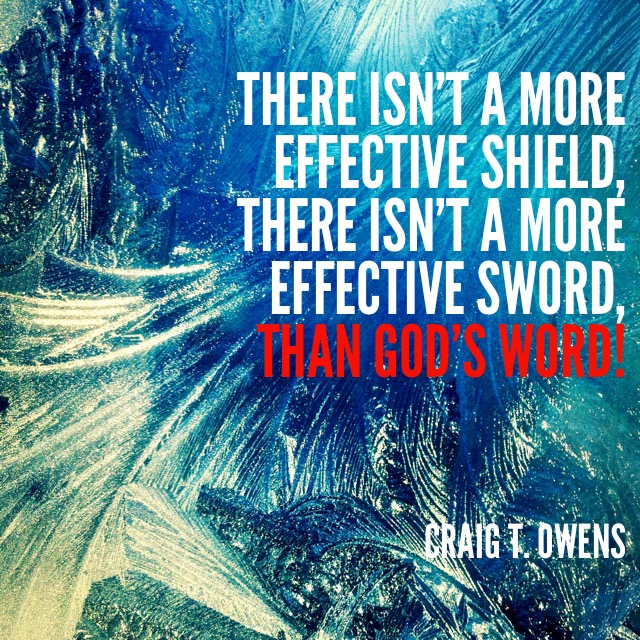
There isn’t a more effective sword or shield than God’s (s)word!
This is a weekly series with things I’m reading and pondering from Charles Spurgeon. You can read the original seed thought here, or type “Thursdays With Spurgeon” in the search box to read more entries.
Listen to the podcast of this post by clicking on the player below, and you can also subscribe on iTunes or Spotify.
Holy Familiarity
All these thirteen years, so far as Scripture informs us, Abram had not a single visit from his God. We do not find any record of his either doing anything memorable or having so much as a single audience with the Most High. Learn from this that if we once forsake the track of simple faith, once cease to walk according to the purity that faith approves, we strew our path with thorns, cause God to withhold the light of His countenance from us, and pierce ourselves through with many sorrows.
But mark, beloved, the exceeding grace of God: The way to recover Abram from his backsliding was that the Lord should appear to him…. This brings to my remembrance the words in the book of Revelation concerning the church in Laodicea: ‘You are neither cold nor hot. I could wish you were cold or hot. So then, because you are lukewarm, and neither cold nor hot, I will vomit you out of My mouth’ (Revelation 3:15-16)—a very solemn declaration. But what follows? ‘Behold, I stand at the door and knock. If anyone hears My voice and opens the door, I will come in to him and dine with him, and he with Me’ (Revelation 3:20). That means just this: For recovery out of a horrible state of languishing and lukewarmness there is no remedy but the coming of Jesus Christ to the soul in near and dear communion! …
Distance from God’s presence always means sin. Holy familiarity with God engenders holiness. The more you think of God, the more you meditate on His works, the more you praise Him, the more you pray to Him, the more constantly you talk with Him and He with you by the Holy Spirit, the more surely are you on the road to thorough consecration to His cause!
From Consecration To God
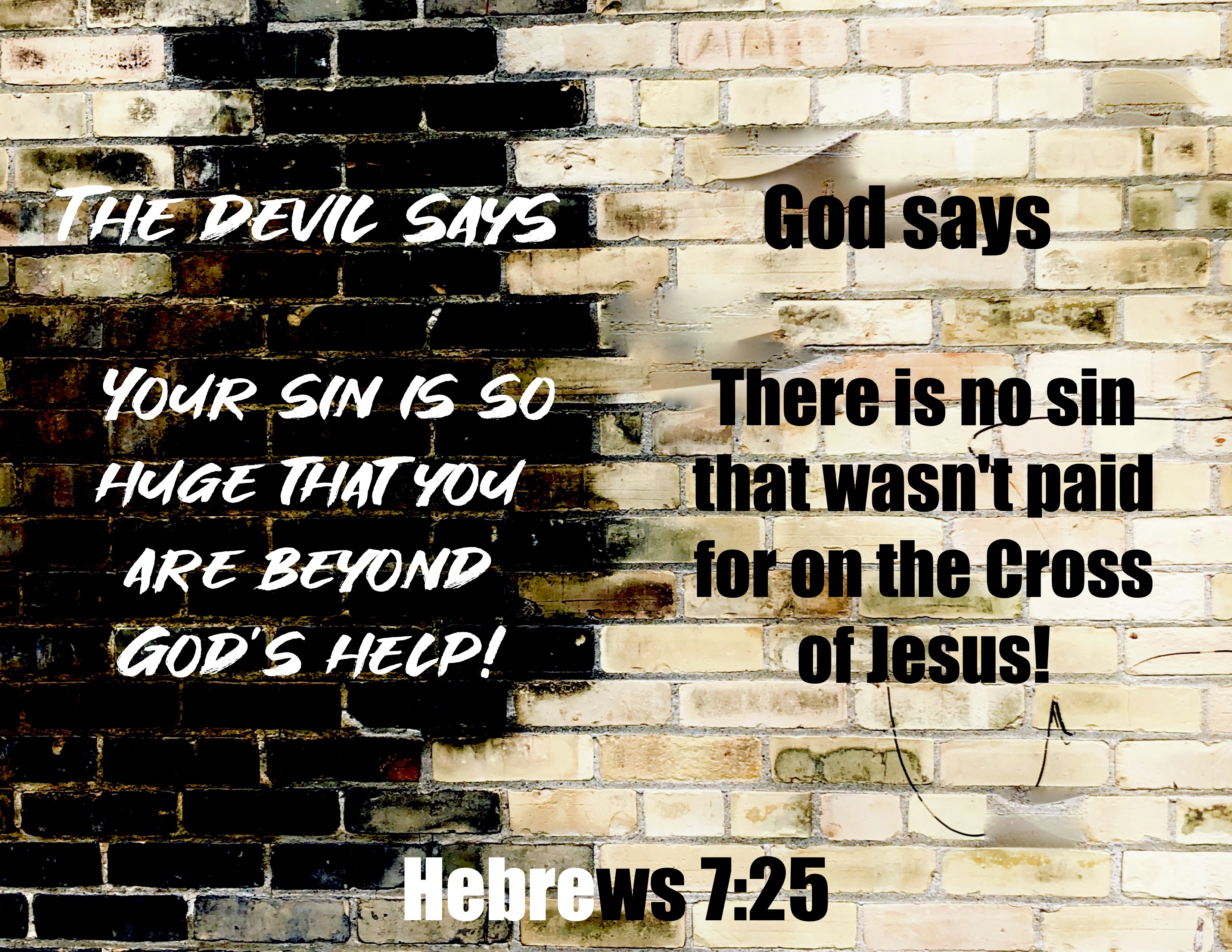
I’ve often said that one of the most powerful prayers we can pray is simply, “God, help!” In those two words we acknowledge our helplessness and His omnipotence, our sin and His forgiveness, our shortcomings and His desire to restore us.
The devil lies! He loves to whisper the condemning words of, “You’ve messed up one too many times. You’re too far away for God to rescue you now. This time you exhausted God’s mercy.”
Once again, by simply crying out, “God, help!” you are calling out satan’s lies. Jesus paid too high of a price for Him to ever let you go. Near the end of this sermon, Charles Spurgeon spoke a powerful reminder: “The blessings of grace are not given today to be taken back tomorrow, but are eternal blessings [Genesis 17:7, 13, 19].” Amen!
My friend, cry out to God today—He loves you and He’s longing to restore you!
Listen to the podcast of this post by clicking on the player below, and you can also subscribe on Apple, Spotify, or Audible.
In the Foreword to my book Shepherd Leadership: The Metrics That Really Matter, Dick Brogden observes, “God plucked David from the sheepfold. God chose a sheep to be a shepherd. And though we all are stupid sheep, when God plucks us out of obscurity to serve others, we can have the humble confidence for as long as we are asked to lead that God has chosen us. That confidence both faithfully drives us to our knees and fearlessly propels us against our giants. It is good to be a sheep; it is good to be an under-shepherd. Just remember you are stupid, chosen by the Wise One, and as long as you serve as a shepherd, you and your flock will be safe.”
How true it is that all of us are sheep. The role of the shepherd is to care for the sheep and create a healthy environment for them. The role of healthy sheep is to reproduce more sheep. In this, both shepherds and sheep are ministers—we all minister to those God has placed around us.
God calls all Christians to be ministers. The Church is the sheepfold that equips us, but then we must go out to minister in a way that will bring lost sheep to a personal relationship with Jesus.
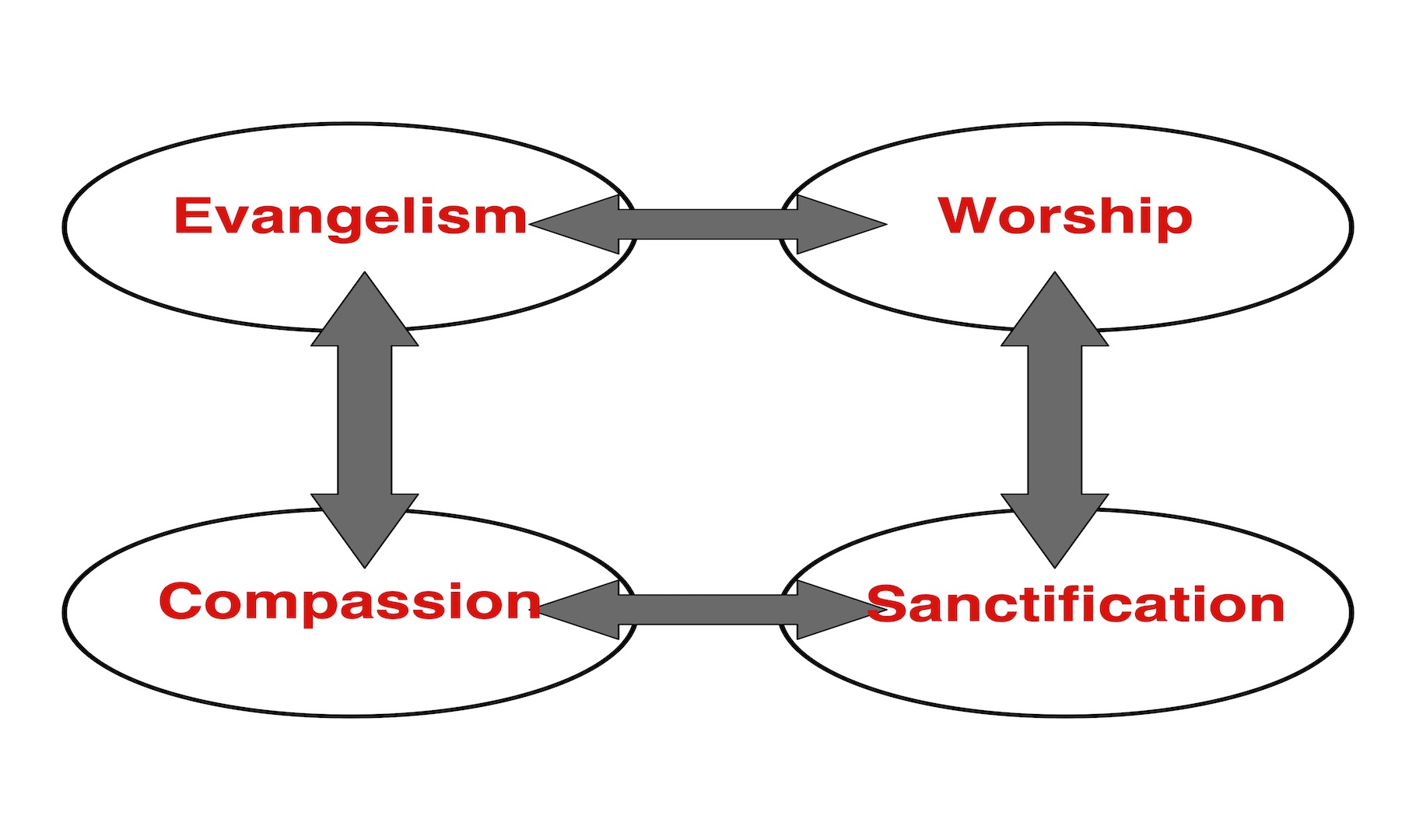
Our foundational truth statement about church ministry says: A divinely called and scripturally ordained ministry has been provided by our Lord for the fourfold purpose of leading the Church in evangelism, worship, sanctification, and compassion.
(1) Evangelism. When we looked at the foundational belief about the Church, we noted that it’s not either-or—evangelism or discipleship—but it’s both-and. Christians are being the Church when they are intentionally living in a way that makes Jesus known (Matthew 10:1, 7-8; 28:18-20).
(3) Sanctification. Remember that we are all in-process of becoming saints (I like to remember this by calling it saint-ification). We need each other to do this, which is why God gives gifts to bring out Christ-like maturity in us (Ephesians 4:1-7, 11-16).
So here are two important questions we need to ask ourselves: (1) Am I doing quality work? (2) Am I faithfully doing my work?
To help answer those questions, I like this thought from Leonard Sweet’s book I Am A Follower: “The most important metrics we must rely on, the crucial ‘deliverables’ we can present, must focus on the newly formed lives of the disciples we are making, the followers who are following Christ into a place of serving Him by serving others. The most important measure of our faithfulness to Christ must be the extent of transformation into the living image of Christ Himself. … The quantifiable fruit of our church is not found in the number of people we can gather on a weekly basis. What counts is what is happening in the lives of those who have gathered.”
These are questions we should all ask the Holy Spirit to reveal to us:
What is happening in my life?
Am I telling others about Jesus?
Am I worshipping God so consistently that everyone can see it?
Am I maturating as a saint and am I helping other saints mature?
Is my faith seen in my compassionate actions?
Our individual answers to those questions will determine the success of our individual churches, which will ultimately determine the effectiveness of the global Church of Jesus Christ. I hope you will take some time to consider these questions for yourself.
Listen to the podcast of this post by clicking on the player below, and you can also subscribe on Apple, Spotify, or Audible.
When you’ve been at a church service have you ever asked yourself, “What are we doing here? What exactly is ‘church’? What are we supposed to be doing?”
Some people think church is saints going out to tell people about Jesus, and some people think church is saints coming together to hear about Jesus (see Matthew 28:19-20; 1 Corinthians 11:18). I think this is an either-or trap.
I think a better way of looking at this is “both-and” and “so that”: BOTH coming to a gathering of believers so that we can be equipped to go out AND going out to tell people about Jesus so that we can bring new disciples into the church.
Our foundational truth statement says: The Church is the Body of Christ, the habitation of God through the Spirit, with divine appointments for the fulfillment of her great commission. Each believer, born of the Spirit, is an integral part of the General Assembly and Church of the Firstborn, which are written in heaven.
To help us see where we play a vital role in all of this, the Bible gives us three pictures of the church:
All of these pictures speak of multiple parts making up one unified, healthy whole. Remove any part or any function, and the whole thing is diminished. All of these pictures also speak of intentionality. No one becomes healthy by accident, or builds a sound structure by accident, or enjoys a fulfilling marriage by accident. Health, soundness, and fulfillment all result from being intentional about our choices and interactions.
I believe these three pictures also help us see what the church isn’t and is.
A healthy church isn’t about numbers
A healthy church isn’t about the day of the week that we meet
The first Church in the New Testament showed us how they followed the example of Jesus. Before trying to fulfill the Great Commission of going into all the world, they first obeyed the directive from Jesus to stay in Jerusalem until they were empowered by the Holy Spirit. Then we see an intentionality, and an empowerment, and a complete reliance on the Holy Spirit in everything they undertook from that point on.
It’s not about going to “my church” or going to “your church.” It’s about being the Church (with a capital “C”)—the Body of of Christ, the Building of Christ, the Bride of Christ.
Bottom line:
Christians are being the Church when they are intentionally living in a way that makes Jesus known.
Listen to the podcast of this post by clicking on the player below, and you can also subscribe on Apple, Spotify, or Audible.
I had just finished playing three games of full-court basketball and it was time to leave for work. A young kid challenged me to stay for another game by making some comment about my old(er) age, which give me a fresh motivation to play another game. I told him I would play one more game on one condition: he had to guard me. I scored all 15 of our team’s points. One of my teammates said to that kid after the game, “You shouldn’t have made Craig angry.”
I know the Israelites had strayed from God, but the Assyrians made no pretense whatsoever to honor Yahweh, so why was God allowing them to get away with this? Doesn’t it seem sometimes like God is waiting too long to deal with these wicked insulters?
Many scholars feel that Psalm 76 was written after Sennacherib’s defeat. And make no mistake about this: it was a decisive defeat—God struck down 185,000 Assyrian soldiers while they slept! Asaph’s song of victory contains two Selah pauses, both of them intended for us to consider the greatness of Yahweh:
one Selah is after verse 3—pause and remember that God is Sovereign and Resplendent in glorious victory
the second Selah is after verse 9—pause and reflect that God’s wrath defeats His enemies and brings forth praise from His people
Jesus said, “No one can serve two masters. Either you will hate the one and love the other, or you will be devoted to the one and despise the other. You cannot serve both God and money.” The Pharisees, who loved money, heard all this and were sneering at Jesus. (Luke 16:13-14)
Jesus said, “Father, forgive them, for they do not know what they are doing.” And they divided up His clothes by casting lots. The people stood watching, and the rulers even sneered at Him. They said, “He saved others; let Him save Himself if He is God’s Messiah, the Chosen One.” (Luke 23:34-35)
These are the only two times in the New Testament that this Greek word for “sneer” is used. It means to deride, scoff, or mock. But in the Septuagint (the Greek translation of the Old Testament) the same word that Luke used for sneer is used when God Himself says to Sennacherib, “The Virgin Daughter Zion despises you and mocks you” (see 2 Kings 19:20-28).
Sennacherib thought he was insulting God’s people, but God said, “You are really insulting Me!” Yikes—you shouldn’t make God angry!
Psalm 76 gives us the same reminder that we read in Revelation 12:10-11—“Now have come the salvation and the power and the kingdom of our God, and the authority of His Messiah. For the accuser of our brothers and sisters, who accuses them before our God day and night, has been hurled down. They triumphed over him by the blood of the Lamb and by the word of their testimony; they did not love their lives so much as to shrink from death.”
We defeat the enemy of our soul not by facing him but by facing our King!
When we are confronted by the ungodly insults from snarling, scoffing, wicked people, we must Selah to remind ourselves that Yahweh is—
Alpha
Known and Renown
Invincible
Majestic
Awesome
Holy
The Final Judge
Irrefutable
Glorious
Omniscient
Omnipotent
Unrivaled
Undefeated
King of kings
Lord of lords
Sovereign Ruler
Omega
THE Decisive Word
Let me say it again: We defeat the enemy of our soul not by facing him but by facing THIS King of kings!
I was recently interviewed on The Post Covid Church Podcast.
In this episode, Stuart Kellogg and I discuss church leadership, my forthcoming book Shepherd Leadership: The Metrics That Really Matter, and even how church members can effectively talk to their pastor about some needed changes in their church. The episode is entitled Changing Focus: Measuring The Right Things and you can listen to it by clicking here. Stuart also provided a transcript of the entire interview—
Announcer
Welcome to the post COVID church podcast with your host, Stuart Kellogg.
Stuart Kellogg 0:12
Thank you for joining us. You know, since The Post Covid Church project is all about helping churches…our mission statement is Helping the church share more of the good news in the face of hostility, persecution and disinterest….Well, that can’t be done unless we spend a lot of time talking about leadership. Today, you’ll hear from a leader who’s focusing on helping churches to quit focusing on numbers, and start focusing on what matters.
Craig T. Owens is a pastor of Calvary Assembly of God in Cedar Springs, Michigan, the northern part of that northern state. He’s also worked in a variety of leadership positions in the for profit and nonprofit worlds. It’s given him a great perspective on how to help The Post Covid Church regain its influence to, as we say, here, not just survive, but thrive. Craig is an accomplished blogger, podcaster and author. He’s also as I mentioned, a pastor. We’ll be talking about what he’s learned and shared in his book, Shepherd Leadership, The Metrics That Really Matter. Craig and his wife, Betsy have three children. Welcome, Craig to The Post Covid Church Podcast.
Craig T. Owens
Thanks, Stuart. It’s great to be here with you.
Stuart:
Let’s jump right into the tough stuff. You say way, way too many pastors are measuring the wrong things. Please explain.
Craig
Yeah, you know, where this really kind of I guess started for me was when I have some well-meaning friends that would ask me, “You know, how are things going in your church?” And almost before I can answer their follow up question that is in their mind, I guess gauging whether I’m actually doing well or not was, ‘How many are you running on Sunday morning?” And I used to just answer that question. But then after a while, I began to say, “Alright, well, what if I said, 300?” And I get see him get really excited. And then I say, “What if I said, 20.” And they began to look a little confused. And so I said, “Well, let me clarify, what if I said, 300 that only show up on Sunday morning? And that’s it? I don’t see anything else happening the rest of the week. But what if I said 20, that not only showed up on Sunday morning, but throughout the entire week, I see them engaged, living out their faith actively involved. So you know, which would you rather have?” And they’re like, “Well, the 20.” And so I said, “So then why are you asking me? How many is showing up on Sunday morning? That is that the number that really matters? So are we counting the right things that we measuring the right things?” And you know, I just don’t really see when we go through the New Testament, I don’t see like, you know, Paul saying to us, “Hey, your church will be successful. If you’re growing at 7.5% per year in your attendance.” That’s never been the biblical metric for success.
Stuart
Well, is it because we’re in America, and that’s the American way, counting grow?
Craig 3:03
I think that’s part of it. And I think the other part and again, you know, when I wrote the book, I told my editor, I said, right up front, “Listen, check me on this, I don’t want to be on a soapbox sounding like I’m preaching at people, I want to help people.” And so I think a lot of this stuff, people were very well-intentioned. When we look at churches, and even parachurch nonprofit organizations, for the most part, the boards are made up of people from the corporate world. And so their natural mindset, the way that they think all of the time is in those quantifiable things that you can measure, they look at a bottom line, or they look at how many widgets or they look at, you know, they’re things that they can count. And so I think they’re well-intentioned, when they are then speaking to their pastor or the leader of their nonprofit organization and say, “Hey, show us what is how you’re being successful here.” And they’re almost forcing them to start counting things.
Stuart
Well, to use your example, you’re still counting by saying we have 30 who are engaged. It’s just that you’re counting a different activity.
Craig 4:18
I use the words really, I’m looking for things that are more quality than I am quantity. I mean, quantity’s fine, but not by itself. You know, we could use the example of Philip in the book of Acts. He goes to Samaria and he is preaching there, people are getting saved. Demons are being cast out, people get healed. And then God takes him from there, out into the wilderness. And at first, it appears to Philip he doesn’t even have a mission. It’s just get on this road that goes to Gaza through the desert. If we’re in worldly standards, you know, we would say Philip looks like he really took a step backwards. He went from a church if you will a congregation of hundreds to go where? But perhaps it was that maybe Philip’s way of talking to that Ethiopian official was the one guy that was going to be able to help him connect.
Here’s what I’m reading in the Old Testament scripture and connect that to Jesus. And so we wouldn’t say that that was a step backwards. That was where God needed Philip to go. But, you know, I, I think that sometimes we just go, well, it’s got to it, things have to keep moving up. The dollars got to go up, the donors have to go up, the attendance has to go up. But toward what end? What are we trying to accomplish with that?
Stuart
As the church re-gathers now, should leaders start by rethinking their mission, how to impact the culture and make disciples and from that, the numbers will follow?
Craig
Yes. So I think that, especially for leaders of churches, and this is why I called the book Shepherd Leadership, because when you think in terms of a shepherd and a flock, shepherds don’t reproduce more sheep. The role of the shepherd is to take the sheep to the place where there’s a healthy environment, help the sheep get healthy, so that they can reproduce. And so it’s not necessarily again about, “Okay, how many sheep do I have here?” Well, you might have a whole bunch of them, and they’re unhealthy. So it’s, how healthy are the sheep? If there’s, if there’s lots of them, great. I’m not, you know, again, I don’t mean to be preaching at somebody and saying, “You should never have a large church or a large organization.” That’s, that’s not it. I’m just saying we shouldn’t say I’m successful, because it’s big. We want it to be really God-honoring healthy sheep-producing sheep.
Stuart 6:53
My guest, Craig T. Owens pastor, author, leadership, podcaster. And about to be published Shepherd Leadership, The Metrics That Really Matter.
George Barna, who has been studying the church for a generation plus, told me one big problem is that senior pastors get their jobs by being really good preachers and teachers, not because they’re great leaders. Do you agree? And if so, what should churches do?
Craig
Yeah, I totally agree. I’ve laughed with people about that before. I’m like, you know, we could spend like hours interviewing a potential pastor for a church. And really it comes down to how does he preach on Sunday? And so you’re like, “So you’re going to pick the way that he can speak publicly for 30 minutes?” Doesn’t necessarily, that’s not an indication of the the rest of the the week that he’s interacting with people.
You know, you had a previous guest on that was talking about in Ephesians, chapter four, that there are gifts that God gives to the church. And I paraphrase, so this will kind of dated but Dwight Eisenhower when he was President, he said, “If we ever think of the United States as one leader and 158 million followers, it wouldn’t be the United States.” I think the same thing in the church. If we think of it as just being one pastor, one minister, and then the rest of the congregation, t’s not really a healthy church.
I see myself as the shepherd. Yes, I minister to people, but my main goal, according to Ephesians, four, God, Jesus gave these gifts to the church to prepare the people to do the works of service, prepare them to minister. So really, my focus should be on, I want my whole congregation to be ministers. I don’t want them to just think of, “well, Craig Owens, is the minister here.” No, I’m not the minister. I’m one of the ministers. I might be the pastor the shepherd. But I’m not the only minister.
Stuart
So that means giving up control, delegating and finding talent in the pews.
Craig
Absolutely. Because I, I’ll be the first to admit I don’t do everything well. There are some things that the people say, you know, just stop doing that. It’s not very good. And so then there’s other people that God has equipped them and gifted them and say, “Boy, this is right in your strength zone.” This is how you’re going to be a key part of the body of Christ by using your gifts to minister this way.
Stuart:
How can lay leaders or members best take the initiative and help a pastor be a better shepherd leader if the pastor isn’t, or isn’t open to change?
Craig: 9:40
Well, you know, that’s a tough one because I know that there are some pastors that have the mentality that they are the final authority in the church and they’re really not open to input from other people. So I have usually said to people, you know, they’re like, I think I need to leave my church or I want to help my pastor. Change something. And the bottom line is like for myself, I’m not going to change unless I want to change, if I’m open to wanting to change. And if I don’t have that kind of humility, or that posture, the words that other people speak aren’t going to do anything to me.
So I think that that has to be the first spot is that a senior pastor, any senior leader needs to be out among the people all the time and admit your mistakes, and let people know, “Hey, I was no good in this area. That’s why I’m reading this book, or why I’ve gotten a mentor.” Those kind of things will send the signals, “Hey, I’m teachable. I’m open, I’m willing to hear what other people have to say to me.” Or, as you mentioned, when a senior pastor gives up some of their authority when they take their hands off some things that sends a signal. So I’d say if somebody’s a leader, a lay leader in a church, and they’re not seeing those kind of things, I’d be really cautious about approaching because, you know, you might be stepping on some toes there. But if you hear those kind of statements coming from that pastor, that leader, then they probably are open to having further conversations.
Stuart
What are some success stories you’ve seen at organizations you’ve consulted with?
Craig
Well, you know, I’ll tell you one of the organizations I just recently worked with, it was really eye-opening for me was, I was seeing it was a pregnancy Resource Center. And I saw this huge disconnect between the staff and the board. They were all friendly, they all got along, but you could just see that they weren’t on the same page. And as I just kind of sat back during one time, was just kind of observing. I realized that all of the board members, were all business owners.
And so I spoke to him like this. I said, “You know, in your business, if you made a $10,000 investment in your company to buy a new piece of equipment, or hire somebody or something like that, you would be looking at at the end of your fiscal year, at the bottom line financially, how did that affect us?” And you know, they all kind of agreed with that. So I said, “But now as a board member here, if you go out and raise $10,000, for this pregnancy Resource Center, they’re going to spend all $10,000 there’s not going to be any money left over at the end. But how many women that were abortion-minded? Might they have convinced to keep their child? What value would you put on that life that was saved?” And they just really kind of were all speechless. And so I said, “So that’s where I think that the disconnect is, is you guys are raising money. And then you’re expecting to see something that you can, like, ‘Oh, hey, look at the bottom line.’ And you might not see that, but you do see a life that was saved? And can you put a value on that? Of course, you can’t. It’s, it’s priceless.”
And, and that organization since that time, what’s been amazing, is that when the board went out and started their fundraising efforts, again, they were a now with this total mindset of saying to the staff, “What can we do as we raise this money, so that you can better get the message out to women who are in that crisis place.” And so it was just that little shift of thinking on their part. And then I watched Unity as that that staff in that board then got on the same page, and realize what it was that they were actually working for is not just you know, paying off a mortgage, or, you know, having nicer furniture in there, or that sort of thing. But it was creating a place where they could change people’s minds who were maybe leaning towards abortion to change the other way. So I think it’s never really been big changes. When I’ve consulted with people, it’s just dropping that one seed, how does it look? And then when people get it, because, as I said earlier, I think those board members, I think a lot of those people, everybody is well-intentioned. They just you just got to get maybe you’re speaking a slightly different accent. Let’s get everybody on the same page. And that’s what I love being able to do.
Stuart
Well, would an analogy in the church be “Christ said the mission is making disciples. So everything we do should be focused on doing that. making disciples.”
Craig 14:51
Yeah, I think that, you know, like I joked with one church, they were like, “Hey, do you have any ideas how to grow the church?” And I said, “Well, define grow for me.” And they really couldn’t. So I said, I offered a very tongue-in-cheek suggestion I said, “You’re right here on the main road and you have a big marquee out front. So why don’t you put a sign up that says free $50 gift certificate for all first-time visitors, you should have the church packed on Sunday morning.” And they all were like, “No, no.” I said, “Oh, that’s not what you meant by grow. Okay, so now that we got that out of the way, you know, let’s focus: What does grow really mean?”
So even if it’s just one person, you know, can you move them to the next step in their leadership development, ultimately, having them become disciple makers themselves and raising up other disciple makers. That, that sounds like a better plan for grow than just, “let’s, you know, turn on the lights and do some really cool stuff that makes people come in and go, ooh, you have a lot of people there.” But are you moving them towards becoming disciple makers?
Stuart
And a key part of what you’re talking about is communication.
I’ve really noticed that leaders tend to gravitate toward one pole or the other. The confident leader, you know, knows that God has a call on their life. I use a simple phrase, God chose me. So I would say, Okay, well, God’s the one who chose me. So I, I’m confident in that. But if that confidence is not balanced by humility, that leader can come across as so hard-charging, so focused on the goal that I think that sometimes people have a hard time approaching or getting around them for fear of, “Well, what if I get in the way am I am I going to get run over?” That would be I’d be the first to admit, that’s the way that I’m naturally wired. So I have to deliberately find ways to serve the servants, I have to find ways to do things that other people find distasteful. To do whatever that is, you know, certainly serving alongside the church custodians or, you know, you’re just you’re finding your ways to make sure that you’re sending again, that message to everybody else, “Hey, it’s not like I’ve arrived on some level. And these other tasks are beneath me.” Now, if Jesus, who in John chapter 13, it says that he knew that God had placed everything under his power. So John 13 opens with us seeing that Jesus is the most powerful person and he knew it, and his very next action is to stoop down and begin to wash feet.
Did he want to do that? I don’t, you know, that’s not a very pleasant task. But he delighted in being able to serve those people that were around him. And so I think that if you find yourself being that overly confident leader, you know that you tend towards that poll, you’re really going to have to make the extra effort to add humility, to your confidence.
Stuart
You’re a blogger, podcaster writer, you’re also a pastor. What gives you the greatest joy as a senior pastor?
Craig:
Well, that’s an easy one. I love when I can just sit back and just watch, especially like Sunday morning. I’ve often joked, like when we kind of have a greeting time, or whatever, and people are going around, even like, the start at the beginning, when people are arriving. If If I didn’t go up front, or send somebody up front and say, “Let’s start now”, they would just keep going all morning. And I just listen in, you know, here’s somebody over here talking about, yeah, I’ve got this medical concern. I’m not sure what’s going on. And a couple people say, well, let’s pray. You know, somebody said, I just got foot surgery coming up. Can we help get to the store to get groceries for you?
You know, I just those are the kinds of conversations that I overhear, or when we’re out in the community, just watching the way that, you know, totally on their own, I watched our youth group, organize a time where they all got garbage bags, and they just went around the school campus and just started picking up all the trash that was around the school campus. That’s the most thrilling thing for me as a pastor to just say, you know, there it is, in a real simple, tangible way. They’re exhibiting the love of Jesus. They’re saying, “This is our community. We didn’t make the mess. We’re more than happy to clean it up, clean it up.” You know, there’s somebody that’s in need, we don’t need to, you know, “Let’s call the church office and organize what we’re right here. Let’s just take care of it. We’ll get meals to that person. We’ll pray for him. We’ll take them to a doctor’s office.” You know what, whatever it is I that is the biggest thrill for me.
Stuart 19:58
That sounds kind of biblical.
Craig
Yeah, just sounds like that Acts chapter 2, you know, when everybody’s together taking care of each other.
Stuart
What a time for that to happen. Thanks for sharing. How can folks find out more about you your ministry and creative work?
Craig:
craigtowens.com is my blog. Just about every day I’m blogging, devotional thoughts or books I’m reading or different things like that. There’s a separate page on there that talks about that book.
And then I’m more than happy to I love dialoguing with people. My email is real simple. It’s just craig@craigtowens.com
Stuart
The contact information will be in the transcript of this podcast. Just go to the website, www.thepostcovidchurch.com, click on the title, Changing Focus Measuring the Right Things. There it is. Thank you, Craig, for joining me today.
Craig
My pleasure.
Stuart
This is the 50th Post Covid Church episode. Thank you for taking part and listening. I’d love to hear from you. Ideas feedback, anything: stuart@thepostcovidchurch.org I mentioned the website www.thepostcovidchurch.com You can go there and find all the archive material from the last year. I so appreciate your support. I’m Stuart Kellogg.
Announcer
Thank you for listening to The Post Covid Church Podcast. You can find much more at The Post Covid Church group on Facebook or on the website, http://www.thepostcovidchurch.com
This is a weekly series with things I’m reading and pondering from Charles Spurgeon. You can read the original seed thought here, or type “Thursdays With Spurgeon” in the search box to read more entries.
Listen to the podcast of this post by clicking on the player below, and you can also subscribe on iTunes or Spotify.
It’s Not About Me
Look to Me, and be saved, all you ends of the earth! For I am God, and there is no other. (Isaiah 45:22 NKJV)
To whom does God tell us to look for salvation? Oh, does it not lower the pride of man when we hear the Lord say, ‘Look to Me, and be saved, all you ends of the earth’? … How frequently you who are coming to Christ look to yourselves. ‘Oh!’ you say, ‘I do not repent enough.’ That is looking to yourself. ‘I do not believe enough.’ That is looking to yourself. ‘I am not worthy.’ That is looking to yourself.
‘I cannot discover,’ says another, ‘that I have any righteousness.’ It is quite right to say that you have not any righteousness. But it is quite wrong to look for any. It is ‘Look to Me.’ God will have you turn your eye off yourself and look to Him. The hardest thing in the world is to turn a man’s eye off himself. As long as he lives, he always has a predilection to turn his eye inside and look at himself, whereas God says, ‘Look to Me.’ …
It is not a consideration of what you are but a consideration of what God is and what Christ is that can save you.
For God has committed them all to disobedience, that He might have mercy on all (Romans 11:32). He has passed a sentence of condemnation on all so that the free grace of God might come upon many to salvation. ‘Look! Look! Look!’ This is the simple method of salvation. ‘Look to Me, and be saved, all you ends of the earth!’
From Sovereignty And Salvation
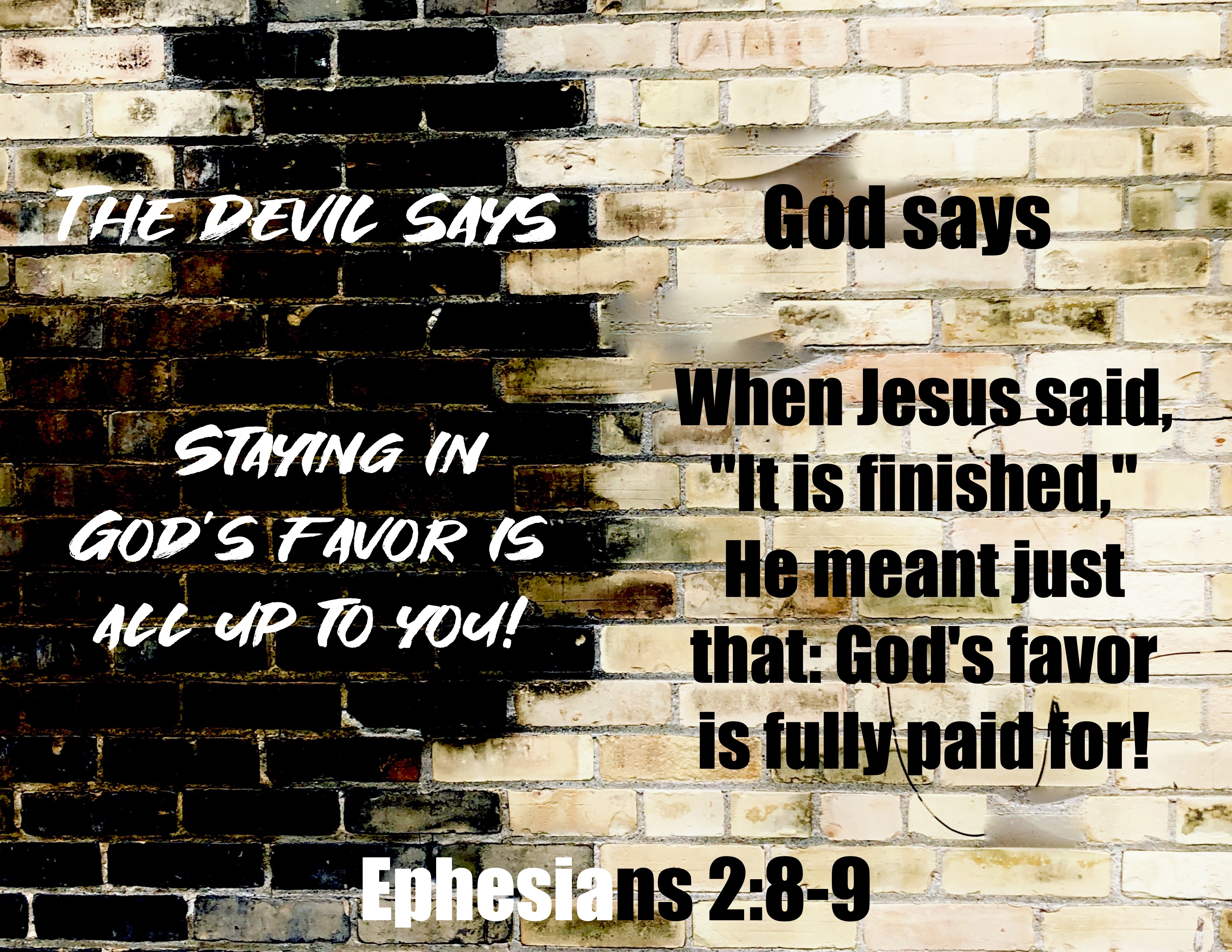
One of the greatest—and most effective—lies that satan keeps whispering is that you have to do something to be saved. Or you have to do something to stay in God’s favor. Or your salvation is hanging by a flimsy thread.
No, no, no! A thousand times no!
When Jesus said, “It is finished,” He meant just that: everything is done. Salvation is a free gift of God’s grace extended to you through faith in Jesus alone. Jesus paid it all, so there is absolutely nothing you or I can add to it. For it is by grace you have been saved, through faith—and this is not from yourselves, it is the gift of God—not by works, so that no one can boast (Ephesians 2:8-9).
Tell the devil he is a liar. Then, as Spurgeon said, look away from yourself and what you think you have to do and look only to the completed work of Calvary. True freedom and eternal joy come to the heart that looks away from itself and keeps its gaze on its Savior! When Jesus said, “It is finished,” He meant it! It is no longer what I must do, but what Jesus already did!