This is a weekly series with things I’m reading and pondering from Charles Spurgeon. You can read the original seed thought here, or type “Thursdays With Spurgeon” in the search box to read more entries.
Listen to the podcast of this post by clicking on the player below, and you can also subscribe on Apple, Spotify, or Audible.
Christians Shouldn’t Be Lazy
A man who wastes his time and his strength in sloth offers himself to be a target for the devil, who is a wonderfully good rifleman and will riddle the idler with his shots: In other words, idle men tempt the devil to tempt them. …
The Lord Jesus tells us Himself that while men slept the enemy sowed the tares. That hits the nail on the head, for it is by the door of sluggishness that evil enters the heart more often, it seems to me, than by any other. …
All are not hunters to wear red coats, and all are not working men who call themselves so. I wonder sometimes that some of our employers keep so many cats that catch no mice. …
I wish all religious people would take this matter under their consideration, for some professors are amazingly lazy and make sad work for the tongues of the wicked. I think a godly plowman ought to be the best man in the field and let no team beat him. When we are at work, we ought to be at it and not stop the plow to talk, even though the talk may be about religion. For then we not only rob our employers of our own time, but of the time of the horses, too.
From John Ploughman’s Talks of Plain Advice For Plain People
Listen to the podcast of this post by clicking on the player below, and you can also subscribe on Apple, Spotify, or Audible.
A couple of weeks ago I asked a question about a fictitious job. Which job would you rather have: a job that’s (a) boring, not utilizing your skills, where you’re treated as a cog in the wheel, or (b) energizing, calling out your best talents, a place where you are making a difference?
As a follow up I asked, “Which of those jobs are you more likely to be happy to go to? Which job is going to inspire you to give your best work ethic?”
We all want that ideal job, but the reality is that in this fallen world there are no perfect jobs, so it’s very likely that we’re going to have the challenging jobs. Even when we have that kind of job, Christians are called to work with excellence and to find joy in that work (Colossians 3:23).
Work originated with God. At the conclusion of every day of Creation, God looked at His magnificent handiwork and pronounced it good. When God placed Adam and Eve in the Garden of Eden, He gave them instructions to work, and even after their sin, He repeated the call to work (Genesis 2:15, 3:17-19).
Whether we are called to be gardeners or evangelists, plumbers or salespeople, teachers or doctors, we are to work well. William Tyndale wrote, “There is no work better than to please God; to pour water, to wash dishes, to be a cobbler, or an apostle, all are one; to wash dishes and to preach are all one, as touching the deed, to please God.”
Let me give you two examples of good workers.
The first is Joseph whom we meet in the first book of the Bible. Out of their jealousy of their father’s preferential treatment of Joseph, his brothers sold him into slavery. Joseph ended up in Egypt working for a man named Potiphar. I don’t think anyone would have blamed Joseph for grumbling about his condition and giving the least effort possible, but instead, Joseph so excelled in his work that Potiphar promoted him over all his household.
After being framed for a crime he didn’t commit, Joseph found himself in prison. Once again, this innocent man could have sulked and complained and shirked his work responsibility. But once again, Joseph did such excellent work that the warden promoted him to a trustee position over all the other prisoners.
Eventually, Joseph was promoted to second in command in all of Egypt, where he continued to do excellent and innovative work. Joseph’s good attitude and impeccable work ethic allowed God to place him in a position where he could save his people from starvation (see Genesis 39-50).
What about the example of Jesus? He was fully God, yet He gave up His divine prerogatives to work as a carpenter and to eventually perform the most important work of all: the willing sacrifice for the sins of all humankind. Paul describes the servanthood and willing attitude of Jesus in Philippians 2, adding an important “therefore” when he tells us that the excellent work of Jesus allowed God to place Him in a position where He could save His people from eternal separation from God (Philippians 2:6-11).
But Paul also has an important word for us in the verse preceding this passage: “Let this same attitude and purpose and humble mind be in you which was in Christ Jesus” (v. 5 AMP).
I may not be able to choose my job, but I can always choose to have a God-glorifying attitude about my job. When I choose this attitude and live it out with an excellent work ethic, God is pleased.
So allow me to give you four attitude-checking questions about your own work ethic:
Do I feel like I have to go to work? I should so crave God’s glory and God’s rewards that I have a get to attitude about my work.
Am I living for T.G.I.F.? We shouldn’t be focused on just getting things done, but we should make the most of every day of work that we have been given. We should be living out T.G.I.T.—Thank God It’s Today (Psalm 90:12, 17)!
Let me repeat an important principle: I may not be able to choose my job, but I can always choose to have a God-glorifying attitude about my job. When you have this kind of attitude, you will experience the joy of a fulfilled craving that God has put in all of us—the desire to do meaningful and God-honoring work. This is the attitude and work ethic God delights to reward.
Listen to the podcast of this post by clicking on the player below, and you can also subscribe on Apple, Spotify, or Audible.
There’s a misconception that many people have about God’s laws: they think that they are intended to rob us of enjoyment, that they restrict our lives and remove our pursuit of happiness.
In actuality, the exact opposite is true. God is love (1 John 4:8). That means everything God does is rooted in His love for us. Including the laws He gives us. He loves us and wants us to stay in the place where we don’t experience the heartache, pain, and disappointment of missing out on His blessings.
God is also happy. Paul calls it “the glory of the blessed God” (1 Timothy 1:11). The word “blessed” can easily be translated as happy. God is happy and He wants us to share in this ultimate happiness.
Consider the blessings that are in first and last of the Ten Commandments:
The first commandment says there is only one God. Far from this being restrictive, it’s a huge blessing. I don’t have to search and compare, I don’t have to make a list of pros and cons and then settle on the best option, but I can enjoy the one and only true God.
The tenth commandment says I don’t need to crave anything outside of what God has given me. Again, this is a huge blessing because it tells me that my loving Father has given me all that I need, that He alone satisfies my cravings.
John Piper gave the essence of idolatry in this line: “Preferring other things above God.” This is why God delights for us to delight in Him. When we do, He is our sole focus. When He is our focus, we enjoy Him immensely and we reject anything that would remove our gaze from Him.
That’s why there is a continuous linkage in all 176 verses of Psalm 119 between God’s laws and our delight—between obedience and satisfaction. When we obey God, we experience His happiness.
The apostle Paul called Christians to live this way: “Whatever happens, conduct yourselves in a manner worthy of the gospel of Christ” (Philippians 1:27). Gospel literally means “good news.” What good news are we supposed to proclaim? The good news that God is happy and that He wants to say to us, “Come and share your Master’s happiness” (Matthew 25:21)!
When I was a kid I struggled with this question: Do I love God just because He first loved me? I thought, “That seems like a cop out. Am I really saying that the only reason I have for loving Him is that He went first?” But then I realized it couldn’t be any other way. How could I love an angry God? How could I ever expect to approach a God who knew all my sins and had the final say on my punishment, and was just waiting for a chance to get His hands on me?
I can only love a loving God. I can only love Him because He first loved me (see Romans 5:8).
In a similar way, I can only crave God because He first craved a relationship with me. Otherwise I’m setting myself up for unimaginable heartbreak and disappointment!
Jesus said it was His Father’s “good pleasure” to reveal Himself to us. No one knows the Son except the Father, and no one knows the Father except the Son. Our heavenly Father craved a relationship with us, so He revealed His Son Jesus to us so that Jesus could reveal the Father to us (see Matthew 11:25-30; John 14:7).
Just as we could only love God because He loved us first, we could only crave a relationship with God because He craved a relationship with us first. It was always His plan to adopt us into His family—this is what gives Him great pleasure (Ephesians 1:5). Then God works in us to fulfill His craving for us, which empowers us to find our deepest longings satisfied exclusively in Him (Philippians 2:13).
Sometimes we get a small taste or experience of earthly pleasure that quickly fades away. C.S. Lewis reminded us, “If I find in myself a desire which no experience in this world can satisfy, the most probable explanation is that I was made for another world.”
Our craving for God is only satisfied in the knowledge that God first craved a relationship with us. Only the intimacy of our Savior will fulfill our cravings. Anything else will end only in utter disappointment.
We have been studying the different sets of gifts listed in the New Testament. These gifts are to bring maturity and health to the church. Previously we have looked at:
Near the end of this lesson, I shared something that I hadn’t included in the handouts, but I promised to share it—
LOVE for God fill us with love for others → there is JOY in knowing His nearness → PEACE comes in the face of anxiety-causing tribulations → which gives me PATIENCE with others who are anxious without God → then I can have KINDNESS to draw them to God → and GOODNESS that is expressed in kind deeds → and my FAITHFULNESS that creates a sense of stick-to-it-iveness → and GENTLENESS that gives me courage to stand up for what’s right → my SELF-CONTROL keeps the fruit of the flesh in-check → which gives me greater LOVE for God and others…
“This is one of the rewards of reading the Old Testament regularly. You keep on discovering more and more what a tissue of quotations from it the New Testament is; how constantly Our Lord repeated, reinforced, continued, refined, and sublimated the Judaic ethics, how very seldom He introduced a novelty.” —C.S. Lewis, Reflections On The Psalms
The folks at Fight The New Drug provide excellent research on the dangers of pornography as well as many helpful resources for folks to break free from a porn addiction. Pornography often attracts people when they are emotionally drained, but viewing porn actually increases feelings of loneliness and isolation.
If we ever start to think the Church is one or two ministers and a whole bunch of parishioners, it really won’t be a Church. According to Ephesians 4, all Christians should be ministers.
You can check out the full message that this clip is from by clicking here.
Here is a word of encouragement for anyone in a time of spiritual warfare—
Wow, this post from T.M. Moore on how we respond to God’s “call” is a much-needed reminder. In the post, he wrote,
“Probably most Christians treat the calling of God as a kind of punctuated equilibrium. He breaks into their lives to ‘call’ them to some activity or task, but only from time to time, and only for that activity or task. He ‘calls’ us to believe the Gospel, and we do. He ‘calls’ us to this or that church, and we go. He ‘calls’ us to some ministry or other Christian activity, and so we participate. He ‘calls’ us to make a special gift, go on a mission trip, send a note of encouragement to a friend, and so forth. Our lives run on their own schedules, so whenever God ‘calls’ us to do something, we’ll try to get it done.
“But most of the time, other things have prior claims on our lives. We have jobs, families, friends, responsibilities, things we like to do or must do. We can’t respond to every calling from God because, well, there just isn’t enough time. We say, when friends press us to consider this or that Christian opportunity, ‘If God calls me to it, I will.’ But aren’t we just using the language of piety to relieve the discomfort of pressure to do something we’d rather not do?
“We are called of God. Of this there is no doubt. But for most Christians, the way they understand God’s calling is not the same as the way God issues it. And they have not yet learned to value His calling as He intends, as the defining and guiding value of our lives.”
Listen to the podcast of this post by clicking on the player below, and you can also subscribe on Apple, Spotify, or Audible.
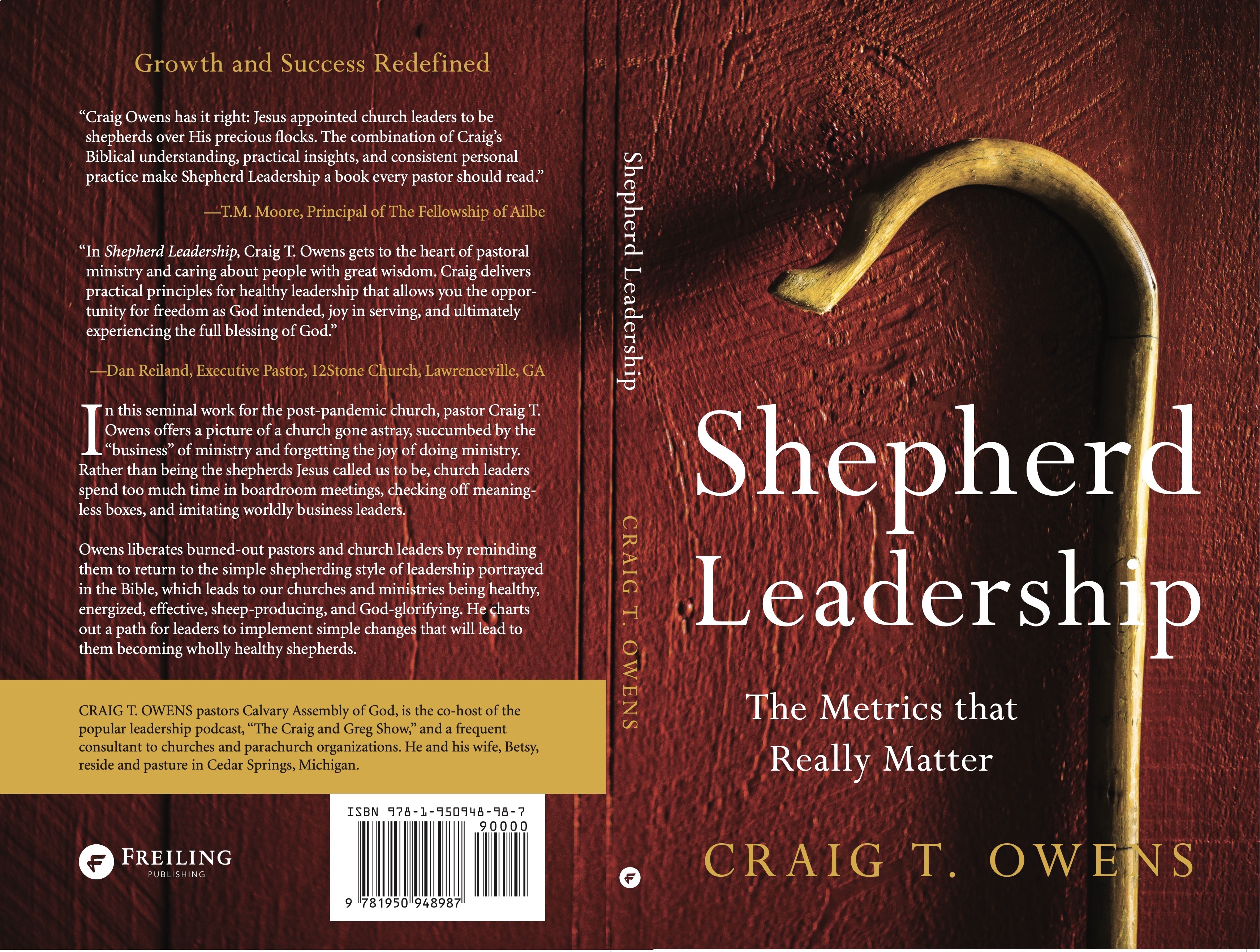
T.M. Moore shares my heartbeat for pastors to align their minds, hearts, and wills to leading as shepherds. T.M. graciously wrote one of the endorsements for my book Shepherd Leadership: The Metrics That Really Matter by saying,
“The combination of Craig’s Biblical understanding, practical insights, and consistent personal practice make this a book every pastor should read. Unless our goals and practices in ministry line up with those Jesus taught and exemplified, we cannot expect Him to bless us with world-uprighting power.”
“Many pastors today seek to model themselves and their ministries along the lines of whichever pastor and whatever church seem to be the most ‘popular’ or ‘successful’ in attracting people. The result is, increasingly, worship services are starting to look alike, and pastors are starting to preach alike. And those who aren’t are wondering what they might do to become more like everybody else.
“We ought not model ourselves on our contemporaries, be they ever so ‘successful.’ Such comparing and adjusting, Paul suggested, is not wise (2 Corinthians 10:12). Jesus is our great model for ministry, and we should look to Him to wash, shape, enliven, empower, and employ every aspect of our lives and ministries for His glory.
“In his sermon, ‘Christ the Example of Ministers,’ Jonathan Edwards offered a concise summary of the reason people submit themselves for ordination to ministry: ‘The work and business of ministers is as it were that of servants, to wash and cleanse the souls of men: for this is done by the preaching of the Word, which is their main business, Ephesians 5:26. “That He might sanctify and cleanse it with the washing of water by the Word.” … It is the duty of ministers of the gospel, in the work of their ministry, to follow the example of their great Lord and Master.’
“Elsewhere Paul talked about spending and being spent for the souls of God’s people (2 Corinthians 12:15). The challenge that faces us who have accepted the call to ministry is to follow the example of Paul (1 Corinthians 11:1) and strive to see Jesus, become like Jesus, work and serve like Jesus, lay down our lives like Jesus, and trust in Jesus to make our labors fruitful for His glory.”
Listen to the podcast of this post by clicking on the player below, and you can also subscribe on Apple, Spotify, or Audible.
It’s a bit scary to me to realize how many people have a scarcity mindset. As a result, far too many people are trying to figure out how to get their piece of the pie, but they don’t really want others to have their piece too. This should never be the mindset of a Christian! Our God has an unlimited supply, so we should be the most generous and abundance-minded people.
Sadly, sometimes I still encounter Christians who think that only some people can claim some of God’s promises.
This is part 5 in our series “Is that in the Bible?”
Statement #5—Old Testament promises are for the Jews, New Testament promises are for the Christians. Is that in the Bible? No!
Jesus Himself said, “Do not think that I have come to do away with or undo the Law or the Prophets; I have come not to do away with or undo but to complete and fulfill them” (Matthew 5:17 AMP).
Plato told a story about people chained in a cave in such a way that they could only see the shadows on the wall. He said that if the chains were unlocked, some would turn toward the opening of the cave, see the solid figures that had been creating the shadows, and move out of the cave. Plato also said that some would see the reality and choose to stay trapped in the cave—they would prefer shadows over reality.
Both John and the writer of Hebrews describe how Jesus came as the incarnate Reality of God. Jesus reveals that He is the Substance behind all of the shadows of worship in the First Testament (Hebrews 1:1-2; John 1:1-14).
Look at the worship practices of the tabernacle, specifically the practices on the Day of Atonement. Two goats or lambs were brought into the outer court on that day—one had all of the sins of the people transferred to it and was sent into the wilderness as the scapegoat, and the other was sacrificed so its blood could make atonement for the sins of the people. The high priest would take this blood past the curtain separating the Holy Place from the Holy of Holies, and would sprinkle it on the atonement cover (also called the mercyseat) of the ark of the covenant of the Lord.
John said that Jesus came to make His dwelling among humans. The word John uses for “dwelling” is the same word for “tabernacle.” Jesus Himself became not only our High Priest, but every single item the earthly high priest used on the Day of Atonement. Jesus is the…
scapegoat—Leviticus 16:20-22; John 1:29
sacrificial lamb—Leviticus 16:15; 1 Peter 1:18-19
curtain in front of the Holy of Holies—Hebrews 10:22
By His life, death, and resurrection the shadows became Substance through Jesus. Hebrews 10:1-14 describes this, but especially note verse 12: “But when this High Priest [Jesus] offered for all time one sacrifice for sins, He sat down at the right hand of God.”
Look again at the picture of the tabernacle and note that there are no chairs. That was because the earthly priest’s work was never done. But our fully human, fully divine High Priest completed everything that needed to be done, so He could sit down.
This High Priest not only sits down in God’s presence, but He takes us with Him into the Holy of Holies: “God raised us up with Christ and seated us with Him in the heavenly realms in Christ Jesus” (Ephesians 2:6)!
So now ALL God’s promises are for ALL who are in Jesus! “For no matter how many promises God has made, they are ‘Yes’ in Christ. And so through Him the ‘Amen’ is spoken by us to the glory of God” (2 Corinthians 1:20).
I like how the Personalize Promise Bible turns that verse into this prayer: “My heavenly Father is faithful to His every Word. No matter how many promises He has made, in Jesus, He makes good on every one. I have God’s Word; therefore, I have God’s will. Every time that I pray in line with His Word, the answer is guaranteed.”
My friend, if you have placed your faith in the completed work of Jesus, then EVERY promise in the Bible is a promise you can claim for your life. Hallelujah! What an amazing thing God has done for us through His Son Jesus Christ!
Listen to the podcast of this post by clicking on the player below, and you can also subscribe on Apple, Spotify, or Audible.
C.S. Lewis, like many atheists, wondered if the God of the Bible might be an egomaniac because He is always encouraging people to praise Him. In his book Reflections on the Psalms, Lewis wrote a thoughtful response to this after he had become a Christian:
“Just as men spontaneously praise whatever they value, so they spontaneously urge us to join them in praising it. ‘Isn’t she lovely? Wasn’t it glorious? Don’t you think that magnificent?’ … I think we delight to praise what we enjoy because the praise not merely expresses but completes the enjoyment; it is its appointed consummation. It is not out of compliment that lovers keep on telling one another how beautiful they are; the delight is incomplete till it is expressed. … This is so even when our expressions are inadequate, as of course they usually are. But how if one could really and fully praise even such things to perfection—utterly ‘get out’ in poetry or music or pain the upsurge of appreciation which almost bursts you? Then indeed the object would be fully appreciated and our delight would have attained perfect development. The worthier the object, the more intense this delight would be.”
His phrase, “our expressions are inadequate” is especially true when we are attempting to appreciate and praise the Infinite, the Eternal, the Omnipresence, the Omnipotence of our God and Savior! But the biblical authors call for Christians to mature in this—we want to keep praising, keep expressing, until we finally find the perfect fulfillment in His presence.
Paul talks about the maturing nature of love—when I was a child, I talked like a child, I thought like a child, I reasoned like a child (1 Corinthians 13:11)—but then he prays for us to grow in both our understanding and our expressions of our Savior’s love (Ephesians 1:17-19).
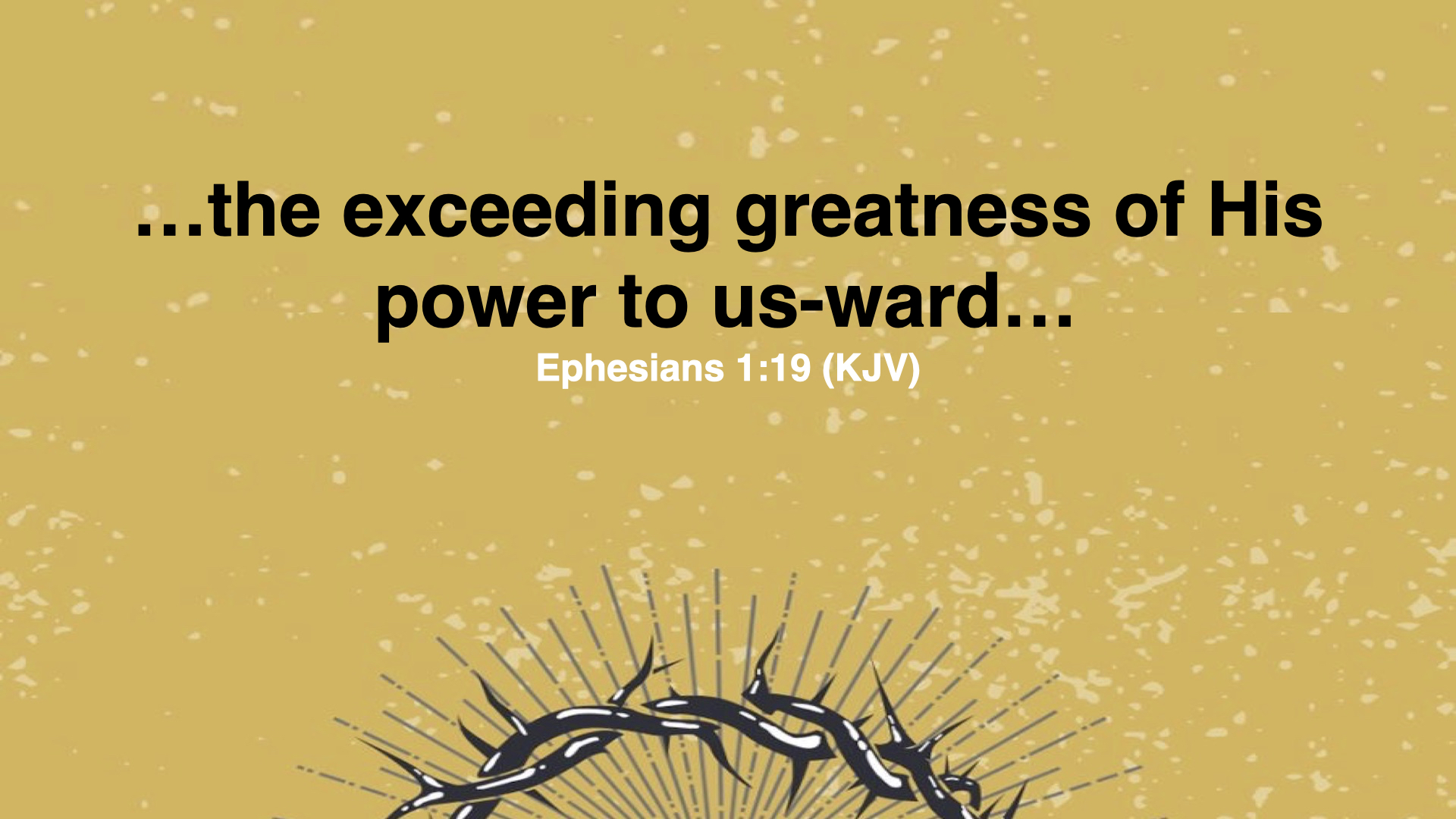
I like the wording of Ephesians 1:19 in the King James Version: the exceeding greatness of His power to us-ward. The word “exceeding” means God pours out in a way that is beyond human imagining. The Greek word that Paul uses for “greatness” is only used here, and it reinforces the truth that God is beyond our full comprehension. And then Paul adds that this overflowing, incomparable power is directed “to us-ward”!
Paul then prays for us to be able to understand ever-increasing new dimensions of this transcendent power and ability that God directs to us through His Son Jesus, and for us to be able to express it (Ephesians 3:14-19). In other words, we are to grow in our experience of Jesus so that we can grow in our praise to Jesus.
The incomparable Jesus means at least four things for us. It means Jesus is…
…beyond comparison. Isaiah, God Himself, and the psalmists ask rhetorically, “Who is like God? Who could ever compare to Him?” (Isaiah 40:13-14, 18, 25; Psalm 89:5-8).
…matchless in His power. Isaiah 40:12 says God holds the waters of the world in the hollow of His hand. How much water is this? Scientists estimate the Earth’s water supply to be 326 quintillion gallons of water (that’s 326 followed by 18 zeros)! Not only does God hold all of the water, but He directs its activities on behalf of His children (Exodus 15:11-13).
…unequaled in knowledge.Isaiah 40:12, 26 tell us that all of the stars in our universe fit onto God’s outstretched hand, and that He knows all of the stars by name. How many stars is this? Astronomers calculate the heavens to contain 10 septillion stars (that’s 10 followed by 24 zeros)! Not only does God know each star by name, He knows each human by name, and thesmallest of details about each of them (Isaiah 49:16; Matthew 10:29-31).
…inimitable in His care. We humans can get to the end of our strength, but God never does. He cares for us unlike anyone else or anything else ever can (Isaiah 40:28-31). The Lord hears His people when they call to Him for help. He rescues them from all their troubles (Psalm 34:17).
Knowing we have a Savior like this, why would you ever settle for anything less The Genuine?!
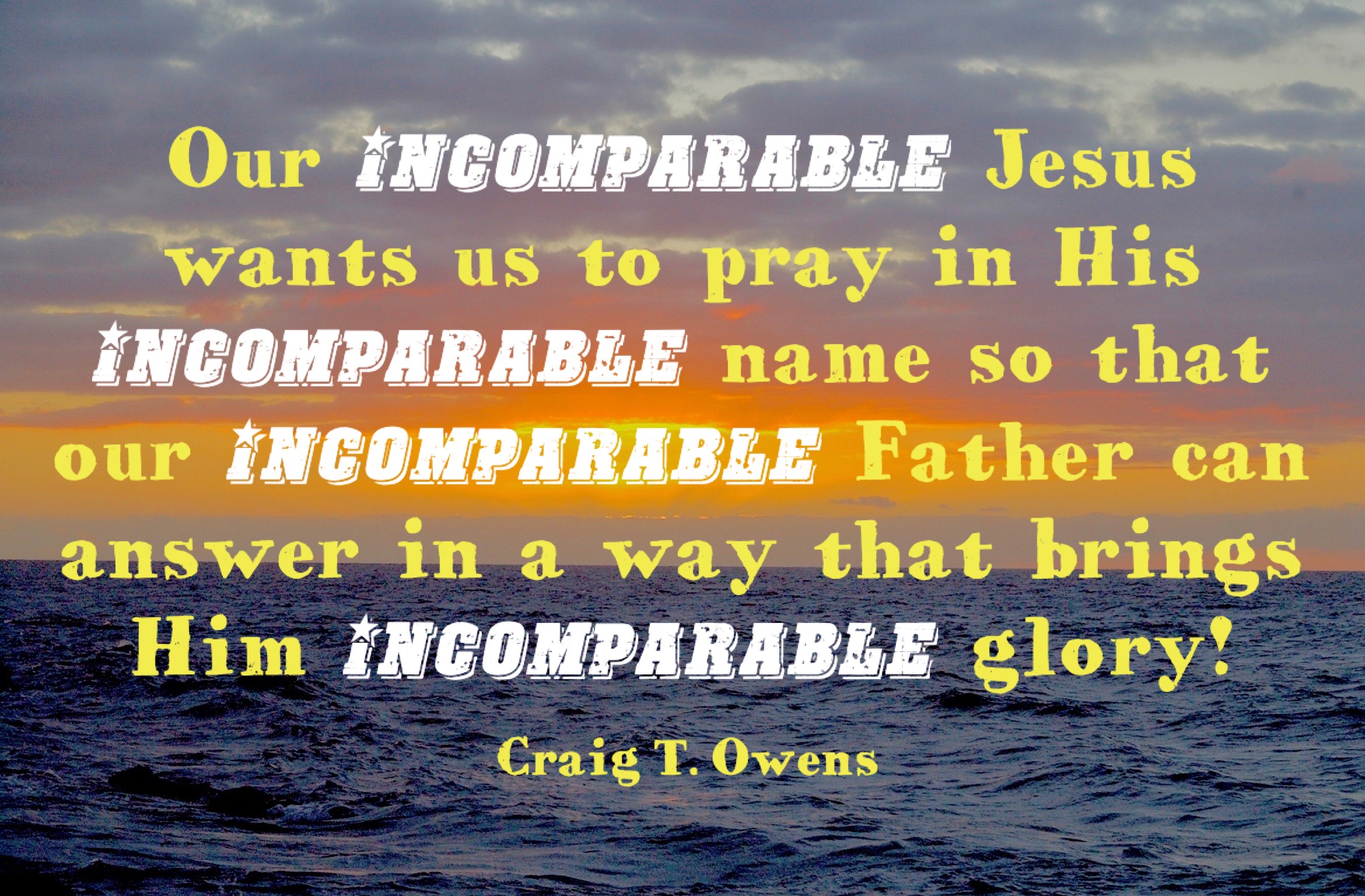
Our incomparable Jesus wants us to pray in His incomparable name so that our incomparable Father can answer in a way that brings Him incomparable glory! We’re helped, He’s lifted up, and others are drawn to Him.