


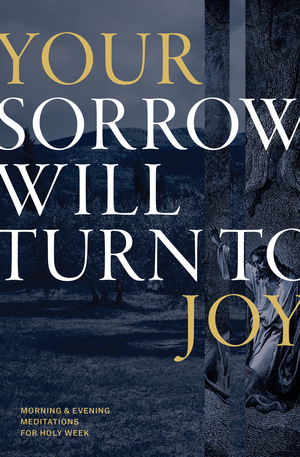
 This is from a chapter in Your Sorrow Will Turn To Joy, and is probably one of the best depictions of Good Friday I have read. Jon Bloom writes—
It is Friday, April 3, A.D. 33. It is the darkest day in human history, though most humans have no clue of this. In Rome, Tiberius attends to the demanding business of the empire. Throughout the inhabited world, babies are born, people eat and drink, marry and are given in marriage, barter in marketplaces, sail merchant ships, and fight battles. Children play, old women gossip, young men lust, and people die.
But today, one death, one brutal, gruesome death, the worst and best of all human deaths, will leave upon the canvas of human history the darkest brushstroke. In Jerusalem, God the Son, the Creator of all that is (John 1:3), will be executed.
The Garden
The Jewish day dawns with night, and never has it been more fitting, since today the hour has come and the power of darkness (Luke 22:53). Jesus is in Gethsemane, where He has prayed with loud cries and tears, being heard by His Father (Heb. 5:7) whose will will be done. Jesus hears noises and looks up. Torches and hushed voices signal the arrest party’s arrival.
Jesus wakes His sleepy friends who are jarred alert at the sight of their brother, Judas, betraying his Rabbi with a kiss. Soldiers and servants encircle Jesus. Peter, flushed with anger, pulls out his sword and lunges at those nearest Jesus. Malchus flinches, but not enough. Blinding pain and blood surge where his ear had been. Voices speak, but Malchus only hears the screaming wound, which he’s grabbed with both hands. He feels a hand touch his hands and the pain vanishes. Under his hands is an ear. Stunned, he looks at Jesus, already being led away. Disciples are scattering. Malchus looks down at his bloody hands.
The Sanhedrin
Jesus is led brusquely into the house of Annas, a former High Priest, who questions Him about His teaching. Jesus knows this informal interrogation is meant to catch Him disoriented and unguarded. He is neither, and gives this manipulative leader nothing. Rather, He refers Annas to his hearers and is struck with irony by a Jewish officer for showing disrespect. Frustrated, Annas sends Jesus on to his son-in-law Caiaphas, the current High Priest.
At Caiaphas’s house the trial gets underway quickly. Morning will come fast. The Council needs a damning verdict by daybreak. The examination proceeds as bleary-eyed Sanhedrin members continue to file in.
The trial has been assembled hastily and witnesses haven’t been screened well. Testimonies don’t line up. Council members look disconcerted. Jesus is silent as a lamb. Irritated and impatient, Caiaphas cuts to the quick: “I adjure You by the living God, tell us if you are the Christ, the Son of God” (Matt. 26:63). The hour has come. Charged in the name of His Father to answer, Jesus speaks the words that seal the doom for which He had come to endure (John 12:27): “You have said so. But I tell you, from now on you will see the Son of Man seated at the right hand of Power and coming on the clouds of heaven” (Matt. 26:64).
In a moment of law-breaking (Lev. 21:10) politically religious theater, Caiaphas tears his robes in feigned outrage and thinly concealed relief over Jesus’s blasphemy. He declares the trial’s end with, “What further testimony do we need? We have heard it ourselves from His own lips” (Luke 22:71).
As the sun breaks over Jerusalem’s eastern ridge, Judas swings from his own belt, Peter writhes in the grief of his failure, and Jesus’s face is streaked with dried blood and saliva from the pre-dawn sport of the temple police. The Council’s verdict: guilty of blasphemy. Their sentence: death. But it’s a sentence they cannot carry out. Rome refuses to delegate capital punishment.
The Governor
Pilate’s mood, already sour over the Sanhedrin’s sudden insistent intrusion so early in the morning, worsens as he grasps the situation. They want him to execute a Galilean “prophet.” His seasoned instincts tell him something isn’t right. He questions Jesus and then tells the Council, “I find no guilt in this Man” (Luke 23:4).
A game of political chess ensues between Pilate and the Sanhedrin, neither realizing that they are pawns, not kings. Pilate makes a move. As a Galilean, Jesus falls under Herod Antipas’s jurisdiction. Let Herod judge. Herod initially receives Jesus happily, hoping to see a miracle. But Jesus refuses to entertain or even respond. Antipas, disappointed, blocks the move by returning Jesus to Pilate.
Pilate makes another move. He offers to release Jesus as this year’s annual Passover pardoned prisoner. The Council blocks the move. “Not this man, but Barabbas!” they cry (John 18:40). Pilate is astounded. The Sanhedrin prefers a thief and murderer to this peasant prophet?
Pilate tries another move. He has Jesus severely flogged and humiliated, hoping to curb the Council’s blood thirst. Again the move is blocked when the Council insists that Jesus must be crucified because “He has made Himself the Son of God” (John 19:7). Check. Pilate’s fear grows. Jesus’s divine claim could threaten Rome. Worse, it could be true. Roman deities supposedly could take on human form. His further questioning of Jesus unnerves him.
One last move. Pilate tries to persuade the Sanhedrin to release Jesus. One last block and trap. “If you release this Man, you are not Caesar’s friend. Everyone who makes himself a king opposes Caesar” (John 19:12). The Council has Pilate where they want him: cornered. Checkmate.
And the triune God has the Council, Pilate, and satan where He wants them. They would have no authority over the Son at all unless it had been given them from above (John 19:11). Fallen Jews, Gentiles, and spiritual powers unwittingly collaborate in executing the only innocent death that could possibly grant the guilty life. Checkmate.
The Cross
Morning wanes as Jesus stumbles out of the Praetorium, horribly beaten and bleeding profusely. The Roman soldiers had been brutal in their creative cruelty. Thorns have ripped Jesus’s scalp and His back is one grotesque, oozing wound. Golgotha is barely a third of a mile through the Garden Gate, but Jesus has no strength to manage the forty-pound crossbar. Simon of Cyrene is drafted from the crowd.
Twenty-five minutes later, Jesus is hanging in sheer agony on one of the cruelest instruments of torture ever devised. Nails have been driven through His wrists (which we only know about because of the doubt Thomas will express in a couple days—see John 20:25). A sign above Jesus declares in Greek, Latin, and Aramaic who He is: the King of the Jews.
The King is flanked on either side by thieves and around Him are gawkers and mockers. “Let Him save Himself, if He is the Christ of God, His Chosen One!” some yell (Luke 23:35). One dying thief even joins in the derision. They do not understand that if the King saves Himself, their only hope for salvation is lost. Jesus asks His Father to forgive them. The other crucified thief sees a Messiah in the mutilated man beside him, and he asks the Messiah to remember him. Jesus’s prayer is beginning to be answered. Hundreds of millions will follow.
It is mid-afternoon now and the eerie darkness that has fallen has everyone on edge. But for Jesus, the darkness is a horror He has never known. This, more than the nails and thorns and lashings, is what made Him sweat blood in the garden. The Father’s wrath is hitting Him in full force. He is in that moment no longer the Blessed, but the Cursed (Gal. 3:13). He has become sin (2 Cor. 5:21). In terrifying isolation, cut off from His Father and all humans, He screams, “Eli, Eli, lema sabachthani,” Aramaic for “My God, My God, why have You forsaken Me?” (Matt. 27:46; Ps. 22:1). No greater love (John 15:13), humility (Phil. 2:8), or obedience (Heb. 5:8) has ever or will ever be displayed.
Shortly after 3:00 P.M., Jesus whispers hoarsely for a drink. In love, He has drained the cup of His Father’s wrath to the dregs. He has born our full curse. There is no debt left to pay and He has nothing left to give. The wine moistens His mouth just enough to say one final word: “It is finished” (John 19:30). And God the Son dies.
It is the worst and best of all human deaths. For on this tree He bears our sins in His body (1 Pet. 2:24), “the righteous for the unrighteous, that He might bring us to God” (1 Pet. 3:18). And now it is finished.
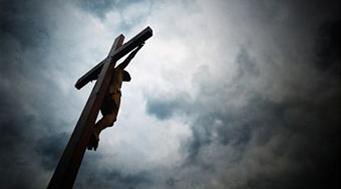


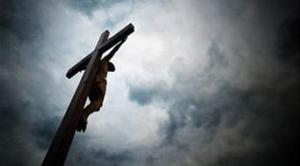 “See Him; like a cart pressed down with sheaves He goes through the streets of Jerusalem. Well may you weep, daughters of Jerusalem, though He bids you dry your tears; they hoot Him as He walks along bowed beneath the load of His own Cross which was the emblem of your sin and mine. They have brought Him to Golgotha. They throw Him on his back, they stretch out His hands and His feet. The accursed iron penetrates the tenderest part of His body, where most the nerves do congregate. They lift up the Cross. O bleeding Savior, Thy time of woe has come! They dash it into the socket with rough hands; the nails are tearing through His hands and feet. He hangs in extremity, for God has forsaken Him; His enemies persecute and take Him, for there is none to deliver Him. They mock His nakedness; they point at His agonies. They look and stare upon Him with ribald jests; they insult His griefs, and make puns upon His prayers. He is now indeed a worm and no man, crushed till you can think scarcely that there is divinity within. The fever gets hold upon Him. His tongue is dried up like a potsherd, and He cries, ‘I thirst!’ Vinegar is all they yield Him; the sun refuses to shine, and the thick midnight darkness of that awful mid-day is a fitting emblem of the tenfold midnight of His soul. Out of that thick horror He cries ‘My God, My God, why hast Thou forsaken Me?’ Then, indeed, was He pressed down! O there was never sorrow like unto His sorrow. All human griefs found a reservoir in His heart, and all the punishment of human guilt spent itself upon His body and His soul.


 Craig T. Owens
6 More Quotes From “Light & Truth—Acts and the Larger Epistles”
February 17, 2016 — Craig T. Owens“We are described as feeble men, bearing on our shoulders a burden too heavy to be borne; the Holy Spirit comes up to us; not exactly to take away the burden; nor to strengthen us under it; but to put His own Almighty shoulder under it, in the room of, and along with ours; thus lightening the load, though not changing it; and bearing the heavier part of it with His own Almightiness. Thus it is that He ‘helps’ our infirmities; making us to feel both the burden and the infirmity all the while that He helps; nay, giving us such a kind and mode of help, as will keep us constantly sensible of both.” [Romans 8:26]
“How real, how true, how fast must that love have been. Here is its sincerity demonstrated. Here are its dimensions measured. What is its height? The answer is, ‘He spared not His Son.’ What is its depth? ‘He spared not His Son.’ What is its length? ‘He spared not His Son.’ What is its breadth? ‘He spared not His Son.’ Nay, He delivered Him up. Nay, He laid our sins upon Him; He made Him a curse for us. The more that we meditate on this one gift, the more does its greatness display itself. It passeth all measurement and all understanding.” [Romans 8:32]
“Prayer takes for granted that God is full, and we are empty; that He is infinitely full, and we unspeakably empty. … Prayer takes for granted that there is a connection between His fullness and our emptiness. The fullness is not inaccessible. It is not too high for us to reach, or for it to stoop. It is not too great for us, nor too distant, so as to be incommunicable. There is a connection, and it has been established by God Himself; it is a divine medium of communication: ‘Ask, and you shall receive.’ Prayer takes for granted that we are entitled to use this channel.” [Romans 12:12]
“If you are Christians then, be consistent. Be Christians out and out; Christians every hour, in every part, and in every matter. Beware of half-hearted discipleship, of compromise with evil, of conformity to the world, of trying to serve two masters. … Half-hearted Christianity will only dishonor God, while it makes you miserable. There is abundance of Christianity, so-called, in our day. Who does not call himself a Christian? But who cultivates the holiness, the blamelessness, the devotedness, the calm consistency of a follower of Christ? Who hates sin as it ought to be hated? Who separates from the world as he ought? Who follows Christ as He ought to be followed? Who walks in the footsteps of the holy Son of God?” [1 Corinthians 1:8]
“Let us walk worthy [of the blessings in Christ Jesus]; as men who really believe it; happy, holy, unworldly, zealous, generous, loving. Let us carry the consciousness of our calling into everything—great or small; into business, daily life, recreations, reading, education, everything; maintaining our true position before men; manifesting our proper character; letting the world know our prospects, and doing nothing inconsistent with what we profess to be now, and with what we shall be when the Lord comes.” [1 Corinthians 1:9]
“Thus, then, is our whole earthly life, in all its parts, to be regulated by the magnitude of the eternal. Things present must be subordinated to those which are to come, the seen to the unseen, the earthly to the heavenly. It is by the light of the coming glory that we must walk while here. It is from the clock of eternity that our time is to be always taken. Arrange your business, your recreations, your duties with reference to the invisible and unending future. Live, speak, work, move, as those who believe that the things which are seen are temporal, but the things which are not seen are eternal.” [1 Corinthians 7:29-31]
The first set of quotes I shared from this book can be read here. And my review of this book is posted here.
Share this: