What Does The Bible Say About Church Leaders?

God’s plan has always been for His leaders to organize and oversee His ministry.

The important thing for us to distinguish is “His.” It’s not a man or woman saying, “I will be a leader,” or even a God-appointed leader saying, “I am going to build up my ministry.”

The New Testament gives us a fourfold purpose for the Body of Christ:

  1. Mobilizing for evangelism
  2. Organizing for more meaningful ministry
  3. Making disciple-makers
  4. Caring for one another

We see God’s leaders involved in all of these aspects—

Mobilizing for evangelism—Peter pointed out the need for an apostle to be appointed to replace Judas, thus returning their ranks to the 12 apostles just as Jesus had originally said (Acts 1:15-22).

Organizing for more meaningful ministry—Everywhere Paul founded a church, he also appointed leaders to oversee and shepherd that church.

Making disciple-makers—Paul tells us that God appointed five offices of leaders in the church who had the specific task of preparing church members to do the ministry of building maturity in the church (Ephesians 4:11-16).

Caring for one another—The First Church set the pace for providing care for all who were in need, including organizing leaders to oversee specific care ministries (Acts 6:1-5).

What about a church congregation’s responsibility to their leaders? I see five areas:

  1. Hold them accountable to the Word (Acts 17:11). The Bible has to be THE standard to which leaders are held.
  2. Give them your confidence and submission after they have shown accountability to their biblical mandate (Hebrews 13:17).
  3. Pray for them (Ephesians 6:19).
  4. Pay them (1 Timothy 5:17).
  5. Be very careful about accusing them (1 Timothy 5:19).

A church and its leaders following this biblical pattern is a church that can effectively fulfill the Great Commission which Jesus gave us.

A Leader’s Grace And Power

None of them could stand against the wisdom and the Spirit with which Stephen spoke. (Acts 6:10)

Here’s a truth we can all stand on: The man with an experience is never at the mercy of a man with an argument.

A large group of people wanted to debate with Stephen about his belief in Jesus Christ. I’m sure that these debaters had some excellent points. But they couldn’t win the debate with Stephen because he had something they didn’t have: grace and power from God that was irrefutable!

Stephen’s words were backed up and verified by a lifestyle that was undeniable—

Stephen, a man full of God’s grace and power, performed amazing miracles and signs among the people. But one day some men from the Synagogue of Freed Slaves, as it was called, started to debate with him. They were Jews from Cyrene, Alexandria, Cilicia, and the province of Asia. None of them could stand against the wisdom and the Spirit with which Stephen spoke. (Acts 6:8-10)

“Knowing that we have God’s ability in us, should give us the confidence to lead well when others don’t approve of or appreciate our leadership.” —Liz Sarno

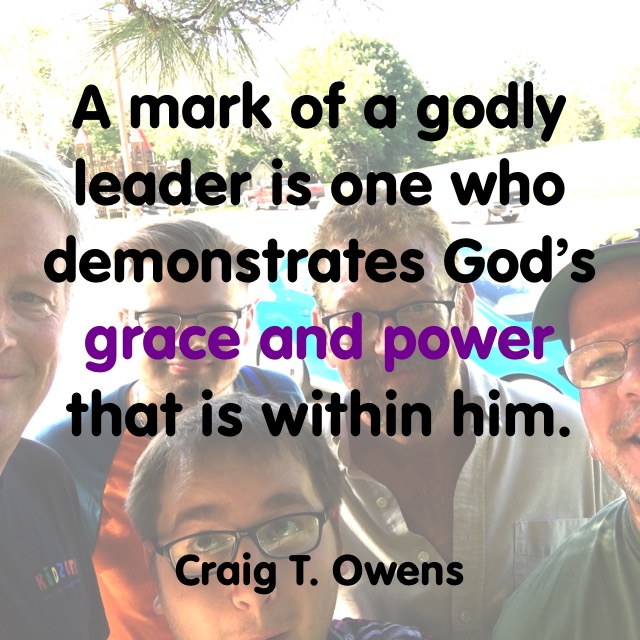
A mark of a godly leader is one who demonstrates God’s grace and power that is within him.

This is Part 8 in my series on godly leadership. To read my other posts, please click here.

Are There Ghosts?

As a part of our annual Q Series, this was a question that was turned in: Are there ghosts?

Check out the video below…

The Scriptures I reference in this answer:

For other Q&As from this series, check out discussions about the Bible here, and questions about the mark of the beast here, and a question about a Christian losing his/her salvation here.

Thursdays With Oswald—God Has A Plan For Your Life

Oswald ChambersThis is a weekly series with things I’m reading and pondering from Oswald Chambers. You can read the original seed thought here, or type “Thursdays With Oswald” in the search box to read more entries.

God Has A Plan For Your Life

     “Before I formed thee…I knew thee…” [Jeremiah 1:5]. There are prenatal forces of God at work in a man’s life which he may be unconscious of for long enough; but at any moment there may break upon him the sudden consciousness of this incalculable, supernatural surprising power that has got hold of his life before he has got hold of it himself.  

     Another force at work is the prayers of other people. You are born into this world and will probably never know to whose prayers your life is the answer. … Our lives are the answers not only to the prayers of other people, but to the prayer the Holy Spirit is making for us, and to the prayer of Our Lord Himself. …  

     When once Paul realized God’s call and knew the meaning of his life, there was no competitor for his strength. Is there anything competing for our strength in our devotion to the call of God?

From So Send I You

Isn’t it amazing to think that not only has God had a plan for your life before you even arrived on earth, but that your life is an answer to prayer?!

The Apostle Paul lived the first part of his life oblivious to God’s call. But once he had his encounter with Jesus, his whole focus and passion changed (see Acts 9:15-16; Galatians 1:15-16).

What about you?

  • Have you realized that God has a plan for your life?
  • Are you living like you are an answer to prayer?
  • Is there anything competing for your attention that is keeping you from being “all in” for God?

The Cure For Spiritual Fanaticism

“Some time after Pentecost a group of believers met to pray for strength and power to meet the emergency then facing them, and to enlist the help of God on their behalf. ‘And when they had prayed, the place was shaken where they were assembled together; and they were all filled with the Holy Ghost, and they spake the Word of God with boldness’ (Acts 4:31). Some of these were of the original number filled at Pentecost. It is hardly conceivable that God acted contrary to His own will in filling them again after Pentecost. Still other outpourings are recorded in Acts 8, Acts 10 and Acts 19. All these occurred some years after the original act.

“In brief, the teaching of the New Testament is that the outpouring at Pentecost was the historic beginning of an era which was to be characterized by a continuous outpouring of the Holy Spirit. …

“This anti-emotionalism, though it is sponsored by some good people and travels in pretty orthodox company, is nevertheless an unwarranted inference, not a scriptural doctrine, and is in violent opposition to psychology and common sense. Where in the Bible are feeling and faith said to be at odds? The fact is that faith engenders feeling as certainly as life engenders motion. We can have feeling without faith, it is true, we can never have faith without feeling. Faith as a cold, unemotional light is wholly unknown in the Scriptures. …

“The Holy Spirit is the cure for fanaticism. Not the cause of it.”

—A.W. Tozer, in Paths To Power

8 Quotes From “Paths To Power” by A.W. Tozer

As I said in my book review, A.W. Tozer’s words frequently make me say both “Ouch!” and “Amen!” Maybe you’ll feel the same thing in these few quotes.

“Left to herself the Church must have perished as a thousand abortive sects had done before her, and have left nothing for a future generation to remember. That the Church did not so perish was due entirely to the miraculous element within her. That element was supplied by the Holy Spirit who came at Pentecost to empower her for her task. For the Church was not an organization merely, not a movement, but a walking incarnation of spiritual energy. …

“In short, the Church began in power, moved in power, and moved just as long as she had power. When she no longer had power she dug in for safety and sought to conserve her gains. But her blessings were like manna: when they tried to keep it overnight it bred worms and stank. So we have had monasticism, scholasticism, institutionalism; and they have all been indicative of the same thing: absence of spiritual power.” 

“The weakness in our message today is our overemphasis on faith with a corresponding underemphasis on obedience. This has been carried so far that ‘believe’ has been made to double for ‘obey’ in the minds of millions of religious persons.”

“In every denomination, missionary society, local church, or individual Christian this law operates. God works as long as His people live daringly; He ceases when they no longer need His aid.” 

“To any casual observer of the religious scene today, two things will at once be evident: one, that there is very little sense of sin among the unsaved, and two, that the average professed Christian lives a life so worldly and careless that it is difficult to distinguish him from the unconverted man.”

“It is always dangerous to isolate a truth and then press it to its limit without regard to other truth.”

“It may be stated as an axiom of the Christian system that whatever makes sin permissible is a foe of God and an enemy of the souls of men.”

“Some time after Pentecost a group of believers met to pray for strength and power to meet the emergency then facing them, and to enlist the help of God on their behalf. ‘And when they had prayed, the place was shaken where they were assembled together; and they were all filled with the Holy Ghost, and they spake the Word of God with boldness’ (Acts 4:31). Some of these were of the original number filled at Pentecost. It is hardly conceivable that God acted contrary to His own will in filling them again after Pentecost. Still other outpourings are recorded in Acts 8, 10 and 19. All these occurred some years after the original act.

“In brief, the teaching of the New Testament is that the outpouring at Pentecost was the historic beginning of an era which was to be characterized by a continuous outpouring of the Holy Spirit.”

“This anti-emotionalism, though it is sponsored by some good people and travels in pretty orthodox company, is nevertheless an unwarranted inference, not a scriptural doctrine, and is in violent opposition to psychology and common sense. Where in the Bible are feeling and faith said to be at odds? The fact is that faith engenders feeling as certainly as life engenders motion. We can have feeling without faith, it is true, we can never have faith without feeling. Faith as a cold, unemotional light is wholly unknown in the Scriptures.”

The Dawn Of Christianity (book review)

Sometimes when people are reading the Gospels and the Book of Acts in the New Testament of the Bible they forget what an accurate history is presented at a pivotal time in world events. In The Dawn Of Christianity, Robert J. Hutchinson makes the history behind, surrounding, and after the biblical accounts come to life in a fresh way.

The Dawn Of Christianity tells the history surrounding Jesus of Nazareth and His followers almost in a novel-like format. Hutchinson masterfully puts together the four Gospel accounts and Luke’s history of the early church in chronological order, and then brings in archaeological, geographic, and anthropological resources like a supporting cast to the biblical account. Along the way, we are introduced to extra-biblical characters, places, and customs that add a new depth of understanding to the history presented in Scripture.

Hutchinson notes, “Recent archaeological discoveries are showing that the New Testament in general, and the Gospels in particular, are far more reliable historical sources than previous generations of New Testament experts realized.” Indeed, he makes good use of as many pertinent finds as possible to enhance his storytelling.

The Dawn Of Christianity spans the time from just before the birth of Jesus Christ of Nazareth and then tracks the spread of Christianity for about 20 years following Christ’s ascension into heaven. It’s a fascinating and enlightening story for both Bible aficionados and skeptics alike.

I am a Thomas Nelson book reviewer.

The Promised Power Of Pentecost

When the Israelites were delivered from Egypt on the night of Passover, fifty days later they arrived at Mount Sinai where God delivered the Ten Commandments to them. This became the birth of the Jewish nation. For millennia following this, not only did the Jewish people observe Passover but they also celebrated “The Feast of Weeks” (also known as Pentecost) fifty days following Passover.

But on the first Pentecost after Christ ascended to Heaven, something amazing happened which was a game-changer for the new Christians. An event which became the birth of the Christian nation.

On that Pentecost Sunday, the Holy Spirit was poured out on Christ’s followers in a way never before seen in history. Although this had never been seen before, it was the fulfillment of something God had promised thousands of years before.

  1. Promised

This blessing of the Holy Spirit had been hinted at when God first called Abraham, as He promised that from Abraham would come a blessing for all peoples on earth (Genesis 12:3). Jesus said that this blessing would be realized with the outpouring of the Holy Spirit, and then Peter tied the Day of Pentecost experience to the fulfillment of those promises (Acts 2:38-39).

  1. Commanded

Jesus had this empowerment of the Holy Spirit and He wanted all of His followers to have it too, so His directive to His follower is not a suggestion. Twice when Jesus tells His followers to receive the baptism in the Holy Spirit, the verbs He uses are commands (see Luke 24:49 and Acts 1:4).

  1. Normal Experience

For the first Christians, the baptism in the Holy Spirit was a normal experience for them following salvation. This baptism gave them power to…

  1. Initial Evidence

The baptism in the Holy Spirit is accompanied by an initial physical evidence of speaking in a language you’ve never studied. This is to be an unmistakable proof—primarily to you—of the Spirit’s outpouring. But the ongoing development of Christlike character is the continual evidence of the baptism in the Holy Spirit.

So what’s the controversy? Why do people spend so much time arguing this baptism isn’t for us, or for now? If we start down that path, what else are we going to say is outdated or exclusive for some?

Doesn’t it seem much more logical to simply accept what God promised all His people?!

So here’s the question I would ask you—Have you been baptized in the Holy Spirit? If not, why not?

8 Quotes From “Born After Midnight”

A.W. Tozer’s writings are nearly five decades old, but they still ring with prophetic truth for this generation. Check out my book review of Born After Midnight by clicking here. Below are a few of the quotes from this book.

“It may be said without qualification that every man is as holy and as full of the Spirit as he wants to be. He may not be as full as he wishes he were, but he is most certainly as full as he wants to be. … The problem is not to persuade God to fill us, but to want God sufficiently to permit Him to do so.”

“In of book of Acts, faith was for each believer a beginning, not an end; it was a journey, not a bed in which to lie while waiting for the day of our Lord’s triumph. Believing was not a once-done act; it was more than an act, it was an attitude of heart and mind that inspired and enabled the believer to take up his cross and follow the Lamb whithersoever He went.”

“I am afraid we modern Christians are long on talk and short on conduct. … Our Lord and His apostles were long on deeds. The Gospels depict a Man walking in power, ‘who went about doing good, and healing all that were oppressed of the devil; for God was with Him’ (Acts 10:38). The moral relation between words and deeds appears quite plainly in the life and teachings of Christ; He did before He spoke, and all the doing gave validity to the speaking.”

“We settle for words in religion because deeds are too costly. It is easier to pray, ‘Lord, help me to carry my cross daily’ than to pick up the cross and carry it.”

“‘Whoever will be great among you, let him be your minister,’ said our Lord (Matthew 20:26), and from these words, we may properly conclude (and the context strongly supports the conclusion) that there is nothing wrong with the desire to be great provided (1) we seek the right kind of greatness; (2) we allow God to decide what is greatness; (3) we are willing to pay the full price that greatness demands; and (4) we are content to wait for the judgment of God to settle the whole matter of who is great at last.”

“God may allow his servant to succeed when He has disciplined him to a point where he does not need to succeed to be happy. The man who is elated by success and cast down by failure is still a carnal man. … God will allow His servant to succeed when he has learned that success does not make him dearer to God nor more valuable in the total scheme of things.”

“While we cannot determine circumstances, we can determine our reaction to them. And there is where the battle is to be fought and the victory won.”

“To ‘accept the universe’ does not mean that we are to accept evil conditions as inevitable and make no effort to improve them. So to teach would be to cancel the plain teaching of the Scriptures on that point. Where a situation is contrary to the will of God, and there are clear promises concerning it in the Scriptures, it is our privilege and obligation to pray and labor to bring about change.”

More quotes from this book are coming soon…

No Apathetic Christians Allowed!

Healthy love loves God and then serves God by loving and serving others. Quite simply—love loves.

But my question is how does love love?

Sometimes we can get a fuller definition of a word by looking at its opposite. So what’s the opposite of love? It isn’t hate because hate is actually the flip side of love. That means our hatred for anything that comes against the object of our love is just as strong as our love is.

The opposite of love is apathy.

Apathy means without pathos (or feeling). Specifically, without feeling that moves us to action. So in order for love to love, it needs pathos as its fuel.

For example. If you hear a coworker mention her frustration with construction slowing down her morning commute, apathy says, “Bummer!” and does nothing else. But love fuel by pathos says, “I found an alternate route that I can share with you.”

When a friend tells you about his frustration with trying to lose weight, apathy says, “Good luck!” Pathos love says, “Here’s the diet that worked for me” or “I’ll go to the gym with you.”

Love is fueled by pathos to: speak out, act out, and reach out.

When Peter was describing the ministry of Jesus, he said, “He went around doing good and healing all who were under the power of the devil” (Acts 10:38).

As His follower, we are supposed to feel the needs of the hurting and confused around us, and then let that pathos fuel our love to go around doing good:

  • When you hear someone asking for help, offer help.
  • When you see someone who is down, be their friend.
  • When you don’t see a neighbor for a couple of days, check on them.
  • When you meet someone looking for answers, invite them to church with you.
  • When a friend is sick, send a card, bring a meal, or mow their lawn.

These kinds of good deeds make Jesus happy (see Matthew 25:40) because it’s a tangible way to love God and then serve God by loving and serving others.

BE LIKE JESUS—GO AROUND DOING GOOD! 

There should never, ever be such a thing as an apathetic Christian!