Links & Quotes

link quote

Some good reading from today…

“I have no special talents. I am only passionately curious.” —Albert Einstein

The danger of redefining marriage: How The Decline In Marriage Is Fueling Inequality.

An important post from Tim Elmore for parents and teachers: How Stress Disables Empathy In Students.

My cousin, Dick Brogden, has an amazing year-long devotional book called Live Dead Joy. Get the Kindle edition now for only $2.

“How may I tell when satan hinders me? I think you may tell thus: first by the object. satan’s object in hindering us is to prevent our glorifying God. If anything has happened to you which has prevented your growing holy, useful, humble, and sanctified, then you may trace that to satan.” —Charles Spurgeon

“It is good to come to the understanding that while God wants us to be holy and Spirit-filled, He does not expect us to look like Abraham or to play the harp like David or to have the same spiritual insight given to Paul. All of those former heroes of the faith are dead. You are alive in your generation.” —A.W. Tozer

Good and evil both increase at compound interest. That is why the little decisions you and I make every day are of such infinite importance. The smallest good act today is the capture of a strategic point from which, a few months later, you may be able to go on to victories you never dreamed of. An apparently trivial indulgence in lust or anger today is the loss of a ridge or railway line or bridgehead from which the enemy may launch an attack otherwise impossible.” —C.S. Lewis

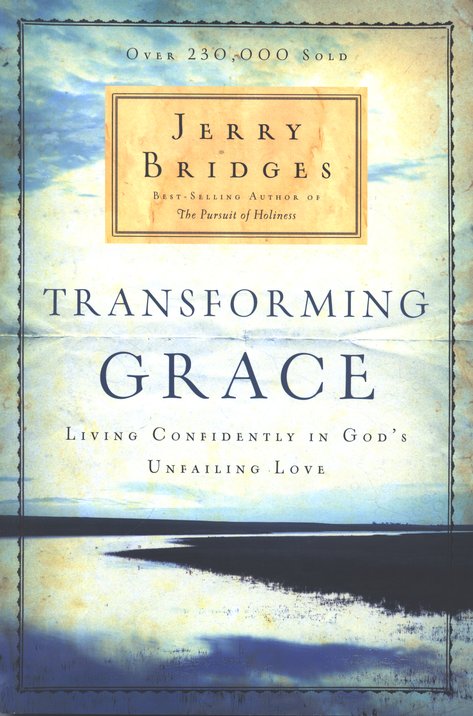
13 Quotes From Jerry Bridges In “Transforming Grace”

Transforming GraceI think Transforming Grace by Jerry Bridges is one of the best books about God’s grace I have ever read! You can read my full book review by clicking here. There are way too many quotes for me to share from this book, so here are a few that really zero-in on grace (I’ll be posting more quotes soon).

“I think most of us actually declared temporary bankruptcy. Having trusted in Christ alone for our salvation, we have subtly and unconsciously reverted to a works relationship with God in our Christian lives. We recognize that even our best efforts cannot get us into heaven, but we do think they earn God’s blessings in our daily lives.” 

“It was because of His grace that God the Father sent His only Son to die in our place. To say it another way, Christ’s death was the result of God’s grace; grace is not the result of Christ’s death.”

“The gospel is addressed to those who have no money or good works. It invites us to come and ‘buy’ salvation without money and without cost [Isaiah 55:1]. But note the invitation to come is addressed to those who have no money—not to those who don’t have enough. Grace is not a matter of God’s making up the difference, but of God’s providing all the ‘cost’ of salvation through His Son, Jesus Christ.” 

“We can never rightly understand God’s grace until we understand our place as those who need His grace.”

“We were dead in our transgressions, but God intervened. We were in bondage to sin, but God intervened. We were objects of wrath, but God intervened. God Who is rich in mercy intervened. Because of His great love for us, God intervened and made us alive with Christ, even when we were dead in our transgressions and sins. All this is summed up in one succinct statement: ‘it is by grace you have been saved.’ Our condition was hopeless, but God intervened in grace.” 

“God’s grace, then, does not supplement our good works. Instead, His grace overcomes our bad works, which are our sins. God did this by placing our sins on Christ and by letting fall on Him the wrath we so richly deserved. … That’s the way His grace operates. It looks not to our sins or even to our good deeds but only to the merit of Christ.”

“The apostle John wrote that Jesus was ‘full of grace and truth,’ and ‘from the fullness of His grace we have all received one blessing after another’ (John 1:14, 16). The idea portrayed in verse 16 is analogous to the ocean waves crashing upon the beach. One wave has hardly disappeared before another arrives. They just keep coming from an inexhaustible supply. So it is with the grace of God through Christ. He is full of grace and truth, and it is from His inexhaustible fullness that we received one blessing after another.” 

“God often does bless people who seem to us to be quite unworthy. But that is what grace is all about, because we are all unworthy.”

“We all want grace, but we cannot enjoy grace when there is an attitude of comparing.” 

“Under a sense of legalism, obedience is done with a view to meriting salvation or God’s blessing on our lives. Under grace, obedience is a loving response to salvation already provided in Christ, and the assurance that, having provided salvation, God will also through Christ provide all else that we need.”

“All Christians look to Christ alone for their justification, but not nearly as many also look to Him for their perfect holiness before God. … Holiness should be an objective for your daily life. But to live by grace, you must never, never look to the work of the Holy Spirit in you as the basis for your relationship with God. You must always look outside of yourself to Christ. You will never be holy enough through your own efforts to come before God. You are holy only through Christ.” 

“When our Father looks at us, He does not see our miserable performance. Instead, He sees the perfect performance of Jesus.”

“We died to the observance of the law as a requirement for attaining righteousness before God. We died to the curse and condemnation that resulted from our inability to perfectly keep the law. … Being under law implies the wrath of God, whereas grace implies forgiveness and favor. Law implies a broken relationship with God, whereas grace implies a restored relationship with Him. So when Paul said we died to the law, he meant we died to that entire state of condemnation, curse, and alienation from God.” 

Smashing Idols

Puny idolsWhen looking at God’s commandments, we must look at them through a lens of love. If God—the Lawgiver—is love, then all of His laws must be saturated in His love.

So what happens when we look at the Second Commandment through this lens? The wording is simple: “You shall not make for yourself an idol…” (Exodus 20:4-6). If the First Commandment says, “I love you so much that I want to be the One and Only God you have a relationship with” then the Second Commandment says, “Because of this loving relationship, don’t try to make Me smaller to fit your worldview, but let Me by fully Me!

This idolatry starts in our minds, long before we ever create anything with our hands. Idolatry is a mental state that says, “I can define the Creator. I can figure out all of His dimensions. I can predict what He’s going to do. God operates just as I expect Him to.”

But God says, “My thoughts are nothing like your thoughts. And My ways are far beyond anything you could imagine” (Isaiah 55:8).

The Apostle Paul warned us of exchanging God’s uncontainable glory and majesty for something that we can neatly contain in our box: …they exchanged the glory of the immortal God for images … they exchanged the truth of God for a lie, and worshiped and served created things rather than the Creator… (Romans 1:21-25).

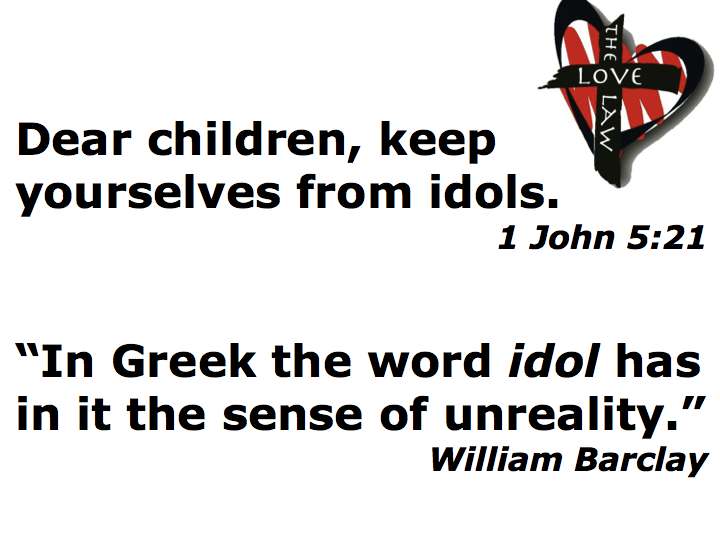
William Barclay offers this commentary about the flimsiness of idols: “In Greek the word idol has in it the sense of unreality. Plato used it for the illusions of this world as opposed to the unchangeable realities of eternity.” Our puny thoughts about God can create the idols that keep us from the reality of God. 

So how do we avoid this idolatry? Quite simply: we smash every mental idol!

…We refute arguments and theories and reasonings and every proud and lofty thing that sets itself up against the true knowledge of God; and we lead every thought and purpose away captive into the obedience of Christ… (2 Corinthians 10:5).

So… what idols do you need to smash?

If you have missed any of the messages in our series The Love In The Law, you can find them all by clicking here.

Thursdays With Oswald—The Most Audacious Verse

Oswald ChambersThis is a weekly series with things I’m reading and pondering from Oswald Chambers. You can read the original seed thought here, or type “Thursdays With Oswald” in the search box to read more entries.

The Most Audacious Verse

     The faith that does not react in the flesh is very immature. Paul was so identified with Jesus Christ that he had the audacity to say that what men saw in his life in the flesh was the very faith of the Son of God. Galatians 2:20 is the most audacious verse in the Bible! Paul is not referring to his own elementary faith in Jesus Christ as his Savior, but to the faith of the Son of God, and he says that that identical faith is now in him.

From Conformed To His Image

Do you think that Paul is being audacious?

If so, do you think that Chambers is right that we can have that sort of faith?

If so, what’s it going to take?

More Ministers Needed In The Church

The church goesI always get a bit nervous when someone calls me “the minister of Calvary Assembly of God.” I am not the minister; I’m the pastor and a minister.

There’s a big difference! 

A pastor is one of the gifts Jesus gives the church to equip lots of ministers (see Ephesians 4:7-13). A pastor is not the minister, but a minister-equipper.

Check out this quote from Oswald Chambers—

“Notice the gifts that the Apostle Paul says Jesus sent after He ascended—viz. apostles, prophets, evangelists, pastors and teachers—‘for the perfecting of the saints, for the work of the ministry, for the edifying of the body of Christ.’  The test of a preacher or teacher is that as we listen to him we are built up in our faith in Jesus Christ and in our intimacy with Him; otherwise he is not a gift from God. Today we are apt to test the preacher on the ground of his personality and not by his building up of the saints.” (emphasis added)

I don’t want to be put on a pedestal as the minister. I want Jesus to be exalted. This will only happen when all the gifts to the church—apostles, prophets, evangelists, pastors and teachers—are equipping the entire church to minister.

What do you think?

Links & Quotes

link quote

Some good reading from today…

“The upright man must never think of depriving another of anything, nor must he ever wish to increase his own advantage to the disadvantage of another. This rule the Apostle gives thee, saying: ‘All things are lawful, all things are not expedient; all things are lawful, but all things edify not. Let no man seek his own, but each another’s.’ That is: Let no man seek his own advantage, but another’s; let no man seek his own honor, but another’s.” —Ambrose

Frank Viola has a challenging word to Christians in the quote he shares from A.W. Tozer: Recovering The Departed Glory.

Claiming Jesus is not what many think it is, says Chilly Chilton in his post: Name It, Claim It, Proclaim It!

When we don’t know that life is a war and satan is the enemy, or forget when we need to know it most, we can’t make sense of our struggles, suffering, and strife.” Read more of Mark Driscoll’s post Spiritual Warfare: Who, What & Why.

The Overview Bible Project always uncovers some cool things in Scripture. Like this post about what Beelzebul really means.

Why is it organizations are not allowed to hire a Christian, but at that same time are encouraged (forced?) to hire homosexuals? The story of David Tyree is a case-in-point.

The fact is, that the same moment which brings the consciousness of sin ought to bring also the confession and the consciousness of forgiveness.” —Hannah Whitall Smith

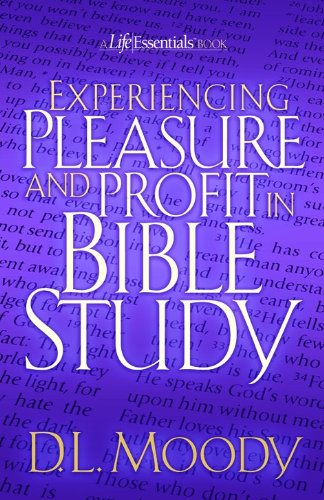
7 Bible Study Ideas From D.L. Moody

Pleasure & ProfitAs I read D.L. Moody’s book Pleasure & Profit In Bible Study, I made note of several ideas that could stimulate a great Bible study. Check out my review of this book by clicking here, then check out these great study-starters:

“If you are impatient, sit down quietly and commune with Job. If you are strong-headed, read of Moses and Peter. If you are weak-kneed, look at Elijah. If there is no song in your heart, listen to David. If you are a politician, read Daniel. If you are getting sordid, read Isaiah. If you are chilly, read of the beloved disciple. If your faith is low, read Paul. If you are getting lazy, watch James. If you are losing sight of the future, read in Revelation of the promised land.” —Richard Baxter 

“Every chapter [of Mark] but the first, seventh, eighth and fourteenth begins with ‘And,’ as if there was no pause in Christ’s ministry.”

“Matthew begins with Abraham; Mark with Malachi; Luke with John the Baptist; but John with God Himself. Matthew sets forth Christ as the Jew’s Messiah. Mark as the active worker. Luke as a man. John as a personal Savior.”

“[In John’s Gospel] the word repent does not occur once, but the word believe occurs ninety-eight times.”

“Dr. A. T. Pierson says: Let the introduction cover five P’s; place where written; person by whom written; people to whom written; purpose for which written; period at which written.” 

“Some time ago a man wanted to take my Bible home to get a few things out of it, and when it came back I found this noted in it:

  • Justification, a change of state, a new standing before God.
  • Repentance, a change of mind, a new mind about God.
  • Regeneration, a change of nature, a new heart from God.
  • Conversion, a change of life, a new life for God.
  • Adoption, a change of family, new relationship towards God.
  • Sanctification, a change of service, separation unto God.
  • Glorification, a new state, a new condition with God.”

“I was wonderfully blessed by taking the seven ‘Blesseds’ of the Revelation. … Or you may take the eight ‘overcomes’ in Revelation…. I have been greatly blessed by going through the ‘believings’ of John. Every chapter but two speaks of believing. … Take the six ‘precious’ things in Peter’s Epistles. And the seven ‘walks’ of the Epistle to the Ephesians. And the five ‘much mores’ of Romans 5. Or the two ‘receiveds’ of John 1. Or the seven ‘hearts’ in Proverbs 13, and especially an eighth. Or ‘the fear of the Lord’ in Proverbs.” 

“No scripture is exhausted by a single explanation. The flowers of God’s garden bloom, not only double, but seven-fold: they are continually pouring forth fresh fragrance.” —Charles Spurgeon

Rewards For Faithfulness

NunI unabashedly tell anyone who asks me what my favorite book is … It’s the Bible. I have yet to find such a collection of writings that work every single time they’re applied.

Two summers ago we began a series of messages on the 119th Psalm. It appears that the psalmist shares my passion for God’s Word, as he writes time and time again the difference Scripture makes in his life.

The other thing that makes this psalm so cool to me is the organization of the 176 verses into twenty-two 8-verse segments, with each verse in a segment beginning with the the same Hebrew letter as its title. In the Hebrew language, the letters in the alphabet had their own meaning. In English an “n” is simply spelled “n.” It has no other definition or meaning. But in Hebrew the letter nun has both a spelling and a meaning. Nun is spelled nun-vav-nun (final), and it means both faithfulness and the reward for faithfulness.

Look at the three Hebrew characters that spell nun. Reading right to left it tells a story and gives the meaning of the letter/word—the one who is humbled in faithfulness will be the one who stands in righteousness. The perfect example of this is Jesus, Who humbled Himself when He came to earth and to the Cross, and then was exalted by the Heavenly Father to wear the crown of righteousness (see Philippians 2:5-11 and Revelation 14:14). Paul starts this passage by calling on us to “have the same attitude as that of Jesus” (v. 5), and concludes with the call to stick with it all the way to the end (see vv. 12-13).

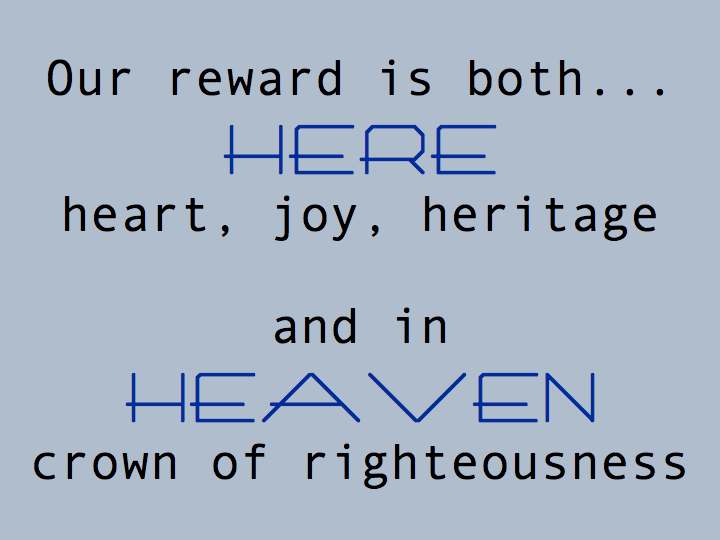
RewardsThe psalmist calls us to this same thing in nun (Psalm 119:105-112). The “bookend” verses say, “Your Word is a lamp for me… so my heart is set on keeping Your Word” (vv. 105 and 112). In between the psalmist commits himself to a life of humbly persevering to God’s ways, and reaps the rewards of a changed heart, the joy of the Lord, and a heritage to pass on to others.

I have fought the good fight, I have finished the race, I have kept the faith. Now there is in store for me the crown of righteousness, which the Lord, the righteous Judge, will award me on that day—and not only to me, but also TO ALL who have longed for His appearing (2 Timothy 4:7-8).

Humble yourself before the Lord, and He will lift you up (James 4:10).

My heart is set on keeping Your decrees to the very end (Psalm 119:112).

Rewards here (new heart, joy, heritage) AND rewards in Heaven (a crown of righteousness). How awesome is that!!

If you have missed any of the messages in our P119 series, you can access them all by clicking here.

12 Quotes From “Tactics

TacticsIn Tactics Greg Koukl gives Christians more how than what/why in defending the Biblical faith. It is an outstanding read that I recommend to all Christians (young or old). You can read my full book review by clicking here. Below are just a few of the quotes I highlighted in this empowering book.

“First, Christ’s ambassadors need the basic knowledge necessary for the task. They must know the central message of God’s kingdom and something about how to respond to the obstacles they’ll encounter on their diplomatic mission. … However, it is not enough for followers of Jesus to have an accurately informed mind. Our knowledge must be tempered with the kind of wisdom that makes our message clear and persuasive. This requires the tools of a diplomat, not the weapons of a warrior, tactical skill rather than brute force. Finally, our character can make or break our mission. Knowledge and wisdom are packaged in a person, so to speak. If that person does not embody the virtues of the kingdom he serves, he will undermine his message and handicap his efforts.” 

“The tactical approach requires as much careful listening as thoughtful response.”

“It is not the Christian life to wound, embarrass, or play one-upmanship with colleagues, friends, or even opponents, but it’s a common vice that anyone can easily fall into.” — Hugh Hewitt 

“Always make it a goal to keep your conversations cordial. Sometimes that will not be possible. If a principled, charitable expression of your ideas makes someone mad, there’s little you can do about it. Jesus’ teaching made some people furious. Just make sure it’s your ideas that offend and not you, that your beliefs cause the dispute and not your behavior.”

“The ability to argue well is vital for clear thinking. That’s why arguments are good things. Arguing is a virtue because it helps us determine what is true and discard what is false. … Paul warns against wrangling about words and quarreling about foolish speculations (2 Timothy 2:14, 23). But he also commands us to be diligent workmen, handling the word of truth accurately (2 Timothy 2:15). And, because some disputes are vitally important, Paul solemnly charges us to reprove, rebuke, and exhort when necessary (2 Timothy 4:112). This cannot be done without some confrontation, but disagreement need not threaten genuine unity.”

“If you want skeptics to believe in the Bible, don’t get into a tug-of-war with them about inspiration. Instead, invite them to listen—to engage Jesus’ words firsthand—then let the Spirit do the heavy lifting for you.”

“You have to know why Jesus is the only way before it is helpful to tell people that He is the only way.” 

“There are three specific things you can do to ‘ready’ yourself to respond. You can anticipate beforehand what might come up. You can reflect afterward on what took place. And in both cases you can practice the responses you think of during these reflective moments so you will be prepared for the next opportunity.”

“Knowing when to step back requires the ability to separate the hogs and the dogs from the lost sheep looking for a shepherd. But how do you know when someone has crossed the line? When do we have an obligation to speak, and when should we save our pearls for another time? Part of the answer can be found in Jesus’ next words in Matthew 7:6: ‘…lest they trample [the pearls] under their feet, and turn and tear you to pieces.’ Be generous with the truth except with someone who shows utter contempt for the precious gift being offered him. He will simply trample it in the mud and then viciously turn on you. … There is an exception to this principle, however. I have learned from my radio show that sometimes my real audience is not the person I’m talking to, but the people who are listening in, eavesdropping on the conversation. … Lee Strobel calls this ‘ricochet evangelism.’” 

“When I face an aggressive challenger, I often give him the last word. Not only is this gracious, it’s also powerful, conveying a deep sense of confidence in one’s own view. Instead of fighting for the final say-so, give it away. Make your concluding point clearly and succinctly, and then say, “I’ll let you have the last word.” But don’t break this promise. Grant him his parting shot, and then let it rest.”

“Know the truth. Know your Bible well enough to give an accurate answer. Tactics are not a substitute for knowledge. Cleverness without truth is manipulation.”

“Culture is most profoundly changed not by the efforts of huge institutions, but by individual people.” —Chuck Colson


Altar To Alter

Listen to the podcast of this post by clicking on the player below, and you can also subscribe on AppleSpotify, or Audible.

The process of sanctification—or as I like remember the word: saint-ification—is the process whereby the Holy Spirit develops Christlike character in us. His process is immediate, personalized, and ongoing. In other words, the Spirit is intimately and immediately involved in every aspect of our lives.

Christlikeness in us is described in the Bible with phrases like…

  • Being made new in the attitude of your minds; and putting on the new self, created to be like God in true righteousness and holiness (Ephesians 4:23-24).
  • Conformed to the likeness of God’s Son (Romans 8:29).

The Holy Spirit is often portrayed as fire. In fact, the Bible says that Jesus will baptize you with the Holy Spirit and with fire (Matthew 3:11). This is because in order for Christlike character to be formed in us, that character will have to be forged in us. Forged in the Spirit’s fire.

Look at two examples:

  • Until the time came to fulfill his dreams, the Lord tested Joseph’s character (Psalm 105:19).
  • Even though Jesus was God’s Son, He learned obedience from the things He suffered (Hebrews 5:8).

Here’s what I’ve learned—

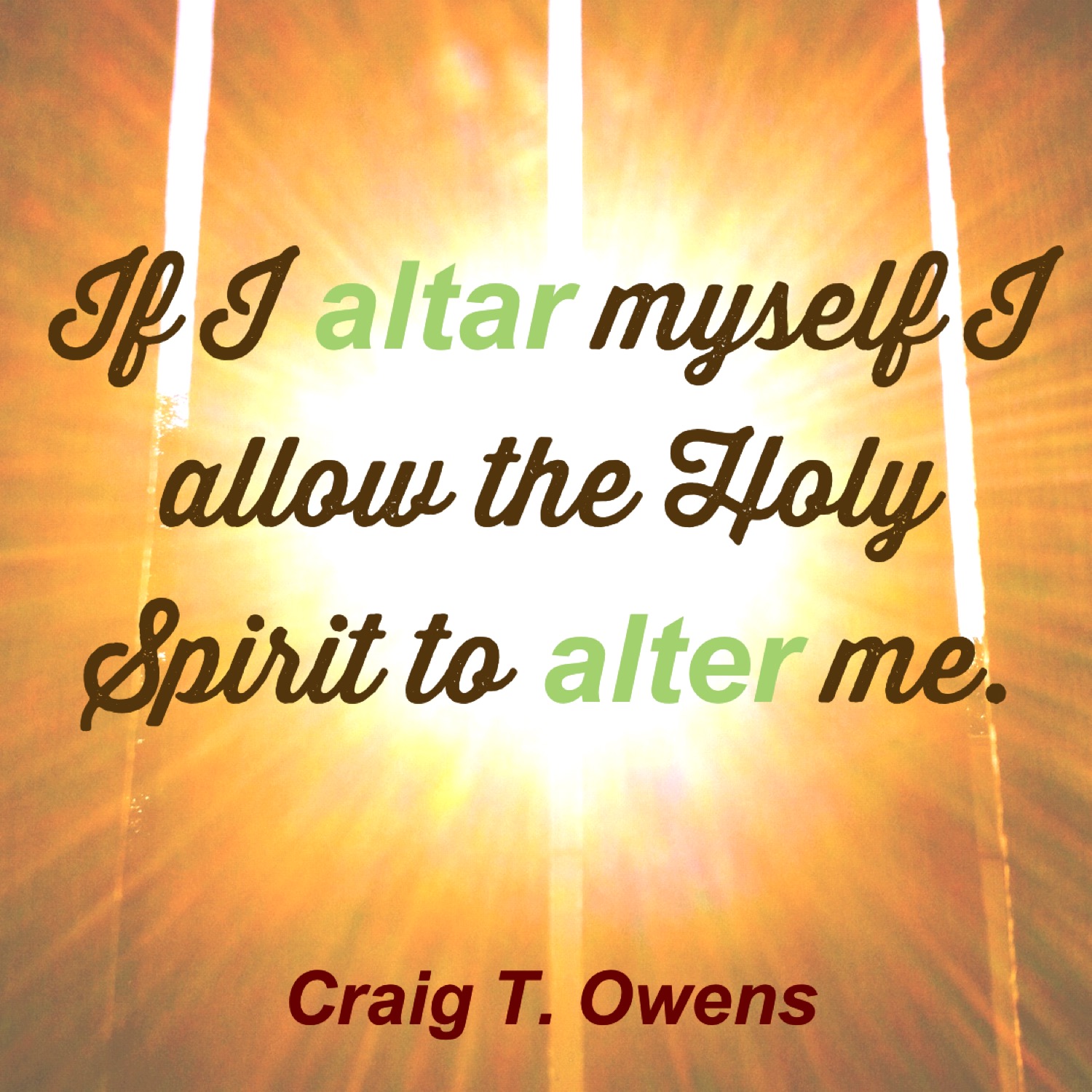
We must altar our lives so that the Holy Spirit can alter our lives.

Unless we yield to what the Holy Spirit wants to do with us, He cannot and will not bring about the changes that will lead to more Christlikeness being revealed in us.

It may be painful to altar our lives, but the apostle Paul says, “I consider that our present sufferings are not worth comparing with the glory that will be revealed in us” (Romans 8:18).

You altar, and then watch the Holy Spirit alter your life in a way that reveals God’s glory!

►► Would you please prayerfully consider supporting this ministry? ◀︎◀︎