Altar To Alter

Listen to the podcast of this post by clicking on the player below, and you can also subscribe on AppleSpotify, or Audible.

The process of sanctification—or as I like remember the word: saint-ification—is the process whereby the Holy Spirit develops Christlike character in us. His process is immediate, personalized, and ongoing. In other words, the Spirit is intimately and immediately involved in every aspect of our lives.

Christlikeness in us is described in the Bible with phrases like…

  • Being made new in the attitude of your minds; and putting on the new self, created to be like God in true righteousness and holiness (Ephesians 4:23-24).
  • Conformed to the likeness of God’s Son (Romans 8:29).

The Holy Spirit is often portrayed as fire. In fact, the Bible says that Jesus will baptize you with the Holy Spirit and with fire (Matthew 3:11). This is because in order for Christlike character to be formed in us, that character will have to be forged in us. Forged in the Spirit’s fire.

Look at two examples:

  • Until the time came to fulfill his dreams, the Lord tested Joseph’s character (Psalm 105:19).
  • Even though Jesus was God’s Son, He learned obedience from the things He suffered (Hebrews 5:8).

Here’s what I’ve learned—

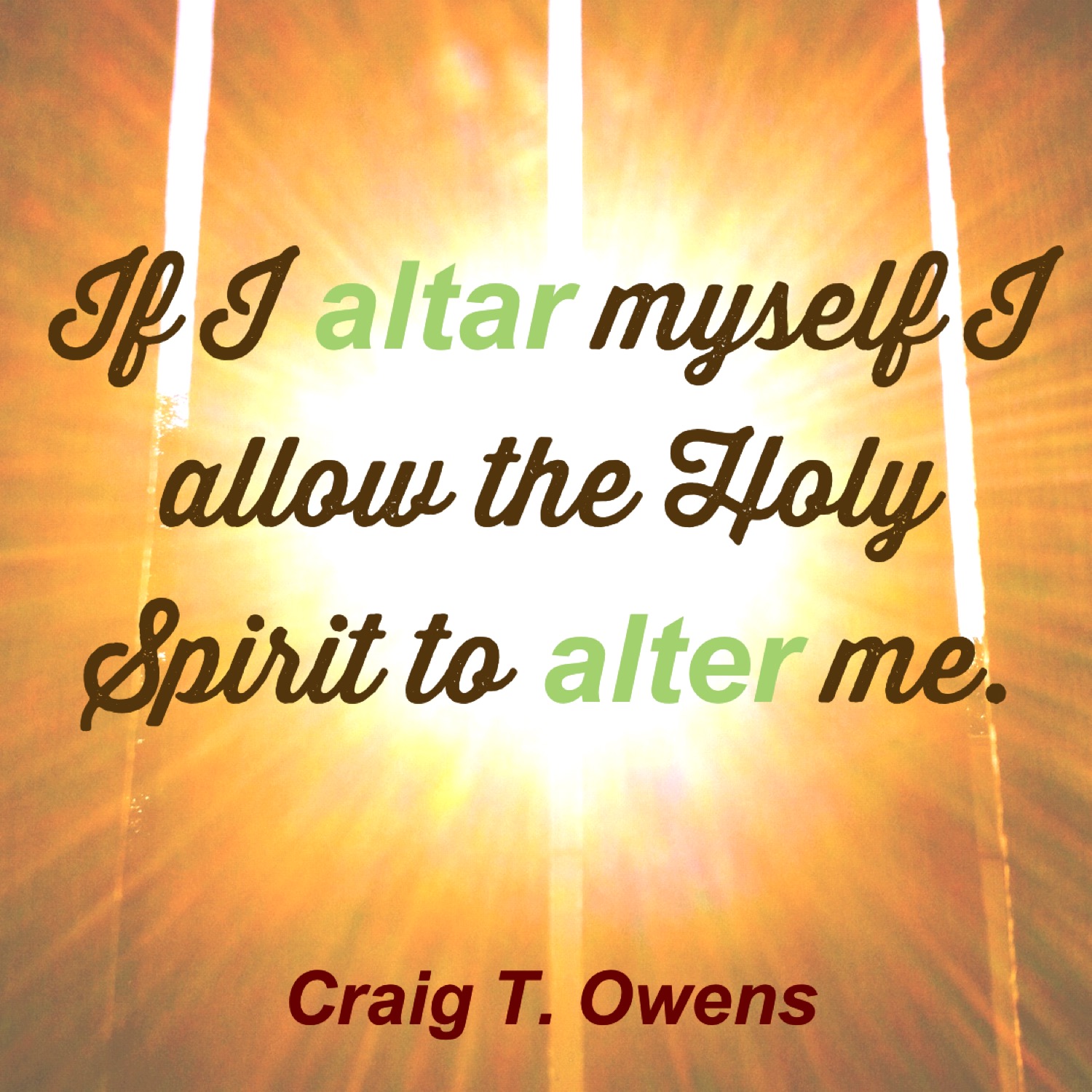
We must altar our lives so that the Holy Spirit can alter our lives.

Unless we yield to what the Holy Spirit wants to do with us, He cannot and will not bring about the changes that will lead to more Christlikeness being revealed in us.

It may be painful to altar our lives, but the apostle Paul says, “I consider that our present sufferings are not worth comparing with the glory that will be revealed in us” (Romans 8:18).

You altar, and then watch the Holy Spirit alter your life in a way that reveals God’s glory!

►► Would you please prayerfully consider supporting this ministry? ◀︎◀︎

Links & Quotes

link quote

Some good reading (and watching) from today…

GREAT NEWS! The FBI rescued 168 child victims of sex trafficking.

John Maxwell talks about the value of concentration.

“Don’t fornicate with your body. Worship with your body. The Apostle Paul even says that the body is a temple, that is, a place of worship. The body is a place for meeting God, not prostitutes. This doesn’t mean sex is bad. It means that sex is precious. Too precious to be treated cheaply. God means that we put it in a very secure and sacred place—marriage. There it becomes the expression of the love between Christ and the church. It shows the glory of the intensity of God’s love for His people. It becomes worship. ‘Glorify God in your body.’ And not doing sex outside marriage also shows the preciousness of what it stands for. So chastity is worship.” —John Piper, commenting on 1 Corinthians 6:18-20

Here’s a piece of advice: admit it when you mess up. Don’t lie or plead ignorance. Don’t try to make yourself out to be a victim. And above all, don’t throw your wife (or anyone else) under the bus. If you did it, own it. Any other choice will lead you into deeper problems than you already have, both in the here and now and the hereafter.” Read more from Mark Atteberry in his post The IRS Scandal: Eden Revisited.

[VIDEO] …speaking of the IRS scandal, Rep. Trey Gowdy grills IRS commissioner John Koskinen.

Some fascinating statistics that show a stable marriage leads to better performance in school for kids, and more stable employment options after school: How Churches Can Bridge The Marriage Divide.

Noble Revenge

Noble revengePerhaps one of the most counter culture things a Christian will ever do is to forgive. More specifically, to forgive God’s way in which the offending party is forgiven and the offense is no longer counter against him.

But this isn’t what today’s culture teaches us. Instead they say things like—

  • “I’ll forgive them only if they’re really, really, REALLY sorry for what they did….
  • …and I’ll forgive them only if they ask for forgiveness…
  • …and then only I’ll only forgive them a certain number of times…
  • …and most importantly, I may forgive, but I’ll never forget.

Why do we feel this way?

  • We buy into the old line: “Hurt me once, shame on you; hurt me twice, shame on me,” and we don’t want to feel shame.
  • We like to be in control. If we hold on to slights and injuries, then we have a trump card we can play later—“You owe me” or “This is why I don’t trust you.”
  • We mistakenly think that forgiveness makes us appear weak, like our offender won and we lost. And we certainly don’t want them to think they can take advantage of us again.
  • Because if they take advantage of us again it’s right back to, “Hurt me once…” so I’m going to make a preemptive strike and not forgive them.

Yes, forgiveness could make us appear vulnerable. Yes, we could be hurt again by the same offender. And, yes, we could be viewed as weak. But—The foolish thing that has its source in God is wiser than men, and the weak thing that springs from God is stronger than men (1 Corinthians 1:25, AMP). Total forgiveness is foolish looking in the natural, but it has God’s blessing on it.

With this in mind, the Apostle Paul wrote—

But Jesus said to me, “My grace is sufficient for you, for My power is made perfect in weakness.” Therefore I will boast all the more gladly about my weaknesses, so that Christ’s power may rest on me. That is why, for Christ’s sake, I delight in weaknesses, in insults, in hardships, in persecutions, in difficulties. For when I am weak, then I am strong. (2 Corinthians 12:9-10)

When we are totally reliant on Christ, that’s when His power rests on us. When we say, “I’m going to do this my way,” we block ourselves off from Christ’s grace and power and strength.

We need to remember HOW MUCH God has forgiven in us—He forgave ALL my sins and He no longer counts any of my treachery and rebellion against me. With this in mind, how dare I hold on to the comparatively small injuries others have inflicted on me (see Matthew 18:21-35).

“The noblest revenge is to forgive.” —Thomas Fuller


Forgiveness gives me a nobility.
Forgiveness sets me free from the hurt.
Forgiveness makes me a child of God.
Forgiveness gives me God-sent strength.
Forgiveness is counter culture.
Because forgiveness glorifies God, and not my wound.

What are you waiting for? Get free today by giving and receiving forgiveness.

Weekend Quotes

“quotes”

Some challenging quotes from this weekend:

“A wise man will make haste to forgive, because he knows the true value of time, and will not suffer it to pass away in unnecessary pain.”  —Samuel Johnson

“The noblest revenge is to forgive.” —Thomas Fuller

“Being deeply loved by someone gives you strength, while loving someone deeply gives you courage.” —Lao-tzu

“Love keeps no records of wrongs. … It always protects, always trusts, always hopes, always perseveres.” —Apostle Paul (1 Corinthians 13:6-7)

And for my pastor friends: “There will always be new ways to do good works and speak good words which are not presently in our experience or repertoire. So in all our studies, let us study to acquire new insights and visions of how we can serve others through good works. And in all our teaching and preaching, let us not grow negligent in exhorting the people of God to do likewise.” —T.M. Moore

Thursdays With Oswald−Remorse Is Hell On Earth

This is a weekly series with things I’m reading and pondering from Oswald Chambers. You can read the original seed thought here, or type “Thursdays With Oswald” in the search box to read more entries.

Oswald ChambersRemorse Is Hell On Earth

     Never mistake remorse for repentance; remorse simply puts a man in hell while he is on earth, it carries no remedial quality with it at all, nothing that betters a man.

From Conformed To His Image

I meet people all the time who are sorry for the wrong things they’ve done, and perpetually beat themselves up over those sins. As Chambers says, their remorse has created a hell on earth and it doesn’t do a single thing to help them.

Even a great man like the Apostle Paul felt the hell-on-earth trap of remorse. “I know what the wrong thing is and I don’t want to do it, but I give in and do it anyhow. I say I’m not going to do it again, but I do it again. Oh, what a wretched man I am! (see Romans 7:15-24). That’s where remorse leaves us, and the devil uses that feeling of remorse to condemn us and to imprison us in his hell on earth.

Repentance, on the other hand, is feeling bad for the sin and also asking God to forgive us through the work Jesus Christ did on the Cross—Thanks be to God, who delivers me through Jesus Christ our Lord! (Romans 7:25). As a result of this repentance and forgiveness Paul can then conclude…

So now there is NO CONDEMNATION for those who belong to Christ Jesus. And because you belong to Him, the power of the life-giving Spirit has freed you from the power of sin that leads to death. (Romans 8:1-2)

Remorse imprisons. Repentance and forgiveness are the only things that free us!

Atomic Spiritual Power

Atomic spiritual powerI was so excited while listening to Tom Kaastra’s message in our series on Ephesians yesterday! To really reflect on the power God wants to see operating in our lives is almost mind-blowing! 

In Paul’s lengthy prayer for the Christians in Ephesus, he three times says he is praying, “For this reason” (Ephesians 1:15; 3:1; 3:14). And every one of the reasons has to do with power or strength. In fact, Paul uses four Greek words for power in his prayer to try to convey the magnitude of God’s awesome power. This power can be summed up two ways:

  • Quantity (resurrection power): That power is the same as the mighty strength He exerted when He raised Christ from the dead (1:19-20).
  • Quality (love power): And I pray that you, being rooted and established in love, may have power… to grasp how wide and long and high and deep is the love of Christ, and to know this love surpasses knowledge (1:17-19).

Notice that this power only comes to me through the Holy Spirit, and resides in my “inner being” (3:16) and “within us” (3:20). It is power waiting to be released! 

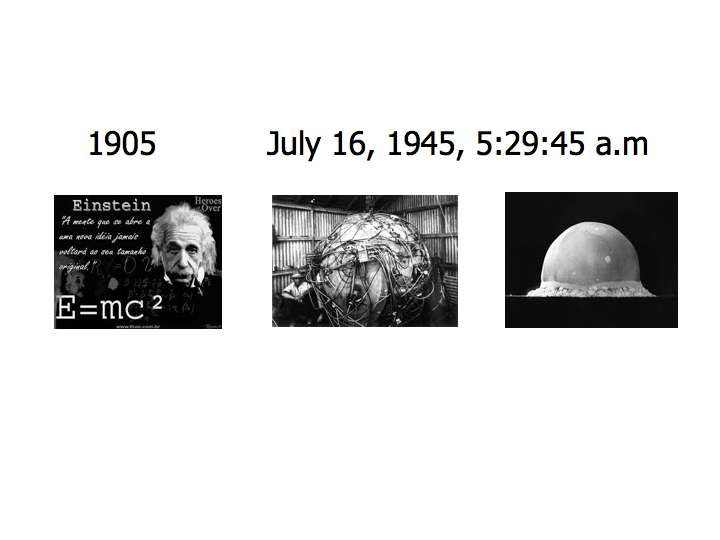
Think of this Holy Spirit power in terms of atomic energy power. The awesome power in the atom has been around since Genesis 1:1, but it was hidden from human awareness until July 16, 1945, at 5:29:45 AM, when the first atomic bomb was detonated. People couldn’t release the power because they didn’t know that it was there! In similar fashion, Paul wants us to know what sort of atomic spiritual power is available to us.

Paul’s prayer is that we will intimately know this power (1:18), and that we will release this power (Ephesians 3:20; Colossians 1:29; Philippians 2:12-13). The Holy Spirit is not released through dormant people, but through people who are moving toward Him and willing to let Him move through them.

There are three kinds of people in the world. Those who are…

1. …designed by God to be adopted into His family and to do great things, but are dead apart from Him.

2. …designed by God to be adopted into His family and to do great things, adopted into His family, but not using the power He has provided.

3. ..designed by God to be adopted into His family and to do great things, adopted into His family, and fully operating in His awesome atomic-like power.

In what category are you? What’s holding you back for all that God has planned for you?

Hyper-Mega Dynamite

Ephesians 1-19One of my favorite scenes in the movie Elf is when Buddy is discovering all the amazing human things in New York City. In a public restroom he stands up on the toilet in his stall to shout to the person occupying the stall next to him, “Have you seen these toilets? They’re ginormous!” It was so amazing to him that gigantic wouldn’t cut it, and neither would enormous, so he combined them together … it’s ginormous!!

When I read Paul’s prayer for the Christians in Ephesus (see Ephesians 1:17-23), I get the sense that even the well-educated apostle was having difficulty finding enough adjectives to describe the amazing inheritance we have in Christ. He mentions things like…

  • Out-of-this-world wisdom,
  • divine revelation,
  • deep and intimate knowledge of God,
  • a flooding of heavenly light,
  • supernatural hope, and
  • an overflowing, incalculable, inestimable, eternally-compounding inheritance!

But then he comes to God’s power and his vocabulary almost fails him. Like Buddy the elf, he starts putting words together to try to convey the vast majesty of this power.

Most Bible translations say something like incomparably great power. But when you look at the Greek you see prefixes like hyper! and mega! and you realize that Paul is saying it’s so beyond gigantic or enormous … it’s ginormous!! 

The word for power is “dynamis,” and many people have said that God’s power is like dynamite. But they have it exactly backwards! Dynamite has only been around for 200 years. When dynamite was created it was named after Christians who were living in the hyper-mega, ginormous, dynamic power of Jesus Christ. Christians’ power wasn’t named after dynamite; dynamite was named after empowered Christians!

This is the power in which Christians can live everyday in every way! This is the power God has for you! If you’re living in anything less than hyper-mega dynamite power, perhaps you should pray for yourself the prayer that Paul prayed for us! 

We’ll be continuing our series in Ephesians this coming Sunday, and I’d love for you to join us.

In Desperate Need Of A Physician

Here’s a really simple statement: You cannot give what you do not have. Even if I really want to give my friend the $20 he is asking for, I can’t give it to him if my wallet is empty. And yet pastors are guilty of trying to do this spiritually frequently.

Somehow we’ve forgotten that Peter denied Jesus, that Paul persecuted Christians and called himself the chief of sinners, that James at one time thought Jesus was out of His mind. We hold these men up as “saints” and “perfect” pastors. But all of these men knew that they were were in desperate need of The Physician who could restore them and fill them for service.

Pastor, do you feel the need to look “perfect” to your congregation? Are you leery of ever mentioning any of your shortcomings? Do you think you have to have what everyone else needs? Do you think you have to answer every call?

Read carefully these words from A.W. Tozer—

Tozer

“Human nature being what it is, the man of God may soon adopt an air of constant piety and try to appear what the public thinks he is. The fixed smile and hollow tones of the professional cleric are too well known to require further mention. All this show of godliness, by the squeeze of circumstances and through no fault of the man himself, may become a front behind which the man hides, a plaintive, secretly discouraged and lonely soul. Here is no hypocrisy, no intentional double living, no actual desire to deceive. The man has been mastered by the circumstances. He has been made the keeper of other people’s vineyards but his own vineyard has not been kept. So many demands have been made upon him that they have long ago exhausted his supply. He has been compelled to minister to others while he himself is in desperate need of a physician.” (emphasis added)

My dear pastor, please drop the pretense: you are not super-human.

  • It’s okay to say “no” to another request so you can spend time at home.
  • It’s important to make the time to “keep your own vineyard”—read the Bible for you (not for sermon prep), spend time with your spouse and children, get a good night’s rest, take a vacation.
  • You need to find a friend who can hold you accountable, and listen to your struggles, and pray for you.
  • You must take all the time you need to get filled up with God’s presence, to meet with The Physician of your soul.

Remember: you cannot give what you do not have. So make sure you’ve got it before you try to give it!

What God Will You Choose?

What God:godMy friend Chuck and I have a sort of shorthand when we talk. We’ve been through so many experiences together, that now just a single word can bring to our minds the fullness of that time, with all of its tears and laughter. Someone listening to one of our conversations might not get the full impact, but we sure do!

It’s the same way when we read one of the Apostle Paul’s letters. He is writing to a church or an individual with whom he had a rich, personal experience. So when he alludes to something, those friends who went through that experience with him recall all of the fullness. When reading the letter to the church at Ephesus, you can experience some of that fullness by reading about Paul’s experience in that city in Acts 19.

In Acts 19 you will meet the followers of Jesus who were already there and see them get baptized in the Holy Spirit … watch Paul teach for three months in the synagogue before the Jewish troublemakers run him out … see Paul lecture for the next three years in the Hall of Tyrannus, so that everyone in that province heard the Word of God … see how God authenticated Paul’s ministry with miracles … experience those who tried to counterfeit what Paul was doing … see many in that city turn from their witchcraft and idol worship … and finally experience the tumult of a near-riot started by the merchants who were losing their income on sales of mythological trinkets because so many were turning to Christ.

With this backdrop, you can then understand why Paul uses such specific language in the opening greeting of his letter to Ephesus (see Ephesians 1:1-3). By doing so he is contrasting the followers of Jesus with the followers of Artemis—

  • Christians for whom God has a specific plan (“by the will of God” [1:1a]; see also 1:4 and 2:10) versus Artemis’ followers who felt like they had no choice (Acts 19:26).
  • Christians who are called saints (set apart for God’s special use) and faithful (trusting Jesus implicitly [1:1b]) versus those followers of Artemis who are self-serving (Acts 19:24, 25).
  • Christians who experience God’s grace and peace (1:2) versus those followers of Artemis who did not even know why they were there (Acts 19:32).

But the most specific language is in Ephesians 1:3—Praise be to THE God and Father of our Lord Jesus Christ (emphasis added)….

  • Not “a” god, but “THE” God.
  • Not a god that needs to be appeased, but THE loving Father.
  • Not a god that may or may not be able to respond, but OUR Lord Jesus Christ Who overcame death, hell and the grave so that our sins can be forgiven!

The question Paul invites the Ephesians to consider is the same question we must consider:

What God / god will you choose?

We will be continuing our study on the book of Ephesians next Sunday, and I would love to have you join us!

Pentecost (book review)

PentecostI grew up with this stuff: I’m a fourth-generation Pentecostal, so I cut my teeth on this distinctive doctrine. But I was still amazed at the depth of insight into this dynamic theology that Dr. Robert Menzies shares in Pentecost: This Story Is Our Story.

Although Dr. Menzies shares a number of anecdotal stories to help illustrate certain points, this book is really a serious doctrinal work. Many people have written-off the operational gifts of the Holy Spirit seen in the book of Acts as something that ceased at the death of the apostles, or at the closing of the cannon of Scripture. But Dr. Menzies points out from the outset that Luke’s writings in the Gospel that bears his name and in the book of Acts are not just historical, but doctrinal too.

Many times people look at Paul’s writings as doctrinal, and the four Gospels and Acts as simply historical; thus giving more “weight” to the Pauline epistles. Dr. Menzies persuasively shows that Luke’s writing in Luke-Acts is just as doctrinal, and just as Holy Spirit-inspired, as every other book of the New Testament. In fact, he really goes beyond that to show how Luke’s writing is heavily influenced by Old Testament prophesies about the coming of the Messiah and the subsequent outpouring of the Holy Spirit.

This is not a sensational book, but a scholarly work. It is extensively referenced, as evidenced by the ample endnotes. But don’t let this scare you off as a book just for pastors and theologians, as Dr. Menzies’ writing style is very readable by all.

Anyone who is interested in this distinctive doctrine of the Holy Spirit should read Pentecost.