Links & Quotes

There’s no secret formula to fruitfulness as a Christian. We just stay connected to Jesus and the fruit will grow. This clip is from this sermon.

I have lots of new content every week, which you can check out on my YouTube channel.

The “Ten Commandments” are not explicitly listed or reiterated in the New Testament. Does that mean they are obsolete? No, says David Mathis, it means they are fulfilled. “Jesus Himself says He did not come to destroy the Law and Prophets, but to do something even more striking: fulfill them (Matthew 5:17). That is, fulfill like prophecy. Not simply keep the Ten in place, or remain under them, or leave them untouched, but fulfill them—first in His own person, and then by His Spirit in His church. He came not to cast off Moses, but to fulfill Jeremiah, and in doing so, He accomplished what is even more radical: establishing Himself as the supreme authority, putting God’s law within His people (rather than on tablets), writing it on their hearts (rather than stone), and making all His people to know Him (Jeremiah 31:31–34).” Check out my post The 10 Commandments in the New Testament.

More archeological evidence supporting to the historicity of the Bible. You can check out the full article, but this paragraph is a good summation: “One of the surprising findings was that, according to the results of their tests, the Broad Wall in Jerusalem, also known as Hezekiah’s Wall, was likely built during the reign of Uzziah, who Scripture says built fortifications in Jerusalem (2 Chronicles 26:9). Another finding was that Jerusalem was much more heavily populated and urbanized in the 12th through 10th centuries BC than some scholars previously thought. This would align with the biblical description of Jerusalem, particularly during the days of David and Solomon.”

“There is much of beauty, goodness, and truth to be discovered in the city of man, as Augustine pointed out toward the end of his great treatise, City of God. But all the culture and best intentions of men turn to corruption apart from the power of God to redeem and renew them. We who live also in the heavenly city now possess the mind of Christ (1 Corinthians 2:16); we are able to see the ways that culture can be ‘taken captive’ from the clutches of sin and unbelief and made to serve the purposes of Christ in all things. Thus, for the honor and glory of God, we commit ourselves daily to using all our time, activities, relationships, roles, responsibilities, and culture to furthering His rule on earth as it is in heaven.” —T.M. Moore

“Have movies and most conventional paleontologists got it all wrong? T. rex and other theropod dinosaurs (the meat-eaters) are often portrayed as intelligent predators that can outmuscle and outsmart their opponents. But is that really supported by science?” A very interesting compilation of research can be found here. The conclusion is exactly right: “God designed dinosaur brains that were perfectly suited for their lifestyles and body size when He created dinosaurs on Day 6 of the creation week (Genesis 1:25).” 

Links & Quotes

The word “saints” is always plural in the New Testament. That means that each us needs all of us, and all of us need each of us. Check out this full message hereI have lots of new content every week, which you can check out on my YouTube channel.

“The words of the civil codes of God’s Law are neither salvific nor exhaustive; they are, rather, designed to illustrate applications of the Ten Commandments in various situations, so that local judges and authorities could reason based on the words of the Law concerning what the spirit of the Law required in any situation.” —T.M. Moore

“Sin grows when we think we deserve something from God, or life. Godliness grows when we remember we are debtors to God, throughout life.” —Tim Keller

“Pornography is not new. Archeological discoveries testify that fascination with sexual portrayals is nearly as old as humanity. Yet our times present new challenges. Technological advancements coupled with moral corrosion are increasing the accessibility and normality of pornography at a dizzying rate.” Check out this post that shares nine ways parents can talk about pornography with their children.

The Wait Of Parenting

Listen to the podcast of this post by clicking on the player below, and you can also subscribe on AppleSpotify, or Audible. 

I’ve been called to some challenging leadership roles in my life—many of which made me feel like I was in way over my head! But without a close second, the heaviest mantle I’ve ever felt is the one called “Father.” Holding my firstborn son in my arms was indescribable, and it didn’t feel any lighter or less daunting when our other children arrived.  

The rabbis saw something significant in the Ten Commandments. Some people have noted that the first four Commandments are about our vertical relationship with God, while the next six are about our horizontal relationships with people. But the rabbis saw the Fifth Commandment as the linchpin—with parents in a creator-like role and as the first leader our children will be exposed to, and parents taking on the role as the first and most significant instructor for our children to know God for themselves. 

God gives us the example to follow: He instructs us gently but firmly, anticipating our needs, and giving us exactly what we need (Psalm 103:13-14; Luke 6:36, 12:32; Matthew 6:8).  

And then Jesus tells us to follow this example: “Be perfect, therefore, as your heavenly Father is perfect” (Matthew 5:48). Yikes, talk about a heavy weight! 

In the only song of ascent attributed to King Solomon (Psalm 127) we read both a longing for our families to be with us at the end of our journey to Zion, but also a hint of the difficulty of this. 

In the middle verse of this song, we are assured that our children are given to specific parents by God on purpose. He knew what He was doing in giving them into our care. That means each parent is uniquely equipped for each child’s unique personality, temperament, and gift package. 

Twice in the opening verse, Solomon uses the word “unless.” Unless we seek God’s help in building our children and watching over them, our efforts on their own will be “in vain.” That phrase (“in vain”) is used three times in the opening two verses. Solomon wrote a lot about vanity in the Book of Ecclesiastes. But it’s important to note that Solomon always uses this word in association with the phrase “under the sun.” Unless we get help from God—unless we lift our eyes up higher than this earth—our efforts alone will be frustrating and anxiety-inducing. 

Remember that parents are the linchpin in the Ten Commandments? Those first four Commandments tell us to put God first, don’t create any idols to rival Him, don’t misuse His name, and trust Him enough to rest from your labors (Exodus 20:1-11). That means that we parents cannot put our kids ahead of God (Luke 14:26). Unless God is our first priority, we won’t have the spiritual, emotional, or mental stamina to parent well. Or, as C.S. Lewis noted,  “When I have learned to love God better than my earthly dearest, I shall love my earthly dearest better than I do now.” 

In his collection of proverbs, Solomon told us, “Start children off on the way they should go, and even when they are old they will not turn from it” (Proverbs 22:6). Jesus said there is only one sure foundation, and that is knowledge and obedience of God’s Word (Matthew 7:24-27). 

The final two verses of Psalm 127 assure parents that when we commit our children to God’s hands, He blesses them and uses them as His weapons, His leaders, and His culture changers. 

There is not only a weight in parenting, but there is also a wait in parenting. In the last song of ascent we studied, we learned that we have a promise two times that we will (not “might”) reap a harvest, even if we have to sow seeds in tears (Psalm 126:5-6). 

In the Bible, waiting is never passive. It’s an active watching to see how God will move. We see this in the story of the prodigal son (Luke 15:11-32) where the father waited expectantly for his wayward son to return. This Dad had given his son a firm foundation at the start of his life, and then he waited in prayer until his son “came to his senses”—until he realized that all other ways of living away from God were vanity. 

In the midst of her prayers for her own prodigal son, Monica shared her concerns with Ambrose, bishop of Milan, and he said, “It cannot be that the son of those tears be lost.” Monica continued to wait for her son Augustine, sowing her seeds in tears but fully expecting the song of joy that would come with the harvest. 

Years later, in his autobiography called Confessions, Augustine wrote of his mother, “My mother, Your faithful servant, wept to You for me, shedding more tears for my spiritual death than others shed for the bodily death of a son. You heard her.” 

Parents, as you call out to God on behalf of your children, shed those tears in the joy of the anticipated harvest, knowing that God hears you! 

If you’ve missed any of the other messages in our series looking at these songs of ascent in the Book of Psalms, you can find them all here.  

►► Would you please prayerfully consider supporting this ministry? My Patreon supporters get behind-the-scenes access to exclusive materials. ◀︎◀︎

God Longs For You

Listen to the podcast of this post by clicking on the player below, and you can also subscribe on AppleSpotify, or Audible. 

There’s a misconception that many people have about God’s laws: they think that they are intended to rob us of enjoyment, that they restrict our lives and remove our pursuit of happiness. 

In actuality, the exact opposite is true. God is love (1 John 4:8). That means everything God does is rooted in His love for us. Including the laws He gives us. He loves us and wants us to stay in the place where we don’t experience the heartache, pain, and disappointment of missing out on His blessings. 

God is also happy. Paul calls it “the glory of the blessed God” (1 Timothy 1:11). The word “blessed” can easily be translated as happy. God is happy and He wants us to share in this ultimate happiness. 

Consider the blessings that are in first and last of the Ten Commandments: 

  • The first commandment says there is only one God. Far from this being restrictive, it’s a huge blessing. I don’t have to search and compare, I don’t have to make a list of pros and cons and then settle on the best option, but I can enjoy the one and only true God. 
  • The tenth commandment says I don’t need to crave anything outside of what God has given me. Again, this is a huge blessing because it tells me that my loving Father has given me all that I need, that He alone satisfies my cravings. 

John Piper gave the essence of idolatry in this line: “Preferring other things above God.” This is why God delights for us to delight in Him. When we do, He is our sole focus. When He is our focus, we enjoy Him immensely and we reject anything that would remove our gaze from Him. 

That’s why there is a continuous linkage in all 176 verses of Psalm 119 between God’s laws and our delight—between obedience and satisfaction. When we obey God, we experience His happiness. 

The apostle Paul called Christians to live this way: “Whatever happens, conduct yourselves in a manner worthy of the gospel of Christ” (Philippians 1:27). Gospel literally means “good news.” What good news are we supposed to proclaim? The good news that God is happy and that He wants to say to us, “Come and share your Master’s happiness” (Matthew 25:21)! 

When I was a kid I struggled with this question: Do I love God just because He first loved me? I thought, “That seems like a cop out. Am I really saying that the only reason I have for loving Him is that He went first?” But then I realized it couldn’t be any other way. How could I love an angry God? How could I ever expect to approach a God who knew all my sins and had the final say on my punishment, and was just waiting for a chance to get His hands on me? 

I can only love a loving God. I can only love Him because He first loved me (see Romans 5:8). 

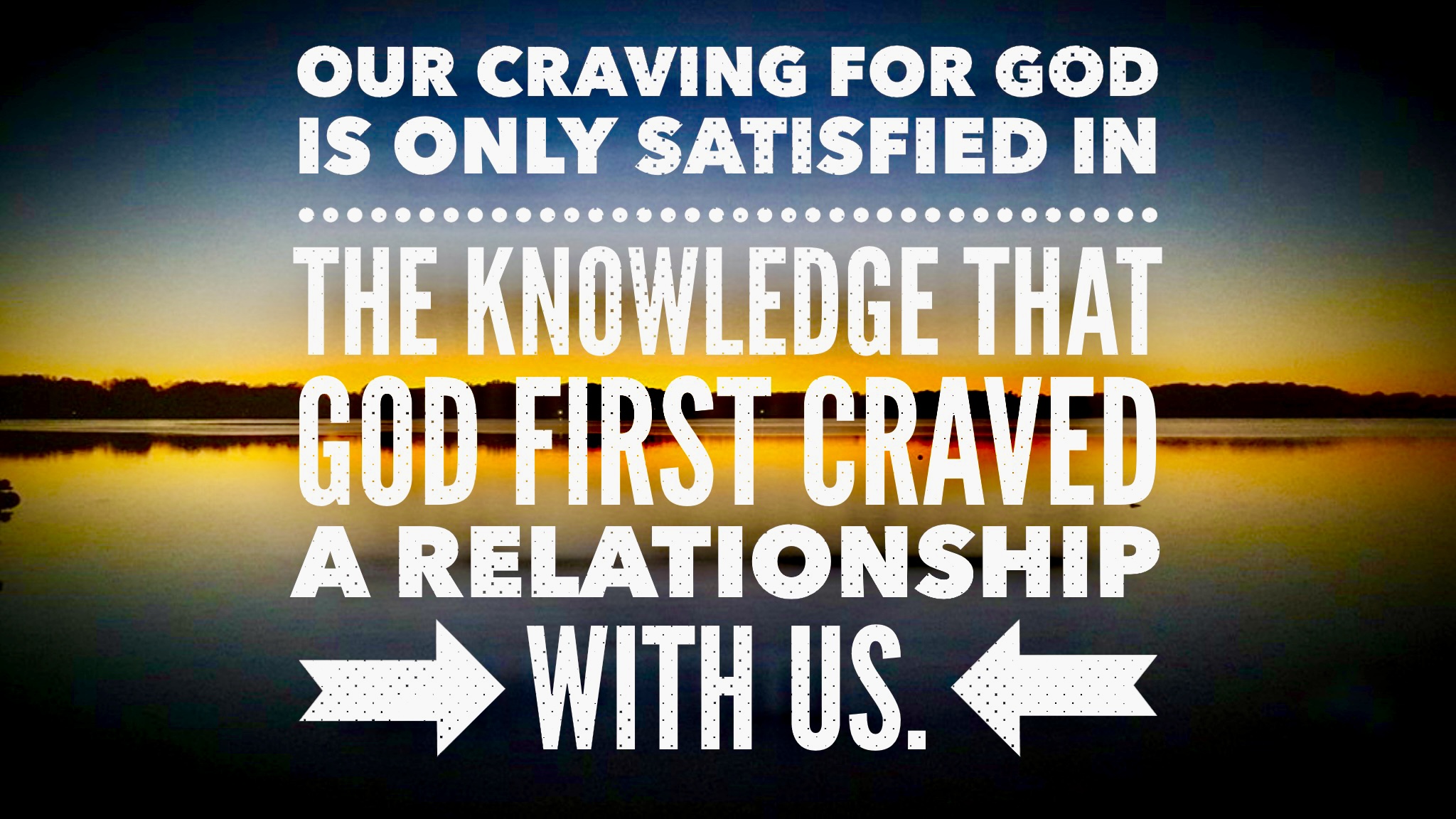
In a similar way, I can only crave God because He first craved a relationship with me. Otherwise I’m setting myself up for unimaginable heartbreak and disappointment! 

Jesus said it was His Father’s “good pleasure” to reveal Himself to us. No one knows the Son except the Father, and no one knows the Father except the Son. Our heavenly Father craved a relationship with us, so He revealed His Son Jesus to us so that Jesus could reveal the Father to us (see Matthew 11:25-30; John 14:7).

Just as we could only love God because He loved us first, we could only crave a relationship with God because He craved a relationship with us first. It was always His plan to adopt us into His family—this is what gives Him great pleasure (Ephesians 1:5). Then God works in us to fulfill His craving for us, which empowers us to find our deepest longings satisfied exclusively in Him (Philippians 2:13). 

Sometimes we get a small taste or experience of earthly pleasure that quickly fades away. C.S. Lewis reminded us, “If I find in myself a desire which no experience in this world can satisfy, the most probable explanation is that I was made for another world.” 

Our craving for God is only satisfied in the knowledge that God first craved a relationship with us. Only the intimacy of our Savior will fulfill our cravings. Anything else will end only in utter disappointment. 

If you have missed any of the message in our series called Craving, you can find a list of all of the messages by clicking here. 

►► Would you please prayerfully consider supporting this ministry? My Patreon supporters get behind-the-scenes access to exclusive materials. ◀︎◀︎

The Value Of The Old Testament

“Jesus exalted the law of God, and made its importance more evident even than it had been before. In a word, ‘He magnified the law and made it honorable’ (Isaiah 42:21). …

“Let us beware of despising the Old Testament under any pretense whatever. Let us never listen to those who bid us throw it aside as an obsolete, antiquated, useless book. The religion of the Old Testament is the embryo of Christianity. The Old Testament is the Gospel in the bud. The New Testament is the Gospel in full flower. The Old Testament is the Gospel in the blade. The New Testament is the Gospel in full ear. …

“Let us, for another thing, beware of despising the law of the Ten Commandments. Let us not suppose for a moment that it is set aside by the Gospel, or that Christians have nothing to do with it. The coming of Christ did not alter the position of the Ten Commandments one hair’s breadth. If anything, it exalted and raised their authority (Romans 3:31). …

“In the last place, let us beware of supposing that the Gospel has lowered the standard of personal holiness, and that the Christian is not intended to be as strict and particular about his daily life as the Jew. … The more light we have, the more we ought to love God. The more clearly we see our own complete and full forgiveness in Christ, the more heartily we ought to work for His glory. …

“Jesus shows us that the law, as expounded by Him, was a far more spiritual and heart-searching rule than most of the Jews supposed.” —J.C. Ryle, in Expository Thoughts On The Gospels

10 Quotes From “As Kingfishers Catch Fire”

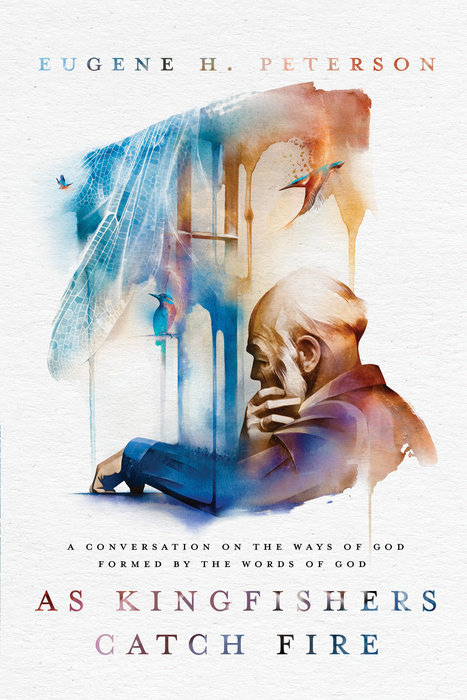
As Kingfishers Catch Fire is a collection of 49 sermons from Eugene Peterson. Check out my full book review by clicking here. Below are a few quotes that caught my attention.

“The Christian life is the lifelong practice of attending to the details of congruence—congruence between ends and means, congruence between what we do and the way we do it, congruence between what is written in Scripture and our living out what is written, congruence between a ship and its prow, congruence between preaching and living, congruence between the sermon and what is lived in both preacher and congregation, the congruence of the Word made flesh in Jesus with what is lived in our flesh.”

“Science and religion are opposites, the way your thumb and forefinger are opposites: if you are going to get a grip on things, you need them both.”

“Friendship is not a way of accomplishing something but a way of being with another in which we become more authentically ourselves.”

“Naming an event a miracle doesn’t mean we can’t understand it. It means we can’t anticipate it. It means we can’t reproduce it. We cannot control it. There is more going on then we can comprehend.”

“There are people today who mistakenly look at those [Ten] Commandments as restrictive, not realizing that for those who first heard them—and for those who hear them still, in faith—they provide for and preserve the values of the free life. The reality and truth of God is protected from commercialization and manipulation. Human life is honored. The dignity of work is protected. Close personal relationships are preserved. Truth is respected. Each of the commands articulates a reality and a value that protects a free life.”

“Aaron made a god, a golden calf. At that moment Aaron quit being their pastor and became their accomplice. There are some people who are always looking for a religion that makes no demands and offers only rewards, a religion that dazzles and entertains, a religion in which there is no waiting and no emptiness. And they can usually find someone like Aaron who will help them make it up, some sort of golden calf religion.”

“Acts of love cannot be canned and then used off the shelf. Every act of love requires creative and personal giving, responding, and serving appropriate to—context specific to—both the person doing the loving and the person being loved.”

“Our habit is to talk about God, not to Him. We love discussing God. The psalms resist these discussions. They are not provided to teach us about God but to train us in responding to Him.”

“The Christian life is not, in the first place, something we do. It consists of the healthy and mature formation of our lives by the Spirit, the Holy Spirit. Christian living goes off the rails badly when it is conceived as a program or routine that we engage in or skills that we master.”

“In prayer we do not act. God does. In prayer we do not develop a technology that sets the gears and pulleys of miracle in motion. We participate in God’s action. ‘Not my will but Yours.’”

Book Reviews From 2014

BookshelfHere are the books I read and reviewed in 2014. Click a title to read the review…

12 Huge Mistakes Parents Can Avoid

A Call To Prayer

Beyond IQ

Bible Reading

C.S. Lewis In A Time Of War

Create

David Wilkerson

Did Jesus Rise From The Dead?

Discipleship In Crisis

Finding God In Hidden Places

Finding The Love Of Your Life

From This Day Forward

God’s Pursuit Of Man

High Adventure In Tibet

Holy Fire

How Do You Kill 11 Million People?

How High Will You Climb?

Humility

I Like Giving

Impertinent Poems

In His Steps

Inspire To Be Great

Jesus Daily

Keeping The Ten Commandments

Lincoln’s Battle With God

Mansfield’s Book Of Manly Men

Miracles

Pentecost

Pilgrim’s Progress

Pleasure & Profit In Bible Study

Sidelined

Smith Wigglesworth On Prayer, Power & Miracles

Stand Strong

Tactics

Taste And See

The Cell’s Design

The Christian’s Secret Of A Happy Life

The Facts On World Religions

The Furious Longing Of God

The Global War On Christians

The Greatest Words Ever Spoken

The Illustrated Guide To The Authors Of The Bible

The Love Of God

The Ministry Of God’s Word

The Moral Foundations Of Life

The Quick-Start Guide To The Whole Bible

The Solomon Seduction

There Is A God

This Day In Christian History

Transforming Grace

Winning With Principle

Yawning At Tigers

Here are my book reviews for 2011.

Here are my book reviews for 2012.

Here are my book reviews for 2013.

Good Coveting

Covet GodIf we simply state the last of the Ten Commandments like this—You shall not covet—we have missed the true intention of that commandment. You see, God created us to covet. The issue is not if we will covet, but what we will covet.

The word covet means (1) long for greatly, (2) take pleasure in, or (3) find desirable. Throughout the Old Testament this word is used twice as many times in the positive sense as in the negative. The Bible, in fact, encourages us to covet after a deeper relationship with God; to covet God’s ways; to covet our spouse … to covet all of the good and moral things God created for us.

The tenth commandment prohibits us from coveting immorally.

If we restate the first commandment like this—I am the Lord your God. You shall covet a relationship with Me alone—then we will immediately be able to obey all of the other commandments. But if we break the tenth commandment by coveting things other than God, we are liable to break every commandment.

Check this out:

  • Adam & Eve—their immoral coveting led to violating commandments 1, 5 and 8.
  • Achan—his immoral coveting led to violating commandments 2, 8 and 6.
  • David—his immoral coveting led to violating commandments 7, 8, 9 and 6.
  • Judas Iscariot—his immoral coveting led to violating commandments 1, 9, 3 and 6.

Augustine said, “I call the love to God the motion of the soul toward the enjoyment of God for His own sake, and the enjoyment of one’s self and of one’s neighbor for the sake of God.” Coveting God is good!

We were made to covet Him. satan wants us to covet our neighbor’s house, spouse, lifestyle, and possessions, but if we listen to him, we will end up miserable.

God coveting = good coveting!

If you have missed any of the messages in our series The Love In The Law, you can find them all by clicking here.

The 10 Commandments In The New Testament

I have heard far too many people say, “The laws of the Old Testament were for ‘back then.’ We live in the New Testament era, so those laws don’t apply to us any longer.” This is a blatant disregard of facts.

Not only are every single one of the Ten Commandments reiterated in the New Testament, they are also amplified. Consider this example: Under the Old Testament law, as long as I hadn’t slept with someone other than my wife I hadn’t broken the 7th commandment (do not commit adultery). Jesus not only reiterated that 7th commandment, but He amplified it to say my lustful thoughts toward someone not my wife made me a violator of that commandment.

Here’s the list of the commandments reiterated and amplified—

10 Commandments In The New Testament

You may download a PDF version of this chart here → 10 Commandments In The New Testament


From The Cutting Room Floor: The Love In The Law

Love In The LawWhenever I am working on a series of messages, I always end up with way more material than I could possibly share. But it’s still really good stuff! I remember a movie director once remarking that some of his best and favorite scenes ended up on the cutting room floor during the movie’s editing process. So here are some of the quotes and thoughts I really liked, recovered from “the cutting room floor” as I prepared our Love In The Law series.

“True obedience to God (not just to lists of laws) means more than outward performances which can be tallied in percentages (like 80 percent obeyed). Rather, true obedience is to be so transformed that we delight to do God’s will at multiple levels. We delight in His will as the excellent expression of His wisdom and justice and love. We delight in personal, close communion with Him as our guide, which we would lose, at least for a season, if we acted against His counsel. We delight in His gift of a clean conscience. We delight in the smile of His approval. We delight in God Himself whom we see and know more clearly when we walk in unbroken fellowship and obedience. We delight in the prospect of ongoing assurance and hope, which is jeopardized and weakened if we gradually slip away from Him in callous disobedience.” —John Piper

I delight to do Your will, O my God; yes, Your law is with in my heart. —Psalm 40:8

“To detect ourselves thus balancing a transgression here, against many observances there, ought at once to startle us into the conviction that the whole principle of our lives must be faulty. Our aim is, not to love God, or to obey Him, but to get to heaven, or at least escape hell, on the cheapest terms.” —Alfred Plummer

“Our will is morally and spiritually flawed. Nevertheless we are responsible to do the commandments of God. The moral corruption that cripples us does not relieve us of our responsibility to do what is right and good to do.” —John Piper

“I call the love to God the motion of the soul toward the enjoyment of God for His own sake, and the enjoyment of one’s self and of one’s neighbor for the sake of God.” —Augustine

“If thou neglect thy love to thy neighbor, in vain thou professest thy love to God; for by thy love to God, the love to thy neighbor is begotten, and by thy love to thy neighbor, thy love to God is nourished.” —Francis Quarles

“A pennyweight o’ love is worth a pound o’ law.” —Scottish Proverb

It pleased the Lord for the sake of His righteousness to make His law great and glorious. —Isaiah 42:21