In The Shadow Of The Cross

Listen to the podcast of this post by clicking on the player below, and you can also subscribe on AppleSpotify, or Audible.

Some people really know how to find the deals when they’re shopping. They know where to shop, when to shop, where to find the coupons, and how to find the rebates.

Rebates have always amazed me. I wondered how companies could give away money and still make a profit. Then I read that often up to 70 percent of rebates go unclaimed. Some people say it’s too much work to fill out all the correct forms, others say it takes too long to get their rebate, and still others think the amount they get back isn’t worth the effort.

I’m concerned about Christians who slip into a rebate mentality with God. It seems some Christians believe that they need to “fill out the right forms” in order to claim all that God has for them. They seem to think that salvation isn’t enough, and that they have to add church attendance, offerings, good works, Bible reading and other activities to make sure they don’t miss out.

Not that there’s anything wrong with those activities, but there is something wrong with thinking we have to do something to keep our salvation at its full effectiveness.

If we have placed our faith in Christ’s work on an old rugged Cross, then all of our sins have been forgiven (see Psalm 103:1-5, 10-12; Jeremiah 33:8). This is a gift that is available to everyone (Acts 10:43).

But here’s when I think satan steps in to deceive us: It’s when we feel convicted by the Holy Spirit. God’s Spirit is constantly refining us to make Christ’s image visible in us. But satan wants to twist and pervert this conviction into condemnation.

It’s only in the shadow of the old rugged Cross that I can see my sin correctly. Consider these four points:

(1) The Holy Spirit’s conviction of sin tells me that He desires for me to be more like Jesus―John 14:25-27.

(2) Sin isn’t my master any longer―Romans 6:1-2, 8-11.

(3) My sin never diminishes God’s love for me―1 John 1:8-2:2.

(4) Sin cannot condemn me―Romans 8:1-2.

As we remember and celebrate what Jesus did on Calvary for us, let’s also remember to stay in the shadow of the Cross. It’s only there we can see ourselves accurately from Heaven’s point of view.

If you are in the area and don’t have a church home, I would love for you to celebrate Resurrection Sunday with us! We’ll continue our look at what happened on the old rugged Cross.

►► Would you please prayerfully consider supporting this ministry? My Patreon supporters get behind-the-scenes access to exclusive materials. ◀︎◀︎
The Ministry Of Reconciliation

Ministry of reconciliationWhen couples are divorcing, their most common complaint is summed up in two words: irreconcilable differences. The couple is saying that things have gotten so bad―and the distance between them has gotten so vast―that there is no hope at all of ever patching things up.

Sometimes we might be able to say that both husband and wife shared some of the blame. But this isn’t true in a spiritual divorce. When we are separated from God, it’s all on us. Paul describes us as powerless sinners, unholy enemies of God (see Romans 5:6, 8, 10). We did the leaving; we are the problem.

But in the desire to bring reconciliation, God puts it all on Himself―more specifically, on the death of His Son Jesus on an old rugged Cross. In Romans 5 Paul says our reconciliation was through Christ five times in just three verses (vv. 9-11).

As if it weren’t amazing enough that Christ’s death on the Cross saved us, justified us, and reconciled us, giving us a brand new start (2 Corinthians 5:16-17), God then gave us the same ministry that He undertook through Jesus: the ministry of reconciliation (vv. 18-19)!

What Jesus purchased for us on an old rugged Cross allows us to “become the righteousness of Christ” (v. 21). Not reflect His righteousness, not talk about His righteousness, but actually become His righteousness!

We have the supreme privilege of being able to bring the message of reconciliation to others who used to be where we were: powerless sinners, unholy enemies of God!

We have the awesome joy of being God’s righteousness to people who think their irreconcilable differences will keep them from God!

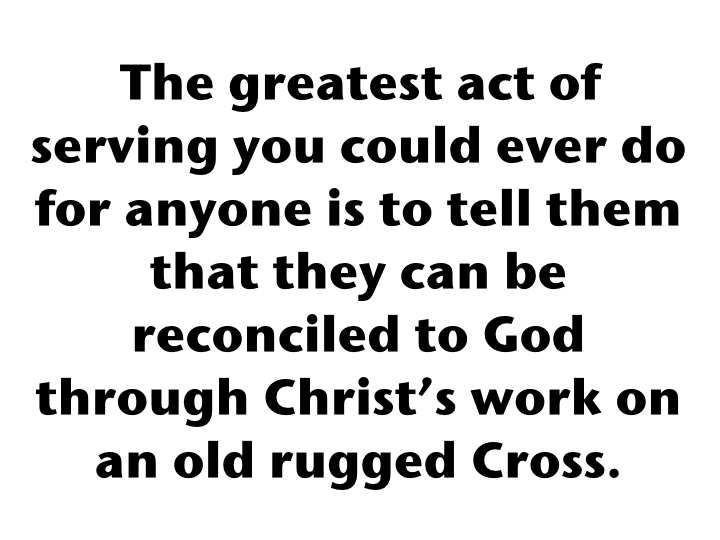
The greatest act of serving you could ever do for anyone is telling them that they can be reconciled to God through Jesus Christ’s work on an old rugged Cross!

Absolutely amazing!

We’ll continue our look at the Old Rugged Cross next Sunday, and I’d love to have you join me at Calvary Assembly of God.

Links & Quotes

link quote

Some good reading from today…

“The book of Romans in a sentence: Because you were condemned (1:1 – 3:20) and God justified you (3:21-5:21), empowered you to be distinct (6-8), and explained His plan to keep His promises to Abraham (9-11), it is right for you to submit your life for Divine inspection (12:1-2), and live the life of a real believer (12:2-16:27).” —Dr. Randall D. Smith

[INFOGRAPHIC] I love the Bible study tools from The Overview Bible Project! Check out this one on the main characters in Genesis.

A great story about a marathon runner who intentionally loses the race.

The co-founder of The Weather Channel blasts the “global warming” crowd.

“It is too bad that anything so obvious should need to be said at this late date, but from all appearances, we Christians have about forgotten the lesson so carefully taught by Paul: God’s servants are not to be competitors, but co-workers.” —A.W. Tozer

“The truth is that evil is not a real thing at all, like God. It is simply good spoiled. That is why I say there can be good without evil, but no evil without good. You know what the biologists mean by a parasite—an animal that lives on another animal. Evil is a parasite. It is there only because good is there for it to spoil and confuse.” —C.S. Lewis

“Love, in the Christian sense, does not mean an emotion. It is a state not of the feelings but of the will; that state of the will which we have naturally about ourselves, and must learn to have about other people.” —C.S. Lewis

“In our time we have all kinds of status symbols in the Christian church—membership, attendance, pastoral staff, missionary offerings. But there is only one status symbol that should make a Christian congregation genuinely glad. That is to know that our Lord is present, walking in our midst!” —A.W. Tozer

Altar To Alter

Listen to the podcast of this post by clicking on the player below, and you can also subscribe on AppleSpotify, or Audible.

The process of sanctification—or as I like remember the word: saint-ification—is the process whereby the Holy Spirit develops Christlike character in us. His process is immediate, personalized, and ongoing. In other words, the Spirit is intimately and immediately involved in every aspect of our lives.

Christlikeness in us is described in the Bible with phrases like…

  • Being made new in the attitude of your minds; and putting on the new self, created to be like God in true righteousness and holiness (Ephesians 4:23-24).
  • Conformed to the likeness of God’s Son (Romans 8:29).

The Holy Spirit is often portrayed as fire. In fact, the Bible says that Jesus will baptize you with the Holy Spirit and with fire (Matthew 3:11). This is because in order for Christlike character to be formed in us, that character will have to be forged in us. Forged in the Spirit’s fire.

Look at two examples:

  • Until the time came to fulfill his dreams, the Lord tested Joseph’s character (Psalm 105:19).
  • Even though Jesus was God’s Son, He learned obedience from the things He suffered (Hebrews 5:8).

Here’s what I’ve learned—

We must altar our lives so that the Holy Spirit can alter our lives.

Unless we yield to what the Holy Spirit wants to do with us, He cannot and will not bring about the changes that will lead to more Christlikeness being revealed in us.

It may be painful to altar our lives, but the apostle Paul says, “I consider that our present sufferings are not worth comparing with the glory that will be revealed in us” (Romans 8:18).

You altar, and then watch the Holy Spirit alter your life in a way that reveals God’s glory!

►► Would you please prayerfully consider supporting this ministry? ◀︎◀︎

Thursdays With Oswald−Remorse Is Hell On Earth

This is a weekly series with things I’m reading and pondering from Oswald Chambers. You can read the original seed thought here, or type “Thursdays With Oswald” in the search box to read more entries.

Oswald ChambersRemorse Is Hell On Earth

     Never mistake remorse for repentance; remorse simply puts a man in hell while he is on earth, it carries no remedial quality with it at all, nothing that betters a man.

From Conformed To His Image

I meet people all the time who are sorry for the wrong things they’ve done, and perpetually beat themselves up over those sins. As Chambers says, their remorse has created a hell on earth and it doesn’t do a single thing to help them.

Even a great man like the Apostle Paul felt the hell-on-earth trap of remorse. “I know what the wrong thing is and I don’t want to do it, but I give in and do it anyhow. I say I’m not going to do it again, but I do it again. Oh, what a wretched man I am! (see Romans 7:15-24). That’s where remorse leaves us, and the devil uses that feeling of remorse to condemn us and to imprison us in his hell on earth.

Repentance, on the other hand, is feeling bad for the sin and also asking God to forgive us through the work Jesus Christ did on the Cross—Thanks be to God, who delivers me through Jesus Christ our Lord! (Romans 7:25). As a result of this repentance and forgiveness Paul can then conclude…

So now there is NO CONDEMNATION for those who belong to Christ Jesus. And because you belong to Him, the power of the life-giving Spirit has freed you from the power of sin that leads to death. (Romans 8:1-2)

Remorse imprisons. Repentance and forgiveness are the only things that free us!

Such Wondrous Love

CrossAs I am preparing both a Good Friday message and an Easter message, I am immersed in the details of Christ’s passion for us. There are so many thoughts swirling through my head about the amazing, unequaled, undeserved, overflowing love that Jesus has for us.

See from His head, His hands, His feet / Sorrow and love flow mingled down! / Did e’er such love and sorrow meet, / Or thorns compose so rich a crown? (Isaac Watts, When I Survey The Wondrous Cross)

You see, at just the right time, when we were still powerless, Christ died for the ungodly. Very rarely will anyone die for a righteous person, though for a good person someone might possibly dare to die. But God demonstrates His own love for us in this: While we were still sinners, Christ died for us. (Romans 5:6-8)

That Christ should join so freely in the scheme / Although it meant His death on Calvary / Did ever human tongue find nobler theme / Than love divine that ransomed me?

Such love, such wondrous love / Such love, such wondrous love / That God should love a sinner such as I / How wonderful is love like this!

That for a willful outcast such as I / The Father planned, the Savior bled and died / Redemption for a worthless slave to buy / Who long had law and grace defied (C.Bishop, Such Love)

Because of the joy awaiting Him, Jesus endured the Cross, disregarding its shame. Now He is seated in the place of honor beside God’s throne. (Hebrews 12:2)

I hope this week you will reflect on God’s amazing grace, Christ’s great love, and the Holy Spirit’s persistent drawing of your heart. Jesus died for us so that we could be brought into a loving relationship with our Heavenly Father!

If you are in the Cedar Springs area, please join me in celebrating with our churches our combined Good Friday service, or our Easter morning breakfast drama called Conspiracy!

Thursdays With Oswald—Our Father

This is a weekly series with things I’m reading and pondering from Oswald Chambers. You can read the original seed thought here, or type “Thursdays With Oswald” in the search box to read more entries.

Our Father

     Think for one minute, have you behaved today as though God were your Father or have you to hang your head in absolute shame before Him for the miserable, mean, unworthy thoughts you have had about your life? 

     It all springs from one thing, you have lost hold of the idea that God is your Father. Some of us are such fussy, busy people, refusing to look up and realize the tremendous revelation in Jesus Christ’s words—Your heavenly Father knows what you need…. 

From He Shall Glorify Me 

What an amazing thought that when Jesus taught us to pray, He said we could address Almighty God with the affectionate title of “Our Father.” In his book Who Do You Think You Are?, Mark Driscoll points out:

     “In the thirty-nine books of the Old Testament, God is referred to only as Father roughly fourteen times—and each time it’s impersonally, in reference to the nation of Israel, not to individuals. Everything radically changed with Jesus. He spoke of God as Father more than sixty times in the New Testament.

Your heavenly Father loves you more than you can possibly imagine! Let that truth sink in. Don’t give in to the thoughts that your life is not very valuable, or even that God doesn’t like you very much.

God loves you as if you were the only person on earth to love! And He sent Jesus to earth to make it possible for you to be adopted into His family, to call Him Father. Even more than that, to call Him “Daddy God” (see Romans 8:15-17).

Live in your heavenly Father’s love today.

Love Is… (part 2)

Love is… worksheet 2We are taking a practical look at the incredible definition of love in 1 Corinthians 13. We’re doing this in the context of learning how to love the “unloveable”—or maybe I should say, loving those who are the most resistant to real love. If we can show them love, how much more will the love of Jesus be seen!

All of these verbs are present tense verbs. That means they aren’t exhausted in the past, and they aren’t waiting for future conditions to improve—they are in operation NOW.

Far too many people know Christians more by what we’re against than by what we’re for. So where the biblical text say “love does not” or “love isn’t,” I’ve changed it into the positive “love is.”

You can read about the first five attributes love love by clicking here.

The next five attributes are:

Love is graceful

  • The root word means something that should be covered up, or something we’re ashamed of. Because our words and actions are graceful, they are things we wouldn’t have to defend, or explain, or apologize for later. They are words and actions that wouldn’t embarrass us.
  • Agape will do nothing that misbecomes it.” —Matthew Henry

Love knows our relationship > my rights

  • True love “does not demand its own way” (New Living Translation) nor does it “insist on its own rights” (Amplified Bible). Instead it always seeks ways that the relationship can be repaired or enhanced, even if that means giving up something I consider to be “my right.”
  • NOTE: I’m not saying that you become a doormat. This is not a license for someone to abuse you, but it is a call for us to balance our responses. Romans 12:18 says as far as it depends on you, live at peace with everyone.
  • Here are some great balancing verses. Balance Proverbs 26:4-5 (here is a video where I expand on this idea), and then balance Philippians 2:3-4.

Love is even-tempered

  • The Amplified Bible says it well: love is not touchy or fretful or resentful.
  • This Greek word means not getting stirred up or exasperated. So we need to lighten up!
  • There are some places where we’ve become too sensitive, too touchy, too short-fused. The fire of hurt has replaced the fire of love. So Matthew Henry advises us: “Where the fire of love is kept in, the flames of wrath will not easily kindle, nor long keep burning.”

Love is forgiving

  • The New International Version says love keeps no record of wrongs.
  • This Greek phrase speaks of an accountant tallying up the hurts (where there is an overdrawn account), seeing there is a debt to be paid back, and then appointing himself as the bill collector. True love cancels those IOUs.
  • We don’t forgive others because they deserve forgiveness, but we forgive others because we received forgiveness from God that we did not deserve!
  • For if you forgive people their trespasses [their reckless and willful sins, leaving them, letting them go, and giving up resentment], your heavenly Father will also forgive you. (Matthew 6:14 AMP)

Love is God-honoring

  • Agape loves what God loves and hates what God hates.
  • Agape loves when people find God’s truth, and hates anything that blocks that pursuit.
  • Agape loves the sinner and hates the sin.
  • “The sins of others are the grief of an agape spirit [not] its sport or delight; they will touch it to the quick….” —Matthew Henry

Here’s where the real test comes in: How will you apply these attributes of love to someone in your life? More specifically: to someone you think is “unloveable”?

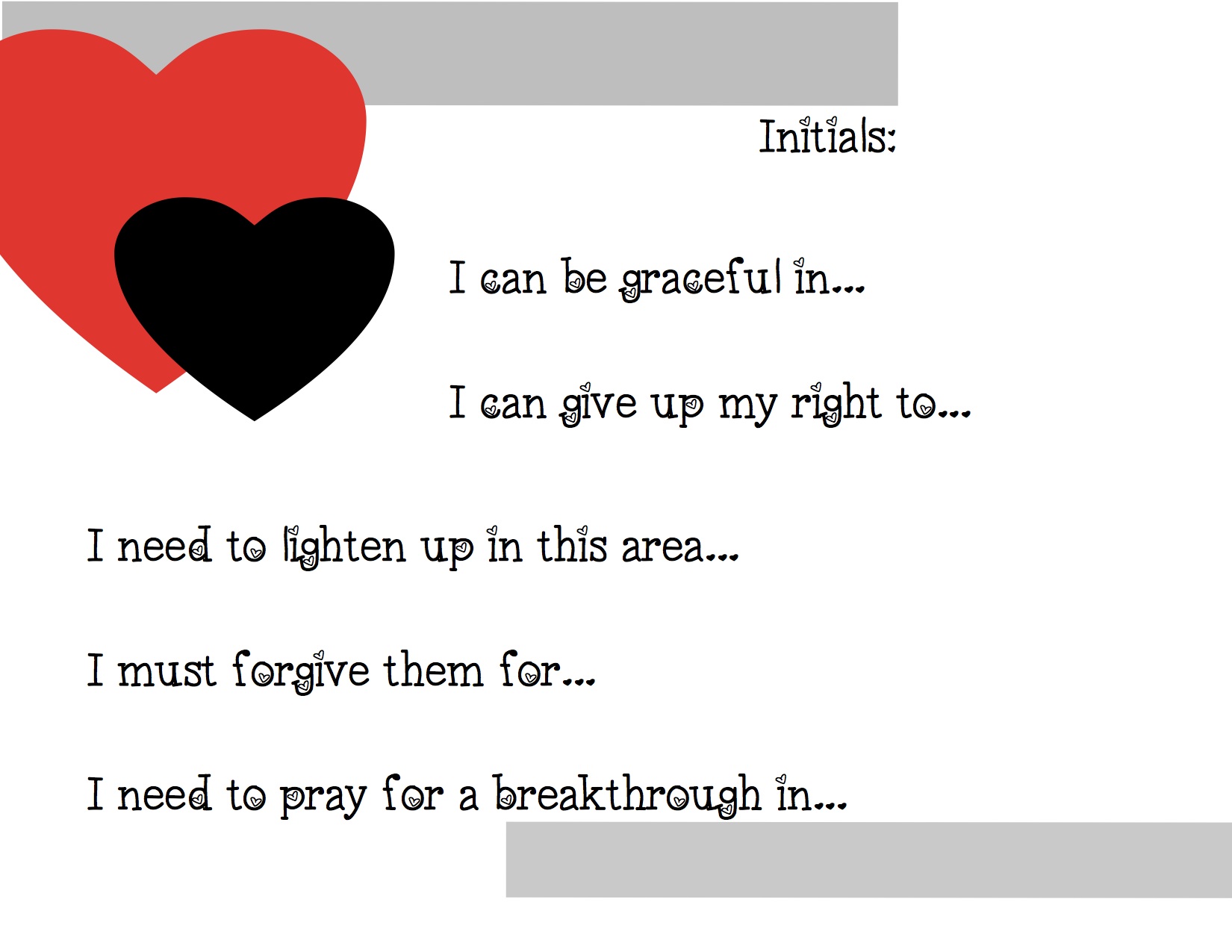
I know you have someone in your life that you think is unloveable. With that person’s face clearly in mind, how will you fill in the blanks:

  1. I can be graceful in…
  2. I can give up my right to…
  3. I need to lighten up in this area…
  4. I must forgive them for…
  5. I need to pray for a breakthrough in…

If you would like a downloadable PDF of this worksheet, click here –> Love is… worksheet 2

If you missed any of the messages in our Loving the Unlovable series, you can check them all our here.

Love Is… (part 1)

Love is… worksheet 1The greatest definition of love in the history of mankind is given to us in 1 Corinthians 13. This is the “gold standard” to which all of us should strive to pattern our lives.

But notice that right at the beginning, Paul says, “Love IS” (verse 4). Not love feels good or even love does; but love is. Love is not love because it makes us feel good. Love is not love because we did something nice. Love is love because it measures up to this standard in 1 Corinthians.

Here are the first five attributes of love.

Love is patient

  • Patient love doesn’t lose heart, but stays hopeful.
  • It endures patiently and bravely in enduring misfortune and disappointment.
  • “It can endure evil, injury, and provocation, without being filled with resentment, indignation, or revenge.” —Matthew Henry

Love is kind

  • It is pleasant and courteous.
  • It both seizes opportunities and makes opportunities to show kindness.
  • …as far as it depends on you, live at peace with everyone. (Romans 12:18)

Love is catching others doing something good

  • The biblical phrase is love is not envious, but I want to turn the positive into a negative. Far too often we Christians are known more for what we against, not what we’re for. So the positive way of saying this: we rejoice when others succeed. Or, we catch them doing something good.

Love is complementing others

  • Again, we turn the negative love does not boast into a positive, and say love complements others.
  • Agape raises the value of the object of its love.

Love is others-focused

  • Again, turning the negative love is not proud into a positive.
  • Do nothing out of selfish ambition or vain conceit, but in humility consider others better than yourselves. (Philippians 2:3)

Here’s where the real test comes in: How will you apply these attributes of love to someone in your life? More specifically: to someone you think is “unloveable”?

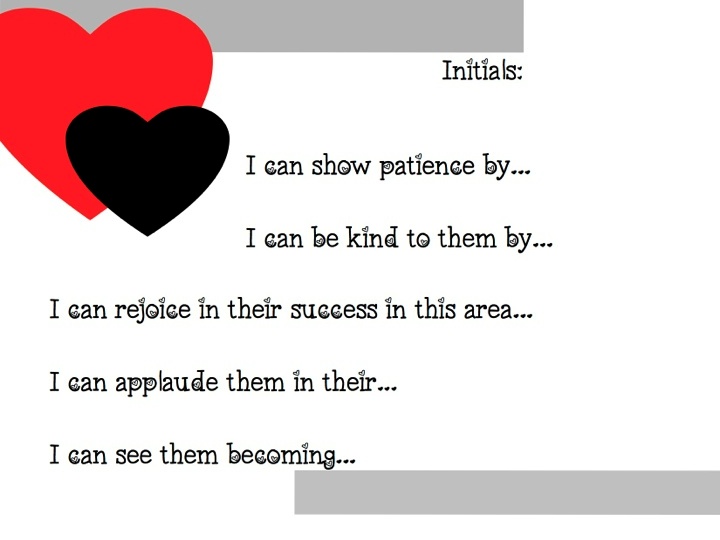
I know you have someone in your life that you think is unloveable. With that person’s face clearly in mind, how will you fill in the blanks:

  1. I can show patience by…
  2. I can be kind to them by…
  3. I can rejoice in their success in this area…
  4. I can applaud them in their…
  5. I can see them becoming…

If you would like a downloadable PDF of this worksheet, click here –> Love is… worksheet 1

If you missed any of the messages in our Loving the Unlovable series, you can check them all our here.

Weighing The Positives And Negatives*

WeighingDon’t you get annoyed when an overly-religious person spouts off some pie-in-the-sky, feel-goodism that sounds religious, but doesn’t seem to have any grounding in the real world?

Like when a church leader says, “Praise be to the God and Father of our Lord Jesus Christ” when you are in the midst of a painful situation? This is one of those statements that’s great for church, but not so great for the battlefield of life, right?

Actually that statement was made by the apostle Peter (see 1 Peter 1:3).

He didn’t shout it in a church service, but in a letter to Christians who were on the run from their persecutors. Many of them had lost their homes and businesses, had to leave their hometowns, were separated from their families, and were having their very lives threatened. Peter didn’t just shout this praise, he explained its origin, too.

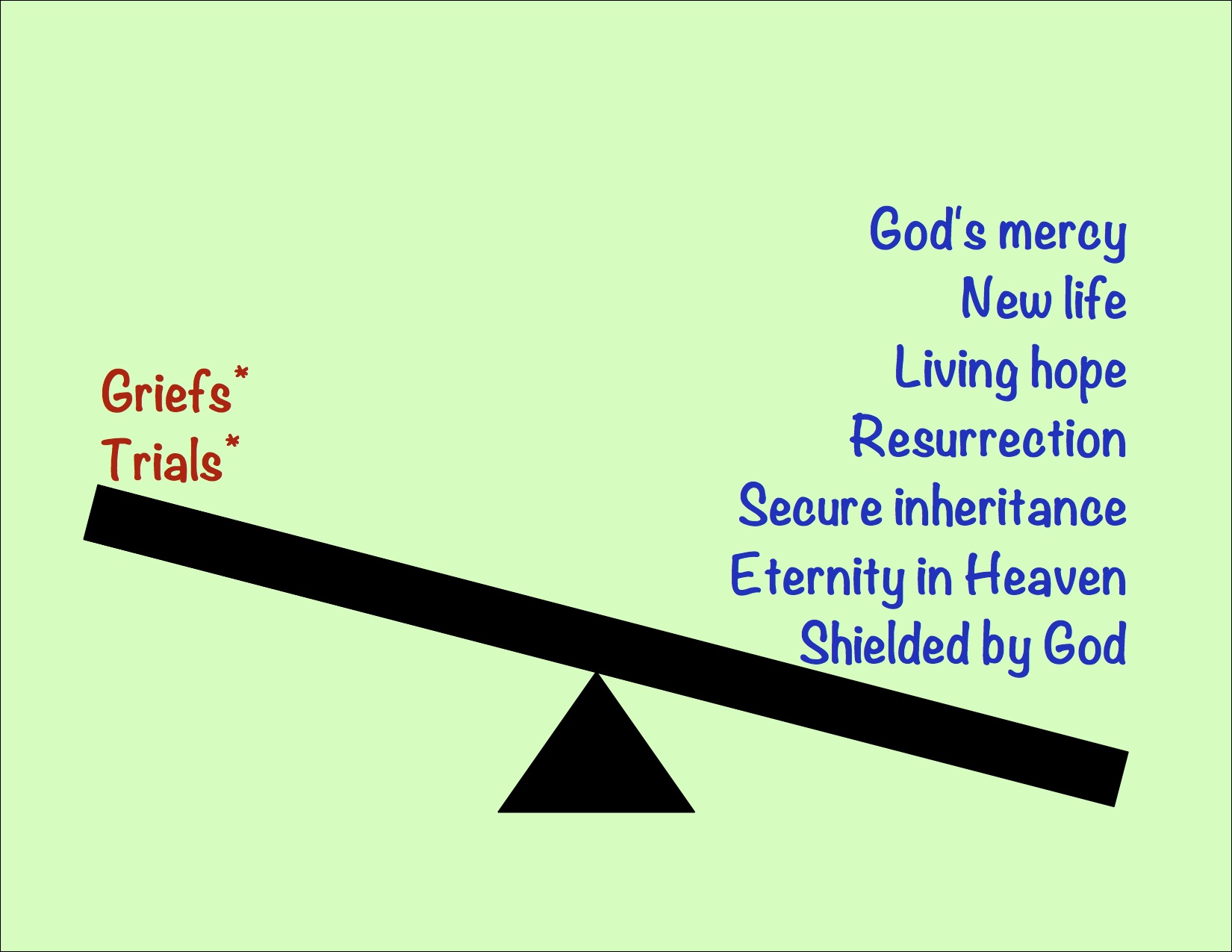
Over the next few verses he asks us to consider what a relationship with Jesus Christ would bring us, and then to put the positives and negatives on a scale—

The Positives

  • God’s mercy
  • New life
  • Living hope
  • Resurrection from the dead
  • Secure inheritance
  • An eternity with God in Heaven
  • God’s power shielding us

The Negatives*

  • Grief
  • Trials

*

So whether we look at the eternal positives or the temporary “negatives” there is cause for rejoicing. When a Christian is in a difficult situation, he must remember this:

  1. This situation is only temporary
  2. This situation will ultimately bring glory to God

Weigh the positives and negatives and you will see that what you are going through now cannot even begin to compare to the glory of God that is coming! The apostle Paul echoed Peter’s words when he wrote, “I consider that our present sufferings are not worth comparing with the glory that will be revealed in us” (Romans 8:18).

So keep your eyes on Jesus, and keep shouting your praise to Him.

Holy Spirit, please help me to look away from the temporary and keep my eyes on my eternal God and Savior.