When couples are divorcing, their most common complaint is summed up in two words: irreconcilable differences. The couple is saying that things have gotten so bad―and the distance between them has gotten so vast―that there is no hope at all of ever patching things up.
Sometimes we might be able to say that both husband and wife shared some of the blame. But this isn’t true in a spiritual divorce. When we are separated from God, it’s all on us. Paul describes us as powerless sinners, unholy enemies of God (see Romans 5:6, 8, 10). We did the leaving; we are the problem.
But in the desire to bring reconciliation, God puts it all on Himself―more specifically, on the death of His Son Jesus on an old rugged Cross. In Romans 5 Paul says our reconciliation was through Christ five times in just three verses (vv. 9-11).
As if it weren’t amazing enough that Christ’s death on the Cross saved us, justified us, and reconciled us, giving us a brand new start (2 Corinthians 5:16-17), God then gave us the same ministry that He undertook through Jesus: the ministry of reconciliation (vv. 18-19)!
What Jesus purchased for us on an old rugged Cross allows us to “become the righteousness of Christ” (v. 21). Not reflect His righteousness, not talk about His righteousness, but actually become His righteousness!
We have the supreme privilege of being able to bring the message of reconciliation to others who used to be where we were: powerless sinners, unholy enemies of God!
We have the awesome joy of being God’s righteousness to people who think their irreconcilable differences will keep them from God!
The greatest act of serving you could ever do for anyone is telling them that they can be reconciled to God through Jesus Christ’s work on an old rugged Cross!
Absolutely amazing!
We’ll continue our look at the Old Rugged Cross next Sunday, and I’d love to have you join me at Calvary Assembly of God.
I love the insight of this godly man, and I hope you enjoy these quotes too…
“God, as Creator, formed man to be a vessel in which He could show forth His power and goodness. Man was not to have in himself a fountain of life or strength or happiness. The ever-living and only living One was intended each moment to be the communicator to man of all that he needed.”
“The blessing of God’s Word is only to be known and enjoyed by obeying it: ‘If you love Me, you will obey what I command’ (John 14:15). Keeping His Word is the only proof of a genuine saving knowledge of God, of not being self-deceived in our faith, of God’s love being experientially known and not merely imagined.”
“The person who reads his Bible with longing and determination to learn and to obey every commandment of God is on the right path to receiving all the blessing the Word is meant to bring.”
“The New Testament standard of Christian commitment is barely realized in the church today. Its whole tone is intensely supernatural. Christian commitment and devotion involves a life totally identified with the life of Christ. It must be a life in the continual presence and under the guidance of the Holy Spirit.”
“Many pray for the Spirit that they may make use of Him and His power for their work. This is an entirely wrong concept. It is He who must use you.”
“Unless we are willing to pay the price, to sacrifice time and attention and seemingly legitimate or necessary tasks for the sake of the spiritual gifts, we need not look for much power from above in our work. God’s call to much prayer need not be a burden or cause for continual self-condemnation. He intends it to be a joyful task. He can make it an inspiration. Through it He can give us strength for all our work and bring blessing to others by His power that works in us.”
“Let our lack of prayer convict us of the coolness in our Christian life that lies at the root of it. God will use the discovery to bring us not only the power to pray that we long for but also the joy of a new and healthy life of which prayer is the spontaneous expression.”
“Our prayers must not be vague appeals to His mercy or indefinite cries for blessing, but the distinct expression of a specific need. It is not that Jesus’ loving heart does not understand our cry or is not ready to hear, but He desires that we be specific for our own good. Prayer that is specific teaches us to better know our own needs.”
“Do you see what holiness is and how it is to be found? It is not something formed in you. It is not something put on you from without. Holiness is the presence of God resting on you. Holiness comes as you consciously abide in that presence, doing all as a sacrifice to Him.”
“The connection between the prayer life and the Spirit life is close and indissoluble. … Learn from our Lord Jesus how impossible it is to walk with God, obtain God’s blessing or leading, or do His work joyously and fruitfully apart from close, unbroken fellowship with the One who is our living fountain of spiritual life and power.”
“His blood is the eternal and undeniable proof that God the Father and Christ will do for you all that is needed, and that they will not forsake you until they have accomplished their work in you from beginning to end.”
“Live your daily life in full consciousness of being righteous in God’s sight, an object of delight and pleasure in Christ. Connect every view you have of Christ in His other graces with this first one: Christ Jesus—our righteousness from God. This will keep you in perfect peace.”
“His greatness no one can fathom” (Psalm 145:3).
God’s kingdom is everlasting and endures through all generations (v. 13). Look at all of God’s “alls”—
My only appropriate response to all God’s “alls”—I will praise Your name for ever and ever. Every day I will praise You and extol Your name for ever and ever. … My mouth will speak in praise of the Lord. Let every creature praise His holy name for ever and ever (vv. 1, 2, 21).
ALL praise to God FOREVER!
Here’s what God says about you and me: “I long to redeem them” (Hosea 7:13). The prophet Hosea has a front row seat, watching God pursue and woo His people, and Hosea records for us God’s longing passion.
The placement of God’s declaration—I long to redeem them—is a wonder to me. It’s right in the middle of a catalogue of His people’s sins. God says:
And still in the midst of all this comes, “I long to redeem them.” Astounding!
God tells us what we need to do—
Sow for yourselves righteousness, reap the fruit of unfailing love, and break up your unplowed ground; for it is time to seek the Lord, until He comes and showers righteousness on you. (10:12)
The alternative?
BUT you have planted wickedness, you have reaped evil, you have eaten the fruit of deception. Because you have depended on your own strength and on your many warriors…you will be completely destroyed. (10:13-15)
What will you choose: To seek God OR to depend on your own strength?
God LONGS to redeem you, but you have to ask Him to do so.
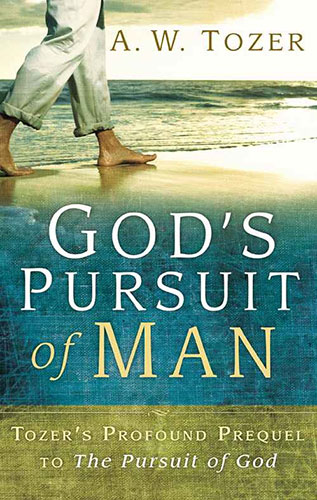
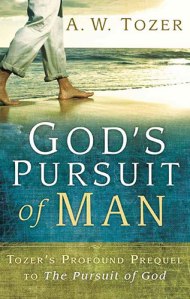
A.W. Tozer paints such a vivid picture of God’s desire for us to be in a deeper relationship with Him. I love it! You can read my full book review by clicking here. Below are some quotes I especially appreciated from God’s Pursuit Of Man.
“We habitually stand in our now and look back by faith to see the past filled with God. We look forward and see Him inhabiting our future; but our now is uninhabited except for ourselves. Thus we are guilty of a kind of temporary atheism which leaves us alone in the universe while, for the time, God is not.”
“Whatever else it embraces, true Christian experience must always include a genuine encounter with God. Without this, religion is but a shadow, a reflection of reality, a cheap copy of an original once enjoyed by someone else of whom we have heard. It cannot but be a major tragedy in the life of any man to live in a church from childhood to old age and know nothing more real than some synthetic god compounded of theology and logic, but having no eyes to see, no ears to hear and no heart to love.”
“Self-righteousness is an effective bar to God’s favor because it throws the sinner back upon his own merits and shuts him out from the imputed righteousness of Christ.”
“Every man looks to his fellow men because he has no one else to whom he can look. David could say, ‘Whom have I in heaven but Thee? and there is none upon earth that I desire beside Thee’ (Psalm 73:25). But the sons of this world have not God; they have only each other, and they walk holding to each other and looking to one another for assurance like frightened children. But their hope will fail them, for they are like a group of men, none of whom has learned to fly a plane, who suddenly find themselves aloft without a pilot, each looking to the other to bring them safely down. Their desperate but mistaken trust cannot save them from the crash which must certainly follow. … Yet in their pride men assert their will and claim ownership of the earth. Well, for a time it is true that this is man’s world. God is admitted only by man’s sufferance. He is treated as visiting royalty in a democratic country. Everyone takes His name upon his lips and (especially at certain seasons) He is feted and celebrated and hymned. But behind all this flattery men hold firmly to their right of self-determination. As long as man is allowed to play host he will honor God with his attention, but always He must remain a guest and never seek to be Lord. Man will have it understood that this is his world; he will make its laws and decide how it shall be run. God is permitted to decide nothing. Man bows to Him and as he bows, manages with difficulty to conceal the crown upon his own head.”
“The degree of blessing enjoyed by any man will correspond exactly with the completeness of God’s victory over him.”
“A thousand years of remorse over a wrong act would not please God as much as a change of conduct and a reformed life. … We can best repent our neglect by neglecting Him no more. Let us begin to think of Him as One to be worshiped and obeyed. Let us throw open every door and invite Him in. Let us surrender to Him every room in the temple of our hearts and insist that He enter and occupy as Lord and Master within His own dwelling.”
“God made man in His own image and placed within him an organ by means of which he could know spiritual things. When man sinned that organ died. ‘Dead in sin’ is a description not of the body nor yet of the intellect, but of the organ of God-knowledge within the human soul. Now men are forced to depend upon another and inferior organ and one furthermore which is wholly inadequate to the purpose. I mean, of course, the mind as the seat of his powers of reason and understanding. Man by reason cannot know God; he can only know about God.”
“The danger is that we think of ‘the power of God’ as something belonging to God as muscular energy belongs to a man, as something which He has and which might be separated from Him and still have existence in itself. We must remember that the “attributes” of God are not component parts of the blessed Godhead nor elements out of which He is composed. A god who could be composed would not be God at all but the work of something or someone greater than he, great enough to compose him. We would then have a synthetic god made out of the pieces we call attributes, and the true God would be another being altogether, One indeed who is above all thought and all conceiving.”
“Christianity takes for granted the absence of any self-help and offers a power which is nothing less than the power of God. This power is to come upon powerless men as a gentle but resistless invasion from another world, bringing a moral potency infinitely beyond anything that might be stirred up from within. This power is sufficient; no additional help is needed, no auxiliary source of spiritual energy, for it is the Holy Spirit of God come where the weakness lay to supply power and grace to meet the moral need.”
“Man, who moved out of the heart of God by sin, now moves back into the heart of God by redemption. God, who moved out of the heart of man because of sin, now enters again His ancient dwelling to drive out His enemies and once more make the place of His feet glorious.”
“To will the will of God is to do more than give unprotesting consent to it; it is rather to choose God’s will with positive determination. As the work of God advances, the Christian finds himself free to choose whatever he will, and he gladly chooses the will of God as his highest conceivable good.”
“That terrible zone of confusion so evident in the whole life of the Christian community could be cleared up in one day if the followers of Christ would begin to follow Christ instead of each other.”
“Religious contentment is the enemy of the spiritual life always.”
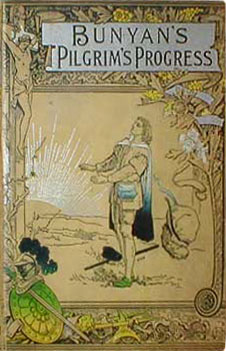
I love Pilgrim’s Progress! You can read my full book review by clicking here. I’m sharing some of my favorite passages from this classic.
This is part of a dialogue between Great-heart and Christiana—
Great-heart: “He [Christ] has more righteousness than you have need of, or than He needeth Himself.”
Christiana: “Pray make that appear.”
Great-heart: “With all my heart: but first I must premise, that He of whom we are now about to speak, is one that has not His fellow. He has two natures in one person, plain to be distinguished, impossible to be divided. Unto each of these natures a righteousness belongeth, and each righteousness is essential to that nature; so that one may as easily cause the nature to be extinct, as to separate its justice or righteousness from it. Of these righteousnesses therefore we are not made partakers, so as that they, or any of them, should be put upon us, that we might be made just, and live thereby. Besides these, there is a righteousness, which this person has, as these two natures are joined in one. And this is not the righteousness of the Godhead, as distinguished from the manhood; nor the righteousness of the manhood, as distinguished from the Godhead; but a righteousness which standeth in the union of both natures, and may properly be called the righteousness that is essential to His being prepared of God to the capacity of the mediatory office, which He was to be intrusted with. If He parts with His first righteousness, He parts with His Godhead; if He parts with His second righteousness, He parts with the purity of His manhood; if He parts with this third, He parts with that perfection which capacitates Him for the office of mediation. He has therefore another righteousness, which standeth in performance, or obedience to a revealed will; and that is it that He puts upon sinners, and that by which their sins are covered. Wherefore He saith, As by one man’s disobedience many were made sinners, so by the obedience of One shall many be made righteous.”
Christiana: “But are the other righteousnesses of no use to us?”
Great-heart: “Yes; for though they are essential to His natures and office, and so cannot be communicated unto another; yet it is by virtue of them that the righteousness that justifies is for that purpose efficacious. The righteousness of His Godhead gives virtue to His obedience; the righteousness of His manhood giveth capability to His obedience to justify; and the righteousness that standeth in the union of these two natures to His office, giveth authority to that righteousness to do the work for which it is ordained.
“So then here is a righteousness that Christ, as God, has no need of; for He is God without it. Here is a righteousness that Christ, as man, has no need of to make Him so; for He is perfect man without it. Again, here is a righteousness that Christ, as God-man, has no need of; for He is perfectly so without it. Here then is a righteousness that Christ, as God, as man, as God-man, has no need of with reference to Himself, and therefore He can spare it; a justifying righteousness, that He for Himself wanteth not, and therefore He giveth it away. Hence ’tis called the gift of righteousness. This righteousness, since Christ Jesus the Lord has made Himself under the law, must be given away; for the law doth not only bind him that is under it, to do justly, but to use charity. Wherefore he must, he ought by the law, if he hath two coats, to give one to him that has none. Now our Lord indeed hath two coats, one for Himself, and one to spare; wherefore He freely bestows one upon those that have none.”
Read a dialogue between Faithful, Christian, and Talkative by clicking here.
And a dialogue between Christian and Hopeful by clicking here.
I unabashedly tell anyone who asks me what my favorite book is … It’s the Bible. I have yet to find such a collection of writings that work every single time they’re applied.
Two summers ago we began a series of messages on the 119th Psalm. It appears that the psalmist shares my passion for God’s Word, as he writes time and time again the difference Scripture makes in his life.
The other thing that makes this psalm so cool to me is the organization of the 176 verses into twenty-two 8-verse segments, with each verse in a segment beginning with the the same Hebrew letter as its title. In the Hebrew language, the letters in the alphabet had their own meaning. In English an “n” is simply spelled “n.” It has no other definition or meaning. But in Hebrew the letter nun has both a spelling and a meaning. Nun is spelled nun-vav-nun (final), and it means both faithfulness and the reward for faithfulness.
Look at the three Hebrew characters that spell nun. Reading right to left it tells a story and gives the meaning of the letter/word—the one who is humbled in faithfulness will be the one who stands in righteousness. The perfect example of this is Jesus, Who humbled Himself when He came to earth and to the Cross, and then was exalted by the Heavenly Father to wear the crown of righteousness (see Philippians 2:5-11 and Revelation 14:14). Paul starts this passage by calling on us to “have the same attitude as that of Jesus” (v. 5), and concludes with the call to stick with it all the way to the end (see vv. 12-13).
The psalmist calls us to this same thing in nun (Psalm 119:105-112). The “bookend” verses say, “Your Word is a lamp for me… so my heart is set on keeping Your Word” (vv. 105 and 112). In between the psalmist commits himself to a life of humbly persevering to God’s ways, and reaps the rewards of a changed heart, the joy of the Lord, and a heritage to pass on to others.
I have fought the good fight, I have finished the race, I have kept the faith. Now there is in store for me the crown of righteousness, which the Lord, the righteous Judge, will award me on that day—and not only to me, but also TO ALL who have longed for His appearing (2 Timothy 4:7-8).
Humble yourself before the Lord, and He will lift you up (James 4:10).
My heart is set on keeping Your decrees to the very end (Psalm 119:112).
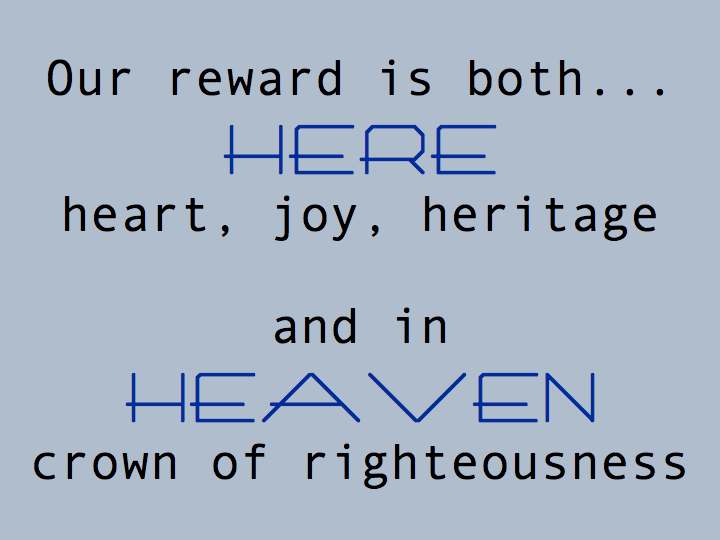
Rewards here (new heart, joy, heritage) AND rewards in Heaven (a crown of righteousness). How awesome is that!!
If you have missed any of the messages in our P119 series, you can access them all by clicking here.
This is a weekly series with things I’m reading and pondering from Oswald Chambers. You can read the original seed thought here, or type “Thursdays With Oswald” in the search box to read more entries.
The Holy Spirit In Me
When I receive the Holy Spirit He lifts my personality back into its primal relationship with God. Holy Spirit coming into my spirit never becomes my spirit; He energizes my spirit and enables me “to will and to do of His good pleasure.”
… When the Holy Spirit begins to unearth the works of the flesh in you, don’t temporize it, don’t whitewash them; don’t call suspicion “discernment of the spirit,” or ill-temper “righteous indignation”; bring it to the light, come face to face with it, confess it and get cleansed away.
From Conformed To His Image
Jesus said the Holy Spirit would help form the righteousness of Christ in us, but we have to obediently respond to what the Spirit is convicting us of.
Probably like you, I am more apt to make excuses or rationalize why what I’m doing is okay (even though the Holy Spirit is convicting me otherwise). It becomes a battle that won’t end well for me! The better course of action is to listen to the conviction of the Holy Spirit, repent of my fleshly behavior as He reveals it to me, and receive more of the life in Christ in me.
What do you think?