How To Be Wise With Your Mouth And Ears

A fool finds no pleasure in understanding but delights in airing his own opinion. (Proverbs 18:2)

One’s open mouth—and closed ears and mind—says a lot of one’s heart! In this 18th chapter of Proverbs, Solomon draws a pretty stark contrast between the mouth and ears of a fool and of a wise person. Check out the links on each of the verses to Bible Gateway to get a full picture of both the fool and the wise person.

Big MouthThe fool…

  • His lips bring him trouble, a smack on the jaw, and may even cost him his life. And yet he keeps on spouting foolishness. He’s not interested in getting any better (vv. 6, 7).
  • His ears gobble up the latest gossip (v. 8).
  • He fires off an answer before really listening (v. 13).
  • His quick, careless words creates the poison food that he continues to eat (v. 21).

The wise…

  • He is always learning how to use his words in a God-honoring, soul-benefitting way (v. 4).
  • He avoids “cheap candy” gossip (v. 8).
  • He listens fully before trying to respond (v. 13).
  • He asks good, clarifying questions (v. 17).
  • His wise words creates the healthy food that nourishes him (v. 20).

So… are you being wise or foolish with your mouth and ears?

Links & Quotes

link quote

“Getting ready to feast on all God’s Word is not first an intellectual challenge; it is first a moral challenge. If you want to eat the solid food of the Word, you must exercise your spiritual senses so as to develop a mind that discerns between good and evil. The startling truth is that, if you stumble over understanding Melchizedek in Genesis and Hebrews, it may be because you watch questionable TV programs. If you stumble over the doctrine of election, it may be because you still use some shady business practices. If you stumble over the God-centered work of Christ in the Cross, it may be because you love money and spend too much and give too little. The pathway to maturity and to solid biblical food is not first becoming an intelligent person, but becoming an obedient person. What you do with alcohol and sex and money and leisure and food and computers has more to do with your capacity for solid food than where you go to school or what books you read.” —John Piper

“When God is our strength, it is strength indeed; when our strength is of our own, it is only weakness.” —Augustine

In the United States of America, our presidents have had much to say about Thanksgiving. In this article, learn what those proclamations tell us.

[VIDEO] A good reminder from Dennis Prager to be thankful for what we DO have, not complaining about what we DON’T have—

8 Quotes Worth Studying From “Proverbs”

ProverbsIn my review of Proverbs by Charles Bridges (which you can read by clicking here), I noted how he weaved the principles in the biblical book of Proverbs into the teaching that occurs throughout the Scripture. In others words, he showed that the wisdom in Proverbs wasn’t just a “stand-alone” wisdom, but integrated into the whole.

In the quotes I’m sharing today, I trust you will get a glimpse of what I mean. The reference in brackets before the quote indicate the Proverb to which Bridges is commenting. I have also linked all of the Scripture references to my friends at Bible Gateway, so you can look them up easily (and I encourage you to do so!).

[Proverbs 1:10-16] “If the temptation prevail, charge it not on God; no—nor on the devil. As the worst he can do, he can only tempt, he cannot force us, to sin. When he has plied us with his utmost power, and most subtle artifice, it is at the choice of our own will, whether we yield or no (see James 1:13-15). The habitual resistance of the will clears us of responsibility (cp. Romans 7:14-17, 19-20, 23). The consent, even if it be not carried out into the act, lays the responsibility at our own door.”

[Proverbs 2:10-11] “The forsaken sin only makes way for some more plausible, but not less deadly passion. The heart, cast into the mold of the Gospel, is the only cover from those snares within and without (Romans 6:17, 18; 2 Corinthians 3:18), which so imperceptibly, yet so fatally, estrange us from God. Never, till the vital principle is implanted, is their mischief discerned. Never, till then, does the heart find its proper object, its true resting-place.”

[Proverbs 3:5-6] “Take one step at a time, every step under Divine warrant and direction (cp. Ezekiel 18:21-23; Nehemiah 1:11). Ever plan for yourself in simple dependence on God. It is nothing less than self-idolatry to conceive that we can carry on even the ordinary matters of the day without His counsel. He loves to be consulted. Therefore, take all thy difficulties to be resolved by Him. Be in the habit of going to Him in the first place—before self-will, self-pleasing, self-wisdom, human friends, convenience, expediency. Before any of these have been consulted, go to God at once. Consider no circumstances too clear to need His direction. In all thy ways, small as well as great; in all thy concerns, personal or relative, temporal or eternal, let Him be supreme.”

[Proverbs 3:11-12] “Faith understands the reasons of the discipline (1 Peter 1:6, 7); acknowledges it as a part of His gracious providence (Deuteronomy 8:2, 15, 16), and the provision of His everlasting covenant (Psalm 89:30-32); waits to see the end of the Lord (James 5:11); and meanwhile draws its main support from the seal of adoption.”

[Proverbs 4:14-17] “To pray not to be led into temptation; yet not to watch, that we enter not into it (Matthew 6:13; 26:41)—is practically to contradict our prayers; to mock our God, by asking for what we do not heartily wish.”

[Proverbs 11:18-19] “Righteousness is the seed; happiness is the harvest. The reward indeed is not from cause, but of consequence; not of debt, but of grace depending upon a free promise; mercifully yet surely linked with Christian perseverance (Ecclesiastes 11:6; Hosea 10:12; 1 Corinthians 15:58; Galatians 6:7, 8).”

[Proverbs 17:22] “If then, Christian, you believe the Gospel to be ‘glad tidings’ (Luke 1:19; 8:1), show that you believe it, by lighting up your face with a smile.”

[Proverbs 28:13] “The love of sin struggles with the power of conscience. The door of access to God is barred (Psalm 66:18). Christian confidence is clouded (Psalm 32:3, 4); and, unless Sovereign mercy interpose, it must end in the sting of ‘the never-dying worm’ (Isaiah 66:24; Mark 9:44-48). The covering of the disease precludes the possibility of the cure. Only the penitent confessor can be the pardoned sinner.”

“The best work on the Proverbs. While explaining the passage in hand, he sets other portions of the Word in new lights.” —C.H. Spurgeon, commenting on this book

Proverbs (book review)

ProverbsWhat’s the difference between a travel agent and a tour guide? A travel agents simply points the way, a tour guide goes on the trip alongside you, pointing out things they’ve seen and experienced firsthand. I love reading the book of Proverbs in the Bible, but this time I read it with Charles Bridges’ book Proverbs as my tour guide.

Charles Bridges was a pastor par excellence who skillfully wove together supporting Scriptures to give a fuller picture of the particular text on which he was teaching. As a result, you are able to see more clearly how individual lines in each of the Proverbs was supported and integrated into other Scriptures, and how it was immediately applicable to daily life.

My only disappointment with this book is that Bridges only offers commentaries on 22 of the Proverbs. But what he does show is brilliant, and it gave me a new light for my own tour of the remaining Proverbs.

Check this book out the next time you would like to read the rich wisdom in the biblical Proverbs.

Links & Quotes

link quote

“Scripture is about God, God is love, therefore, if you want to learn the Scriptures, look to learn love.” —T.M. Moore

“It is remarkable that the persons in positions of power who wrote most of Israel’s Wisdom Literature did not present the poor as immoral or second-class, but as neighbors in need of mercy. On the other hand, there is never an indication that the needy are necessarily more pious; after all, poverty was never presented as an ideal of Israelite society (Deuteronomy 15:4).” —Archeological Study Bible

“Where would you have been but for grace? To repeat the old saying of John Bradford, when he saw a cartful of men going off to Tyburn to be hanged, ‘There goes John Bradford but for the grace of God.’ When you see the swearer in the street, or the drunkard rolling home at night, there are you, there am I, but for the grace of God. Who am I? What should I have been if the Lord, in mercy, had not stopped me in my mad career?” —Charles Spurgeon

[VIDEO] I hadn’t thought of it this way before, but John Maxwell says there is a healthy and unhealthy way of being defensive—

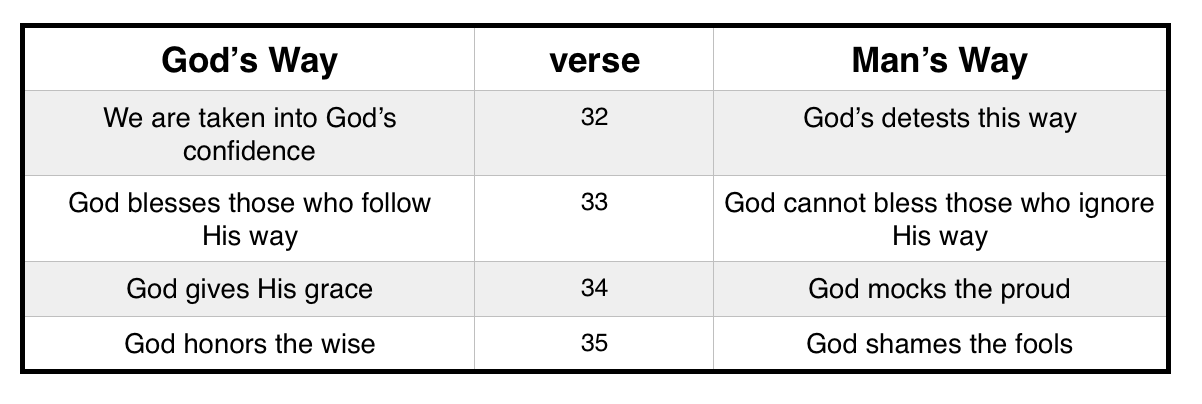
4 Reasons Why God’s Way Is Better

Notice the contrasts (see the conjunction “but”) in these wise words from King Solomon—

For the Lord detests a perverse man but takes the upright into His confidence.

The Lord’s curse is on the house of the wicked, but He blesses the home of the righteous.

He mocks proud mockers but gives grace to the humble.

The wise inherit honor, but fools He holds up to shame. (Proverbs 3:32-35)

Solomon is inviting us to compare God’s way with our way.

God's way or man's way

Looking at this, it’s not too hard to figure out which way is the better way to live! 

Charles Bridges commented on these verses, “The value of our inheritance is beyond all price; its happiness unspeakable; its security unchangeable; its duration eternity. The wise shall inherit glory. ‘They that be wise shall shine as the brightness of the firmament for ever and ever’ (Daniel 12:3; Matthew 13:43).”

(To download a PDF version of the chart above, click here → God’s way or man’s way)

You Are God’s Lavish Gift To Others

GratefulI have noticed a couple of things about thank-full people (people who are full of thanks). In a single word the difference is ABUNDANCE.

  • Thank-full people have an abundance mentality—they believe there’s plenty for everyone; that God’s grace overflows and is boundless.
  • Thank-full people want others to find this abundant life too. As Charles Spurgeon prayed, “I would then that the quickening Spirit would come down upon me, and upon you, upon every one of us in abundance, to create men valiant for truth and mighty for the Lord.”

This abundance mentality is what Paul is referring to when he writes, “Let the word of Christ dwell in you richly” (Colossians 3:16). Both words dwell and richly convey someone who is so saturated in the abundance of God, that they cannot help wanting to share it with everyone!

So how do Christians lavish their thank-fullness and peace-fullness on others? The rest of that verse in Colossians tells us:

  1. We teach.
  2. We admonish with all wisdom.
  3. We sing.

Teaching others is always rooted in love, and is for the benefit of the other person (Ephesians 4:15, 25, 29).

Wisdom is the Greek word sophia. It means heavenly insight that is extremely practical. That’s what we need when we admonish those we love. This word means to warn people if they are on a wrong path. We love them enough to speak a loving word of warning (Proverbs 27:5-6).

And we sing out of our abundant overflow. The word of Christ dwells in us so richly that it literally bursts out of us in song! Have you ever been around someone so full of God’s presence that their words almost seem to be a song?

But don’t miss out on this. The lavish gift God wants to pour out on people is YOU! Notice how many times the pronoun you is used in Colossians 3:15-17. YOU are God’s gift to your family, your friends, your co-workers, your community!

Don’t rob others of this amazing gift by becoming ungrateful.

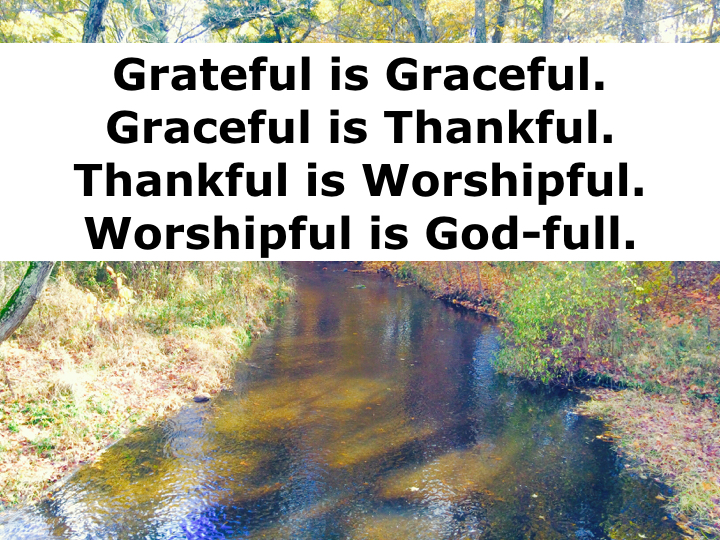
Grateful is graceful. 
Graceful is thankful. 
Thankful is worshipful.
Worshipful is God-full.

“The essence of Christianity is that we give the Son of God a chance to live and move and have His being in us, and the meaning of all spiritual growth is that He has an increasing opportunity to manifest Himself in our mortal flesh.” —Oswald Chambers

What will you do to remain thank-full, and remain God’s lavish gift to others?

Part three of our 3-part series on gratitude is coming up this Sunday. If you don’t have a home church in the Cedar Springs area, I would be so thank-full to have you come join us!

Links & Quotes

link quote

“Those of us who are married need to ponder again and again how mysterious and wonderful it is that God grants us in marriage the privilege to image forth stupendous divine realities infinitely bigger and greater than ourselves.” —John Piper

“Have we any work to do now that we can set about at once? If we have, whatsoever our hand finds to do, let us do it. Let us not be asking for greater abilities than we have. If we can get them, let us do so; but meanwhile let us use what we have. … The best preparation for it will be, renew your dedication to Christ, be much in earnest prayer, seek the sanctifying influences of the Holy Spirit, and then go forth in your Master’s strength with this as your resolve—that as portraits of Jesus Christ it shall be said of you, ‘He went about doing good’ [Acts 10:38].” —Charles Spurgeon

“The only difference between the Christian life and any other life is the matter of where we stand as we encounter the everyday trials and difficulties of life. … Even though the circumstances of a Christian’s life change, and even become adverse and cumbersome at times, this does not alter the fact that the Christian stands in—has access to, come what may—the glory of God. Believers may, under all circumstances and in every situation, slump down into the loving arms of the Lord and find glory and strength to help them bear up with joy and peace through even the worst life can throw at them.” —T.M. Moore

“Better to ask twice than to lose your way once.” —Danish Proverb

Sad to see how abortion providers target minority communities. Two-thirds of abortions in Michigan are done in the Detroit area, where only 40 percent of the state’s population is.

Eric Metaxas has some great advice for talking to your atheist friends about the problems with Darwin’s theories.


10 Quotes On Emotional Health From “Brain Savvy-Leaders”

Brain-Savvy LeadersOur emotions start in our brain. Charles Stone wrote a very helpful book called Brain-Savvy Leaders, in which he covers a lot of ground inside our heads. One aspect is our emotional health. I encourage you to read my review of this book by clicking here. Below are some quotes Charles shared on our emotional health.

“Gratefulness is actually good for brain and body health.” 

“When the emotionality of leaders takes over, they compromise their ability to lead well in these ways:

  • impulse can overwhelm intention
  • imagination gets pushed aside by instinct
  • defensiveness stifles healthy positions
  • automatic behavior shuts down reflective thought
  • emotionality gets in the way of intentionality.”

“Fear, conscious and unconscious, is prompted by the amygdala. The brain naturally focuses on problems and the negative. It overestimates threats and underestimates opportunities. In fact, two-thirds of the brain cells in our amygdala are primed for negativity and fear. Negative networks in our brain outweigh positive ones by five to one. And negative emotions are more easily consolidated (made more permanent) into our long-term memory than positive emotions.”

“Fear can even be subconscious, especially if we’re surrounded by bad news, critical people, or if our self-talk is constantly negative.”

“Neuroscientists have found that stuffing, denying, or a ignoring our emotions reinforces them, affects short-term memory, increases blood pressure, and robs our brain’s prefrontal cortex of the mental energy it needs.”

“Although it may seem counterintuitive, tagging your emotions, through labeling and naming them by putting feelings into words, actually recruits our impulse break and dampens activity in our panic alarm.”

“Anger is the wind that blows out the lamp of the mind.” —Chinese Proverb

“Since our brains process and remember bad events more thoroughly than good ones…it’s vital that we develop the discipline of being aware of our thoughts. … Thinking about our thinking is called ‘metacognition.’”

“Emotions play a significant role in decision-making and influence how well your team will embrace change. Just presenting facts without engaging positive and hopeful emotions will seldom move your team forward. The brain can only handle so much change at once. Trying to create too much change too quickly can engage the brain’s fear center and cause an away response, thus hindering change.”

“In one research study in Israel, Dr. Tal Shafir looked at the impact of movement on the brain of twenty-two young male and female participants. They looked at video clips of actors performing various emotions that corresponded to sad, fearful, happy, or neutral. Happy movements included raising their arms in the air, skipping, and jumping. Sad movements included closing their chests and slumping forward. The participants then either mimicked the movements or imagined themselves doing them. The emotions they reported mirrored the corresponding movements. So, if you need a mood boost, keep a good posture or throw your arms up and out into the air.”

Previously I shared some other quotes from this book on how we learn, and on how to keep our brain healthy. Please check these out too.

Holy Rescuers

QophThe Hebrew Aleph-Bet is nothing like the English alphabet. First of all, in English, letters are just letters; they don’t really mean anything. In Hebrew, every letter has its own definition and imagery. Second, in the English alphabet, the order of the letters doesn’t have any significance; but the order in Hebrew is of vital importance.

It is significant that qoph (vv. 145-152) comes after tsadhe (vv. 137-144) in Psalm 119. Tsadhe tells us about God’s righteousness, and how the Word gives us a reliable way to approach All-Righteous God as a humble, obedient servant. This must come before qoph, which encourages us to stay in the presence of Holy God for a specific reason.

Qoph is the second of two Hebrew letters that has two pen strokes that don’t touch. This is a reminder for us to stay close to God. But qoph is the only Hebrew letter that goes below the line. This is a reminder that God came down to rescue us!

Qoph is the first letter in the Hebrew word for holy. When Isaiah saw God, and heard the angels shouting, “Holy, Holy, Holy is the Lord God Almighty,” he saw himself unworthy to come into God’s presence, until his sin had been atoned for. After that, he was ready to be sent out as God’s messenger. (see Isaiah 6:1-8).

In the last book of the Bible, the picture in Heaven is similar, with angels still crying, “Holy!” (Revelation 4:8). As Christians, Jesus Christ has become our Atonement, so we can approach holy God’s throne with humble confidence.

Not only that, but Jesus sent us out as holy witnesses. He sent us “below the line.” Just like He came down to rescue us, He has commissioned us as holy rescuers (Proverbs 24:11-12; Jude 21-25).

As you stay close to God’s holiness, you become a more effective witness for Christ, a holy rescuer! What a privilege to be used by God in this way.

If you would like to watch the message I delivered yesterday on being holy rescuers, check this out—

If you have missed any of the messages in our P119 series, you can access them all by clicking here.