Passover And Communion

Last Sunday we began a new series called BC / AD, which is helping us discover how Jesus fulfills all of the “hints” we see of Him throughout what we now call the Old Testament. In truth, there is no such thing as “BC,” as there has never been a time before Christ. He always IS.

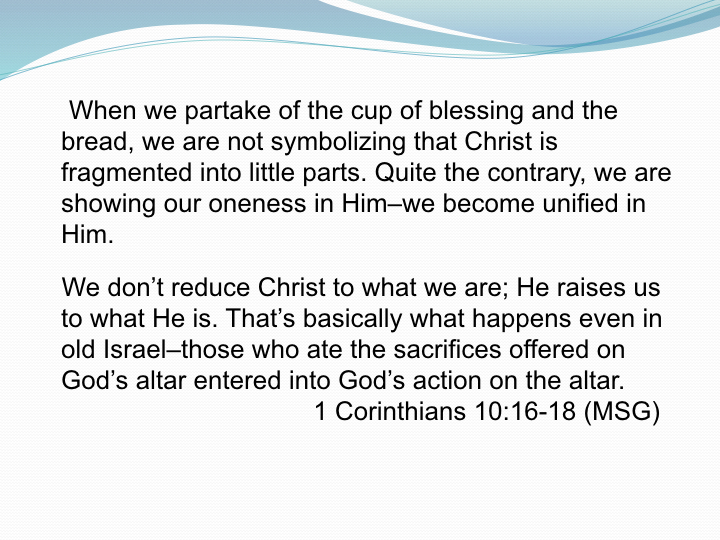
Yesterday, Jeff Hlavin shared with us a marvelous look at the foreshadowing of Christ’s work on Calvary in the institution of the Old Testament observance of Passover. In the “AD” period, Christians now remember what Jesus did through the observance of Communion.

Watch the video of Pastor Jeff’s message to learn more.

And if you would like to download the handout from his message, please click here → Passover and Communion

If you don’t have a home church in the Cedar Springs area, I invite you to join me on Easter Sunday as we continue to see how Jesus fulfilled in the “AD” all that was promised about Him in the “BC.” It’s going to be a fantastic morning!

Thursdays With Oswald—Extravagant Christians

Oswald ChambersThis is a weekly series with things I’m reading and pondering from Oswald Chambers. You can read the original seed thought here, or type “Thursdays With Oswald” in the search box to read more entries.

Extravagant Christians

      Our reason for giving is not to be because men deserve it, but because Christ tells us to give. All through the Old and New Testaments the counsel is on the line of hospitality. As long as we have something to give, we must give. … The true nature of devotion to Jesus Christ must be extravagance. … 

      We have deified economy, placed insurance and economy on the throne, consequently we will do nothing on the line of adventure or extravagance. To use the word “economy” in connection with God is to belittle and misunderstand Him. Where is the economy of God in His sunsets and sunrises, in the grass and flowers and trees? God has made a superabounding number of things that are of no use to anyone. … 

      When a man is rightly related to God he has to see that he enjoys his own life and that others do too.

From Shade Of His Hand

What controls your hospitality and generosity? Is it economy, or an extravagant overflow?

How much God has blessed us with that we should be lavishly giving to others! If we’re not, perhaps Common Sense is on the throne of our hearts instead of our All-Gracious God.

Just something to think about…

9 Quotes From “Seeing Jesus”

Nancy Guthrie marvelously shows us how Jesus links the Old Testament prophesies with His New Testament activities. This book makes the Old Testament come alive! Check out my full book review by clicking here, and then enjoy a few quotes from this book.

“satan’s power is wielded in the world in the form of death. What gives him that power is sin and the estrangement from God it brings. But on the Cross, Jesus did what was necessary for sinners to be reconciled with God. The devil thought he was defeating Christ, but in reality Christ was reconciling us to God, defeating the devil, and delivering us out of his clutches.”

“It has always been God’s way to use the weak, the foolish, the imperfect—even the shamefully sinful but ultimately repentant—in His redemptive plan. It is His glory to do so, and will be into eternity.”

“God has always wanted His people to know Him—not in a generic or shallow way, but personally, as He truly is. So He revealed Himself in a progressive way, not only through His name, but also through His glorious presence that dwelt in the Temple, through the Law, and through His mighty deeds on behalf of His people. But these revelations all led up to a definitive revelation in the Person of Jesus.”

“Our security in Christ frees us to enjoy His Sabbath rest. Christ fills our hearts with the same love He has for His Father so that we can honor our parents. Christ fills us with His very own faithfulness so that we can live in sexual purity. He convinces us of all that is ours in Him eternally so that we can stop coveting the things other people have that will not last beyond this life. As we refuse to allow anything else to be a god to us; we honor His name, His day, and our parents; as we value life; as we live in sexual purity and fidelity; as we nurture contentment and integrity, we’re not being merely legalistic. The grace of God is at work in our lives, making us holy and happy in God.”

“Jesus was less interested in explaining Himself to Nicodemus than in offering Himself to Nicodemus. … Jesus wanted Nicodemus to understand that we, too, have been bitten—not by a poisonous snake, but by the poison of sin. We, too, need a cure or we face certain death. And just as God provided the cure to His people in the desert, so has He provided a cure to us. But to experience healing requires something of us. We have to look to Jesus.”

“Jesus came into the world to make God knowable so that we can truly love Him with all our hearts, souls, and minds.”

“Jesus came the first time to offer forgiveness rather than bring down fire. He came down the first time to experience the fiery judgment of God in the place of guilty sinners. But the day is coming when Jesus will ‘come with His mighty angels, in flaming fire, bringing judgment on those who don’t know God and those who refuse to obey the Good News of our Lord Jesus’ (2 Thessalonians 1:7-8).”

“Whereas Proverbs describes a way of wisdom that leads to life and to God, Jesus defined that way in much more personal terms. He said, ‘I am the way, the truth, and the life. No one can come to the Father except through Me’ (John 14:6). The decision, as Jesus made clear, is not merely a matter of behavior or companions, but a choice about how we respond to Him, whether or not we will choose Him as our path, our life.”

“The people of Israel had the law; they knew what God wanted from them and for them. But they didn’t have the power or strength to obey. They knew what to do, but they didn’t have the ‘want-to’ to live as God commanded and to love Him as He desired. God’s commands in the covenant of the law were just a list of external rules. …

“In the new covenant, God’s law would be written on the hearts of His people rather than on stone tablets. He would put His Spirit inside His people. In this way, He would give them a love for His will and His ways, and a hatred of sin. His people would finally be able to love His will and walk in His ways because they would want to.”

Seeing Jesus (book review)

seeing-jesusB.B. Warfield once commented that the Old Testament is like a beautiful mansion, but the lights are turned off; with the Advent of Jesus, the lights have come on and we can now appreciate the beauty that was always there. In Seeing Jesus, Nancy Guthrie shows us the beauty of Jesus that is on full display from the opening words of the Bible, shining a bright light on passages that many may have previously missed.

Sadly, a lot people mistakenly believe that Jesus first shows up at His birth in Bethlehem, forgetting that Jesus Himself said that all the Scriptures point to Him. Nancy does just what Jesus said: She links together passages from both Testaments to show how all the Scripture finds its fulfillment in Jesus Christ.

Each chapter opens with a passage from the Old Testament and a passage from the New Testament. Then Nancy masterfully shows how Jesus links the two Testaments by the work He completed at Calvary. I appreciate how there is a satisfying conclusion to each chapter, but also how there is an open door to explore each particular topic more in my own Bible study time.

Especially for those who have thought the Old Testament is confusing, or outdated, or even boring, Seeing Jesus will bring a whole new excitement and insight into your Bible study time.

I am a Tyndale book reviewer.

Book Reviews From 2016

8 Quotes From “More Than A Carpenter”

more-than-a-carpenterMore Than A Carpenter by Josh & Sean McDowell is a wonderful resource to prepare you to share the uniqueness of Jesus Christ. Check out my book review by clicking here, and then enjoy these quotes that I especially found interesting.

“Why don’t the names of Buddha, Mohammed, or Confucius offend people the way the name of Jesus does? I think the reason is that these other religious leaders didn’t claim to be God.” —Josh McDowell

“It was reserved for Christianity to present to the world an ideal which through all the changes of eighteen centuries has inspired the hearts of men with an impassioned love; has shown itself capable of acting on an all ages, nations, temperaments, and conditions; has been not only the highest pattern of virtue, but the strongest incentive to its practice. … The simple record of these three short years of active fife has done more to regenerate and soften mankind than all the disquisitions of philosophers and all the expectations of moralists.” —William Lecky, one of Great Britain’s most noted historians and a fierce opponent of organized Christianity

“This testimony [that Jesus was God], if not true, must be downright blasphemy or madness. … Self-deception in a matter so momentous, and with an intellect in all respects so clear and so sound, is equally out of the question. How could He be an enthusiast or a mad man who never lost the even balance of His mind, who sailed serenely over all the troubles and persecutions, as the sun above the clouds, who always returned the wisest answer to tempting questions, who calmly and deliberately predicted His death on the Cross, His resurrection on the third day, the outpouring of the Holy Spirit, the founding of His church, the distraction of Jerusalem—predictions which have been literally fulfilled? A character so original, so complete, so uniformly consistent, so perfect, so human and set so high above all human greatness, can be neither a fraud nor a fiction. The poet, as has been well said, would in this case be greater than the hero. It would take more than a Jesus to invent a Jesus.” —Philip Schaff

“There exists no document from the ancient world witnessed by so excellent a set of textual and historical testimonies, and offering so superb an array of historical data on which an intelligent decision may be made. An honest [person] cannot dismiss a source of this kind. Skepticism regarding the historical credentials of Christianity is based on an irrational bias.” —Clark H. Pinnock

“The Gospels tell us Jesus’ family, including James, were embarrassed by what He was claiming to be. They didn’t believe in Him; they confronted Him. In ancient Judaism it was highly embarrassing for a rabbi’s family not to accept him. Therefore, the Gospel writers would have no motive for fabricating this skepticism if it weren’t true. Later the historian Josephus tells us that James, the brother of Jesus, who was the leader of the Jerusalem church, was stoned to death because of his belief in his brother. Why did James’ life change? Paul tells us: the resurrected Jesus appeared to him. There’s no other explanation.” —J. P. Moreland

“The resurrection takes the question ‘Is Christianity valid?’ out of the realm of philosophy and makes it a question of history.”

“I believe in the resurrection, partly because a series of facts are unaccountable without it.” —Michael Ramsey, former Archbishop of Canterbury

“The Old Testament contains sixty major messianic prophecies and approximately 270 ramifications that were fulfilled in one Person, Jesus Christ. … We find the chances of just forty-eight of these prophecies being fulfilled in one person to be only 1 in 10157. … All of the prophecies about the Messiah were made at least four hundred years before He was to appear. … This description of the manner of [Christ’s] death was written eight hundred years before the Romans used crucifixion as a method of execution.” —Josh McDowell

I am always sharing quotes from More Than A Carpenter and other interesting authors regularly on both Twitter and Tumblr. Please make sure you are following me there as well to see these quotes as soon as they are posted.

Thursdays With Oswald—It All Comes Down To Jesus

Oswald ChambersThis is a weekly series with things I’m reading and pondering from Oswald Chambers. You can read the original seed thought here, or type “Thursdays With Oswald” in the search box to read more entries.

It All Comes Down To Jesus

     The atheist, or socialist, or Christian—all who look to the future and express a view of what ought to be, see the same vision. They see the brotherhood of man, a time of peace on earth when there will be no more war, but a state of goodwill and perfect liberty, at present inconceivable. There is nothing wrong with the vision, and there is no difference in the vision because its source is the Spirit of God; the difference is in the way it is to be reached. The vision is of the nature of a castle in the air. That is where a castle should be; who ever heard of a castle underground! The problem is how to put the foundation under your castle in the air so that it can stand upon the earth. The New Testament says that the only foundation is not Rationalism but the absolute efficacy of the Redemption of Jesus Christ. … 

     There is only one thing as futile as the Roman Catholic Church and that is Protestantism. In Roman Catholicism the great dominating authority is Churchianity, the church is vested with all authority. In Protestantism it is what the Book says that is the supreme authority, and a man gets rest when he decides for either. “I am going to give up all the turmoil and let my Church do my thinking for me.” If you put your faith in a Church, it will solve your problems for you. Or you may stake your faith in Bibliolatry with the same result. “Ye search the Scriptures, because ye think in them ye have eternal life; and these are they which bear witness of Me, and ye will not come to Me that ye may have life” (John 5:39-40). Jesus Christ says neither the Church nor the Bible is the authority, but “I am the Way, the Truth, and the Life”; the Church and the Bible are secondary. 

From The Shadow Of An Agony 

Atheism, socialism, Christianism, Catholicism, Protestantism—all these –isms are man’s ideas.

Our priority should be a personal relationship to Jesus Christ! Stop fighting for an idea; but fight those ideas that want you to choose them over Jesus.

Only One is THE Way, Truth, and Life.

Light And Truth—Revelation (book review)

light-and-truth-revelationI love looking at the Scripture through wiser eyes. I have just completed my journey through the New Testament with Horatius Bonar pointing out things I may have otherwise missed. The fourth in his series of commentaries on the New Testament is Light And Truth—Revelation.

In reviewing the first three books in this series, I mentioned that Bonar seldom presents a verse-by-verse commentary on the Scriptures, but more of an overall theme on select passages. In Revelation he departs from this pattern. Frequently there are extensive passages which he dissects word-by-word, going deep into the implication for Christians. This was unexpected, but greatly welcomed.

Since the Bible is inspired by the Holy Spirit, He is the best source of illumination when reading Scripture. But Horatius Bonar is clearly a man immersed in the overall message of the Bible, and guided by the Holy Spirit in his writings. This is an excellent set of commentaries to enhance your study of the New Testament.

Be sure to check out my reviews of Horatius Bonar’s other Light And Truth commentaries on the New Testament:

Thursdays With Oswald—Get Rid Of Jargon!

Oswald ChambersThis is a weekly series with things I’m reading and pondering from Oswald Chambers. You can read the original seed thought here, or type “Thursdays With Oswald” in the search box to read more entries.

Get Rid Of Jargon! 

     The New Testament is not written to prove that Jesus Christ is God Incarnate; the New Testament does not prove anything; it simply confirms the faith of those who believe beforehand. Christian evidences don’t amount to anything; you can’t convince a man against his will. … 

     Creeds are the effects of our belief, not the cause of it. I do not have to believe all that before I can be a Christian; but after I have become a Christian I begin to try and expound to myself Who Jesus Christ is, and to do that I must first of all take into consideration the New Testament explanation. “Blessed art thou, Simon bar Jonah: for flesh and blood hath not revealed it unto thee, but My Father which is in heaven.” … 

     Jesus Christ did not come primarily to teach; He came to make it possible for us to receive His heredity, to have put into us a new disposition whereby we can live totally new lives. … The Sermon on the Mount is impossible to a man, and yet it is what our Lord taught. Jesus Christ did not come to teach man to be what he cannot be, but to reveal that He can put into him a totally new heredity; and all He requires a man to say is—“I need it.” … Jesus Christ cannot begin to do anything for a man until he knows his need; but immediately he is at his wits’ end through sin or limitation or agony and cannot go any further, Jesus Christ says to him, “Blessed are you; if you ask God for the Holy Spirit, He will give Him to you.” God does not give us the Holy Spirit until we come to the place of seeing that we cannot do without Him (Luke 11:13). … 

     We have been taken up with creeds and doctrines, and when a man is hit we do not know what to give him; we have no Jesus Christ, we have only theology. For one man who can introduce another to Jesus Christ by the way he lives and by the atmosphere of his life, there are a thousand who can only talk jargon about Him.

From The Shadow Of An Agony

Oswald Chambers is reminding Christians that we only learn more about Jesus by confessing “I need You!” Then the Holy Spirit can begin to reveal real-life truths to us from God’s Word.

Peter reminded us that in order to be ready to give an answer to anyone who asks a Christian the reason for the hope they had, we must first make Jesus the Lord of our life (see 1 Peter 3:15). Creeds and doctrines and theories are of no help to a friend who is in trouble. Let’s not be one of the thousands “who can only talk jargon about Him,” but let’s really know Jesus as Lord, so that we have something real and tangible to pass on to our friends.

Get rid of the jargon! Go deeper in your personal relationship with Jesus Christ!

A Unique Look At “Church”

gods-people-are-the-saintsHave you ever noticed that nowhere in the New Testament do we see an “order of service” for a church congregation? It’s simply not there.

Neither is there a list of acceptable songs, or the design of a church building, or how or when Communion is served, or even what clothing the pastor is supposed to wear. Yet we modern-day Christians seem to spend a lot of time not only arguing about these non-essentials, but even (gasp!) evaluating the “churchness” of a church based on these things.

It’s understandable, then, when someone says, “I enjoy being a Christian, but I really don’t like going to church.” Or even insisting that they can be a Christian without attending a church.

But here’s where those statements miss the mark: “Church” was never intended to be merely a group of people who met at a designated address once a week.

The Church that Jesus described—and the Church the apostles were a part of—was a living organism. It was fellow followers of Jesus Christ interacting with each other as they worshiped the Lord.

The Apostle Peter describes a gathering of Christians in just one verse. In this verse he gives five descriptors of how Church should be done. To stress the point that every gathering of Christians is unique, three of Peter’s five descriptors are found nowhere else in Scripture.

  1. Live in harmony with one another (the first unique word)

One translation has this as “one mind.” Paul has a similar thought in 1 Corinthians 14:20. The bottom line—get on the same page working toward the same goal. What’s that goal? Pointing people to Jesus!

2.  Be sympathetic (the next unique word)

A definition we may better understand is “empathy.” This world literally means to “vibrate with others.” Be on in tune with what they’re going through that you can feel it just like it was happening to you.

      3.  Love as brothers

This is the Greek word philadelphos, which means to treat other Christians like they’re from the same womb as you.

4.  Be compassionate

That is: be strong enough to step into other people’s stuff. Keep on increasing your capacity to carry a bigger load for someone else (Galatians 6:2).

      5.  Be humble (the last unique word)

The King James Version translates this “courteous.” Not just being strong enough to help, but gentle enough that your help will be accepted.

Let me repeat: The Church is not a physical address where we gather once per week. YOU are the temple of God’s presence, which is why Jesus said if just two of His followers get together, He is right there with them. That’s right—two Christians can have “church” wherever they happen to meet

Don’t just go to church, BE the church. Don’t miss an opportunity to encourage, pray with, instruct, or learn from another Christ-follower whenever and wherever you happen to meet.

If you’ve missed any messages in this series, you may find the complete list by clicking here.