Simpatico

Have you ever heard the word simpatico? It means to be like-minded. The idea is being on the same page with someone else, ideally someone that is a positive role model. Peter calls himself a leader in the church (Greek word presbyteros) but then says he is simpatico with us (sympresbyteros). 

And this isn’t just for leaders in the church, because the same appeal he makes to leaders is the same appeal he makes to both young men and to all of you. 

Although Peter didn’t use the phrase servant-leader, that’s exactly what he describes. In fact, for Christians, the words servant and leader are really one-and-the-same idea! Peter says God’s leaders are:

  • shepherds (those who nurture, guide, and guard) 
  • serving leaders
  • serving not because you must, but because you are willing (it’s “want to” not “have to”)
  • eager to serve with a great attitude 
  • not lording it over others
  • realizing people have been entrusted into their care
  • being examples to the flock that are follow-worthy
  • being submissive to others
  • clothing themselves with humility 

Three key concepts that Peter brings out are all seen in the life of Jesus: clothing, example, and humility

Jesus set the example for us when He said the Son of Man did not come to be served, but to serve (Matthew 20:25-28). 

When Jesus was incarnated in human flesh, He literally made Himself nothing, taking the very nature of a servant, which means He put on the clothing of a servant. He completely humbled Himself (Philippians 2:3-8). 

Jesus most clearly demonstrated this when at the last supper He wrapped a towel around His waist (i.e. clothed Himself as a servant) to wash His disciples’ feet, and then told us to follow His example (John 13:2-5; 13-17).

That’s why Peter tells us all of you, clothe yourselves with humility toward one another. The word Peter uses for “clothe” means keep on doing this every single day. 

God opposes the proud [those unwilling to be simpatico with Jesus] but gives grace to the humble [those choose to be simpatico with Jesus].

So here are two questions I’m asking myself—

Q: How do I know when I’m a servant?
A: When someone treats me like one. 

Q: How do I know I have a servant’s attitude? 
A: When I don’t mind being treated like a servant.

If you’ve missed any messages in this series, you may find the complete list by clicking here.

10 More Quotes From “Yours, Jack”

I love reading C.S. Lewis’ books, and I loved learning more about Lewis himself through his personal correspondence. Here are a few more quotes from Yours, Jack. 

“Indeed the best thing about happiness itself is that it liberates you from thinking about happiness—as the greatest pleasure that money can give us is to make it unnecessary to think about money. And one sees why we have to be taught the ‘not thinking’ when we lack as well as when we have.” 

“Read your New Testament (preferably a modern translation) intelligently. Pray for guidance, obey your conscience, in small as well as great matters, as strictly as you can. Don’t bother much about your feelings. When they are humble, loving, brave, give thanks for them: when they are conceited, selfish, cowardly, ask to have them altered. In neither case are they you, but only a thing that happens to you.”

“The Bible itself gives us one short prayer which is suitable for all who are struggling with the beliefs and doctrines. It is: ‘Lord, I believe, help Thou my unbelief.’ Would something of this sort be any good: Almighty God, who art the Father of lights and who has promised by Thy dear Son that all who do Thy will shall know Thy doctrine: give me grace so to live that by daily obedience I daily increase in faith and in the understanding of Thy Holy Word, through Jesus Christ our Lord. Amen.” 

“I would prefer to combat the ‘I’m special’ feeling not by the thought ‘I’m no more special than anyone else’ but by the feeling ‘Everyone is as special as me.’ In one way there is no difference, I grant, for both remove the speciality. But there is a difference in another way. The first might lead you to think, ‘I’m only one of the crowd like anyone else.’ But the second leads to the truth that there isn’t any crowd. No one is like anyone else. All are ‘members’ (organs) in the Body of Christ. All different and all necessary to the whole and to one another: each loved by God individually, as if it were the only creature in existence. Otherwise you might get the idea that God is like the government which can only deal with the people as a mass.” 

“As to the ‘state of the world’ if we have time to hope and fear about it, we certainly have time to pray. I agree it is very hard to keep one’s eyes on God amid all the daily claims and problems. I think it wise, if possible, to move one’s main prayers from the last-thing-at-night position to some earlier time: give them a better chance to infiltrate one’s other thoughts.” 

“One can’t help momentary wishes: guilt begins only when one embraces them. You can’t help their knocking at the door, but one mustn’t ask them in to lunch.” 

“I take it as a first principle that we must not interpret any one part of Scripture so that it contradicts other parts: and specially we must not use an Apostle’s teaching to contradict that of Our Lord.” 

“Any honest workmanship (whether making stories, shoes, or rabbit hutches) can be done to the glory of God.” 

“It is important to keep on giving thanks. Otherwise, as one continues to pray for the others who have not yet been relieved, one simply fails to notice how many of one’s intercessory prayers have been granted—never notices how the list of Thank-you’s grows and perhaps outstrips the list of mere Please’s.” 

“The only thing one can usually change in one’s situation is oneself. And yet one can’t change that either—only ask Our Lord to do so.” 

You can read my review of Yours, Jack by clicking here. And be sure to check out the first set of quotes I shared from this book by clicking here. 

A Leader’s Sincere Apology

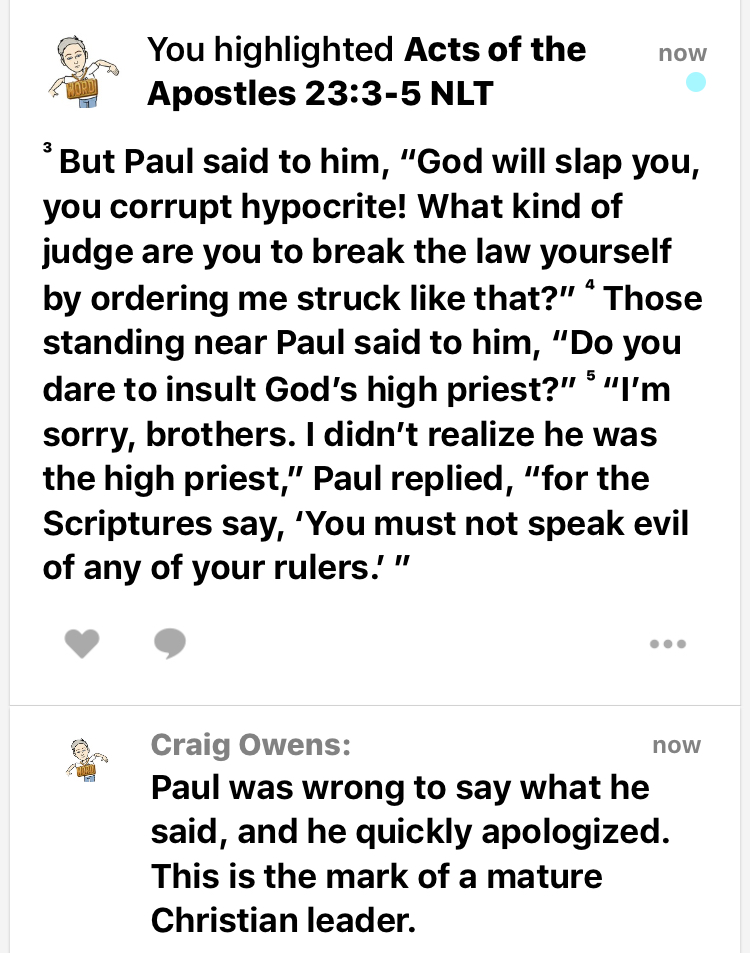
…I’m sorry, brothers… (Acts 23:5). 

It started off innocently enough. Paul was addressing the Jewish high counsel and simply said, “Brothers, I have always lived before God with a clear conscience!” 

That doesn’t seem too controversial nor insensitive, but the next move does—Instantly Ananias the high priest commanded those close to Paul to slap him on the mouth. What?! That seems like a bit of an over-reaction on the part of the high priest, or maybe a bit of show of force to let Paul know who was really in charge here. 

If you were Paul and got slapped in the face for a pretty simple and true statement, how would you respond? Paul responded like I think I may have, with a little verbal “slap” of his own: “God will slap you, you corrupt hypocrite! What kind of judge are you to break the law yourself by ordering me struck like that?” 

Yeah, take that, you big meanie! 

Those standing closest to Paul must have gasped in horror as they said, “Do you realize who you’re talking to?” 

Paul is an old man by this time. He’s been through shipwrecks, beatings, imprisonments, without food, traveled more miles than he can count, preached more sermons than he can remember. His body was giving out on him, and his eyesight was especially weak. Clearly, Paul didn’t realize to whom we was addressing his remarks. 

But Paul immediately owned up to his mistake. “I’m sorry, brothers. I didn’t realize he was the high priest, for the Scriptures say, ‘You must not speak evil of any of your rulers.’” 

A mark of a godly leader is one who is quick to apologize.

Paul could have made excuses. He could have justified what he said by explaining, “He deserved it because of how he spoke to me!” or “He started it!” 

But Paul offered no excuses or justifications, just a quick, simple, sincere apology. 

Oh, that all Christian leaders were as sensitive as Paul and as quick to apologize!

This is part 26 in my series on godly leadership. You can check out all of my posts in this series by clicking here.

Saturday In The Proverbs—Setting Myself Up For Failure (Proverbs 20)

[Each chapter in the Book of Proverbs contains thoughts that fit into a theme; they are not just random thoughts gathered together. In this “Saturday In The Proverbs” series, I will share a theme that I see in each chapter. But the cool thing about God’s Word is that you may see an entirely different theme. That’s great! If you do, I would love for you to share it in the comments below.]

Wine is a mock, strong drink is a brawler, and whoever is led astray by it is not wise (Proverbs 20:1).

This collection of proverbs warns against things that impair a person’s judgment, or things that set us up for failure. Things like…



  • intemperance (v. 1)
  • making leaders angry (vv. 2, 8, 26)
  • starting petty quarrels (v. 3)
  • laziness (vv. 4, 13)
  • shallow thinking (vv. 5, 12, 25)
  • unfaithfulness or a lack of integrity (vv. 6, 7, 11, 27)
  • unconfessed sin (vv. 9, 24)
  • duplicity or favoritism (vv. 10, 14, 17, 23)
  • not valuing wisdom (vv. 15, 18. 25)
  • risky business deals (vv. 16, 25)
  • gossiping (v. 19)
  • dishonoring your parents (vv. 20, 21)
  • holding a grudge (v. 22)
  • unkindness or dishonesty (v. 28)
  • not valuing life (v. 29)
  • not allowing anyone to correct you (v. 30)

Now that you know these items that set you up for failure, ask the Holy Spirit to help you root any of these out of your life before failure happens to you! 

❤️ The Love Test

The description of love that Paul gives in 1 Corinthians 13 is well known, and I think most people would agree that this is an outstanding definition of true love. But the ultimate test is this: can this definition of love be said of me?

God wants you to be able to say “yes!” and so the Holy Spirit works on us to make this definition more and more consistently true of us. Here’s how we can test ourselves and find out where we need to allow the Spirit to work on us—put your name in this passage everywhere you find the word “love.”

Can this be truly said of me:

“Craig is patient. Craig is kind. Craig isn’t jealous. Craig doesn’t sing his own praises. Craig isn’t arrogant. Craig isn’t rude. Craig doesn’t think about himself. Craig isn’t irritable. Craig doesn’t keep track of wrongs. Craig isn’t happy when injustice is done, but he is happy with the truth. Craig never stops being patient with others, he never stops believing the best for others, he never stops hoping for the best for others, he never gives up on others. Craig’s love never fails.”

If you put your name in that passage, how well do you do on the love test? If you will let Him, the Holy Spirit will help you get all As on these tests.

Saturday In The Proverbs—15 Ways To Defuse Tense Relationships (Proverbs 15)

[Each chapter in the Book of Proverbs contains thoughts that fit into a theme; they are not just random thoughts gathered together. In this “Saturday In The Proverbs” series, I will share a theme that I see in each chapter. But the cool thing about God’s Word is that you may see an entirely different theme. That’s great! If you do, I would love for you to share it in the comments below.]

A soft answer turns away wrath, but a harsh word stirs up anger (Proverbs 15:1).

Here’s how to defuse potentially volatile situations with other people—

  1. Speak gently (vv. 1, 28)
  2. Speak truthfully (v. 2)
  3. Remember that God is watching (vv. 3, 9, 11, 25, 26)
  4. Speak helpful words or stay silent (vv. 4, 7, 14, 23, 30)
  5. Receive correction from others (vv. 5, 12, 31, 32)
  6. Find ways to add value to other people (v. 6)
  7. Ask for God’s help (vv. 8, 29)
  8. Be gentle (v. 10) 
  9. Develop emotional intelligence (vv. 13, 15, 21)
  10. Don’t envy others (vv. 16, 17, 27)
  11. Guard against getting angry (v. 18)
  12. Remember: good relationships take work (vv. 19, 24)
  13. Use all the wisdom you have… (v. 20)
  14. …get all the wisdom that others have too (v. 22)
  15. Stay humble (v. 33)

Relationships can be one of the greatest treasures in our life, or they can be one of the biggest disappointments in our life. 

Put the ball in your court, and YOU work on making your relationships treasures! 

The Blessing Of Quiet Humility

“When you’re full of yourself, God can’t fill you. But when you empty yourself, God has a useful vessel. Your Bible overflows with examples of those who did.

“In his gospel, Matthew mentions his own name only twice. Both times he calls himself a tax collector. In his list of apostles, he assigns himself the eighth spot.

John doesn’t even mention his name in his gospel. The twenty appearances of ‘John’ all refer to the Baptist. John the apostle simply calls himself ‘the other disciple’ or the ‘disciple whom Jesus loved.’

Luke wrote two of the most important books in the Bible but never once penned his own name.

Paul, the Bible’s most prolific author, referred to himself as ‘a fool’ (2 Corinthians 12:11).

King David wrote no psalm celebrating his victory over Goliath. But he wrote a public poem of penitence confessing his sin with Bathsheba (see Psalm 51).

“And then there is Joseph. The quiet father of Jesus. Rather than make a name for himself, he made a home for Christ. And because he did, a great reward came his way. ‘He called His name Jesus’ (Matthew 1:25).” —Max Lucado, in You!

Check out my book review of You! by clicking here, and you can read some other quotes from this book here.

9 More Quotes From “Brothers, We Are Not Professionals”

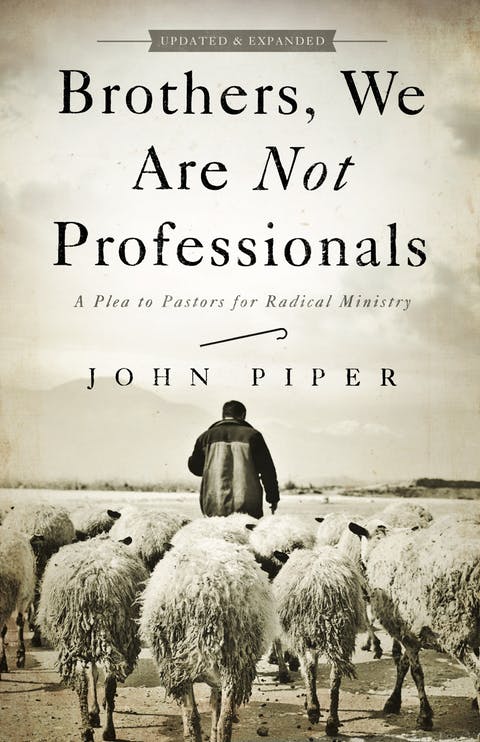
Those in pastoral ministry are ministers; they are not professional, career-minded, corporate ladder-climbers. John Piper has written a book that I believe every pastor should read: Brothers, We Are Not Professionals. Here are a few more quotes from this excellent book. 

“Is not our most painful failure in the pastorate the inability to weep over the unbelievers in our neighborhoods and the carnal members of our churches? …  

“I must feel the truth of hell—that it exists and is terrible and horrible beyond imaginings forever and ever. ‘These will go away into eternal punishment’ (Matthew 25:46). Even if I try to make the ‘lake of fire’ (Revelation 20:15) or the ‘fiery furnace’ (Matthew 13:42) a symbol, I am confronted with the terrifying thought that symbols are not overstatements but understatements of reality. …

“I say to you, on the authority of Scripture, remember, remember, remember the horrid condition of being separated from Christ, without hope and without God, on the brink of hell. ‘Remember that you were at that time separated from Christ, alienated from the commonwealth of Israel and strangers to the covenants of promise, having no hope and without God in the world’ (Ephesians 2:12). … 

“When the heart no longer feels the truth of hell, the gospel passes from good news to simply news.” 

“Warning has value in stirring us up to take the glories of holiness and heaven seriously so that we come to see them for what they are and delight in them. But it is the delight in them that causes the true grief when we fall short.” 

“Pastors, you will know your people’s souls best by knowing your own. So try to be ruthlessly honest with yourself.” 

“If the heart is without passion, it will produce lifeless, jargon-laden spontaneity. And if the heart is aflame, no form will quench it.” 

“We ought to experience the deepest emotions about the deepest things. And we ought to speak often, and publicly, about what means most to us, in a way that shows its value.” 

“Eating, exercising, and sleeping are more spiritually relevant in the ministry than we may think. … The point is that we be intentional about how our eating affects the ability of our body to be a helpful partner in seeing the glory of God.” 

“When we say that what we do on Sunday morning is to ‘go hard after God,’ what we mean is that we are going hard after satisfaction in God, and going hard after God as our prize, and going hard after God as our treasure, our soul-food, our heart-delight, our spirit’s pleasure. Or to put Christ in His rightful place—it means that we are going hard after all that God is for us in Jesus Christ, crucified and risen.” 

“It will transform your pastoral leadership in worship if you teach your people that the basic attitude of worship on Sunday morning is not to come with your hands full to give to God but with your hands empty to receive from God.” 

“Brothers, we are leaders, and the burden of change lies most heavily on us.” 

You can read my full book review of Brothers, We Are Not Professionals by clicking here, and you can check out some other quotes from this book here. 

Thursdays With Oswald—Jeremiah 4

Oswald ChambersThis is a weekly series with things I’m reading and pondering from Oswald Chambers. You can read the original seed thought here, or type “Thursdays With Oswald” in the search box to read more entries.

Jeremiah 4

[These are notes from Oswald Chambers’ lectures on Jeremiah 4.]

     The great truth underlying calamity is that the truth and way of God is seen but abandoned because it is too difficult. Unless we understand this we shall misjudge God in His dealings with His people and imagine that He is too stern. … Abandon is not rebellion yet; abandon simply means—“That is a nice vision, but it is not for me.” … 

     The battle is lost or won in the secret places of the will with God alone, never first in external circumstances. … When that is done we can go forth with the smiling certainty that our battle is won, nothing will ever again enthrall us on that line. The world, the flesh and the devil have not the slightest power over the man who can rule his own spirit, who has fought the battle out before God and won there. …

     When the secret places of our will before God are revealed you know exactly what you have to do. Let the Word of God bore a hole in your self-complacency about the particular thing He has hauled you up about and then put in another Word that He brings to you, and you will soon find His dynamite at work. … 

     We are choked by a little thing that has not its root in God, which God condemned and we pathetically wept over but left there. … Never put a thing off and say, “It does not matter, no one sees.” No, but they will see you go down like standing corn before the scythe in external circumstances, because you played the traitor to God in secret. If God has revealed anything to you for the tiniest glimmer of a second and you don’t obey Him and cultivate that territory for Him, you will go down when the crisis comes. … 

     The basis of life on earth apart from God is chaos. … No whining and no shirking will ever help us to escape the utter confusion that is at the basis of every bit of human life that has ignored God. … 

From Notes On Jeremiah 

Our battles are won or lost in secret long before they are ever fought externally. 

God’s Holy Spirit wants to dynamite the areas of our life that would cause us to falter in the day of battle. If we will allow Him to deal with these things in private, we will be more than conquerors when that day of external temptation finally comes. 

If we maintain the “It’s no big deal” attitude with God in private, we shall surely be defeated by the temptations when they do come. 

The choice is yours…

8 Quotes From “How To Listen So People Will Talk”

In How To Listen So People Will Talk you will learn some invaluable skills for taking your relationships and your leadership deeper. Becky Harling has given us an amazing resource! Check out my full book review by clicking here. 

“Honestly, it’s impossible to be a good listener without developing a humble spirit. Think about it. When you’re listening and fully engaged, you allow the other person to have all the attention. Listening forces you to lay aside your agenda. It challenges you to let go of your need to share your opinions, theories, and assumptions in favor of listening to another’s feelings, thoughts, and sentiments. That decision can only come from a heart of humility.” 

“Resist the urge to dive in with your own story. … Whenever you dive in with your own story, you are stealing the microphone from the person who is telling their story. … The best advice is to remember to let someone be the star of their own show. Keep the focus on the person talking.” 

“How is it that we who have problems ourselves are so quick to try to fix someone else’s problem? James was spot on when he wrote, ‘Everyone should be quick to listen, slow to speak’ (James 1:19). I’d like to suggest that a great paraphrase for this verse is, ‘Let everyone be quick to listen and slow to give advice!’” 

“Don’t tell people what to do; ask them questions. … You gain greater insight, they gain greater self-awareness, and the two of you grow closer. … When we dare to ask someone what they want, we give them the opportunity to verbalize their need. … The best questions allow people to explore what’s in their hearts.” 

“When you validate another person’s feelings, you’re basically saying, ‘Your feelings make sense.’ You compassionately acknowledge that the person’s feelings are important and that those feelings are understandable. You don’t correct feelings or instruct a person on how to feel. You simply offer understanding. … Validating someone’s feelings doesn’t necessarily mean you agree with the actions of the other person. … Feelings are neither right nor wrong. They’re just feelings. It’s what we do with those feelings that determines whether or not we sin. … Validate feelings, but only validate actions that line up with Scripture.” 

“In your relationships, what does it look like for you to mimic Jesus and show others how valuable they are? How does your face send the signal, ‘I want to hear what you have to say’? Your nonverbal signals act as a green light, inviting others to share their feelings.” 

“Conflict can be transformational. In the chaos of an argument, if you will listen to understand and focus on meeting the others need, you’ll be more able to work as a team, coming up with a solution that satisfies both. In the end, your relationship will emerge stronger and more resilient.” 

“People are dying to feel heard, and unless we’ve purpose in our hearts to offer our full presence to others, we’ll drift through life distracted and dishonor those who matter to us in the process.”