Therefore, behold, I will allure her [Israel] and bring her into the wilderness, and I will speak tenderly and to her heart. There I will give her her vineyards and make the Valley of Achor [troubling] to be for her a door of hope and expectation. And she shall sing there and respond as in the days of her youth and as at the time when she came up out of the land of Egypt. (Hosea 2:14-15 AMPC)
This “therefore” seems out of place. God has just finished listing the sins of the people (vv. 1-13), so I would expect Him to say something like, “Therefore, behold, I will punish you.” God would be just in this judgment.
But even when we are faithless, God remains faithful! “If we are faithless, He remains faithful, for He cannot disown Himself” (2 Timothy 2:13).
So He says He will speak tenderly and turn your trouble into blessing. How amazing and undeserved is the love that our God lavishes on us!
He turned to God and the people put away their idols <or>
He turned from God and the people turned to their idols
It’s true: As goes the leader, so go the people.
In my life, I’ve experienced that the good things that I do over-the-top are only moderately emulated by those around me. But the unhealthy things that I even slightly indulge in are adopted quickly by everyone else.
Godly leaders must be so aware of how their example impacts everyone around them, and they must fight to maintain biblical standards. When we miss the mark, we must be quick to admit our shortcoming, repent, and get back on track.
In Hosea 4:9, God warns that the people will follow the ungodly example of their leaders, which is why God’s punishment is often more severe for those leaders.
On the positive side, in Leviticus 9, Moses and Aaron demonstrate the leadership example of spending time in God’s presence and fully obeying everything God had revealed to them there. Then verse 23 it says that after they came out of His presence, God’s glory appeared to all the people. The positive example of the leaders led to huge blessings for all the people!
A mark of a godly leader is one who increasingly aware of the power of his example.
Leaders, let’s be first to go first in…
…being in God’s presence
…obeying God’s commands
…repenting when we fall short
…asking forgiveness of those who have seen our poor example
…asking God to bless His people because of our good example
This is part 77 in my series on godly leadership. You can check out all of my posts in this series by clicking here.
Listen to the podcast of this post by clicking on the player below, and you can also subscribe on Apple, Spotify, or Audible.
I have been so grateful for the insights of Dr. Gary Chapman in his book The Five Love Languages. I have found this book to be of immense value in helping couple prepares for marriage, and in helping married couples get beyond a place where intimacy has become stuck.
In short, the five love languages are words of affirmation, quality time, gifts, acts of service, and physical touch. The goal of learning the other person’s love language—and learning to speak it consistently and fluently—is an increased level of intimacy. In the book of Amos, God asks, “Can two people walk together without agreeing on the direction?” (Amos 3:3 NLT), and speaking the right love language definitely helps people agree!
The whole reason we come to God in prayer as a Father, as a Brother, and as a Counselor is so that we can hear Him speaking our love language and we can continue to walk in deeper intimacy with Him.
When my then-girlfriend Betsy and I first met, we spent hours and hours getting to know each other. We would ask questions, share stories, and tell things we did and didn’t enjoy. This is the epitome of intimate conversation: getting to know the other person’s heart as you open up your heart to them as well.
I’ve shared this analogy before, but intimacy grows stale and can eventually disappear altogether if those in a relationship are no longer walking together. It doesn’t work if I say, “Betsy, I’m looking forward to spending an hour with you each week,” or even if I say, “I’ll give you 15 minutes each morning.” Instead, our relationship needs to be one of continual walking.
It’s the same thing for us as Christians: we cannot only give God an hour at a church service on Sunday mornings, nor is intimacy going to increase if I only walk and talk with my Savior for a few minutes in my morning devotions.
Walking closely with Him is what God has desired right from the beginning. He walked with Adam and Eve each evening. This phrase “walking with God” is used consistently throughout the Bible of those who had an intimate relationship with their Father, Brother, and Counselor—Noah, Abraham, Isaac, the people of Israel (Genesis 3:8, 6:9, 17:1, 48:15; Leviticus 26:12). And even as the New Testament era dawns, we read, “And they [Zechariah and Elizabeth] were both righteous before God, walking in all the commandments and ordinances of the Lord blameless” (Luke 1:6 NKJV).
But I’m especially intrigued by the story of Enoch in Genesis 5:21-24. Twice in four short verses, we read “Enoch walked with God.” Remember that verse in Amos—“Can two people walk together without agreeing on the direction?”—so Enoch and God had to be in agreement. In fact, that’s exactly what we read about Enoch in the Book of Hebrews:
By faith Enoch was taken from this life, so that he did not experience death: “He could not be found, because God had taken him away.” For before he was taken, he was commended as one who pleased God. And without faith it is impossible to please God, because anyone who comes to Him must believe that He exists and that He rewards those who earnestly seek Him. (Hebrews 11:5-6)
If you’ve taken Dr. Chapman’s love language assessment, you probably found that you were pretty lopsided: maybe you scored very highly in one love language and then barely registered in another. We may be lopsided in our love language skill, but God speaks every language perfectly!
Dr. Chapman noted that when our love language is being spoken to us sincerely and consistently, our love tank is filled, and all of the love languages begin to become more meaningful.
Just as God walked with Enoch until the day He brought him Home, so He wants to walk with us.
Walk in obedience to all that the Lord your God has commanded you, so that you may live and prosper. (Deuteronomy 5:33)
The Lord will establish you as His holy people, as He promised you on oath, if you keep the commands of the Lord your God and walk in obedience to Him. (Deuteronomy 28:9)
May He turn our hearts to Him, to walk in obedience to Him and keep the commands. (1 Kings 8:58)
Blessed are all who fear the Lord, who walk in obedience to Him. (Psalm 128:1)
And this is love: that we walk in obedience to His commands. As you have heard from the beginning, His command is that you walk in love. (2 John 6)
When we walk in loving intimacy with Him, our intimacy grows deeper and more mature. Sometimes they will say of couples who have been married for a long time and walk in increasingly deeper intimacy with each other, “They seem to know each other’s thoughts.” That’s because they know each other’s hearts—and that’s what God wants to do with us. He did it with Enoch, and He will do that with us too (Jude 14; Jeremiah 33:3; Habakkuk 3:19).
Enoch walked intimately with God for 365 years. Let us walk intimately with God for 365 days a year, for as many years as He gives us until God takes us away with Him forever!
If you’ve missed any of the messages in our prayer series called Intimate Conversation, you can find all of the messages by clicking here.
This is a weekly series with things I’m reading and pondering from Charles Spurgeon. You can read the original seed thought here, or type “Thursdays With Spurgeon” in the search box to read more entries.
Listen to the podcast of this post by clicking on the player below, and you can also subscribe on Apple, Spotify, or Audible.
Froth Or Substance?
Many of you will read a novel from beginning to end, and what have you got? A mouthful of froth when you have done. But you cannot read the Bible—that solid, lasting, substantial, and satisfying food goes uneaten, locked up in the cupboard of neglect, while anything that man writes, as a catch of the day is greedily devoured. ‘I have written for him the great things of My law, but they were considered a strange thing’ [Hosea 8:12].
From The Bible
The Bible is the most important book anyone can read, contemplate, and apply to their lives. Yet far too many people say, “I just don’t have enough time to sit down to read the Bible.” Sadly, these same people take a lot of time on much less meaningful activities.
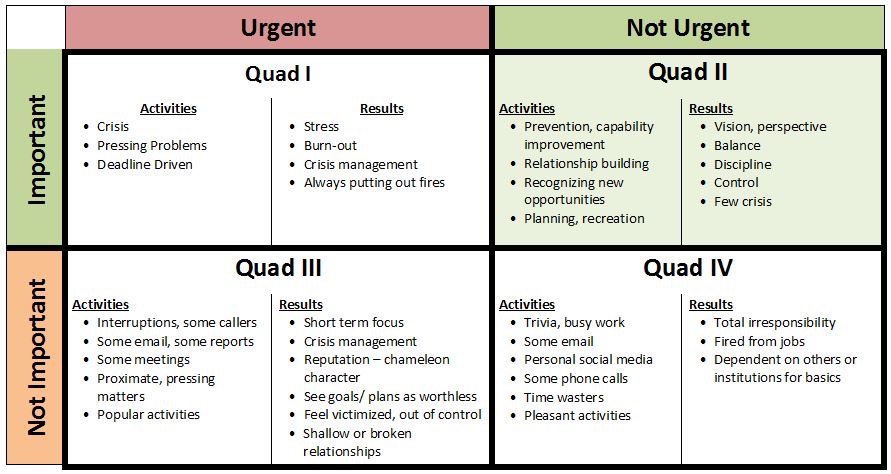
One thing that has been immensely helpful to me is the Urgent/Important grid Stephen Covey talks about in his book The Seven Habits Of Highly Effective People. Your Bible reading is never urgent—that is, an alarm will not go off to tell you it is time to read. However, your Bible reading is hugely important.
Covey discusses how we can put all of our activities into one of the four quadrants in this chart:
Your Bible reading time is definitely a Quadrant II activity, and the best place to find time for this activity is by eliminating things in Quadrant IV—the activities Spurgeon would call froth. In my book Shepherd Leadership: The Metrics That Really Matter, I discuss how leaders can use this grid to increase their leadership effectiveness.
The bottom line: We all must make sure we are eliminating the froth so that we have time for the great Substance that can only be found in God’s Word.
And then check out chapter 10 in Shepherd Leadership—“Can’t, Won’t or Don’t”—to learn how to use this grid to help you make the time for those important Quadrant II activities.
This is a weekly series with things I’m reading and pondering from Charles Spurgeon. You can read the original seed thought here, or type “Thursdays With Spurgeon” in the search box to read more entries.
Listen to the podcast of this post by clicking on the player below, and you can also subscribe on Apple, Spotify, or Audible.
Proof Of God’s Love
I have written for him the great things of My law, but they were considered a strange thing. (Hosea 8:12)
It is no mean proof of His goodness, that He stoops to, rebuke His erring creatures. It is a great argument of His gracious disposition, that He bows His head to notice terrestrial affairs. … He might dwell alone, far, far above this world, up in the seventh heaven, and look down with calm and silent indifference upon all the doings of His creatures. He might do as the heathens supposed their Jove did, sit in perpetual silence, sometimes nodding his awful head to make the Fates move as he pleased. But Jove never thought of the little things of earth, disposing of them as beneath his notice, engrossed within his own being, swallowed up within himself, living alone and retired. …
We see from our text that God looks upon man, for He says of Ephraim, ‘I have written for him the great things of My law, but they were considered a strange thing.’ But see how when He observes the sin of man He does not dash him away and spurn him with His foot? He does not shake him by the neck over the gulf of hell until his brain does reel and then drop him forever. But rather, He comes down from heaven to plead with His creatures. He argues with them, He puts Himself, as it were, upon a level with the sinner, states His grievances, and pleads His claim.
In all their affliction He was afflicted, and the Angel of His Presence saved them; in His love and in His pity He redeemed them; and He bore them and carried them all the days of old.
But they rebelled and grieved His Holy Spirit; so He turned Himself against them as an enemy, and He fought against them. (Isaiah 63:9-10)
In His love, God both carries us in our adversity AND turns to confront us in our waywardness. BOTH of these actions are proof of His love. My friend, wherever you are and whatever you may be facing, be assured of God’s unquenchable love for you!
Listen to the podcast of this post by clicking on the player below, and you can also subscribe on Apple, Spotify, or Audible.
The Book of Hosea is a love story. It’s a real story telling a much grander story.
The real story is between a man named Hosea and his wife Gomer. Sometime after their marriage, Gomer became unfaithful to Hosea and became entrapped to someone like a pimp, because it required a rather large payment from Hosea to redeem her. Gomer was restored to Hosea and they lived together faithfully from that point on.
The grander story is the relationship between God and His people. God’s faithful love redeemed us, but our sin is like that of a cheating wife who has abandoned her husband for another lover.
God’s love sounds like this:
“Let My tender words woo you back to Me” (2:14)
“I will betroth you to Me forever” (2:19)
“My compassion is aroused toward you” (11:8)
“I will not carry out my fierce anger against your sin” (11:9)
“I will care for you in the wilderness” (13:5)
“I will feed you until you are satisfied” (13:6)
But God’s love also sounds like:
“I will block your path with thornbushes” (2:5)
“I will ignore you” (4:6)
“I will hide Myself from you” (5:6)
“My sword will flash in your cities” (11:6)
“I will terrify you like a roaring lion” (11:10)
“I will attack you like a mother bear robbed of her cubs” (13:8)
God loves us too much—His Son paid too high of a price for us—for Him to let us head down a path that leads to eternal destruction. Listen to how the prophet Isaiah says this:
In all their distress He too was distressed, and the angel of His presence saved them.In His love and mercy He redeemed them; He lifted them up and carried them all the days of old. Yet they rebelled and grieved His Holy Spirit. So He turned and became their enemy and He Himself fought against them. (Isaiah 63:9-10)
We need both the comfort and the terror of God’s love.
We need Him to roar His lion’s roar and flash His terrible sword when we are on the path of destruction so that we can return to the path of life and experience His tender voice and bountiful provision.
When we pray for our wayward loved ones, pray for both God’s sword and His loving words. He knows best which to use. And for ourselves, when we are stricken with fear, use that as an opportunity to ask why we have heard God’s roar or seen His sword flash. Then, if needed, repent and return to His tender embrace.
God’s love speaks tenderly and roars ferociously because He loves you so very much!
“The greater our weakness, the greater glory will be God’s as we work in His power.”
“We are busier than God intends us to be if we are too busy to take time for relaxation.”
“It is characteristic of the earthly mind that it always covets the service of others: it desires to avoid toil and drudgery. This is one of the factors which makes wealth so desirable—it can secure the service of others. The mind of Christ manifested itself in His words: ‘I am among you as He that serves’ (Luke 22:27). ‘The Son of Man came not to be ministered to, but to minister’ (Matthew 20:28). It was His delight to be servant of all.”
“How are we to obtain the mind of Christ? … Is not the secret hinted at in the exhortation, ‘Let this mind be in you, which was also in Christ Jesus’? It is the work of Another. Is not the supreme work of the Holy Spirit to reproduce in the yielded believer the inner disposition of Christ? What is the fruit of the Spirit (Galatians 5:22-23) but the mind of Christ? As we willingly consent to the crucifixion of the earthly mind and purposefully yield to the sanctifying influences of the Holy Spirit, He will perform the miracle. Our minds will be transformed in ever-increasing degree by the renewing of the Holy Spirit.”
“Nothing so tends to inflate a man with a sense of his own importance as the possession of great gifts of intellect and the enjoyment of special and unusual experiences. And there is nothing which more surely disqualifies from spiritual usefulness than spiritual pride.”
“It will be recalled that the favored three disciples were not permitted to encamp on the Mount of Transfiguration. They must exchange the vision glorious for the convulsions of a demon-possessed boy. So must Paul descend into the valley if he is to be God’s messenger to a distraught humanity. He must learn that the mountain is only as high as the valley is deep. The higher he ascends in spiritual experience, the more deeply must he be identified with his crucified Lord.”
“Even God’s honored servants cannot break His physical laws with impunity, nor are they immune from the onslaught of despondency. … We must seek physical and spiritual renewal if we are not to be put to flight by our enemy. If we shift our center from God to self, even for a period, we lay ourselves open to this malady of the spirit.”
“Discouragement over the apparent failure of our best efforts, if not met with the shield of faith, will react disastrously on our spirits and degenerate into self-pity and despair.”
“We seldom give God time to deal with us radically and deeply. Even when we experience conviction of failure and sin, we do not allow the Holy Spirit to work in us so strongly that we are brought to hate the sin. We lightly assent to our sinfulness without seriously and permanently dealing with it. We act as though new results would take the place of heart repentance and renunciation. [see Hosea 6:4]
“By two great lies was man led away from God. By the same two lies has the estrangement been kept up. On these two lies the world has been feeding ever since the Fall. Their fruit has been woe and death—‘Ye shall not die’ and ‘Ye shall be as gods.’ …
“The world’s history is the same. Our race has been eating the fruit of lies [Hosea 10:13]; not simply of sin, but of lies. The sorrows, sighs, tears, pains of our race are the fruit of lies—the original lie of Paradise, and a thousand such since then. …
“The two original satanic lies are continually coming up, and along with them myriads of others, all leading us astray. Each day brings forth the lie, the fruit, the eating thereof. satan, or the world, or the flesh, or a friend, or a book, or a scene whispers the lie; it is fair and specious, we believe it; it brings forth fruit, we eat of it, and the end is bitterness and disappointment. We feed on lies. … We persuade ourselves that this world is good, and pleasant, and excellent, so we pursue it in preference to the world to come. …
“Jesus says, ‘Yes, ye shall not surely die, but that deliverance shall not be in the way you think. Death is the wages of sin, yet I bring life to the sinner, everlasting life, life through the belief of the Truth, even as death came through the belief of a lie. Yes, ye shall be as gods, but not in your way. I will make you partakers if the divine nature, not by eating the forbidden tree, but by eating of Me.’”—Horatius Bonar, in Light and Truth: The Old Testament
Micah believes our culture has watered down and diminished what love really means. And I heartily agree with him! There’s an old children’s song that says, “Jesus loves me this I know,” but Micah entitles one of his chapters: “Jesus loves me… this I don’t know.” This book is meant to help us recapture what real love is.
Weaving aspects of the rescuing love Hosea had for Gomer throughout the entire book, Micah teases out thoughts that many may not have considered. He then skillfully uses his own personal life journey to bring a modern-day feel to this love story. Each chapter opens a new facet of God’s love that is intended to dismantle all of the false definitions of love too many have previously taken to heart.
Although this book is a good reminder for a wide audience, I especially think this would be a good discussion guide for a mature Christian to use with someone who is struggling to believe that God can unconditionally love and forgive them.
I already shared the bizarre but beautiful sermon illustration that Hosea lived out for the Israelites and for us. His wife had been unfaithful to him and had gotten herself so far in debt that she was a virtual slave. Hosea, in a clear picture of God’s amazing, unrelenting love, bought back his wife, paid off her debts, and completely restored her to himself.
Sadly, the people of Israel—even after seeing this grace-filled living lesson—continue to push farther and farther away from God. This prompted God to announce the indictment against them…
Hear the word of the Lord, you Israelites, because the Lord has a charge to bring against you who live in the land: “There is no faithfulness, no love, no acknowledgment of God in the land. There is only cursing,lying and murder, stealing and adultery; they break all bounds, and bloodshed follows bloodshed” (Hosea 4:1-2).
It wasn’t the first time that someone preferred the things of the world to the things of God (like Adam and Eve), and it wasn’t the last time (like you and me). We mortals tend to be seduced by what we can see and hold right now, instead of trusting God for something far better.
Jesus told a story about a son who enjoyed the full privilege and favor of his father, yet this son thought he could do better on his own. He asked his father for his share of the inheritance and left for a distant land, determined to live a life where he called all the shots. But with his money gone, he found himself in debt, starving, and working as a hired hand in a pigsty.
It was then that Jesus said that young man came to his senses. He had nothing to bring to his father—no gift of restitution, no token of respect, nothing except his words. All he could say was, “Father, forgive me.”
But that’s all that was needed.Hosea counseled the Israelites to do the same thing:
Return, Israel, to the Lord your God. Your sins have been your downfall! Take words with you and return to the Lord. Say to Him: “Forgive all our sins and receive us graciously, that we may offer the fruit of our lips” (Hosea 14:1-2).
The wayward son had a rehearsed speech asking his father to simply hire him as a servant, as if he wasn’t worthy to be considered a son any longer. But the father—in words that reflect our Heavenly Father’s love—cut the son’s speech short. He let the son only say, “Forgive me,” but before the son could make the request to be a servant the father totally restored him.
After Hosea calls the wayward people to return with their “forgive us,” he quotes God’s reply: “I will heal their waywardness and love them freely, for My anger has turned away from them” (14:4).
How could this be? How could God’s full judgment not fall on His wayward people? How could it not fall on you and me?! Because it fell on Jesus (2 Corinthians 5:21)! So when we come back to God with our words of forgiveness, He restores us and clothes us in the robe of Jesus (Galatians 3:27).
Absolutely amazing!
God longingly speaks to His wayward people, “It’s time to come home. I’m waiting for you with open arms. I am ready to restore you completely. Just come home.”



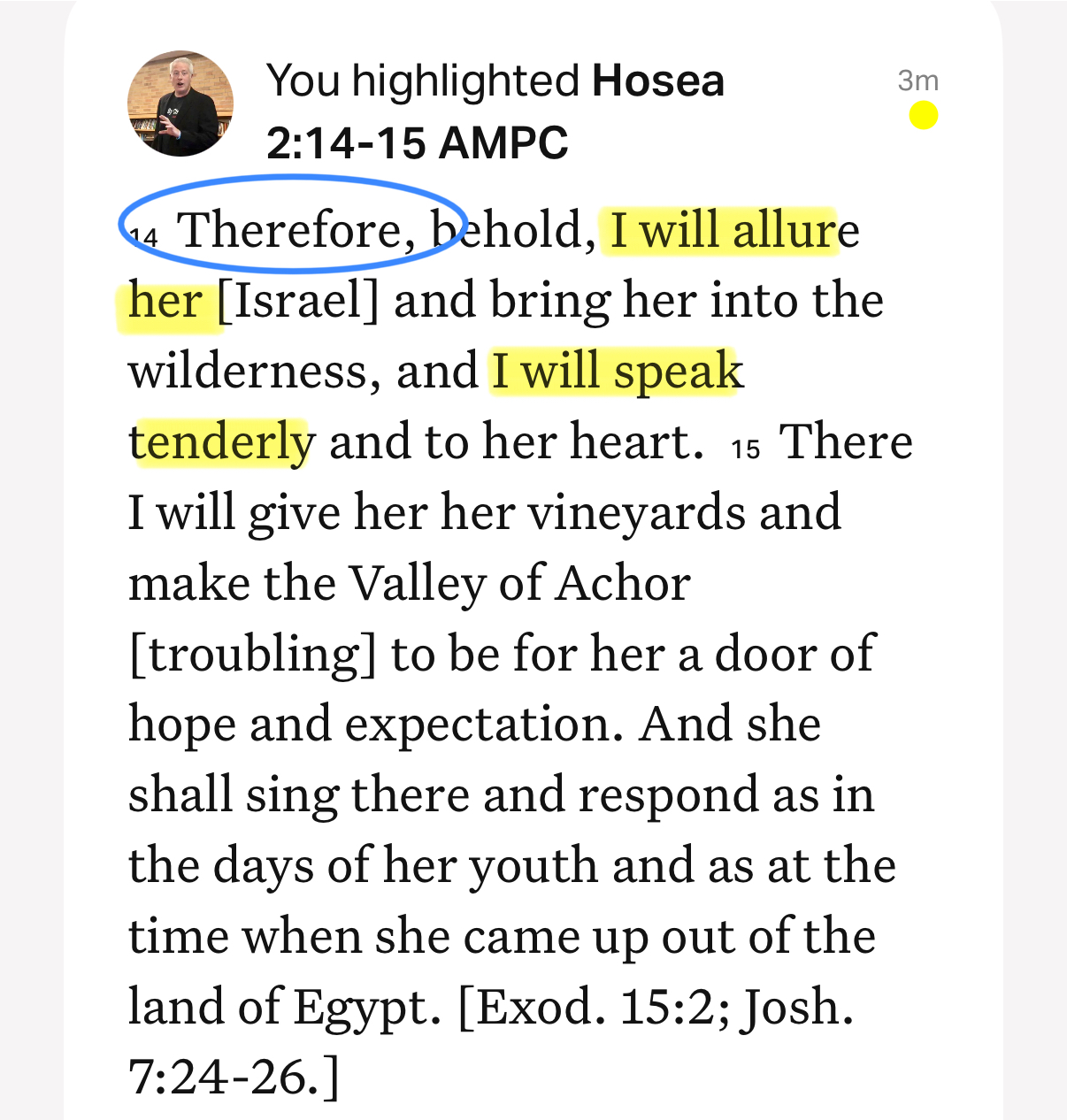 Therefore, behold, I will allure her [Israel] and bring her into the wilderness, and I will speak tenderly and to her heart. There I will give her her vineyards and make the Valley of Achor [troubling] to be for her a door of hope and expectation. And she shall sing there and respond as in the days of her youth and as at the time when she came up out of the land of Egypt. (Hosea 2:14-15 AMPC)








 Craig T. Owens