Silent Night? Holy Night!

A little boy wanted to do something special for his family, so he thought he would do something he had seen his mother do dozens of times: bake a cake. Quickly he looked through a cookbook and got to work.

Dad was the first one to come home and heard an unusual clatter in the kitchen. Peeking around the corner he saw his son wearing his wife’s apron, slightly dusted in flour, and vigorously stirring a big bowl of batter.

“What are you doing, son” Dad asked.

Without looking up from his work the boy proudly answered, “I’m making a cake, Dad!”

Dad looked around the kitchen and saw all the proper ingredients out, so he was somewhat assured when he asked, “So how’s it going?”

The little boy paused and looked up at him, “Pretty good I think. I’m just having a little trouble with the ‘tbls” and ‘tsps.’”

For those of you who have done any baking, you know that “tbls” are tablespoons and “tsps” are teaspoons. If you get those mixed up, the cake might not turn out very well. For instance, adding a teaspoon of baking powder when the recipe calls for a tablespoon might result in a flat cake. Or adding a tablespoon of salt when the recipe asks for a teaspoon might making a rather salty cake.

Abbreviations only work if everyone is on the same page with you. If they’re not, it could be rather unsavory or maybe even dangerous.

In 1816, Joseph Mohr penned the words to what some have called the best-known Christmas carol in the world: Silent Night! Holy Night!

I’m not really sure how “silent” the night Jesus was born really was: a village so filled with people that no bedrooms were available, a mother in labor, a crying newborn, animals in a stable disturbed by the mother and child, singing angels, and curious shepherds. But let’s leave that part alone for a while.

Although it may not have been a silent night, it most assuredly was a Holy Night! That full title gives us the full impact of what happened at Christ’s First Advent.

Holy means something unlike anything else; someone or something devoted to God; something divine; something with God’s fingerprints all of it. I see at least three divinely holy things in this carol.

  1. The virgin birth of Jesus. 

Not only was the birth of Jesus a fulfillment of prophesy (see Isaiah 7:14 and Matthew 1:18-25), but it was also an indication of God’s miracle-working power. The fact the Luke gives so many specific details about that birth night (see Luke 2:1-2) also lets us know that this isn’t a “once upon a time” myth.

  1. The involvement of angels in the affairs of humans. 

Angels bring messages to key people before the birth of Jesus (Luke 1:11, 26; Matthew 1:20) and on the night of His birth (Luke 2:9-14). John also gives us a peek behind the scenes of the massive spiritual warfare taking place the night of Christ’s birth (see Revelation 12:1-5). Paul tells us that we, too, are involved in this spiritual battle, but that because of Christ’s Advent we’re more than conquerors through Jesus (Ephesians 6:12; Romans 8:37).

  1. The full deity and the full humanity of Jesus. 

Jesus was fully Man and fully God (see Philippians 2:5-7; Matthew 26:63-64; John 8:54-58). This is so important, because without this we would be lost. If Jesus wasn’t fully Man, He wouldn’t know how to help us; if He wasn’t fully God, He couldn’t help us.

So when you hear this carol playing, ask someone if they know the title. More than likely they will say, “Silent Night.” To which you can easily reply, “Actually it’s Silent Night! Holy Night! and I’d like to tell you three amazing, holy things that took place!”

Let’s never abbreviate away the miracles. It may or may not have been a Silent Night, but it most certainly was a Holy Night! These supernatural miracles surrounding Christ’s First Advent provided us freedom from sin, and a rock-solid hope of our eternal reward in Heaven at Christ’s Second Advent.

If you’ve missed any of the other Christmas carols we have already looked at, you can check them out by clicking here.

Thursdays With Oswald—The Power Is In The Solitude

Oswald ChambersThis is a weekly series with things I’m reading and pondering from Oswald Chambers. You can read the original seed thought here, or type “Thursdays With Oswald” in the search box to read more entries.

The Power Is In The Solitude

     If we want to know the universal sovereignty of Christ, we must get into solitude with Him. It is not sufficient for someone else to tell us about Him; we must perceive with our own eyes Who He is, we must know Him for ourselves. … 

     We must get to the place of real solitude with Christ. He is our mountain-height and our sea-calm; He is the recreating power; He is the universal Sovereign. He tells us to consider the lilies; we say—“No, we must consider life.” We mistake the mechanism of life for life itself, and that idea has become incorporated into Christian work. In the active work we do for God we do not really believe that Jesus Christ is sovereign Lord; if we did, we should fuss less and build more faith in Him. We cannot do the Savior’s work by fuss, but only by knowing Him as the supreme sovereign Lord. … 

     Our Lord’s word “go” simply means “live,” and Acts 1:8 describes the “going.” Jesus did not say to the disciples—“Go into Jerusalem, go into Judea, go into Samaria, go into the uttermost part of the earth”; but—“You shall be My witnesses” in all these places: He undertakes to establish the goings. So many people are obsessed with this idea—“What are you going to do?” I hope none of us are going to do anything: I hope we are going to be what He wants us to be. … 

     The key to the missionary is the absolute Sovereignty of the Lord Jesus Christ. We must get into real solitude with Him, feed our soul on His Word, and He will engineer our circumstances.

From So Send I You 

Jesus gave a command to all His followers—including all of us today—All authority in heaven and on earth has been given to Me. Therefore go (Matthew 28:18-19). Jesus is saying to us, “Preach and teach out of a living experience of Myself.” In this respect, we are all missionaries.

Oswald Chambers reminds us missionaries that the only way we will be effective in our goings is by spending adequate time in solitude and worship with Our Lord. If we don’t, then we are trying to do ministry on our own, trying to engineer our own circumstances. But the missionary who is spending time with Jesus finds that He directs all our goings and engineers all our circumstances.

The power to testify about Jesus comes from our time of solitude with Jesus.

The Advent “Nicknames” Of Jesus

Most of us who have nicknames didn’t receive them at birth, but they were given to us later on. It might have been because of a memorable incident, or even a character trait that we are known for.

But think about Jesus. Even before His first Advent, He was given numerous “nicknames” or titles that foretold what He was going to do. In the Christmas carol “O Come O Come Emmanuel” four of Christ’s nicknames/titles are key for us today.

It’s so important for us to look back at these First Advent titles because they give us perspective for today and hope for Christ’s Second Advent.

Paul makes it clear that we are living in a time of both already and not yet. We have redemption (Ephesians 1:7), and we are waiting for the day of redemption (Ephesians 4:30). Jesus has already paid for our freedom (First Advent), but we are still awaiting the rewards that will come with His Second Advent.

O come, O come…

  1. …Emmanuel

Literally, this means “God is with His people.” The prophesy was originally given to the prophet Isaiah (see 7:14 and 8:6-10), but it was repeated when Jesus was born (Matthew 1:23). Only One Who was fully God and fully Man could pay the price for our ransom from sin.

  1. …Rod of Jesse 

David, the son of Jesse, prayed, “Who am I, Sovereign Lord, and what is my family, that You have brought me this far?” (2 Samuel 7:18). Yet God was going to continue to keep David’s family line alive (although at times it looked like the dead stump of a long-forgotten tree) to give a throne to Jesus as the King of kings that would once and for all crush satan’s tyranny.

  1. …Dayspring 

When I think of Dayspring, I think of light exploding immediately into the darkness (Isaiah 9:2 and Luke 1:77-78). Jesus Himself told us of His victory over the darkness: I have told you these things, so that in Me you may have [perfect] peace and confidence. In the world you have tribulation and trials and distress and frustration; but be of good cheer [take courage; be confident, certain, undaunted]! For I have overcome the world. [I have deprived it of power to harm you and have conquered it for you] (John 16:33, AMP).

  1. …Key of David

Only Jesus holds the key to open wide our heavenly home (Isaiah 22:22; Revelation 1:8)!

What do you need? 

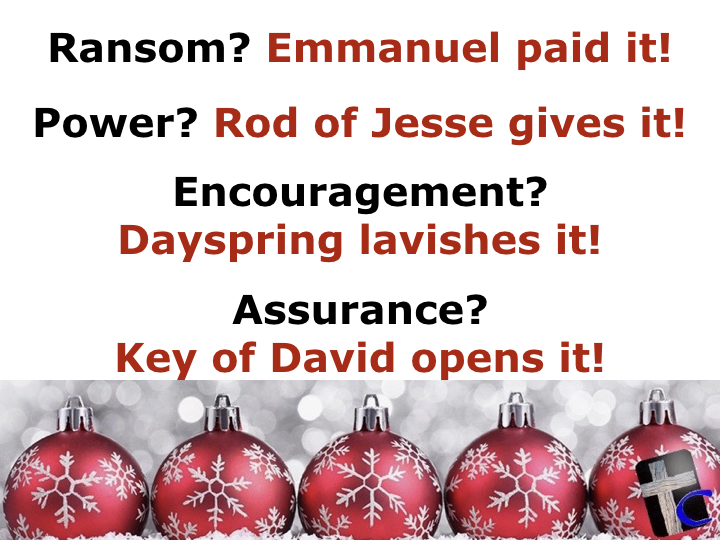
  • Ransom? Emmanuel paid it! 
  • Power to defeat satan? The Rod of Jesse gives it! 
  • Encouragement to press on? The Dayspring lavishes it! 
  • Assurance of your eternal home in Heaven? The Key of David opens it! 

All our longings—all our O come! O come!—are satisfied in Jesus. His First Advent is the already, and His Second Advent gives us hope for the not yet.

If you’ve missed any of the other Christmas carols we have already looked at, you can check them out by clicking here.
Thursdays With Oswald—Prayer Is The Work

Oswald ChambersThis is a weekly series with things I’m reading and pondering from Oswald Chambers. You can read the original seed thought here, or type “Thursdays With Oswald” in the search box to read more entries.

Prayer Is The Work 

     The key to the missionary problem is in the hand of God, not of man, and according to Our Lord, the key is prayer, not work, as that word is popularly understood, because work may mean evading spiritual concentration. Our Lord says—“Pray therefore…” [Matthew 9:38]. … 

     We are apt to think of prayer as a common-sense exercise of our higher powers in order to prepare us for work; whereas in the teaching of Jesus, prayer is not to fit us for the “greater works,” prayer is the work. Prayer is the outcome of our apprehension of the nature of God, the means whereby we assimilate more and more of His mind, and the means whereby He unveils His purposes to us. …  

     God is not impressed by our earnestness, He nowhere promises to answer prayer because of our agony in intercession, but only on the ground of Redemption. We have “boldness to enter into the holiest by the blood of Jesus,” and in no other way. … 

     The armor is for the battle of prayer [see Ephesians 6:11-20]. “Take up the whole armor of God … stand therefore …” and then pray. The armor is not to fight in, but to shield us while we pray. Prayer is the battle. … 

     We have to live depending on Jesus Christ’s wisdom, not on our own. He is the Master, and the problem is His, not ours. We have to use the key He gives us, the key of prayer. Our Lord puts the key into our hands, and we have to learn to pray under His direction. That is the simplicity which He says His Father will bless.

From So Send I You

In light of these thoughts from Oswald Chambers, how does this change your view of prayer?

Fear God, Honor The King

Give to Caesar what belongs to Caesar, and give to God what belongs to God (Matthew 22:21).

The Bible has much to say to God-followers about how to interact with earthly governments:

  • Wise King Solomon told us to “fear the Lord and the king” and not go along with rebels against the government (Proverbs 24:21)
  • Daniel said several times that “the Most High is sovereign over all kingdoms on earth and gives them to anyone He wishes” (Daniel 4 & 5)
  • The Apostle Paul declared he was no rebel to either the civil or religious governors: “I have done nothing wrong against the Jewish law or against the temple or against Caesar” (Acts 25:8)
  • Later on, Paul reminded the church that government officials are God’s servants, and that we need to give them the respect that is owed to them (see Romans 13:1-7)
  • Peter counseled Christians: “Submit yourselves for the Lord’s sake to every human authority: whether to the emperor, as the supreme authority, or to governors … Show proper respect to everyone, love the family of believers, fear God, honor the emperor” (1 Peter 2:13-17)

But a man that exemplifies this balance between fearing God and honoring the king best is Mordecai. Mordecai was a Jew who served the Babylonian king faithfully—

  • He protected the king from would-be assassins
  • But disobeyed the king when the law of the land conflicted with God’s law
  • Then Mordecai helped the king get out of a bad law written by an evil man

A mark of a godly leader is one who knows the difference between fearing God and honoring earthly kings.

How can today’s leaders live out this principle? This is something that should lead us to prayerfully search the Scriptures, and then boldly live out what the Holy Spirit reveals to us.

This is Part 13 in my series on godly leadership. You can check out all of my posts by clicking here.

How Should Christians Handle Unfriendly Earthlings?

Christians are citizens of Heaven who are merely passing through Earth, so this isn’t a Christian’s final home. Because of this, it’s not unusual for Earthlings to mistreat, insult, and even persecute these “aliens and strangers.”

How are Christians supposed to respond to this?

First off, let’s make sure the persecution is for the right reason. Jesus said, “Blessed are you when people insult you, persecute you and falsely say all kinds of evil against you because of Me (Matthew 5:11).

Jesus also told us that this persecution has a blessing in it: we would be able to share our faith in Jesus Christ at the highest levels on Earth: On account of Me you will stand before governors and kings as witnesses to them” (Mark 13:9).

In 1 Peter 3:8, the apostle tells us how to live with everyone, Christian and Earthling alike:

  1. Harmoniously—keep The Main Thing the main thing; don’t get caught up in petty arguments
  2. Empathetically—put yourself in others’ shoes
  3. Kindly—treat everyone like a sibling that shares the same parents with you
  4. Compassionately—be strong enough to handle other people’s stuff
  5. Courteously—remember this: manners matter!

This list may be easy to live out when people are friendly to you, but what about when unfriendly Earthlings are downright mean to you? In the very next verse Peter gives us two Don’ts and one Do:

  1. Don’t repay evil with evil—Jesus is our example of this (see 1 Peter 2:21-23)
  2. Don’t insult the insulters—treat others as you want them to treat you (Luke 6:31)
  3. Do bless those who slander and persecute you—Jesus says we get absolutely no credit if we only treat kind people kindly (see Luke 6:32-33)

In Psalm 35 David is dealing with people who are fighting against him. They are saying mean things and trying to do even meaner things. This prayer shows both God’s part and our part

God’s part—defend me against the evildoers … remind me of Your salvation … pursue those who are falsely pursuing me … stay close to me.

My part—listen to God’s voice of assurance … live quietly … don’t give others cause to mistreat me … pray for those who persecute me … continually turn my thoughts and praise to God.

Peter wraps up this thought with these words—Who is going to harm you if you are eager to do good? But even it you should suffer for what is right, you are blessed (1 Peter 3:13-14).

Don’t give in to mistreatment and lash out in anger. Trust God to handle things. Keep on living a good life that is focused on bringing God all the glory due His name!

If you’ve missed any messages in this series, you may find the complete list by clicking here.

How “Alien” Is Your Christianity?

Peter pulls no punches as he calls Christians for what they are (or perhaps what they really should be): aliens … strangers … peculiar people.

But how can that be, especially in the United States of America? Survey after survey says that upwards of 95% of Americans claim to believe in God, and fully 8-out-of-10 of every American call themselves a Christian.

You only need to take a look at our schools, our government, or our entertainment to see how “alien” biblical values are with current cultural trends. I think all of us have experienced that when we try to live by a biblical standard, people roll their eyes at us (at best) or maybe outright mock us. Perhaps the term “aliens” is not so much for what we say we believe, but how we live what we believe.

That’s why Peter calls us peculiar (1 Peter 2:9). This word means a people so focused on what God wants, that they don’t have time to worry about what the world wants. Peculiar people are so focused on “Your kingdom come and Your will be done” that they don’t pay attention to “keeping up with the times.”

Peter says that the inevitable outcomes of this peculiar lifestyle are accusations of wrong doing, unjust treatment, insults, and slander, just to name a few (see 1 Peter 2:12, 19, 21-23; 3:16).

When we are treated this way, Peter tells Christians about their alien response:

  • Love one another deeply
  • Live good lives doing good deeds
  • Do not retaliate with insults or threats
  • Live in such a hope-filled way that others can’t help to ask you about it (see 1:22; 2:12, 23; 3:15)

So… how “alien” is your Christianity? Are you doing so many good things that it catches the attention of others? Are you responding to mistreatment in a Christ-honoring manner? Do you speak with others gently and respectfully? Is your life so full of hope in your eternal home in Heaven that people can’t help but ask you for the reason for the hope you have?

Don’t worry about being popular; be peculiar. Be so alien to this world’s values that you compel others to encounter Jesus Christ as you have! 

If you’ve missed any messages in this series, you may find the complete list by clicking here.

What Is The Church Supposed To Be Doing?

Listen to the podcast of this post by clicking on the player below, and you can also subscribe on AppleSpotify, or Audible.

Before ascending back to Heaven, Jesus commissioned His followers. He gave them a mission that Christians often refer to as The Great Commission.

Jesus said, “All authority in heaven and on earth has been given to Me. Therefore go and make disciples of all nations, baptizing them in the name of the Father and of the Son and of the Holy Spirit, and teaching them to obey everything I have commanded you. And surely I am with you always to the very end of the age.”

There are several pictures in the New Testament of how the Church could live out this Great Commission, but one of the pictures that I find the most helpful is that of a Body.

The human body is an amazing creation! Just to accomplish the simple task of picking up something between our thumb and forefinger is a miracle in itself. The structure of bones and ligaments and tendons, the interaction of nerves in the fingers coordinating with the optical nerve, not to mention the enzymes and blood vessels that are all doing their part.

Yet if any part is not functioning properly, that simple action becomes more difficult. Maybe it even becomes impossible.

The Church is the same way. Every part of the Church Body has to be functioning in healthy order for the whole Body to be effective.

Here are four aspects of a healthy Church Body that the Apostle Paul lists in Ephesians 4:

  1. Caring for one another
  2. Mobilizing for evangelism
  3. Making disciple-makers
  4. Helping organize for more meaningful ministry

If every part of the Body is doing its part, we’re Living out the Great Commission.

If some parts are missing or unhealthy, we’re Wallowing in the Great Omission.

It’s not about your church (small “c”) or my church. It’s about all Christian disciples being a part of one Church—one Body—going into all the world and making disciples of all peoples. That’s what the Church is supposed to be doing!

►► Would you please prayerfully consider supporting this ministry? My Patreon supporters get behind-the-scenes access to exclusive materials. ◀︎◀︎

Jesus Our Healer

“It’s clear from the Gospels that Jesus was a healer. We don’t know the exact number of people He healed, but it was certainly in the thousands, as on many occasions the Gospel writers tell us He healed ‘multitudes.’ We don’t know all the afflictions people suffered from, but they included leprosy, a deformed hand, swollen limbs, hemorrhaging, blindness, deafness, lameness, paralysis, seizures, a severed ear, and even death.

“It’s tempting to believe that all these people were healed by their faith, but we don’t know that for sure. We do know, however, that they were all healed by Jesus.

“I’m not just playing with words here.

“There are about forty different descriptions of healings in the four Gospels (some are described in more than one place), but faith is said to play an explicit part in only a little more than one-third of them. And in most of those healings, the faith of another person, not the afflicted, is stated. Faith is not even mentioned in the majority of Jesus’ recorded healings. Only twice did Jesus remark about someone (the centurion in Matthew 8:10 and the Gentile mother in Matthew 15:28) having great faith before He healed that person’s loved one.

“The common factor in all Jesus’ recorded healing miracles was Jesus Himself—not the faith of the sick people or their loved ones.” —Lynn Eib, in Peace In The Face Of Cancer

The Q Series—Parables, End Times, And Prayer

Our annual Q Series is where folks send their questions to me on a variety of subjects and we do our best to answer them. This week we tackled questions like:

  • What does Christ’s Parable of the Sower mean?
  • Can people lose their salvation?
  • Are micro-chips implanted in humans the start of “the mark of the beast”?
  • What does “666” stand for?
  • Why aren’t all of my prayers answered?

Here’s what we discussed, along with the time this discussion appears on the video:

  • The Parable of the Sower [1:27]
  • What is a parable? [2:19] **Be sure to check out What Was Jesus Teaching In The Parables? on Biblegateway
  • Who is the farmer in this parable? [4:30]
  • “The best commentary on Scripture is Scripture” [5:14]
  • Can someone lose their salvation? [7:42]
  • Keep sowing seed [11:51]
  • Eternal security? [13:50]
  • The Scripture has “a lot of faces” [17:20]
  • Are micro-chips “the mark of the beast”? [20:37]
  • What is gematria? How does this fit with 666? [22:58]
  • 666 falls short of God’s perfection [25:54]
  • The antichrist is a parody of Jesus Christ [26:08]
  • What is the significance of 666 on the right hand and forehead? [27:31]
  • To understand the future, look to an historic event [29:05]
  • A lesson from the socialism of the Nazis and Adolf Hitler [29:49]
  • A quote from Dr. Erwin Lutzer [31:15]
  • Why did Jesus talk about material possession so much? [32:48]
  • Why aren’t all my prayers answered? [36:36] **Be sure to check out Praying With Authority on Biblegateway.
  • How do we pray “in Jesus’ name”? [37:07]
  • How did Jesus speak to His Father in prayer? [39:10]
  • James on unanswered prayers [41:32]
  • Perseverance in prayer [43:30]

We will be answering your questions one more time next Sunday. Please click here to find all the ways you can submit your questions.