“These Things”

Listen to the podcast of this post by clicking on the player below, and you can also subscribe on Apple or Spotify.
…whoever does these things will never be shaken (Psalm 15:5). 

David says “these things” are what allow us to come into God’s presence, but we cannot consistently nor completely do “these things” without the help that can only come from being in God’s presence. So I have to already be doing “these things” in order to get into His presence in order to get empowered to do “these things”?! 

That seems like a classic, no-win, Catch-22! 

So… how do I get into God’s presence in the first place?

Simple: I can’t. 

Only Jesus can. 

Thankfully, He made it possible for me to come in: He became the Door! 

Only by Jesus can I come in. Only in Jesus can I be empowered. Only with Jesus can I consistently do “these things.” 

What are “these things” that David listed that both allow me to come into God’s presence and then keep me in God’s presence? David said we must…

  1. …walk blamelessly before God. Or as Jesus said, “Be perfect, therefore, as your heavenly Father is perfect” (Matthew 5:48). I am blameless in God’s sight only when I am in Jesus.  
  2. …speak truthfully: from the heart, no slander on my tongue, no unkind words in my mouth, no gossip on my lips. 
  3. …live courageously: honoring what is good and opposing what is evil. 
  4. …keep my oaths: making my yes mean yes, not making any excuses, helping others to do the same. 

“These things” both glorify God and keep me in God’s presence. And “these things” attract others to His presence too. But I don’t try to do “these things” in my own strength—that would make me God—nor just as a religious To-Do List—that would make me a Pharisee. But I take a cue from the apostle Paul—

But whatever I am now, it is all because God poured out His special favor on me—and not without results. For I have worked harder than any of the other apostles; yet it was not I but God who was working through me by His grace (1 Corinthians 15:10). 

It is grace—a free gift of God—that enables me to do “these things” not in my own strength, but in His strength! 

I don’t try harder to do “these things” that keep me secure in God’s presence, but I trust more profoundly in His grace that continually empowers me to successfully do “these things” every single day.

God Is One, God Is Love

Listen to the podcast of this post by clicking on the player below, and you can also subscribe on Apple or Spotify.

There is a common characteristic among every human civilization: they all have had a pantheon of gods. It seems that no one god could capture all of the attributes each civilization thought were important, so they created multiple gods to help fill in the gaps. 

Onto the world scene comes the account recorded for us in the Bible of a God who creates the universe. The Hebrew word for this God is elohiym which means “a divine one.” This name is used throughout the Creation story in Genesis 1. 

Then in Genesis 2:4, a new name appears, one that is used over 6500 times in the Bible. It is the unpronounceable name YHWH: often pronounced Yahweh or substituted with the word Jehovah. In most Bible translations this name is designated by all capital letters: LORD. Yahweh or Jehovah means “the existing One.” 

The first part of our second foundational truth states, “The one true God has revealed Himself as the eternally self-existent ‘I AM,’ the Creator of heaven and earth and the Redeemer of mankind.” This Creator is uncreated: He sustains the universe without needing to be replenished Himself. He is utterly complete in Himself; hence, His name means I AM (see Exodus 3:13-15). 

The second part of this foundational truth statement says, “He has further revealed Himself as embodying the principles of relationship and association as Father, Son and Holy Spirit.” 

The I AM is One (see Deuteronomy 6:4), but He reveals Himself in three Persons—Father, Son, Spirit—that we call the Trinity (although this is not a word found in the Bible). 

Sometimes Christians have done a disservice to the I AM by making it appear He is divided. For instance, we might say, “The Father is the Creator, the Son is the Redeemer, and the Spirit is the Regenerator.” But remember that our One God is not a pantheon of gods; He is One. We see the fullness of the Trinity operating in every area. Here’s just a short sampling:  

  • The creation of the universe—Genesis 1:1; Colossians 1:15-16; Psalm 104:30 
  • The creation of man—Genesis 1:26-27 
  • A prophecy about Jesus’ advent—Isaiah 9:6 
  • The incarnation of Jesus—Luke 1:35 
  • The baptism of Jesus—Matthew 3:16-17
  • The resurrection of Jesus—Acts 2:32; John 10:18; Romans 1:4 
  • Our atonement—Hebrews 9:14 
  • A Christian’s baptism in the Holy Spirit—John 14:16 

(You can read all of these verses for yourself by clicking here.) 

A good question for us to ponder is: Why would this I AM God create humans? If He needs nothing to complete Himself or sustain Himself, why make us? 

The apostle John captures the essence of the Trinity in three words: God is love.

God created us out of an overflow of His love so that we too could enjoy the intimate, eternal pleasure of being at-onement with Him forever. God then wants our love to overflow to everyone around us, so that they will also be drawn into this at-oneness with the I AM. 

When Jesus was asked to state the greatest commandment, He first quoted from Deuteronomy 6: “Hear, O Israel: The LORD [Yahweh] our God, the LORD [Yahweh] is one.” Christ’s conclusion was for us to love this All-Loving God with all our heart, soul, mind, and strength. And then Jesus added an obvious overflow of that love: “And love your neighbor as yourself” (see Mark 12:29-31).

Love to God and from God should overflow from us to others to bring them into the One God who is love itself.  

The more we understand this love that the I AM has for us: (1) the better able we will be to love and worship Him, (2) the more we will love others out of this overflow of love, and (3) the more glory our awesome GOD will receive. Which is exactly what the apostle Paul prayed for us in Ephesians 3:14-19. 

This idea of an I AM God who reveals Himself as Father, Son, and Spirit has been described by the Latin phrase mysterium tremendum. It is indeed a mystery: not one that frightens and confuses, but one that energizes and enlivens. Pray Paul’s prayer for yourself, so that you can see more dimensions of this awesome love that God has for you! 

If you missed any parts of this series exploring our foundational belief statements, you can check out the full list by clicking here.

The Prayerful Heart Of Our Testimony

Listen to the podcast of this post by clicking on the player below, and you can also subscribe on iTunes or Spotify.

The best way to be a first responder in prayer is to work on making prayer a habit. Prayer needs to come first. Remember: I can do more than pray, but I shouldn’t do anything until I have prayed. 

King David showed us his nearly-identical “bookend prayer” that he prayed both at the beginning of his reign as king and again just before he died. We can pray similar bookend prayers when we begin with a petitionary prayer—“God, please help me”—and finish with a thankful prayer—“God, thank You for helping me.” We can also try to expand those bookends toward the middle, allowing us to live as the apostle Paul admonished in 1 Thessalonians 5:17: 

  • Pray without ceasing 
  • Pray continually 
  • Never stop praying 

Jesus gave us a model prayer at the heart—the very middle—of His Sermon on the Mount. This sermon has 107 verses of Christ’s words, making the middle verse Matthew 6:6, which starts, “When you pray….” Notice the model Jesus gave us: 

  • Hallowing God—Our Father in heaven, hallowed be Your name
  • Bringing our petitions—Give us our daily bread, help us forgive, deliver us from evil
  • Worshiping God for His answers and for Who He is—Yours is the kingdom and the power and the glory forever. Amen!

Surrounding this prayer is a Christ-centered life that is:

  • Blessed (the beatitudes) 
  • God-glorifying—so they may see your good works and glorify your Father in heaven
  • Perfect—be perfect, even as your heavenly Father is perfect
  • Compassionate—when you give to the needy

—Model Prayer—

  • Disciplined—fasting, handling your treasures 
  • Anxiety-free—do not worry
  • Fruitful—every good tree bears good fruit
  • Secure—your foundation is on the rock

You see: Prayer helps us live out a God-honoring testimony, and that God-honoring testimony is empowered by prayer. Prayer is both the bookends AND at the heart of a Christ-centered life. 

The heart of a God-honoring prayer is to live out a God-honoring testimony.

David’s bookend prayer follows the same model Jesus gave us: hallowing God, making petitions, and then worshipping God. 

Christians need to be BOTH first responders in prayer AND continual responders in prayer—prayer at the beginning, prayer at the heart, and prayer at the end. This way, when God does answer, there is no doubt that He was the One who answered, and it wasn’t just because of something we did. 

Prayer fuels our testimony. Our testimony glorifies God. At the heart of this testimony, our answered prayers glorify our heavenly Father and point others to Him. 

Let me say it again: The heart of a God-honoring prayer is to live out a God-honoring testimony.

If you’ve missed any of the messages in our series called Be A First Responder, you can access the full list by clicking here.

Do I Have Standing?

Listen to this post as a podcast by clicking here:

If it is true that I have gone astray, my error remains my concern alone (Job 19:4).

Why do we find it necessary to stick our noses in where they are not wanted? Why do we feel like the other person needs to hear our opinion? 

The law dictionary defines “standing” as the right to file a lawsuit or file a petition under the circumstances. In legal terms, Job’s three friends had no standing to bring charges against him. Job himself even said he didn’t want to hear their opinions. Instead, all Job asked for was, “Have pity on me, my friends, have pity.” He goes on to ask, “Why do you pursue me as God does? Will you never get enough of my flesh?” 

And then Job gives this warning: “If you say, ‘How we will hound him, since the root of trouble lies in him,’ you should fear the sword yourselves.” Despite this warning, Zophar still begins his argument by stating, “I hear a rebuke that dishonors me so I have to speak up.” 

There are indeed times when our friends may be going astray and the loving thing we can do for them is speak a word of truth, but that is something entirely different than feeling compelled to share an opinion or sticking our noses in where they don’t belong. A good question to ask ourselves before speaking: Do I have standing here?

Far better for us to apply the Golden Rule this way: Treat others in their condition the way I would want to be treated in the same condition. And if I do feel as though I have standing, and need to speak a loving word, I need to examine myself first.

Job tells his friends, “You are miserable comforters, all of you!” (16:2). One of the best things they did for him was to simply sit silently in mourning alongside him. It was when they felt compelled to argue that they not only disappointed Job, but they dishonored God too. 

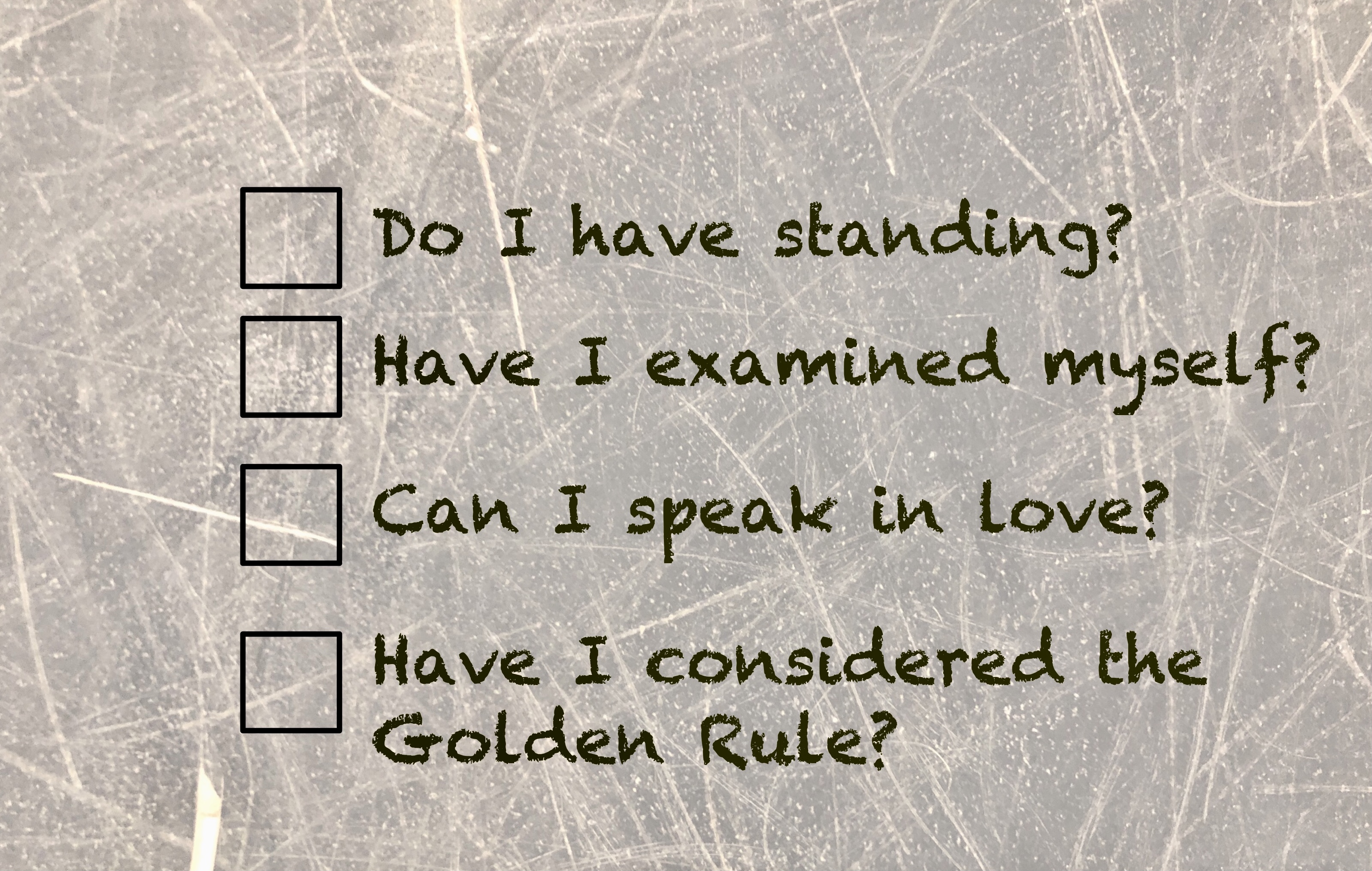
My checklist before speaking:

  1. Do I have standing? 
  2. Have I examined myself? 
  3. Can I speak truth in love (and not just air my opinion)? 
  4. Have I considered the Golden Rule? 

If I can answer “Yes” to all four questions, then speak; otherwise, it’s far more loving to remain silent. 

Think, Do, Evaluate, Propose

Listen to the podcast of this post by clicking on the player below, and you can also subscribe on AppleSpotify, or Audible.

The seed thought for me was this quote from John Maxwell: 

“Nothing you do will be perfect, so embrace the reality and benefits of failure by releasing yourself from the burden of not making mistakes.” 

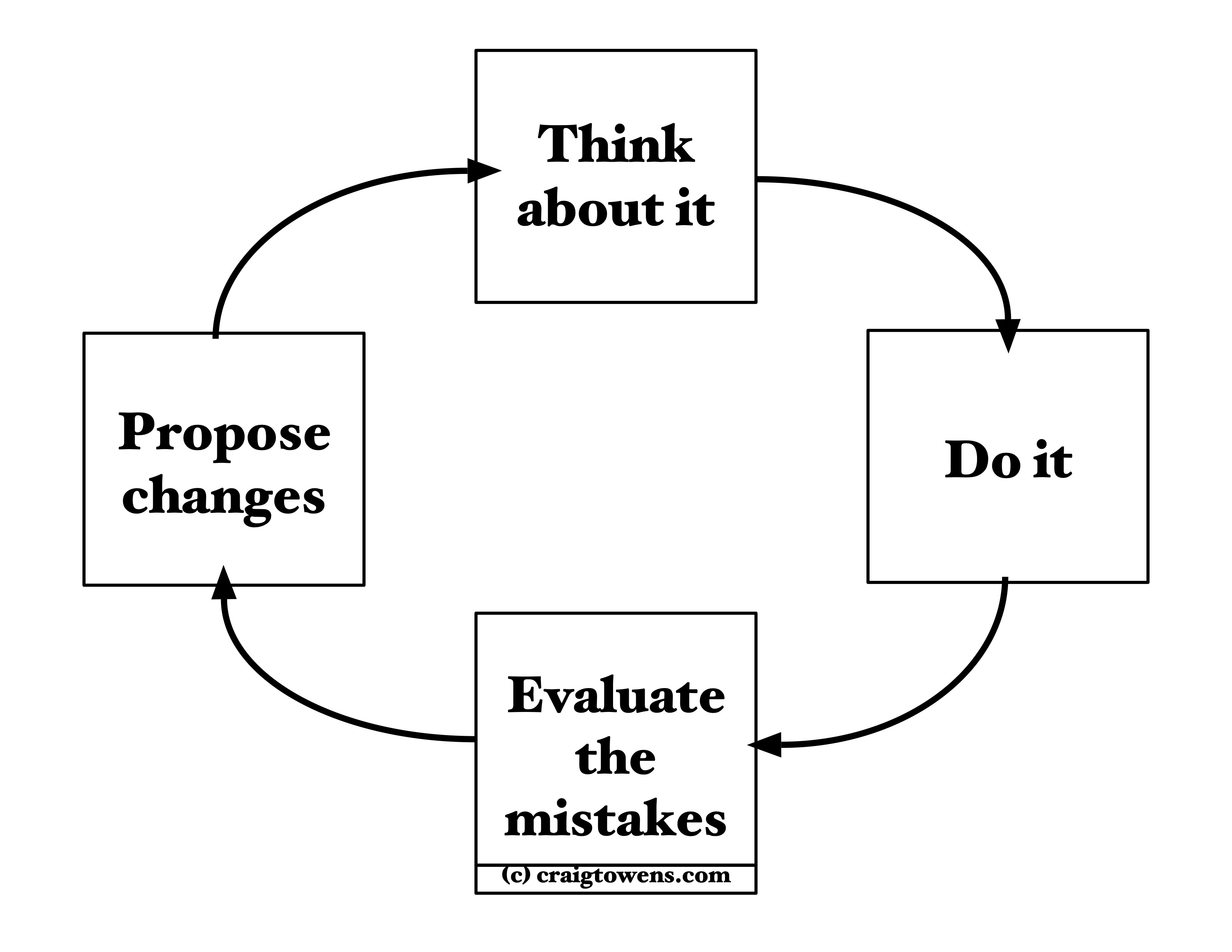
Here’s what I am endeavoring to implement: Think, Do, Evaluate, Propose. And then Repeat. 

THINK ABOUT IT—It’s important to put some thought into what you want to do before you do it, but we cannot camp-out here forever. I like to think in terms of goals I want to accomplish, whether those are for me personally or for organizations I lead. 

DO IT—At some point, I must launch out. Many people point out that Peter began to sink under the waves when he took his eyes off Jesus and began to look at the storm. But let’s not forget that Peter was the only one of the disciples who actually got out of the boat and walked on water! I often remind people who are hesitant to begin something that you cannot steer a parked car. We have to get moving first. 

EVALUATE THE MISTAKES—Let’s remove all doubt: you will make mistakes. But those mistakes are beneficial because it gives you something on which to work. Get some wise friends around you that can help you evaluate your mistakes. And always remember I failed ≠ I am a failure (here’s another post where I elaborate on this point). 

PROPOSE CHANGES—After evaluating your mistakes or shortcomings, you now have evidence that can be processed for your next attempt. This evidence can be taken back into the laboratory of the “Think” box as you prepare to try again, except now you are more informed than you were in your first attempt. 

REPEAT THE PROCESS AGAIN—No one is an overnight success, so keep trying again and again and again.

Leaders, walk through this process with your team members. Help guide their thinking, and then move them to action. Let them know that mistakes are okay because they have given you some invaluable feedback you can use as you make your proposals for your next attempt. 

Success is a continual run through the Think-Do-Evaluate-Propose cycle, with each revolution moving you closer to success. 

►► Would you please prayerfully consider supporting this ministry? My Patreon supporters get behind-the-scenes access to exclusive materials. ◀︎◀︎

God Delights In Me

It’s been said that the bookends of success are starting well and finishing well. I believe that! 

David started well when he lifted up a prayer of thankfulness to God when he became king over the united nation of Israel. Prayer at the the beginning puts us on a path toward success. 

Have you ever begun to assemble a child’s toy or a piece of furniture, gotten completely stumped, and only then read the instruction manual? We’ve all been there! There are many things in life that we start on our own and then hit our knees in prayer only after we’ve exhausted all of our human resources. Fortunately, after we pray and God answers, we often end up finishing well with a prayer of praise and thanksgiving. The question is: what do we do when we again get ready to start something else? Do we pause to start well with prayer, or do we dive in on our own again? 

I think one of the biggest reasons we don’t go to prayer quickly is because we feel unworthy to go into the presence of a holy, righteous God. 

One commentator said about Psalm 18 that David probably prayed this “before he committed his terrible sin” with Bathsheba and Uriah. That may be, but with very few minor changes, David prayed this exact same prayer (2 Samuel 22) at the very end of his reign. His reign as king was bookended with the same prayer. 

Between the bookend prayers of Psalm 18 and 2 Samuel 22, David prayed another prayer—this one was after he had sinned against God, Bathsheba, and Uriah. David truly believed that God forgave that sin and wiped the slate clean, so much so that he noted this great blessing on his life: “He brought me out into a spacious place; He rescued me because He delighted in me. 

He rescued me because He delighted in me?! Yes! 

David knew that God had told us that He delights in those who obey Him. The example of God’s delight was seen in Jesus. Because Jesus paid the price for the forgiveness of my sins, I can be completely cleansed. Then Jesus comes in me, and takes me into Him, and takes both of us into the Father. So now when our Heavenly Father looks at a forgiven sinner, He sees only the righteousness of Jesus—something He utterly delights to see! (Check out all of the biblical passages I’m referencing by clicking here.)  

David said his sin had been washed “whiter than snow” (Psalm 51:7), So now look at what he could claim—

The Lord has dealt with me according to my righteousness; according to the cleanness of my hands He has rewarded me. For I have kept the ways of the Lord; I am not guilty of turning from my God. All His laws are before me; I have not turned away from His decrees. I have been blameless before Him and have kept myself from sin. The Lord has rewarded me according to my righteousness, according to my cleanness in His sight” (2 Samuel 22:21-25). 

…according to my cleanness in His sight. 

In GOD’S sight! The devil wants to accuse me. He wants my sight to dominate. The devil doesn’t want me to see myself as God sees me. But I declare it out loud: I am clean IN HIS SIGHT! 

This cleanness allows me full, bold, confident access to Almighty God! I can take everything to God in prayer because I am clean in His sight! 

If you would like to read more of the posts in our prayer series called Be A First Responder, please click here. 

Solving The Unsolvable Dilemma

When Gabriel told Mary that she would be the mother of Jesus, he said that “the Lord God will give Him the throne of His father David.” Just before the angel showed up Luke noted that Mary was “pledged to be married to a man named Joseph, a descendant of David (Luke 1:27, 32).

At this time in history marriages were often arranged to preserve and strengthen family lines. Both Joseph and Mary could trace their family lineage through the royal line of Israel’s King David. 

Mary is betrothed to Joseph. Betrothal was considered as strong as a marriage with the only exception being that the couple didn’t yet live together nor sleep together. Betrothal usually lasted a year and would require a divorce to cancel it. 

Mary tells Joseph what Gabriel said to her and then she leaves to visit Elizabeth for the next three months! Joseph is left alone to consider his options. 

The word Luke uses for “consider” is not even close to what’s happening in Joseph’s mind. The word means to revolve around and around in your mind, like trying to solve a Rubik’s Cube. 

Consider Joseph’s options. If he divorces Mary—which was apparently his first reaction—Mary would be publicly embarrassed. Not to mention that Joseph knew that God hated divorce. 

If Joseph decided to proceed with the marriage, he would either have to confess he was the father of her child—which could result in both of them being stoned—or admit that she was pregnant by another man—which would be a permanent disgrace for Mary’s family. 

In either case, both families would be shamed! 

While Joseph was still considering all these unsavory options an angel says to him, “Joseph, son of David, do not be afraid.” By calling him by that title he is really saying, “I know how important your family heritage is to you. I know how important Mary’s family heritage is to her. But do not be afraid to take Mary home as your wife because this all fits into God’s plan. 

Would it have been easier on Joseph and Mary and their families if God could have waited until after they were married? Of course! But then it wouldn’t fit into God’s miraculous plan, because 700 years earlier God promised that Jesus would be born of an unmarried virgin. 

Fearing what’s coming in the future means we have forgotten Who already knows the future. 

God knows YOUR future too! It’s a future He already saw as good and fruitful, if you will put your trust in Him (Psalm 139:16; Jeremiah 29:11; John 15:16).

If you seem paralyzed by a no-win dilemma like Joseph was, first DON’T do what Joseph did: pray! Then DO what Joseph did after hearing the angel: obey. 

Remember Who knows you and Who knows your future, and then take each step on your journey as God directs you. 

If you’ve missed any of the other messages in our series called Do Not Be Afraid, you can access the full list by clicking here. 

Thursdays With Spurgeon—The Initiation Of Power

This is a weekly series with things I’m reading and pondering from Charles Spurgeon. You can read the original seed thought here, or type “Thursdays With Spurgeon” in the search box to read more entries.

The Initiation Of Power 

     Whatever the Holy Spirit was at the first, He is that now, for as God, He remains forever the same. … We would greatly grieve the Holy Spirit if we supposed that His might was less today than in the beginning. …  

     If at the commencement of the gospel we behold the Holy Spirit working great signs and wonders, may we not expect a continuance of and, if anything, increased displays of His power as the ages roll on? … 

     It ought not to be forgotten that Pentecost was the feast of firstfruits. It was the time when the first ears of ripe corn were offered to God. If, then, at the commencement of the gospel harvest we see so plainly the power of the Holy Spirit, may we not most properly expect infinitely more as the harvest advances and, most of all, when the most numerous sheaves will be gathered? May we not conclude that if the Pentecost was thus marvelous, the actual harvest will be still more wonderful?

From Pentecostal Wind And Fire

When Jesus was approaching the Cross, He gathered His disciples together to tell them what was coming. One of the assurances He gave His followers was this: “I assure you, most solemnly I tell you, if anyone steadfastly believes in Me, he will himself be able to do the things that I do; and he will do even greater things than these, because I go to the Father” (John 14:12). 

The empowering force for these “greater things” would be the Holy Spirit indwelling the Christian (Matthew 3:11; Luke 24:49; Acts 1:8, 2:1-4). 

Pentecost wasn’t the culmination, it was the initiation. 

Pentecost was the launching point for followers of Jesus to be filled with dunamis power that would enable them to go into all the world and preach the gospel, and to have signs and wonders follow to confirm the preaching of the Word. 

As Spurgeon said, we greatly grieve the Holy Spirit when we attempt to put Him in a box as to what He can or can’t do today, or if we try to limit Him to one era of long-past history. The Holy Spirit is as vital for a Christian today as He was on that Pentecost Sunday described in Acts 2! 

Authority To Serve

And David knew the Lord has established him as king over Israel and that his kingdom had been highly exalted for the sake of His people Israel. (1 Chronicles 14:2) 

“David knew” reminds me of “Jesus knew” in John 13:3.

Both knew God had placed them exactly where they were supposed to be. 

Both knew the authority God had given them. 

Both knew the power that was theirs to use.

Both knew they could do self-glorifying, self-promoting things with their power. Yet both used their authority and power to serve others: “for the sake of His people.”

Jesus gave His authority to us (Matthew 28:18). 

Do I know that? 

I mean, really know that? 

If so, am I using His authority to serve others?

A mark of a godly leader is one who uses his God-given authority to serve others. 

This is part 53 in my series on godly leadership. You can check out all of my posts in this series by clicking here.

Learning Contentment

A mark of a maturING saint is one who when he realizes he is in a trough begins to praise God in anticipation of the blessings which are coming! Even the most mature Christian you know hasn’t “arrived”; we are all a work-in-progress. Going through the dark nights is one way God helps mature our understanding of contentment. 

You know the differences between a need and a want: a need is something vital, something I require to survive; a want is something that would be nice to have. 

In good times I can convince myself that my wants are really the same as my needs. In the bright, sunny times a lot of wants mistakenly get called needs. But in the dark nights, this confusion is quickly clarified! 

In Philippians 4, Paul explains what he has learned about needs as he went through some very challenging, dark times. When he says he knows what a need is, he isn’t exaggerating a bit (see 2 Corinthians 11:24-28). And yet the Amplified Bible has Paul saying, “Not that I am implying that I was in any personal want.” 

That’s because Paul was learnING contentment. The verb tense here means I have learned, I am learning, and I will keep on learning. It was an ongoing process that helped him clarify needs from wants. The word Paul uses for content is unique in all the New Testament and it means independent of external circumstances, or as the Amplified Bible says, “satisfied to the point where I am not disturbed or disquieted in whatever state I am. 

Paul uses another unique word in verse 12 when he says “I have learned.” This is a different Greek word from the previous verse. This time it means disciplined by experience to know how to respond. In other words, Paul disciplined himself to reflect on the lessons he learned in the night. The cliche “Experience is the best teacher” isn’t necessarily true. Lots of people go through experiences and never learn a single thing. Instead, we should say, “Evaluated experience is the best teacher.” That’s exactly what Paul is saying here: “I have learned lessons in my time of meditation after going through a dark night.” 

The English dictionary defines contentment in two important phrases: 

  1. Satisfied with what I have. In Psalm 16, David learned that he had everything he needed in God, and Jesus reminded us that “your Father knows what you NEED before you ask Him” (Matthew 6:8).
  2. Satisfied with who I am. Paul knew that “God, who set me apart from my mother’s womb and called me by His grace, was pleased” (Galatians 1:15). God made Paul on purpose and for a purpose, and Paul was satisfied with who he was in Christ. God made you on purpose too! 

Our relationship with Jesus is a maturING one. It’s only IN Christ that I can be satisfied with what I have, and satisfied with who I am. It’s only IN the night that my wants get separated from my needs, by learnING contentment.

I can be thankful in the night because I am learning contentment. 

If you’ve missed any of the other messages in this series called Thankful In The Night, you can access the full list by clicking here.