Serving The Body

Listen to the podcast of this post by clicking on the player below, and you can also subscribe on AppleSpotify, or Audible. 

Last week we were reminded that sanctification (or as I call it “saint-ification”) is an ongoing process that usually involves the help of other saints. There is something else we need to do with other saints: serve them. 

We are all a part of the same Body so it is beneficial for the whole Body if we care for every part of the Body (1 Corinthians 12:25 AMPC; Ephesians 5:30). 

(Check out all of the Scriptures in this post by clicking here.) 

In order to serve others, we are going to have to check our attitude. We have been called to have the attitude that Jesus had about the Church (Ephesians 5:29; Philippians 2:3-7; John 13:3-5, 14-17). 

We must all know: 

  • I have a gift—notice the phrase each of you in 1 Peter 4:10 
  • I must use my gift to serve the Body of Christ (Luke 17:10)

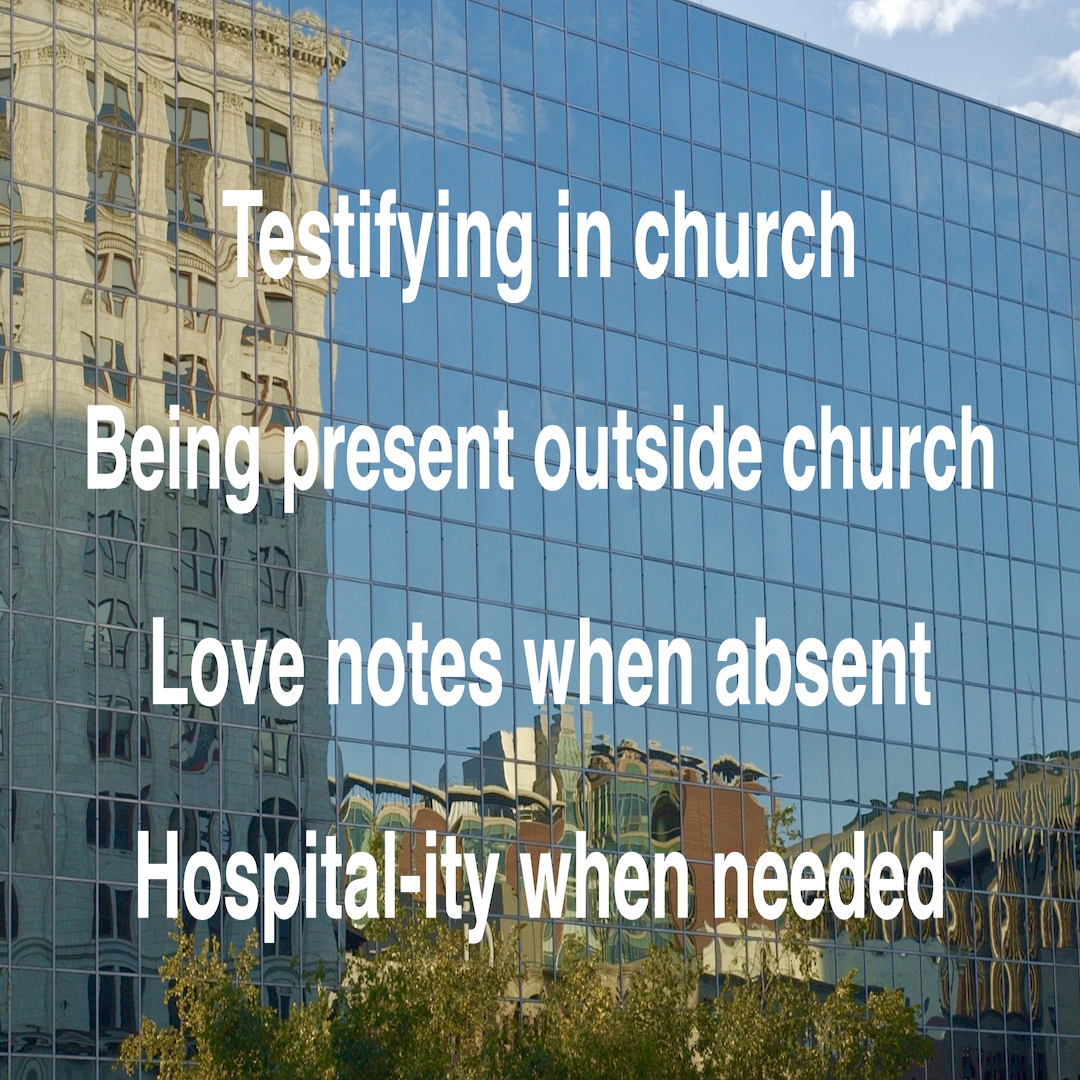
In the early Church, we see so much togetherness that they rewrote the definition of the Greek word koinonia (see Acts 2:42). Here’s what koinonia looks like in the Church:

(1) Testifying in church (Psalm 40:9-10 NLT) 

(2) Being present with saints outside of church. From Acts 20-28, the pronouns “we” and “us” are used over 80 times! Paul was blessed simply by Luke being with him, just as saints are blessed when you are truly with them. 

(3) Love notes when a saint is absent. The apostle John was brilliant at this. Look at his three epistles: 

  • dear children 9x in 1 John  
  • chosen / dear lady 2x in 2 John  
  • dear friend 4x in 3 John  

(4) Hospital-ity whenever it’s needed. Be a place of healing and refreshment for the saints God has placed in your life, just as Philemon did (Philemon 2-7, 22). 

What a testimony it is when we live this way (Romans 12:10, 13)! 

Remember the saint-ification process brings fruitfulness, joy-fullness, and an enhanced testimony. I love this quote from Richard Stearns, “The beautiful simplicity of our faith is that it distills down to the exact same bottom line for both the brilliant theologian and the five-year-old child: love God and love each other—period. Everything else derives from that.” 

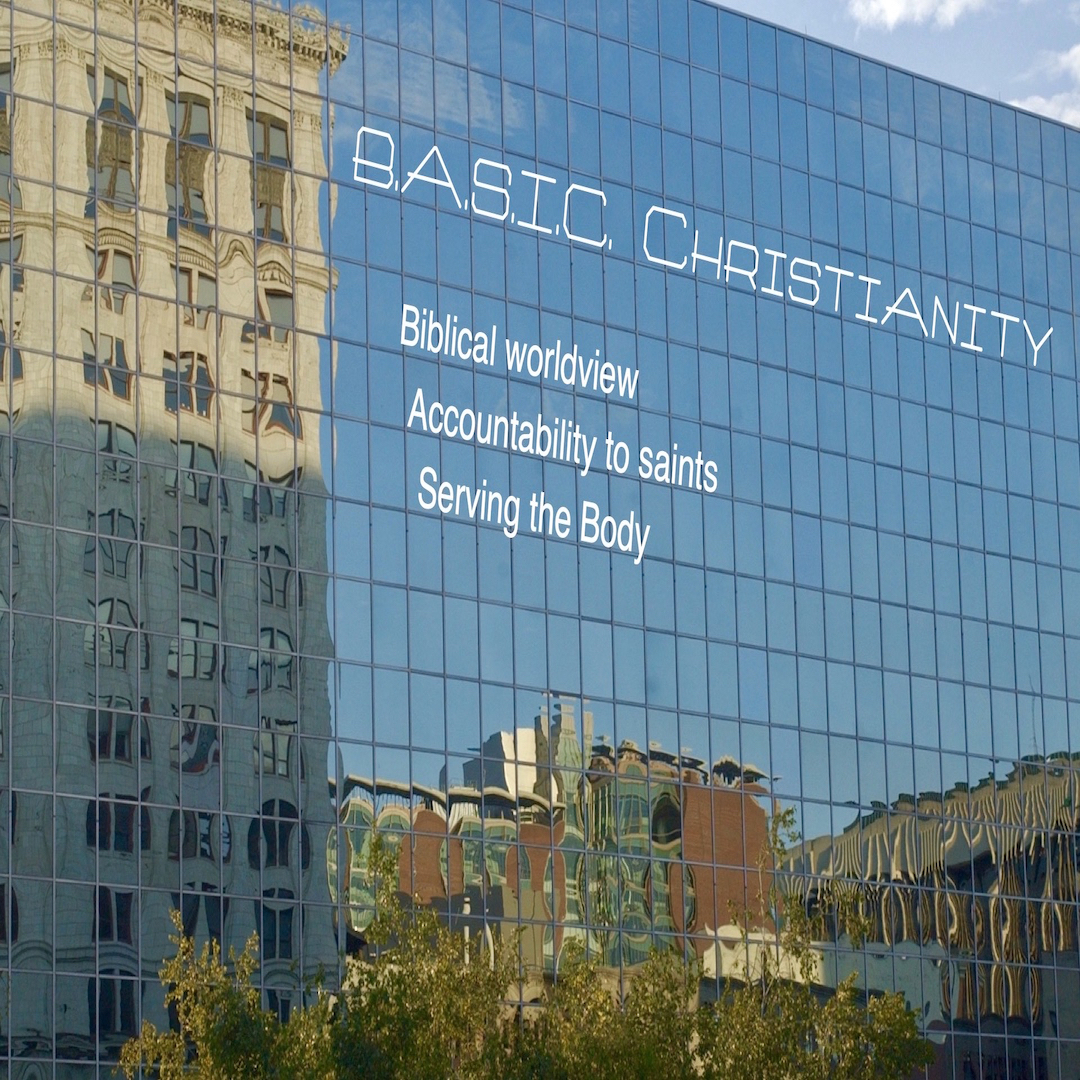
If you’ve missed the “B” or “A” in our series B.A.S.I.C. Christianity, you can check those out here. 

►► Would you please prayerfully consider supporting this ministry? My Patreon supporters get behind-the-scenes access to exclusive materials. ◀︎◀︎
Come To God And Keep Walking With Him

Listen to the podcast of this post by clicking on the player below, and you can also subscribe on AppleSpotify, or Audible. 

I have been so grateful for the insights of Dr. Gary Chapman in his book The Five Love Languages. I have found this book to be of immense value in helping couple prepares for marriage, and in helping married couples get beyond a place where intimacy has become stuck. 

In short, the five love languages are words of affirmation, quality time, gifts, acts of service, and physical touch. The goal of learning the other person’s love language—and learning to speak it consistently and fluently—is an increased level of intimacy. In the book of Amos, God asks, “Can two people walk together without agreeing on the direction?” (Amos 3:3 NLT), and speaking the right love language definitely helps people agree! 

The whole reason we come to God in prayer as a Father, as a Brother, and as a Counselor is so that we can hear Him speaking our love language and we can continue to walk in deeper intimacy with Him. 

When my then-girlfriend Betsy and I first met, we spent hours and hours getting to know each other. We would ask questions, share stories, and tell things we did and didn’t enjoy. This is the epitome of intimate conversation: getting to know the other person’s heart as you open up your heart to them as well.

I’ve shared this analogy before, but intimacy grows stale and can eventually disappear altogether if those in a relationship are no longer walking together. It doesn’t work if I say, “Betsy, I’m looking forward to spending an hour with you each week,” or even if I say, “I’ll give you 15 minutes each morning.” Instead, our relationship needs to be one of continual walking. 

It’s the same thing for us as Christians: we cannot only give God an hour at a church service on Sunday mornings, nor is intimacy going to increase if I only walk and talk with my Savior for a few minutes in my morning devotions. 

Walking closely with Him is what God has desired right from the beginning. He walked with Adam and Eve each evening. This phrase “walking with God” is used consistently throughout the Bible of those who had an intimate relationship with their Father, Brother, and Counselor—Noah, Abraham, Isaac, the people of Israel (Genesis 3:8, 6:9, 17:1, 48:15; Leviticus 26:12). And even as the New Testament era dawns, we read, “And they [Zechariah and Elizabeth] were both righteous before God, walking in all the commandments and ordinances of the Lord blameless” (Luke 1:6 NKJV). 

But I’m especially intrigued by the story of Enoch in Genesis 5:21-24. Twice in four short verses, we read “Enoch walked with God.” Remember that verse in Amos—“Can two people walk together without agreeing on the direction?”—so Enoch and God had to be in agreement. In fact, that’s exactly what we read about Enoch in the Book of Hebrews: 

By faith Enoch was taken from this life, so that he did not experience death: “He could not be found, because God had taken him away.” For before he was taken, he was commended as one who pleased God. And without faith it is impossible to please God, because anyone who comes to Him must believe that He exists and that He rewards those who earnestly seek Him. (Hebrews 11:5-6)

If you’ve taken Dr. Chapman’s love language assessment, you probably found that you were pretty lopsided: maybe you scored very highly in one love language and then barely registered in another. We may be lopsided in our love language skill, but God speaks every language perfectly! 

  • Words of affirmation—Hosea 2:14; Isaiah 40:2 
  • Quality time—Deuteronomy 31:6; Psalm 23:3-4
  • Gifts—James 1:17; 2 Peter 1:3
  • Acts of service—Philippians 2:13; Romans 8:28
  • Physical touch—Psalm 139:13-15; Luke 24:39 

(Click here to check out all of those verses.) 

Dr. Chapman noted that when our love language is being spoken to us sincerely and consistently, our love tank is filled, and all of the love languages begin to become more meaningful. 

Just as God walked with Enoch until the day He brought him Home, so He wants to walk with us. 

  • Walk in obedience to all that the Lord your God has commanded you, so that you may live and prosper. (Deuteronomy 5:33) 
  • The Lord will establish you as His holy people, as He promised you on oath, if you keep the commands of the Lord your God and walk in obedience to Him. (Deuteronomy 28:9) 
  • May He turn our hearts to Him, to walk in obedience to Him and keep the commands. (1 Kings 8:58) 
  • Blessed are all who fear the Lord, who walk in obedience to Him. (Psalm 128:1) 
  • And this is love: that we walk in obedience to His commands. As you have heard from the beginning, His command is that you walk in love. (2 John 6) 

When we walk in loving intimacy with Him, our intimacy grows deeper and more mature. Sometimes they will say of couples who have been married for a long time and walk in increasingly deeper intimacy with each other, “They seem to know each other’s thoughts.” That’s because they know each other’s hearts—and that’s what God wants to do with us. He did it with Enoch, and He will do that with us too (Jude 14; Jeremiah 33:3; Habakkuk 3:19). 

Enoch walked intimately with God for 365 years. Let us walk intimately with God for 365 days a year, for as many years as He gives us until God takes us away with Him forever! 

If you’ve missed any of the messages in our prayer series called Intimate Conversation, you can find all of the messages by clicking here. 

►► Would you please prayerfully consider supporting this ministry? My Patreon supporters get behind-the-scenes access to exclusive materials. ◀︎◀︎
6 Quotes From “Light & Truth—The Lesser Epistles”

Light & Truth The Lesser EpistlesHoratius Bonar’s insights on the Scriptures are amazing! So far I’ve read and reviewed three of the four commentaries he has prepared on the New Testament (you can read those reviews here, here and here). These are a few quotes from the third book on the epistles Galatians through Jude. Any reference in brackets is the passage from the Bible on which Bonar is commenting.

“It is a busy, lighthearted, laughing, pleasure-seeking world. But sin is here, and pain is here, and broken hearts are here, and weeping is here, and death is here, and the grave is here. Oh! in spite of all its laughter and vanity, it is an evil world. And the great proof of its evil is, that it cost the death of the Son of God to deliver you from it. … Give yourselves to Him Who came to deliver you from it, and Who stretches out His hands to you all day long, asking you to allow Him to deliver you. He yearns over you; and with sincere earnestness proffers to you His love, His friendship, His great salvation. Consent, O man, consent! His desire is to bless, and not to curse; to save, and not to destroy.” [Galatians 1:4]

“There never have been two gospels. There is not an Old Testament gospel and a New Testament Gospel. There is not one gospel for the Jew, and another for the Gentile, one gospel for the first century, and another for the nineteenth. It is but one gospel, as there is but one Cross and one Savior. Many ages, but one gospel; many sinners, but one gospel; many prophets and apostles, but one gospel. As our earth has had but one sun, so it has had but one gospel. Nor does it need more; that one is sufficient.” [Galatians 1:6-9]

“As the earth without rain or sunshine turns to barrenness, so is it with the Church or soul without the Spirit. … The age thinks it can do without the Spirit. Let the Church watch against this blasphemy. Let her keep hold of the Lord’s promise, the promise of the Father. Let her prize the gift; long for more of it. Let every saint seek more of it. Let our cry be continually: More of the Holy Spirit; more of His fullness; more of His gifts and graces!”

“Strength for the race is needed, hourly strength, superhuman strength; for it is no earthly race, but something lofty, supernatural, divine. Forgetting the supernatural source of strength, we betake ourselves to the internal or the simply external. And so we weary. For only God can supply the power which keeps us running. By Him only shall we run, and not be weary.” [Galatians 5:7]

“‘To Him who is able’—He is the Mighty One, the mighty God, the Lord God Almighty. Hear how this word ‘able’ is used. ‘He is able to subdue all things unto Himself’ (Philippians 3:21). ‘He is able to help them that are tempted’ (Hebrews 2:18). ‘He is able to save to the uttermost’ (Hebrews 7: 25). ‘He is able to keep us from falling’ (Jude 24). It is with the mighty God that we have to do; mightier than ourselves or our foes; mightier than earth or hell; omnipotent.” [Ephesians 3:20]

“Are you expecting the Lord? Are you living in this expectation? Is it a deep-seated, abiding, cherished hope? Is it a hope that tells upon your character, your life, your daily actings in public or private, your opinions, your whole man? Does it quicken you? Does it purify you? Does it keep you separate from the world? Does it keep you calm in the midst of earth’s most exciting events, or most untoward changes? Does it give you a new view of history as well as prophecy? … Let your expectation of the Lord’s coming be a calm and healthy one; not one that excites, but one that tranquilizes; not one that unfits for duty, but one that nerves you more firmly for it; not one that paralyzes exertion, but one that invigorates you for it; not one that makes you indifferent to present duty, but one that makes you doubly in earnest about everything that your hand findeth to do; not one that stops liberality, and prayer, and work, but one that increases all these a hundred fold; not one that dwells exclusively on the future’s dark side—the judgments that are at hand—but one that realizes the glory and the joy of Messiah’s approaching victory and triumphant reign.” [Philippians 3:20]

Get Some Face Time

Listen to the podcast of this post by clicking on the player below, and you can also subscribe on AppleSpotify, or Audible. 

The apostle John closed his second and third letters very similarly—

I have much to write to you, but I do not want to use paper and ink. Instead I hope to visit you and talk with you face to face, so that our joy may be complete. (2 John 12; 3 John 13)

John didn’t use his advanced years, or the difficulty and expense of travel, or the busyness of his schedule, or even the inconvenience of trying to work something into someone else’s schedule as an excuse to stay home and fire off letters.

Certainly letters have their value, but they are a one-way talking TO people. Personal visits are face to face time. They are a two-way talking WITH people. And this, John says, leads to joy for both parties!

How many excuses could I use today?

  • My schedule is so busy
  • Technology is very convenient to use
  • I’m not sure if they have the time
  • I really don’t have that much to say

Can I paraphrase John’s desire in a modern setting?

I have much to say to you, but I do not want to use Facebook or Twitter or texting. Instead I hope to visit you and talk with you face to face, so that our joy may be complete.

Make some time for face time, and you’ll be increasing both your joy and the joy of your friend as you talk WITH each other.

You may also be interested in a related post called Our Growing Communication Problem.

►► Would you please prayerfully consider supporting this ministry? My Patreon supporters get behind-the-scenes access to exclusive materials. ◀︎◀︎

Still Learning

I live by the axiom, “If you’re through learning, you’re through.” So I try to learn something new every day.

I just finished a class called New Testament Survey: a quick overview of the 27 books that compromise the New Testament of the Bible. Here’s a couple of interesting factoids I picked up from my studies:

  • The earliest-written book was James. Interesting, because at one point James thought Jesus (his half-brother) was nuts.
  • Only Matthew uses the term kingdom of heaven; all of the other writers use kingdom of God.
  • Mark uses the word immediately more times than anyone else. Perhaps because his source (Peter) was always doing things so quickly… sort of a ready, FIRE!, aim kinda guy.
  • Luke wrote what is called “the global gospel” for everyone, so he included 45 teachings/events that no one else records.
  • John doesn’t record any of Jesus’ parables.
  • John uses the word believe nearly 100 times— way more than any other writer.
  • Luke talks about the Holy Spirit nearly 60 times in the 28 chapters of Acts.
  • Romans is the longest of Paul’s epistles with 7101 words; Philemon is the shortest with just 355 words.
  • With the exception of the pastoral epistles (1 Timothy, 2 Timothy, Titus) Paul’s letters are arranged in the Bible from longest to shortest.
  • In 1 & 2 Thessalonians (only 136 verses) Paul refers to God, Christ, the Holy Spirit, or a combination thereof more than 150 times.
  • Paul gives Timothy seven word pictures to describe the kind of pastor he should be: son, soldier, athlete, farmer, workman, instrument, and servant.
  • Hebrews is called “the book of better things” so better is used 13 times. This word is used only six times in the remaining 26 books of the New Testament.
  • James wrote 108 verses but issues 50+ direct commands.
  • In John’s three short epistles he uses the word know 33 times, and the word dear ten times.

Keep on learning! There’s a lot of good stuff out there. What have you learned lately?