Misbehaving Government

Misbehaving governmentChristians are to have an “alien” response to earthly governments. Simply stated: the Bible says we should not rail against governing authorities the way Earthlings do. Christians should respond with proper submission (check this out).

But what if those earthly governors are misbehaving? What then?

We can still be in God-honoring submission to them in the way we call out their misbehavior. 

Look at some examples—

  • Daniel asked permission to go against the king’s wishes (Daniel 1:8), proposed an alternative plan (v. 12), but ultimately agreed to submit to the authority’s decision (v. 13).
  • Shadrach, Meshach and Abednego didn’t argue with King Nebuchadnezzar (Daniel 3:16-18), but respectfully took their stance for God (notice the use of the phrase “O king” as a title of respect).
  • Peter and John simply stated, “We must obey God rather than human authority” (Acts 5:29).

This is exactly what Jesus told us to do when He said, “Give to Caesar what is Caesar’s, and to God what is God’s” (Luke 20:25). Jesus said something very similar to Pilate, when that governor said, “Don’t you realize I have the power to set You free?” Jesus said, “You would have no authority over Me if it were not given to you from above” (John 19:10-11).

So how do we respond to misbehaving governors?

[1] With respect to their office.

[2] With reverent fear of God (see 1 Peter 2:17). “Because we reverence God as the Lord of history, we see beyond the fear and intimidation of the moment.” —James W. Thompson

[3] Leaving the results to God—Daniel 3:26-29, 6:16-27; Acts 5:40-42.

[4] With lots of prayer—1 Timothy 2:1-4.

Throughout history, Christians have always had the opportunity to confront ungodly governors. HOW they did it is what set them apart from the Earthling response, and what brought glory to God.

Here’s the video of my full message on this topic—

Next Sunday, November 8, is a day of prayer for those facing persecution for their Christian faith around the world. Join us in a time of prayer for them. If you’ve missed any messages in this series, you may find the complete list by clicking here.

Alien Government

Are we submittingPerhaps you can relate to one or more of these quotes about our government:

  • “Government is like a baby: …a big appetite at one end and no sense of responsibility at the other.” —Ronald Reagan
  • “If you ever injected truth into politics you have no politics.” —Will Rogers
  • “The word ‘politics’ is derived from the word ‘poly,’ meaning ‘many,’ and the word ‘ticks,’ meaning ‘blood sucking parasites.’” —Larry Hardiman
  • “Politics have no relation to morals.” —Nicolo Machiavelli

But if you are a Christian, the Bible calls you to not give in to the cynicism that many feel toward our government. As aliens and strangers on Earth, we are called to to interact with government officials in a peculiar way.

In a single word, the Bible calls us to submit. The Greek word that both Peter (1 Peter 2:13) and Paul use (Romans 13:1, 5) has a couple of definitions. On the one hand it carries a military meaning to arrange troops under the command of a leader. On the other hand, it’s also a voluntary attitude of cooperating, assuming responsibility, and carrying a burden for the common good.

No where does submission imply letting leaders abuse us, or remaining silent and uninvolved if their activities are immoral or unbiblical. Instead submission recognizes that government officials have been placed in their positions by God (Daniel 4:25, 32—the Most High is sovereign over all the kingdoms of men, and gives them to anyone He wishes), and that they are God’s servants (Romans 13:4, 6) who have to give an accounting to God for their actions.

Our alien response of properly submitting is our way of supporting them in their God-given responsibilities. How do we do this?

  1. Treat them with respect (Romans 13:7; 1 Peter 2:17).
  2. Separate the person [loved by God] from the policy [may or may not line up biblically], then disagree with the policy, not with the person.
  3. Pray for them (1 Timothy 2:1-4).

This way of interacting with them will bring glory to God (1 Timothy 2:3; 1 Peter 2:15).

Here’s a good question to ask ourselves: Are we submitting like servants of the King of kings?

If you’ve missed any messages in this series, you may find the complete list by clicking here.

You may also be interested in my video The Church should be pre-political.

Thursdays With Oswald—The Memory Of Sin

This is a periodic series with things I’m reading and pondering from Oswald Chambers. You can read the original seed thought here, or type “Thursdays With Oswald” in the search box to read more entries.

The Memory Of Sin

     No aspect of Christian life and service is in more need of revision than our attitude to the memory of sin in the saint. When the Apostle Paul said “forgetting those things which are behind,” he was talking not about sin, but about his spiritual attainment. Paul never forgot what he had been; it comes out repeatedly in the Epistles—“For I am the least of the apostles, that am not meet to be called an apostle” (1 Corinthians 15:9); “unto me who am less than the least of all saints, is this grace given” (Ephesians 3:8); “…sinners, of whom I am chief” (1 Timothy 1:15). …

     If one wants a touchstone for the depth of true spiritual Christianity, one will surely find it in this matter of the memory of sin. There are those who exhibit a Pharisaic holiness, they thank God with an arrogant offensiveness that they are “not as other men are”; they have forgotten the horrible pit and miry clay from whence they were taken, and their feet set upon a rock through the might of the Atonement. … 

     May the conviction of God come with swift and stern rebuke upon any one who is remembering the past of another, and deliberately choosing to forget their restoration through God’s grace. When a servant of God meets these sins in others, let him be reverent with what he does not understand and leave God to deal with them. 

From Conformed To His Image (emphasis added)

These are good questions for Christians to ask themselves regularly: (1) Am I remembering the sins of others the way I would want others to remember my sins? (2) Am I remembering my forgiven sins the way that God remembers them (Psalm 103:10-12)?

Links & Quotes

link quote


“The way to thwart the devil is to strengthen the very thing he is trying most to destroy—your faith.” —John Piper

“O blessed hurricane that drives the soul to God and God alone! … And now you have nothing but your God to trust to, what are you going to do? To fret? To whine? O, I pray you, do not thus dishonor your Lord and Master! Now, play the man, play the man of God. Show the world that your God is worth ten thousand worlds to you. Show rich men how rich you are in your poverty when the Lord God is your helper. Show the strong man how strong you are in your weakness when underneath you are the everlasting arms. Now man, now is your time to glorify God.” —Charles Spurgeon

“When it comes to a question of our forgiving other people, it is partly the same and partly different [from asking God to forgive us]. It is the same because, here also, forgiving does not mean excusing. Many people seem to think it does. They think that if you ask them to forgive someone who has cheated or bullied them you are trying to make out that there was really no cheating or no bullying. But if that were so, there would be nothing to forgive. They keep on replying, ‘But I tell you the man broke a most solemn promise.’ Exactly: that is precisely what you have to forgive. (This doesn’t mean that you must necessarily believe his next promise. It does mean that you must make every effort to kill every taste of resentment in your own heart—every wish to humiliate or hurt him or to pay him out.) The difference between this situation and the one in which you are asking God’s forgiveness is this. In our own case we accept excuses too easily; in other people’s we do not accept them easily enough.” ―C.S. Lewis, in Weight Of Glory

“Forgiveness is not foolishness. Forgiveness, at its core, is choosing to see your offender with different eyes. By the way, how can we grace-recipients do anything less? Dare we ask God for grace when we refuse to give it?” —Max Lucado

“Money is the currency of human resources. So the heart that loves money is a heart that pins its hopes, and pursues its pleasures, and puts its trust in what human resources can offer. So the love of money [1 Timothy 6:10] is virtually the same as faith in money—belief (trust, confidence, assurance) that money will meet your needs and make you happy.” —John Piper

“When the devil throws our sins up to us and declares that we deserve death and hell, we ought to speak thus: ‘I admit that I deserve death and hell. What of it? Does this mean that I shall be sentenced to eternal damnation? By no means. For I know One who suffered and made satisfaction in my behalf. His name is Jesus Christ, the Son of God. Where He is, there shall I be also.’” ―Martin Luther

Really proud to see how my fellowship, The Assemblies of God, is helping those with mental diseases.

What emotions pop up when someone says to you, “Can we talk about this?” Seth Godin has some helpful thoughts on this.

Money & Hammers

Money checklistHammers are very similar to money. Don’t believe me? Just take a look at some of the things they have in common. They both…

  1. …are tools.
  2. …can be used to build up or destroy.
  3. …are amoral.
  4. …don’t have any power until they’re in a person’s hand.

I realize in church circles it can make people uncomfortable to talk about money, but it shouldn’t be that way. The Bible is very clear in saying wealth comes from God, as well as how to use that wealth, so why should that be uncomfortable? Here are some of the things the Bible says about wealth:

  • If we honor God, He blesses our work (Proverbs 3:9-10).
  • If we take the glory for our success, God calls us “foolish” (Luke 12:16-21).
  • Money can be used to build God’s kingdom (Acts 4:34-37) or to build our own reputations (Acts 5:1-11).
  • Making the pursuit of money our priority becomes an idol (Luke 16:10-13).
  • The anxiety over money can choke our spiritual life (Matthew 13:22).
  • God gives us the ability to work, to make money, and to enjoy both the work and the rewards of work (Ecclesiastes 5:19).
  • God alone judges our attitude toward money (Luke 16:15).

It’s not money that is immoral, but our pursuit of Money (with a capital “M” or what the Bible calls Mammon) that is immoral.

It’s not money that will ruin us, but our trust in money that will ruin us.

It’s not money that gives us a secure future, but God Who richly provides us with everything for our enjoyment (1 Timothy 6:17).

Don’t envy people with more money than you. Don’t look down on people with less money than you. Don’t—as Jesus said to the Pharisees—justify your opinions and attitudes about money.

Only an honest listening to the Holy Spirit about your attitude and lifestyle concerning money is what can keep us from letting money rob us of God’s blessing.


Is Confrontation A Dirty Word?

ConfrontationJesus takes the church of Thyatira to task because they are tolerating someone with a Jezebel spirit to remain in a position of leadership and influence (Revelation 2:18-29). This is still a message to the church today!

However, for some reason Christians have made “confrontation” a dirty word. We don’t confront people in error, especially those who are in leadership positions within their church. Perhaps equally as wrong: when we do confront, we do it in a way that is destructive.

The goal of confrontation is restoration, not destruction!

In Revelation 2, Jesus gives us five steps toward healthy, biblical, God-honoring confrontation:

  1. Don’t tolerate a Jezebel spirit by remaining silent (v. 20). Instead we need to follow the principles in Matthew 18:15-17 and 1 Timothy 5:19.
  2. Allow the one whom you’ve confronted time to repent (v. 21a).
  3. If they don’t repent, don’t rescue them from God-inflicted punishment (vv. 21b-23).
  4. Run away from secrets (v. 24). If something more than Scripture is required by the Jezebel leader, reject it.
  5. Don’t run away from the situation, but hold on to Jesus until Jesus returns (vv. 25-28).

Not one human is infallible, but Jezebel not only claims infallibility, but also demands blind allegiance to her teachings. But it is just as wrong to tolerate Jezebel as it is to confront her unbiblically; Jesus opposed both.

One way for us to always avoid these two extremes: Try to out-serve one another, just as Jesus directed us—

“You know that the rulers of the Gentiles lord it over them, and their high officials exercise authority over them. Not so with you. Instead, whoever wants to become great among you must be your servant, and whoever wants to be first must be your slave—just as the Son of Man did not come to be served, but to serve, and to give His life as a ransom for many.” (Matthew 20:25-28)

If you are near Cedar Springs next Sunday, please join me as we continue our series on The 7-Star Church.

Check out this clip about confrontation—

National Sin And Repentance

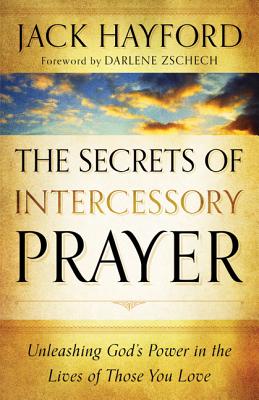
The Secrets of Intercessory Prayer“It is a sad thing when a nation’s sins accumulate to the point that God says, ‘Here, if you want that, you can have all of it and the hideous things that come with it. You have removed yourself from My mercy and its preventative grace.’ Preventative grace is a term we use to describe the merciful actions of God—essentially unseen in their execution and, by many, seldom honored because God’s kindness is presumed to be our right (if indeed He does exist, as unbelievers say). …America, for instance, has invited God out of its life, His Word out of its educational system and His moral values out of its laws. The plagues of venereal disease, gang warfare, teen suicide, divorce (the list could go on) are the direct outflow of the darkness to which our land has surrendered. However, our nation has not yet been swamped to the point of complete ruin—and therein is our call. As people who know our God, prayer for our land can bring healing. The passage is a virtual signal flag, summoning us with the assurance that it is not too late yet. God’s mercy promises that with our intercession, ‘Help is on the way!’ (see 2 Chronicles 7:14; 1 Timothy 2:1-5).” —Jack Hayford, The Secrets Of Intercessory Prayer (emphasis added)

What a powerful promise in Scripture:

If My people, who are called by My name, will humble themselves and pray and seek My face and turn from their wicked ways, then I will hear from heaven, and I will forgive their sin and will heal their land. (2 Chronicles 7:14)

Pastor, God’s blessings can return to our nation IF our people will humble themselves and pray. But our people will not do this unless we go first, and model the way for them!

Look how Nehemiah identified with the sin of Israel, and went first in his prayer of confession and repentance—

Let Your ear be attentive and Your eyes open to hear the prayer Your servant is praying before you day and night for Your servants, the people of Israel. I CONFESS THE SINS WE ISRAELITES, INCLUDING MYSELF and my father’s family, have committed against You…. (Nehemiah 1:6)

Lead the way, pastor, before it is too late for us.

(You may also be interested in this post: How to See a National Revival.)

Start With Thanksgiving Day

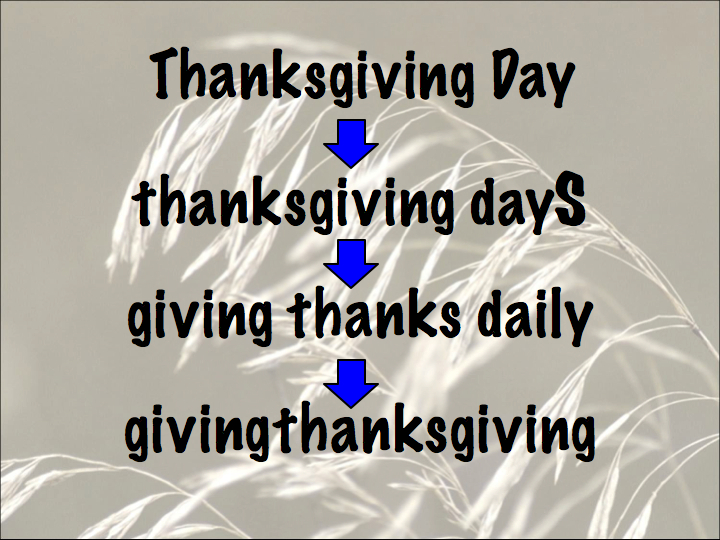
Thanksgiving Day is a good place to start. It’s a good day to begin to flex your gratitude muscles.

But don’t stop there! 

Allow those thankful feelings from Thanksgiving Day to expand into multiple thanksgiving dayS.

But don’t stop there! 

Let multiple thanksgiving dayS expand into a habit of daily thanksgiving.

But don’t stop there! 

Let the habit of daily thanksgiving become a lifestyle of givingthanksgiving—a lifestyle that is always God-focused, Christ-centered, and Spirit-led in constant thanks for everything!

Givingthanksgiving looks like this…

Always giving thanks to God the Father for everything, in the name of our Lord Jesus Christ. (Ephesians 5:20)

Do not be anxious about anything, but ineverything, by prayer and petition, withthanksgiving, present your requests to God. (Philippians 4:6)

For everything God created is good, and nothing is to be rejected if it is received with thanksgiving. (1 Timothy 4:4)

Let’s not limit ourselves to only one day of giving thanks, but a lifestyle of givingthanksgiving every single day!

Giving Thanks For Gifted People

Listen to the podcast of this post by clicking on the player below, and you can also subscribe on Apple, Spotify, or Audible.

Have you ever noticed how quickly we label people? We tend to give them a label based on their education, their socio-economic status, their race, their age, their job, even their choice of vocabulary.

We may not verbally express these labels, but we think them. And we will always treat people as we label them! In fact, it’s impossible to treat someone differently than you think about them.

What sort of label does God use? Well, He says that He knit you together in your mother’s womb; that He saw all of the days of your life before you were even a twinkle in your father’s eye; He knows the number of hairs on your head; He knows the thoughts in your head; He knows what you’re going to say before you say it. And then there’s this beautiful thought—

For we are God’s workmanship, created in Christ Jesus to do good works, which God prepared in advance for us to do. (Ephesians 2:10)

The label God puts on you:

My one-of-a-kind, irreplaceable, invaluable masterpiece!

When you are givingthanksgiving for people (that means you are always thankful for people), you will begin to see them as God’s masterpieces too!

Everyone you meet is God’s gift. He gave them to humanity to do the good works which He prepared in advance for them to do. You are surrounded by gifted people!

If you don’t see people this way—or if you tend to label them with less-than-flattering tags—perhaps you should begin to pray for them. Try a prayer like this:

I thank my God for you; in fact, I always thank God for you. And every time I thank God for you, I pray for you, night and day. In all my prayers for you, I always pray with joy, being confident of this, that He who began a good work in you will carry it on to completion until the day of Christ Jesus. And this is also my prayer: that your love may abound more and more in knowledge and depth of insight, so that you may be able to discern what is best and may be pure and blameless until the day of Christ, filled with the fruit of righteousness that comes through Jesus Christ—to the glory and praise of God. So I urge you to join me in offering requests, prayers, intercession and thanksgiving for everyone. (This prayer is taken from Romans 1:8; 1 Corinthians 1:4; Colossians 1:3; 2 Timothy 1:3; Philippians 1:3-11; 1 Timothy 2:1)

Don’t just express your thanks for people on Thanksgiving Day, but be givingthanksgiving all the time. Remember: everyone you meet is a gifted person because everyone you meet is God’s one-of-a-kind, irreplaceable, invaluable masterpiece.

Check out the other message in this two-part series series here.

►► Would you please prayerfully consider supporting this ministry? My Patreon supporters get behind-the-scenes access to exclusive materials. ◀︎◀︎

Choose Your Battles Wisely

You’ve probably heard that phrase before: Choose your battles wisely. Its origins may come from these verses of Scripture—

Fight the good fight of faith…. Turn away from godless chatter and the opposing ideas of what is falsely called knowledge. (1 Timothy 6: 12, 20)

We are all in a spiritual battle. So what does it mean to fight the good fight of faith?

The word good means things that are beautiful, excellent, and praiseworthy. In other words, good is what is God-glorifying. And faith means that it’s not about my opinion or my advancement.

The bottom line: Don’t fight unless God’s Word or God’s character is being maligned. 

Paul said, “Turn away from godless chatter and opposing ideas.” The King James Version describes these as vain and profane ideas. These sorts of battles are un-winnable and therefore unworthy of your time and effort. 

My spiritual battles should not be chosen strategically, but biblically.

We need to put on our armor and fight, but the fight must be the good fight of faith. Don’t take the bait of those who just want to quibble over obscure and irrelevant opinions. But when the attack comes against God’s honor or seeks to diminish His glory, it’s time to storm the battlefield!

May God give us the wisdom to know the difference.