God Delights In Me

It’s been said that the bookends of success are starting well and finishing well. I believe that! 

David started well when he lifted up a prayer of thankfulness to God when he became king over the united nation of Israel. Prayer at the the beginning puts us on a path toward success. 

Have you ever begun to assemble a child’s toy or a piece of furniture, gotten completely stumped, and only then read the instruction manual? We’ve all been there! There are many things in life that we start on our own and then hit our knees in prayer only after we’ve exhausted all of our human resources. Fortunately, after we pray and God answers, we often end up finishing well with a prayer of praise and thanksgiving. The question is: what do we do when we again get ready to start something else? Do we pause to start well with prayer, or do we dive in on our own again? 

I think one of the biggest reasons we don’t go to prayer quickly is because we feel unworthy to go into the presence of a holy, righteous God. 

One commentator said about Psalm 18 that David probably prayed this “before he committed his terrible sin” with Bathsheba and Uriah. That may be, but with very few minor changes, David prayed this exact same prayer (2 Samuel 22) at the very end of his reign. His reign as king was bookended with the same prayer. 

Between the bookend prayers of Psalm 18 and 2 Samuel 22, David prayed another prayer—this one was after he had sinned against God, Bathsheba, and Uriah. David truly believed that God forgave that sin and wiped the slate clean, so much so that he noted this great blessing on his life: “He brought me out into a spacious place; He rescued me because He delighted in me.” 

He rescued me because He delighted in me?! Yes! 

David knew that God had told us that He delights in those who obey Him. The example of God’s delight was seen in Jesus. Because Jesus paid the price for the forgiveness of my sins, I can be completely cleansed. Then Jesus comes in me, and takes me into Him, and takes both of us into the Father. So now when our Heavenly Father looks at a forgiven sinner, He sees only the righteousness of Jesus—something He utterly delights to see! (Check out all of the biblical passages I’m referencing by clicking here.)  

David said his sin had been washed “whiter than snow” (Psalm 51:7), So now look at what he could claim—

“The Lord has dealt with me according to my righteousness; according to the cleanness of my hands He has rewarded me. For I have kept the ways of the Lord; I am not guilty of turning from my God. All His laws are before me; I have not turned away from His decrees. I have been blameless before Him and have kept myself from sin. The Lord has rewarded me according to my righteousness, according to my cleanness in His sight” (2 Samuel 22:21-25). 

…according to my cleanness in His sight. 

In GOD’S sight! The devil wants to accuse me. He wants my sight to dominate. The devil doesn’t want me to see myself as God sees me. But I declare it out loud: I am clean IN HIS SIGHT! 

This cleanness allows me full, bold, confident access to Almighty God! I can take everything to God in prayer because I am clean in His sight! 

If you would like to read more of the posts in our prayer series called Be A First Responder, please click here. 

Thursdays With Spurgeon—Seeing God In Jesus

This is a weekly series with things I’m reading and pondering from Charles Spurgeon. You can read the original seed thought here, or type “Thursdays With Spurgeon” in the search box to read more entries.

Seeing God In Jesus 

For it is the God who commanded light to shine out of darkness, who has shone in our hearts to give the light of the knowledge of the glory of God in the face of Jesus Christ. (2 Corinthians 4:6) 

     Paul knew not merely God, but God in Christ Jesus! Not merely ‘the glory of God,’ but ‘the glory of God in the face of Jesus Christ’ (2 Corinthians 4:6). The knowledge dealt with God, but it was Christward knowledge! He pined not for a Christless theism but for God in Christ! This, beloved, is the one thing that you and I should aim to know. …  

     Even when your thought sweeps round the stars and circumnavigates space, you feel that heaven, even the heaven of heavens, cannot contain Him. Everything conceivable falls short of the inconceivable glory of God! When you come, however, to gaze upon the face of Christ Jesus, how different is the feeling! Now you have a mirror equal to the reflection of the eternal Face, ‘in Him dwells in the fullness of the Godhead bodily’ (Colossians 2:9). His name is ‘Wonderful, Counselor, Mighty God’ (Isaiah 9:6). He is the image of God, ‘the brightness of His glory and the express image of His person’ (Hebrews 1:3). If your conception of Christ is truthful, it will coincide with the true idea of God and you will exclaim, ‘This is the true God and eternal life’ (1 John 5:20). Like Thomas, you will salute the wounded Savior with the cry, ‘My Lord and my God!’ (John 20:28). …  

     How softly breaks the divine glory through the human life of Jesus; a babe in grace may gaze upon this brightness without fear! When Moses’ face shone, the people could not look at him, but when Jesus came from His transfiguration, the people ran to Him and saluted Him! Everything is attractive in God in Christ Jesus! In Him we see God to the fullest, but the Deity so mildly beams through the medium of human flesh that mortal man may draw near and look and live. 

From The Glory Of God In The Face Of Jesus Christ

If you would like to know God more intimately, look more closely at Jesus. 

Read through the Gospels slowly, focusing on what Jesus was saying and doing. Let the Holy Spirit transport you to those dusty Israelite roads, where you can walk with Jesus and get a new glimpse of the majestic glory of God.

The Core Curriculum Of The Spirit

“The Law of God teaches us how to love Him and our neighbors (Matthew 22:34-40). The Law of God is critical for seeking the Kingdom of God (Matthew 5:17-19). The Law of God liberates us from the blinding and binding power of sin (James 2:8-13). The Law of God marks the path of love that Jesus walked, and that all must walk who would follow Him (1 John 2:1-6; 5:1-3). The Law of God provided the framework within which the apostles ordered their churches (cf. 1 Corinthians 5, 9; James 2:5; 1 John 5). The Law of God is the core curriculum of the Spirit, as He brings us into the presence of God’s glory and transforms us into the image of Jesus Christ (Ezekiel 36:26-27; 2 Corinthians 3:12-18). Neglecting the Law of God is a major cause for the decline of true and selfless love in the world; it licenses the progress of evil; and it threatens to render the prayers of Law-neglecting believers an ‘abomination’ or, we might say, ‘a dead and a useless thing’ (Matthew 24:12; Proverbs 28:4, 9). 

[all Scriptures from the above paragraph are here]

“It’s no wonder the psalmist, echoing Moses, insisted that the righteous person, the one who embodies the goodness of God in all his ways, meditates on the Law of God day and night, hides it in his heart and embodies it in all his ways (Psalm 119:9-11; Deuteronomy 6:1-9), keeps it diligently, delights in and loves it, and hastens to make sure his feet follow in its path (cf. Psalm 1; Psalm 119:4, 5, 35, 59, 60, 97). 

[all Scriptures from the above paragraph are here]

“If you are missing the Law of God in your relationship with Jesus, you are depriving yourself of a most important resource for bringing the goodness of God to light in the land of the living. The good works outlined in the Law of God are those ‘ordained of old’ which God intends us to do in all our ways (Ephesians 2:10). Yes, understanding the Law can be difficult. But we can learn from the prophets, Jesus, and the apostles how to read, study, and meditate in this most important corpus of Biblical literature, and thus we can discover the true freedom for goodness and love that God has prepared for us.” —T.M. Moore 

Feelings, Facts, and Faith

Confusing times become more stressful—and more confusing!—when the response of people seems to throw more fuel on the fire. Frustration boils up into anger. Confusion gives way to fear. Uncertainty about what to believe or what to do becomes anxiety over what might be coming next. 

You might think I’m describing current events in our country right now. But in times like these we need to remember that there have always been times like these. When I talk about frustration, anger, confusion, fear, uncertainty, and anxiety, I am actually thinking about events that took place over 2000 years ago. 

Like when the residents of Ephesus became Christians and stopped buying idols of Artemis, a huge backlash broke out. “Soon the whole city was in an uproar. … The assembly was in confusion: Some were shouting one thing, some another. Most of the people did not even know why they were there” (Acts 19:29-32). 

Or when some Jews thought Paul had taken some non-Jews into the part of temple restricted to Jews only. “Jews from the province of Asia saw Paul at the temple. They stirred up the whole crowd and seized him, shouting, ‘Fellow Israelites, help us! This is the man who teaches everyone everywhere against our people and our law and this place. And besides, he has brought Greeks into the temple and defiled this holy place.’ (They had previously seen Trophimus the Ephesian in the city with Paul and assumed that Paul had brought him into the temple.) The whole city was aroused, and the people came running from all directions. Seizing Paul, they dragged him from the temple. … Some in the crowd shouted one thing and some another, and the commander could not get at the truth because of the uproar…” (Acts 21:27-34). 

There are three Fs at work here: feelings, facts, and faith. 

Have you heard it said, “Feelings are not facts”? Feeling are a fact to the one experiencing those feelings, so feelings can indeed be facts: subjective facts that are factual to me. 

Facts are not necessarily better than feelings because our facts might come from faulty sources. For example, Trophimos was with Paul, but Paul did not bring him into the restricted area. 

Whether feelings or facts, we need faith in God’s sovereignty. We need to remember: God has a plan, He is in control, nothing takes Him by surprise, nothing derails His purpose, He is intimately aware of everything that is happening. 

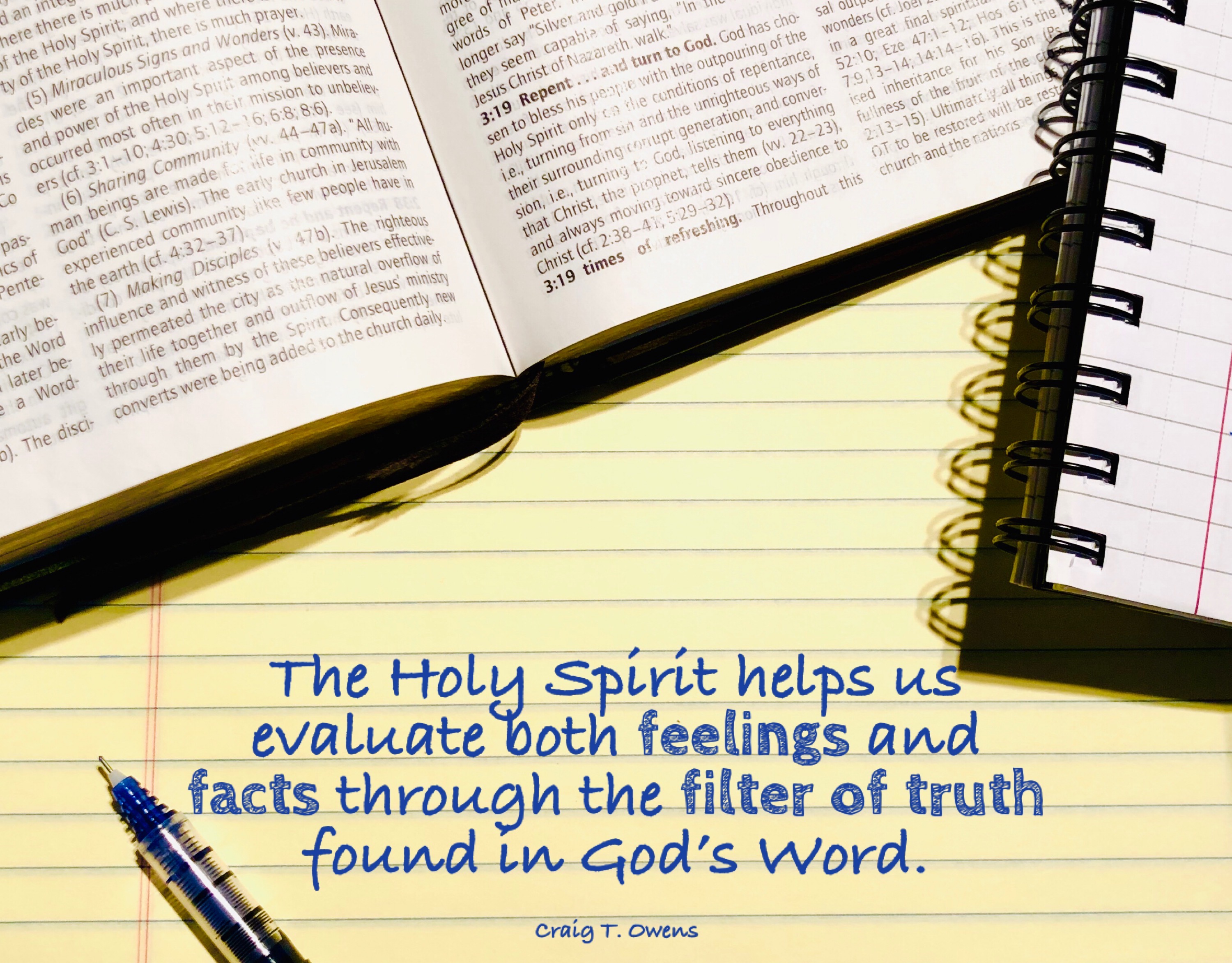
The Holy Spirit helps us evaluate both feelings and facts through the filter of truth found in God’s Word. Then the Spirit also gives us faith to stand firm despite the feelings and the facts. 

The Holy Spirit not only helps us pray through these confusing times (Romans 8:27), but He helps us know what’s really behind the confusing times, as well as how we can communicate that truth to others (1 Corinthians 2:10, 13 AMP). 

Probably my favorite promise (which I especially like in the Old English of the King James Version) is this: Ye have an unction from the Holy One, and ye know all things (1 John 2:20).

So I want to encourage you again: Don’t stop at salvation—be baptized in the Holy Spirit and have that unction that will help you with all your feelings and all the facts that are thrown at you. 

If you have missed any messages in this series on Pentecostal Christians, you can find the full list by clicking here. 

What We Can Know

… we know … (1 John 3:16, 19, 24; 4:2, 6, 13; 5:2, 13, 19, 20).

God clearly reveals Himself to us so that it is not a mystery of how to abide with Him. 

The word John uses for “know” in the Greek is ginosko. This is a knowledge through personal, firsthand experience; not knowledge someone told us about secondhand. 

God reveals Himself in Creation, in His law, in the rituals of worship, in our conscience, and in the voice of the prophets. Ultimately—and most unmistakably of all—God reveals Himself in Jesus (John 14:9). 

So here are 8 things we can now know…

  1. We know true love because of the sacrifice of Jesus (3:16; 4:7-10).
  2. We know we have God’s love in us by the way we treat others (3:17-19; 4:11; 4:20-21).
  3. We know our hearts our confident by the inward witness of the Holy Spirit Who assures us that we abide in God and He in us (3:20-24).
  4. We know how to discern deceptive spirits (4:1-6).
  5. We know what it means to be confident on Judgment Day (4:12-19).
  6. We know that loving others fulfills God’s commands (5:1-13).
  7. We know God hears our prayers (5:14-17).
  8. We know that we can be victorious over sin (5:18-21).

WE KNOW!

No doubts, no ambiguity. It’s crystal clear, pure knowledge through Him Who loves us!  

“With-ness”

…fellowship… (four times in 1 John 1:3, 6, 7)

The word “fellowship” is the Greek word koinonia. It means intimacy of relationship.

All of the apostle John’s books carry this key theme: Jesus loves us so this is how we should live differently because of that love. 

Koinonia means giving all I’ve got to someone else, and graciously receiving all they have to give to me. This creates a… 

  • … oneness
  • … togetherness
  • … with-ness

Our with-ness creates a visible witness of God’s love. 

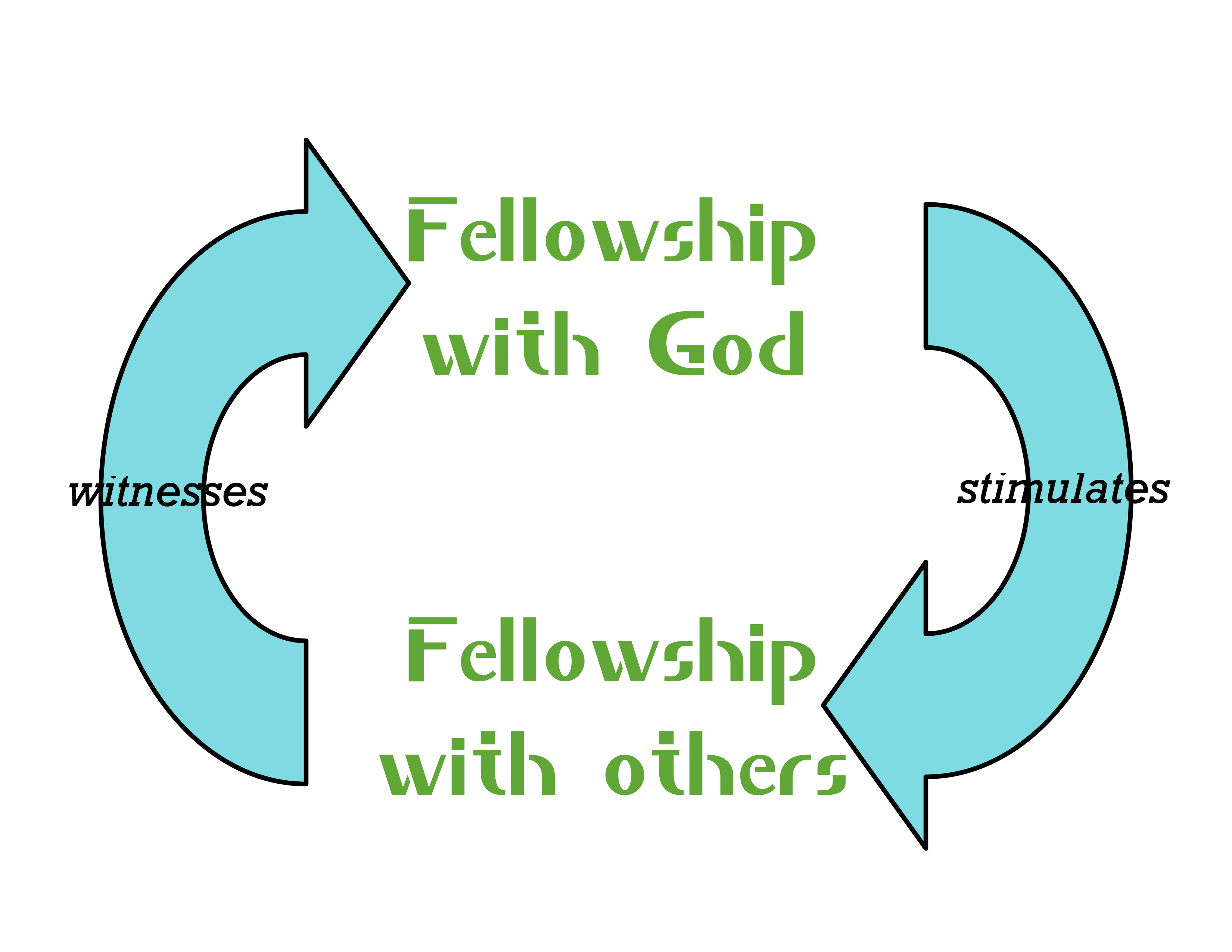
John says that fellowship with God can’t help but be expressed in fellowship with others. And then fellowship with others stimulates us to a deeper relationship with God. This love dance is itself a picture of the Ultimate Koinonia of the Trinity—“I am in You, Father, and You are in Me. These followers of Us are in Me and I in them,” said Jesus.

Don’t try to pursue a relationship with Jesus on your own, but find people that you can be in fellowship with and then watch how that deepens your fellowship with God!

Am I The Genuine Article?

Examine and test and evaluate your own selves to see whether you are holding to your faith and showing the proper fruits of it. Test and prove yourselves… (2 Corinthians 13:5). 

The root word for discern in the New Testament Greek is dokimazō. This word means to examine something—scrutinize it closely—to see if it is genuine. We’re instructed to take a close, scrutinizing look at…

  • …our beliefs about God (Romans 1:28)
  • …our understanding of God’s will for our lives (Romans 12:2)
  • …our relationship with God and others (1 Corinthians 11:28) 
  • …our faith (2 Corinthians 13:5)
  • …our motives (2 Thessalonians 2:4)
  • …the teaching we are listening to (1 John 4:1) 

In his book Romans: God’s Glory, Donald Grey Barnhouse discussed the root word for discern (the Greek word dokimos). He said, 

“In the ancient world there was no banking system as we know it today, and no paper money. All money was made from metal, heated until liquid, poured into moulds and allowed to cool. When the coins were cooled, it was necessary to smooth off the uneven edges. The coins were comparatively soft, and of course many people shaved them closely. In one century, more than eighty laws were passed in Athens to stop the practice of whittling down the coins then in circulation. But some money-changers were men of integrity, who would accept no counterfeit money; they were men of honour who put only genuine, full-weight money into circulation. Such men were called dokimos, and this word is used here for the Christian as he is to be seen by the world.” (emphasis mine)

This should be said of every Christian: “They are dokimos—men and women who are honorable and are the real deal. They don’t shave anything off; they don’t water anything down. They can be scrutinized closely and found to be the genuine article.” 

The Bible makes it clear that before the world can call us dokimos, the Holy Spirit first has to stamp that word on us. It’s only after we have allowed Him to scrutinize (and correct) our beliefs, relationships, faith, and motives that we can be labeled dokimos. When we are the real deal in His presence, the world cannot help but see the genuine article when they examine us. 

Let’s live this way! May both God and the watching world be able to call us dokimos! 

When Fear Must Go

Listen to the podcast of this post by clicking on the player below, and you can also subscribe on Apple, Spotify, or Audible.

I love the balancing thought of being humbly confident in God’s presence (or if you like: being confidently humble).

Humble to know I have nothing in myself that gives me access to God’s presence and love and power, but confident to know that God through Christ’s work on the Cross desires to have me with Him. 

C.S. Lewis wisely noted: “Humility is not thinking less of yourself, it’s thinking of yourself less.” Fear comes in when I’m thinking about me—how unworthy I am, how I messed up, how I wish I would have….

Fear leaves when I set my thoughts on Christ—how absolutely worthy He is, how He has accomplished everything for me, how He is working all things together for good. 

There is no fear in love—dread does not exist—but full-grown, complete, perfect love turns fear out of doors and expels every trace of terror! For fear brings with it the thought of punishment, and so he who is afraid has not reached the full maturity of love—is not yet grown into love’s complete perfection. (1 John 4:18)

It is humbly confident (and confidently humble) to keep my mind off me and take all my thoughts to His perfect love. That’s when fear must go!

“The mark of God’s people is not incapacitating fear, but rather contrite courageous confidence in God. … The good news of the Bible is not that we are not worms, but that God helps worms who trust Him.” —John Piper, commenting on Isaiah 41:14

►► Would you please prayerfully consider supporting this ministry? My Patreon supporters get behind-the-scenes access to exclusive materials. ◀︎◀︎

Thursdays With Oswald—What Is Mammon?

Oswald ChambersThis is a weekly series with things I’m reading and pondering from Oswald Chambers. You can read the original seed thought here, or type “Thursdays With Oswald” in the search box to read more entries.

What Is Mammon?

     You cannot serve God and Mammon [Matthew 6:24]. A man of the world says we can; with a little subtlety and wisdom and compromise (it is called diplomacy or tact), we can serve both. The devil’s temptation to our Lord to fall down and worship him, i.e., to compromise, is repeated over and over again in Christian experience. We have to realize that there is a division as high as heaven and as deep as hell between the Christian and the world. ‘Whosoever therefore will be a friend of the world is the enemy of God’ [James 4:4]. … 

     Never compromise with the spirit of Mammon. When you are right with God, you become contemptible in the eyes of the world. Put into practice any of the teaching of the Sermon on the Mount and you will be treated with amusement at first; then if you persist, the world will get annoyed and will detest you. … What is Mammon? The system of civilized life which organizes itself without considering God. … 

     When we become mature in godliness God trusts His own honor to us by placing us where the world, the flesh, and the devil may try us, knowing that ‘greater is He that is in you than he that is in the world’ [1 John 4:4].

From Studies In The Sermon On The Mount

Mammon wants to get what it wants to get, without considering God and without regard to the long-term consequences. Mammon wants satisfaction right now! 

Mammon is the system of the world. People are constantly driven by what they can get for themselves right now, with little—if any—thought to what God thinks or to what the inevitable outcome is going to be. 

A Christian is different. 

A Christian is focused on something which cannot be seen right now. But just because the rewards cannot be seen doesn’t make them any less real. In fact, Jesus teaches that the rewards He gives are Reality itself. 

When a Christian insists on doing things God’s way, the devil will sneer and people will laugh. But God’s Spirit in you is greater than all of that, and He will help you to stand firm in Him, not compromising with the lure of Mammon. 

No Asterisks

This past Christmas I was quite surprised to receive a package in the mail. It was something I ordered as a Christmas gift for my wife. 

Sort of. 

It was actually half of what I thought I ordered. I went back online and discovered some “fine print” that I hadn’t really noticed earlier. 

You’ve probably experienced that too—asterisks … fine print … footnotes … hidden fees … “limits and exclusions may apply” are all so frustrating!

Unfortunately, we get so used to these things that we begin to—consciously or subconsciously—plug them into places where they don’t actually belong. So even when Jesus Himself says something that sounds wonderful like, “I tell you the truth, if you have faith as small as a mustard seed, you can say to this mountain, ‘Move from here to there’ and it will move. Nothing will be impossible for you” (Matthew 17:20), we want to insert an asterisk. 

Or when He says, “And I will do whatever you ask in My name so that the Son may bring glory to the Father. You may ask Me for anything in My name, and I will do it” (John 14:13-14), we think we’re supposed to ask, “What’s the catch?” 

Christians are inserting asterisks where they don’t belong and, as a result, are praying timid prayers. 

Why do we pray this way? Perhaps we are…

  1. …fearful of being too bold. But in telling us how to pray, Jesus says God rewards our bold “shameless persistence” in prayer. 

I tell you, although he will not get up and supply him anything because he is his friend, yet because of his shameless persistence and insistence he will get up and give him as much as he needs. So I say to you, ask and keep on asking and it shall be given you; seek and keep on seeking and you shall find; knock and keep on knocking and the door shall be opened to you. (Luke 11:8-9 AMP) 

  1. …unsure that God hears us, cares for us, or even wants to answer us. But the Bible is quite clear that all of these things are true: He hears us, cares for us, and does want to give us what He has promised (1 John 5:14-15; Romans 8:32; Romans 4:20-21).  
  1. …ignorant of what/how to pray. T.M. Moore reminds us, “God has given us three great helps to assist us in our prayers. His Spirit groans for us; His Word guides us; and His Son governs and intercedes for us.” 
  1. …not looking for God’s answer. David said that after praying, he expectantly watched for God’s answer (Psalm 5:3). Indeed, the Aramaic word for prayer means “to set a trap.” 

“He is the God of limitless resources—the only limit comes from us. Our requests, our thoughts, and our prayers are too small, and our expectations are too low. God is trying to raise our vision to a higher level, call us to have greater expectations, and thereby bring us to greater appropriation. Shall we continue living in a way that mocks His will and denies His Word?” —A.B. Simpson 

Why are you hesitating to ask God for even a tiny amount when such vast resources are available? What would happen if you started to pray more boldly? What if you began to make mountain-moving requests? I dare you to try! 

Stop looking for the asterisks and start taking God at His word!

Join me next week as we continue our series on Boldly Praying, looking at some bold pray-ers in the Bible.