Thursdays With Spurgeon—No Fear Of Inspection

This is a weekly series with things I’m reading and pondering from Charles Spurgeon. You can read the original seed thought here, or type “Thursdays With Spurgeon” in the search box to read more entries.

Listen to the podcast of this post by clicking on the player below, and you can also subscribe on AppleSpotify, or Audible. 

No Fear Of Inspection

Having a form of godliness but denying its power. Have nothing to do with such people. (2 Timothy 3:5) 

     Paul warns us of certain characters that will appear in the last times. It is a terrible list. The like have appeared in other days, but we are led by his warning to apprehend that they will appear in greater numbers in the last days than in any previous age. ‘People will be lovers of themselves, lovers of money, boastful, proud, abusive, disobedient to their parents, ungrateful, unholy, without love, unforgiving, slanderous, without self-control, brutal, not lovers of the good, treacherous, rash, conceited, lovers of pleasure rather than lovers of God’ (2 Timothy 3:2-4). … 

     The raw material of a devil was an angel bereft of holiness. You cannot make a Judas except out of an apostle. The eminently good in outward form, when without inward life, decays into the foulest thing under heaven. You cannot wonder that these are called perilous times, in which such characters abound. … 

     Those who constantly associate in worship, unite in church fellowship, and work together for sacred purposes have a form of godliness, and a very useful and proper form it is. Alas, it is of no value without the power of the Holy Spirit. 

     Some go farther than public worship. They use a great deal of religious talk. They freely speak of the things of God in Christian company. They can defend the doctrines of Scripture, they can plead for its precepts, and they can narrate the experience of a believer. …

     That religion that comes from the lips outward but does not well up from the deep fountains of the heart is not that living water that will spring up to eternal life. Tongue godliness is an abomination if the heart is destitute of divine grace.  

     When we have done all the work our position requires of us, we may only have displayed the form of godliness. Unless we harken to our Lord and from His presence derive power, we will be as a sounding brass and a tinkling cymbal. Brethren, I speak to myself and to each one of you in solemn earnestness. If much speaking, generous giving, and constant occupation could win heaven, we might easily make sure of it. But more than these are needed. … 

     O my active and energetic brother, remember the word, ‘Therefore let him who thinks he stands take heed lest he fall’ (1 Corinthians 10:12). If any of you dislikes this searching sermon, your dislike proves how much you need it. He that is not willing to search himself should stand self-incriminated by that unwillingness to look at his affairs. If you are right, you will not object to being weighed in the balances. If you are indeed pure gold, you may still feel anxiety at the sight of the furnace, but you will not be driven to anger at the prospect of the fire. Your prayer will always be, ‘Search me, God, and know my heart; test me and know my anxious thoughts. See if there is any offensive way in me, and lead me in the way everlasting’ (Psalm 139:23-24).

From The Form Of Godliness Without The Power

Those who are in right standing with God—in other words, those who are not merely godly in outward appearance only—should have no fear of their lives being inspected. Accountability among fellow Christians is a liberating thing because it keeps us in a place of safety. But even better is when we pray, “Search me, Lord” and then we quickly, and without offering any excuses, correct whatever the Holy Spirit reveals to our hearts. 

In these last days, let us be even more attentive to this!

►► Would you please prayerfully consider supporting this ministry? ◀︎◀︎
Thursdays With Spurgeon—Beautiful Homegoing

This is a weekly series with things I’m reading and pondering from Charles Spurgeon. You can read the original seed thought here, or type “Thursdays With Spurgeon” in the search box to read more entries.

Listen to the podcast of this post by clicking on the player below, and you can also subscribe on AppleSpotify, or Audible. 

Beautiful Homegoing

You shall come to the grave at full age, as a sheaf of grain ripens in its season. (Job 5:26) 

     The Christian’s death is always timely. ‘You shall come to the grave at full age. 

     ‘Ah,’ says one, ‘that is not true. Good people do not live longer than others. The most pious man may die in the prime of his youth.’ But look at my text. It does not say you will come to your grave in old age, but in a ‘full age.’ … All fruits do not get ripe and mellow at the same season. So it is with Christians. They are at a ‘full age’ when God chooses to take them home. … 

     There are two mercies to a Christian. The first is that he will never die too soon. And the second is that he will never die too late. … 

     ‘But,’ say some, ‘how useful might they have been had they lived.’ Ah, but how damaging they might have been! And were it not better to die than to do something afterward that would disgrace them and bring disgrace to the Christian character? Were it not better for them to sleep while their work was going on than to break it down afterward? … 

     Again, the Christian never dies too late. … God is too good a Husbandman to leave His wheat in the field too long and let it shale out. …  

     Now the last thing is that a Christian will die with honor. … I think there are two funerals for every Christian: one is the funeral of the body, and the other of the soul. Funeral, did I say, of the soul? No, I meant not so. I meant not so. It is a marriage of the soul. For as soon as it leaves the body, the angel reapers stand ready to carry it away. They may not bring a fiery chariot as they had for Elijah. But they have their broad spreading wings. I rejoice to believe that angels will come as convoys to the soul across the ethereal plains. … I think the most honorable and glorious thing we will ever behold, next to Christ’s entrance into heaven and His glory there, is the entrance of one of God’s people into heaven.

From The Death Of The Christian

As I mentioned last week, this sermon was so providential in its timing for me because my precious mother went Home to be with Jesus just days before I opened to this sermon from Charles Spurgeon. 

We are comforted by the promises Rev. Spurgeon shares because they are based on the truth in God’s Word. “Good people pass away; the godly often die before their time. But no one seems to care or wonder why. No one seems to understand that God is protecting them from the evil to come. For those who follow godly paths will rest in peace when they die” (Isaiah 57:1-2). 

At my Mom’s graveside committal service I shared this—

One of my favorite authors C.S. Lewis made a comment, “You don’t have a soul. You are a soul. You have a body.” 

This part that we called Claudia Owens was just the body that carried around who she really was. What a beautiful soul that we got to experience for 78 years. What shined through was so sweet and graceful and wonderful. What a glimpse we got! But a joy to know that it was only a glimpse. That the part of my Mom that was so beautiful that we got to see, was only a fraction of her full beauty! The part that was really her, that is at Home with her Savior Jesus now is shining in all its brilliance. … 

We will all miss her and we will grieve our loss. But as the apostle Paul reminded us, we don’t grieve as those who have no hope. We know that to be absent from the body is to be present with the Lord. We know that this body is sown perishable ravaged by the disease of cancer, but that my Mom is now in a place with no more tears or disease. We know that the same Savior that prepared a place for Claudia has prepared a place for us.

And we concluded with this prayer that can be offered up for every Christian who has died at their “full age”: 

Heavenly Father, 

We commit this body to the ground with the full assurance that her soul is in your everlasting presence. Holy Spirit, help us in our grief to be reminded of the hope of eternal life that we all share. Thank You, Jesus, for purchasing this hope on which we stand.

As I mentioned last week, if you don’t have this blessed assurance of the marriage of your soul when you take your last breath here on earth, please don’t hesitate to contact me.

►► Would you please prayerfully consider supporting this ministry? ◀︎◀︎
Our Blessed Hope

Listen to the podcast of this post by clicking on the player below, and you can also subscribe on AppleSpotify, or Audible. 

As we wrap up our series looking at our foundational belief statements, I want to combine the last four statements together, not only because they all cover the same theme of end-times events, but also because these statements should give every Christian hope! 

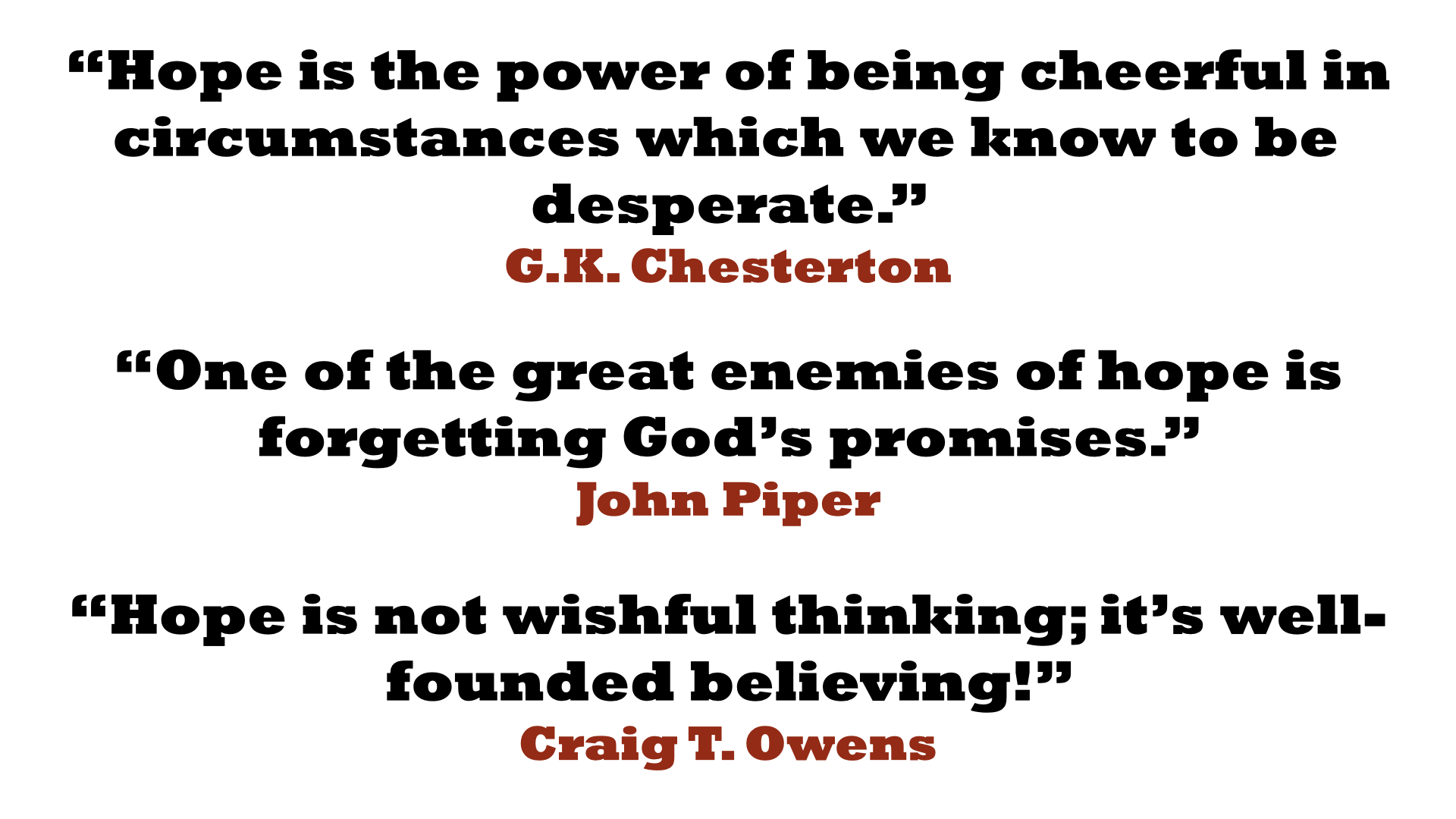
  • “Hope is the power of being cheerful in circumstances which we know to be desperate.” —G.K. Chesterton 
  • “One of the great enemies of hope is forgetting God’s promises.” —John Piper 
  • “Hope is not wishful thinking; it’s well-founded believing!” —Craig T. Owens 

Christians have a fantastic, unshakable, blessed hope on which we can stand not only secure but joyful! 

Foundational truth #13: “The resurrection of those who have fallen asleep in Christ and their translation together with those who are alive and remain unto the coming of the Lord is the imminent and blessed hope of the church.” 

This blessed hope in the future helps us live with joy today! Knowing that death has been defeated and Jesus will come back to take us home with Him should fuel us to say “no” to the temporary pleasures of sin, and live such godly lives that it turns others’ eyes to Jesus (Titus 2:11-14; 1 Corinthians 15:51-52; 1 Thessalonians 4:16-17). 

Foundational truth #14: “The second coming of Christ includes the rapture of the saints, which is our blessed hope, followed by the visible return of Christ with His saints to reign on earth for one thousand years.” 

Sometimes you will hear Christians talk about the “rapture” of the Church. Although this word itself isn’t in the Bible, the Greek word harpazo in 1 Thessalonians 4:17 means “catching up.” It also means “to eagerly claim for one’s self,” which reminds me that Jesus is thrilled to bring His Bride home to be with Him forever! After the Church has been caught up to Heaven, a period of tribulation will plague the earth, followed by Christ’s Second Coming and His millennial reign (Zechariah 14:4-5; Revelation 19:11-15; 20:1-10). 

Foundational truth #15: “There will be a final judgment in which the wicked dead will be raised and judged according to their works. Whosoever is not found written in the Book of Life, together with the devil and his angels, the beast and the false prophet, will be consigned to the everlasting punishment in the lake which burns with fire and brimstone, which is the second death.” 

Christians have no fear of the second (or final) death because our names are written in the Book of Life (Luke 12:4-6; Revelation 20:11-15). Not only is there judgment for the wicked, but there will be rewards for the righteous. 

Foundational truth #16: “In keeping with His promise we are looking forward to a new heaven and a new earth, where righteousness dwells” (2 Peter 3:13). Revelation 21-22 give us a small glimpse of our eternal home. 

In light of these truths, how should Christians live while still on earth? I think there are three ways we should live: 

  1. Live circumspectly
  2. Live on-mission
  3. Live unafraid

(see Ephesians 5:15; Matthew 28:18-20; Proverbs 24:11-12; Jude 1:20-25) 

With this blessed hope of the Second Coming of Jesus and our security in knowing we will remain with Him forever, let’s tell everyone we can how they too can know what it is to live with this hope in their heart. 

If you’ve missed any of the messages in our series exploring our foundational beliefs, you can access the full list by clicking here. 

►► Would you please prayerfully consider supporting this ministry? ◀︎◀︎
Thursdays With Spurgeon—Faith Sees Better Than Sight Does

This is a weekly series with things I’m reading and pondering from Charles Spurgeon. You can read the original seed thought here, or type “Thursdays With Spurgeon” in the search box to read more entries.

Listen to the podcast of this post by clicking on the player below, and you can also subscribe on iTunes or Spotify.

Faith Sees Better Than Sight Does  

For we walk by faith, not by sight. (2 Corinthians 5:7) 

     There is walking by faith, and there is walking by sight. The most of men, all men indeed, naturally walk by sight. They have a proverb that says, ‘Seeing is believing,’ and they are wise men, for they trust people as far as they can see them, and no further. … Self-reliance is the name of the principle, and according to the world, the best and grandest thing that a man can do is have faith in himself. … 

     I think the world must be pretty well ashamed of itself if it still considers this poor earth to be all that a soul has to live for. I feel as if I could not talk upon the matter. Solomon tried everything there was in this world—riches, power, pleasure—every sort of delicacy and delight he had, beyond the point of satisfaction. And what was his verdict upon at all? ‘Vanity of vanities, all is vanity’ (Ecclesiastes 1:2). … 

     If there is not another world to live for, I must say that this life is a most unutterably empty kind of thing! It is not worthy of a man! But oh, to believe what God tells me: that there is a God; that God became flesh to bear me up to Himself! To believe that I am God’s son, that I have an immortality within myself that will outlast the stars, that I will one day see His face and sing His praise forever with cherubim and seraphim! Why, there is something here! …

     If you walk only by sight and believe only what you see, what do you believe? You believe that while you are living here, it is a good thing to make the best you can of it. And then you will die and be buried, and that will be the end of you! What a poor, miserable, ignorant belief this is! … But when you believe in what God reveals and come to walk by faith, how your information expands! Now riddles are all solved, and the inexplicable is understood! … 

     The principle of faith does best in the dark. He who walks by faith can walk in the sunlight as well as you can, for he walks with God. He has enlightened eyes, but he can walk in the dark as you cannot, for his light is still shining upon him. He trusts in the unseen and in the invisible, and his soul rejoices when present things are passing away.

From Faith Versus Sight

One of the temptations of the devil has been to try to get us focused on the seen—the temporal. He did this successfully with Adam and Eve in the Garden of Eden. He tried to get Jesus to focus on the temporal in his wilderness temptations, but Jesus steadfastly kept His eyes on the unseen. 

The devil’s strategy hasn’t changed. He will try to get you to say, “Woe is me! Look at all of the bad things happening around me!” 

But we walk by faith, not by sight. “Faith is the assurance—the confirmation, the title deed—of the things we hope for, being the proof of things we do not see and the conviction of their reality—faith perceiving as real fact what is not revealed to the senses” (Hebrews 11:1 AMP).   

Don’t give in to the temptation to believe only what you see. There is so much more waiting for you. It’s all yours by faith in Jesus Christ!

►► Would you please prayerfully consider supporting this ministry? ◀︎◀︎

Confident, Bold, and Joyful

Listen to the podcast of this post by clicking on the player below, and you can also subscribe on AppleSpotify, or Audible.

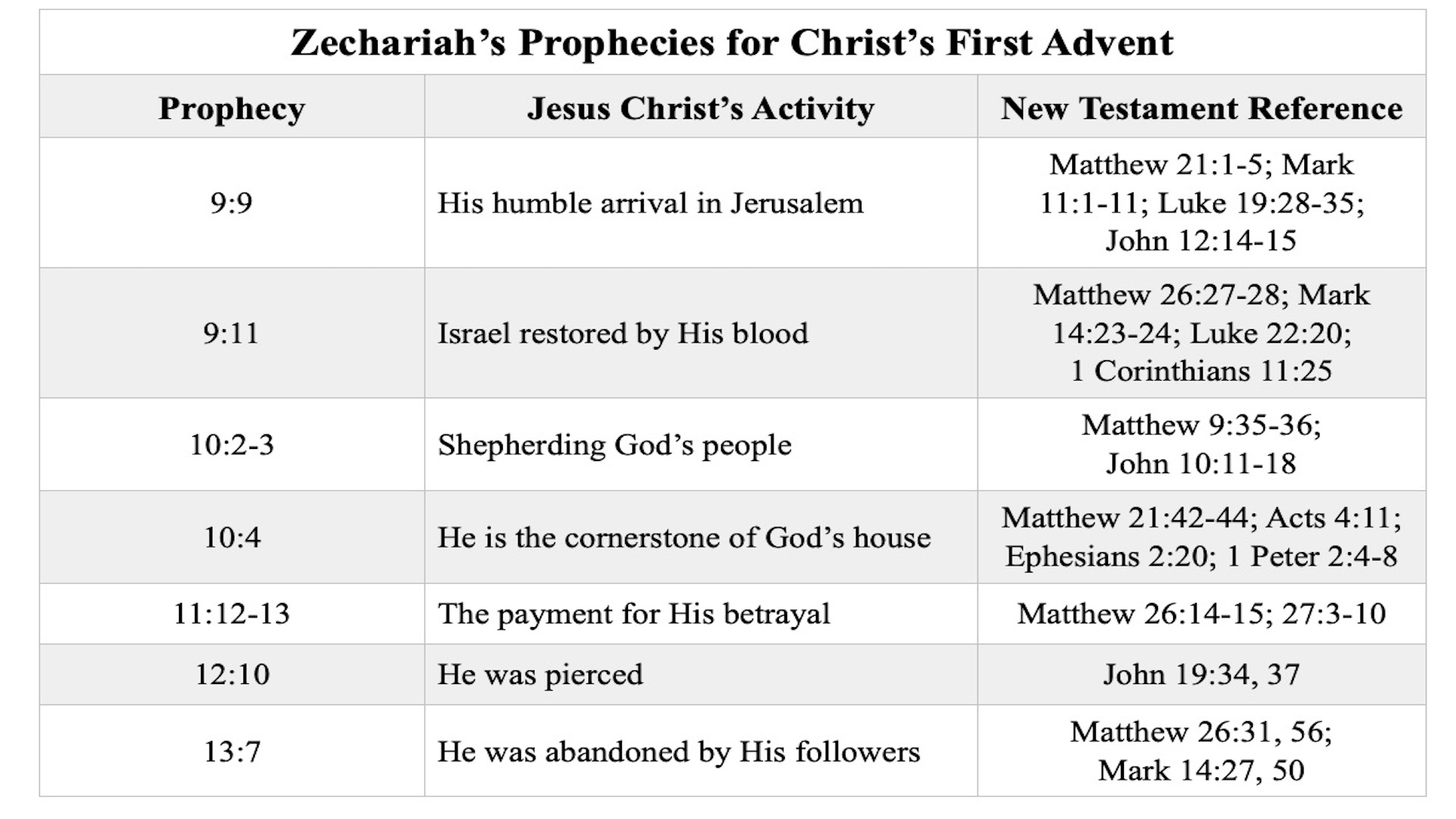
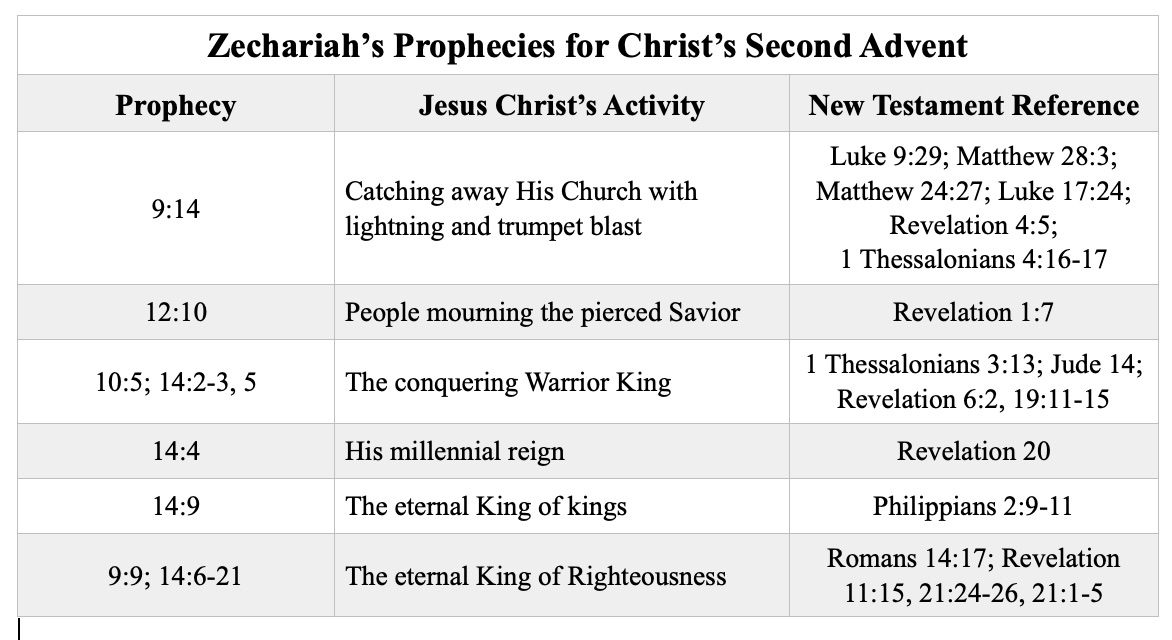
Zechariah pronounces more messianic prophecies than any other biblical writer, with the exception of Isaiah (and he wrote 66 chapters!). These prophecies are fulfilled in Christ’s First Advent, and promised for His Second Advent. Check these out for yourself…

(All of the biblical references for the above chart can be viewed by clicking here.) 

(All of the biblical references for the above chart can be viewed by clicking here.)

Why is it so vital that Jesus fulfilled these prophecies? 

(1) The historicity of these fulfilled prophecies gives us a confidence for the future. 

These fulfilled prophecies assure us that God is sovereign over all history. There are no accidents, and God needs no help from anyone else in fulfilling what He has promised. As a result, no world event—no matter how big it may seem—should be able to rattle us! 

(2) The authenticity of what God has done gives us boldness for today. 

When God does the miraculous, He authenticates His Word. This authenticity has always made God’s people stand out (see Genesis 41:39). It’s also why people recognized Jesus as the divine Son of God (John 3:2; 9:30-33). So we can live with the boldness to know that what God says He will do, He will do! 

(3) The exclusivity of God’s promises and fulfillment of those promises gives us joy for our testimony. 

Only Jesus could have done all of this (Luke 24:26-27, 44), so only Jesus can fulfill what is still remaining to be fulfilled! We can have supreme joy in knowing that only Jesus is our hope of salvation (John 14:6; Acts 4:12). 

It’s vital that we know this is true so that we can live confident, bold, and joyful! Our confident boldness and our bold joy both glorify God and attract seekers to Him. 

If you’ve missed any of the other messages in our series looking at the major lessons from the minor prophets, you can access all of those messages by clicking here. 

You may download a PDF version of the above charts by clicking here → Zechariah prophecies for the First Advent or here → Zechariah prophecies for the Second Advent

►► Would you please prayerfully consider supporting this ministry? ◀︎◀︎
You’re No Match For Sexual Sin

Listen to the podcast of this post by clicking on the player below, and you can also subscribe on AppleSpotify, or Audible. 

At the window of my house I looked out through the lattice. I saw among the simple, I noticed among the young men, a youth who lacked judgment. He was going down the street near her corner, walking along in the direction of her house at twilight, as the day was fading, as the dark of night set in. Then out came a woman to meet him, dressed like a prostitute and with crafty intent. … 

With persuasive words she led him astray; she seduced him with her smooth talk. All at once he followed her like an ox going to the slaughter…. Many are the victims she has brought down; her slain are a mighty throng. Her house is a highway to the grave, leading down to the chambers of death. (Proverbs 7) 

Solomon tells us that we know the place—her corner, her street, her house. 

Solomon tells us that we know her goal—she came out to meet him with crafty intent. 

Solomon tells us that we know her strategy—speaking lies with a brazen face, speaking words that are seductive, persuasive, smooth, and with an outfit to match the vocabulary. 

Solomon tells us we know the outcome—her victim is brought down into the chambers of death. 

The Bible never counsels us to fight sexual sin, but it says we should flee sexual sin. Stronger people than me have been sucked into the quicksand of sexual temptation. 

It sounds innocent enough (“it’s just a little flirting”). It sounds harmless enough (“there’s no harm in looking”). It sounds tame enough (“who will ever know?”). But her slain are a mighty throng! 

Solomon also tells us the way to avoid sexual sin—keep God’s words close by, store up His commands in your heart, keep wise and God-fearing friends around you, and stay away from her corner, her street, her house. 

This is not a trivial thing. I’m no match for the silky seduction of sexual temptation! Flee! Run away! Don’t even get close to it! Jesus said that drastic steps may be needed—get rid of your computer, stop watching TV alone, get a new job. 

Don’t fight it—flee it! Your best strategy is to stay as far, far away as possible. Let me say it again: You are no match for the crushing power of sexual temptation, so FLEE! 

►► Would you please prayerfully consider supporting this ministry? ◀︎◀︎
Really Bad News And Really, Really Good News

Listen to the podcast of this post by clicking on the player below, and you can also subscribe on AppleSpotify, or Audible. 

My cousin Dick Brogden wrote in his book Missionary God, Missionary Bible, “Since good news must often indeed rectify bad news, the gospel message is both warning and invitation.” This is so appropriate when reading the prophet Zephaniah: He wanted to share some really, really good news, but first, he must make us confront the really bad news. 

Zephaniah prophesied near the end of Judah’s decline toward exile. He saw the great revival in King Josiah’s day, and then watched his fellow Israelites once again turn their backs on God. If Jeremiah spoke to faithless Israelites, and Habakkuk spoke to faithful Israelites, then Zephaniah spoke to fake Israelites—those who appeared to be religious, but whose hearts were not actually devoted to God. 

This whole book looks backward in history and forward to soon-to-be-fulfilled prophecy. Most of the time when God speaks, He is asking us to look forward to what is unavoidably coming. Zephaniah then takes God’s words as a call for us to apply them to our lives today. 

In the first chapter, God’s forward-look is a warning of the judgment that most assuredly is coming. Built into His warning are two backward looks to the law of Deuteronomy (vv. 13 and 15 look back to Deuteronomy 28:29-30). 

Zephaniah uses this warning as a wake-up call for us, telling us to “seek the Lord” and “seek righteousness, seek humility” before the day of God’s judgment comes (2:1-3). 

The fact that God’s judgment would fall on godless people shouldn’t surprise anyone (2:4-15), but when Zephaniah says, “Woe to the city of oppressors” (3:1), he’s talking to the people of Judah! Zephaniah addresses his warning to the fake Israelites, the hypocritical people—those claiming God’s name but not God’s nature. 

The apostle Paul sounds a similar warning to New Testament Christians: 

Now these things occurred as examples to keep us from setting our hearts on evil things as they did. Do not be idolaters, as some of them were; as it is written: ‘The people sat down to eat and drink and got up to indulge in revelry.’ We should not commit sexual immorality, as some of them did—and in one day twenty-three thousand of them died. We should not test Christ, as some of them did—and were killed by snakes. And do not grumble, as some of them did—and were killed by the destroying angel. These things happened to them as examples and were written down as warnings for us, on whom the culmination of the ages has come. So, if you think you are standing firm, be careful that you don’t fall! (1 Corinthians 10:6-14) 

The really bad news is ALL of us have sinned and we have ALL fallen short of God’s righteous standard. As a result, ALL of us would stand guilty before God on Judgment Day. 

But the really, really good news is that Jesus allowed our penalty to fall on Him instead! So if we put our faith in Jesus, God’s judgment will be appeased in Christ instead of on us! 

Christians, then, take the name of Jesus Christ, but we need to make sure we also take His nature.  Fake—hypocritical—Christians are those who are “Christian” in name only. 

I like the way Eugene Peterson paraphrased part of the 1 Corinthians passage above—These are all warning markers—danger!—in our history books, written down so that we don’t repeat their mistakes. Our positions in the story are parallel—they at the beginning, we at the end—and we are just as capable of messing it up as they were. Don’t be so naive and self-confident. You’re not exempt. You could fall flat on your face as easily as anyone else. Forget about self-confidence; it’s useless. Cultivate God-confidence. (The Message) 

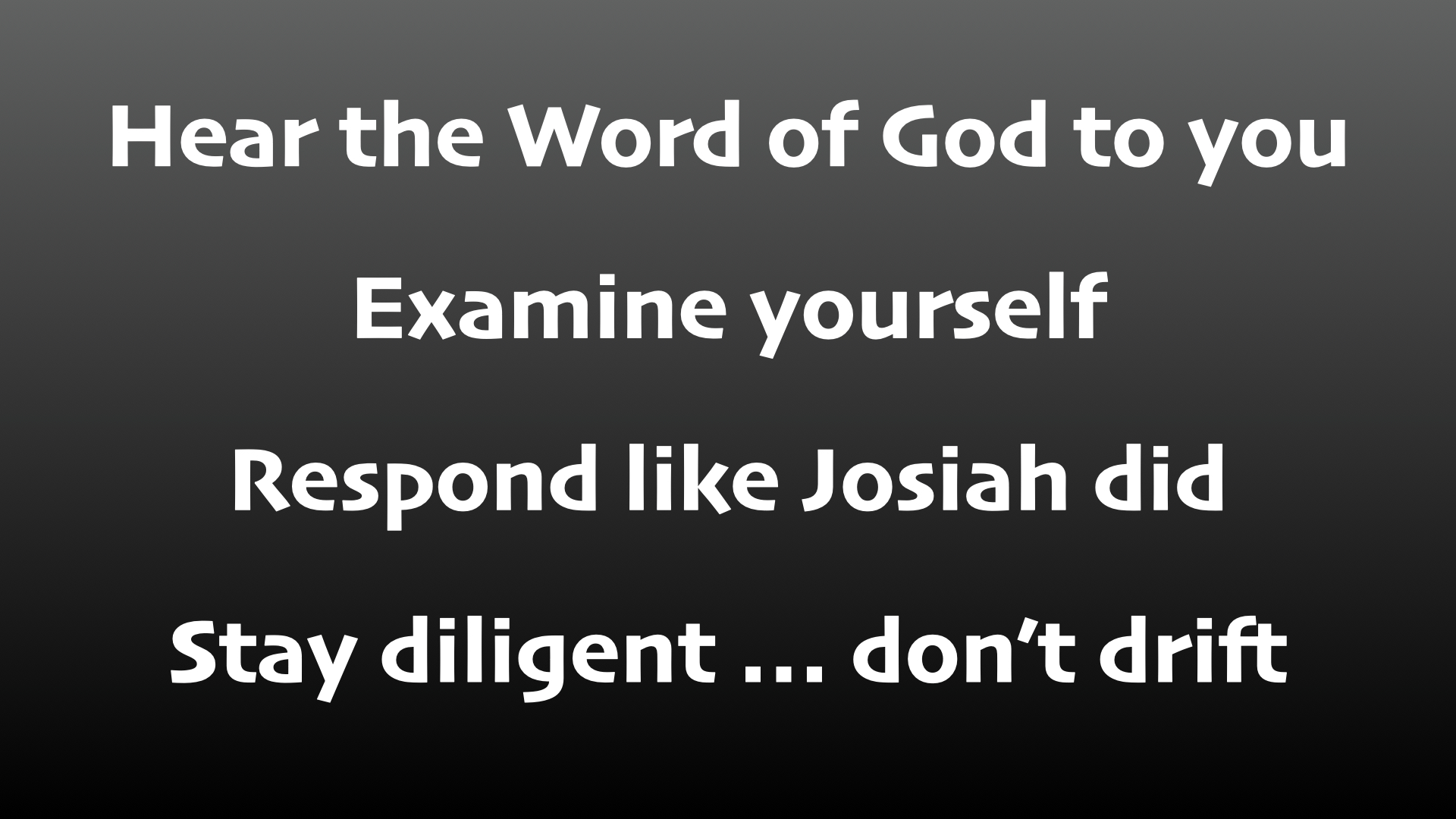
As we read those words, “So if you think you are standing firm, be careful that you don’t fall,” I’d like to suggest four action steps:

  1. Hear the Word of God to YOU—not your neighbor—but you personally. 
  2. After you hear the Word, examine yourself to see if you are truly living in God’s nature and not just using His name. 
  3. Respond like King Josiah did when he heard God’s Word: He made a public commitment “to follow the Lord and keep His commands, statutes and decrees with ALL his heart and ALL his soul” (2 Kings 23:3). 
  4. Stay diligent—Hebrews 2:1 tells us, “We must pay the most careful attention, therefore, to what we have heard, so that we do not drift away.” 

Don’t delay—the Day of the Lord is closer today than it’s ever been before! Pay attention to the really bad news that Judgment Day is coming, but then make certain you are standing in the nature of Jesus Christ on that day so that God’s judgment will pass over you. 

If you’ve missed any of the messages in our series looking at the major lessons in the minor prophets, you can find the full list of messages by clicking here. 

►► Would you please prayerfully consider supporting this ministry? ◀︎◀︎
Thursdays With Spurgeon—Secure Forever

This is a weekly series with things I’m reading and pondering from Charles Spurgeon. You can read the original seed thought here, or type “Thursdays With Spurgeon” in the search box to read more entries.

Listen to the podcast of this post by clicking on the player below, and you can also subscribe on iTunes or Spotify.

Secure Forever  

     Our first parent, Adam, lived in the midst of happiness and peace in the garden. Unlike ourselves he had no depravity, no bias toward evil. God made him upright. He was perfectly pure, and it was in his own will whether he should sin or not. The balance hung evenly in his hands. 

     But have you forgotten how on that sad day he took of the forbidden fruit and ate and thereby cursed himself and all of us! … When you recollect the paradise he left, the happiness and peace that have forever passed away through his sin, do you not hear the voice that says to you, as a depraved and fallen creature, ‘Therefore let him who thinks he stands take heed lest he fall’ (1 Corinthians 10:12)? Conscious of your own weakness as compared with your parent Adam, you are ready to cry out, ‘O my God, how can I stand where Adam falls?’ 

     But here comes the joyous thought that Christ, who has begun with you, will never cease till He has perfected you! Can you help singing with Jude, ‘Now to Him who is able to keep us from stumbling’?”

From Christians Kept In Time And Glorified In Eternity

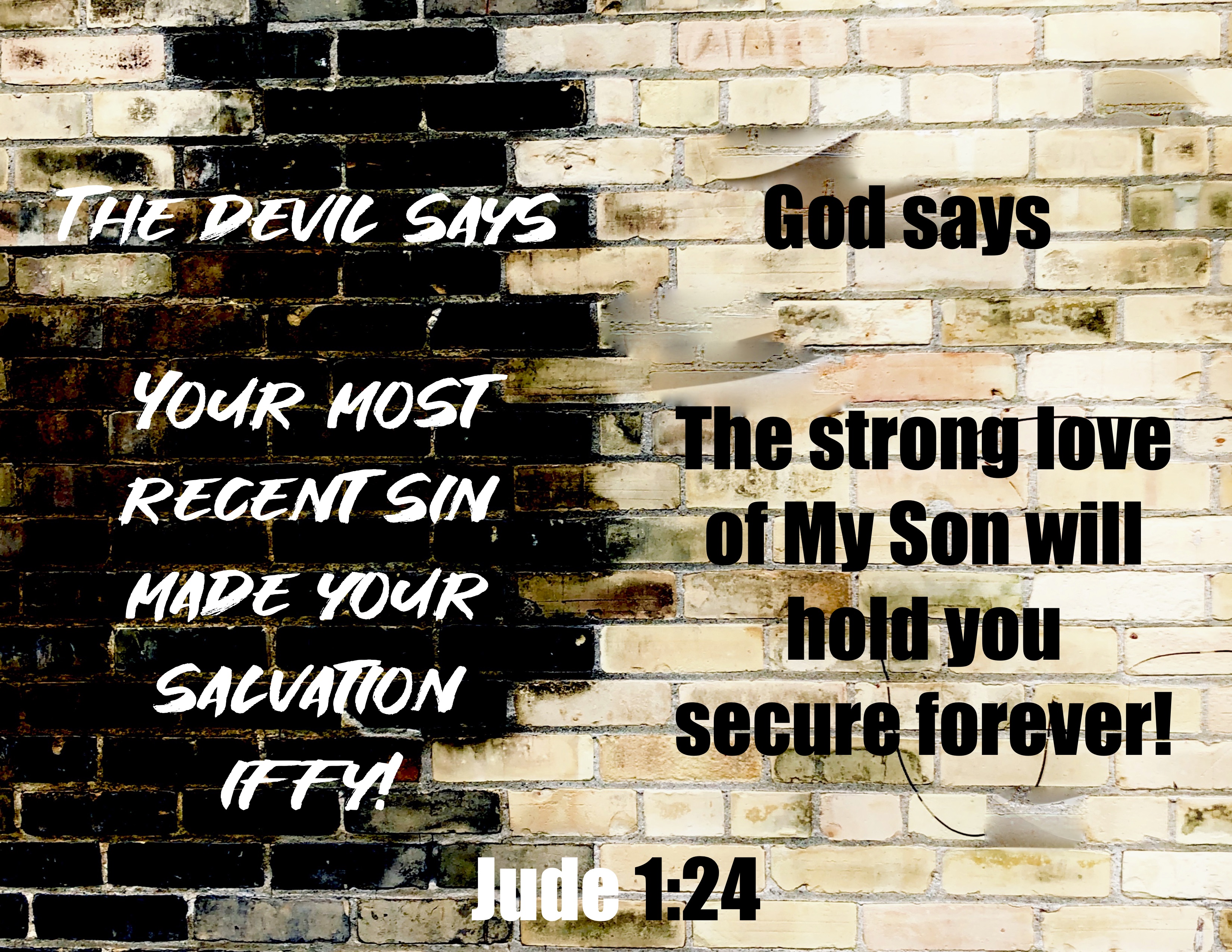
When the devil says, “Your most recent sin made your salvation iffy,” you remind him what God says: “The strong love of My Son will hold you secure forever!” 

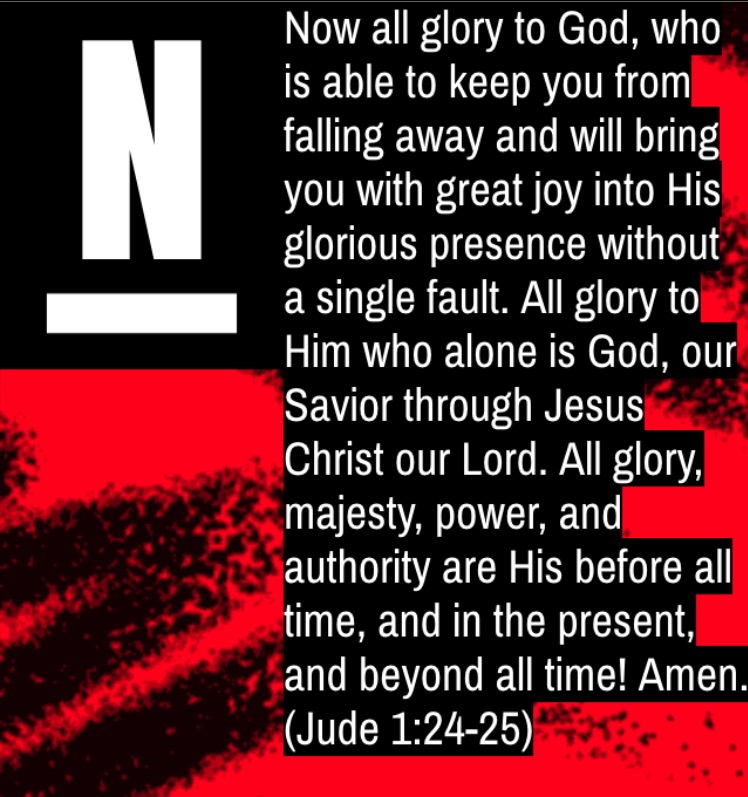
To Him who is able to keep you from stumbling and to present you before His glorious presence without fault and with great joy—to the only God our Savior be glory, majesty, power and authority, through Jesus Christ our Lord, before all ages, now and forevermore! Amen. (Jude 1:24-25)

►► Would you please prayerfully consider supporting this ministry? ◀︎◀︎

4 Ministries Of Healthy Churches

Listen to the podcast of this post by clicking on the player below, and you can also subscribe on AppleSpotify, or Audible.

In the Foreword to my book Shepherd Leadership: The Metrics That Really Matter, Dick Brogden observes, “God plucked David from the sheepfold. God chose a sheep to be a shepherd. And though we all are stupid sheep, when God plucks us out of obscurity to serve others, we can have the humble confidence for as long as we are asked to lead that God has chosen us. That confidence both faithfully drives us to our knees and fearlessly propels us against our giants. It is good to be a sheep; it is good to be an under-shepherd. Just remember you are stupid, chosen by the Wise One, and as long as you serve as a shepherd, you and your flock will be safe.” 

How true it is that all of us are sheep. The role of the shepherd is to care for the sheep and create a healthy environment for them. The role of healthy sheep is to reproduce more sheep. In this, both shepherds and sheep are ministers—we all minister to those God has placed around us. 

God calls all Christians to be ministers. The Church is the sheepfold that equips us, but then we must go out to minister in a way that will bring lost sheep to a personal relationship with Jesus. 

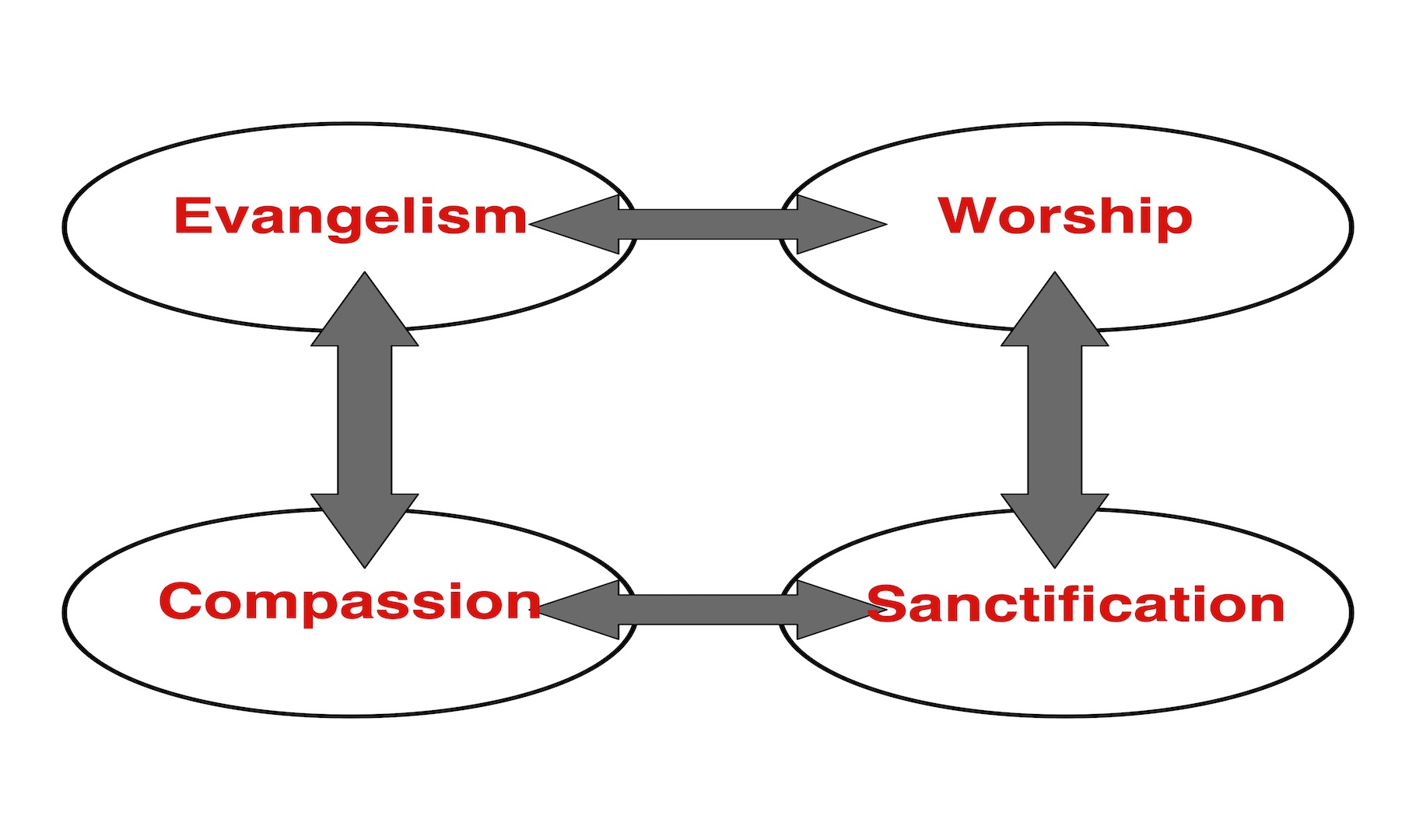
Our foundational truth statement about church ministry says: A divinely called and scripturally ordained ministry has been provided by our Lord for the fourfold purpose of leading the Church in evangelism, worship, sanctification, and compassion. 

(1) Evangelism. When we looked at the foundational belief about the Church, we noted that it’s not either-or—evangelism or discipleship—but it’s both-and. Christians are being the Church when they are intentionally living in a way that makes Jesus known (Matthew 10:1, 7-8; 28:18-20). 

(2) Worship. We shouldn’t have the mindset of, “Let’s go to church to meet with God.” Instead, we need to live in a way where we are always abiding in God’s omnipresence. This worship-centric lifestyle empowers our evangelism, changes our hearts, and fuels our compassion (John 4:23-24; Romans 12:1; Acts 2:46-47). 

(3) Sanctification. Remember that we are all in-process of becoming saints (I like to remember this by calling it saint-ification). We need each other to do this, which is why God gives gifts to bring out Christ-like maturity in us (Ephesians 4:1-7, 11-16). 

(4) Compassion. Compassion is feeling turned into action. This opens the door for evangelism, creates more opportunities for worship, and matures Christians (Mark 6:34-37; Luke 10:33; Acts 2:45).  

Notice that each of these ministries are interdependent with all the other ministries. 

In a blog post nearly 10 years ago, I questioned: “How do we know if our church is successful?  The apostle Paul uses two words to help answer these questions: Quality and Faithfulness (1 Corinthians 3:13, 4:2). 

So here are two important questions we need to ask ourselves: (1) Am I doing quality work? (2) Am I faithfully doing my work? 

To help answer those questions, I like this thought from Leonard Sweet’s book I Am A Follower: “The most important metrics we must rely on, the crucial ‘deliverables’ we can present, must focus on the newly formed lives of the disciples we are making, the followers who are following Christ into a place of serving Him by serving others. The most important measure of our faithfulness to Christ must be the extent of transformation into the living image of Christ Himself. … The quantifiable fruit of our church is not found in the number of people we can gather on a weekly basis. What counts is what is happening in the lives of those who have gathered. 

These are questions we should all ask the Holy Spirit to reveal to us: 

  • What is happening in my life? 
  • Am I telling others about Jesus? 
  • Am I worshipping God so consistently that everyone can see it? 
  • Am I maturating as a saint and am I helping other saints mature? 
  • Is my faith seen in my compassionate actions? 

Our individual answers to those questions will determine the success of our individual churches, which will ultimately determine the effectiveness of the global Church of Jesus Christ. I hope you will take some time to consider these questions for yourself. 

If you’ve missed any of the other messages in our series exploring our foundational beliefs, you can access the full list by clicking here.

►► Would you please prayerfully consider supporting this ministry? ◀︎◀︎

Abiding In God’s Omnipresence

Listen to the podcast of this post by clicking on the player below, and you can also subscribe on AppleSpotify, or Audible. 

Why do Christians say things like, “Let’s go to church” or “Let’s go meet with God”? 

Do we forget that Jesus said He would never leave us, or that He sent the Holy Spirit to be our constant Companion, or that our very heart is the temple of God’s presence (Matthew 28:20; John 14:16; 1 Corinthians 3:16)? We are naturally self-focused creatures. It takes discipline on our part to keep reminding and re-reminding ourselves that God is always with us. 

Psalm 84 and its two Selahs is one way of re-reminding ourselves of God’s abiding presence. The Selahs are reminders to pause and consider, “Where am I?” and to know that the answer can always be, “Surely I am in God’s presence!” 

This psalm is divided into three 4-verse stanzas. Stanzas 1 and 2 end with the call to Selah, and all three stanzas feature a powerful name for God: LORD Almighty. When we see LORD in all capital letters, that is God’s covenant name: Yahweh or Jehovah, which means that He is the “I AM that I AM.” Almighty signifies that He is the invincible, un-defeatable Captain of angel armies. 

In these two combined titles, we have the personal intimate God of love and the unstoppable God of limitless power! If He were just the God of love, we may not be able to trust His power. If He were just the God of power, we may not be able to approach Him. He is the All-Loving, Ever-Approachable Power. 

Another important recurring theme in Psalm 84 is the word blessed. It’s used three times in this psalm, more than in any other single psalm. This word means God’s unmerited favor, and the word either begins or ends each of the three stanzas.  

In stanza 1 (vv. 1-4), twice we have that combined title of LORD Almighty. But we must always remember that our God is not distant and unapproachable, but the sons of Korah call Him “my King” and “my God.” At the end of this first stanza, we are invited to Selah—a pause to praise our glorious King! 

Stanza 2 (vv. 5-8) begins with that reminder that we are blessed. The psalmists tell us that God’s blessings flow even in my Valley of Baca (or weeping). With God’s presence surrounding me, I can go fromstrength to strength” because the LORD Almighty hears my prayer and responds to my prayer! So at the end of this stanza, we are again invited to Selah—this time it’s a pause to pray to our listening God. 

In stanza 3 (vv. 9-12), another important word is featured that reminds us that our God is not a stingy King, but One who delights in His children and wants to lavishes them with His blessings: the word is favor. We read, “look with favor on Your anointed one” and “the LORD bestows favor and honor; no good thing does He withhold from those whose walk is blameless.” God’s favorable blessings flow toward us as eternally as He exists! 

This psalm is circular: it begins as it ends, so it invites us to continue to praise, continue to pray, and continue to abide in His presence. We’re called not just to know about God’s presence, but to rejoice in His presence. 

It’s one thing to know about God’s omnipresence, but it’s an entirely different thing to abide in God’s omnipresence! 

This isn’t something that happens overnight. Brother Lawrence reminds us that this is a progressive revelation for Christians: “One does not become holy all at once. … The more one knows Him, the more one desires to know Him. And as knowledge is commonly the measure of love, the deeper and more extensive our knowledge shall be, the greater will be our love: and if our love of God were great we should love Him equally in pains and pleasures.” 

I encourage you to Selah frequently so that you can move from mere head knowledge of God’s presence to becoming intimately aware of His closeness! 

If you’ve missed any of the messages in our series looking at the Selahs in the Psalms, you may find the full list by clicking here. 

►► Would you please prayerfully consider supporting this ministry? ◀︎◀︎