Quality Over Quantity

Listen to the podcast of this post by clicking on the player below, and you can also subscribe on AppleSpotify, or Audible. 

I had a great time on the Ailbe Podcast with Rusty Rabon. 

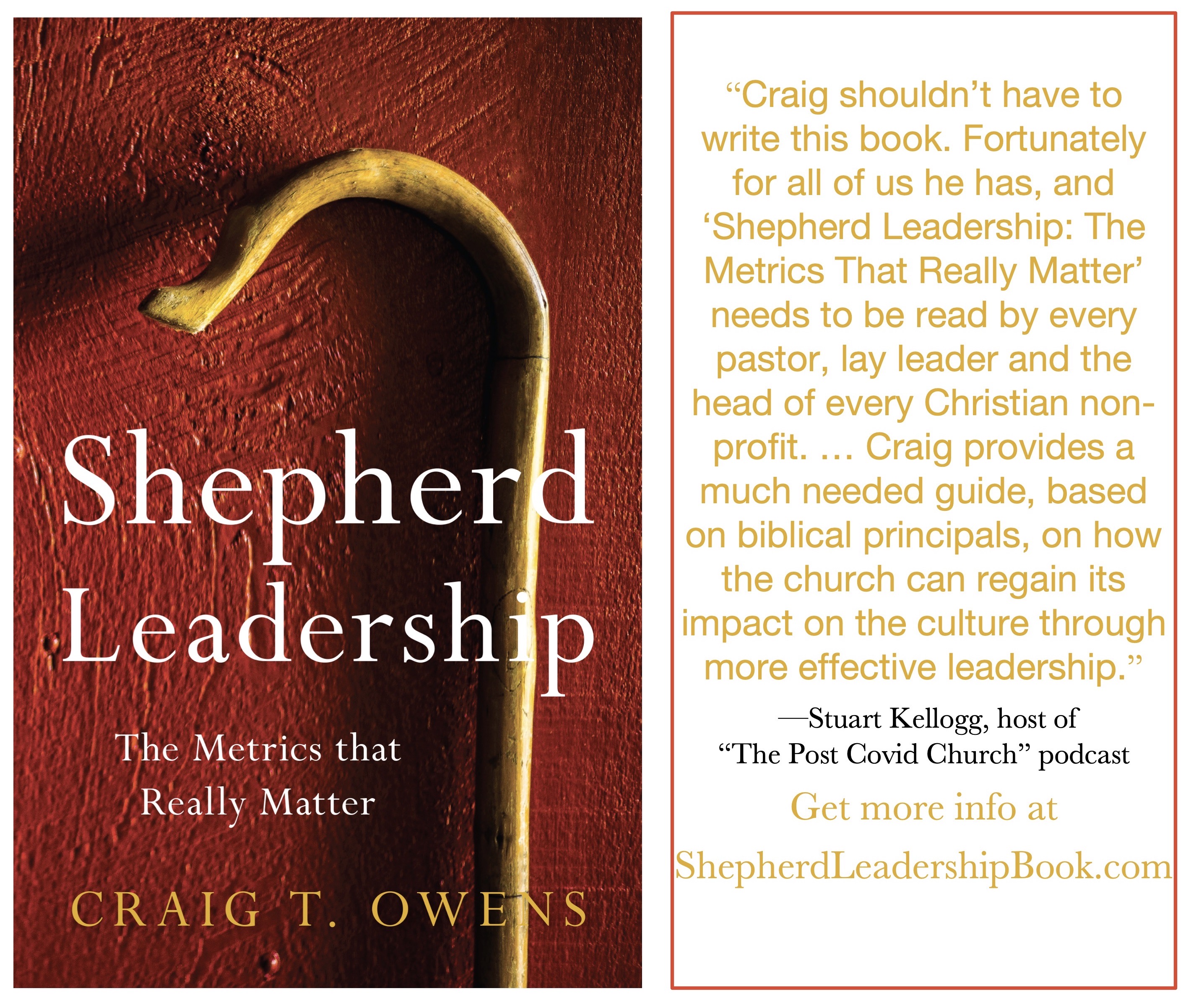
Rusty referred to the opening chapter of my book Shepherd Leadership: The Metrics That Really Matter where I talk about how many of our churches and church leaders are attempting to climb the wrong ladder of success. Rusty noted how many people become frustrated because they are not seeing the success the way that so many people define it.

Before addressing frustrated pastors, I first spoke to the board members that are supporting that pastor. 

In Shepherd Leadership I wrote,

“Businesses think in terms of quantitative gains—things they can count—but churches and nonprofits should be thinking in terms of qualitative gains—a quality improvement that isn’t as easily counted. I think we all know this, and yet we still persist in wanting to define success in a church or a nonprofit by those quantitative standards such as attendance growth, donations, and the like. When we think qualitative over quantitative, suddenly what seemed “small” is so significant and so valuable that it cannot be calculated!”

I’ll be sharing more clips from this interview soon, so please stay tuned. If you would like to check out the other clips I have already shared from this podcast, please check them out here. Shepherd Leadership: The Metrics That Really Matter is available in print or ebook, and in audiobook through either Audible or Apple. 

►► Would you please prayerfully consider supporting this ministry? My Patreon supporters get behind-the-scenes access to exclusive materials. ◀︎◀︎
Completing The Body

Listen to the podcast of this post by clicking on the player below, and you can also subscribe on AppleSpotify, or Audible. 

One of the miracles we talked about last week was the Holy Spirit giving gifts to people that evangelize the sinner and edify the saint. Let me be more specific: YOU are God’s gift to the world if you are using God’s gift to glorify God in the world. 

You are a one-of-a-kind creation. God is infinitely creative so He never has to duplicate any of His creative works. He saw your life and implanted in you what you need to glorify Him (Psalm 139:13-18). But we need to think about this uniqueness the right way. 

Lucifer, an archangel, became satan, the Christian’s archenemy, because of his oversized pride. Pride is what turned Lucifer into satan, and it’s a tactic he still uses today on God’s creations. His other tactic is slander: attempting to get us to think we are insignificant and have no real purpose in the world. 

Just like Jesus did, we overcome satan’s lies with the truth in God’s Word.  

In Romans 12, Paul talks about our lives being used as a living, breathing, God-honoring sacrifice. But Romans 12:1 begins with the word “therefore,” so we need to back up a few verses. The final four verses of chapter 11 are a beautiful doxology that is praising God for His wisdom and sovereignty. Paul then offers this conclusion: Therefore we need to think correctly about our place in the world, allowing the Holy Spirit to transform our thoughts. 

Paul uses the word “think” twice in this passage. The root word is the same in each place (phroneo in Greek), but the prefix is what sets them apart from each other. The first has the prefix hyper-. That means it’s overly-analyzed thinking, overly self-concerned thinking, or self-focused.

The second time the prefix is soph- (which means “wise”). This is sound thinking, big-picture thinking, or others-focused. The Holy Spirit wants to give us sophroneo thinking to reveal our God-implanted gifts and talents that are to be used to benefit others—in fact, to benefit the whole Body of Christ.

In Romans 12, Paul uses the phrase “one body” twice as he talks about our spiritual gifts. He uses the same “one body” praise three times in 1 Corinthians 12 as he again talks about spiritual gifts (1 Corinthians 12:12-13, 20). 

All of our spiritual gifts are to be used in love and to build up others (1 Corinthians 12:31—13:3; 14:1, 12, 26, 40). 

The Holy Spirit gives gifts to individuals so that individuals can edify the whole Body of Christ. It’s not competing with one another but completing one another. 

Remember: Saints is always plural in the New Testament! I need you to bring out the saintly qualities in my life, as much as you need me to bring out the saintly qualities in your life. 

This summer I will be offering an in-depth teaching on the spiritual gifts listed in the New Testament. We’ll take some assessments and discuss how these gifts can best be invested in the Body of Christ. I hope you can join me for an hour of learning on Wednesdays. 

If you’ve missed any of the messages in our series exploring our Pentecostal roots, you can find all of those messages by clicking here.

►► Would you please prayerfully consider supporting this ministry? My Patreon supporters get behind-the-scenes access to exclusive materials. ◀︎◀︎
Expecting Miracles

Listen to the podcast of this post by clicking on the player below, and you can also subscribe on AppleSpotify, or Audible. 

Last week we saw the in-ness of the Holy Spirit guiding us, teaching us, and empowering us to overcome evil. For what purpose? Why does the Holy Spirit lead us this way? Because the Spirit desires to draw everyone into this in-ness. His work in and through our lives is always unmistakable and irrefutable. 

A good word to describe the unmistakable and irrefutable work of the Spirit is: Miracles. 

Miraculous signs characterized the earthly ministry of Jesus, and they also should to the hallmark of Spirit-baptized Christians today who are sharing the Gospel with others (Acts 10:38; 2:43; Mark 16:20). 

Some may ask, “Why don’t we see as many miracles today?” And some skeptics even point to a decrease in miracles as proof of their cessationist paradigm. But consider this: Has God’s power been diminished? Have all needs been met? Are there no more sickness or unsolvable problems of human suffering? Is everyone free of the power of the devil? 

No, of course not! 

So that would mean if there is any diminishment in miracles, the diminishment would seem to be in us! Particularly I think it is that we no longer expect miracles to happen.

Not only should we expect miracles, but we should also expect to be the vessel through which the Holy Spirit demonstrates the miracle. 

Here are 8 miracles that we should be expecting:

  1. Minds opened that were blinded to the Gospel message—2 Corinthians 4:4-6 
  2. Thoughts transformed—Romans 12:2-3; Philippians 2:5 
  3. Invincible words spoken by us to others—Acts 6:10 
  4. Love tangibly expressed through our spiritual gifts—John 13:34-35; 1 Corinthians 12:1, 31—13:3 
  5. Gifts of the Spirit used constructively in the church to both evangelize the sinner and edify the saint—1 Corinthians 14
  6. Compassionate actions constantly initiated to address areas of human suffering—Philemon 4-7, 17
  7. Powerful prayers prayed and answered—Acts 3:6, 4:31, 13:2-3 
  8. Miracles consistently seen as authenticating the Gospel message—Acts 10:38, 19:11-12 

(Check out all of the above scripture verses by clicking here.) 

Don’t limit the Supernatural power of the Holy Spirit in you to only natural expressions. Constantly expect miracles! 

If you’ve missed any of the messages in our series We Are: Pentecostal, you can find them all by clicking here.

►► Would you please prayerfully consider supporting this ministry? My Patreon supporters get behind-the-scenes access to exclusive materials. ◀︎◀︎
The Proper Value Of Words

Listen to the podcast of this post by clicking on the player below, and you can also subscribe on AppleSpotify, or Audible. 

I once knew a businessman who was one of the most silver-tongued talkers I have ever met! He could persuade just about anyone to join him in one of his “can’t miss” business ventures. 

And even after they did miss (which was all of them that I was aware of) he could still convince many of his backers to continue. I never knew him to fulfill what he had promised. 

Eventually, this caught up with him. And so did the law, and he ended up serving a prison term. 

It has always been intriguing to me how much value we put on the words of leaders. It seems as if they can “talk a good game,” we feel a need to exalt them to a higher level. It’s not the one who gets things done, or the one who has the best ideas, or the one who can bring increased efficiency or effectiveness, but the one who can talk the most convincingly. 

I think about in my own profession as a pastor. Churches will select a pastor based on how he sounds from the platform. And yet the sermon is only a tiny fraction of a pastor’s work each week. 

The danger comes when the leader thinks that his highest value to the organization is the words he speaks. Inevitably, then, he will put more effort into what he says than into what he does. He will spend a lot of time figuring out the right words to say, and how to move people’s hearts. 

The apostle Paul told the Christians at Corinth, “My speech and my preaching were not with persuasive words of human wisdom” (1 Corinthians 2:4). And he told the Christians at Thessalonica, “For you remember what we taught you by the authority of the Lord Jesus” (1 Thessalonians 4:2), not Paul’s own authority. 

I don’t want people to be impressed with me. I don’t want my authority to come from my vocabulary. I simply want to be known for speaking the Word of God, and then living a life that matches the Word of God. 

As King Solomon said, “A truly wise person uses few words” (Proverbs 17:27). The wisest words are not mine but God’s. Then “your faith [is] not in the wisdom of men but in the power of God” (1 Corinthians 2:5). 

Words do have their place. But let’s always make sure that that place isn’t in place of God’s Word. 

►► Would you please prayerfully consider supporting this ministry? My Patreon supporters get behind-the-scenes access to exclusive materials. ◀︎◀︎

Don’t Putrefy Your Leadership

Listen to the podcast of this post by clicking on the player below, and you can also subscribe on AppleSpotify, or Audible. 

King Solomon nailed it pretty succinctly with this verse: Dead flies putrefy the perfumer’s ointment, and cause it to give off a foul odor; so does a little folly to one respected for wisdom and honor. (Ecclesiastes 10:1) 

As a Christian leader, I always have mixed emotions when I hear of another prominent Christian leader who has stumbled. Part of me is angry because I know that all Christian leaders will get painted with the same brush. Another part of me is incredibly sad to hear of a brother or sister who has squandered the trust that was placed in them. Finally, part of me becomes quite self-reflective, because I don’t want to repeat their mistakes. 

Tom Peters said, “There are no minor lapses of integrity.” King Solomon would agree. And so do I. 

Godly leadership can be such a beautiful thing, but just a couple of dead flies can putrefy the whole thing! 

Here are four things that I have seen in the lives of those leaders who haven’t finished well. These are the things all of us need to watch carefully in our own lives.

(1) They compromised in “the little things.” None of them started off by saying, “I’m going to completely ruin my reputation as a godly leader.” But they allowed themselves to indulge in things that were just “little things” in their minds. Perhaps they thought, “It won’t hurt if I indulge in this one little thing.” The apostle Paul warns us, “So, if you think you are standing firm, be careful that you don’t fall!” (1 Corinthians 10:12). 

(2) Pride crept in. They thought they were better than others. Peter said it this way: “All of you, clothe yourselves with humility toward one another, because, ‘God opposes the proud but shows favor to the humble’” (1 Peter 5:5). I addressed this topic in my book Shepherd Leadership: The Metrics That Really Matter like this—

     Did you catch that? God stands back from the proud person who will not admit his error nor ask for help, let alone ask for forgiveness. On the other hand, God lavishes His grace on the humble one who admits both his error and his need for help. Admission of an inappropriate action or reaction brings God’s help! 

     Friends, the mark of a maturing shepherd is not one who never misspeaks or never makes a mistake. No, the mark of a maturing shepherd is the one who is closing the gap between his mess up and his confession.

Pride will keep us from confessing the “little sins” and keep us from God’s help. But humility quickly admits the smallest of slip-ups and therefore receives God’s grace and help. 

(3) They lowered their standards. If anything, leaders should raise their standards as they become more successful. Think of it this way: when I was young and immature, I didn’t give much thought to my diet or my exercise routine. As I became older (and hopefully more mature), I became much more tuned-in to these things. Physically, the older I get, the more I need to pay attention to my health. The same thing is true in our leadership: maturity should lead to higher standards and higher levels of scrutiny. 

(4) They stopped listening to others. The combination of little compromises, pride, and lowered standards doesn’t easily invite accountability nor transparency. The track record is pretty consistent among those who have fallen short: they stopped listening to people who tried to correct them.

I want to finish well. I don’t want a leadership stumble in my life to rob God of glory, nor to cause others to stumble in their Christian walk. I am committed to living my life in a way that will allow Jesus to say to me at the end, “Well done, good and faithful servant.” 

I pray that all Christian leaders will join me in this.

►► Would you please prayerfully consider supporting this ministry? My Patreon supporters get behind-the-scenes access to exclusive materials. ◀︎◀︎
It’s What Shepherds Do

Listen to the podcast of this post by clicking on the player below, and you can also subscribe on AppleSpotify, or Audible. 

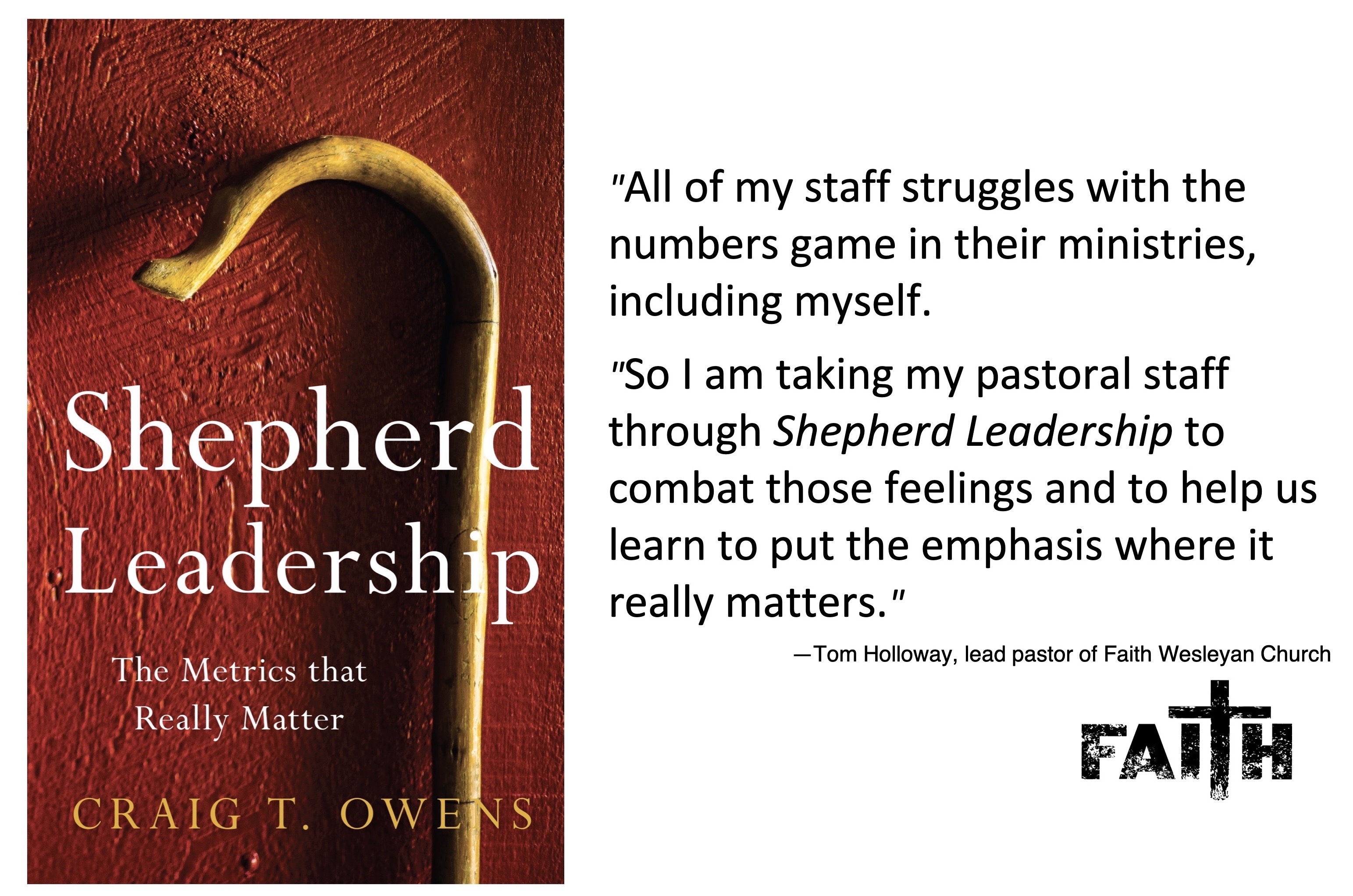
T.M. Moore shares my heartbeat for pastors to align their minds, hearts, and wills to leading as shepherds. T.M. graciously wrote one of the endorsements for my book Shepherd Leadership: The Metrics That Really Matter by saying, 

“The combination of Craig’s Biblical understanding, practical insights, and consistent personal practice make this a book every pastor should read. Unless our goals and practices in ministry line up with those Jesus taught and exemplified, we cannot expect Him to bless us with world-uprighting power.”

In a recent blog post, T.M. shared these poignant words—

     “Many pastors today seek to model themselves and their ministries along the lines of whichever pastor and whatever church seem to be the most ‘popular’ or ‘successful’ in attracting people. The result is, increasingly, worship services are starting to look alike, and pastors are starting to preach alike. And those who aren’t are wondering what they might do to become more like everybody else.

     “We ought not model ourselves on our contemporaries, be they ever so ‘successful.’ Such comparing and adjusting, Paul suggested, is not wise (2 Corinthians 10:12). Jesus is our great model for ministry, and we should look to Him to wash, shape, enliven, empower, and employ every aspect of our lives and ministries for His glory.

     “In his sermon, ‘Christ the Example of Ministers,’ Jonathan Edwards offered a concise summary of the reason people submit themselves for ordination to ministry: ‘The work and business of ministers is as it were that of servants, to wash and cleanse the souls of men: for this is done by the preaching of the Word, which is their main business, Ephesians 5:26. “That He might sanctify and cleanse it with the washing of water by the Word.” … It is the duty of ministers of the gospel, in the work of their ministry, to follow the example of their great Lord and Master.’ 

     “Elsewhere Paul talked about spending and being spent for the souls of God’s people (2 Corinthians 12:15). The challenge that faces us who have accepted the call to ministry is to follow the example of Paul (1 Corinthians 11:1) and strive to see Jesus, become like Jesus, work and serve like Jesus, lay down our lives like Jesus, and trust in Jesus to make our labors fruitful for His glory.” 

I wholeheartedly agree! 

Pastors, let’s get back to the shepherding model the Scriptures show us. This is truly the heartbeat of my book. You can get more information on Shepherd Leadership by clicking here. 

If you feel my book would benefit you (or your pastor) I would be happy to send you the ebook version free of charge. Just email me to let me know. 

►► Would you please prayerfully consider supporting this ministry? My Patreon supporters get behind-the-scenes access to exclusive materials. ◀︎◀︎

The Gift Unmistakably Seen

Listen to the podcast of this post by clicking on the player below, and you can also subscribe on AppleSpotify, or Audible. 

We saw last week that John 3:16 tells us of God’s greatest Gift—Jesus! 

This Gift was not an after-thought. God didn’t say, “I’ve tried everything else and nothing has worked so I guess I have to send My Son.” NO! The Gift was foretold right from the very moment Adam and Eve sinned (Genesis 3:15, 21). In fact, we can even say it was planned before the beginning of Time, as John describes Jesus as “the Lamb who was slaughtered before the world was made” (Revelation 13:8). 

John also writes for us one of the most beautiful and succinct statements of God: God IS Love (1 John 4:8). 

Paul wrote an inspired definition of love. Check out what happens when we put “God” in place of “love” in 1 Corinthians 13:4-8

God is patient, God is kind. God does not envy, God does not boast, God is not proud. God does not dishonor others, God is not self-seeking, God is not easily angered, God keeps no record of wrongs. God does not delight in evil but rejoices with the truth. God always protects, God always trusts, God always hopes, God always perseveres. God’s love never fails. 

This description of God means that He wasn’t forced to send Jesus as the ransom for our sins, but rather that His love foreknew the perfect moment to send this Gift for us. 

Neither did Jesus feel trapped by this plan His Father made. Calvary didn’t happen to Jesus, but Jesus came to make Calvary happen (John 17:24; Hebrews 12:2; John 10:17-18). 

Jesus made His Gift unmistakable:

  • He predicted the unmistakable events leading up to Calvary—Matthew 20:17-19, 26:2; Mark 10:32-34; Luke 18:31-33; John 13:19 
  • He predicted the unmistakable way He would die—John 3:14, 12:32-33 
  • And His Father unmistakably confirmed all of this—John 12:27-28

(check out all of the above verses by clicking here) 

Just before His crucifixion, Jesus gave His followers an unmistakable example of love to follow. He said that His love radiating out of His followers would show the world an unmistakable picture of His love (see John 13:3-5, 12-17, 34-35). 

I may say, “Thank you so much” when I open someone’s gift, but my true gratitude is seen in what I do with their gift after that. Do I put it on a shelf and forget about it? Or do I cherish it, use it, and tell others all about the one who gave the gift to me? This is just as true with how I treat the Love Gift that I was given in Jesus. 

Q: How unmistakable is my gratitude for the Gift of Jesus? 

A: It is unmistakably seen in how I love others. 

Here’s the test: Can I put my name in 1 Corinthians 13:4-8—

Craig is patient, Craig is kind. Craig does not envy, Craig does not boast, Craig is not proud. Craig does not dishonor others, Craig is not self-seeking, Craig is not easily angered, Craig keeps no record of wrongs. Craig does not delight in evil but rejoices with the truth. Craig always protects, Craig always trusts, Craig always hopes, Craig always perseveres. Craig’s love never fails.

The Holy Spirit wants all Christians to be able to truthfully insert their names in that statement. He wants to help us make necessary changes that will allow the amazing Gift of Jesus to be unmistakably seen by everyone. 

God’s plan is unmistakable. The death of Jesus is unmistakable proof of God’s love. Now, let’s make sure that our love is also empowered by the love of God shining unmistakably out of everything we say and do. 

If you’ve missed any of the messages in our series Christmas Unwrapped At Easter, you can find the complete list by clicking here. 

►► Would you please prayerfully consider supporting this ministry? My Patreon supporters get behind-the-scenes access to exclusive materials. ◀︎◀︎

Thursdays With Spurgeon—Don’t Let Your ‘Well Begun’ Be Only ‘Half Done’

This is a weekly series with things I’m reading and pondering from Charles Spurgeon. You can read the original seed thought here, or type “Thursdays With Spurgeon” in the search box to read more entries.

Listen to the podcast of this post by clicking on the player below, and you can also subscribe on AppleSpotify, or Audible. 

Don’t Let Your ‘Well Begun’ Be Only ‘Half Done’

But our citizenship is in heaven. And we eagerly await a Savior from there, the Lord Jesus Christ, Who, by the power that enables Him to bring everything under His control, will transform our lowly bodies so that they will be like His glorious body. Therefore, my brothers and sisters, you whom I love and long for, my joy and crown, stand firm in the Lord in this way, dear friends! (Philippians 3:20—4:1). 

     The start is not everything, but it is a great deal. It has been said by the old proverb that ‘well begun is half done,’ and it is certainly so in the things of God. … See to it that you lay a good foundation. It is better to have no repentance than a repentance that needs to be repented of! It is better to have no faith than a false faith! It is better to make no profession of religion than to make an untruthful one! … We should learn early on the difference between grace and merit, between the purpose of God and the will of man, between trust in God and confidence in the flesh. If we do not start aright, the further we go, the further we will be from our desired end and the more thoroughly in the wrong we will find ourselves.

From The Watchword For Today: “Stand Fast”

Some people love wearing the label “Christian” but they never surrender to the lordship of Jesus. This is scary because Jesus says that these are the people to whom He will have to say, “I never knew you” (Matthew 7:21-23). 

In the biblical passage Spurgeon used as his text, we read some important words. First of all, we need to live as citizens of Heaven, not as citizens of Earth. That means we need to always follow God’s laws, not the passing fads of culture. 

Second, the apostle Paul calls Jesus both Savior and Lord. We don’t get to choose one and ignore the other. We cannot say, “Thank You, Jesus, for saving me, but I’ll take it from here.” 

Finally, we need to not only stand firm, but as Paul also says in another letter, “So, if you think you are standing firm, be careful that you don’t fall!” (1 Corinthians 10:12). No assumptions. No coasting. No merely going through the motions of Christianity, but keeping a humble heart that responds to the correcting word from the Holy Spirit. 

Let’s make sure that our walk with Jesus is never described as only “half done.” But instead, let’s begin well, walk well, and rejoice to hear our Savior say, “Well done, good and faithful servant!

►► Would you please prayerfully consider supporting this ministry? My Patreon supporters get behind-the-scenes access to exclusive materials. ◀︎◀︎

Overwhelmed?

Listen to the podcast of this post by clicking on the player below, and you can also subscribe on AppleSpotify, or Audible. 

Have you noticed some people just say, “Morning,” but not “Good morning”? Almost as if they are waiting to see if it’s actually going to be good. I think many people wake up overwhelmed before their feet hit the floor. If the cliche says, “When it rains it pours,” to them it seems like it’s always pouring! 

In our series, we’ve been asking if certain statements are in the Bible. Statement #7 is God won’t give you more than you can handle. Is that in the Bible? Well, kinda. 

Many people would say, “Yes, it’s in the Bible” based on 1 Corinthians 10:13 which says, “No temptation has overtaken you except what is common to mankind. And God is faithful; He will not let you be tempted beyond what you can bear. But when you are tempted, He will also provide a way out so that you can endure it.” 

Remember that context is king, so we need to look at the whole setting. For this verse, I would suggest going back to the beginning of the chapter (1 Corinthians 10:1-14). Paul is telling us that Israel’s bad examples are a warning for us. What’s the warning? It boils down to not becoming overconfident in our own abilities—“So, if you think you are standing firm, be careful that you don’t fall!” (v. 12). 

Overconfidence exposes us to temptation. James does a really good job of defining temptation as our own evil desires that have met an opportunity to give in (James 1:13-14). When the pressure is on, perhaps I’m tempted to…

  • …cut corners 
  • …water down the truth 
  • …tell a little white lie 
  • …justify helping myself to something that isn’t mine 
  • …excuse my unforgiveness

I like some of the insights we get from the Amplified Bible on 1 Corinthians 10:13. 

One phrase reminds us that “no temptation or trial has come to you that is beyond human resistance and that is not adjusted and adapted” to us. God is helping us grow through those tempting times. 

Another phrase from this verse says that God “can be trusted not to let you be tempted and tried and assayed beyond your ability and strength of resistance and power to endure.” God knows the perfect time and temperature of our trials to remove the impurities from our lives. 

Paul’s conclusion—his “therefore”—is found in the next verse: “Therefore, my dear friends, flee from idolatry” (1 Corinthians 10:14). “Flee” means we are to take hold of ourselves to stay away from dangerous places, and “idols” are anything we put in place of God. 

Notice the verse says, God…will not let you be tempted beyond what you can bear.” Sometimes I set myself up to stumble when I’m…

  • …physically tired 
  • …hangry 
  • …spiritually drained 
  • …emotionally frazzled 

Even in these things God will give us wisdom if we ask Him (James 1:5), but we must apply the wisdom He gives us. 

So God tests me to purify and strengthen me. God will never overwhelm me or set me up for failure, but I may overwhelm myself and set myself up for failure if I’m not being careful about the idols I set up in my life. 

So If you are feeling overwhelmed, if you are feeling like there’s too much, if you feel like you’re giving in to temptations, ask yourself: 

  • Am I getting enough sleep? 
  • How’s my diet? 
  • Have I made Bible reading and prayer a priority this week? 
  • Are there any relationships that are draining me? 
  • Have I confessed my shortcomings? 
  • Have I asked God for wisdom? 
  • Have I obeyed what God has already shown me? 

God will never give me more than I can handle in His tests, but sometimes I give myself more than I can handle. It’s time to remove those idols and stumbling blocks from my life.  

If you’ve missed any of the messages in our series Is That In The Bible?, I’ve shared links to all of the messages here. 

►► Would you please prayerfully consider supporting this ministry? My Patreon supporters get behind-the-scenes access to exclusive materials. ◀︎◀︎

The Incomparable Jesus

Listen to the podcast of this post by clicking on the player below, and you can also subscribe on AppleSpotify, or Audible. 

C.S. Lewis, like many atheists, wondered if the God of the Bible might be an egomaniac because He is always encouraging people to praise Him. In his book Reflections on the Psalms, Lewis wrote a thoughtful response to this after he had become a Christian: 

“Just as men spontaneously praise whatever they value, so they spontaneously urge us to join them in praising it. ‘Isn’t she lovely? Wasn’t it glorious? Don’t you think that magnificent?’ … I think we delight to praise what we enjoy because the praise not merely expresses but completes the enjoyment; it is its appointed consummation. It is not out of compliment that lovers keep on telling one another how beautiful they are; the delight is incomplete till it is expressed. … This is so even when our expressions are inadequate, as of course they usually are. But how if one could really and fully praise even such things to perfection—utterly ‘get out’ in poetry or music or pain the upsurge of appreciation which almost bursts you? Then indeed the object would be fully appreciated and our delight would have attained perfect development. The worthier the object, the more intense this delight would be.” 

His phrase, “our expressions are inadequate” is especially true when we are attempting to appreciate and praise the Infinite, the Eternal, the Omnipresence, the Omnipotence of our God and Savior! But the biblical authors call for Christians to mature in this—we want to keep praising, keep expressing, until we finally find the perfect fulfillment in His presence. 

Paul talks about the maturing nature of love—when I was a child, I talked like a child, I thought like a child, I reasoned like a child (1 Corinthians 13:11)—but then he prays for us to grow in both our understanding and our expressions of our Savior’s love (Ephesians 1:17-19). 

I like the wording of Ephesians 1:19 in the King James Version: the exceeding greatness of His power to us-ward. The word “exceeding” means God pours out in a way that is beyond human imagining. The Greek word that Paul uses for “greatness” is only used here, and it reinforces the truth that God is beyond our full comprehension. And then Paul adds that this overflowing, incomparable power is directed “to us-ward”! 

Paul then prays for us to be able to understand ever-increasing new dimensions of this transcendent power and ability that God directs to us through His Son Jesus, and for us to be able to express it (Ephesians 3:14-19). In other words, we are to grow in our experience of Jesus so that we can grow in our praise to Jesus. 

The incomparable Jesus means at least four things for us. It means Jesus is…

  1. …beyond comparison. Isaiah, God Himself, and the psalmists ask rhetorically, “Who is like God? Who could ever compare to Him?” (Isaiah 40:13-14, 18, 25; Psalm 89:5-8).  
  1. …matchless in His power. Isaiah 40:12 says God holds the waters of the world in the hollow of His hand. How much water is this? Scientists estimate the Earth’s water supply to be 326 quintillion gallons of water (that’s 326 followed by 18 zeros)! Not only does God hold all of the water, but He directs its activities on behalf of His children (Exodus 15:11-13). 
  1. …unequaled in knowledge. Isaiah 40:12, 26 tell us that all of the stars in our universe fit onto God’s outstretched hand, and that He knows all of the stars by name. How many stars is this? Astronomers calculate the heavens to contain 10 septillion stars (that’s 10 followed by 24 zeros)! Not only does God know each star by name, He knows each human by name, and the smallest of details about each of them (Isaiah 49:16; Matthew 10:29-31). 
  1. …inimitable in His care. We humans can get to the end of our strength, but God never does. He cares for us unlike anyone else or anything else ever can (Isaiah 40:28-31). The Lord hears His people when they call to Him for help. He rescues them from all their troubles (Psalm 34:17). 

Knowing we have a Savior like this, why would you ever settle for anything less The Genuine?! 

Our incomparable Jesus wants us to pray in His incomparable name so that our incomparable Father can answer in a way that brings Him incomparable glory! We’re helped, He’s lifted up, and others are drawn to Him. 

►► Would you please prayerfully consider supporting this ministry? My Patreon supporters get behind-the-scenes access to exclusive materials. ◀︎◀︎

If you’ve missed any of the messages in this series on prayer, you can find a list of all of the messages by clicking here.