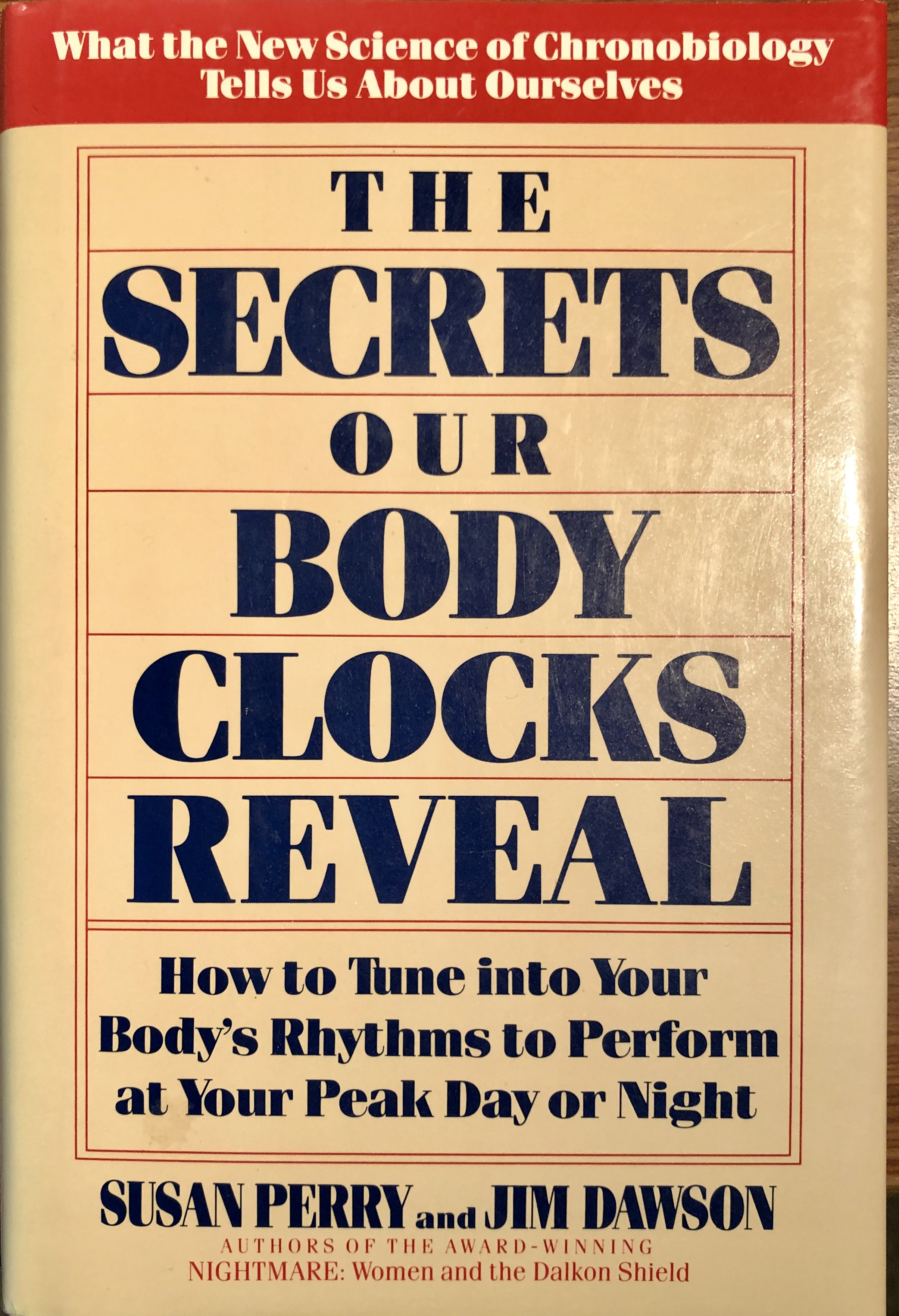
20 Facts & Tips About Your Body Clock

I really enjoyed reading The Secrets Our Body Clocks Reveal (you can read my full book review by clicking here). From this book, I’ve begun implementing a few of the tips I discovered. Here are a few of the facts and tips that I found interesting. 

  1. “Most of us reach our peak of alertness around noon. … We are least alert during the early morning hours—specifically, between 3:00 a.m. and 6:00 a.m.” 
  2. “Your immediate, or short-term, memory is best during the morning hours. … Your long-term memory is a different matter, however. Afternoon is the best time for learning material that you want to recall days, weeks, or even months later. … How well you remember things depends on when you learn them, not when you recall them.” 
  3. “On average, we tend to do best on cognitive tests—things that require the greatest mental effort—during the morning hours, particularly the late morning hours.” 
  4. “All of your senses—taste, sight, hearing, touch, and smell—are their keenest during the twilight hours of late afternoon and early evening.” 
  5. Tips for keeping your daily rhythms on beat: (1) get out in the sun for at least fifteen minutes each day, and (2) try to follow a regular daily routine.
  6. “Fortunately, there is another way to avoid the Monday morning blahs. Stay up as late as you like, but make sure you get up at your regular wake up time. In other words, don’t sleep in. And don’t take naps during the day. Then, when night rolls around again, you’ll find yourself able to fall asleep at or before your regular bedtime, and you’ll avoid pushing your cycle ahead.” 
  7. “Scientists have also discovered that short naps (twenty minutes or less) are just as revitalizing as long ones—and less disruptive to regular sleep rhythms. In addition, regular nappers wake up more refreshed than those who take only an occasional nap. When naps are part of the regular daily rhythm, they are less disruptive.” 
  8. “Generally, our moods peek around four hours after we awaken.” 
  9. “A regular exercise program can go along way toward easing the physical effects of stress. … The exercise program must be regular, however; sporadic physical activity, such as an occasional game of tennis or softball, or an activity that is not appropriate to your physical condition, can be a harmful stressor.” 
  10. “Melatonin’s daily rhythm is similar to that of legendary vampires: it appears at the onset of darkness and begins to disappear at the break of dawn. In other words, darkness triggers the chemical’s release; sunlight suppresses it. It should come as no surprise, therefore, that melatonin reaches its seasonal peak in the body during the dark winter months.” 
  11. “Beards tend to grow the most on Sunday and the least on Wednesday.” 
  12. “If you wake up in the morning with a temperature of 99° F, you are very likely coming down with a cold, the flu, or some other kind of illness. But if you have that same reading around dinner time, you may be in perfect health. The reason, of course, is that your temperature rises during the day. A high reading early in the day is a greater indication of illness than the same reading late in the day.” 
  13. “Take a commonplace drug like aspirin, for example. When swallowed at 7:00 a.m., aspirin stays in the body for up to twenty-two hours. When the same dose is taken at 7:00 p.m., it is completely out of the body within seventeen hours.” 
  14. “When you know your rhythms are out of sync, be aware that you are particularly vulnerable to illness. It is the time to be extra careful about keeping your distance from people with the flu or other viruses.” 
  15. “The best thing you can do for a tension headache is to learn how to relax. As soon as the headache begins, lie down, if possible, so you can take the strain off your neck, since this is the location of most of the muscles that tense up and cause a tension headache. Close your eyes and breathe deeply to return oxygen to your strained muscles. Better yet, ask a sympathetic friend or loved one to gently massage your neck and shoulders.”
  16. “Eat your biggest meal at breakfast, your next biggest at lunch, and your smallest at dinner.” 
  17. “About every ninety minutes, most people experience an urge to put something into their mouths. … Generally, it will pass in about fifteen minutes.” 
  18. “According to recent studies conducted at Northwestern University, both morning and night people perform simple mental tasks better during the morning hours after consuming the caffeine equivalent of one to three cups of coffee. But when the tasks become more complex, only night people do better under the influence of caffeine. For morning people, the higher dose of caffeine, the more mistakes they make.” 
  19. “Carbohydrates help calm and focus your mind.” 
  20. “Protein foods increase your alertness and help you feel more energetic. … Protein can be eaten either alone or with a carbohydrate food to energize the mind. For carbohydrates to have their calming effect, they must be eaten alone.” 

Susan Perry and Jim Dawson also shared what they uncovered about the importance of sleep. Click here to read about their research 

The Secrets Our Body Clocks Reveal (book review)

Do you know when is your best time to work on a mentally-challenging project? Or perform an athletic event? Or even take a nap? Our body clocks function predictably, but the issue is knowing what rhythm your particular body is following. In The Secrets Our Body Clocks Reveal, Susan Perry and Jim Dawson help us discover how to tap into our optimal performances.

The ups-and-downs, alert-and-tired, focus-and-distracted cycles of our body are largely predictable. Our bodies operate fairly consistently on a “clock” that can be learned. Once you know your rhythms, you can adjust your daily activities to operate at your very best. This book gives you amazing insight into the research of chronobiologists, and lots of charts to help you track your body’s clock, and even highly practical tips for how to re-adjust your clock if things have gotten askew. 

You will learn about how to keep things in sync, as well as how to get things back in sync after an illness or traveling to a new timezone. You will discover the best time of day to do certain activities, how to plan your sleep schedule, how to anticipate and regulate your mood changes, your “health thermometer,” and even how your diet can work with your body clock. 

This is a highly practical book! If you want to get back in sync or raise your performance levels, I recommend you check out The Secrets Our Body Clocks Reveal.

Prayer Expectations

Many of our prayers could be much bolder and much more specific than they are. Why is that? Because how we view God is going to determine what we pray and what we expect after we pray.

When we pray, we approach an All-Loving Father, and we approach an All-Powerful God. I have found that typically people get warmed by the idea of Father and get scared by the idea of God. They say things like: “What if my prayers don’t hallow God’s name? What if He’s mad at me? What if I pray an improper prayer?” 

God wants us to come to Him in prayer, so He makes Himself very accessible! The Father is both Father and God; the Son is both Friend and King; the Spirit is both Comforter and Convictor. We get ALL of this in One God. 

Charles Spurgeon had this word of encouragement: “If You are my Father, then You love me. If I am Your child, then You will regard me, and poor though my language is, You will not despise it.” Jesus came to earth fully God and fully man, making Him our perfect intermediary (see Job 9:32-35; 1 Timothy 2:5; Hebrews 7:25). And the Holy Spirit helps interpret our groaning prayers (Romans 8:26-27). 

Have you ever noticed that neither the prophets of the Old Testament, nor Jesus in the Gospels, nor the apostles in the New Testament ever prayed, “God, if this is Your will please do such-and-such”? They simply prayed. Or more accurately, they prayed so boldly and specifically it almost sounded like a command: “Stand up” or “Be clean” or “Go, your prayer has been answered.” 

When you and I are praying to an All-Loving and All-Powerful Father, with Jesus interceding for us, and the Spirit helping us, we too can pray these bold and highly specific prayers. 

After all, if you don’t pray specifically and expectantly, how will you know when your prayer is answered? 

I find John Piper’s acrostic very helpful in praying these bold and expectant prayers. He calls it APTAT: 

  • A—Admit I can’t do anything without Christ. This hallows His Name. 
  • P—Pray for help to do it. 
  • T—Trust a specific promise of God to help me (two general promises are found in Isaiah 41:10 and Romans 8:32). 
  • A—Act. Do the things I need to do: apply for the job, ask forgiveness, schedule a meeting. 
  • T—Thank Him when I’m done. 

Two final thoughts—

  1. Make prayer more of a listening relationship than a talking relationship. 
  2. Give yourself some grace as you are maturing; don’t expect immediate perfection. Start praying and then let the Father, the Son, and the Spirit help you mature in your prayer life. 

I hope you can join me this Sunday as we continue to work on our plans to pray.

Poetry Saturday—Give To The Winds Thy Fears

Give to the winds thy fears,
hope and be undismayed;
God hears thy sighs and counts thy tears;
God shall lift up thy head.

Through waves and clouds and storms,
He gently clears the way;
wait thou His time, so shall this night
soon end in joyous day.

Still heavy is thy heart,
still sink thy spirits down?
Cast off the weight, let fear depart,
and ev’ry care be gone.

What though thou rulest not,
yet heav’n, and earth, and hell
proclaim, God sitteth on the throne,
and ruleth all things well.

Leave to His sov’reign sway
to choose and to command.
so shalt thou wond’ring own His way,
how wise, how strong His hand!

Far, far above thy thought
His counsel shall appear,
when fully He the work hath wrought,
that caused thy needless fear.

Thou seest our weakness, Lord,
our hearts are known to Thee;
O lift Thou up the sinking heart,
confirm the feeble knee.

Let us in life, in death, 
Thy steadfast truth declare,
and publish with our latest breath
Thy love and guardian care. —Paul Gerhardt (translated by John Wesley)

Thursdays With Spurgeon—The Oftener The Better

This is a weekly series with things I’m reading and pondering from Charles Spurgeon. You can read the original seed thought here, or type “Thursdays With Spurgeon” in the search box to read more entries.

The Oftener The Better 

     It is strange that spiritual blessings are our only possessions that we do not employ. We get a great spiritual blessing and we let the rest get on it for many a day. There is the mercy seat, for instance. Ah, my friends, if you had the cash box as full of riches as that mercy seat is, you would go often to it, as often as your necessities require. But you do not go to the mercy seat half so often as you need to go. Most precious things God has given to us, but we never overuse them. The truth is, they cannot be overused. We cannot wear a promise threadbare. We can never burn out the incense of grace. We can never use up the infinite treasures of God’s lovingkindness. … 

     How seldom do we ask counsel at the hands of the Lord! How often do we go about our business without asking His guidance? In our troubles how constantly do we strive to bear our burdens, instead of casting them upon the Lord, that He may sustain us! And this is not because we may not, for the Lord seems to say, “I am yours, soul; come and make use of Me as you will. You may freely come to My store, and the oftener the better. Welcome.” … 

     Have not God in name only. Since He allows you to have such a Friend, use Him daily. My God will supply all your wants. Never want while you have a God. Never fear or faint while you have a God. Go to your treasure and take whatever you need. There is bread and clothes, and health and life, and all that you need. O Christian, learn the divine skill to make God all things; to make bread of your God, and water, and health, and friends, and ease. He can supply you with all these. … 

     Oh! Child of God, let me urge you to make use of your God. Make use of Him in prayer. I beseech you, go to Him often, because He is your God. … Fly to Him; tell Him all your wants; use Him constantly by faith, at all times. …  

     Go to God continually, importunately, confidently. Delight yourself in the Lord, and He will bring it to pass. Commit your way to the Lord, and He will guide you by His counsel and afterward receive you to glory (Psalm 73:24).

From God In The Covenant 

Oh what peace we often forfeit
Oh what needless pain we bear
All because we do not carry
Everything to God in prayer

Godly Leaders Need (+) Desires

…if someone desires to be a church leader, he desires an honorable position (1 Timothy 3:1). 

Desires—Paul uses two different Greek words for this one English word. The first word is orego. In the (+) sense it means to stretch out in order to grasp something. In the (-) sense it means to give one’s self up to the love of money.

The second word is epithymeo. In the (+) sense it means to long for a good thing (see Matthew 13:17; Luke 22:15). In the (-) sense it means to covet what is forbidden (see Matthew 5:28; James 4:2).

So (+) or (-) leadership comes down to desire. If I want a leadership position for what I can get, that is a (-) desire. Should you then seek great things for yourself? Do not seek them… (Jeremiah 45:5). 

But if I desire a leadership position for what I can give, that is a (+) desire. Not so with you. Instead, whoever wants to become great among you must be your servant, and whoever wants to be first must be slave of all. For even the Son of Man did not come to be served, but to serve, and to give His life as a ransom for many (Mark 10:43-45). 

With these differing desires in mind, the list of qualifications for church leaders in verses 2-7 and 8-13 should be viewed through the (+)/(-) desire lenses:

  • Why should I be above reproach: (-) so that I can get something, or (+) so that I can serve others better?
  • Why should I be faithful in marriage: (-) so that I look good, or (+) so that I am strengthened by my spouse to serve? 
  • Why should I be temperate, self-controlled, respectable, hospitable, an able teacher, sober, gentle, agreeable, content, and so on? The answers to those questions determine what desire I have.

A godly leader desires to glorify God and serve others, so a godly leader willingly submits to the Holy Spirit to address any area of (-) desire that may derail the God-honoring (+) desires. Just as Jesus is the Ultimate Servant-leader, I too must “have the same mind as Christ Jesus” (Philippians 2:5).

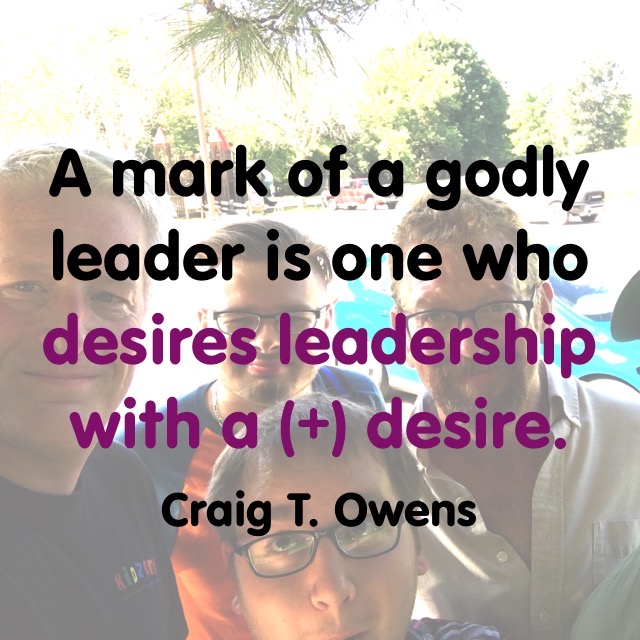
A mark of a godly leader is one who desires leadership with a (+) desire.

This is part 43 in my series on godly leadership. You can check out all of my posts in this series by clicking here.

All Of HIStory Is His Story

There were the kings who reigned in Edom before any Israelite king reigned (Genesis 36:31). 

When Rebecca was pregnant with twins, they jostled each other in her womb. God said this was an indication of what was to come of the two nations that would arise from her sons. God also said that the older son would serve the younger son (25:23).

The nation of Edom was a fierce but unstable people. Just take a look at the succession of their kings to see the power struggles at every transition. But eventually, King Saul would war against Edom, and King David would subjugate them—making the prophecy true that the older son served the younger son.

What went into the fulfillment of this prophecy?

  • Esau (also known as Edom) short-sightedly sold his birthright
  • Jacob and Rebecca conspired to get Isaac to bless Jacob instead of Esau
  • Esau married Canaanite wives, which disappointed his parents and strained relations with them
  • God blessed both Esau and Jacob so that Esau had to move to the region that would eventually bear his name: Edom

Along the way, Esau had a son with his Canaanite wife named Eliphaz. Eliphaz had a child with a concubine named Timna—a son that grew into one of Israel’s most deadly foes: the Amalekites!

Yet all of this was foreseen by God and fulfilled His pre-ordained plan. Once again: All of History is His story. There is never any need for us to worry about turmoil—political or otherwise—because God is in sovereign control… always! 

(By the way, this is not an isolated incident. There are countless examples in the Bible of how God’s sovereign plan is fulfilled, despite man’s best efforts to derail it. Check out another example here.) 

Hallowed Be Your Name

Jesus was once asked, “What is the greatest commandment?” He responded by saying, “The Lord our God, the Lord is One,” and then saying we should love God with all our heart, soul, mind, and strength (which fulfills the first four of the Ten Commandments), and then love our neighbor as ourselves (which fulfills the next six of the Commandments).

To live this way, we need to pray this way too! That’s why Jesus taught us a model prayer—which we typically call “The Lord’s Prayer”—in which the first three petitions are for God’s glory (hallowed be Your name; Your kingdom come; Your will be done), and the next three petitions are for man’s help (daily bread, forgiveness, victory over temptation). 

Jesus says we can pray to our Heavenly Father, but we still need to remember that He is also the God of the Hallowed Name. The Greek word for hallowed is made up of two other Greek words: 

  • hagnos is something totally immaculate, blindingly pure, and unapproachable. The apostle Paul said this about God: Our Master, Jesus Christ, is on His way. He’ll show up right on time, His arrival guaranteed by the Blessed and Undisputed Ruler, High King, High God. He’s the only one death can’t touch, His light so bright no one can get close. He’s never been seen by human eyes—human eyes can’t take Him in! Honor to Him, and eternal rule! (1 Timothy 6:15-16) 
  • thalpo means cherished. The same apostle Paul also said that God has given us the right to approach Him as “Abba, Father” or “Daddy, God” (Romans 8:15). 

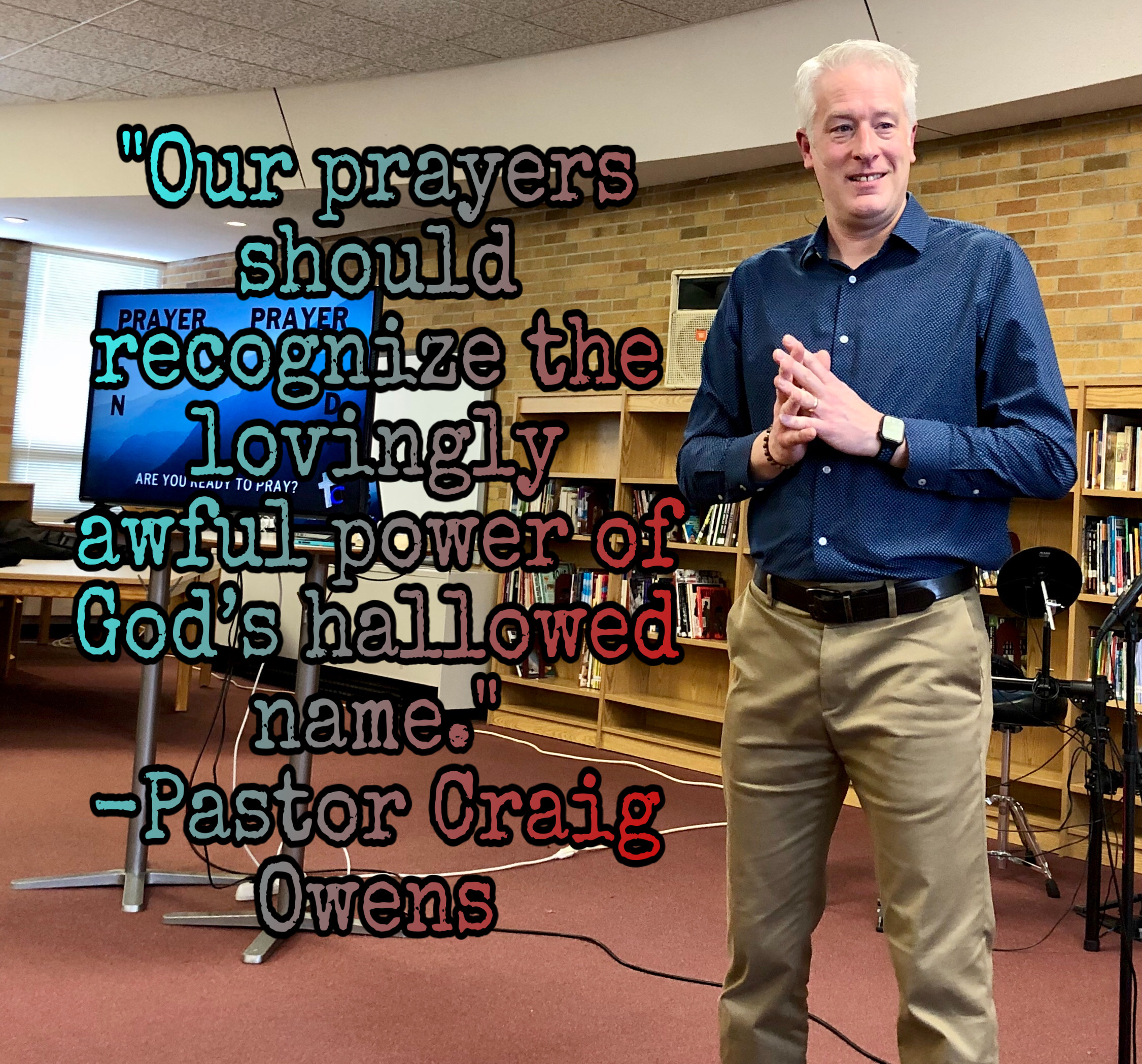
He is both unapproachable and approachable. He is both awful and lovable. He is both Supreme power and Supreme love. He is both Hallowed and Father. He is unique. Since He is unique, we must approach Him uniquely in holy prayer. But we must always approach first and foremost to reverence His holy Name. As Matthew Henry said, “Let Him have the praise of His perfections, and then let us have the benefit of them.” 

Think of His glory in every request you make of Him. Father, may Your holy, righteous name be hallowed and exalted and made famous as You…

  • … provide my daily bread
  • … forgive me and help me forgive others
  • … give me victory over temptations

Let’s not pray prayers that rob God of His glory. Prayers like:

  • Selfish prayers that are all about me, me, me
  • Doubtful prayers that aren’t really sure God can help
  • Little prayers that insult God’s power and His love
  • Unexpectant prayers that ask God to do something, but we don’t really expect that He will

Let’s be known as people who pray confidently humble prayers. Let’s come to a Father Who is All-Love and to a God Who is All-Powerful—a God Whose power is perfectly balanced by His love, and Whose love is perfectly balanced by His power. May our prayers HALLOW His name! 

Join me this Sunday as we continue to learn more about prayer. 

Poetry Saturday—Majesty Divine

Full of glory, full of wonders,
Majesty Divine! 
‘Mid Thine everlasting thunders 
How Thy lightnings shine! 
Shoreless Ocean! who shall sound Thee? 
Thine own eternity is round Thee, 
Majesty Divine!

Timeless, spaceless, single, lonely,
Yet sublimely Three, 
Thou art grandly, always, only 
God in Unity! 
Lone in grandeur, lone in glory, 
Who shall tell Thy wondrous story, 
Awful Trinity?

Speechlessly, without beginning,
Sun that never rose! 
Vast, adorable, and winning, 
Day that hath no close! 
Bliss from Thine own glory tasting, 
Everliving, everlasting, 
Life that never grows!

Thine own Self forever filling
With self-kindled flame, 
In Thyself Thou art distilling 
Unctions without name! 
Without worshipping of creatures, 
Without veiling of Thy features, 
God always the same!

In Thy praise of Self untiring
Thy perfections shine; 
Self-sufficient, self-admiring,—
Such life must be Thine;—
Glorifying Self, yet blameless
With a sanctity all shameless
It is so Divine!

‘Mid Thine uncreated morning,
Like a trembling star 
I behold creation’s dawning 
Glimmering from far; 
Nothing giving, nothing taking, 
Nothing changing, nothing breaking, 
Waiting at time’s bar!

One with life and love diurnal
See myself in Thee, 
All embalmed in love eternal, 
Floating in Thy sea: 
‘Mid Thine uncreated whiteness 
I behold Thy glory’s brightness 
Feed itself on me.

Splendors upon splendors beaming
Change and intertwine!
Glories over glories streaming
All translucent shine! 
Blessings, praises, adorations
Greet Thee from the trembling nations
Majesty Divine! —Frederick Faber

Thursdays With Spurgeon—The Greatest Treasure Ever!

This is a weekly series with things I’m reading and pondering from Charles Spurgeon. You can read the original seed thought here, or type “Thursdays With Spurgeon” in the search box to read more entries.

The Greatest Treasure Ever!

     Oh! Christian, do but consider what it is to have God to be your own! Consider what it is, compared with anything else.

Jacob’s portion is the Lord;
What can Jacob more require?
What can heaven more afford—
Or a creature more desire?

     Some have their portion in the city. Their wealth is superabundant and in constant streams it flows to them, until they become a very reservoir of gold. But what is gold compared with your God? You could not live on it; your spiritual life could not be sustained by it. Apply it to your aching head, and would it afford you any ease? 

     Put it on a troubled conscience, and could your gold allay its pangs? Put it on your desponding heart and see if it could stay a solitary groan or give you one grief the less. But you have God, and in Him you have more than gold or riches ever could buy, more than heaps of brilliant ore could ever purchase for you. … 

     There are griefs here with which men cannot intermeddle, and there are griefs to come with which men cannot interfere to alleviate the pangs, pains, agonies, and dying strife. But when you have this: “I will be your God” [Jeremiah 31:33]—you have as much as other men can have put together. … 

     O Christian, ask for nothing in this world but that you may live on this and that you may die on this: “I will be your God.” This exceeds all the world has to offer. …

     Oh! Here is a very sea of bliss, a very ocean of delight! Come, bathe your spirit in it. You may swim to eternity and never find a shore. You may dive to the very infinite and never find the bottom. “I will be your God.” Oh! If this does not make your eyes sparkle, if this makes not your foot dance for joy and your heart beat high with bliss, then assuredly your soul is not in a healthy state.

From God In The Covenant 

I agree with Spurgeon: “If this does not make your eyes sparkle, if this makes not your foot dance for joy and your heart beat high with bliss, then assuredly your soul is not in a healthy state.” 

If you want your soul to be in this healthy state, it is possible for you to know assuredly that God is saying to you, “I will be your God.” Jesus died in your place to pay the penalty for your sin. If you believe that, you may ask God to forgive all your sins—completely cancel that record of wrongdoing—and He will! Then His Spirit will take up residence in your heart and you can know the unspeakable bliss of the truth of what God says: “I am your God”!