Intimate Knowledge

Listen to the podcast of this post by clicking on the player below, and you can also subscribe on AppleSpotify, or Audible. Check out the video content in this post by clicking here. 

Remember that Peter’s first letter was to instruct Christians how to interact with non-Christians, but his second letter is about Christians interacting within the community of faith. It’s a precious faith that we share with precious friends. Our dear friends encourage us to think wholesomely, have informed perseverance, remain pure, and stay on guard until the very end.  

You can sense Peter’s longing for his dear friends of the faith to grasp this. He even says in this letter that it is his second letter to keep reminding the saints about the richness in Jesus, and he says as long as he has breath in his lungs he will keep on reminding us (2 Peter 1:12-15). 

(Click here to see all of the Scriptures in this post.) 

Peter uses an almost identical greeting in both letters: “Grace and peace be yours in abundance” (1 Peter 1:2; 2 Peter 1:2). This sentiment of linking grace and peace was almost universal, with all but five New Testament books greeting their audiences with the dual blessing of grace and peace. 

Let’s talk about these dual blessings. 

James Thayer defines this Greek word for peace: “According to a conception distinctly peculiar to Christianity, the tranquil state of a soul assured of its salvation through Christ, and so fearing nothing from God and content with its earthly lot, of whatsoever sort that is.” 

This means that Christians who have put their faith in Jesus as their Savior have peace with God (Romans 5:1), and that peace guards our hearts against all fear (Philippians 4:7). 

The other blessing in Peter’s greeting is grace (see also Romans 5:2). This is—quite simply and quite profoundly—God’s favor toward us. God’s grace is unearned by our efforts, undeserved despite our sins, and unending for all eternity. And it comes coming in wave after wave (see John 1:16; I especially like it in the AMPC). 

Peter’s greeting in his second letter adds a phrase from his first letter: “…through the knowledge of God and of Jesus our Lord.” It’s fitting that this is in his second letter, showing he is still growing in his knowledge of Jesus. 

We don’t get more grace and peace through knowledge, but we realize and can apply more grace and peace through this growing knowledge. The tap of God’s blessing is already open full—no more can come out. As we grow in the knowledge of this, we find it increasingly precious and valuable. 

The Greek word for knowledge here is epignosis. This is knowledge through personal experience.

I once worked with a man who was a retired Air Force officer. Before flying one mission, he walked into the flight control building—a huge hanger-like structure—where dozens and dozens of personnel sat staring at screens to forecast the weather. 

Lou asked a private for the forecast: “Sir, you have clear skies and excellent visibility for your mission,” he dutifully reported. 

“Private,” Lou shouted, “on your feet!” The young man snapped to attention. “Follow me,” Lou ordered and began marching toward the door of the hanger. When they got there, Lou ordered the private to open the door, step outside, close the door behind him, and not to re-enter the hanger for 60 seconds. 

One minute later that private stepped back inside and stood before Lou dripping wet. “Now, private,” Lou demanded, “what is my weather forecast.” 

“It looks like rain, sir,” the young private reported. 

Epignosis is not book knowledge about Jesus, but personal, intimate, experiential knowledge of Jesus. That Air Force meteorologist only knew about weather from his radar screen, but once he got drenched outside, he knew of the weather conditions from personal experience. 

Peter says this epignosis is ours (2 Peter 1:3-5). 

There’s only one thing that keeps us from growing in our knowledge of God’s abundant grace and peace: Complacency. In v. 5, Peter says we are to “make every effort.” 

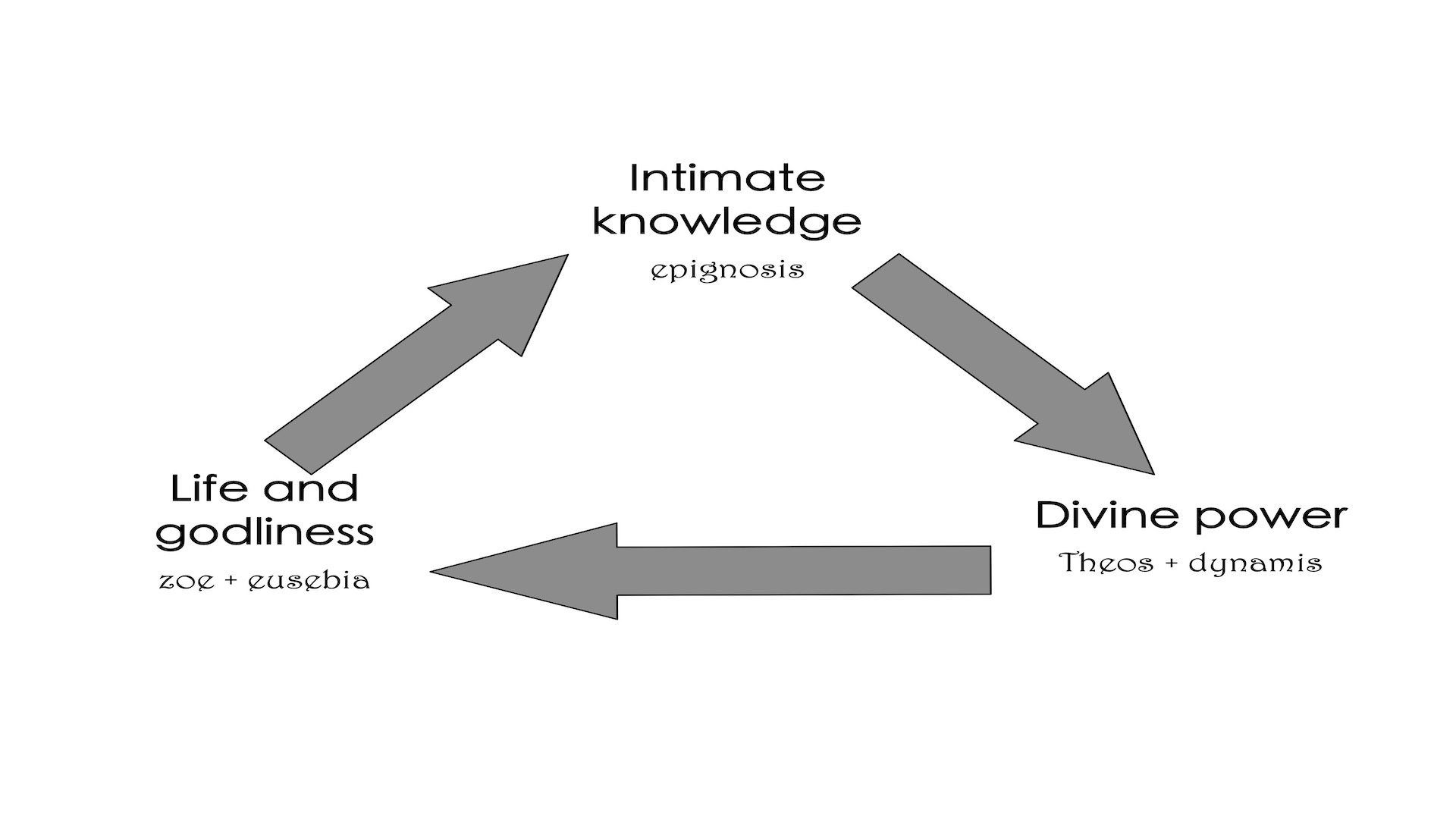
It’s not our effort that brings God’s grace, but it is our effort that allows us to know His grace—to know Jesus personally. Notice the progression:

  • (v. 3) Christ’s divine power has give us everything we need by His own glory and goodness 
  • (v. 4a) Through these gracious gifts He has given us His great and precious promises 
  • (v. 4b) Through His promises we can participate in His divine nature 
  • (v. 5) For this very reason, we are to bring our best effort, our diligent interest, and our total attention 

Peter concludes his letter exactly as he starts it: Keep growing in your epignosis (3:18). 

The more you grow in epignosis, the more intimate knowledge you will have to encourage your dear friends of the faith—

And we know that the Son of God has come, and He has given us understanding so that we can know the true God. And now we live in fellowship with the true God because we live in fellowship with His Son, Jesus Christ. He is the only true God, and He is eternal life. (1 John 5:20 NLT) 

Then like Paul, we can pray for ourselves and for our dear friends for a continual growing in this intimate knowledge of Jesus (see Ephesians 1:15-19). 

Check out the other messages in this series from 2 Peter called Friends of the Faith. 

►► Would you please prayerfully consider supporting this ministry? My Patreon supporters get behind-the-scenes access to exclusive materials. ◀︎◀︎

Links & Quotes

The terms used in the New Testament for followers of Jesus aren’t typically the same terms we use today. As Christians, we need to ask ourselves, “Is my life showing the biblical definition of what it means to know Jesus as my Lord and Savior?”

I have a lot of new video content on my YouTube channel every week. Please check it out and subscribe so you don’t miss anything.

“The trouble is that what we call ‘asking God’s forgiveness’ very often really consists in asking God to accept our excuses. What leads us into this mistake is the fact that there usually is some amount of excuse, some ‘extenuating circumstances.’ We are so very anxious to point these out to God (and to ourselves) that we are apt to forget the really important thing; that is, the bit left over, the bit which the excuses don’t cover, the bit which is inexcusable but not, thank God, unforgivable. And if we forget this, we shall go away imagining that we have repented and been forgiven when all that has really happened is that we have satisfied ourselves with our own excuses.” —C.S. Lewis in The Weight of Glory 

“There is a place for anger. Without it, we would become passive against injustice. Anger helps us turn away from accepting blame that does not belong to us. It allows us to gain needed emotional distance from the one who hurt us. But anger requires safeguards. In this psalm, David had two: (1) He told his anger to God. … (2) He let God handle the execution of anger.” —Dr. George O. Wood, in A Psalm in my Heart

T.M. Moore speaks to the church in this post called Equipped For Good Works. A couple of comments that especially caught my attention: “A local church grows as it increases in the likeness of Jesus Christ” and “Churches grow as individual church members grow in zeal for good works, and do good to others at every opportunity, beginning within the household of faith.”

“I believe that the prophesies in the Revelation, and in the books of Daniel and Ezekiel are very much of this character, and that, while it is quite right to watch for and expect the coming of the Lord, we shall spend our time more profitably in preaching the doctrines of the gospel than in meditating upon the mysterious prophecies of the Word. They will be understood when they are fulfilled, but we do not think they will be fully understood before that time.” —Charles Spurgeon 

The name of God is an important topic. Dr. Kaspars Ozolins writes, “What, then, is the actual name of Israel’s God? In biblical Hebrew it is represented by a sequence of four consonants, the famous tetragrammaton: YHWH. This name occurs a total of 6,828 times in the Old Testament.” Learn more about this name in this post.

This year marks the 500th anniversary of the printing of the Tyndale Bible. This is an important event in Christian and world history. Check out this short overview of how this Bible came to be, and its impact that is still being felt today.

Jesus Is THE One And Only

Listen to the podcast of this post by clicking on the player below, and you can also subscribe on AppleSpotify, or Audible. 

When the angelic messengers bring the news of the birth of Jesus to the shepherds, they announce—

The Savior—yes, the Messiah, the Lord—has been born today in Bethlehem, the city of David! (Luke 2:11 NLT) 

(See all of the Scriptures in this post by clicking here.) 

Many people claiming to be a savior of the Jewish people had come on the scene earlier. 

We see the Jewish leadership asking John the Baptizer if he was “the one” they had been expecting (John 1:19-23). In the Book of Acts, Gamaliel reminds the Sanhedrin of all of the previous men who had claimed to be the deliverer and had utterly failed in their attempts (see Acts 5:34-37). 

Undoubtedly, the shepherds had heard many stories as they sat around their campfires at night. So notice that the angel clarifies that this is not just another story, but the fulfillment of the promises of the advent of THE Messiah. Jesus wasn’t just another so-called savior, but He was “THE Messiah, THE Lord. 

Jesus Himself would say of Himself, “I am THE way, THE truth, and THE life” (John 14:6).

He is THE ONE AND ONLY! 

Only Jesus is the Alpha and Omega (Revelation 1:8).
Only Jesus holds the keys of death and Hell (Revelation 1:18).
Only Jesus fulfills every prophetic promise (Hebrews 1:1-2; 2 Peter 1:19-20).

All confusion is removed when we look to Jesus.
All doubts are satisfied in Him.
All uncertainty is made certain by Who He is, what He did, what He is still doing, and what He will soon complete!

No other name but the name of Jesus! 

You may also want to check out: 

►► Would you please prayerfully consider supporting this ministry? My Patreon supporters get behind-the-scenes access to exclusive materials. ◀︎◀︎
Don’t Let Your Gift Rob God

God has given each of you a gift from His great variety of spiritual gifts. Use them well to serve one another. (1 Peter 4:10 NLT) 

In Greek, the root word for “gift” is grace. We all have received a grace gift from God and we are to employ that gift graciously. 

My gift is not for showing off but for building up—“to serve one another.” 

My gift is not for my benefit but to benefit others—“so that in all things God may be praised through Jesus Christ” (v. 11 NIV). 

My gift is given to me so that I may help others see Jesus and praise God. If people only see my gift—and nothing more—I am misusing my gift and I am robbing God of His glory. 

To HIM be the glory and the power for ever and ever. Amen. (1 Peter 4:11 NIV) 

Father, thank You for the grace gift You have given me. Holy Spirit, help me graciously steward this gift to serve others so that they can better glorify God.