The Hiding Place (book review)

Listen to the podcast of this post by clicking on the player below, and you can also subscribe on Apple or Spotify.

In The Problem of Pain, C.S. Lewis writes, “Suffering is not good in itself. What is good in any painful experience is, for the sufferer, her submission to the will of God, and, for the spectators, the compassion aroused and the acts of mercy to which it leads.” This sentiment was never more fully displayed than in the lives of the ten Boom family. Corrie ten Boom relates her story in The Hiding Place. 

The ten Boom family had lived in Holland for a couple of generations at the time the Germans occupied their country during World War II. Immediately, their family home and watch repair shop became a hub for underground resistance activity. But the start of this war was not the start of their compassionate activity in their city. The ten Booms lived out their Christian faith in tangible, compassionate ways every single day, and their neighbors reaped the benefits. 

The entire ten Boom family was actively involved in the efforts to protect at-risk people during the Nazi oppression of their country, including the elderly and sick, their Jewish neighbors, the mentally disabled, and the young men that were being pressed into duties to support the German war effort. As The Hiding Place progresses, the story begins to zoom-in on two sisters: Betsie and Corrie, especially their activities inside the German prisons and concentration camps in which they were imprisoned. 

The miracles that God performed for these women are too many to recount here, but it seems like hardly a page in the story passes before another miracle is seen. These Christian women took full advantage of each miracle and used them to continue to bring light and love into one of the most dark and hateful times in human history. Even after the war has ended and Corrie has returned to her Holland home, the ministry of healing, forgiveness, and reconciliation continued unabated through her tirelessly loving activities. 

The Hiding Place is truly a heroic tale! I highly recommend parents and grandparents reading it aloud to their children and grandchildren. May all Christians follow the example of the ten Boom family in finding ways to daily share the love of Jesus to their neighbors-in-need. 

►► Would you please prayerfully consider supporting this ministry? ◀︎◀︎
The Deity And Divinity Of Jesus

Listen to the podcast of this post by clicking on the player below, and you can also subscribe on Apple or Spotify.

Some really silly guys did a series of videos called “Neature Walk” because they wanted to share how neat is nature! In episode one Vic sees a tree that he really likes and says, “Score! This is an aspen tree. You can that it’s an aspen tree because of the way it is.” This is either circular reasoning or an obvious statement. “Just look at this thing. You can tell it’s this thing because it looks and acts like this thing.” 

I feel a lot like this when I look at the first part of our third foundational truth statement: “We believe in the Deity of the Lord Jesus Christ.” (As a side note, I covered the second part of this statement—“As God’s Son, Jesus was both human and divine”—in another post, which you may find here.) 

Check this out: the definition for Deity is the divine character of God, and the definition for divine means things relating to the Deity. In saying we believe Jesus is God we are really saying, “You can tell that Jesus is God because of the way He is.” 

In order to make this definition work, we need evidence for both the divinity and the deity of Jesus. That being said, let me remind you of J. Warner Wallace’s instruction on faith. There is:

  • Blind faith—believing in something without evidence 
  • Unreasonable faith—believing in something in spite of the evidence 
  • Reasonable faith—believing in something because of the evidence 

Here is some evidence that I think makes it reasonable to believe that Jesus is divine:

  1. Virgin birth—Isaiah 7:14; Luke 1:34-35; Matthew 1:22-23 
  2. Sinless life—Isaiah 53:4-6, 9; Hebrews 7:26-27; 1 Peter 2:22 
  3. Miracles—Acts 10:38; 2:22-24 
  4. Death, resurrection, exaltation—Isaiah 53:10-12; Philippians 2:6-8; Hebrews 1:3 

(Check out all the Scriptural references listed above by clicking here.) 

I think the best evidence for the Deity of Jesus is the connection He Himself made between the “Jehovah” titles of the First Testament and His “I AM” statements in the Second Testament:

  • Jehovah Jireh (I Am Your Provider) → I am the Bread of Life (John 6:35)
  • Jehovah Rapha (I Am Your Healing) → I am the Resurrection and the Life (John 11:25-26)
  • Jehovah Nissi (I Am Your Source) → I am the Vine (John 15:5)
  • Jehovah Shalom (I Am Your Peace) → I am the Light of the world (John 8:12)
  • Jehovah Raah (I Am Your Shepherd) → I am the Good Shepherd (John 10:11)
  • Jehovah Sabaoth (I Am Your Wall Of Protection) → I am the Gate (John 10:9)
  • Jehovah Tsid-kenu (I Am Your Righteousness) → I am the Way, Truth, and Life (John 14:6)
  • Jehovah Shammah (I Am Here) → I am the Alpha and Omega (Revelation 1:8; 22:13). 

(Check out all the Scriptural references listed above by clicking here.)

The Jewish leadership understood perfectly what Jesus was claiming! But the more pertinent question is this: Do we understand what we must do with this evidence? 

We cannot claim that Jesus was born of a virgin, or lived a sinless life, or did miracles, or died and rose again and then not believe He is God. We cannot pick and choose the parts of Jesus we want. 

The apostle Paul reminded us that someday “at the name of Jesus every knee should bow, in heaven and on earth and under the earth, and every tongue acknowledge that Jesus Christ is Lord, to the glory of God the Father” (Philippians 2:11-12). 

Every knee will bow to Him one day: Either in worship of Jesus their Savior, or in abject terror of Jesus their Judge. 

I pray that you believe in Jesus as your Lord and Savior today… don’t wait another moment! 

►► Would you please prayerfully consider supporting this ministry? ◀︎◀︎
If you’ve missed any of the other messages in our Foundational Stones series, which is exploring our foundational beliefs, you may access all of them by clicking here.

Poetry Saturday—Arise, My Soul, Arise

Listen to the podcast of this post by clicking on the player below, and you can also subscribe on Apple or Spotify.

Arise, my soul, arise,
shake off your guilty fears;
The bleeding sacrifice,
in my behalf appears;
Before the throne my Surety stands,
My name is written on His hands.

He ever lives above,
for me to intercede;
His all redeeming love,
His precious blood, to plead;
His blood atoned for every race,
And sprinkles now the throne of grace.

Five bleeding wounds He bears;
received on Calvary;
They pour effectual prayers;
they strongly plead for me:
“Forgive him, O forgive,” they cry,
“Nor let that ransomed sinner die!”

The Father hears Him pray,
His dear anointed One;
He cannot turn away
the presence of His Son;
The Spirit answers to the blood,
The Spirit answers to the blood
And tells me I am born of God.

My God is reconciled;
His pardoning voice I hear;
He owns me for His child;
I can no longer fear
With confidence I now draw nigh,
And “Father, Abba, Father,” cry. —Charles Wesley

►► Would you please prayerfully consider supporting this ministry? ◀︎◀︎

Thursdays With Spurgeon—Security

This is a weekly series with things I’m reading and pondering from Charles Spurgeon. You can read the original seed thought here, or type “Thursdays With Spurgeon” in the search box to read more entries.

Listen to the podcast of this post by clicking on the player below, and you can also subscribe on iTunes or Spotify.

Security 

[God] alone is my rock and my salvation (Psalm 62:2).

     I do not reckon that is salvation that regenerates me and then puts me in such a position that I may fall out of the covenant and be lost. I cannot call that a bridge that only goes halfway over the stream. I cannot call that salvation that does not carry me all the way to heaven, wash me perfectly clean, and put me among the glorified who sing constant hosannas around the throne. … 

     Do I live to God a holy life? It is not I, but Christ who lives in me. Am I sanctified? I did not sanctify myself. God’s Holy Spirit sanctifies me. Am I weaned from the world? I am weaned by God’s chastisements. Do I grow in knowledge? The great Instructor teaches me.

From God Alone The Salvation Of His People


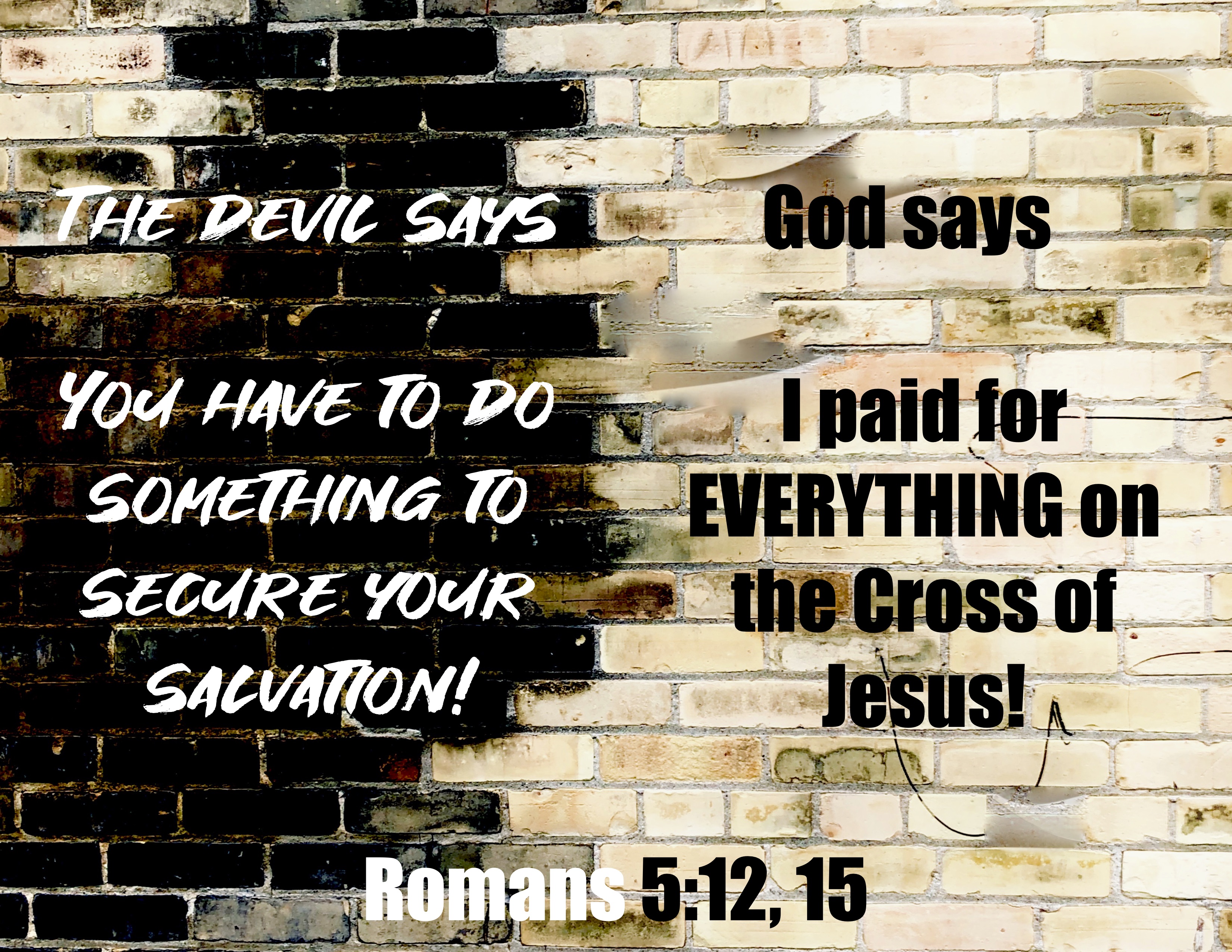
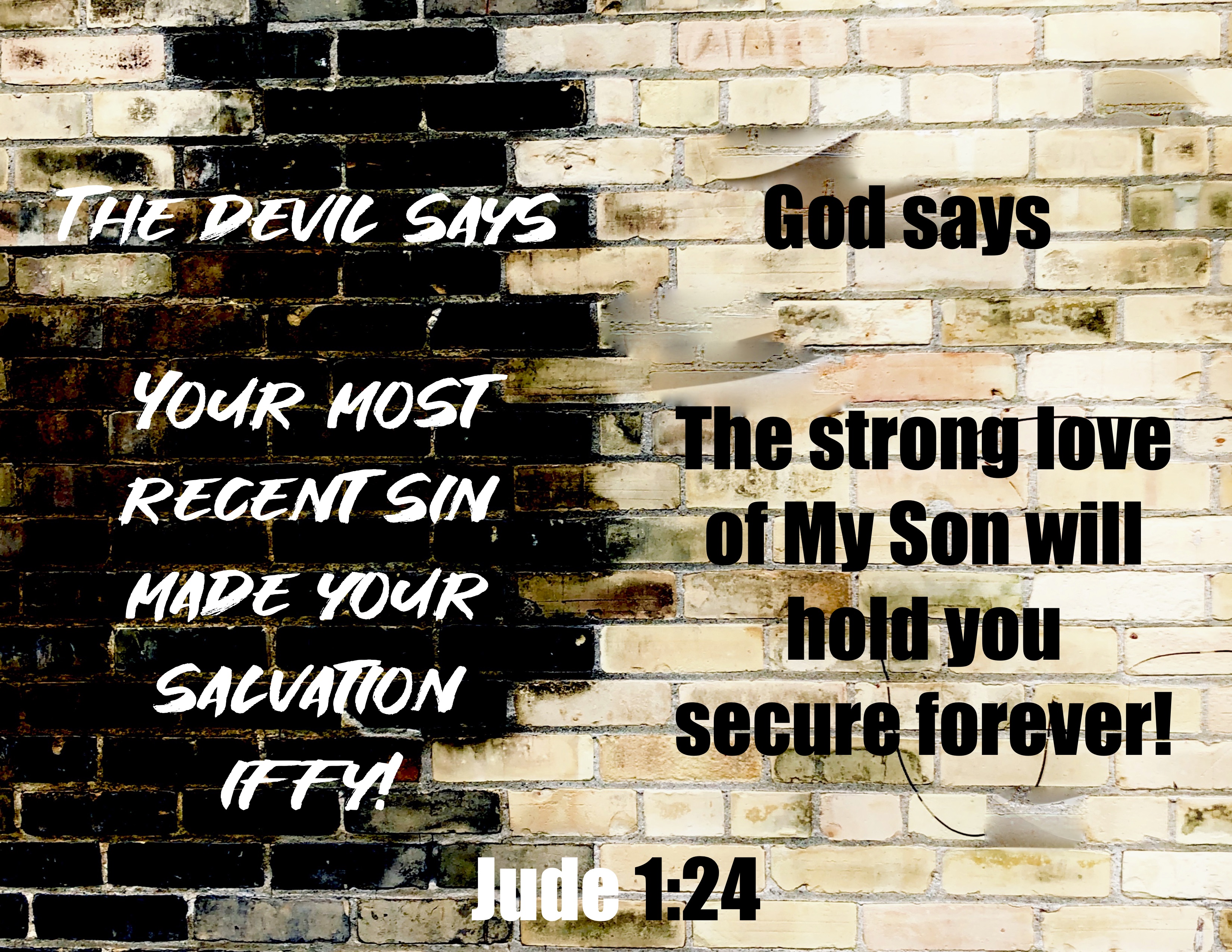
A few months ago I began designing a series of graphics under the heading, “Says who?” I took some of the lies of satan and put them side-by-side with the truth from God’s Word. 

When God is our Savior, we are secure. The devil would love to make us think that our salvation is hanging by a thread, that we have to work harder to make sure we don’t miss out, that a single sin can disqualify us from God’s favor, and a hundred other lies. But they are all just that: lies! 

We have to learn to capture each of these thoughts, and if they are thoughts that don’t align with God’s Word, then we need to confront them with the truth. I have found it very helpful to speak these truths out loud. To see some of the ways I suggested thinking differently about the devil’s lies, check out this post on reversing your thinking.

As the old hymn says, “Jesus paid it all, all to Him I owe.” You don’t have to earn your salvation or make your position secure—your salvation has been paid-in-full and you are perfectly secure! Now what you owe to Jesus is to allow Him to take you safely home. 

►► Would you please prayerfully consider supporting this ministry? ◀︎◀︎
Halfway Leaders Become Evil Leaders

Listen to the podcast of this post by clicking on the player below, and you can also subscribe on Apple or Spotify.

Amaziah did what was right in the eyes of the Lord, but not wholeheartedly (2 Chronicles 25:2).

Notice the contradictions in Amaziah’s life and leadership: 

obeyed God’s law (v. 4)
🚫disobeyed God’s law (v. 14)

trusted that God would give success to the army of Judah (v. 5)
🚫supplemented his army with mercenaries from Israel (v. 6)

listened to the prophet God sent to him (vv. 7-10)
🚫ignored the prophet God sent to him (vv. 15-16)

trusted God (vv. 9-10)
🚫turned to idols (v. 14)

Sadly, the “not wholeheartedly” leader usually ends up just like other leaders that God calls “evil” (vv. 22-24, 27). 

Bottom line: there is no such thing as a halfway leader in God’s eyes. There is only following God or rebelling against God—all leaders must choose one or the other.

A mark of a godly leader is one who consistently chooses to follow God wholeheartedly.

This is part 55 in my series on godly leadership. You can check out all of my posts in this series by clicking here.

►► Would you please prayerfully consider supporting this ministry? ◀︎◀︎
The Craig And Greg Show: The Value Of Feedback

On this episode of “The Craig And Greg Show” we talk about: 

  • “Feedback is the breakfast of champions,” says Greg
  • giving and receiving feedback is a mark of a healthy leader 
  • why people don’t like feedback
  • whose feedback we should value
  • the best attitude for both giving and receiving feedback
  • we should view feedback as a tool to help people (including ourselves) get better  
  • how do we gain credibility that will better enable us to give feedback
  • my pet peeve about feedback and what Greg suggests to correct this
  • an important spiritual component of feedback
  • feedback is never intended to make clones of the leader, nor is it to make the leader superior over his/her teammates
  • why it is important to be both “do as I say” and “do as I do” leaders
  • our coaching huddles are an excellent place for leadership-lifting feedback

Check out this episode and subscribe on YouTube so you can watch all of the upcoming episodes. You can also listen to our podcast on Spotify and Apple.

The Mercyseat

Listen to the podcast of this post by clicking on the player below, and you can also subscribe on Apple or Spotify.

Hear my cry for mercy … He has heard my cry for mercy (Psalm 28:2, 6).

For David, his cry for mercy was never a one-and-done action. The verb in verse 2 makes this verse read more like, “Hear my cry for mercy as I am continually calling to You for help, as I am continually lifting up my hands toward Your Most Holy Place.” 

Why the Most Holy Place? What was there? Inside the Most Holy Place was the ark of the covenant of the Lord which represented the presence of God. 

What was on top of the ark of the covenant, covering and superseding the Law that was inside the ark? It was the mercyseat (or the “atonement cover” in some translations). The mercyseat is where the high priest sprinkled the blood of the sacrificial lamb every year to make atonement for sins.

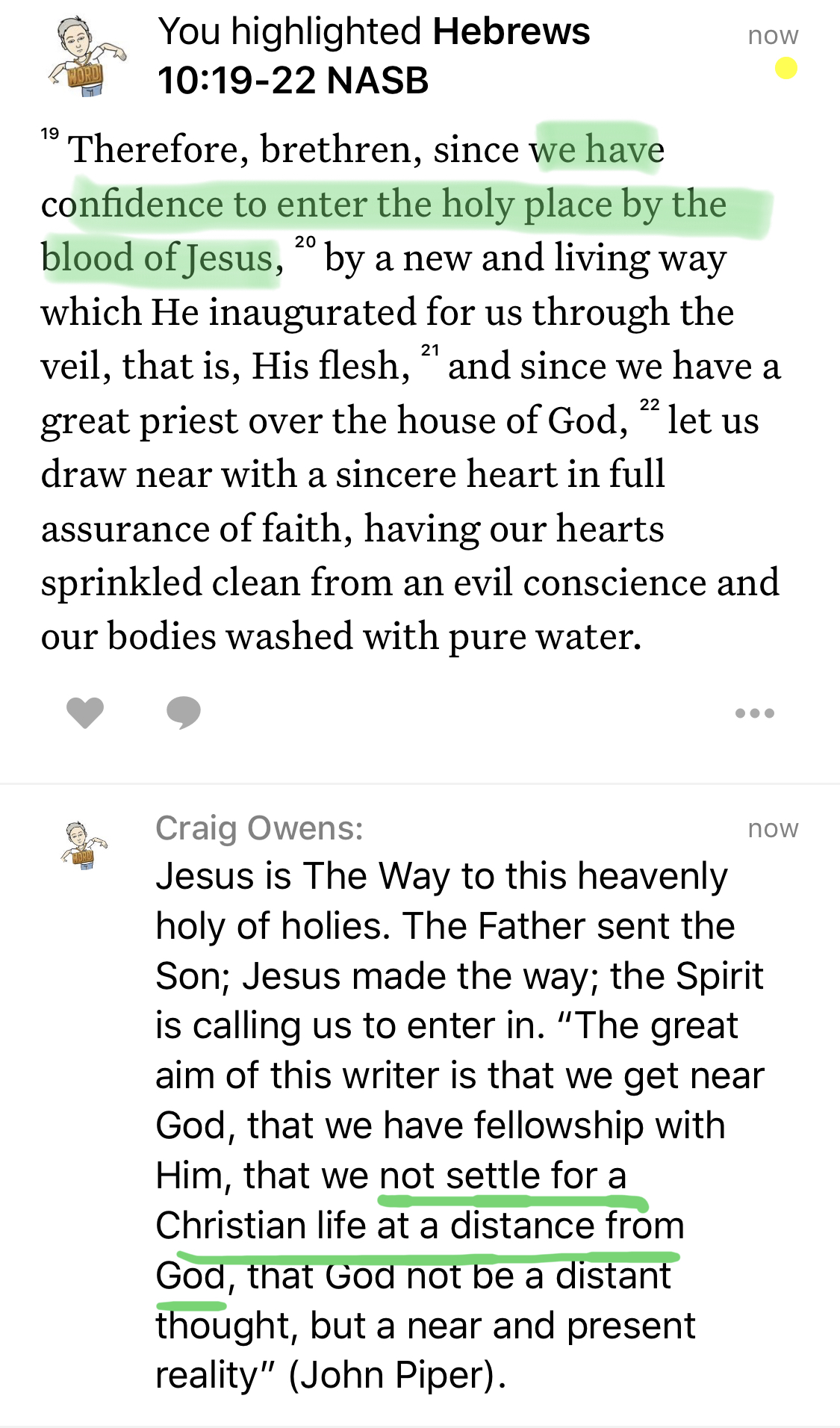
Jesus became the once-for-all sacrificial Lamb to make ultimate atonement for all who would believe in Him. When Jesus had finished His work on the Cross, the curtain separating us from the Most Holy Place was torn in two. The ark of the covenant of the Lord with its covering mercyseat—the presence of God—was now accessible to all of us! It was accessible because it was in Jesus, and when I have taken Jesus as my atonement, He is in me and He takes me in to the Father. The mercyseat of my heart has been sprinkled with the blood of the Lamb (see Hebrews 9:1-5, 11-14; 10:19-22). 

Whether David was saying, “Hear my cry,” or “He has heard my cry,” the Hebrew word means to listen with interest and full attention. Whenever you pray, God listens to you with interest and full attention because you are praying right in His presence! Your very breath can be a continual crying, a continual lifting of your voice toward the mercyseat where God meets with you! 

God is not far away from us. He is closer than we usually think. That’s why David says, “My heart leaps for joy, and with my song I praise Him”! 

Keep this in mind the next time you are asking God to hear your cry: He listens to you with full attention because Jesus has taken you right into His presence.

Would you please prayerfully consider supporting this ministry?

Persistent And Insistent Prayer

Listen to the podcast of this post by clicking on the player below, and you can also subscribe on Apple or Spotify.

When I first began this series on prayer, I challenged all of us to make prayer a habit. I suggested putting up “Have I prayed about it?” Post-It Notes all over the place to get us thinking about prayer continually. 

“Have I prayed about it?” is a great start. But then I need to ask, “How long have I prayed about it?” or maybe even, “How long am I willing to pray about it?” 

Thomas Merton wrote, “What is the use of praying if at the very moment of prayer we have so little confidence in God that we are busy planning our own kind of answer to our prayer?” In other words, why do we go through the motions of praying and then strike out on our own? Or why do we pray for a little bit and then think, “Oh, perhaps God isn’t interested in this prayer”? 

In Romans 12:12, the apostle Paul challenged us to never stop praying:

  • faithful in prayer (NIV) 
  • constant in prayer (AMP) 
  • prayerful always (TLB) 
  • continuing steadfastly (NKJV) 

This verb emphasizes the –ing part. Even though this is a verb, it’s what is known as a “verbal noun”: the noun pray is the same thing as the verb praying. 

This Greek word is defined as: devoted, giving unremitting care to something, being courageous in perseverance, and staying at constant readiness. I would sum it up this way—

Prayer that is both persistent and insistent! 

When Jesus teaches us that the motive for our prayer is, “Your kingdom come, Your will be done,” He is also implying that this requires continuous—persistent and insistent—involvement. With every prayer, we are persistently and insistently advancing God’s Kingdom and God’s glory. 

One of my favorite stories in the Gospels is of a persistent and insistent mother. Her daughter was in desperate need, and she simply would not take “no” for an answer. She insistently kept asking Jesus for a miraculous touch, and Jesus finally said, “Woman, you have great faith! Your request is granted.”

I’m also moved by the insistent and persistent prayer of Nehemiah. He prayed, “Give Your servant success today by granting him favor in the presence of [King Artaxerxes].” He prayed this every day for over 4 months. The king finally noticed Nehemiah’s downcast face, asked him what was wrong, and then “because the gracious hand of my God was upon me, the king granted my requests.”  

Nehemiah kept praying for 120 days or more, believing every day God would open the door of favor. In the meantime, God was moving things into place so that when Artaxerxes finally noticed Nehemiah’s downcast face, and Nehemiah shared what was on his heart, the king granted every single request! 

Friends, don’t be timid in your prayers and don’t give up praying. P.U.S.H.—Pray Until Something Happens. Pray for God’s glory to be seen, for His kingdom to advance on earth, and for His will to be done. 

Prayer starts it, prayer sustains it, prayer successfully concludes it! 

Let me say it again: DON’T STOP PRAYING! 

If you missed any of the messages in our Be A First Responder series, you may access all of them by clicking here.

Would you please prayerfully consider supporting this ministry?