The Preeminent Jesus

Listen to the podcast of this post by clicking on the player below, and you can also subscribe on Apple, Spotify, or Audible. 

There is only one Jesus, but He is presented to us in the Bible with many facets, and we get to pray in all of those facets of His name! 

One of the facets of Jesus is His preeminence. The dictionary defines preeminent as “above and before others; superior; surpassing.” 

The Bible uses the word preeminence to mean “holding the first place.” The apostle Paul uses this idea of Christ’s supremacy when He describes Him this way—

The Son is the image of the invisible God, the FIRSTBORN over all creation. For in Him ALL things were created: things in heaven and on earth, visible and invisible, whether thrones or powers or rulers or authorities; ALL things have been created through Him and for Him. He is BEFORE ALL things, and in Him ALL things hold together. And He is the HEAD of the body, the church; He is the BEGINNING and the FIRSTBORN from among the dead, so that in EVERYTHING He might have the SUPREMACY. For God was pleased to have ALL His fullness dwell in Him. (Colossians 1:15-19, emphasis mine) 

Therefore God exalted Him to THE HIGHEST PLACE and gave Him the name that is above EVERY name, that at the name of Jesus EVERY knee should bow, in heaven and on earth and under the earth, and EVERY tongue acknowledge that Jesus Christ is Lord, to the glory of God the Father. (Philippians 2:9-11, emphasis mine) 

Praying in Christ’s preeminence means that we never have to settle for less than God’s best! 

When we began this series, I mentioned that there were some people who misuse the words of Jesus. Specifically the phrase where Jesus says, “I will do whatever you ask in My name” (John 14:13, 15:16, 16:23). They have taken this as license to ask for things for their own comfort, or claiming that praying “in the name of Jesus” means that we never have to experience pain, poverty, or any setbacks. 

But preeminence ≠ prosperity! 

Prosperity wrongly says Christians will never have trouble, never experience poverty or lack, and can claim and obtain lavish things just by invoking “in the name of Jesus.” 

Preeminence correctly says that Christians may have trouble, or poverty, or even martyrdom, but that Christ’s preeminence gets the final word, the decisive word, and the best word! 

Jesus didn’t pray to be removed from trials. The godly apostle Paul experienced ample trouble, and so did the heroes of faith (John 12:27-28; 2 Corinthians 11:23-27; Hebrews 11:35-38). Yet even in all of these troubles and pain and hardship, Christ’s preeminence prevails! 

As Paul said in Colossians 1, Jesus was the “firstborn from among the dead,” meaning that He is now preeminent even over death! Jesus said that His followers will—not “may”—experience persecution here, just as those heroes of the faith listed in Hebrews 11 did, but that the rewards in eternity are beyond compare (see 1 Corinthians 15:55, 57-58; Matthew 5:11-12; Hebrews 11:39-40). 

Horatio Spafford wrote the hymn It Is Well With My Soul. One of the stanzas reminds us:

Though satan should buffet though trials should come
Let this blest assurance control
That Christ has regarded my helpless estate
And has shed His own blood for my soul

Praying in the name of the preeminent Jesus does at least four things for us: 

  1. Gives us a surpassing victory—Romans 8:31-32, 37 
  2. Keeps us humble and God glorified—2 Corinthians 4:7
  3. Detaches us from earthly things that would take our eyes off of Jesus—Philippians 3:8
  4. Keeps us focused on Heaven—2 Corinthians 4:17

(check out all of the verses listed above by clicking here)

Let me say it again: Praying in Christ’s preeminence means that we never have to settle for less than God’s best! 

God’s best is not awaiting us here on earth, but it is our promised eternal reward for persevering to the end. It may seem tough at times, but our preeminent Savior walks with us every step of the way! 

If you’ve missed any of the other messages in this series on prayer, you can find links to all of those messages by clicking here. 

►► Would you please prayerfully consider supporting this ministry? My Patreon supporters get behind-the-scenes access to exclusive materials. ◀︎◀︎
The Divine Jesus

Listen to the podcast of this post by clicking on the player below, and you can also subscribe on Apple, Spotify, or Audible. 

I was teaching a class for my team members, and at one of the breaks a new employee came up to me to say how much he was enjoying the day, and to tell me that he would like to do what I was doing. I asked him, “But do you want to do what I did in order to do what I’m doing?” When I explained that I read about 10-12 books for this training time, and that it took me about 40 hours to prepare for our 4-hour class, he didn’t seem as interested. 

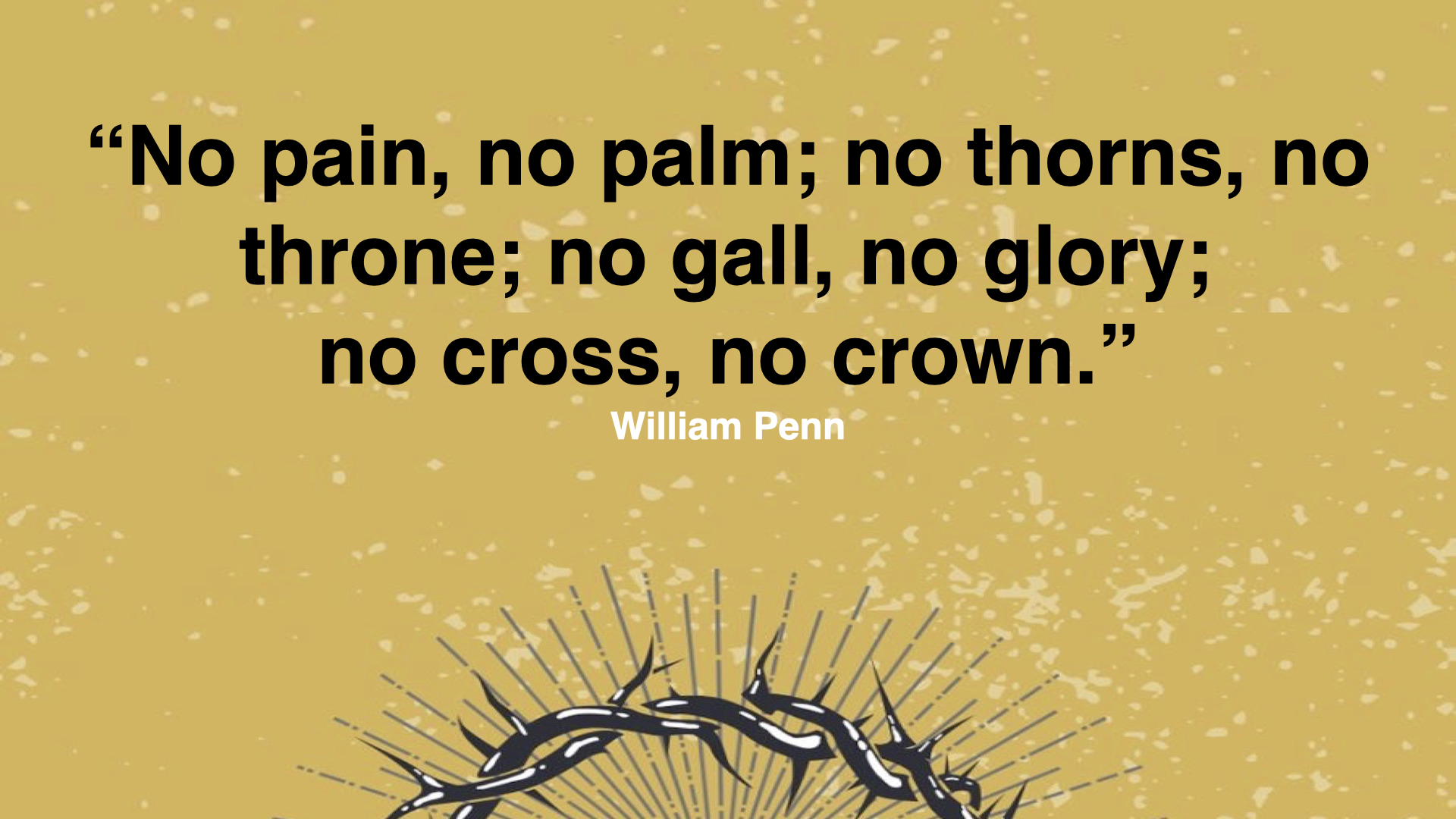
Most people don’t want to put in the work, but they just want the results. As Christians we need to remember these words from William Penn: “No pain, no palm; no thorns, no throne; no gall, no glory; no cross, no crown.” 

The human Jesus understands and empathizes with our painful struggles, and the divine Jesus helps us endure through these painful struggles to get the rewards on the other side. 

What do we mean by divine? The dictionary simply defines it as things relating to God or gods, so we need to use some context to help us understand who this divine Jesus is. After all, the New Testament refers to both Jesus and Artemis as divine (Romans 1:20; Hebrews 1:1-3; Acts 19:27). 

One way we can distinguish is by doing what the writer of Hebrews advised: “Remember your leaders, who spoke the word of God to you. Consider the outcome of their way of life and imitate their faith” (Hebrews 13:7). We see that the so-called worshippers of Artemis were more interested in their own financial gain than they were her divinity (Acts 19:23-27). In contrast, the apostle Paul demonstrated a totally Jesus-focused lifestyle: “However, I consider my life worth nothing to me; my only aim is to finish the race and complete the task the Lord Jesus has given me—the task of testifying to the good news of God’s grace” (Acts 20:24). 

Paul was following Jesus, and called all Christians to do the same. He noted that Jesus gave up all of His divine privileges to become our human Jesus, but because of this obedience, God made the divinity of Jesus shine more gloriously than anything else in creation! Then Paul transitioned to a word specifically for Christians: 

Therefore, my dear friends, as you have always obeyed—not only in my presence, but now much more in my absence—continue to work out your salvation with fear and trembling, for it is God who works in you to will and to act in order to fulfill His good purpose. (Philippians 2:12-13) 

In essence this is like Jesus saying, “I want you to have what I have, but you will have to do what I did to get it: That is, go through the painful struggles of life. But I will be right here with you every single step of the way!” 

The writer of Hebrews echoes this idea by reminding us that Jesus was made perfect through suffering, and so are we. So he calls us to “not throw away your confidence; it will be richly rewarded.” He also reminds us that although the times of suffering are not pleasant, there is an unimaginable reward on the other side (Hebrews 2:9-11; 10:35-39; 12:1-11).

I especially like this conclusion: “No discipline seems pleasant at the time, but painful. Later on, however, it produces a harvest of righteousness and peace for those who have been trained by it” (Hebrews 12:11).

The divine Jesus has made it possible for us to be rewarded as He was rewarded! His divine power leads to our divine nature. And His divine power helps us defeat the world’s weapons (2 Peter 1:3-4; 2 Corinthians 10:4) 

Jesus asks, “Do you want to do what I did in order to do what I’m doing?” The power of the divine Jesus can help us be perfected, but we only get to this perfected place by suffering as He suffered. That’s why we need to know our human Jesus understands, empathizes, and helps. 

Most people don’t want to put in the work, but they just want the rewards. Our divine Savior helps us work out what God has worked in us. He helps us get the rewards! 

If you’ve missed any of the messages in our series on prayer called Awesome: Learning to pray in the awesome name of Jesus, you can find all of the messages by clicking here. 

►► Would you please prayerfully consider supporting this ministry? My Patreon supporters get behind-the-scenes access to exclusive materials. ◀︎◀︎
Poetry Saturday—Two For Mom

Listen to the podcast of this post by clicking on the player below, and you can also subscribe on Apple, Spotify, or Audible.

My Mom passed away on December 26, 2021. My sister and my son each wrote poems in honor of her life.

Two generations
One begins other goodbyes
Both clasped to Jesus —Denise Van Der Kolk, Haiku for Mom
 
Along the road, sometimes riches disappear
In their place, family and friends appear
Trading time for talents, love and balance
Into the dark we pace together
Fighting wars, we race forever
Some tiresome battles seem unrewarded
But everything in the Kingdom, you can afford it
Here on earth many want more
But in Heaven, you have Riches in Store —Brandon Owens, Riches In Store

►► Would you please prayerfully consider supporting this ministry? ◀︎◀︎

Our Blessed Hope

Listen to the podcast of this post by clicking on the player below, and you can also subscribe on Apple, Spotify, or Audible. 

As we wrap up our series looking at our foundational belief statements, I want to combine the last four statements together, not only because they all cover the same theme of end-times events, but also because these statements should give every Christian hope! 

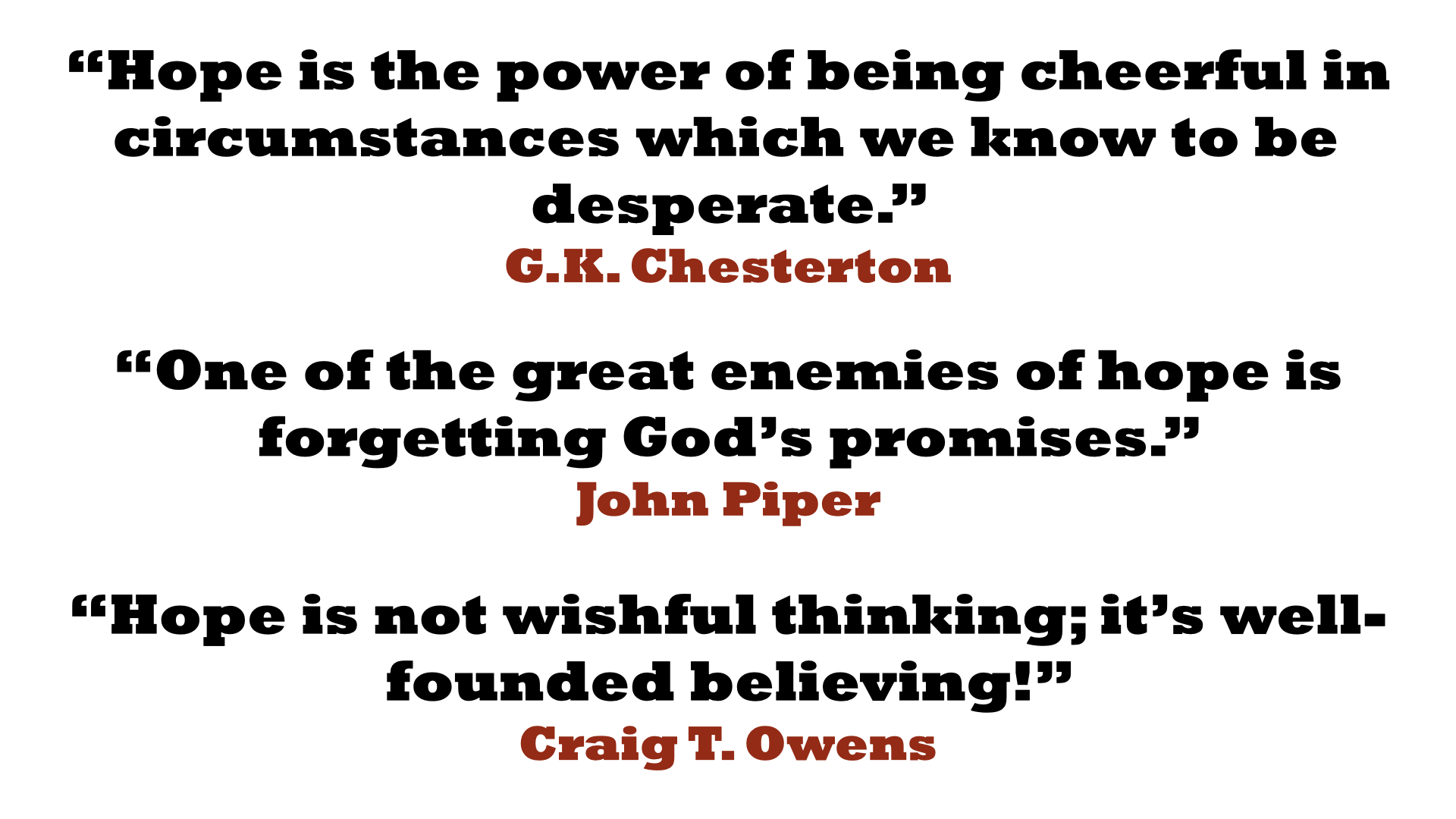
  • “Hope is the power of being cheerful in circumstances which we know to be desperate.” —G.K. Chesterton 
  • “One of the great enemies of hope is forgetting God’s promises.” —John Piper 
  • “Hope is not wishful thinking; it’s well-founded believing!” —Craig T. Owens 

Christians have a fantastic, unshakable, blessed hope on which we can stand not only secure but joyful! 

Foundational truth #13: “The resurrection of those who have fallen asleep in Christ and their translation together with those who are alive and remain unto the coming of the Lord is the imminent and blessed hope of the church.” 

This blessed hope in the future helps us live with joy today! Knowing that death has been defeated and Jesus will come back to take us home with Him should fuel us to say “no” to the temporary pleasures of sin, and live such godly lives that it turns others’ eyes to Jesus (Titus 2:11-14; 1 Corinthians 15:51-52; 1 Thessalonians 4:16-17). 

Foundational truth #14: “The second coming of Christ includes the rapture of the saints, which is our blessed hope, followed by the visible return of Christ with His saints to reign on earth for one thousand years.” 

Sometimes you will hear Christians talk about the “rapture” of the Church. Although this word itself isn’t in the Bible, the Greek word harpazo in 1 Thessalonians 4:17 means “catching up.” It also means “to eagerly claim for one’s self,” which reminds me that Jesus is thrilled to bring His Bride home to be with Him forever! After the Church has been caught up to Heaven, a period of tribulation will plague the earth, followed by Christ’s Second Coming and His millennial reign (Zechariah 14:4-5; Revelation 19:11-15; 20:1-10). 

Foundational truth #15: “There will be a final judgment in which the wicked dead will be raised and judged according to their works. Whosoever is not found written in the Book of Life, together with the devil and his angels, the beast and the false prophet, will be consigned to the everlasting punishment in the lake which burns with fire and brimstone, which is the second death.” 

Christians have no fear of the second (or final) death because our names are written in the Book of Life (Luke 12:4-6; Revelation 20:11-15). Not only is there judgment for the wicked, but there will be rewards for the righteous. 

Foundational truth #16: “In keeping with His promise we are looking forward to a new heaven and a new earth, where righteousness dwells” (2 Peter 3:13). Revelation 21-22 give us a small glimpse of our eternal home. 

In light of these truths, how should Christians live while still on earth? I think there are three ways we should live: 

  1. Live circumspectly
  2. Live on-mission
  3. Live unafraid

(see Ephesians 5:15; Matthew 28:18-20; Proverbs 24:11-12; Jude 1:20-25) 

With this blessed hope of the Second Coming of Jesus and our security in knowing we will remain with Him forever, let’s tell everyone we can how they too can know what it is to live with this hope in their heart. 

If you’ve missed any of the messages in our series exploring our foundational beliefs, you can access the full list by clicking here. 

►► Would you please prayerfully consider supporting this ministry? ◀︎◀︎

Perspective On Persecution

Listen to the podcast of this post by clicking on the player below, and you can also subscribe on Apple, Spotify, or Audible.

Around the world we hear of Christians being persecuted for their faith in Jesus: Afghanistan … N. Korea … China … even in the USA, Christians like Jack Phillips and Barronelle Stutzman are being persecuted for standing up for what they believe. 

Here’s an important principle to keep in mind: In times like these, we need to remember there have always been times like these. Especially because the psalmist Asaph, Jesus, and the apostle Paul all forewarned us about persecution (Psalm 83; Mark 13:9, 12-13; 2 Timothy 3:12-13). 

Jesus said that our persecution should only come “on account of Me.” And Asaph notices the same thing in his prayer, using phrases like “Your enemies,” “Your foes,” “they conspire against Your people,” and “they form an alliance against You.” 

Asaph also recognized that times like these call for a Selah pause—a pause to calmly consider. (You may also be interested in this flowchart on persecution.) 

I think the first thing we need to consider is our part in bringing on the persecution. I need to ask the Holy Spirit to reveal if I may have been the trigger to the anger of these wicked people. If I have done something, I need to repent, ask forgiveness, and see what I can do to make restitution. 

Next, we need to Selah to consider this: It might look desperate, but God has handled these kinds of evil people before. Asaph mentions several enemies of God’s people whom God decisively defeated in the past. Our Selah pause will help us recall that God is the same today as He was yesterday—He is more than able to handle these persecutors. 

With all of these bullies ganging up on Israel, you can understand why Asaph cries out for God’s strong action against them. But I want you to notice that the call for judgment is NOT vindictive but redemptive. Asaph asks for punishment “so that men will seek Your name, O LORD” and that they may “know that You, whose name is the LORD—that You alone are the Most High over all the earth.” 

In other words, this isn’t a “Get ‘em, God” prayer, but a “Save ‘em, God” prayer! 

We’re not looking for relief for ourselves—that’s only temporary—but we’re looking for glory for God—that’s eternal!

Jesus and the apostle Peter both tell us that God’s desire is for no one to perish apart from a relationship with Him through Jesus Christ (John 3:16-17; 2 Peter 3:9). 

The reason we need to Selah and ask that introspective question about our words or actions triggering our persecutor’s anger is because God will use our righteous response to persecution as a testimony. 

Jesus said our persecution should be because of Him, but He also told us that there would be a blessing in it (Matthew 5:11-12; Mark 13:13; Luke 21:17-19). And Paul tells us that this reward isn’t just a silver lining to a dark cloud, but a reward beyond compare (Romans 8:18). 

Asaph went to prayer when Israel was attacked, and that should be our first response too. 

But let’s Selah in that prayer to make sure we’re not the trigger, and then may our prayer be more for God’s eternal glory than it is for our temporary relief. 

If you’ve missed any of the messages in our series looking at the Selahs in the Psalms, you can access the full list by clicking here.

►► Would you please prayerfully consider supporting this ministry? ◀︎◀︎

Judging Like God

Listen to the podcast of this post by clicking on the player below, and you can also subscribe on Apple, Spotify, or Audible.

I may have heard more confusion, bad preaching, and even heresy based on Psalm 82 than almost any other passage! Most of the confusion comes from just verses 1 and 6, but if we read the entire psalm, I think confusions are quickly cleared up.

The biggest point of confusion is the use of the word “gods.” The Hebrew language doesn’t have capital and lowercase letters like we do. So the word God (with or without a capital “G”) is the same Hebrew word—el (singular) or elohiym (plural)—which means mighty One or mighty ones. Humans can be mighty ones, but only Yahweh is the Mighty One. 

Further adding to the confusion for some people is that Yahweh God is sometimes referred to in the plural in Hebrew: elohiym. This is understandable because we believe God is Three-in-One. Not three gods, but one God in three Persons. 

Bible translators have to use context clues to determine whether the biblical authors are referring to Yahweh or a pretend deity. Thankfully, English Bible translators have helped us out:

  • when the Hebrew word is Yahweh, most Bibles print it LORD 
  • when the Mighty One is implied in the text it’s God (with a capital “G”), and when it’s just a mighty person it’s typed god/gods (with lowercase a “g”). 
  • the NIV translators really helped us in Psalm 82 by designating the false deities in quotation marks (“gods”), almost as if they’re saying “the so-called gods.” 

When we were looking at the Selah in Psalm 81, I pointed out the importance of remembering that context is king. Clearly, from the context in Psalm 82, these are false gods (lowercase “g” and inside quotation marks).  

Asaph only speaks in the first and last verses of this psalm, but notice his commentary that “God presides…He gives judgment.” As in, God gets the final and decisive word. In fact, God does the most speaking in this psalm (in verses 2-7). God indicts wicked people for…

  • defending the unjust 
  • showing partiality to the wicked 
  • knowing nothing, understanding  nothing, walking around in darkness 
  • and notes “you will die like mere men” 

Now notice what the Selah pause connects. This is a pause for us to contrast two things: the righteous way and the wicked way. Or maybe we could say the contrast is between the way of the righteous Mighty One and His followers, and the way of wicked mighty ones. 

The Selah really begs an important question, “How long will your pride keep you doing these wicked things?” Notice what God calls on people to do in opposition to what the wicked are doing:

  • the wicked defend the unjust vs. the righteous are to defend the weak and fatherless 
  • the wicked show partiality to the wicked vs. the righteous maintain the rights of the poor and oppressed 
  • the wicked are concerned only about themselves vs. the righteous rescue the weak and needy from the hand of the wicked 

The Selah is intended to prompt us to ask ourselves: “Which are we? What am I doing or not doing?” 

The word for rendering a judgment is used four times in Psalm 82: 

  • God gives judgment on the activities of the “gods” 
  • the wicked defend the unjust, meaning that they condone their unjust activities 
  • the righteous defend the weak, meaning they speak up for those being oppressed by the “gods”
  • finally, Asaph declares in verse 8 that God renders the final and decisive judgement 

God wants us to exercise His righteous judgment on the earth. We have to Selah to examine ourselves first (see Matthew 7:1-5 and this short video), but then we need to act boldly and righteously (see Micah 6:8; Leviticus 5:1; Proverbs 31:8-9). 

We can judge like we are “gods,” or we can judge, defend, and speak up like ambassadors of the Mighty One—the Ultimate Judge.

Wicked people are punished for judging like “gods.” Righteous people are rewarded for judging like God. 

If you’ve missed any of the messages in our series exploring the Selahs in the Psalms, you can access the full list by clicking here. 

►► Would you please prayerfully consider supporting this ministry? ◀︎◀︎

The Story Isn’t Over Yet

Listen to the podcast of this post by clicking on the player below, and you can also subscribe on Apple, Spotify, or Audible. 

One of the things I enjoy about my Apple Watch is the connection I have with others who also use an Apple Watch. For instance, I get notified when my wife has finished a workout, and one of the pre-set replies I could choose is, “I’ve got questions!” That’s a funny way of me saying, “How did you complete that workout?!” 

In Psalm 75 and Psalm 76, Asaph tells us how God will deal with the wicked. But then Psalm 77 begins with Asaph using words like, “My soul refused to be comforted, my spirit is overwhelmed,” and then he launches into the tough questions like: “How long is this going to last? Has God forgotten me? Have I fallen out of favor with God? Has His mercy dried up? Can God keep what He has promised? Is God angry with me?” When I read all this, I feel like saying, “Asaph, I’ve got questions!” 

Yet, these complaints of Asaph ring true to real life. Like when a friend called me last week and started our conversation by asking, “Why can’t things just go easy for me?”

Here’s the simple answer: The Story isn’t over yet. We are in a battle, and the enemy of our soul is still trying to take us out, or at least shut us up. 

In Psalm 77, Asaph tells his story to Jeduthun (a Levite worship leader whose name means praising) in four chapters, with a Selah for each of the breaks between the chapters. 

Chapter 1—Distress (vv. 1-3)

The word distress means confronted by an adversary. Ever been there? Every follower of God has been, so Asaph invites us to Selah: pause to contemplate things like (a) Is this distress causing me to reevaluate the foundation on which I stand? (b) What is it God is shaking in my life? When God shakes things up, it is to cause us to remember and muse about the ONLY sure foundation that can withstand any storm (see Matthew 7:24-27). 

Chapter 2—Questioning (vv. 4-9) 

Notice the words Asaph uses: thought, remembered, mused, inquired. He is asking those tough questions, but he is asking them in a way that he can carefully consider the answers. That means he is really taking a Selah pause with each question. I think he has come to this conclusion: “Aren’t all these really just rhetorical questions? And isn’t the answer to all of them a resounding ‘NO!’?” If you aren’t sure the answer to all of these questions is no, please read Romans 8:31-39.

Chapter 3—Recalling (vv. 10-15) 

Notice the continuation of the words: thought, remember, meditate, consider. He also asks another question in v. 13 which he then answers in the next two verses. His call to Selah here is another pause to reflect: “Has God lost His power? Has He changed His mind?” And once again the answer is a loud and clear, “NO!” (see Isaiah 59:1; Hebrews 13:8) 

One of the important takeaways from this stanza of Psalm 77 is this: Looking back in gratitude at what God has done allows me to look forward in hope to what He is still going to do. My remembering what God has done in the past leads to: 

  1. Release from the darkness 
  2. Renewed praise 
  3. Recovered strength 
  4. Refocused outlook 

Chapter 4—Hope (vv. 16-20) 

Asaph says, “Look what God did! And since He is the same today as He was yesterday, guess what He’s still able to do!” We know this because the Bible says, “For no matter how many promises God has made, they are ‘Yes’ in Christ. And so through Him the ‘Amen’ is spoken by us to the glory of God” (2 Corinthians 1:20). 

Remember I said earlier that God isn’t done telling His story yet? God isn’t done yet, He knows His Story, and His Story is still being told. But He’s also already told us how His story will end (see Revelation 21:4-6). And the end of His story is really just the beginning of the Real Story! 

C.S. Lewis said it this way in the closing words of The Last Battle:

“And for us this is the end of all the stories, and we can most truly say that they all lived happily ever after. But for them it was only the beginning of the real story. All their life in this world and all their adventures in Narnia had only been the cover and the title page; now at last they were beginning Chapter 1 of the Great Story, which no one on earth has read; which goes on forever; in which every chapter is better than the one before.” 

When you find yourself saying, “I’ve got questions: How long is this going to last,” Selah to remember that the Story isn’t over yet. The Storyteller knows how it ends, and He promises us: But what of that? For I consider that the sufferings of this present time—this present life—are not worth being compared with the glory that is about to be revealed to us and in us and for us and conferred on us! (Romans 8:18 AMP)

If you have missed any of the messages in our Selah series, you can find the complete list by clicking here.

►► Would you please prayerfully consider supporting this ministry? ◀︎◀︎

Poetry Saturday—Truth

Listen to the podcast of this post by clicking on the player below, and you can also subscribe on Apple or Spotify.

Since the dear hour that brought me to Thy foot,
And cut up all my follies by the root,
I never trusted in an arm but Thine,
Nor hoped, but in Thy righteousness divine:
My prayers and alms, imperfect and defiled,
Were but the feeble efforts of a child;
Howe’er perform’d, it was their brightest part,
That they proceeded from a grateful heart:
Cleansed in Thine own all-purifying blood,
Forgive their evil and accept their good:
I cast them at Thy feet—my only plea
Is what it was, dependence upon Thee:
While struggling in the vale of tears below,
That never fail’d, nor shall it fail me now.
Angelic gratulations rend the skies,
Pride fall unpitied, never more to rise,
Humility is crown’d, and Faith receives the prize. —William Cowper

►► Would you please prayerfully consider supporting this ministry? ◀︎◀︎

Obvious Consequences

I think these correlations are pretty visible in the life of King Jehoshaphat. See if you can spot them too. 

Jehoshaphat “followed [God’s] commands” and “the Lord established the kingdom under his control.” 

Jehoshaphat sent Levites out to teach the people God’s law and “the fear of the Lord fell on all the kingdoms of the land surrounding Judah.” 

Jehoshaphat cried out to God while being pursued by enemies, “and the Lord helped him.” 

Jehoshaphat allied himself with Israel—marrying Ahab’s daughter and going to war with Israel—and he was told, “the wrath of the Lord is on you.” 

“Jehoshaphat resolved to inquire of the Lord” when the enemy was poised to attack and God gave him assurance of victory. 

Jehoshaphat appointed worshipers to lead the army and “the Lord set ambushes” to defeat the enemy, causing His fear to once again fall on the surrounding nations. 

Jehoshaphat allied himself with Israel again and their joint sailing venture ended in shipwreck. 

[check out the biblical texts for all of the above examples by clicking here] 

It seems to me that the blessings of following God and doing things His way, and the consequences of ignoring His commands, are so plainly visible. There really is no excuse for my ignorance on this.

The question is: Will I do things God’s way and enjoy His blessings, or will I continue to try to do things my way and risk God’s wrath?

Jesus Says

Jesus says, “I will… 

…make you fishers of men” (Matthew 7:23; Mark 1:17) 

…acknowledge in Heaven those who acknowledge Me on earth” (Matthew 10:32-33) 

…give you rest” (Matthew 11:28) 

…build My church” (Matthew 16:18) 

…give you the keys of the Kingdom of Heaven” (Matthew 16:19) 

…show you whom you should fear” (Luke 12:5) 

…drive out demons and heal people” (Luke 13:32) 

…never drive away those who come to Me” (John 6:37) 

…give My life for your life” (John 6:51) 

…rise again from the dead” (Matthew 27:63; Mark 14:28; John 2:19) 

…raise up believers to eternal life” (John 6:40, 44, 54) 

…come back to take you to be with Me forever” (John 14:3) 

…do whatever you ask in My name” (John 14:13, 14; 16:28) 

…not leave you as orphans” (John 14:18) 

…ask the Father to give you an Advocate” (John 14:18) 

…give you words and wisdom that are irresistible” (Luke 21:15) 

…see you again and give you eternal joy” (John 16:22)

Oh, what a Savior!