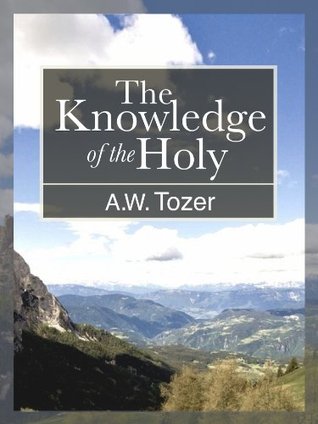
10 Quotes From “The Knowledge Of The Holy”

A.W. Tozer helps us think long and deep about the greatness of God, opening windows of insight that many have not contemplated previously. Check out my full book review of The Knowledge Of The Holy by clicking here. 

“With our loss of the sense of Majesty has come the further loss of religious awe and consciousness of the divine presence. … The decline of the knowledge of the holy has brought on our troubles. A rediscovery of the majesty of God will go along way toward curing them.” 

“What comes into our minds when we think about God is the most important thing about us.” 

“The man who comes to a right belief about God is relieved of ten thousand temporal problems, for he sees at once that these have to do with matters which at the most cannot concern him for very long; but even if the multiple burdens of time may be lifted from him, the one mighty single burden of eternity begins to press down upon him with a weight more crushing then all the woes of the world piled one upon another. …

“But unless the weight of the burden is felt, the gospel can mean nothing to the man; and until he sees a vision of God high and lifted up, there will be no woe and no burden. Low views of God destroyed the gospel for all who hold them.” 

“Among the sins to which the human heart is prone, hardly any other is more hateful to God than idolatry, for idolatry is at bottom a libel on His character. … The essence of idolatry is the entertainment of thoughts about God that are unworthy of Him.” 

“The heaviest obligation lying upon the Christian Church today is to purify and elevate her concept of God until it is once more worthy of Him—and of her.” 

“When the Spirit would acquaint us with something that lies beyond the field of our knowledge, He tells us that this thing is like something we already know, but He is always careful to phrase His description so as to save us from slavish literalism.” 

“An attribute of God is whatever God has in anyway revealed as being true of Himself.” 

“We might be wise to follow the insight of the enraptured heart rather than the more cautious reasonings of the theological mind.” 

“If we ever think well it should be when we think of God.” 

“The harmony of His being is the result not of a perfect balance of parts but of the absence of parts.… An attribute, then, is not a part of God, it is how God is…. The divine attributes are what we know to be true of God. He does not possess them as qualities; they are how God is as He reveals Himself to His creatures.” 

The Knowledge Of The Holy (book review)

One definition of a Christian mystic is someone who engages in deep, prayerful pondering of the nature of God, as He is revealed in the Scriptures, and then emerges from those intimate encounters to share with us what he or she has learned. I would put A.W. Tozer in this category, especially in his book The Knowledge Of The Holy—The Attributes of God: Their Meaning in the Christian Life. 

Tozer himself described the Christian mystic more fully than I could in his book The Christian Book Of Mystical Verse. In that book, Tozer shared some poetic verses from some of his favorite mystical thinkers. He noted, “The hymns and poems found here are mystical in that they are God-oriented; they begin with God, embrace the worshipping soul, and return to God again.” 

In The Knowledge Of The Holy, Tozer takes us on his own personal journey into the immeasurable depths of God’s greatness. Whereas many theologians tend to focus on one attribute of God at a time, Tozer has a God-given ability to help us see all of God’s attributes operating in their infinite fullness. 

Even as Tozer plunges deep into the attributes of God’s self-existence, self-sufficiency, omniscience, omnipotence, omnipresence, love, mercy, justice, grace, and sovereignty, he reminds us, “Because God is immutable He always acts like Himself, and because He is a unity He never suspends one of His attributes in order to exercise another.” 

This is not a book you can ready lightly or casually, or even quickly. This is a book that invites you to read slowly and reverently each of the short chapters, and then to meditate long on the immenseness of an All-Powerful, All-Loving God who wants to reveal Himself to you. 

The Knowledge Of The Holy is a soul-expanding book!

Enjoying The Meal

I am so active every day that I need to eat about 2700 calories just to maintain my weight. Eating that often, if I’m not careful, I can just simply put food in my mouth and really not taste it. 

I think most people realize that there is a difference between eating and enjoying their food. Not only is gulping not very pleasurable, but doctors have even found some negative impacts on habitual food-gulpers. Things like: 

  1. Indigestion 
  2. Weight gain 
  3. Disconnection from hunger/full signals 
  4. Increasingly likelihood of unhealthy food choices 

In the same way, there’s a difference between praying and enjoying our time with God (see Mark 6:30-31 and Revelation 3:20).

Just as there are many physical benefits to enjoying healthy food, there are also many spiritual benefits to enjoying our time in God’s Word and God’s presence. This spiritual eating and digestion process is called meditation. 

Allow me to put a couple of thoughts together to show you the value of this spiritual discipline: 

  • The apostle Paul told us, “Pray continually” (1 Thessalonians 5:17). 
  • God told Joshua, “Keep this Book of the Law always on your lips; meditate on it day and night, so that you may be careful to do everything written in it. Then you will be prosperous and successful” (Joshua 1:8).

So the way we pray continually is to have something healthy to digest. We can feast on God’s Word and then allow the Holy Spirit to extract all of the healthy spiritual nutrients that will allow us to grow and mature. 

David said, “Taste and see that the Lord is good” (Psalm 34:8). Don’t gulp down your meal of the Scripture—taste it. Don’t rush through your prayer time—enjoy it. Keep mulling over what you have read. Keep chewing on it to help the digestion of the good stuff you need to be healthy.

We meditate on the Word of God to learn how to continually commune with the God of the Word. 

Meditating on God’s Word with the Holy Spirit’s help means you will never lack material for praying continually.

What’s In A Name?

Leah became pregnant and gave birth to a son… (Genesis 29:32). 

Jesus said that ALL the Scripture pointed to Him (John 5:39). That means even the various names of people in the Scripture give us some insight into the nature of Jesus. 

Consider Jacob and his sons, who become the fathers of the tribes of the nation of Israel. Jacob the deceiver is transformed into Israel the guileless, and the names of his sons point to what Jesus does to transform all of us into His righteous brothers and sisters. 

[Check out the links posted below to read all the Scripture references.]

Reuben—God sees my misery and sends His Son (Genesis 29:32; John 3:16). 

Simeon—God sent His Son when I was unlovable (Genesis 29:33; Romans 5:6-8). 

Levi—after I am saved from my sins, I am joined to God (Genesis 29:34; Ephesians 2:1-5).

Judah—my salvation brings praise to God (Genesis 29:35; John 15:8).

Dan—God has vindicated me in Jesus (Genesis 30:6; John 8:11).

Naphtali—Christ’s righteousness has given me victory over my struggles (Genesis 30:8; Romans 8:1; 1 Corinthians 15:54-56). 

Gad—God’s favor now advances toward me like an unstoppable troop (Genesis 30:11; Romans 8:31-39). 

Asher—I am now able to enjoy God’s happiness (Genesis 30:13; Matthew 25:21, 34). 

Issachar—God IS my reward (Genesis 30:18; Revelation 3:20-21).

Zebulun—my Husband (Jesus) honors me (Genesis 30:20; Ephesians 5:22-23; Hebrews 2:11).

Joseph—God has taken away my disgrace and added His blessing (Genesis 30:24; Romans 8:1, 32).

Manasseh—God has made me forget my past (Genesis 41:51; Psalm 103:12).

Ephraim—God has made me abundantly fruitful (Genesis 41:52; 1 Peter 2:9-10).

Benjamin—I am God’s son (Genesis 35:18; Ephesians 2:6)! 

God has done ALL this—and more!—through Jesus! 

When you read the Bible, don’t rush through it. Slow down. Meditate on it. Soak in it. And then see how the Holy Spirit will illuminate truth to you. 

[Please check out the Bible references I’ve listed above for yourself. All of the Genesis references are here, and all of the other references are here.]

Is There Room In Your Heart For Jesus?

I think all of you can finish this poem: ’Twas the night before Christmas and all through the house not a creature was stirring, not even a mouse. 

Haddon Sundblom’s painting for Coca-Cola

This poem was written in 1837 by Clement Moore. Most people assume the title of the poem is the first line of the poem, but Moore’s original title is actually “A Visit From St. Nicholas.” And we all know what St. Nicholas (aka Santa Claus) looks like, right? Actually, this well-known painting of Santa Claus is the creation of Haddon Sundblom for Coca-Cola in 1930, but it’s not too far off from the original St. Nicholas. 

Nicholas of Myra

Nicholas of Myra was a Christian bishop who lived in the 3rd century AD. It was discovered by some of his peers that he would anonymously throw bags of money through the open windows of the poor people in his town. Some of the coins landed in these poor families’ shoes and socks as they were drying by the fireplace. The myth grew that without your stockings hung by the fireplace you wouldn’t receive any gifts. After Nicholas died in 342 AD he was declared a saint, so his popular practice of blessing the poor spread and took on a life of its own. 

I’m struck by a contrast from the line in Moore’s poem that “the stockings were all hung by the chimney with care.” This tells us how well people prepare for the “arrival” of St. Nicholas each Christmas, but let’s contrast that with how ill-prepared—if they even know they need to prepare!—people are for the absolutely certain fact of the arrival of King Jesus! 

Just as the vast majority of Israelites weren’t prepared for the Messiah’s first Advent in Bethlehem in the 1st century, how many people are still unprepared for His second Advent which could occur at any moment? 

Think about the contrasts between the legend of St. Nicholas (i.e. Santa Claus) and the certainty of Jesus Christ:

  1. St. Nicholas was a poor monk who has now become richer than imaginable. Jesus is the King of kings who left all His riches and kingly rights to become poor. 
  2. St. Nicholas was a servant who has now been elevated to royalty status. Jesus is Absolute Royalty who became a servant. 
  3. St. Nicholas lives in a castle at the North Pole; there wasn’t even a room for Jesus at His birth, or even later in His adult life. 
  4. St. Nicholas is a fable that people venerate; Jesus is the Truth that people mock. 
  5. St. Nicholas left a legend with nothing of lasting value; Jesus is Absolute Reality and He is coming again (see Hebrews 2:14; Philippians 2:6-11; Luke 2:7; Matthew 8:20; Acts 2:22-23).

There was no room in any inn, although Joseph knocked and knocked. Jesus is still knocking today, except today it’s on the door of your heart (Revelation 3:20). Will you let Him in? Or will you continue to allow your heart and mind to be dominated by myths and legends? 

Advent is a time for reflection. I don’t think we could ask a more heart-searching question than this—

Am I more prepared for St. Nicholas than I am for King Jesus?

If you’ve missed any of the message in this series, you can check them out by clicking here.

Why Should Christians Sing?

Some things are fascinating by what isn’t said. For instance, in the Christmas carol It Came Upon A Midnight Clear there is something conspicuously missing. 

One thing that isn’t missing is singing. Every one of the stanzas ends with a phrase about the angels singing. But can you spot what IS missing? I didn’t see it at first until I read this quote from respected music professor Dr. C. Michael Hawn: “This may be the only commonly sung Christmas carol in our hymnals that does not mention the birth of Christ! 

This carol just sort of assumes that we know why the angels are singing. But do we know? 

The Bible tells us that the angels were singing at Creation and that they are still singing in Heaven for all of eternity (Job 38:4-7; Revelation 5:9-13; 7:9-12; 15:2-4). Then we have this glimpse of the angels singing when Jesus was incarnated as a human baby in Bethlehem (Luke 2:14). Where did they get their song and their inspiration to sing it?

Their song comes from the Choir Leader who is the King of kings. Jesus is singing in Heaven, before the throne of His Father, about the salvation that He brought to mankind through His incarnation, sinless life, death on Calvary, and resurrection from the grave (see Hebrews 2:9-12). 

The song that Jesus sings tells the story of how He came to earth just like us—made a little lower than the angels—so that He might taste sin and death and conquer them for us. Now as our victorious Savior, He is not ashamed to call those who put their faith in Him His brothers and sisters.

Now perhaps you see why angels are also singing all the time! 

Even today there is a lot of singing around the Christmas season, but there is something missing in most of the songs: a focus on what Christmas really means. The world’s songs are about trees, and gifts, and Santa, and falling in love, but it’s a song that is out of tune with the angelic song. 

As Christians, we have a choice we can look around at this out-of-tune singing and lament what’s happening in our world, we can join in these meaningless songs, or we can look up at our Savior and sing the song He is singing. 

Christian, will you join with the angelic choir to let the world hear the unmistakable love song that Jesus is still singing today? 

If you’ve missed any of the message in this series, you can check them out by clicking here.

Thursdays With Spurgeon—You Cannot Hide Your Heart From God

This is a weekly series with things I’m reading and pondering from Charles Spurgeon. You can read the original seed thought here, or type “Thursdays With Spurgeon” in the search box to read more entries.

You Cannot Hide Your Heart From God

Hell and destruction are before the Lord: how much more then the hearts of the children of men? (Proverbs 15:11 KJV) 

     God knows the burial places of all His people. He notes as well the resting place of the man who is buried tombless and alone as the man over home a mighty mausoleum has been raised. He saw the traveler who fell in the barren desert, whose body became the prey of vultures and whose bones were bleach in the sun. He saw the mariner, who was wrecked far out at sea and over whose corpse no dirge was ever wailed, except the howling of the winds and the murmuring of the wild waves. God knows the thousands who have perished in battle, unnumbered and unnoticed; the many who have died alone amid dreary forests, frozen seas, and devouring snowstorms; all these and the places of their sepulcher. God has marked that silent grotto within the sea, where pearls lie deep, where now the shipwrecked one is sleeping, as the death place of one of His redeemed. …

     Yes, hell, horrible as it is and veiled in many clouds and covered over with darkness, is naked before the vision of the Most High. There is the grand fact stated: “Hell and destruction are before the Lord.” After this the inference seems to be easy: “How much more, then, the hearts of the children of men?” … 

     God who sees death and hell sees our hearts, for they are far less extensive. … Scarcely have we time enough to tell the story before it comes to its end. Surely, then, God may easily understand the history of a man, when He knows the history of the monarchies of death and hell. [see Psalm 44:21; Jeremiah 23:24; Revelation 2:23] … 

     God does not judge by the appearance of a man’s great heart, or the outside appearance of a good heart. But He puts it in the scales and weighs it; puts His own Word in one scale and the heart in the other. He knows the exact weight. He knows whether we have grace in the heart, which makes us good weight, or only presence in the heart, which makes us weigh light when put into the scale. He searches the heart in every possible way. …

     Oh, you may endeavor as much as you can to hide your faults from God. But beyond a doubt, He will discover you.  

From God, The All-Seeing One

When—not if—God looks at your heart, what will He find? 

Yes, we should pray—Search me, O God, show me anything that is offensive to You [Psalm 139:23-24]—but then we must repent and ask forgiveness when the offense is revealed. No excuses, no covering up!


City Of God

With “LONG LIVE THE KING!” still reverberating in our ears from Psalm 47, the sons of Korah ask us to zoom out a little farther to see how things begin to change now that the King has assumed His rightful place on the throne.

So Psalm 48 opens with the same praise with which Psalm 47 closed—Great is the Lord and most worthy of praise! The Hebrew word for great means massiveness! God is great beyond comprehension. He is larger than any problem. He is unique. He is uncontainable, unlimited, utterly beyond description. His glory is so bright that no sun is needed (see Revelation 21:23).

His glorious light reveals God’s beauty all around us. As C.S. Lewis noted, “I believe in God as I believe the sun has risen. Not because I can see it, but because by way of it I can see everything else.” Indeed, the psalmist reminds us that the city of our God has become “beautiful in its loftiness”(v. 2).

Look at how majestic our King is, and how majestic He makes His city, with phrases like the city of our Godthe city of the Great King, and the city of the Lord Almighty. 

God makes His city secure forever. 

Selah—pause and consider that. 

About 1200 years after this psalm was written, Augustine would write his book called The City of God in which he contrasted the City of God with the City of Man. He noted how the Romans had gods they trusted in, but the Romans had to “rescue” their gods from the invading barbarians. Rome ultimately fell to those invading barbarians, but, Augustine said, the City of God can never fall because it isn’t a tangible place. The City of God resides inside God’s people. 

So notice that after the Selah the word “city” doesn’t appear anymore. Instead, we read about:

    • God’s temple (v. 9; the Hebrew word is heykal) means the palace of God the King
    • the villages of Judah (v. 11) is translated daughters in the KJV, but it actually means “the beloved apple of My eye” 
    • her towers (v. 12) are something that has grown up because it’s been nourished, not something built up by brick and mortar
    • her citadels (v. 13) are the highest and strongest places, which recalls God’s massiveness that we read in verse 1 

Here’s the question for all of us to ask—Is my heart a City of God or a City of Man? 

God does not dwell in palaces made by men.

God dwells where He is enthroned! 

When people look at the “city” of my life, can they tell God is on the throne? The telling characteristics of a City of God are a city where…

  • … thoughts continually turn to my King and His unfailing love (v. 9)
  • … praise, rejoicing, and gladness are constantly rising to God (vv. 10, 11)
  • … the King is able to freely walk around His kingdom—anywhere He likes (v. 12)
  • … others can walk around and see what a God-enthroned life looks like (vv. 12, 13)

I’ll ask it again—Can people clearly see that God is the unrivaled King of your heart? 

Join me next Sunday as we continue our look at the Selahs in the Psalms. 

Awesome God, Awesome Praise

Last I week I told you how Hebrew poetry often puts the climax in the middle. In Psalm 47 that middle climax is in verse 5—God has ascended. This is one of seven “psalms of enthronement” in the Psalter. Since all of the Scripture points to Jesus, let’s look at the definition of this word ascend and see how it fits with Jesus: 

When a king is coronated—when he is heading toward his throne—we can expect the people to be happy. So the psalmist tells us that in God’s case the people are clapping and shouting (v. 1), telling God how awesome He is (v. 2), thanking Him for subduing their enemies (v. 3), and expressing their gratitude that He has established them as His people (v. 4). 

Then comes the Selah / Pause—what is happening during this pause? The King is being crowned. He has ascended to His rightful throne. So this is selah/pause is really a deep breath that’s about to explode in a crescendo of praise! 

Now there are shouts of joy (v. 5a). In our earthly understanding, it would be something like: “LONG LIVE THE KING!!” There is also a sounding of trumpets (v. 5b) which literally means a thundering of trumpets. And then there’s the singing—lots and lots of singing. In fact, the word sing appears five times in the next two verses. 

From The Infographic Bible (click the image for more)

There are so many ways to say LONG LIVE THE KING—singing, dancing, raising our hands, falling down on our knees. shouting.  

Our God is praise-worthy. He is clap-worthy! He is sing-worthy! He is dance-worthy! He is shout-worthy! He is bowing-worthy! 

Our awesome God deserves awesome praise! 

Why does it seem that we are prone to worship so quietly? Perhaps we need to take it up a notch or two (or three or four). Perhaps we haven’t gazed into His awesome beauty enough to realize just how incredible He is! 

Do you think shouting praises to the King of kings is too undignified? Did you know that when the King of kings returns, He is going to shout and there is also going to be a thundering trumpet? For the Lord Himself shall descend from heaven with a shout, with the voice of an archangel, and with the trumpet of God (1 Thessalonians 4:16)! 

Here are 4 important lessons from this Psalm of Enthronement—

  1. God is the King of all kings, enthroned on the Throne above all thrones. He is worthy of your “undignified” praise and acclamation. 
  2. God should always get your best praise. In verse 7 the phrase sing praises with understanding really means to sing with insight and skill. 
  3. God deserves a holy vocabulary. We see the word awesome in verse 2. Every time this word is used in the Scripture, it’s speaking of God. So why would we use a word like this for something like a hamburger!?!
  4. All nations and kings and peoples and tribes will bow before God at the end. They will bow in either acclamation for their King, or in abject terror of the All-Righteous Judge. Let’s remain missional so more people in the end are crowning Him as their All-Merciful King. 

I hope you can join me this next Sunday as we continue our series looking at the Selahs in the Psalms. 

The Jesus Who Surprises (book review)

Oswald Chambers wisely noted, “God did not give a progressive revelation of Himself through the Old Testament: the people progressively grasped the revelation, which is very different.” Jesus is all throughout the Old Testament, giving us ample opportunity to discover Him on every page. A helpful guide to get you started on this journey of discovery is The Jesus Who Surprises by Dee Brestin. 

Dee wrote that she was intrigued by Christ’s words to the questioning disciples walking the road to Emmaus on the morning of His resurrection. These men were having a hard time wrapping their minds around the report from eyewitnesses who said Jesus was alive! As Jesus walked with them (although unrecognized by them for the moment), Luke records, “And beginning with Moses and all the Prophets, He explained to them what was said in all the Scriptures concerning Himself” (Luke 24:27). 

The Jews divided their Scripture—the part we now refer to as the Old Testament—into three sections: the Law, the Writings (the poetic books), and the Prophets. In The Jesus Who Surprises, Dee divides her book into the same three sections, giving us samples of how Jesus surprises us in the pages of each section of the Old Testament Scripture. Each chapter concludes with a Bible study that can be done on your own, or in a small group setting. 

The two disciples on the road Jesus commented to each other later that they felt their hearts burning as Jesus revealed Himself all throughout the Scriptures. I pray that as you read The Jesus Who Surprises you will experience the same burning. Then I believe this book will start you on your own lifelong journey to read the Scriptures for yourself and see Jesus on every single page! 

I am a Multnomah book reviewer.